ScholarWorks @ Georgia State University
ScholarWorks @ Georgia State University
English Dissertations Department of English
Spring 5-10-2014
Using Burke’s Dramatism to Unpack Intractable Conflict: Bush 43
Using Burke’s Dramatism to Unpack Intractable Conflict: Bush 43
and the Process of Peace in the Middle East
and the Process of Peace in the Middle East
Trent Mills
Follow this and additional works at: https://scholarworks.gsu.edu/english_diss
Recommended Citation Recommended Citation
Mills, Trent, "Using Burke’s Dramatism to Unpack Intractable Conflict: Bush 43 and the Process of Peace in the Middle East." Dissertation, Georgia State University, 2014.
https://scholarworks.gsu.edu/english_diss/120
OF PEACE IN THE MIDDLE EAST
by
TRENT MILLS
Under the Direction of Elizabeth Lopez
ABSTRACT
I investigate how the Israeli-Palestinian conflict, as an exemplar case study of intractable
conflict, might be re-envisioned by destabilizing the paradigms of the belligerents. I detail how
paradigms and our perceptions of and interactions with them influence, direct, and even defeat
attempts at understanding social situations (of which violent conflict is one). Furthermore, with
the premise that proposed solutions are reactions to existing paradigms, I analyze the potential
benefits and risks of revealing the assumptions, premises, and biases of the paradigms with
which belligerents, and those who represent them, construct their realities. In addition, I
demonstrate how narratives and rhetorical myths prescribe action, not passively reflect action.
Ultimately, I demonstrate the recursive relationship amongst originating paradigms, rhetorical
myths, and the terms and concepts of narratives. This problem set transcends the motives of
individual Agents and directs the focus on the rhetorical nature of the conflict’s intractability,
will result in peace.
This project joins current efforts to extend Burke’s dramatism into arenas where
multi-ple rhetorical artifacts must be critically analyzed simultaneously to produce a more synoptic
perspective. My approach leverages the heuristic character of Burke’s pentad to reveal a set of
variables and relationships which account for a phenomenon: a “dramatistic” methodology for
unpacking intractable conflict. My methodology also treats other Burkean concepts generally
nested under the Dramatism moniker: god terms, comic and tragic frames of acceptance,
en-telechy, and the pitfalls of the scapegoat. I demonstrate how the suite of Dramatistic terms and
concepts might be leveraged to reveal the interconnectivity amongst U.S. policies, the Scenes
the artifacts call forth, and the Agents who manipulate them. Furthermore, to address the
im-plications of prescriptive paradigms on problem formulation, I align my approach with Burke’s
mythic, constitutive, and narrative projects.
This study is significant for rhetorical studies and peace and conflict studies because it
provides a rhetorical framework to destabilize paradigms: a first step toward shifting a conflict
from an intractable to a tractable condition. To that end, policy makers should be able to assess
phenomena, like the Arab Spring, as part of a Dramatistic framework burdened with countless
motives, rhetorical myths, competing narratives. For these reasons, this project is immediately
relevant for understanding problem constitution at the intersection of rhetorical studies, peace
and conflict studies, and policy development.
OF PEACE IN THE MIDDLE EAST
by
TRENT MILLS
A Dissertation Submitted in Partial Fulfillment of the Requirements for the Degree of
Doctor of Philosophy
in the College of Arts and Sciences
Georgia State University
Copyright by Trent Irwin Mills
OF PEACE IN THE MIDDLE EAST
by
TRENT MILLS
Committee Chair: Elizabeth Lopez
Committee: Carol Winkler
Michael Harker
Electronic Version Approved:
Office of Graduate Studies
College of Arts and Sciences
Georgia State University
ACKNOWLEDGEMENTS
I’d like to thank my committee for the rope I wanted and the reigning in I needed. To
Carol Winkler for pointing to Burke and saying, “right there.” To Michael Harker for being the
first to sign on and knowing which rock to place upstream. To Elizabeth Lopez for seeing so
clearly how this project fit within our discipline and ensuring I did not waver. Special thanks to
Tomasz Tabako for hosting a frustrating and frenetic summer of Burke that changed the way I
LIST OF FIGURES
TABLE OF CONTENTS
ACKNOWLEDGEMENTS ... v
LIST OF FIGURES ... vi
1 INTRODUCTORY MATTERS ... 1
1.1 Background to the Problem ... 3
1.2 Significance of the Study ... 6
1.3 Chapter Overview ... 10
1.4 Review of Literature ... 11
1.4.1 Paradigms of Peace, War, and the Spaces Between ... 11
1.4.2 Narrative, Myth, and Burke’s Dramatism ... 24
1.4.3 Peace as Process ... 31
1.5 Methodology ... 38
1.5.1 Dramatism: Refining the Problem ... 39
1.5.2 Dramatism: As a Guide for Collection ... 41
1.5.3 Dramatism: Framing the Interpretation of Results ... 44
2 A ROLE FOR MYTH IN “PERFECTING” THE PROBLEM ... 47
2.1 The Problem-solving Power of Myth ... 49
2.2 Form and Function of Rhetorical Myth ... 53
2.4 Toward a Shared Myth ... 66
3 THE COMEDY OF INTRACTABLE CONFLICT ... 70
3.1 Comic Frame: Defined in/by the Context of Intractable Conflict ... 74
3.2 Comic Frame: Distinctions and Methods ... 82
3.3 Comic Frame in Application ... 86
3.4 Intractable Conflict Revisited ... 90
4 TO DESTABILIZE A PARADIGM: A QUESTION OF CIRCUMFERENCE ... 98
4.1 A Roadmap to Peace Situated Within a War on Terror ... 99
4.2 A Pentadic Process of Unpacking... 108
4.3 The Role and Influence of Scene on Policy: A Practioners Perspective ... 116
4.4 A Look Past the War on Terror Paradigm ... 124
5 CONCLUSION ... 128
1 INTRODUCTORY MATTERS
Politics, insofar as it concerns relations among states, seems to signify—in both ideal and objective terms—simply the survival of states confronting the potential threat created by the existence of other states…the art of politics teaches men to live in peace within collectivities, while it teaches collectivities to live in either peace or war (Aron 6-7)
Raymond Aron’s 1966 theory of international relations delineates foreign affairs from
any other form of social intercourse because interstate relations “take place in the shadow of
war or, to use a more rigorous expression, relations among states involve, in essence, the
alter-natives of war and peace” (5). From this dire characterization alone, rhetoricians have rightfully
focused on the rhetorics of international politics by focusing on the most influential statesman
in U.S. politics: the president. The perception of the institution of the president is perhaps more
valuable than the efficacy of any solitary rhetorical act. In terms of rhetorical power in
inter-state social discourse, the privileged position of the institution of the president relies on the
preeminence of political realism; a concept of realism where the “the focus of international
re-lations is on the behavior of the state, its security and interests being the highest priority of
po-litical life” (Haslam 12). As a successful sociologist and popo-litical journalist in early
twentieth-century France, Aron’s theory of international relations resists traditional political realism
cred-ited to Morgenthou which considers politics a “constant across time and space” (Davis 91) and
is overly reliant on rationalism (Haslam 10). Instead of the conventional realism that is arguably
still the dominant paradigm for international relations (Kraig), Aron views the social discourse
at the core of international relations though the “refracting prism of a very specific
circum-stance indeed, namely, state sovereignty” (Davis 90, emphasis mine). For Aron’s theory,
relevance from, or as Burke would designate it: “the ultimate motivation, or substance, of a
Constitutional frame” (AGrammar of Motives 355). Joining the abundant scholarship focused
on presidential rhetoric, this study interrogates the rhetorical functions of the statesman as the
very definition of statehood is problemetized.
As a requisite for understanding historical causation, rhetoric and communication
scholars have leaned on rhetorical methods to analyze the relationship between presidential
discourse and the rhetorical context a president navigates to achieve political objectives
(Medhurst 4, Winkler 4-7, Campbell and Jamieson 3-6, Graham 2, Kraig 3, Wander 340). With
ample scholarly distance between the historical event and the associated analysis, most
con-tributors to Medhurst’s Critical Reflections on the Cold War map presidential rhetorical artifacts
(and their commensurate labels) as they help construct our perceptions on history. Because of
the centrality of the office in U.S. culture, there is an indisputable exclamation point that
punc-tuates presidential oratory no matter how subdued the delivery. Furthermore, as Campbell and
Jamieson argue, understanding the presidency-as-institution relies on consideration of public
rhetorical artifacts instead of the non-public correspondences that lead up to the public ones
(4). Instead of an exclamation point, it would seem that an ellipsis or some other inconclusive
icon generally accompanies bureaucratic policy documents. Of Medhurst’s many contributors,
only Newman distinguishes between presidential oratory and the policy documents that
physi-cally operationalize a president’s vision; documents produced through a discrete dialectic
pro-cess facilitated by policy advisors.
Whereas oral policy can frame a public discussion on an issue, written policy, like
blue-print for U.S. Cold War policy) provides useful insight into the policy-making process that
ac-counts for the behind-the-scenes actors Campbell and Jamieson avoid. As it relates to interstate
conflict, an emphasis on the lesser known nodes of the policy-making system is important
be-cause it emphasizes the rhetorical nature of a policy-making system—what Graham calls “policy
web construction” whereby rhetorical justifications are linked (5)—and invites a consideration
as to how policy makers wielding rhetorical analytics might re-envision problems as they
consti-tute them.
From the perspective of a rhetorical critic, there is little substantive difference between
a political context and a historical context. Political reality is constituted by political rhetoric
(Medhurst 7) just as history is historicized through whatever paradigm is used; both are
rhetori-cally constructed. Medhurst’s compilation of Cold War analyses partners the methods of the
rhetorical critic with the “tools of historiography” to discern how a message functions to create
change in its original context as well as how we historicize events retrospectively (268-269). The
historian, according to Medhurst, shares characteristics with rhetoricians and political scientists
in that a historian assigns labels, prescribes meaning to the labels, and “uses language to make
and remake the world around us” (6). This study follows Medhurst’s attention on the methods
of rhetorical critics but instead of historiography, my focus is on possible rhetorical tools and
approaches for shifting a conflict from an intractable to a tractable condition.
1.1 Background to the Problem
When the Arab Spring—Revolt, Awakening, or Uprising based on your perspective—
began in early 2011, the world tuned in to watch how this turbulence might translate into
in-ternal shifts of power, one wonders how these simultaneous upheavals might affect the
direc-tion of long-standing regional conflicts that have tradidirec-tionally carried global economic and
secu-rity implications. For example, the international effort to resolve the conflict between the
Is-raelis and the Palestinians (colloquially known as the Middle East Peace Process or MEPP) is
several decades old having endured several attempts at the publically-stated, shared objective
of a two-state solution. Results and motives notwithstanding, nearly every nation that borders
Israel and the Palestinian territories is now either a failed or potentially failing state based on
even the most charitable metric making the geopolitical context as uninviting as possible. Yet,
the U.S. administration has made negotiations between the government of Israel and the
politi-cal representative of the Palestinians, the Palestinian Authority1 (PA), a centerpiece of its
re-gional foreign policy strategy (National Security Strategy of the United States 2010). The
deci-sion to attempt to disrupt the status-quo in the Israeli-Palestinian conflict, i.e. bring focus on
final status agreements between the belligerents, is therefore an interesting one. With the
re-gion in turmoil, why interrupt a “peaceful” status quo?
In the week preceding President Obama’s first presidential trip to Israel and the
Pales-tinian territories in early 2013, columnists, activists, and policy wonks clamored enthusiastically
about where he might focus his visit. While the calls for renewal of the MEPP were predictably
well represented, other voices made note of the evolving function of a peace “process” itself
and the dramatically shifting regional environment framed by the War on Terror; an
unpredict-able Arab Spring; Iranian influence across Iraq, Syria, and Lebanon; threat of nuclear
1 The PA is the political apparatus of the internationally-recognized representative of the Palestinians: the
tion; the U.S. pivot to the Pacific; China’s pivot to the East; and civil war in Syria.
Complement-ing those concerned voices were columns by Thomas Friedman and David Brooks citComplement-ing
fore-casts that the U.S. will be the largest exporter of oil by 2020 and the possible foreign policy
reprioritization the U.S. might have to make regarding its traditional commitments to the
Mid-dle East region. Vali Nasr argues in his unflattering critique of the first Obama administration’s
foreign policy decisions that the “eye of the storm in the Middle East” has shifted east from the
fractures in the Levant2 to the Arab-versus-Persian and Shia-versus-Sunni tensions centered on
the Persian Gulf region (199). Regardless, President Obama leveraged much of his foreign
poli-cy political capital and momentum from his first term toward restarting the MEPP in his second
term. As an example of this emphasis, the U.S. Secretary of State, John Kerry, invested the first
half of 2013 and six personal trips to the Levant just to get Israelis and Palestinians to return to
direct negotiations. An assumption underpinning the overall U.S. policy is that the efforts of
di-rect negotiations, as the core of the peace process, will actually result in peace.
In an interview on the topic of the MEPP, Hrair Balian, the Director of President Carter’s
Conflict Resolution Program, outlined two narratives to help explain part of the complexity.
One narrative was oriented on “human rights” and prioritized universal rights for the people of
both belligerent communities over the second narrative he referred to as, “facts on the ground”
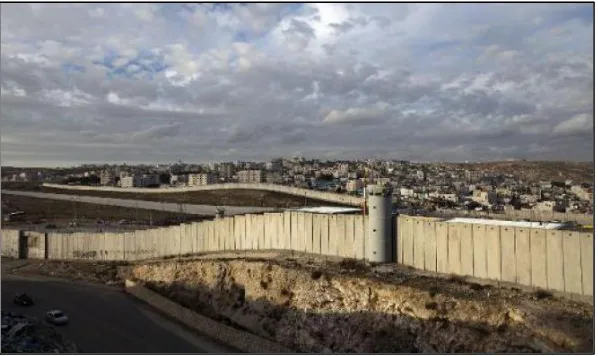
which reacted to the frequent, often politicized and traumatic events like the fence (or wall
based on who you ask) between Israel and the West Bank. These narratives as Balian offered
them prompt three claims pursued in this study: 1) the narratives were rhetorically-constituted
and could be disentangled and analyzed as such, 2) the narratives are reactionary approaches
2
to at least two different paradigms for experiencing and understanding the same reality, and 3)
the narratives may explain events, but they also revivify the paradigms and myths which
influ-ence future action. This study interrogates the above claims by analyzing how intractable
con-flict can be re-envisioned through unpacking and reconstructing the rhetorical paradigms of the
belligerents thereby revealing avenues for resolution. I address how rhetorical paradigms and
our perceptions of and interactions with them influence, direct, and even defeat attempts at
understanding—let alone predict outcome in—social situations (of which war is one). I
investi-gate how and why narratives and rhetorical myths prescribe action, not passively reflect them
and ask whether myths are something that can (or should) be changed or controlled via
rhetor-ical methods. Following the premise that proposed solutions are reactions to existing
para-digms, I analyze the potential benefits and risks of revealing the assumptions, premises, and
biases of the paradigms with which belligerents, and those who represent them, construct their
realities. Ultimately, I provide a heuristic framework for disentangling intractable conflict based
primarily on Burke’s dramatistic methodology.
1.2 Significance of the Study
The significance of this study is linked to the role paradigms play in problem formulation
in foreign policy decision making. Treating paradigms begs the question whether conflict
reso-lution should focus on solving problems or changing paradigms, via rhetorical methods, or even
to accept the problems as organic to the situation while working to make them less relevant.
Moreover, isolating paradigms can be problematic as there are multiple belligerents and
col-laborators each burdened with a distinct paradigm through which to (re)define a single
Authority regarding the Syrian civil war. Peace between Israel and Syria has long been argued to
be an integral step (if not prerequisite) for eventual peace between Israel and the Palestinians
(Ross and Quandt). It follows that anyone interested in Israeli-Palestinian peace must figure the
civil war in Syria in terms of potential changes to the existing network of relationships that
comprise the problem between Israelis and Palestinians. Therefore, if one defines a
prerequi-site for progress toward Israeli-Palestinian peace as peace (or at least stasis) between Israel and
Syria3, then any threat to the later relationship should be considered a concern for
Israeli-Palestinian peace. In fact, Michael Eisenstadt of the Washington Institute, points to the
para-dox of instability in Syria contributing to breaking the stasis between Israel and the Palestinians.
As long as Syria is in a state of civil war, the negotiation table is “clear of painful decisions”
re-garding Syria-Israel and therefore Israeli-Palestinian issues can be dealt with one less Agent at
the table (Eisenstadt).
Although there is a nascent body of analysis regarding the impact of the Arab Spring on
the region, few have articulated it as a trigger to re-visit—perhaps revise?—the paradigm upon
which the MEPP was originally conceived and is currently operationalized by the U.S. and
en-dorsed by numerous foreign secretaries in the Middle East and Europe. Following Sil and
Katzenstein’s work with analytic eclecticism, I establish interdisciplinary links to investigate how
paradigms of Middle East peace provide context for competing paradigms, myths, and
narra-tives (of which the Arab Spring is just one) which recursively contribute to the U.S. policy
per-spective for better or worse. There are as many paradigms, with resultant myths and
3 Syria and Israel have fought three wars (1948, 1967, 1973) and have never had diplomatic relations. This
tives, as there are disciplines and interest groups. For example, a humanitarian paradigm may
privilege the impact of Syrian refugees on regional efforts to deal with an already calamitous,
half-century-old, Palestinian refugee problem. An economic paradigm may frame issues in light
of instability along Israel’s border with Egypt due to the unrest following President Mubarak’s
ouster and subsequent political turmoil. A U.S. security interest paradigm will privilege the
bal-ance of power (lethal and political) between Israel and Egypt. In contrast, if rhetorically
con-structing the Arab Spring as a focusing event reveals new policy opportunities for peace makers,
how might a narrative of paralysis manifest itself to work against progress in any paradigm?
As the global socio-political environment changes, so do the various disciplinary and
cul-tural paradigms through which we understand peace and its alternatives. The U.S. has
consid-ered the Israeli-Palestinian conflict using various paradigms since the earliest wars between
Is-rael and its neighbors beginning in 1948. This is not to imply the problems began after WWII;
only that it was a situation Great Britain was burdened with. At the outset, the U.S. paradigm
was arguably a post-WWII (Holocaust) perspective followed by a 40-year Cold War lens (nested
within was the influential rise of the oil-states). Following the collapse of the Soviet Union, the
post-Cold War decade was a paradigm bracketed by the liberation of an Arab nation (Kuwait)
by predominantly Western powers and ended with the outset of the War on Terror decade(s)
of which we are now a part of and I will treat in detail in Chapter Four. Of course none of these
paradigms are as clearly delineated in reality as I have made them out to seem here. Moreover,
each one overlapped with its predecessor and successor and often only defined in retrospect.
Regardless, with each paradigm came proposed solutions to the problems the paradigm itself
ignored, or they forced the paradigm to shift to accommodate it. Thus, I contend that, to date,
proposed solutions in the Israeli-Palestinian conflict are simply reactions to a prescriptive
para-digm or as “explanations that gratify our own ideological preferences and prejudices, but that
function like mental stencils: they are a priori patterns we superimpose on events to create the
picture we want to see, but only by concealing other events that do not fit the pattern”
(Thornton). Therefore, this study is significant for the disciplines of rhetorical studies and peace
and conflict studies because it provides a framework4 to destabilize paradigms: a first step
to-ward revealing new potentials—the Arab Spring being an unavoidable potential.
Although resolving the Israeli-Palestinian conflict is well outside the scope of this
pro-ject, this research has implications for policy makers and peace and conflict practitioners
inter-ested in unpacking intractable conflict through an appreciation of the intractable(ness) of
con-flict: an undoubtedly rhetorical condition. Integral to this appreciation is the task of expanding
what Burke describes as the “circumference” of key concepts in a paradigm. As outlined in
Chapter Four, treating the “circumference” of the “god term” security, will change how terms
and concepts animate a narrative which in turn reifies the dominant paradigm. For example, as
a point of contention between belligerents, the term border may bring with it strictly physical
connotations like separation and protection. Approaching the term with an eye on the
4 Framework-Theory-Model. Framework: set of variables and relationships that presumably account for a
set of phenomena (may include a hypothesis). Theory: Denser and more logically coherent set of relationships. Several theories may be consistent with the same conceptual framework. From Aron’s description of theory of international relations,
. . . the meaning of theory is dependent to some degree upon the meaning of the object. We cannot de-termine the structure and function of economic theory, for example, until we have first dede-termined the nature of economic behavior. Similarly, we cannot establish the nature and purpose of a theory of inter-national relations until we have first determined the nature of interinter-national relations . . . the structure of theory, like the structure of all intentional objects, is thoroughly dialectical. (Davis 88)
ference of terms may expand the meaning of border to account for metaphysical issues like
human rights or equality. As the narrative (comprised of numerous concepts and terms) affects
its governing paradigm, the terms of the paradigm may shift to the point where the very frame
of acceptance is shifted from a tragic to comic. Although it may sound counter-intuitive, I
in-vestigate what happens if policy-makers carefully avoid the objective of peace when trying to
design an often clumsy path toward peace. Phrased differently, what if reaching peace was less
about reconciliation (or breather between wars) and more about arriving at a shared
under-standing of how intractable conditions are rhetorically constructed?
1.3 Chapter Overview
With these stakes in mind and in the chapters that follow, I contend that by joining the
conversation with an eye toward the rhetorical (re)construction of paradigms and investigating
how rhetorical methods might be used in understanding intractable conflict, this research may
help make explicit the interconnectivity of competing agendas within and between
nation-states, unpack intransigence, and approach a heuristic framework to disentangle motives
shaped and constrained by paradigms. The balance of this chapter provides a structure of
knowledge on the topic which addresses the myriad relationships between paradigms and ways
policy makers approach interstate conflict. In addition to demonstrating how the trends and
potentials in the study of paradigms converge with understanding intractable conflict
(specifi-cally the MEPP), I show how key tenets of Burke’s dramatism can be deployed in conjunction
with an appreciation of prescriptive paradigms to reveal gaps relevant for rhetorical and peace
and conflict studies. Informed by Burke’s dramatism, I outline the methodologies employed to
methodological guide for discerning motives in a human situation, I demonstrate in Chapter
Two how discerning the rhetorical myths underlying the Israeli-Palestinian conflict is
fundamen-tal to understanding the recursivity of paradigms, the myths that emerge from paradigms, and
the narratives that animate the myths. Chapter Three situates the conflict within Burke’s comic
framework and demonstrates how the comic frame might be used to unpack the intractable
conditions that comprise the Israeli-Palestinian conflict. Chapter Four argues the viability of
ap-plying dramatistic methodologies toward understanding the intractable(ness) of conflict by
ana-lyzing key artifacts from the early years of the George W. Bush administration relevant to the
MEPP. With this timeframe of the MEPP as rhetorical context, Chapter Four also demonstrates
how rhetorical methodologies can help U.S. policy-makers build a synoptic analysis of a body of
rhetorical artifacts in order to map the (potential) trajectory of a policy initiative. Taken
togeth-er, these chapters provide a thoroughly rhetorical, yet also pragmatic, way of understanding
the malleable conditions of intractable conflict and what it might take to transform it.
1.4 Review of Literature
To the intrinsic difficulties of the enterprise we might add that Averroes, who knew neither Syriac nor Greek, was working from a translation of a translation. The night before, two doubtful words had halted him at the very portals of the
Poetics. Those words were “tragedy” and “comedy.” He had come across them years earlier, in the third book of the Rhetoric; no one in all of Islam could hazard a guess as to their meaning. He had pored through the pages of Alexander of Aphrodisias . . . and he had found nothing. Yet the two arcane words were eve-rywhere in the text of the Poetics—it was impossible to avoid them. (Borges 236)
1.4.1 Paradigms of Peace, War, and the Spaces Between
Nathan Funk and Abdul Aziz Said’s Islam and Peacemaking in the Middle East, invites
of a post-9/11 world. They argue that Islamic precepts provide a coherent and affirmative
posi-tion on the desirability of peace for human flourishing. To that end, Islamic culture provides not
one but multiple paradigms to help translate Islamic precepts into reality while shifting
discus-sion of Islam and peace away from the hackneyed dichotomy of extremist versus moderate.
Funk and Aziz argue that variances between Western and Islamic “peace vocabularies”
may frustrate but should not be misconstrued to signify inevitable conflict. Common ground
exists when concepts of Western peace (i.e. “smoothly functioning social order”) are compared
to Islamic understandings laden with religious conceptions of “social solidarity and justice” (50).
Their five paradigms of Islamic peacemaking draw out the interconnectivity among the political,
religious, and cultural spheres of Muslim nations and provide a framework for resisting “those
who fatalistically resign themselves to escalating conflict [because they] tend to view
Islamic-Western conflict as an unalterable fact of history, an outcome of incompatible doctrines and
values” (231). Considering peacemaking through these paradigms sensitizes us to meanings
that are central to collective identity and provide a basis for shifting away from paradigms
pre-supposing exclusion, injustice, and war (54). Their assumptions and research methods are not
bracketed by a West versus Islam binary; instead, Funk and Aziz focus on conflict amongst
Mus-lim nations reaching back to embryonic Islam. As components to their ultimate
recommenda-tions, the authors also emphasize the importance of reconciling Islam with democracy and
de-velopment: two concepts generally considered as Western models with Western definitions
(246).
According to Funk and Aziz, as some peace vocabularies center around the absence of
social, spiritual, or ecological harmony” (52). I agree with the authors’ claim that concepts for
peace should be the foundation for any critical analysis of value systems within which goals as
development, democratization, and conflict resolution are selected, defined, and pursued (52).
Of particular relevance to the object of this study is Funk and Aziz’s delineation of the concept
of peace between Israelis and Palestinians. Although Israeli conception of peace is best
repre-sented in “shalom”, which includes expectations for wholeness and safety, a Palestinian
con-ception includes overtones “suggesting a desire for dignity, justice, and honor” (52). Although
not irreconcilable, observers should not be surprised by divergent paths towards peace.
The authors assemble resources for intercultural and interreligious peacemaking by
crafting a welcoming common ground where Western peace paradigms might intersect with
Islamic ones. Their proposed paradigms for peace may appear familiar to non-Muslims, but as
the authors employ a truly Islamic set of terms of reference, the difference among paradigms
become quite dramatic and invites discussion of Western paradigms for understanding peace. I
agree with the authors that Western conceptions of international relations are based on
Westphalian secularism that originated as a response to thirty years of Protestant versus
Catho-lic warfare. If such a characterization is accurate, a charitable critique may be that Western
conceptions of international relations are constrained by secularism’s overreliance on
rationali-zation or political realism. Western policy theorists have tempered this through a concept of
bounded rationality and agenda-setting which accepts politics as never driven solely by
ration-ally-calculated interests (Jones). Funk and Aziz did not treat the differences between Western
international relations and Western peace paradigms. In fact, their approach focused more on
they applied it to Muslims). To remedy this, the authors might have contrasted their five Islamic
peace paradigms with the numerous Western peace paradigms outlined by Milton Rinehart in
1995.
Rinehart goes further than simply listing major Western peace concepts, he assembles
them into two contrasting orientations of peace: Popular and Numinar paradigms. By Popular,
Rinehart means the prevailing paradigm practiced by presidents and other world leaders
seek-ing the absence of war, violence, and conflict—a (negative) paradigm that continues to inform
Western concepts of peace (Boulding). Rinehart appropriates “Numinar” from a body of
phi-losophies linked to “numinous” individuals belonging to a paradigm of peace represented by
Buddha and Jesus and manifested by Gandhi. The Numinar paradigm is a micro-social approach
to peace exampled when “previously antagonistic parties are able to hear and understand each
other, resolve their disagreement, and leave making plans for friendly get-togethers” (386).
“Numinar” does not appear to have gained the traction Rinehart hoped for but it can still be
useful as a way to structure knowledge on the topic if we follow Funk and Aziz’s
recommenda-tion that ‘concepts for peace should be the foundarecommenda-tion for any critical analysis of value
sys-tems’.
From a practioner’s perspective (albeit Western), the peace paradigms proffered by
Funk, Aziz, and Rinehart (among others) tend to be more useful when they can be
operational-ized and then applied to unique situations. Perhaps “Numinar” did not take as an applicable
paradigm for peace because it was not fully regimented for use? Even Rinehart’s example of
Gandhi is problematic as a case study of the Numinar paradigm—as I will discuss later in
end of the peace spectrum: absence of war, conflict, and suffering. With a set of measurable
conditions to represent peace, one can appreciate why politicians and diplomats are
comforta-ble with the Popular paradigm which further reifies the approaches of the conflict theorists.
No-Yang Park would likely scoff at both of Rinehart’s paradigms and instead direct
at-tention on the source of both. In his 1948 book, The White Man’s Peace, Park refuses to
enter-tain any path toward peace which does not first address the “state of anarchy” where
milita-rism is an inevitable condition. On the heels of WWII and the birth of the United Nations, Park’s
thesis was an intriguing one: the cause of all wars is the absence of a means of preserving
in-ternational and intrastate justice (50). Park blames the state of anarchy where humans struggle
for survival and develop “militant cultures and institutions” and expectations for nationalism,
patriotism, and “absolute sovereignty” that then feed a perpetual cycle of war. For Park, even
the vocabulary of the current world order is a reaction to the state of anarchy:
. . . a state cannot survive in anarchy without sovereignty, because without the exercise
of absolute sovereignty, it cannot coerce its citizens or subjects to sacrifice their private
interests for the safety of the state . . . [it] is the symbol of life and liberty and the
inal-ienable right to survive. In other words, sovereignty is not the cause of lawlessness; it is
the lawlessness which is the cause of sovereignty. (51)
The fourth edition of Plano and Olton’s The International Relations Dictionary (1988) begins
with a definition of balance of power which can be problemetized just as readily as Park treats
sovereignty. According to Plano and Olton, the balance of power phenomenon is necessary
“because states are sovereign and seek to maximize their individual national interests, the
that reaches back to Park: the balance of power mechanism would be irrelevant if the world
was organized on a basis other than “that of a decentralized system of independent sovereign
states” (4, see also Haslam 7). Extending from balance of power, the editors overlay several
categories of competing ideologies, economic theories, international laws, and vocabularies of
war and peace—in all, 570 terms and concepts to help diplomats and politicians maintain our
international system of relationships—all based on an assumption regarding sovereignty.
Evans and Newnham provide a well-cited dictionary for international relations (1998)
which subtly, if not inadvertently, rehabilitates Park’s thesis and points to my general interest in
disentangling the paradigms underlying intractable conflict. Unlike Plano and Olton, Evans and
Newnham’s view on sovereignty considers a post-Cold War international environment coupled
with the exponential growth of economic and social interdependence. This pivot from a
pre-dominately binary balance of power (U.S. vs U.S.S.R.) points to turbulence in the traditional
pa-rameters of sovereignty: “sovereignty has been eroded on all fronts, especially with the
devel-opment of human rights and humanitarian intervention norms” (43). Although Evans and
Newnham acknowledge the consequences of such a shift, their purpose is not to initiate or
propagate a paradigm shift. Furthermore, it is not Plano and Olton’s responsibility to reconsider
their 570 terms through an eroding perspective because that would not serve their audience
well. These dictionaries offer definitions involving factual propositions that Edward Schiappa
might consider a reasonable combination of facts of “essence” and facts of “usage” (6) that are
dominant in that they remain unchallenged (31). Both sets of dictionary editors reflect a
partic-ular perspective on reality and offer terms of art as they are commonly used and reinforced
in-ternational relations dictionaries is outside the purview of this literature review. However,
fol-lowing from Schiappa’s distinction between “definitional gaps” and “definitional ruptures” (8),
what might be revealed when focus shifts from reconciling a misunderstanding using a
diction-ary as arbitrator (gap) and destabilizing the assumptions of the entire dictiondiction-ary (definitional
rupture) used by the belligerents or their policy advisors?
According to Schiappa, a “definitional rupture” occurs when “the natural attitude has
been disrupted because the assumption that dominant [concept] usage as recorded in
diction-aries corresponds to what things are has been called into question in such a way that the
partic-ipants in the conversation have to reconcile the difference” (9, emphasis original). It is
im-portant to note that Schiappa’s definition presumes one or both participants recognize that
there is a controversy regarding how words are defined—I wonder if this is always the case? In
fact, it might be argued that one or both participants actually benefit domestically from the
‘rupture’ and take pains to maintain confusion as integral to perpetuating the status quo.
Re-gardless, Shiappa’s methods for mitigating a ‘definitional rupture’ may offer an interdisciplinary
approach to discerning the motives of belligerents in an intractable conflict much in the same
way Burke uses “identification” to establish common ground in the communicative act (see also
“adherence” in Perelman, Realm of Rhetoric 42). Furthermore, Shiappa’s analysis of how the
act and process of definition functions within the rhetorical situation is also revealing. Of
par-ticular relevance to this study is how he attributes prescription to definition (50, 131), the social
influence of “framing” (165), and the normative implications of definition (175). Although he
addresses ethical obligations for an arguer (45), perhaps the most relevant component of
particular interest and are empowered through rhetorical methods (69). From a
characteriza-tion of politics as who gets what and why, Shiappa’s project might be considered a framework
for a political paradigm which can control, as well as inform, a rhetorical environment.
Jurgen Habermas’s “public sphere” can be shown to be an example of such a controlling
paradigm. The depth and breadth of scholarship across multiple disciplines is testament to the
relevance and, by the prevalence of calls to “rethink” it, controversy of his theory. But as the
theory is applied as a paradigm for social discourse, it may work to silence alternative
demo-cratic models. Fraser’s well-known critiques of Habermas acknowledge the appeal of a public
sphere that “provides a way of circumventing some confusions that have plagued progressive
social movements and the political theories associated with them.” Unfortunately, Fraser
con-tinues, successful circumvention conflates the state apparatus with the public sphere of
dis-course causing all sorts of confusion by appropriators ("Rethinking the Public Sphere” 56).
Fra-ser’s mitigation is a post-bourgeois conception of the “public sphere” designed to undermine
the normativity of the bourgeois “public sphere” and introduce a critical theory of an “actually
existing democracy” (77). This later objective was initially comprised of four tenets functioning
together to resist the exclusionary determinism of the public sphere. The core of her proposal is
to “expose ways in which the labeling of some issues and interests as ‘private’ limits the range
of problems, and of approaches to problems” (77). Thus, Fraser proposes a counter-theory to
expose the limitations of capitalist democracy. Fraser’s strategy shifts, however, in her 2005
re-rethinking on the topic. Instead of proposing a new theory, she seeks to “reformulate the
criti-cal theory of the public sphere in a way that can illustrate the emancipatory possibilities of the
origi-nal). This pivot to the underlying paradigm, or constellation, argues for “major institutional
ren-ovation” to force critical and social theorists to “rethink the [public sphere] theory’s basic
prem-ises, both institutional and normative” (Ibid 7, emphasis mine). While Fraser’s particular
pro-posal to “repoliticize” public-sphere theory is not the focus of this review, the evolution of her
theory demonstrates the important distinction between a paradigm and the theories
con-strained by it.
This review does not seek yet another rethinking of Habermas’s public-sphere theory
nor his broader theory of communication; however, I am interested in how scholars are refining
our understanding of prescriptive paradigms in general as they are often invisible: Habermas’s
public sphere being a poignantly relevant one that I will return to shortly. Bracketed by Thomas
Kuhn and Kenneth Burke, the next section brings forward rhetorical concepts applicable to
un-derstanding intractable conflict.
In the landmark work, The Structure of Scientific Revolutions, Kuhn explains how the
re-lationship between a paradigm and the community it serves reveals the prescriptive role a
par-adigm can play in the development of a theory or model that then informs the actions of the
community. Although Kuhn seeks to understand how paradigm shifts in certain scientific
com-munities result in revolutions across multiple comcom-munities, one can appropriate his work to
il-lustrate epistemic patterns and reveal useful implications in the fields of rhetoric and
commu-nication. A complex environment where a problem may not have a solution seems a perfect fit
for rhetorical theory; however, if the paradigm is taken for granted, Kuhn warns us that the
de-terminism of paradigms can trap us into fulfilling only the desires of the paradigm (23).
fur-thering the aims of the paradigm and is solvable according to the rules of the paradigm (37). It
follows that a paradigm can assume an instrumental function because it determines the
objec-tives, means, and ways available to the rhetor. Finally, a paradigm can “insulate the community
from those socially important problems that are not reducible to the puzzle form, because they
cannot be stated in terms of the conceptual and instrumental tools the paradigm supplies” (37).
This ‘insulation’ is perhaps the most problematic for scholars interested in the role of
para-digms in social scenarios because the paradigm may inadvertently discipline a scenario into
ir-relevance.
In his extended defense of Habermas, Goode concludes with a challenge to extend
Habermas’s body of work into the arena of reflexive democracy. While he addresses
Habermas’s comprehensive theory of communicative action, Goode argues specifically that the
narrative of the “public sphere” destabilizes the terminology of democracy that the public
sphere was intended to support. Terms like politics and citizenship are contested because of a
process of constant reinvention that is less about a “clean break with the past” and more about
recognition of shifting political models that “bubble up to the surface in the context of opaque
and shifting power relations which increasingly escape the grasp of liberal democracy’s official
polity” (121-122). Goode incorporates a fundamental element of Kuhn’s concept of “paradigm
shift” but maintains focus on the downstream positive effects of the “public sphere” thus, he
neglects the prescriptive influence of the paradigm as Kuhn warns. Both Goode’s conception of
Habermas’s public-sphere theory and Kuhn’s structure of revolutions consider overlapping
par-adigms as the process whereby change occurs. In fact, Kuhn reinforces Goode’s refrain of
a Burkean “terministic screen” where “once a first paradigm through which to view nature has
been found, there is no such thing as research in the absence of any paradigm” (Kuhn 79).
As Sil and Katzenstein define paradigm usage in accordance with Kuhn’s precepts, they
also point to intersections with terministic screens like ideology, narrative, perspective,
reli-gious faith, and even research tradition:
Proponents of particular paradigms proceed on the basis of specific sets of a priori
as-sumptions not shared by others. They pose research questions, establish boundaries for
investigations, and evaluate research products in a manner that reflects these
assump-tions. Based on ontological and epistemological principles established by fiat, they posit
clusters of theories or narratives that assign primacy to certain kinds of causal factors
rather than others. (2)
One should see from this description that paradigms precede the tangible markers typically
as-sociated with a paradigm, e.g. narratives or scientific processes. Paradigms are also
exclusive-by-design as once one it is employed, it obscures or marginalizes new inputs that do not
con-form to the a priori assumptions of the community. It follows then that the same paradigm that
excludes also mandates epistemology and even truth. In other words, if the “markers” of the
paradigm fail to keep up with the shifts, or revolutions as Kuhn would say, that “occur in those
brief interludes when scientific communities, frustrated by increasing numbers of anomalies,
begin to focus on new problems and take up new approaches that help resolve such anomalies
. . . a new door opens for the emergence of new paradigm” (Sil and Katzenstein 5). The same
door that opens for a new paradigm “closes only when the paradigm theory has been adjusted
(potential knowledge) adhere to the community’s a priori assumptions because the a priori
as-sumptions have been redefined. A new vocabulary and concepts for interrogating events are
prerequisites for the paradigm shift.
In contrast with Kuhn’s criteria for paradigm shift, Burke’s bureaucratization of the
im-aginative explains how “an imaginative possibility is bureaucratized when it is embodied in the
realities of a social texture, in all the complexity of language and habits, in the property
rela-tionships, the methods of government, production and distribution, and in the development of
rituals that re-enforce the same emphasis” (Attitudes Toward History 225). A heavily-rhetorical
process; what was once imaginative becomes a “cow path” in the epistemological structure of
the community that represents a body of abstract concepts (Ibid 228). Ultimately, a shift occurs
when a nomenclature fails to explain a phenomenon and “value placed upon a new
phenome-non . . . varies with our estimate of the extent to which the phenomephenome-non violated
paradigm-induced anticipations” (Kuhn 56).
Lucaites and Condit’s analysis of the culturetypal and counter-cultural rhetorics of
Mar-tin Luther King and Malcom X offer a useful contrast to Burke’s version of paradigm and
para-digm shift. According to the authors, characterizations begin as labels placed on agents, acts,
scenes, etc from outside a community. Narratives then connect the characterizations to form a
“network of a community’s public vocabulary” and in so doing infuse the characterizations with
“rhetorical puissance and resonance.” Ultimately, narratives become ideographic as per
McGee, e.g. liberty and equality, thus contributing significantly to the identity of a community
the transition between paradigms, e.g. what causes them, who causes them, and who uses
them.
Within Lucaites and Condit’s characterization-narrative-ideograph model, conditions
demand social change (authors use displaced groups as an example). This demand requires the
existing public vocabulary be “managed and reconstituted” via culturetypal and
counter-cultural rhetoric—rhetorics wielded by rhetors like Martin Luther King and Malcom X to pursue
their political objectives. In sum: a demand for social change is the purpose, a rhetor wielding
rhetorics is the agent, and the same rhetor uses the “new” public vocabulary as agency to
achieve a political objective.
The significant differences turn on the question of what causes change in the respective
systems. As I mentioned earlier, paradigm shifts occur when a nomenclature fails to explain a
phenomenon and ‘value placed upon a new phenomenon . . . varies with our estimate of the
extent to which the phenomenon violated paradigm-induced anticipations’. Was there an
indis-cernible phenomenon that occurred in the 1960s that could not be conceptualized using the
existing vocabulary? Perhaps, but I don’t think this is what Lucaites and Condit were arguing. In
fact, the authors credit the “historical confluence of [Martin Luther King’s and Malcom X’s]
per-sonal experiences with those of their listeners” as what enabled black people to even hear the
culturetypal and counter-cultural rhetorics (19). A displaced group (African-Americans) judged
something (equality) was inadequate in the dominant system; rhetors identified weaknesses in
the dominant system and exploited them rhetorically; finally, the dominant system changed
from within to account for the judgment. I return to Lucaites’s and Condit’s
1.4.2 Narrative, Myth, and Burke’s Dramatism
The previous section of the review is not intended to simply reify the power of
para-digms to better understand epistemic revolutions. Rather, I hope to have offered reasons to
reconsider prevalent, and in many cases omnipresent, paradigms for their biased, prescriptive,
and constraining influence on any discipline. As to the efficacy of any given paradigm, one
might pivot the emphasis from the delivered text to what Burke called the “more or less
orga-nized system of meaning by which a thinking man gauges the historical situation and adopts a
role with relation with to it” (Attitudes Toward History 5). Incorporating Burke’s “frames of
ac-ceptance” into a conversation about paradigms is immediately problematic, yet revealing.
Burke would likely reject the centrality with which I have characterized Kuhn’s conception of
paradigms as being essentialist while simultaneously acknowledging the bracketing of human
motives his own “frame of acceptance” purports. Coope’s 2005 analysis of Burke’s myth project
best captures his reluctance. For Burke, the
adoption of a paradigm necessarily involves selectivity, overemphasis, and even
distor-tion, so that it is a theorist's duty to remain open to the possibility of error . . . [and that]
theoretical orientations should include some scope for the critique of their own
premis-es, that they should be knowingly provisional and partial, on the grounds that ultimate,
integrated knowledge is a long-term aim rather than an immediate objective. (45)
Therefore, the ameliorative nature of Burke’s “frames of acceptance” provides a useful contrast
to Kuhn’s brand of determinism which can be used to further frame the paradigmatic elements
As Goode argues, the “public sphere” debate continues around fault lines like public and
private, system and lifeworld, universal and particular, moral and ethical, and expert and citizen
(113). Kuhn might enter this debate by arguing how the paradigm itself acts to delimit the
ar-gument with predetermined methods and instruments so as to produce a result commensurate
with the designs of the paradigm. In contrast, Burke would caution us to beware the
essentializing nature of paradigms and instead recommend transcending the binary construct
of the public sphere for his “frames of acceptance.” In fact, Burke preempts Habermas’s
idealis-tic notion of a bourgeois public sphere (and its accompanying binaries) that arguably sought to
“fix attitudes that prepare for combat . . . it was the bourgeois interregnum that tried to
elimi-nate [social classes] by fiat, in treating the bourgeois class as universal mankind” (Burke,
Atti-tudes Toward History 20). Instead, Burke argues that it is “out of such frames we derive our
vo-cabularies for the charting of human motives. And implicit in our theory of motives is a program
of action, since we form ourselves and judge others . . . in accordance with our attitudes” (Ibid
92). Whereas both Burke and Kuhn transcend the binary for the higher paradigm and its
asso-ciated premises, the distinction as it relates to prescription is that Burke’s vocabulary for
mo-tives helps us chart motives whereas Kuhn’s brand of determinism would direct human motives
in accordance with the paradigm.
Burke’s description of the “didactic frame” may also contribute to the rationale for
in-vestigating the problem-solving power of myth and myth’s mode of conveyance: narrative. In
Attitudes Toward History, Burke’s didactic “frames of acceptance” provide space for an artist or
rhetor to transcend conflict by creating a higher category that obviates the binary conflict and
judgment sets up a higher level synthesis based on a fabricated class the artist or rhetor uses to
“coach” his attitude according to a class philosophy. Furthermore, the propagandist, according
to Burke, transcends the apparent discontinuity by appealing to a “higher synthesis” (Ibid 80).
The didactic poet recognizes binaries, but refuses to submit to them as the dominant framing
elements. Instead, he or she perceives the world through a “frame of acceptance” that resists
the “us versus them” narrative that can so easily restrict avenues for understanding the
condi-tions of intractable conflict (see also Schiappa 112).
In a rhetorical analysis of the 1993 Oslo Peace Accords, Michael Carcasson describes a
way to approach the Israeli-Palestinian conflict through a paradigm situating peacemakers
against enemies of peace (214). Through Carcasson’s paradigm—akin to Burke’s “frames of
ac-ceptance”—observers and practioners of conflict resolution could consider actions as steps to
fulfill, or operationalize, competing narratives. The narratives allow for members of the
bellig-erent communities to both belong to the “peacemaker” category. Thus, it rhetorically reframes
the conflict from between opposing sides to between different categories. This paradigm
in-vites belligerents to look inward to realize the problem may not be a question of “us versus
them” but instead one of “us versus us.” According to Carcasson and others, one can use
narra-tive as a schematic to better understand the rationale behind seemingly incoherent actions (see
also Rotberg). In contrast, practioners of conflict resolution, like Robert Rothstein, might argue
that a narrative can become stagnant and even inextricable from our conceptions of the
con-flict. And, when left unattended, a dominant narrative can devolve into a normative logic that
constrains potential solutions instead of revealing them (Rothstein 2). What if the use of
As a way to interrogate the tension (and positive potential) inherent in narratives, one might
consider conflict through a rhetorical perspective that accommodates the normative attributes
of narrative: Robert Rowland’s model for rhetorical myth.
The central claim of Rowland’s 2011 model is that myths evolve as they are rectified
with changing perceptions of reality. Citing shifts in the “Zionist myth,” Rowland argues that
even the most obstinate myth system will eventually be tempered by the constraints of reality.
It follows then that Rowland’s framework for a peace process begins with the Palestinians and
Israelis revising their “mythic symbol systems” that left as is will continue to thwart any attempt
at peace through the more visible means of shuttle diplomacy and peace initiatives (“Mythic
Rhetoric and Rectification in the Israeli-Palestinian Conflict” 44). Rowland’s criteria provide a
useful model for deconstructing conflict by understanding its underlying myths, but in order to
create the change Rowland hopes for, his program requires a party “rectify” its mythic system
according to a singular reality: a prerequisite Schiappa would likely criticize as being grounded
in “metaphysical absolutism” (40) and thereby reject Rowland’s project completely.
Following Schiappa (and by extension Perelman and Olbrechts-Tyteca) I too would
char-acterize Rowland’s “rectification” as an effort to “maintain a given lexicon while changing its
referents.” In other words: an attempt at dissociation (Schiappa 36-39). Dissociation can be
problematic for practical and philosophical reasons (Ibid 39-41); when applied to a discernible
context, however, the rhetorical act of dissociation can “remodel our conception of reality”
(Pe-relman and Olbrechts-Tyteca 413) thus destabilizing the referents that contribute to
incompati-ble myths. Perhaps Rowland presumes too much by making the act of rectification a blunt
on this assertion in Chapter Two. Whereas Rowland would use rectification to change one side
of an incompatible equation once it becomes problematic (when it is likely too difficult to
change), Jullien would instead advise us to “intervene upstream” from where the turbulence is
likely (42). Applied to Rowland’s process of mythic rectification, looking upstream from the
proximate problem would require shifting the focus away from the point where the
incompati-ble myths intersect and result in violence. Such a re-focus would invite a longitudinal analysis of
relevant myths and their narratives simultaneously.
In regards to conflict resolution, practitioners have tried to understand the role of myth
in the policy-making process in order to understand where an “upstream” policy might be
em-placed to compel or coerce the situation into alignment with U.S. objectives. One of the most
prolific scholars on the Israeli-Palestinian conflict and early foreign policy advisor to President
Obama, Dennis Ross, frames his assessment of the MEPP with the pervasive myths held by
Is-raelis, Palestinians, and Arabs in general (A Missing Peace). However, in his recent work written
in coordination with David Makovsky, he makes no effort to distinguish between myth and
as-sumption; in fact, he characterizes them as synonymous. Moreover, Ross and Makovsky argue
that the benefits of myth emerge only when they are debunked by reality. For the authors, “we
use the term ‘myths’ because these assumptions don’t reflect reality but are taken as givens.
They may be untrue or invalid, but for those who embrace them, they are unquestioned . . .
[however] they fail to fit the reality of the Middle East” (8). Specific to the MEPP, Ross and
Makovsky attempt to debunk key assumptions that they argue realists and neoconservatives
Chapter Four. Instead of debunking Ross and Makovsky’s approach, however, my study adheres
to Burke’s warning about debunking in Philosophy of Literary Form:
I think the typical debunker is involved in a strategy of this sort: He discerns an evil. He
wants to eradicate this evil. And he wants to do a thorough job of it. Hence, in order to
be sure that he thorough enough, he becomes too thorough. In order to knock the
un-derpinnings from beneath the arguments of his opponents, he perfects a mode of
ar-gument that would, if carried out consistently, also knock the underpinnings from
be-neath his own argument. (171, emphasis original)
This review of literature is not a defense against those looking to debunk myth; such a move
would simply be another manifestation of debunking. Instead, I wish only to draw attention to a
perspective on myth held by an expert on the Israeli-Palestinian conflict which may provide
space for a broader question regarding disentangling the conditions of intractable conflict of
which myth and narrative are integral components.
There are countless narratives to account for the many perspectives on the
Israeli-Palestinian conflict. For the purpose of this review of literature, I include a representative
col-lection from Rotberg which offers a set of contrasting historical narratives and the myths that
underpin them. Rotberg does not propose a theory or model of understanding how the
narra-tives function rhetorically. Instead, he argues that ending the immediate conflict and achieving
eventual reconciliation will require mutual recognition of the legitimacy of both narratives. In
addition, a recurring theme throughout Rotberg’s work is a call for changes in the belligerents'
"collective narratives." For the purposes of this review, Rotberg’s collection is also a useful
members in a paradigm that limits options. One essay in particular attempts to "build" bridges
between the narratives as if they were static banks of a river. By applying elements of Burke's
dramatistic methodology, I will describe how the banks of this river are shifting and eroding.
Therefore, it does not matter what kind of rhetorical bridge you build, the central span of the
bridge will always be too short. While my characterization admittedly sounds cynical, it also
begs the question whether the Israeli-Palestinian conflict requires a bridge, a dam, a dredging,
or following Jullien, an intervention “upstream”.
In his 2006 study for the U.S. Institute of Peace, “How Not to Make Peace, ‘Conflict
Syn-drome’ and the Demise of the Oslo Accords”, Rothstein blames the failure of the 1993 Oslo
Peace Accords on a “set of attitudes, assumptions, and beliefs that become embedded over
decades of bitter conflict and are difficult to unlearn even if some kind of peace agreement—or
exploratory truce—has been signed” (1, see also Carcasson). Rothstein calls this condition
Con-flict Syndrome and he argues it brought with it a vocabulary and a cognitive framework that
doomed the diplomatic proceedings in 1993, each subsequent effort to reconcile, and by
exten-sion likely doom the 2014 effort. In contrast to Carcasson’s more optimistic framework where
belligerents can share the moniker “peacemaker”, acts of political violence (or terrorism) fit
neatly into the narrative of Conflict Syndrome. Although political violence is often a symbolic
act designed to achieve a desired effect (fear), Conflict Syndrome shapes an environment
where violence is the dominant form of symbolic action. Therefore, it can be argued this
em-bedded model of perception restricts action as well as thought. Concessions can only be
Con-cessions, or any other form—or rhetorical trope—of negotiation, becomes an invitation for
cheating and thus construed rhetorically as politically naïve or dangerous.
Using Burke’s dramatistic methodology to re-envision the rhetorical environment may
enable an alternative model to Rothstein’s Conflict Syndrome or binary narratives like
Carcasson’s and perhaps reveal opportunities that always existed in the system, but were
simp-ly concealed by the dominant vocabulary. If our actions are constrained by our vocabularies,
then discerning the origin and movement of a vocabulary is essential if one wishes to learn
from Oslo and perhaps recognize future opportunities as paradigms U.S. policy-makers use
come into view.
1.4.3 Peace as Process
This section of the review deals with three prominent American scholars on U.S. policy
regarding the MEPP. All three have experienced the process first-hand as senior advisors to
multiple U.S. administrations and so provide wide-ranging and largely apolitical perspectives on
a constantly shifting environment. The purpose of this section is to articulate the general
framework (including shared vocabulary) for U.S. policy-making by emphasizing commonalities
amongst the scholars and revealing where they differ. Ultimately, I hope to outline the U.S.
paradigm for the MEPP prior to George W. Bush. In Chapter Four, I will narrow the scope
to-wards a finer understanding of the underlying paradigms of the Israeli-Palestinian conflict
em-ployed by the early George W. Bush administration.
Quandt’s third edition of Peace Process: American Diplomacy and the Arab-Israeli
Con-flict Since 1967 (2005) concludes with a first draft of the history of George W. Bush’s
com-prehensive guide to how previous administrations have envisioned, executed, and often revised
their paradigms of the MEPP. Beginning as a senior advisor during the Nixon and Carter years,
Quandt was sought after as a theoretician by every preceding administration and as recently as
2006 participated in a United States Institute of Peace (USIP) study group (the subject of the
third book in this section by Daniel Kurtzer). As a product of his vast experience, Quandt
pro-vides a framework for understanding U.S. policy that has endured largely unmodified since the
Clinton administration. Key elements and assumptions are the following:
The basic U.S. principles toward the MEPP are predictable, presidential “policies” are
not.
There are three primary perspectives that must be accommodated: Arab, Palestinian,
and Israeli.
To understand policy-making in the MEPP, three models for U.S. policy development
must be considered: strategic (president-centered), bureaucratic politics, and domestic
politics.
There is a general consensus amongst all parties as to what a permanent solution looks
like.
Success requires maximum energy from all parties, especially the U.S. as a third party.
Incremental improvement or incremental effort towards peace is ineffective.
U.S. policy-making has a procedural bias and is “rhetoric-heavy” over substantive.
Israeli flexibility regarding negotiations is tied to the perceived strength of its