7544
EFFICIENT GROUP KEY DISTRIBUTION SCHEME IN NVR
1GUN-WOOK CHOI, 2YONG-WOON HWANG, 3IM-YEONG LEE
1,2,3 Department of Computer Science and Engineering, Soonchunhyang University, South Korea
E-mail: 1[email protected], 2[email protected], 3[email protected]
ABSTRACT
NVR is a network video surveillance system that can be used in the Internet environment. Through the system, the user can acquire image information remotely and use it for various purposes. However, when cameras connected to the network or not connected to the network are connected to the Internet, security problems such as unauthorized access and leakage of image information occur. Therefore, this paper can solve various threats effectively by encrypting image information generated in IP CCTV through symmetric key group key management.
Keywords: IP CCTV, Group Key Management, Authentication, NVR
1. INTRODUCTION
This Network Video Recorder (NVR) is installed at important sites that need to be monitored in complex cities and major buildings, and can be used for prevention and post-war measures against various kinds of risks such as crime, fire, and traffic accidents[1]. Recently, Internet-based network video surveillance system has attracted attention and individuals have become popular enough to purchase IP CCTV (Internet Protocol Closed Circuit Television) to check their personal space anytime and anywhere on the Internet[2]. IP CCTV includes the concept of closed-circuit television (CCTV) and consists of cameras, transmission devices, amplifiers, and control system. As the use of IP CCTV is increased, the crime rate is increased especially through the surveillance equipment, and the arrest rate of the criminal is increased, contributing greatly to creating an environment where citizens can live with peace of mind. However, the cameras that were connected to the closed network were connected to the Internet, which is a public channel[3]. Illegal access to image data transmitted through a public network to take data or control the camera can be used for various crimes. Also, the damage of privacy infringement such as exposing the identity to the leaked image data is becoming a big social problem[4].
In this paper, we propose an efficient group key management system using symmetric key in NVR. IP CCTV with a specific location or purpose can be grouped together to distribute a session key to encrypt video data, and only a user with access to the group can access the video data. In addition, when a new IP CCTV joins in a group or when an old IP
CCTV is excluded from a group, it can cope with Forward / Backward threats by re-forming the group and redistributing the new key. This paper introduces related works in Chapter 2, and discusses security requirements in Chapter 3. Chapter 4 introduces the proposed schemes, Chapter 5 analyzes the proposed schemes, and concludes with the final Chapter 6 conclusions.
2. RELATED WORKS
2.1 NVR
Journal of Theoretical and Applied Information Technology 30th November 2018. Vol.96. No 22
© 2005 – ongoing JATIT & LLS
ISSN: 1992-8645 www.jatit.org E-ISSN: 1817-3195
7545
2.2 Group Key Management
NVR can configure several IPCCTV in the network and can receive video data remotely. Due to the nature of IP CCTV, video data is transmitted through an open network, so image data encryption is an essential element for image data leakage and user privacy protection[8]. In order to provide this efficiently and safely, the group key management technique can safely protect the image data. The group key management scheme is a technique of using a group key to locally group nearby nodes or nodes having a specific purpose or feature, and to maintain group security. The method used in this paper is a type in which a leader of a group IP CCTV performs a mutual authentication process with a key management server on behalf of a group based on a cluster structure. [9]. After that, the key management server sends the group key to be used in the group to the leader of the IP CCTV, and the leader distributes the group key again to the group members. In addition, if a new IP CCTV joins the group or old IP CCTV leaves, the group can be re-formed to reissue the group key, thereby coping with threats such as data leakage that may occur by using old keys[10].
3. SECURITY REQUIREMENT
In this chapter, we propose an efficient group key management system using symmetric key in NVR. In order to safely distribute the group key after forming a group of several IP CCTVs according to a specific purpose, the group leader and the key management server must be able to access image data efficiently by mutual authentication using each other. In addition, it is necessary to prevent re-transmission attack by reusing session data and disguising as a legitimate user, and it should not be possible to communicate using a key that is used when re-grouping.
∙ Mutual Authentication: The group leader and the
key management server should be able to securely distribute group keys after verifying that they are legitimate entities through mutual authentication. By providing mutual authentication, an attacker can not intercept data as a legitimate object and prevent data leakage.
∙ Replay Attack: To provide secure service, mutual
authentication and distribution of group keys must be provided. In the process of providing authentication and key distribution, an attacker can intercept the message and resend the already
communicated content to disguise it as a legitimate entity. To prevent this, even if the contents of the communication are randomized and the message is retransmitted, it should not be authenticated as a legitimate entity.
∙ Key Refresh: When a specific event occurs or a
certain period passes, a new key must be generated and operated. It is possible to increase the safety by replacing the key when the group circle changes while using the group key of the same group.
∙ Authentication / Integrity: The recipient must be
able to decrypt the message only after authentication of the encrypted data has been verified after passing the authentication. By using the message after identifying the legitimate object, a malicious attacker should be able to send a message so that the key can not be exchanged.
∙ Forward / Backward Secrecy: When the group is
re-formed due to the change of the group circle, it should not be used for group communication by using the existing key. A group of malicious attackers can join a group and eavesdrop on a message when forming a group with a previously used key.
4. PROPOSED SCHEMES
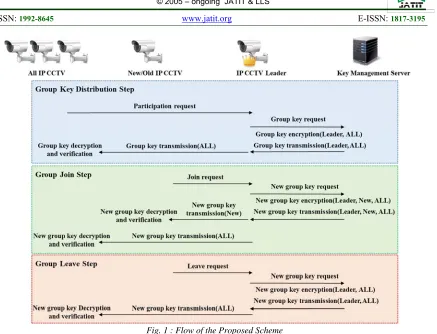
In this chapter, we propose a mutual authentication and group key management system using symmetric key in NVR. Figure 1 is a all scenario of the proposed schemes. The proposed scheme proposes two different schemes of key distribution in the group member 's join and leave step. The proposed schemes consists of group key distribution step, group join step, and group leve step. The system parameters used in the communication are as follows.
𝐼𝐷∗ - Identifier of ∗
𝑟∗ - ∗ Generated random value
𝐺1 - Group 1
𝐾𝑀𝑆 – Key management server
G𝐿𝐼𝐶 – IP CCTV Leader in Group 1
𝐼𝐶 – IP CCTV members in Group 1
𝑁𝐼𝐶 –New IP CCTV in Group 1
𝑂𝐼𝐶 – Old IP CCTV in Group 1
7546
𝐸∗ - Decryption with ∗
𝐷∗ - Decryption with ∗
𝐺𝐾1 - Shared key between IP CCTV Leader and KMS
𝐺𝑆𝐾 - Group session key of group G1
𝑀𝐴𝐶∗ - * Message authentication code
𝐸𝐺𝑆𝐾 - Encrypted group key
𝐴𝑢𝑡ℎ𝑀 - Authentication message M
4.1 Proposed Scheme 1
Proposed scheme 1 is a method in which KMS manages regeneration of keys in the process of joining and leaving group members. This scheme consists of a group key
distribution step, a join step, and a leave step.
4.1.1 Group key distribution phase
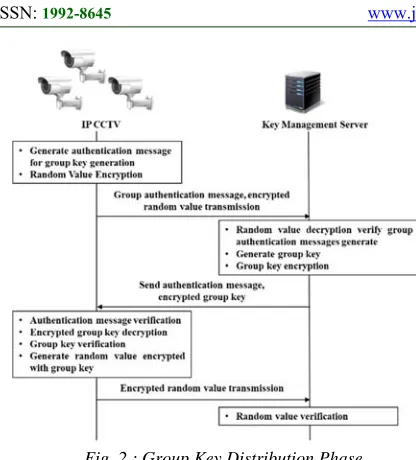
It is the step where the leader of the group forms a group and the group key is distributed from KMS.
Step 1. The group members create a message
𝑀 using identifier 𝐼𝐷 ,𝐼𝐷 , and random value 𝑟 to construct a group, add a symmetric
key 𝐾 to the message 𝑀 , generate a hashed 𝑀𝐴𝐶 , and send it to the group leader IPCCTV G𝐿𝐼𝐶 do. The formula for this is as follows.
𝑀 _ 𝐼𝐷 ∥ 𝐼𝐷 _ ∥ 𝑟 _
𝑀𝐴𝐶 _ ℎ 𝐼𝐷 ∥ 𝐼𝐷 ∥ 𝑟 _
∥ 𝐾 _
Step 2. G𝐿𝐼𝐶 generates 𝑀𝐴𝐶 by using
group members' messages and collects 𝑀𝐴𝐶 of group members to generate 𝐴𝑢𝑡ℎ𝑀 . Next, 𝑟 is encrypted using the group leader key 𝐸𝑟 . Finally,
𝐴𝑢𝑡ℎ𝑀 and 𝐸𝑟 are sent to the Key
Management Server 𝐾𝑀𝑆. The formula for this is as follows.
𝑀𝐴𝐶
𝑀𝐴𝐶 ⨁𝑀𝐴𝐶 ⋯ 𝑀𝐴𝐶 ⨁𝑟
𝐴𝑢𝑡ℎ𝑀 𝑀 ∥ 𝑀 ⋯ 𝑀 ∥
𝑀𝐴𝐶 .
[image:3.612.96.533.60.394.2]𝐸𝑟 𝐸 𝑟 .
Journal of Theoretical and Applied Information Technology 30th November 2018. Vol.96. No 22
© 2005 – ongoing JATIT & LLS
ISSN: 1992-8645 www.jatit.org E-ISSN: 1817-3195
7547
Step 3. The 𝐾𝑀𝑆 decrypts the erg to obtain the
random value 𝑟 ` Then, a message 𝑀 sent from IPCCTV and a symmetric key 𝐾 are combined to generate a 𝑀𝐴𝐶 `.𝑀𝐴𝐶 ` is generated and compared with the received 𝑀𝐴𝐶 .
𝑟 ` 𝐷 𝐸𝑟
Step 4. The 𝐾𝑀𝑆 generates the group session key
𝐺𝑆𝐾 by hashing the random value 𝑟 of the
𝑀𝐴𝐶 and the and the random value 𝑟 of the server. The formula for this is as follows.
𝐺𝑆𝐾 ℎ 𝑀𝐴𝐶 ∥ 𝑟 ∥ 𝑟
𝑀𝐴𝐶 ℎ 𝐼𝐷 ∥ 𝑟 ∥ 𝑟
𝐺𝑆𝐾 encrypts each IPCCTV symmetric key to generate 𝐸𝐺𝑆𝐾 . Then, the 𝑀𝐴𝐶 is enerated by hashing the identifier 𝐼𝐷 of the server, the random value 𝑟 of the server, and the random value 𝑟 of the group. The formula for this is as follows.
𝐸𝐺𝑆𝐾 𝐸 𝐺𝑆𝐾
𝑀𝐴𝐶 ℎ 𝐼𝐷 ∥ 𝑟 ∥ 𝑟
Finally, 𝐴𝑢𝑡ℎ 𝑟 ∥ 𝑀𝐴𝐶 is
generated using random value 𝑟 and 𝑀𝐴𝐶 ,
and then 𝐴𝑢𝑡ℎ and 𝐸𝐺𝑆𝐾 are transmitted to the G𝐿𝐼𝐶 .
Step 5. The G𝐿𝐼𝐶 generates 𝑀𝐴𝐶 ` by
hashing the identifier 𝐼𝐷 of the 𝐾𝑀𝑆, the random value 𝑟 `, and the random value 𝑟 .
𝑀𝐴𝐶 ` ℎ 𝐼𝐷 ∥ `𝑟 ∥ 𝑟
After that, it compares the 𝑀𝐴𝐶 ` value received from the 𝐾𝑀𝑆 and confirms that they are the same. If the values are the same, the G𝐿𝐼𝐶 delivers 𝐸𝐺𝑆𝐾 to the 𝐼𝐶 belonging to the group. Each 𝐼𝐶 belonging to the group can decrypt and obtain 𝐺𝑆𝐾 .
𝐺𝑆𝐾 𝐷 𝐸𝐺𝑆𝐾
Step 6. 𝐼𝐶 generates hash of group 𝐼𝐷 ,
𝐼𝐷 𝐼𝐷 , and 𝐺𝑆𝐾 , generates 𝐴𝐶𝐾 , and sends it to the G𝐿𝐼𝐶 .
Step 7. The G𝐿𝐼𝐶 generates an 𝐴𝐶𝐾 by
hashing 𝐼𝐷 , 𝐼𝐷 , and 𝐺𝑆𝐾 , and sends it to the G𝐿𝐼𝐶 . The G𝐿𝐼𝐶 generates an 𝐴𝐶𝐾
using the received 𝐴𝐶𝐾 and transmits it to the
𝐾𝑀𝑆. The formula for this is as follows.
𝐴𝐶𝐾 ℎ 𝐼𝐷 ∥ 𝐼𝐷 ∥ 𝐺𝑆𝐾
𝐴𝐶𝐾
𝐴𝐶𝐾 ⨁𝐴𝐶𝐾 ⋯ 𝐴𝐶𝐾 ⨁𝑟
Step 8. The 𝐾𝑀𝑆 generates an 𝐴𝐶𝐾 `and
generates a random value 𝑟 from the received
𝐴𝐶𝐾 . Compares the received 𝑟 with the previously generated `𝑟 to verify that the key is distributed correctly.
𝐴𝐶𝐾 `
𝐴𝐶𝐾 _ ⨁𝐴𝐶𝐾 _ ⋯ 𝐴𝐶𝐾 _ ⨁𝑟
4.1.2 Join phase
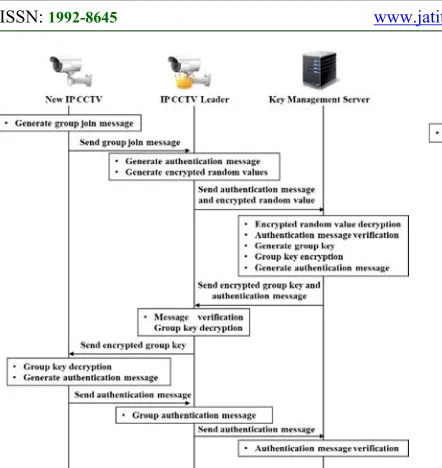
[image:4.612.94.302.72.302.2]The process of new IP CCTV joining the group.
7548
Step 1. The new IPCCTV 𝑁𝐼𝐶 generates
𝑀𝐴𝐶 by hashing the 𝐼𝐷 , 𝐼𝐷 , random value 𝑟 and symmetric key
𝐾 to join the group. Then, a message
𝑀 is generated using the 𝐼𝐷 , the
𝐼𝐷 , the random value 𝑟 , and the join request message 𝑗𝑜𝑖𝑛_𝑟𝑒𝑞𝑢𝑒𝑠𝑡. The formula for this is as follows.
𝑀𝐴𝐶 _ ℎ 𝐼𝐷 ∥ 𝐼𝐷 ∥ 𝑟 _
∥ 𝐾 _
𝑀 _ 𝐼𝐷 ∥ 𝐼𝐷 ∥ 𝑟
∥ 𝑗𝑜𝑖𝑛_𝑟𝑒𝑞𝑢𝑒𝑠𝑡
Step 2. Send 𝑀𝐴𝐶 and message
𝑀 to the G𝐿𝐼𝐶 . The G𝐿𝐼𝐶 generates
𝑀𝐴𝐶 and 𝐴𝑢𝑡ℎ𝑀 using the received value and encrypts the random value 𝑟 using the group leader key 𝐸𝑟 . Finally, 𝐴𝑢𝑡ℎ𝑀 and 𝐸𝑟 are sent to the key management server. The formula for this is as follows.
𝑀𝐴𝐶 𝑀𝐴𝐶 ⨁𝑟
𝐴𝑢𝑡ℎ𝑀 𝑀 ∥ 𝑀𝐴𝐶
𝐸𝑟 𝐸 𝑟
Next, A key verification step is the same at step 3 in 4.1.1(group key distribution phase).
4.1.3 Leave phase
At the group leave step, the old IP CCTV is leave to the group, and the existing group is the process of distributing the new group key for safety.
Step 1. The old IP CCTV 𝑂𝐼𝐶 generates
𝑀𝐴𝐶 by hashing the 𝐼𝐷 , 𝐼𝐷 , random value 𝑟 and symmetric key 𝐾 to join the group. Then, a message 𝑀 is generated using the 𝐼𝐷 , the 𝐼𝐷 , the random value
𝑟 , and the leave request message
𝑙𝑒𝑎𝑣𝑒_𝑟𝑒𝑞𝑢𝑒𝑠𝑡.
𝑀𝐴𝐶 _ ℎ 𝐼𝐷 ∥ 𝐼𝐷 ∥ 𝑟 _
∥ 𝐾 _
𝑀 _ 𝐼𝐷 ∥ 𝐼𝐷 ∥ 𝑟
∥ 𝑙𝑒𝑎𝑣𝑒_𝑟𝑒𝑞𝑢𝑒𝑠𝑡
Step 2. Send 𝑀𝐴𝐶 and message 𝑀
to the G𝐿𝐼𝐶 . The G𝐿𝐼𝐶 generates 𝑀𝐴𝐶 and
𝐴𝑢𝑡ℎ𝑀 using the received value and encrypts the
random value 𝑟 using the group leader key 𝐸𝑟 . Finally, 𝐴𝑢𝑡ℎ𝑀 and 𝐸𝑟 are sent to the key management server. The formula for this is as follows.
𝑀𝐴𝐶 𝑀𝐴𝐶 ⨁𝑟
𝐴𝑢𝑡ℎ𝑀 𝑀 ∥ 𝑀𝐴𝐶
[image:5.612.263.524.41.308.2]𝐸𝑟 𝐸 𝑟
[image:5.612.91.312.70.304.2]Journal of Theoretical and Applied Information Technology 30th November 2018. Vol.96. No 22
© 2005 – ongoing JATIT & LLS
ISSN: 1992-8645 www.jatit.org E-ISSN: 1817-3195
7549 Next, A key verification step is the same at step 3 in 4.1.1(group key distribution phase).
4.2 Proposed Scheme 2
Proposed scheme 2 is a method in which a new IP CCTV is allocated a new group key in order to join the group in the group join step. This is how IP CCTV Leader redistributes the new group key again.
4.2.1 Group key distribution phase
It is the step where the leader of the group forms a group and the group key is distributed from KMS. The method of receiving the key is the same as the proposed scheme 4.1.1.
4.2.2 Join phase
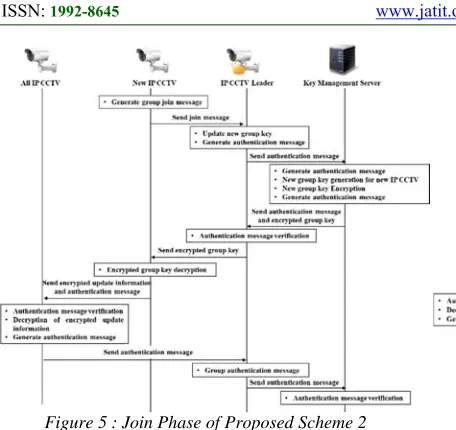
The process of new IP CCTV joining the group.
Step 1. The procedure that the new IP CCTV
generate MAC, random number and symmetric key is the same, at step 1 in 4.1.2(join phase).
Step 2. Send 𝑀𝐴𝐶 and 𝑀 to the
IP CCTV leader G𝐿𝐼𝐶 . G𝐿𝐼𝐶 generates a new group key through 𝐺𝑆𝐾 generates authentication message 𝑀𝐴𝐶 and 𝐴𝑢𝑡ℎ𝑀 encrypts random value 𝐸𝑟 and sends 𝐴𝑢𝑡ℎ𝑀 and 𝐸𝑟 to KMS. The formula for this is as follows.
𝐺𝑆𝐾 ℎ 𝐺𝑆𝐾 ∥ 𝑟 ∥ 𝑀𝐴𝐶
𝑀𝐴𝐶 𝑀𝐴𝐶 ⨁𝑟
𝐴𝑢𝑡ℎ𝑀 𝑀 ∥ 𝑀𝐴𝐶
𝐸𝑟 𝐸 𝑟
Step 3. KMS generates 𝑀𝐴𝐶 through
𝑀𝐴𝐶 ` and 𝑀𝐴𝐶 ` operation and verifies
𝑣𝑒𝑟𝑖𝑓𝑦 𝑀𝐴𝐶 `𝑀𝐴𝐶 to confirm that it is a
legitimate object. The formula for this is as follows.
𝑀𝐴𝐶 ` ℎ 𝑀 ∥ 𝐾
𝑀𝐴𝐶 ` 𝑀𝐴𝐶 `⨁𝑟 `
Step 4. The KMS generates a new group key
𝐺𝑆𝐾 encrypts the group key 𝐸𝐺𝑆𝐾 to be
transmitted to the new IP CCTV, generates an authentication message
𝐴𝑢𝑡ℎ , and transmits 𝐴𝑢𝑡ℎ and
𝐸𝐺𝑆𝐾 to the G𝐿𝐼𝐶 . The formula for this is as follows.
𝐺𝑆𝐾 ℎ 𝐺𝑆𝐾 ∥ 𝑟 ∥ 𝑀𝐴𝐶 ,
𝐸𝐺𝑆𝐾 𝐸 𝐺𝑆𝐾
∥ 𝑀𝐴𝐶
𝐴𝑢𝑡ℎ ℎ 𝐼𝐷 ∥ 𝐺𝑆𝐾 ∥ 𝑟
Step 5. The G𝐿𝐼𝐶 generates and verifies the
`𝐴𝑢𝑡ℎ message to 𝑣𝑒𝑟𝑖𝑓𝑦 𝐴𝑢𝑡ℎ
`𝐴𝑢𝑡ℎ that the KMS generated the group key
correctly.
`𝐴𝑢𝑡ℎ ℎ 𝐼𝐷 ∥ 𝐺𝑆𝐾 ∥ 𝑟
Step 6. The 𝑁𝐼𝐶 can decrypt the 𝐸𝐺𝑆𝐾 to obtain the group key.
𝐷 𝐸𝐺𝑆𝐾 𝐺𝑆𝐾
∥ 𝑀𝐴𝐶
Step 7. G𝐿𝐼𝐶 generates the information
𝐸𝑛𝑔𝑘 and the authentication message
𝐻𝑛𝑔𝑘 which group members can regenerate the group key, and sends it to the group member. The formula for this is as follows.
𝐸𝑛𝑔𝑘 𝐸 𝑟 ∥ 𝑀𝐴𝐶
𝐻𝑛𝑔𝑘 ℎ 𝐺𝑆𝐾 ∥ 𝐺𝑆𝐾 ∥ 𝐼𝐷
Step 8. The group members decrypt the group key
generation message 𝐸𝑛𝑔𝑘 to obtain the group key 𝐺𝑆𝐾 `, and generate and 𝑣𝑒𝑟𝑖𝑓𝑦 𝐻𝑛𝑔𝑘
𝐻𝑛𝑔𝑘` the authentication message 𝐻𝑛𝑔𝑘`. The
formula for this is as follows.
𝐷 𝐸𝑛𝑔𝑘 𝑟 ∥ 𝑀𝐴𝐶
𝐺𝑆𝐾 ` ℎ 𝐺𝑆𝐾 ∥ 𝑟 ∥ 𝑀𝐴𝐶
7550
Step 9. Group members generate an authentication
message 𝐴𝐶𝐾 _ and send it to the G𝐿𝐼𝐶 .
𝐴𝐶𝐾 _ ℎ 𝐼𝐷 ∥ 𝐼𝐷 ∥ 𝐺𝑆𝐾
Step 10. The IP CCTV leader generates the 𝐴𝐶𝐾 of the group members as 𝐴𝐶𝐾 and sends it to KMS. The KMS 𝑣𝑒𝑟𝑖𝑓𝑦 𝑟 `𝑟 and the new group formation is completed.
𝐴𝐶𝐾
𝐴𝐶𝐾 ⨁𝐴𝐶𝐾 ⋯ 𝐴𝐶𝐾 ⨁𝑟
4.2.3 Leave phase
At the group leave step, the old IP CCTV is leave to the group, and the existing group is the process of distributing the new group key for safety.
Step 1. The procedure that the old IP CCTV
generate MAC, random number and symmetric key is the same, at step 1 in 4.1.3(leave phase).
Step 2. Send 𝑀𝐴𝐶 and 𝑀 to the IP
CCTV leader 𝐺𝐿𝐼𝐶 . 𝐺𝐿𝐼𝐶 generates a new group key through 𝐺𝑆𝐾 generates authentication message 𝑀𝐴𝐶 and 𝐴𝑢𝑡ℎ𝑀 encrypts random value 𝐸𝑟 and sends 𝐴𝑢𝑡ℎ𝑀 and 𝐸𝑟 to KMS. The formula for this is as follows.
𝐺𝑆𝐾 ℎ 𝐺𝑆𝐾 ∥ 𝑟 ∥ 𝑀𝐴𝐶
𝑀𝐴𝐶 𝑀𝐴𝐶 ⨁𝑟
𝐴𝑢𝑡ℎ𝑀 𝑀 ∥ 𝑀𝐴𝐶
𝐸𝑟 𝐸 𝑟
Step 3. KMS generates 𝑀𝐴𝐶 through
𝑀𝐴𝐶 ` and 𝑀𝐴𝐶 ` operation and verifies
𝑣𝑒𝑟𝑖𝑓𝑦 𝑀𝐴𝐶 `𝑀𝐴𝐶 to confirm that it is a
legitimate object.
`𝑀𝐴𝐶 ℎ 𝑀 ∥ 𝐾
𝑀𝐴𝐶 ` 𝑀𝐴𝐶 `⨁𝑟 `
Step 4. The KMS generates a new group key
𝐺𝑆𝐾 to be transmitted to the new IP CCTV, generates an authentication message 𝐴𝑢𝑡ℎ , and transmits 𝐴𝑢𝑡ℎ and 𝐸𝐺𝑆𝐾 to the
𝐺𝐿𝐼𝐶 . The formula for this is as follows.
𝐺𝑆𝐾 ℎ 𝐺𝑆𝐾 ∥ 𝑟 ∥ 𝑀𝐴𝐶
𝐴𝑢𝑡ℎ ℎ 𝐼𝐷 ∥ 𝐺𝑆𝐾 ∥ 𝑟
Step 5. The 𝐺𝐿𝐼𝐶 generates and verifies the
`𝐴𝑢𝑡ℎ message to 𝑣𝑒𝑟𝑖𝑓𝑦 𝐴𝑢𝑡ℎ
`𝐴𝑢𝑡ℎ that the KMS generated the group key
correctly.
`𝐴𝑢𝑡ℎ ℎ 𝐼𝐷 ∥ 𝐺𝑆𝐾 ∥ 𝑟
Step 6. The 𝐺𝐿𝐼𝐶 generates the information
𝐸𝑛𝑔𝑘 and the authentication message
[image:7.612.88.531.58.294.2]𝐻𝑛𝑔𝑘 , which group members can regenerate the
[image:7.612.90.318.73.288.2]Journal of Theoretical and Applied Information Technology 30th November 2018. Vol.96. No 22
© 2005 – ongoing JATIT & LLS
ISSN: 1992-8645 www.jatit.org E-ISSN: 1817-3195
7551 group key, and sends it to the group member. The formula for this is as follows.
𝐸𝑛𝑔𝑘 𝐸 𝑟 ∥ 𝑀𝐴𝐶
𝐻𝑛𝑔𝑘 ℎ 𝐺𝑆𝐾 ∥ 𝐺𝑆𝐾 ∥ 𝐼𝐷
Step 7. The group members decrypt the group key
generation message 𝐸𝑛𝑔𝑘 to obtain the group key `𝐺𝑆𝐾 and generate and 𝑣𝑒𝑟𝑖𝑓𝑦 𝐻𝑛𝑔𝑘
`𝐻𝑛𝑔𝑘 the authentication message `𝐻𝑛𝑔𝑘
ℎ `𝐺𝑆𝐾 ∥ 𝐺𝑆𝐾 ∥ 𝐼𝐷 . The formula for
this is as follows.
𝐷 𝐸𝑛𝑔𝑘 𝑟 ∥ 𝑀𝐴𝐶
`𝐺𝑆𝐾 ℎ 𝐺𝑆𝐾 ∥ 𝑟 ∥ 𝑀𝐴𝐶
`𝐻𝑛𝑔𝑘 ℎ `𝐺𝑆𝐾 ∥ 𝐺𝑆𝐾 ∥ 𝐼𝐷
Step 8. Group members generate an authentication
message 𝐴𝐶𝐾 and send it to the 𝐺𝐿𝐼𝐶 .
𝐴𝐶𝐾 ℎ 𝐼𝐷 ∥ 𝐼𝐷 ∥ 𝐺𝑆𝐾
Step 9. The 𝐺𝐿𝐼𝐶 generates the 𝐴𝐶𝐾 of the
group members as 𝐴𝐶𝐾 and sends it to KMS. The
KMS 𝑣𝑒𝑟𝑖𝑓𝑦 𝑟 `𝑟 and the new group
formation is completed.
𝐴𝐶𝐾
𝐴𝐶𝐾 ⨁𝐴𝐶𝐾 ⋯ 𝐴𝐶𝐾 ⨁𝑟
5. ANALYSIS OF PROPOSED SCHEMES
In this chapter, we propose an efficient group key management system using symmetric key in NVR. We investigate the satisfaction of the security requirements introduced in Chapter 3 and compare the computational demands of proposed scheme 1 and 2 by analyzing the computation amount.
5.1 Mutual Authentication
The group leader and the key management server must be able to securely distribute group keys after verifying that they are legitimate entities through mutual authentication. In the proposed scheme, an authentication message is sent to each other through the authentication message
𝐴𝑢𝑡ℎ𝑀 𝑀 _ ∥ 𝑀𝐴𝐶 and 𝐴𝑢𝑡ℎ
ℎ 𝐼𝐷 ∥ 𝐺𝑆𝐾 ∥ 𝑟 So that the key can be securely distributed.
5.2 Replay Attack
To resist a replay attack, it must not be able to authenticate against legitimate entities by re-transmitting already communicated content and distributing mutual authentication and group keys. In the proposed scheme, it is possible to prevent a retransmission attack on a message by using a random number to generate a new message every session through a random value 𝑟 , 𝑟 .
5.3 Key Refresh
Key Refresh should be generated when a specific event occurs or after a certain period of time. In this proposed scheme, when IP CCTV is added or removed from a group, a new key is reissued to provide a key refresh because the previously used key cannot be used. 𝑀𝐴𝐶 𝑀𝐴𝐶 ⨁𝑟 .
5.4 Authentication/Integrity
Authentication / Integrity allows the recipient to decrypt the message only after authentication of the data has been verified after authentication. In the
proposed scheme 𝑀𝐴𝐶 𝑀𝐴𝐶 ⨁𝑟 ,
Authentication / Integrity is authenticated through the MAC value in the authentication key
𝐴𝑢𝑡ℎ𝑀 𝑀 ∥ 𝑀𝐴𝐶 and the signature
value is verified through the Auth value and received encrypted data.
5.5 Forward/Backward secrecy
Due to the change of the existing group circle, it should not be used for group communication by using the existing key when the group is reformed. In the proposed scheme, when a new IP CCTV joins or leaves the existing group key 𝐺𝑆𝐾 , 𝐺𝑆𝐾 is newly updated by KMS or IP CCTV Leader, so that it can not communicate using a previously used key. Therefore, forward / backward secrecy can be provided.
5.6 Computational analysis
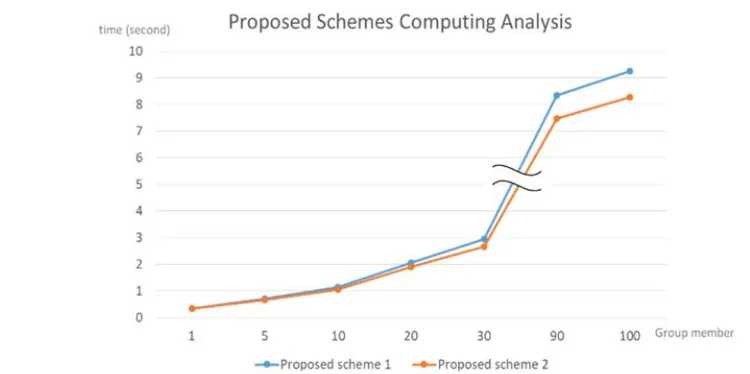
7552 other and distribute keys. However, if there is a large number of IP CCTVs in the group, the burden of KMS will increase. In case of Proposed scheme 2, IP CCTV Leader refreshes the group key necessary for the join and leave step. This allows each IP CCTV to distribute keys and distribute most of the operations. However, proposed scheme 2 may be more inefficient than Proposed scheme 1 if the computational demands of the group IP CCTV are increased and the KMS computation in the group is sufficient or the IP CCTV is small. Figure 7 and Table 1,2 shows how the computation requirements of proposed scheme 1 and proposed scheme 2 change according to the number of IP CCTVs in each group. The test was conducted using the AES encryption operation and the SHA256 hashing operation at about 120MHz operation speed. In case of proposed scheme 1, KMS distributes keys by performing a cryptographic operation in the process of joining a new IP CCTV group and newly renewing a group key to form a new group. This increases the computation on the KMS, and the larger the number of groups, the greater the overall amount of computation. However, as the number of group members is smaller, the computation amount is not high, and if the KMS has sufficient computation capability, the computation amount to be borne by the IP CCTV can be small and efficient. In the case of proposed scheme 2, IP CCTV joins the group and newly updates the group key to reduce the amount of computation of KMS and increase the computation amount of each IP CCTV slightly. So, you can use KMS which is lacking in computation ability or use it more efficiently if there are many group members of the group. In addition, the total amount of computation is smaller than that of the proposed scheme 1 as the number of group members
increases through hash computation rather than encryption computation. However, if KMS has sufficient computing power and group members of the group are significantly fewer, the computation amount of IP CCTV is higher than that of proposed scheme 1, which may not be effective for wireless IP CCTV which requires lightweight environment or IP CCTV with low computation capability.
6. CONCLUSIONS
Recently, as the use of network cameras increases for traffic situation monitoring and crime prevention, it is necessary to securely manage images with personal information and various situation information, control access to network cameras, and manage a large number of network cameras. In this paper, we propose an efficient group key management system using symmetric key cryptography in NVR. An IP CCTV reader representing a group of a specific purpose can perform a mutual authentication process with a key management server to allocate a group key and can not use an existing key when a group is reformed, And increased the safety of illegal access. Howeve
r,
there is a disadvantage that frequent communication is required for mutual authentication. Considering the computation power of IP CCTV, the computation amount is slightly higher using public key cryptosystem, but further research is needed to reduce the number of communication and to prevent frequent exposure of data for group key distribution to the communication path. IP CCTV has recently been experiencing frequent video data leakage accidents and needs constant attention so that it can respond to new threats. [image:9.612.95.522.540.605.2]E – encryption H – hash
Table 1 : Comparison of Proposed Scheme 1 Calculation Requirement
GROUP MEMBER NEW IP CCTV ALL IP CCTV IP CCTV
LEADER CCTV KMS
CCTV 1 1E+2H 1E+3H 2E+3H 1E+3H
CCTV 30 1E+2H 30E+90H 2E+3H 1E+3H
[image:9.612.88.525.642.716.2]CCTV 100 1E+2H 100E+300H 2E+3H 1E+3H
Table 2 : Comparison of Proposed Scheme 1 Calculation Requirement
GROUP MEMBER NEW IP CCTV ALL IP CCTV IP CCTV
LEADER
CCTV KMS
CCTV 1 1E+2H 1E+1H 2E 3E+2H
CCTV 30 1E+2H 30E+30H 2E 32E+2H
Journal of Theoretical and Applied Information Technology 30th November 2018. Vol.96. No 22
© 2005 – ongoing JATIT & LLS
ISSN: 1992-8645 www.jatit.org E-ISSN: 1817-3195
7553
ACKNOWLEDGMENTS: This research was
supported by Barun ICT Research Center at Yonsei University.
REFERENCES:
[1] Lee, Kyungroul, et al. "An efficient key management solution for privacy masking, restoring and user authentication for video surveillance servers." Computer Standards & Interfaces 44: 137-143. (2016)
[2] Jiang, Rong, et al. "EAP-based group authentication and key agreement protocol for machine-type communications." International Journal of Distributed Sensor Networks 9.11: 304601. (2013)
[3] Lai, Chengzhe, et al. "LGTH: a lightweight group authentication protocol for machine-type communication in LTE networks." Global Communications Conference (GLOBECOM), 2013 IEEE. IEEE, (2013)
[4] Lee, Kyungroul, Kangbin Yim, and Mohammad A. Mikki. "A secure framework of the surveillance video network integrating heterogeneous video formats and protocols." Computers & Mathematics with Applications 63.2: 525-535. (2012)
[5] Gu, Yi, et al. "Design and implementation of UPnP-based surveillance camera system for home security." Information Science and Applications (ICISA), 2013 International Conference on. IEEE, (2013)
[6] Tekeoglu, Ali, and Ali Saman Tosun. "Investigating Security and Privacy of a Cloud-Based Wireless IP Camera: NetCam." Computer
Communication and Networks (ICCCN), 2015 24th International Conference on. IEEE, (2015) [7] Costin, Andrei. "Security of CCTV and Video
Surveillance Systems: Threats, Vulnerabilities, Attacks, and Mitigations." Proceedings of the 6th International Workshop on Trustworthy Embedded Devices. ACM, (2016)
[8] Lai, Chengzhe, et al. "LGTH: a lightweight group authentication protocol for machine-type communication in LTE networks." Global Communications Conference (GLOBECOM), 2013 IEEE. IEEE, (2013)
[9] Alezabi, Kamal Ali, et al. "On the authentication and re‐authentication protocols in LTE‐WLAN interworking architecture." Transactions on Emerging Telecommunications Technologies 28.4 (2017)
[10] Yang, Tingting, et al. "EAPSG: Efficient authentication protocol for secure group communications in maritime wideband communication networks." Peer-to-Peer Networking and Applications 8.2: 216-228. (2015)
[11] Choi, Gun-wook, et al. “A Study on Efficient Group Key Management Scheme in CCTV”, KSII The 9th International Conference on Internet (ICONI), (2017)
[image:10.612.108.483.95.282.2][12] Choi, Gun-wook, et al. “Efficient Group Key Distribution Scheme in IP CCTV Environment”, The 3rd International Workshop on Convergence Information Technology(IWCIT), (2017)