455
UNDERSTANDING THE ACCEPTANCE OF
IT-BASED SHARING ECONOMIC SERVICES
1DONG HYUK JO, 2JONG WOO PARK, 3HONG SEOK PARK 123Department of Business Administration, Soongsil University, Seoul, South Korea
E-mail: 1[email protected], 2[email protected], 3[email protected]
ABSTRACT
This study aims to empirically verify the structural relationships between perceived risks, perceived values, trust, and intention to use for sharing economy services. In order to achieve the objective of this study, the survey was conducted targeting the car sharing service which has been noticeably growing in the sharing economy service. In the results of the study, first, the perceived risks of sharing economy service had negative(-) effect on the perceived values. Second, the perceived risks had negative(-) effect on trust. Third, the economic value and social value had positive(+) effect on trust while the functional value not had effect on trust. Fourth, the functional value and economic value had positive(+) effect on the intention of use while the social value not had effect on the intention to use. Lastly, trust had positive(+) effect on the intention to use. This study provided a chance to understand the risks and values actually perceived by potential users before the full-scale vitalization of sharing economy service, and also to see the importance of trust. Moreover, it also suggested the direction to establish strategies for the vitalization of services.
Keywords: Sharing Economy Services, Perceived Risk, Perceived Values, Trust, Intention to Use
1. INTRODUCTION
In his book “The Age of Access”, Jeremy Rifkin claimed that the era of ownership is now ending and the age of access is coming [34]. The Social Network Service (SNS) is spreading as if it supports his argument, as a result, information sharing among individuals has become easier than ever before, and a huge online network is formed, allowing it to search and use various information anytime and anywhere. In addition, people who are not familiar with each other communicate with each other by writing reviews through SNS, and start trading based on trust through their reviews. In this way, consumers are able to consume more rationally than before, which promotes the emergence of a new economic mode called Sharing Economy [21].
Sharing Economy is used as a concept of collaborative consumption economy, as opposed to the capitalism, which is symbolized by mass consumption and mass production [27]. In other words, the sharing economy is basically a way of sharing the products with many people, starting from the concept of tangible resource such as automobile, space, clothing, book, etc., to the concept of intangible resource such as time and talents [2]. Until recently, consumers thought that
the ownership is the most ideal way to access their favorite products and services. But consumers are increasingly paying for temporary access and sharing instead of buying or owning products and services [26].
Forbes (2013) reported that the revenue in the shared economy market is exceeding $ 3.5 billion, with a growth rate of more than 25%, predicting that sharing economy market would grow into megatrend market. With this trend, various business models based on the motive of sharing economy have been introduced competitively, resulting in intense competition to preoccupy the megatrend market. In this way, the sharing economy is a new phenomenon emerged by the spread of social commerce and sharing as well as the development of information and communication technology (ICT), the promotion of consumer consciousness, and the spread of cooperative online communities [18].
456 become popular and IT-based services become more widespread, it becomes easier and safer to use the sharing economy services [21].
However, despite the social and economic advantages of sharing economy services, some people criticize that the sharing economy is a temporary phenomenon arising after the long-term economic downturn. In view that the ownership of stuff is a basic human desire, the refusal to share my stuff with someone who I do not know will be a setback. In particular, it is also difficult to assess the economic value of the tangible resource because it is impossible to accurately depreciate its value after use. In addition, personal privacy may be disclosed while sharing stuff, and liability issues in the event of damage or theft may cause aversion to the use of sharing economy services [21]. For these limitations, Rachel Botsman, the author of “We Generation”, emphasized the importance of trust in a sharing economy by saying that trading through trust among people who are familiar with each other is the core of a shared economy [5].
Although interest in sharing economy services has increased worldwide, empirical studies on sharing economy services have seldom been conducted. To date, studies on sharing economy focus on analyzing the social cost benefits of sharing economic services and successful cases carried out using sharing economy a business model. In addition, there are some studies on the use of sharing economy services, but there is a limit in deriving practical implications in that risk factors and trust factors that should be considered as core issues in accepting sharing economy services are not addressed in a comprehensive manner.
Therefore, this study was conducted with the aim to empirically validate the structural relationship between the perceived risk, perceived value, trust, and intention to use sharing economy services in order to identify factors influencing the acceptance of sharing economy services. More specifically, the author aimed at the following objectives: First, examine the effect of the perceived risk of sharing economy services on trust and intention to use. Second, examine the effect of perceived risk on perceived values such as economic value, functional value, and social value, and the effect on trust and intention to use. Third, examine the effect of user trust on sharing economy service on intention to use.
This study will be meaningful in that it examined the risks and values perceived by the users in relation to the sharing economic service that will be fully activated in Korea in near future. It is also expected that this study will help activate
sharing economy by specifically identifying the factors that effect on the trust of users, which is referred to as core factor in sharing economy services. This study aims to provide an opportunity to understand the acceptance and use environment of sharing economy services and to suggest strategic directions for the acceptance shared economic services and its use.
This study examines the success factors of IT - based shared economic services. Therefore, this study was designed and constructed as a literature review and theoretical framework to achieve the purpose of the study. This study is divided into five chapters. Chapter 1 introduces the thesis and its objectives, scope, and organization. Chapter 2 presents a research hypothesis based on a review of literature on major concepts and theories. Chapter 3 presents the sample, measure and analysis method of the study. Chapter 4 presents the data analyses and findings. Chapter 5 presents the summary and future research directions, based on the results of the test of the theoretical model.
2. THEORETICAL BACKGROUND AND HYPOTHESES
2.1. Sharing Economy Service
The term ‘Sharing Economy’ was first introduced by Harvard professor, Lawrence Lessig, as an opposite concept of capitalistic economy. According to his definition, sharing economy is a cooperative consumption by several people using a product together, and a consumption culture maximizing the value of resources [27]. It is considered not as a cold economics based on demand-supply principle but a warm economics working based on sharing and coexistence [15]. Sharing economy services are being provided in multiple areas, but among those, car sharing service is showing the most distinct growth. Thus, this study conducted research focused on car sharing service.
Car sharing is using a car by several people on time basis, and as shown in Fig. 1, service is carried in a relationship between distance of travel and flexibility [40]. Sharing of transportation vehicle first began in 1948, Switzerland, a cooperative association called ‘Sefage’ provided a car used as common property [36]. Back then, however, this service was not developed as business, and only recently, the car sharing service has developed drastically with the emergence of sharing economy.
457 short time basis for citizens in big cities. In case of Korea, commercial car sharing service has begun in 2008 and currently, companies like Greencar, Socar, Hankook Carsharing, Drive Plus, Citicar are providing services.
Figure 1: The relationship between distance and
flexibility of car sharing service (Tumlin, 2008)
2.2. Perceived Risk
In the midst of decision making, consumers cannot predict the result definitely, and they perceive risk due to uncertainties that unexpected result could come [3]. Cox (1967) defined the perceived risk as a function of loss for the uncertainties in the purpose of purchase objective, satisfaction after purchase, and results that do not fit the purpose of purchase [8]. Peter and Tarpey (1975) defined the perceived risk as expected loss. Perceived risk refers to the loss of expectations that may result from purchasing and choice rather than the uncertainty in choice, which is seen as a negative effect of holding down purchase or withdrawing purchasing intentions [33]. Stone and Winter (1987) argued that the perceived risk should be defined as an independent concept of expected loss, not a function of both uncertainty and loss [38]. In other words, the perceived risk has been studied as a major variable for explaining customer behavior as the perception of negative uncertainty in the unpredictable consequences of product purchase and service utilization and potential losses to come [23].
In the previous studies, the perceived risk was suggested in multi-dimensions, such as economic risk, functional risk, psychological risk, and security risk, and has been found to have a significant effect on customer attitude and behavioral intention [32] [7] [21]. In the case of sharing economy services, uncertainty must inevitably exist because most transactions are made online and the transactions between individuals and
individuals are main stream in sharing economy services. Therefore, unlike an offline trading environment, there is a risk to the transaction itself. In other words, the various risks perceived by the customer in the process of using the service negatively affect the value, trust and satisfaction perceived by users, which in turn may serve as obstacles to the spread of the service [22]. Therefore, this study established hypotheses as follows:
H1: Perceived risk will have a negative effect on perceived value.
H1-1: Perceived risk will have a negative effect on functional value.
H1-2: Perceived risk will have a negative effect on economic value.
H1-3: Perceived risk will have a negative effect on social value.
H2: Perceived risk will have a negative effect on trust.
2.3. Perceived Value
Researches on perceived value have been carried in multiple areas including anthropology, sociology, psychology and its definition is also different [9]. As the most universe definition of perceived value, Zeithaml (1998) presented four different aspects of perceived value: Low cost, desired benefits, quality for paid, difference between paid and gained. Among these aspects, last aspect is used most for definition [43]. Consumers evaluate the value of a product or service according to what to give and gain. In other words, people appraise a product or service based on subjective perception about price, quality and value rather than objective properties. According to Monroe’s definition, perceived value is a trade-off between gained and loss, which is the paid amount of money and gained benefit and value, and the total perceived value is the sum of earned value and transaction value [30]. Kotler & Keller (2007) in their study has expanded the meaning of value from quality and price to psychological value by defining the consumer value as the monetary value of the functional, economic and psychological advantages expected by consumers [25].
458 is formed when product quality is higher than expected [33]. In the previous studies, the perceived value was treated as an important predictor of consumer behavior, and the perceived value was found to have effect on consumer attitudes toward products and services and behavioral intent [29] [32] [7] [21]. Therefore, this study established hypotheses as follows:
H3. Perceived value will have a positive effect on trust.
H3-1: Functional value will have a positive effect on trust.
H3-2: Economic value will have a positive effect on trust.
H3-3: Social value will have a positive effect on trust.
H4. Perceived value will have a positive effect on intention to use.
H4-1: Functional value will have a positive effect on intention to use.
H4-2: Economic value will have a positive effect on intention to use.
H4-3: Social value will have a positive effect on intention to use.
2.4. Trust
Trust is studied in lots of research fields because trust affects decrease of transaction cost, enhancement of productivity, sharing of value, co-development, transaction stabilization, and long-term relationship [12]. Based on previous researches, trust is defined as the extent of belief that a firm could provide products and services for customers with professionality, credibility, and affinity [1]. Moreover, trust is considered as an indispensable factor for a long-term and successful relationship between a firm and customers [31].
Doney & Cannon (1997) defined the trust as the extent of believing that a counterparty who might endanger me would act appropriately without control or oversight [11]. Dick & Basu (1994) said that service provider trust was an important factor in forming a sustained relationship [10]. In other words, trust is built based on observation of the other party or experience interaction in the past, and it is directly related to the fulfillment of expectations, so that long-term satisfaction strengthens the trust of service providers [13]. Kotler (1999) said that long-term relationships can be established when service users are trusted by the service company and the uncertainties and risks described above are expected to be small when the relationship with the company is maintained [24].
Therefore, the following hypothesis can be established. Therefore, this study established hypotheses as follows:
H5: Trust will have a positive effect on intention to use.
3. RESEARCH METHOD 3.1. Sample
In order to reveal the structural relationship between perceived risks, perceived value, trust, and intention to use of car sharing service, this study conducted a survey from potential users who have experience of visiting websites of car sharing companies and do not own a car. Survey was conducted for 4 weeks and 257 surveys were collected for analysis.
Table 1: Sample Characteristics
Category and Items Samplesize ratio(%)
Gender Male 110 42.8 Female 147 57.2
Age
20 ~29 91 35.4 30 ~39 85 33.1 40 ~ 49 66 25.7 More than 50 15 5.8
3.2. Measure
459
3.3. Analysis method
For the analysis method and measurement tool of structural equation models, this study analyzed the results and verified the hypothesis using Amos 24.0. For the analysis of the structural equation model, the measurement model was estimated first, and then it was analyzed using the two-step approach that estimates the structural model.
4. ANALYSIS AND RESULTS
4.1. Measurement Model
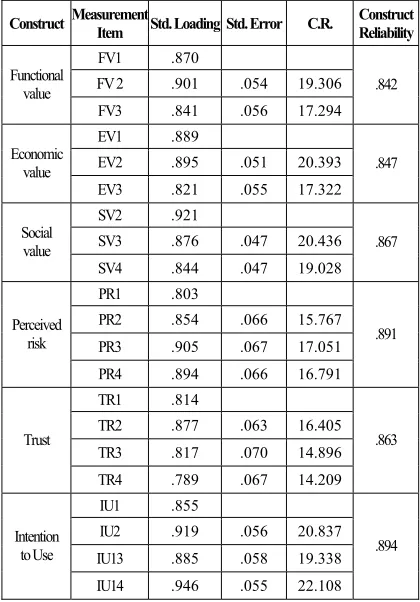
This study conducted confirmatory factor analysis to ensure the content validity of the measurement tool. As a result, initial model did not exceed standard fitness threshold, so modified indices analysis were conducted [17], and measurement items that lowers unidimensionality were deleted (FV4, EV4, SV1). As a result of confirmatory factor analysis of modified measurement model, χ2 = 277.242(P=0.000), χ2/df = 1.593, RMSEA = .048, GFI = .905, CFI = .978, IFI = .978, TLI = .974, indicating that measurement model was fit. Next, for measurement items, reliability and validity test were conducted. For reliability, construct reliability should appear above 0.7, and average variance extract should be above 0.5. Additionally, for validity, two latent variables’ AVE1 and AVE2 should bigger than squared value of its correlation. As a result of analysis, reliability and validity were verified.
4.2. Structural model
As measurement model’s fitness, and reliability and validity of measurement items were verified, structural model analysis were conducted. As a result of structural model’s fitness test, χ = 277.476 (P = .000), χ /df = 1.586 was above threshold 3, and RMSEA = .048 was below standard of 0.08. Moreover, GFI = .904, CFI = .978, IFI = .979, TLI = .974 all of indices appeared above recommended value of 0.9 and therefore, the structural model’ goodness of fit of the research model was verified.
Table 2: Confirmatory factor analysis base on reliability
Construct MeasurementItem Std. Loading Std. Error C.R. Construct Reliability
Functional value
FV1 .870
.842 FV 2 .901 .054 19.306
FV3 .841 .056 17.294
Economic value
EV1 .889
.847
EV2 .895 .051 20.393
EV3 .821 .055 17.322
Social value
SV2 .921
.867
SV3 .876 .047 20.436
SV4 .844 .047 19.028
Perceived risk
PR1 .803
.891
PR2 .854 .066 15.767
PR3 .905 .067 17.051
PR4 .894 .066 16.791
Trust
TR1 .814
.863
TR2 .877 .063 16.405
TR3 .817 .070 14.896
TR4 .789 .067 14.209
Intention to Use
IU1 .855
[image:5.612.312.522.104.405.2].894 IU2 .919 .056 20.837 IU13 .885 .058 19.338 IU14 .946 .055 22.108
Table 3: Correlations between Constructs and Validity
Const
ruct 1 2 3 4 5 6
1 .640*
2 .627 .650*
3 .266 .500 .674*
4 .034 .038 .046 .673*
5 .411 .548 .461 .094 .612*
6 .521 .578 .376 .058 .570 .678*
*AVE (Average Variance Extract)
1 = Functional value, 2 = Economic Value, 3 = Social Value, 4 = Perceived Risk, 5 = Trust, 6 = Intention to Use
4.3. Hypotheses Test
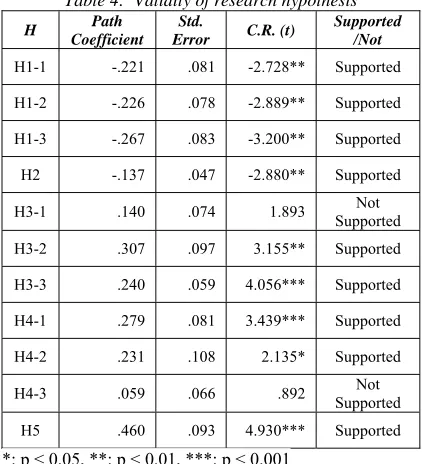
460 and social value (C.R. = -3.200, p = .001), thus, supporting H1-1, H1-2, and H1-3. Second, for relationship between perceived risk and trust, perceived risk (C.R. = -2.880, = .004) have an effect on trust, thus, supporting H2. Third, for relationship between perceived value and trust, economic value (C.R. = 3.115, p = .002) and social value (C.R. = 4.056, p = .000) had significant effects on trust, while functional value (C.R. = 1.893, p = .058) did not have a significant effect on trust, thus H3-2 and 3-2 was supported while H3-1 was not supported. Fourth, for relationship between perceived value and intention to use, functional value (C.R. = 3.439, p = .000) and economic value (C.R. = 2.135, p = .033) had significant effects on intention to use, while social value (C.R. = .892, p = .372) did not have a significant effect on intention to use, thus 1 and 4-2 was supported while H4-3 was not supported. Lastly, for relationship between trust and trust, intention to use (C.R. = 4.930, = .000) have an effect on trust, thus, supporting H5.
Table 4: Validity of research hypothesis
H Path Coefficient
Std.
Error C.R. (t)
Supported /Not
H1-1 -.221 .081 -2.728** Supported
H1-2 -.226 .078 -2.889** Supported
H1-3 -.267 .083 -3.200** Supported
H2 -.137 .047 -2.880** Supported
H3-1 .140 .074 1.893 Supported Not
H3-2 .307 .097 3.155** Supported
H3-3 .240 .059 4.056*** Supported
H4-1 .279 .081 3.439*** Supported
H4-2 .231 .108 2.135* Supported
H4-3 .059 .066 .892 Supported Not
H5 .460 .093 4.930*** Supported
*: p < 0.05, **: p < 0.01, ***: p < 0.001
5. CONCLUSION
In this paper, the cause and effect relationship of perceived risk, perceived value, trust and intention to use of sharing economy service was empirically analyzed. The results of the study are, first, perceived risk negatively affects all the perceived value including functional, economic, social values. This result is consistent with previous researches [4] [6]. Therefore, sharing economy service providers must minimize the risks that
might happen when service is being used. Second, perceived risk of sharing economy service also have a negative effect on trust. This result is verified in previous research as well [35], and implies that the bigger perceived risks are, the lower trust. In sharing economy services, trust has been emphasized as the most important factor and service providers need to lessen the decrease of trust by minimizing perceived risks. Third, among perceived value of sharing economy service, economic value and social value appeared to affect trust positively. On the other hand, functional value does not have any effect on trust. Fourth, functional value and economic value have positive effects on intention to use whereas social value does not have significant effect. This is a congruent result with previous studies [16]. Lastly, trust on sharing economy service positively affects intention to use. This implies again that trust is the important factor that affects consumers’ intention to use. Especially, trust plays a bigger role in uncertain situations like online service environment and person-to-person transaction environment where sharing economy service takes place.
461 strategic directions for the acceptance and spread of sharing economy services.
This study also allows room for future research. This study was focused on car sharing services among shared economic services. In addition to car sharing, there are various services such as accommodation, books, space, and clothing. Therefore, considering the diversity of shared economic services in future research, it can provide a chance to understand shared economic services more broadly.
REFRENCES:
[1] Aaker, D. A., & Keller, K. L., "Consumer evaluations of brand extensions," Journal of Marketing, 54(1), 1990, pp. 24-41.
[2] Bardhi, F., & Eckhardt, G. M., “Access-based consumption: The case of car sharing”, Journal of consumer research, 39(4), 2012, pp.881-898.
[3] Bauer, R. A. "Consumer behavior as risk taking, dynamic marketing for a changing world," In Proc. of 43rd Conference of the American Marketing Association, 1960, pp. 289-400,
[4] Bearden, W. O., & Shimp, T. A., "The use of extrinsic cues to facilitate product adoption," Journal of Marketing, 52(5), 1982, pp. 229-239.
[5] Botsman, R., & Rogers, R., “What's mine is yours: how collaborative consumption is changing the way we live”, New York: Harper Collins, 2011.
[6] Broydrick, S. C., “Seven laws of customer value: Don't turn your product into a commodity,” Leadership Excellence, 15(4), 1998, pp. 15.
[7] Chiu, C. M., Wang, E. T., Fang, Y. H., & Huang, H. Y., “Understanding customers' repeat purchase intentions in B2C e‐ commerce: the roles of utilitarian value, hedonic value and perceived risk”, Information Systems Journal, 24(1), 2014, pp. 85-114.
[8] Cox, D. F., "Risk handling in consumer behavior - An intensive of study two case, in risk taking and informational handling in consumer behavior," Boston: Harvard University Press, 1967, pp. 36-37.
[9] Cronin Jr, J. J., & Taylor, S. A., “A measuring service quality: Are examination and extension,” Journal of Marketing, 1992, pp. 55-68.
[10] Dick, A. S., & Basu, K., “Customer Loyalty: Toward an integrated Conceptual Framework”, Journal of the Academy of Marketing Science, 22(2), 1994, pp. 99-113. [11] Doney, P. M., & Cannon, J. P, “An
Examination of the Nature of Trust in Buyer-Seller Relationships”, Journal of Marketing, 61(2), 1997, pp. 35-51.
[12] Dyer, J. H., & Chu, W., "The role of trustworthiness in reducing transaction costs and improving performance: empirical evidence from the United States, Japan, and Korea", Organization Science, 14(1), 2003, pp. 57-78.
[13] Ganesan, S., “Determinants of Long-Term Orientation in Buyer-Seller Relationships”, Journal of Marketing, 58(2), 1994, pp. 1-19. [14] Gefen, D., Karahanna, E., & Straub, D. W.,
“Trust and TAM in online shopping: An integrated model”, MIS quarterly, 27(1), 2003, pp. 51-90.
[15] Gold, L., & Naughton, M. "New financial horizons the emergence of an economy of communion," New City Press, 2010.
[16] Grace, D., & O’Cass, A., "Service branding: consumer verdicts on service brand," Journal of Retailing and Consumer Services, 12, 2005, pp. 125-139.
[17] Hair, J. F., Black, B., Anderson, R., & Tatham, R., “Multivariate Data Analysis: Text and Readings”, New Jersy: Prentice Hall. 1995. [18] Hamari, J., Sjöklint, M., & Ukkonen, A., “The
sharing economy: Why people participate in collaborative consumption”, Journal of the Association for Information Science and Technology, 67(9), 2016, pp. 2047-2059. [19] Jarvenpaa, S. L., & Todd, P. A., “Is there a
future for retailing on the Internet”, Electronic marketing and the consumer, 1(12), 1997, pp.139-154.
[20] Jarvenpaa, S. L., Tractinsky, N., & Vitale, M., “Consumer trust in an Internet store”, Information Technology and Management, 1, 2000, pp. 45-71.
[21] Kim, H. J., Park, J. W., & Jo, D. H., “An Empirical Study on Success Factors of Sharing Economy Service”, The Journal of the Korea Contents Association, 16(1), 2016, pp. 214-229.
[22] Kwon, H. K., & Seo, K. K., “Application of Value-based Adoption Model to Analyze SaaS Adoption Behavior in Korean B2B Cloud
Market”, International Journal of
462 [23] Kissarijian, H. D., & Robertson, T. S.,
"Perspectives in Consumer Behavior", 4th ed., EnglewoodCliffs, NJ: Prentice Hall, 1991. [24] Kotler, P., “Marketing Management: Analysis,
Planning, Implementation and Control”, 8th Edition, Prentice-Hall, 1999.
[25] Kotler, P., & Keller, K. L., “A framework for marketing management”, 3th Edition, Prentice-Hall, 2007.
[26] Lamberton, C. P., & Rose, R. L., “When is ours better than mine? A framework for understanding and altering participation in commercial sharing systems”, Journal of Marketing, 76(4), 2012, pp.109-125.
[27] Lessig, L. "Remix: Making art and commerce thrive in the hybrid economy,” Bloomsbury Academic, 2008.
[28] Lin, J. C. C., & Lu, H., “Towards an understanding of the behavioural intention to use a web site”, International journal of information management, 20(3), 2000, pp. 197-208.
[29] Mathwick, C., Malhotra, N., & Rigdon, E., "Experiential Value: Conceptualization, Measurement and Application in the Catalog and Internet Shopping Environment", Journal of Retailing, 77(1), 2001, pp. 39–56.
[30] Monroe, K. B., “Pricing, ‘making profitable decisions’,” 2nd ed., London: McGraw-hall, 1990.
[31] Morgan, R. M., & Hunt, S. D., “The commitment-trust theory of relationship marketing”, Journal of Marketing, 58, 1994, pp. 20-38.
[32] Noh, M. J., “An Effects of Perceived Risk and Value on the trust and Use Intention of Smart Phone Banking : Mediating Effect of the
Trust”, Korea Journal of Business
Administration, 24(5), 2011, pp.2599-2615. [33] Peter, J. P., & Tarpey Sr, L. X., "A
Comparative analysis of three consumer decision strategies", Journal of Consumer Research, 2(1), 1975. pp.29-37.
[34] Rifkin, J. (2001). The age of access: The new culture of hypercapitalism. Penguin.
[35] Rotter, J. B., "A new scale for the measurement of interpersonal trust", Journal of Personality, 35, 1967, pp. 651-665.
[36] Shaheen, S., & Cohen, A., "Growth in worldwide carsharing : An international comparison”, Transportation Research Record, 1992, 2007, pp. 81-89.
[37] Sheth, J. N., Newman, B. I., & Gross, B. L., “Why we buy what we buy: A theory of consumption values”, Journal of business
research, 22(2), 1991, pp.159-170.
[38] Stone, R. N., & Grønhaug, K., "Perceived risk: Further consideration for the marketing discipline", European Journal of Marketing, 1987, 27(3), 1987, pp.39-50.
[39] Sweeney, J. C., & Soutar, G. N., “Consumer perceived value: The development of a multiple item scale”, Journal of retailing, 77(2), 2001, pp.203-220.
[40] Tumlin, J. “Sustainable transportation planning,” WILEY, 2008, pp. 205-216. [41] Wang, Y. S., Lin, H. H., & Luarn, P.,
“Predicting consumer intention to use mobile service”, Information systems journal, 16(2), 2006, pp. 157-179.
[42] Ward, M. R., & Lee, M. J., “Internet shopping, consumer search and product branding”, Journal of product & brand management, 9(1), 2000, pp. 6-20.
463
Appendix A. Measurement items.
Dimensions Items Factor
Loading
Perceived risk
1. It seems to be more expensive than existing services. .874 2. It seems that the expected level of quality is unlikely to be provided. .896 3. I am afraid that the value will not be exhibited as much as the cost I paid. .905 4. I am afraid that the information provided previously may not match the actual
service. .899
Functional value
1. It will be convenient to use. .802
2. I will be able to use it immediately when I want. .772 3. It will be able to satisfy my needs. .847 4. It will provide stable service quality. .702
Economic value
1. I will be able to get the value of the price I paid. .676 2. I will be able to reduce the cost of using the service. .677 3. Time and effort for trading will be saved. .700
4. I think the price is reasonable. .736
Social value
1. Use of service matches my lifestyle. .680 2. If I use the service, people around me will have a positive image of me. .830 3. If I use the service, I will feel differentiated from others. .850 4. The service seems to match my usual image. .774
Trust
1. I think that the various information provided when using the service is reliable. .733 2. I think that the quality of the service is trustworthy. .700 3. I think that personal and transactional information will be kept safe. .808 4. I think that the fee is reasonable. .707
intention to use