ORIGINAL RESEARCH ARTICLE
A NUMERICAL STUDY FOR EVOLUTION OF THE REAL TIME FOR PURE GAUGE THEORY IN
QUANTUM MECHANICS (GLUONS WITHOUT QUARKS) WITH GROUP SU (2)
*1
Dr. Salman AL-chatouri,
1Dr. Mohey-ALdin Nizam and
2Silva AL-khassi
1
Associate professor-Department of Physics-Faculty sciences-Tishreen University-Lattakia-Syria
2Postgraduate student, (Ph.D.)-Department of Physics-Faculty sciences-Tishreen University-Lattakia-Syria
ARTICLE INFO ABSTRACT
In this paper, we take the effective Hamiltonian operator until the sixth degree [3] and we apply the perturbation theory (that depends on creation operator and annihilation operator ) on remaining homogenous modes after quantization of the inhomogenous modes and we have concluded the time evolution for the average ensemble of global square operator (the color magnetic energy B ) analytically, and we calculated this time evolution with MATLAB software, we found that life glasma (gluons) of rank 10-29sec According to coupling constant values.
Copyright © 2018,Dr. Salman AL-chatouri et al. This is an open access article distributed under the Creative Commons Attribution License, which permits unrestricted use, distribution, and reproduction in any medium, provided the original work is properly cited.
INTRODUCTION
Understanding the evolution of real time in problems of non-equilibrium, is very important, that is manifested for example in identification on the process of early universe formation, or in the theoretical study of particles under limited conditions, Aimed to predicting a very short transition of phase of quarks and gluons plasma. These problems are treated within the framework of the groups SU (2) and SU(3) in gauge theories [1-4].
There are two methods used for processing problems by real time:
The first method: depends on Schrodinger representation in quantum mechanics, where the operators are not dependent on time [5,6].
The second method: depends on Heisenberg representation in quantum mechanics, where the operators are dependent on time ( ), and is a processed problems of non- equilibrium, either depending on Green function, or Wigner way [4,7,8].
_The real time evolution of quarks and gluons plasma was studied for the pure gauge theory with the two groups SU(2) and SU(3) in [5-6]. In these studies, the perturbation theory which depends on the creation operator and annihilation
operator , was used .The effective Hamiltonian operator expansion was taken into consideration until the fourth degree.
-In [13] the harmonic oscillator of pure gauge theory with group SU(2) was studied numerically using creation operator
and annihilation operator .
-in this work, the starting point is pure gauge theory (gluons without quarks) and taking the effective Hamiltonian operator
expansion until the sixth degree and we used perturbation theory which depends on creation operator and annihilation operator .
*Corresponding author: Dr. Salman AL-chatouri
ISSN: 2230-9926
International Journal of Development Research
Vol. 08, Issue, 12, pp.24723-24737, December, 2018
Article History:
Received 14th September, 2018
Received in revised form 09th October, 2018
Accepted 03rd November, 2018
Published online 31st December, 2018
Key Words:
Real times in non-equilibrium, phase transition to quark-gluon-plasma.
Citation: Dr. Salman AL-chatouri, Dr. Mohey-ALdin Nizam and Silva AL-khassi. 2018. “A numerical study for evolution of the real time for pure
gauge theory in quantum mechanics (gluons without quarks) with group su (2)”, International Journal of Development Research, 8, (12), 24723-24737.
RESEARCH METHODOLOGY
“ Introduction to our research in words ”
According to [3], the Hamilton operator of pure gauge theory with group SU(2) can be described in loop ( )
=
( )+ α Π Π + α B B + ( )+ α F (B)F (B)
+ B B B B + 2B B B B + α B B B B + α ∑ B B
+ ∑ B B B B + α B B B B B B + α F (B)F (B)B B
+ ∑ F (B)F (B)B B + α B B B + 0 (1)
where i,j=1,2,3 the guide of local coordinates,.
a,b=1,2,3 are the evidences of group SU(2) generators,.
-α , … , -α are constants resulted from quantization of inhomogeneous modes of gauge field by the method of paths integration.
is a constant resulted from quantization of inhomogeneous time derivative modes of gauge field by the method of paths integration and it has the following values [3]:
= 0.021810429, α = −0.30104661, α = 0.024624
= 0.0021317, α = −0.0078439, α = 4.9676959x10
= −5.5172502x10 , α = −1.2423581x10 ,
= −1.1130266x10
= −2.1475176x10 , α = −1.2775652x10 (2)
are tensors of the magnetic field intensity represented as [3]:
=ε B B (3)
B is the operator of homogeneous magnetic field, andΠ is the operator of momentum.
=
1 At direct replacement 0 ℎ
−1 At indirect replacement
0 B indicates that the limits of degree greater than are neglected. is a coupling constant represented in the following relation [3]:
where:
represents an identified constant by minimum subtraction of dimension organization.
L is the loop length in all spatial directions.
According to this method of Hamilton operator , the study of pure gauge theory with group SU(2) becomes a form of quantum mechanics with group SU(2), This mean that the study of infinite number of particles and freedom degrees (quarks and gluons plasma), has been physically transformed to a study of three global particles .naemly, to confine the study to nine anharmonic oscillators. nine freedom degrees and particularly nine anhamonic oscillators.
is the harmonic part of the operator :
Where:
, the creation operator can be identified as the following [5,6]:
and annihilation operator is defined as:
(Plank constant) in a system of natural units.
In this case, we find that:
are Kroanker symbols of spatial coordinates and evidences of generating group SU(2). These Kroanker constants are respectively, defined as:
The result of adding the equation (6) to (7) is the operator of homogeneous magnetic field:
The result of subtracting the equation (6) out of (7) is the operator of momentum given as:
Calculated Hamiltonian operator for harmonic oscillator [5]:
Following [5,6], using the equations
- Calculated Hamiltonian operator matrix until sixth degree [14]:
The equation (15) represents Hamiltonian operator matrix until sixth degree in case pure gauge theory (gluons without quarks).
RESULTS AND DISCUSSION
To calculate the evolution of time for the average values for colored magnetic energy :
Depending on (11), (12) we find
The equation (16) represents color magnetic energy matrix.
The colored magnetic energy matrix checks the equation:
And thus:
We can calculate the evolution of time for the average values in equation (18) numerically by MATLAB program after calculating the numerical values of matrix (15),(16) by Fortran(77) language program.
We have got [10]:1GeV-1=6.58x10⁻²⁵ sec
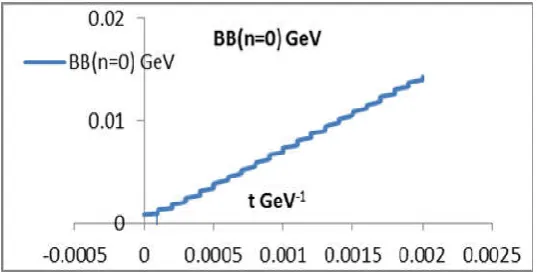
Figure 1. shows the evolution of time for the average values of colored magnetic energy for ground level dependency the time for g=0.599009088
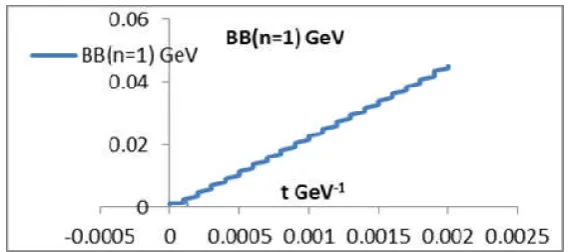
Figure 2. Shows the evolution of time for the average values of colored magnetic energy for first level dependency the time for g=0.599009088
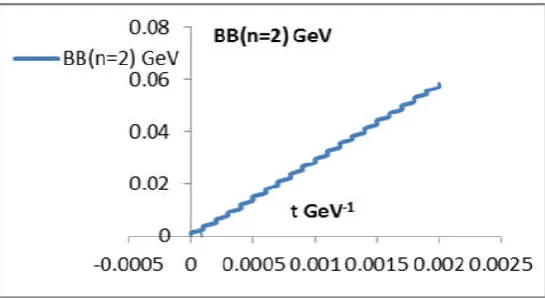
Figure 3. Shows the evolution of time for the average values of colored magnetic energy for second level dependency the time for
g=0.599009088
[image:11.595.158.433.427.557.2] [image:11.595.164.433.602.740.2]Figure 5. Shows the evolution of time for the average values of colored magnetic energy for first level dependency the time for g=1.499088396
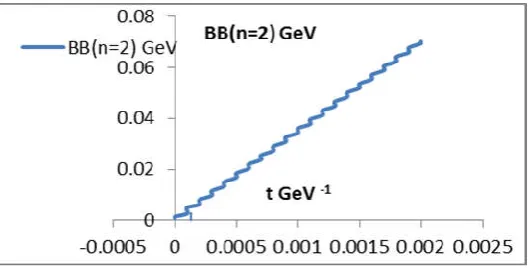
Figure 6. Shows the evolution of time for the average values of colored magnetic energy for second level dependency the time for g=1.499088396
Figure 7. Shows the evolution of time for the average values of colored magnetic energy for ground level dependency the time for g=2.598905472
Figure(8): shows the evolution of time for the average values of colored magnetic energy for first level
[image:12.595.159.436.416.552.2] [image:12.595.155.441.597.723.2]Figure(9): shows the evolution of time for the average values of colored magnetic energy for second level dependency the time for g=2.598905472
[image:13.595.165.432.49.184.2]Figure(10): shows the evolution of time for the average values of colored magnetic energy for ground level dependency the time for g=2.999278861
Figure 11. Shows the evolution of time for the average values of colored magnetic energy for first level dependency the time for g=2.999278861
[image:13.595.169.429.222.355.2] [image:13.595.161.434.396.526.2] [image:13.595.162.435.564.713.2]Figure 13. Shows the evolution of time for the average values of colored magnetic energy for ground level dependency the time for g=3.398312073
Figure 14. Shows the evolution of time for the average values of colored magnetic energy for first level dependency the time for
g=3.398312073
Figure 15. Shows the evolution of time for the average values of colored magnetic energy for second level dependency the time for g=3.398312073
We conclude from figure (1) to figure (15) that it is for large and small sizes from L=2.4893 fm to L=2.622199 fm which corresponds g=0.549915534 to g=3.398312073 is being gluon life time of rank 10-29sec, which is glasma (gluons) is mysterious case of the matter which may be existed before quarks and gluons plasma model, it is a thick mix (liquid) from gluons known as glasma [11], and after this time it moves to quarks and gluons plasma phase.
Conclusions and Recommendations
This study is the first in quantum mechanics which takes a numerical study of the evolution of the real time for pure gauge theory with group SU(2) i.e. nine freedom degrees, we recommend a numerical study of the evolution of the real time for pure gauge theory with group SU(3) i.e. twenty four freedom degree.
Acknowledgements: Tishreen University- Lattakia-Syria.
REFERENCES
[image:14.595.167.432.419.554.2]2-KRIPFGANZ ‚ J. and MICHAEL‚ C.- Fermionic Contributions to The Glueball Spectrum In a Small Volume Phys. Lett.B North-Holland vol. 209, . 1‚ 1988. 77-79.
3- Jeffrey KOLLER and Pierre van BAAL.A non-perturbative analysis in finite Volume gauge theory –Nuclear physics B302 (1988) 1-64,North-Holland,Amsterdam.
4-AL-CHATOURI‚ S.-Untersushungen zum realzeit-verhlten Quantenfeldtheoritische modelle Dissertation‚ Leipzig uni.-1991 -‚ 101p.
5-Dr.AL-chatouri,salman-Evolutionof Real Times in the Problems of Non-equilibrium for Pure Gauge Theory with Group SU(2),Depending on the Creation and Annihilation Operators Tishreen University Journal-vol.(30)No.(1) 2008,23-45.
6- Dr.AL-chatouri,salman-Evolutionof Real Times in the Problems of Non-equilibrium for Pure Gauge Theory with Group SU(3),Depending on the Creation and Annihilation Operators. Tishreen University Journal-vol.(30)No.(3) 2008,41-61.
7-Dr.AL- chatouri,salman;AL-khassi,Silva; An analytical study of the Evolution of the Real time in statistical Quantum mechanics of the Pure Gauge theory(Gluons without Quarks) with Potential expansion until the sixth degree. Tishreen University Journal-vol.(36)No.(6) 2014,131-145.
8-Dr.AL- chatouri,salman;AL-khassi,Silva; An analytical study of the Evolution of the Real time in statistical Quantum mechanics of the Gauge theory(Quarks and Gluons) with Potential expansion until the sixth degree. Tishreen University Journal-vol.(37)No.(1) 2015,183-206.
9-PATHRIA, R.K.-Statistical Mechanics,Great Britain by BPC Wheatons Ltd, Exeter, 1995,529. 10 -www.phys.ufi.edu/ ҇ korytov/…/note-01-NaturalUnits-SMsummary.pdf.
11-www.livesicence.com/22320-quark-gluon-plasma-big-bang-conditions.html. 12-www.nobelprize.org/noble-prizes/physics/laureates/2004/..
13- Dr.AL- chatouri,salman;Dr.Nizam,Nohey-Aldin; AL-khassi,Silva-Harmonic Oscillator Study of Pure Gauge Theory with SU(2) Group and Glonon Semi-Particle novelty journal-vol(5), Issue 3, ; 2018 pp:(10-21).
14- Dr.AL- chatouri,salman; Dr.Nizam,Nohey-Aldin; AL-khassi,Silva-anharmonic oscillator study for pure gauge theory (gluons without quarks) with group SU(2). journal of international academic research for multidisciplinary-vol(6), Issue 10, ; 2018 pp:(1-18).