ISSN: 1992-8645 www.jatit.org E-ISSN: 1817-3195
189
SENTIMENT ANALYSIS OF SMARTPHONE PRODUCT
REVIEW USING SUPPORT VECTOR MACHINE
ALGORITHM-BASED PARTICLE SWARM
OPTIMIZATION
1MOCHAMAD WAHYUDI, 2DINAR AJENG KRISTIYANTI
1,2
Sekolah Tinggi Manajemen Informatika dan Komputer (STMIK Nusa Mandiri)
E-mail: [email protected], [email protected]
ABSTRACT
Nowdays, social media gives the very large effect to the digital improvement in terms of global communications. It can be seen from the increasing of consumers opinion and review about smartphone product that they write on various social media. So that can be recognized various sentiments about the product either positive, negative or neutral. Sentiment analysis is a computational study of the opinions, behaviors and emotions of people toward the entity. The entity describes the individuals, events or topics. That topics generally could be the review of diverse datasets, one of it is a product review. www.gsmarena.com is one of the website that provides information of smartphone products review. Reexamination of smartphone product review by classifiying it into positive and negative class is the good way to find out the consumers response of the products quickly and properly. From some techniques of classifications, the most often used is Support Vector Machine (SVM). SVM are able to identify the sparated hyperplane which maximize margin two different classes. However SVM is lack of electing appropriate parameters or features. Election features and setting parameter at SVM significantly affecting the results of accuracy classifications. Therefore, in this research used the merger method election features, namely Particle Swarm Optimization in order to increase the classifications accuracy Support Vector Machine. This research produces classifications text in the positive or negative of smartphone products review. The evaluation was done by using 10 Fold Cross Validation. While the measurement accuracy is measured by Confusion Matrix and ROC curve. The result showed an increasing in accuracy SVM of 82.00% to 94.50%.
Keywords: Particle Swarm Optimization, Review, Sentiment Analysis, Support Vector Machines, Text Classification.
1.
INTRODUCTIONTrend development of cell phone is a cell phone which is much more smart (or commonly called smartphone) by its nature intricate and easy to use. Due to the evolving nature of mobile technology, the boundaries between "smart" and "dumb" an increasingly unclear phones (Litchfield, 2010). It is predicted that by 2019, there will be approximately 5.6 billion smartphone users, which will produce 10 Exabyte (1018 bits) of data flow (Zhang et al., 2014). The proliferation of the use of smartphones in recent years due to several factors, including the functions of the smartphone itself apart as a means of supporting the work, the nature of smartphone multitasking, as a means of entertainment, communication tools are simple and easy to use and carry anywhere. This is what makes the smartphone demand by any person and by any circles. The
development of smartphones are increasingly diverse not only in terms of looks alone but also in terms of features and specifications ("trend in the use of smartphones for sharing online world").
ISSN: 1992-8645 www.jatit.org E-ISSN: 1817-3195
190 biased. Sentiment classification aims to overcome this problem by automatically classifying user review be positive or negative opinion (Z. Zhang , et al., 2011).
Sentiment analysis or opinion mining is the computational study of the opinions, attitudes and emotions of the entity. The entity may describe an individual, event or topic. The topic is likely to be a review (Medhat, Hassan, & Korashy, 2014). Classification techniques commonly used for sentiment analysis including Naïve Bayes reviews, Support Vector Machines (SVM) and K-Nearest Neighbor (KNN) (Dehkharghani, et al., 2014).
There are few studies that have been conducted within the classification sentiment towards the reviews are available online including, sentiment analysis on mobile user reviews (Zhang et al., 2014). Opinion sentiment analysis on movie reviews using Support Vector Machine classifier and Particle Swarm Optimization (Basari, et al., 2013). Sentiment classification at the reviews online travel destinations using Naïve Bayes classifier, Support Vector Machines and Character-Based N-gram model (Ye, Zhang, & Law, 2009). Sentiment analysis on movie reviews and some products from Amazon.com using a classifier Support Vector Machines and Artificial Neural Network (Moraes, Valiati, & Gaviao Neto, 2013). Sentiment classification at a restaurant review on the internet written in Naïve Bayes classifier Canton use and Support Vector Machines (Z. Zhang et al., 2011). Social media sentiment analysis in the Czech Republic using Supervised Machine Learning (Habernal, Ptacek, & Steinberger, 2014).
The most often techniques used for data classification is Support Vector Machines (SVM). SVM is a supervised learning methods that analyze the data and identify patterns that are used for classification (Basari et al., 2013). Support Vector Machines (SVM) is a special case of a family of algorithms called regularized linear classification methods and powerful method to minimize the risk (Weiss, Indurkhya, & Zhang, 2010). SVM has the advantage of being able to identify separate hyper plane that maximizes the margin between two different classes (Chou et al., 2014). However Support Vector Machine has a deficiency of the problem or the parameter selection corresponding features (Basari et al., 2013). Selection of features at once setup parameters in SVM significantly influence the results of classification accuracy (Zhao, et al., 2011). In certain application problems, not all of these features are equally important. Better performance can be achieved by
removing some of the features. Thus, it can be the removal of noise, data that is irrelevant and redundant (Zhao et al., 2011).
Particle Swarm Optimization (PSO) is widely used to solve optimization problems as well as a feature selection problem (Liu et al., 2011). In engineering Particle Swarm Optimization (PSO), there are several ways to perform optimizing including increased weight attribute (attribute weight) for all attributes or variables used, selecting the attribute (attribute selection) and feature selection. Particle Swarm Optimization (PSO) is an optimization technique that is very simple to implement and modify some parameters (Basari et al., 2013).
In this study Support Vector Machines algorithm and Particle Swarm Optimization algorithm as a feature selection method will be applied by researchers to classify text on smartphone product reviews in order to improve the accuracy of sentiment analysis.
2.
LITERARY REVIEWA. ProductReview
Website is a forum for diverse opinions. A form of opinion that has credibility is product reviews. Websites such as amazon.com encourage users to give a review (review) (Weiss, Indurkhya, & Zhang, 2010). The results of the review text mining can be classified in three categories: positive, negative and neutral. For example, the following are examples of product reviews at amazon.com:
Source: (Weiss, Indurkhya, & Zhang, 2010).
Figure 1: Prototype Product Reviews at amazon.com After analyzed through text mining are obtained decision rule on the classification review of the product as follows:
Source: (Weiss, Indurkhya, & Zhang, 2010).
Figure 2: Decision Rules in
ISSN: 1992-8645 www.jatit.org E-ISSN: 1817-3195
191 B. Sentiment Analysis
According to Tang in Haddi (Haddi, Liu, & Shi, 2013), sentiment analysis on the review is to investigate the process of product reviews on the Internet to determine all the opinion or feelings of a product. According to Thelwall in Haddi (Haddi, Liu, & Shi, 2013, sentiment analysis is treated as a classification task which classifies the orientation of a text into positive or negative. According to Mejova in Basari (Basari et al.,2013), the purpose of the analysis is to determine the behavior sentiment or opinion of an author with attention to a particular topic. The behavior could indicate the reason, opinion or judgment, the tendency conditions (how the author wants to influence the reader).
According to Moraes in (Wahyudi and Putri, 2016) measures that are commonly found in text classification sentiment analysis including:
1) Define the domain of dataset: dataset collection spanning a domain, for example dataset movie reviews, dataset review products and others. 2) Pre-processing: the initial processing stage
which is generally carried out by the process of tokenization, stopwords removal, and stemming.
3) Transformation: The process of representation figures calculated from textual data. Binary representation that is commonly used and only count the presence or absence of a word in the document. How many times a word appears in a document is also used as a weighting scheme of textual data. The process that is commonly used is the TF-IDF, Binary Frequency Transformation and Transformation.
4) Feature Selection: Selection of features (feature selection) can make the classifier more efficient/effective by reducing the amount of data to be analyzed to identify the relevant features for further processing. Feature selection method that is usually used is Expert.
C. Feature Selection
Feature selection is one of the most important factors that may affect the accuracy of classification because if the dataset contains a number of features, dimensions of space will be large, degrading the accuracy of classification (Liu et al., 2011). Feature selection affects several aspects of the pattern of classification, classification accuracy, the time required for learning classification functions, the amount of sample needed for learning and costs associated with the features according to Yang and Honavar in Zhao (Zhao, et al., 2011). Feature selection is an optimization process to reduce a
large set of great features original to a relatively small subset of features that are significant to improve the classification accuracy quickly and effectively.
D. Particle Swarm Optimization (PSO)
Particle Swarm Optimization (PSO) is widely used to solve optimization problems as well as a feature selection problem (Liu et al., 2011). Optimization is the process of adjusting to the input or device characteristics, mathematical process, or experiment to find the minimum or maximum output results. Input consists of variables, process or function known as a cost function, the objective function or the ability to function and the output is the cost or purpose, if the process is an experiment, then the variable is the physical input to the experiment (Haupt and Haupt, 2004). In engineering Particle Swarm Optimization (PSO), there are several ways to perform optimizing including increased weight attribute (attribute weight) for all attributes or variables used, select the attribute (attribute selection) and feature selection. Particle Swarm Optimization (PSO) is an optimization technique that is very simple to implement and modify some parameters (Basari et al., 2013).
E. Support Vector Machine (SVM)
Support Vector Machines (SVM) is a set of methods related to a method of learning, for both classification and regression problems (Maimon, 2010). With task-oriented, robust, computationally tractable nature, SVM has achieved great success and is considered a state-of-the art classifier current (Huang, et al., 2008). Two classes of data are depicted as circles and solid dots presented in this figure. Intuitively observed, there are many decisions hyperplanes that can be used to separate the two groups of data. However, illustrated by figures have been as favorable to separate the field, because it contains the maximum margin between the two classes. Therefore, the goal function of SVM, a regularization term representing the margin appears. Moreover, as seen in this figure, only the full points are called support vectors primarily determines the separating plane, while the other points do not contribute to the margin at all. In other words, only the number of ducks is important for classification purposes in the SVM framework and thus should be taken (Huang et al., 2008).
ISSN: 1992-8645 www.jatit.org E-ISSN: 1817-3195
192 associated label becomes -1 to +1 for class 1 and class 2. The figure below shows some pattern which is members of two classes: positive (denoted by +1) and negative (denoted by -1). Pattern which is incorporated in the negative class symbolized by the box, while the pattern on the positive class, symbolized by a circle. If the input data is linearly separable, separating hyperplane can be given in:
[image:4.612.103.532.50.276.2]Source: (Nugroho, 2008)
Figure 3: SVM Trying to Find the Best Hyperplane that Separates the Two Classes of Negative and Positive
F. Review From Related Research Study
There are several studies using Support Vector Machines as classifiers in text classification sentiment analysis on the review, including:
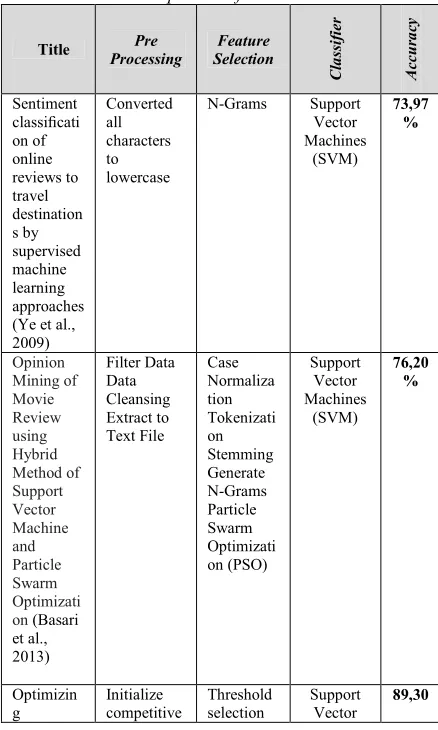
Table 1: Comparison of Related Research
Title Pre
Processing Feature Selection C la ss if ie r A c c u ra cy Sentiment classificati on of online reviews to travel destination s by supervised machine learning approaches (Ye et al., 2009) Converted all characters to lowercase
N-Grams Support
Vector Machines (SVM) 73,97 % Opinion Mining of Movie Review using Hybrid Method of Support Vector Machine and Particle Swarm Optimizati
on (Basari
et al., 2013) Filter Data Data Cleansing Extract to Text File Case Normaliza tion Tokenizati on Stemming Generate N-Grams Particle Swarm Optimizati on (PSO) Support Vector Machines (SVM) 76,20 % Optimizin g Initialize competitive Threshold selection Support Vector 89,30 parameters of support vector machine using fast messy genetic algorithm for dispute classificati on (Chou et al., 2014) template Probabilisti
c all
initializatio n Building blocks filter Genetic Alghorith m Machines (SVM) % The model proposed Tokenizatio n Stopword removal Stemming Particle Swarm Optimizati on (PSO) Support Vector Machines (SVM) ?
By reviewing studies above, it can be seen that the Support Vector Machine (SVM) classifier is best to solve the problem of sentiment analysis. In this study used a Support Vector Machine classifier algorithm (SVM) and methods of optimization techniques used is the Particle Swarm Optimization (PSO) as a feature selection method to improve the accuracy of classifiers.
3.
REVIEW THE RESEARCH OBJECTThe object of research conducted in this research is the analysis of sentiment of smartphone product review and optimization techniques in the context of the selection of features with the following explanation:
A. Smartphone Product Review
The website is a forum for diverse opinions. One form of opinion is a credible product reviews. Web sites such as amazon.com encourage users to provide reviews (review) (Weiss, Indurkhya, & Zhang, 2010). The results of the review text mining can be classified in three categories: positive, negative and neutral. According to Zhang and Liu in (Khan et al., 2014) in-depth analysis of every aspect of products based on consumer opinion is equally important for the community, traders and manufacturers. Besides at amazon.com, or gsmarena.com epinions.com is kind of another site that contains a product review.
One site that provides a complete review of the smartphone is www.gsmarena.com. In which there are less than 36 brand phones with diverse types with a complete review. Due to the many reviews that there is no need at all for research to conduct mining on the review to assess whether the review is positive or negative.
[image:4.612.84.303.373.738.2]ISSN: 1992-8645 www.jatit.org E-ISSN: 1817-3195
193 sites then felt the need to get information from many data via text mining (Zhang et al., 2014).
B. Selection Feature (Feature Selection)
According to Medhat (Medhat et al., 2014) tasks of sentiment analysis has been considered as a classification problem, the first step in a sentiment calcification problem is to extract and select features on the text. Here explanation of some of the current selection of features, including:
1) Terms Presence and Frequance
These features are individual words or N-Gram and the number of frequencies that often appear as giving weight to the words into a binary value (zero if the word message has appeared and one otherwise), or a weighted frequencies are istilh to show interest relative to the feature. 2) Part Of Speech (POS)
The discovery of adjectives as it is someone important indicator of an opinion.
3) Opinion Words and Phrases
Are words commonly used to mengekspersikan including the opinion of the opinion that good or bad and like datau hate. From the other side a few phrases express opinions without using words opinions.
4) Negations
The emergence of negative words that can change the orientation of opinion as well not be on par with the poor.
C. Validation and Evaluation of Data Mining Algorithms
There are many methods used to validate a model based on existing data, such as the holdout, random sub-sampling, cross-validation, stratified sampling, bootstrap and others. According to Han (Han & Kamber, 2007) confusion matrix is a very useful tool to analyze how well the classifier to recognize bias tuple of a different class. In the confusion matrix known terms such as True positives refers to the positive tuple is correctly labeled by the classifier, while True negative is negative tuple is correctly labeled by the classifier. Unisex False positives are negative tuple is incorrectly labeled by the classifier, and False negative is positive tuple is incorrectly labeled by the classifier.
K-fold cross-validation is a validation technique with initial data randomly split into k sections mutually exclusive or "fold" (Han & Kamber, 2007). ROC curves will be used to measure the AUC (Area Under the Curve). ROC curve divides a positive result in the y-axis and a negative result in the x-axis (Witten, Frank, & Hall, 2011). Graph
curve ROC (Receiver operating characteristic) is used to evaluate the accuracy classifier and to compare the different classification models (Vercellis, 2009). So the larger the area under the curve, the better the prediction results.
4.
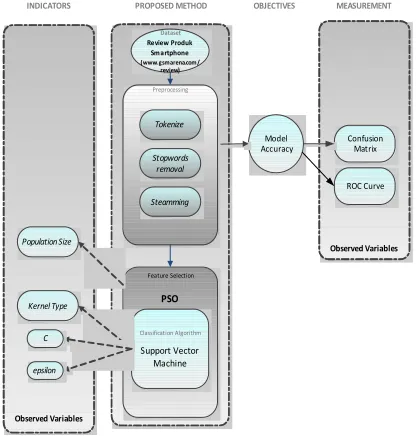
RESEARCH FRAMEWORKThis study starts from the problems in the text classification using a product review classifier Support Vector Machine (SVM), where the classification has a shortage of the appropriate parameter selection problem, due to the incompatibility of a parameter settings may cause the results of the classification to be low. Source of data used in this research that retrieve data on smartphone product review product review website provider obtained from www.gsmarena.com consisting of 100 positive reviews and 100 negative reviews. Preprocessing is done with tokenization, stopwords and stemming Removal. Feature weighting method to be used is the Term Frequency Inverse Document Frequency (TF-IDF) and the selection of feature selection using the Particle Swarm Optimization (PSO). While pengkalsifikasi used is Support Vector Machine. 10 Fold Cross Validation testing will be conducted, the accuracy of algorithm will be measured using the Confusion Matrix and the processed data in the form of the ROC curve. RapidMiner Version 5.3 is used as a tool to measure the accuracy of the data of experiments conducted in the study. Figure 4 illustrates the research framework proposed in this study.
Observed Variables
Observed Variables
PROPOSED METHOD OBJECTIVES
Model Accuracy
MEASUREMENT
Confusion Matrix INDICATORS
Population Size
Dataset Review Produk
Smartphone (www. gsmarena.com/
review)
Feature Selection
PSO
Preprocessing
Tokenize
Stopwords removal
Steamming
Classification Algorithm
Support Vector Machine
ROC Curve
Kernel Type
C
[image:5.612.314.522.483.701.2]epsilon
Figure 4: Illustrates the Framework Proposed in this Study
ISSN: 1992-8645 www.jatit.org E-ISSN: 1817-3195
194 Researchers doing research methods are experimental research methods, with the following stages:
A. Design Research
1) Data Collection: Data for this experiment were collected, and then selected from the data that does not fit.
2) Initial Processing Data: Model selected based on the suitability of the data with the best method of some text classification method that has been used by previous researchers. The model used is the algorithm of Support Vector Machines (SVM).
3) Proposed method: To improve the accuracy of the algorithm of Support Vector Machines (SVM), then the addition of the improved method of optimization that combines Particle Swarm Optimization (PSO).
4) Experiment and Testing Methods: For experimental research data, researchers used Rapid Miner 5.3 to process the data and as an aid in assessing the accuracy of the data of experiments conducted in the study.
5) Evaluation and Validation Results: The evaluation was conducted to determine the accuracy of the model algorithm Support Vector Machines. Validation is used to compare the results of the accuracy of the model used by the results that have been there before. Validation technique used is Cross Validation, accuracy algorithm will be measured using the Confusion Matrix and the processed data in the form of the ROC curve.
B. Data Collection
Researchers used data collected smartphone product review of the site www.gsmarena.com. The data consists of 100 positive reviews and 100 negative reviews. Researchers download the data from http://www.gsmarena.com.
Examples of positive reviews as follows: “The Asus PadFone X is one of the best-rounded high-end propositions available in the Android realm at the moment. It skillfully blends a powerful chipset, a good display, and a capable camera into a solidly built package, thus offering a mighty good alternative to the established players on the US market.The device surely is a welcome sight on the busy smartphone field in the United States by offering a combination of talents which none of its direct competitors can exactly match”.
While examples of the negative review as follows:
“The Samsung Galaxy Mega 6.3 doesn't have a lot of competition - the good thing is it easily stands
out, the bad is that the lack of devices might be due to the lack of potential buyers. Not that Samsung has ever been afraid of exploring uncharted market territories”.
C. Initial Data Processing
For reducing the time of data processing, researchers only use 100 positive reviews and 100 negative reviews as data training. This dataset that in preprocessing should pass 3 steps, they are: 1) Tokenization: collect all the words that appear
and removes any punctuation or symbols that are not letters.
2) Stopwords Removal: deletion of the words that are not relevant, such as the, of, for, with, and so on.
3) Stemming: grouping words into several groups that have the same root, such as drug, drugged, and drugs where the root of it all is said drug. As for the phase transformation by TF-IDF weighting on each word. Where the process calculates the presence or absence of a word in the document. How many times a word appears in a document is also used as a weighting scheme of textual data.
D. Proposed Model
Researchers have proposed method is the use of one (1) type of feature selection method, namely Particle Swarm Optimization that is used as a feature selection method that accuracy classifier Support Vector Machines (SVM) can be increased. Researchers using Support Vector Machines classifiers as a machine learning technique that is popular text classification, and has performed well in many domains.
E. Evaluation and Validation Results
The model proposed in the study on smartphone product review is by applying Support Vector Machines (SVM) and Support Vector Machine (SVM) based Particle Swarm optimization (PSO). Application of SVM algorithm to determine the type of kernel first. Then determine the selection of parameter C and epsilon right. Having obtained the AUC values of accuracy and the greatest, that value will be the value that will be used to find the value of accuracy and the highest AUC. While the application of SVM algorithm based on a determination of the value of the PSO oriented exact population size. Of the value of the most ideal accuracy of these parameters, the ideal structure is formed algorithm for solving the problem.
ISSN: 1992-8645 www.jatit.org E-ISSN: 1817-3195
195 2013):
Accuracy … 1
Note ∶ TP ∶ True Possitive, TN ∶ True Negative, FP ∶ False Possitive, FN ∶ False Negative
[image:7.612.75.528.44.792.2]The test method using Cross Validation with the design model as follows:
Figure 5: Design Model Validation
F. Text Classification Using Support Vector Machine Algorithm
Training data used in this text classification consists of 100 smartphone product reviews positive and 100 negative smartphone product reviews. The data is still a bunch of separate text in the form of documents. Before classified, the data must go through several stages of the process in order to be classified in the next process, the following are the stages of the process:
1) Data Collection: Positive review of data together in a folder with the name of the post. While the data is negative review unified storage in the folder with the name neg. Each extension.txt document that can be opened using Notepad application.
2) Initial Data Processing: The process through which consists of tokenization , stopwords removal and stemming.
Table 2: Initial Data Processing
Review Tokenization Stopwords
Removal Stemming
The Samsung Galaxy Note is the device we all wish we had: a huge high-res screen,
plenty of
processing power, and a great camera. But
as far as
portability
goes, the
Note is closer to a 7" tablet than a phone.
You could
The Samsung Galaxy Note is the device we all wish
we had a
huge high res screen plenty of processing power and a great camera But as far as portability goes the Note is closer to a tablet than a
phone You
could carry it around but it
won t feel
Samsung Galaxy Note device wish huge res screen plenty processing power great camera portability goes Note closer tablet phone carry won t feel comfortable jeans shirt
samsung
galaxi note
devic wish
huge res
screen plenti process power great camera
portabl goe
note closer
tablet phone carri won t
feel comfort
jean shirt
carry it
around, but it
won't feel
comfortable in your jeans
or shirt
pocket.
comfortable in your jeans
or shirt
3). Classification
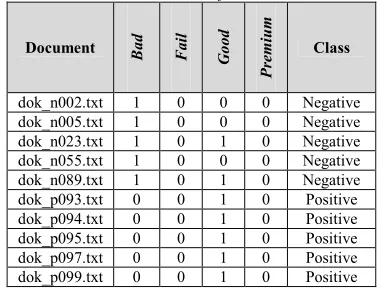
[image:7.612.322.514.363.507.2]Classification process here is to determine a sentence as a member of a class of positive or negative class based on the value of the probability calculation formula larger SVM. If the results of the probability of the sentence for the positive class is greater than the negative class, then the sentence is included in the positive class. If the probability of a positive class is smaller than the negative class, then the sentence is included in the negative class. The researchers only display 10 documents of the overall 200 training data and 4 words related to the sentiment of products, namely bad, fail, good and premium. The presence of the word in a document will be represented by the numbers 1 and 0 if the word does not appear in the document.
Table 3: Table Vector Boolean the Example Documents with Label Class Classification Results
Document Bad
F a il G o o d P re m iu m Class
dok_n002.txt 1 0 0 0 Negative
dok_n005.txt 1 0 0 0 Negative
dok_n023.txt 1 0 1 0 Negative
dok_n055.txt 1 0 0 0 Negative
dok_n089.txt 1 0 1 0 Negative
dok_p093.txt 0 0 1 0 Positive
dok_p094.txt 0 0 1 0 Positive
dok_p095.txt 0 0 1 0 Positive
dok_p097.txt 0 0 1 0 Positive
dok_p099.txt 0 0 1 0 Positive
G. Experimental Results Test Methods 1) Support Vector Machine
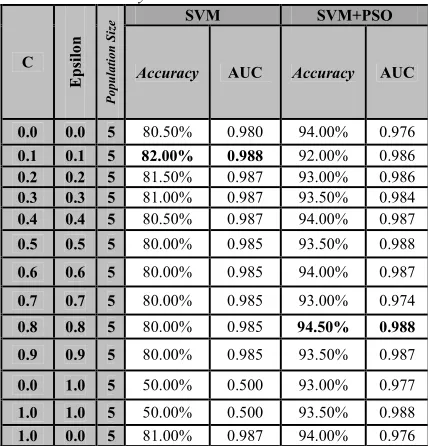
Value of training cycles in this study was determined by testing inserting C, epsilon. Here are the results of the experiments have been conducted to determine the value of training cycles:
Table 4: Experimental Determination of Value Training Cycles SVM
C Epsilon SVM
Accuracy AUC
0.0 0.0 80.50% 0.980
0.1 0.1 82.00% 0.988
0.2 0.2 81.50% 0.987
0.3 0.3 81.00% 0.987
0.4 0.4 80.50% 0.987
0.5 0.5 80.00% 0.985
0.6 0.6 80.00% 0.985
0.7 0.7 80.00% 0.985
0.8 0.8 80.00% 0.985
ISSN: 1992-8645 www.jatit.org E-ISSN: 1817-3195
196
0.0 1.0 50.00% 0.500
1.0 1.0 50.00% 0.500
1.0 0.0 81.00% 0.987
The best results in the experiments above SVM is with C = 0.1 and epsilon = 0.1 resulting accuracy 82.00% and AUC 0.988.
2) Support Vector Machine Based on Particle Swarm Optimization
Value of training cycles in this study was determined by testing inserting C, epsilon and population size. Here are the results of the experiments have been conducted to determine the value of training cycles:
Table 5: Experimental Determination of Value Training Cycles SVM-Based PSO
C
E
p
si
lo
n
P
o
p
u
la
ti
o
n
S
iz
e SVM SVM+PSO
Accuracy AUC Accuracy AUC
0.0 0.0 5 80.50% 0.980 94.00% 0.976
0.1 0.1 5 82.00% 0.988 92.00% 0.986
0.2 0.2 5 81.50% 0.987 93.00% 0.986
0.3 0.3 5 81.00% 0.987 93.50% 0.984
0.4 0.4 5 80.50% 0.987 94.00% 0.987
0.5 0.5 5 80.00% 0.985 93.50% 0.988
0.6 0.6 5 80.00% 0.985 94.00% 0.987
0.7 0.7 5 80.00% 0.985 93.00% 0.974
0.8 0.8 5 80.00% 0.985 94.50% 0.988
0.9 0.9 5 80.00% 0.985 93.50% 0.987
0.0 1.0 5 50.00% 0.500 93.00% 0.977
1.0 1.0 5 50.00% 0.500 93.50% 0.988
1.0 0.0 5 81.00% 0.987 94.00% 0.976
The best results in the experiments above PSO-based SVM is with C = 0.8 and Epsilon = 0.8 and the population size = 5 generated 94.50% accuracy and AUC 0.988.
H. Results of Testing Model Support Vector Machine (SVM)
In the determination of the research results of a review of this smartphone using Support Vector Machine algorithm in the framework Rapid Miner as follows:
Figure 6: Model Validation Testing Support Vector Machine
Value accuracy, precision and recall of training data can be calculated by using RapidMiner. Test results using Support Vector Machine models showed in Table 6.
1) Confusion Matrix
Table 6 training data used consist of 100 positive reviews of data smartphones and 100 negative review of data products smartphone. For data of the positive smartphones reviews, 88 are classified into a positive review in accordance with the predictions made by the method of data predicted SVM and 12 positive reviews but it turns out the prediction results of negative reviews. For data negative reviews smartphones, 76 negative reviews are classified according to the predictions made by the method of data predicted SVM and 24 negative reviews prediction result is positive review.
Table 6: Confusion Matrix Model to Support Vector Machine Method
Accuracy: 82.00%, +/- 8.12% (Micro: 82.00%) True
Positive
True Negative
Class Precission
Predictions Positive 88 24 78.57%
Predictions Negative 12 76 86.36%
Class Recall 88.00% 76.00%
Based on Table 6 shows that, the level of accuracy by using the SVM algorithm is equal to 82.00%, and can be calculated to find the value of Accuracy, Sensitivity, Specificity, PPV and NPV result in the equation below:
[image:8.612.87.301.259.482.2]ISSN: 1992-8645 www.jatit.org E-ISSN: 1817-3195
[image:9.612.86.527.58.337.2]197 Table 7: Value Accuracy, Sensitivity, Specificity, PPV
and NPV for Support Vector Machine Method
Nilai %
Accuracy 82.00%
Sensitivity 78.57%
Specifity 86.36%
PPV 88.00%
NPV 76.00%
2) ROC Curve
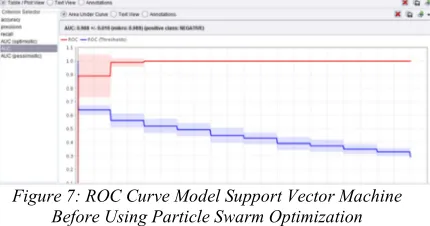
[image:9.612.91.305.66.384.2]The calculation result is visualized by ROC curve. Comparison of two methods of comparison can be seen in Figure 7 which is the ROC curve for Support Vector Machine algorithm. ROC curves in Figure 7. The express confusion matrix of Table 6. The horizontal line is a false positive and true positive vertical lines.
Figure 7: ROC Curve Model Support Vector Machine Before Using Particle Swarm Optimization From Figure 7 is a graph of the ROC with the value AUC (Area Under the Curve) of 0.988 in which diagnosis classification result was very good (excellent classification). To achieve accuracy AUC values close to 1 (perfect) needed a method to improve diagnosis classification results formed. In this case the researchers used the Particle Swarm Optimization (PSO) as the feature selection algorithm to improve the accuracy of classification.
I. Results of Testing Model Support Vector Machine-based PSO
[image:9.612.290.522.71.291.2]In determining the results of the research smartphone product reviews using Support Vector Machine algorithm based on the PSO framework Rapid Miner as follows:
Figure 8: Model Validation Testing Support Vector Machine-Based PSO
Value accuracy, precision and recall of training data can be calculated by using Rapid Miner. Test results using Support Vector Machine-based model of PSO is obtained in Table 8.
1) Confusion Matrix
Table 8 training data used consisted of 100 positive review of data and 100 smartphone data is negative review. For data of positive reviews smartphones, 91 are classified into a positive review in accordance with the predictions made by the method of data predicted SVM and 9 positive reviews but it turns out the prediction results of negative reviews. For data negative reviews smartphones, 98 negative reviews are classified according to the predictions made by the method of data predicted SVM and 2 negative reviews prediction result is positive review.
Table 8: Confusion Matrix Model for Support Vector Machine Method-Based PSO
Accuracy: 94.50%, +/- 5.22% (Micro: 94.50%) True
Positive
True Negative
Class Precission
Predictions Positive 91 2 97.85%
Predictions Negative 9 98 91.59%
Class Recall 91.00% 98.00%
Based on Table 8 shows that, the level of accuracy by using the SVM algorithm is equal to 94.50%, and can be calculated to find the value of Accuracy, Sensitivity, Specificity, PPV and NPV result in the equation below:
a. Accuracy ! "
! " # !"
#$$ 0.945 (1)
b. Sensitivity !
! # !
* 0.9785 (2)
c. Specificity "
" "
!$- 0.9159 (3)
d. PPV !
! !
[image:9.612.91.306.270.383.2]ISSN: 1992-8645 www.jatit.org E-ISSN: 1817-3195
198 e. NPV "
" # "
!$$ 0.98 (5)
[image:10.612.87.294.82.244.2]Conclusion the results of the calculation of the above equation shown in Table 9 below:
Table 9: Value Accuracy, Sensitivity, Specificity, PPV and NPV for Support Vector Machine Method-Based
PSO
Nilai %
Accuracy 94.50%
Sensitivity 97.85%
Specifity 91.59%
PPV 91.00%
NPV 98.00%
2) ROC Curve
The calculation result is visualized by ROC curve. Comparison of two methods of comparison can be seen in Figure 9, which is the ROC curve for Support Vector Machine Algorithm-based PSO. ROC curves in Figure 9 expresses confusion matrix of Table 8. The horizontal line is a false positive and true positive vertical lines.
Figure 9: ROC Curve Support Vector Machine-Based PSO
There is a chart of Figure 9 ROC AUC value (Area Under the Curve) of 0.988 in which the diagnosis result excellent classification.
[image:10.612.91.298.318.427.2] [image:10.612.326.514.324.625.2]J. Evaluation and Validation Analysis Model From the test results above, the measurement accuracy using a confusion matrix and ROC curve proved that the test results of SVM-based PSO algorithm has a higher accuracy rate than the SVM algorithm. Value for the accuracy of the SVM algorithm model of 82.00% and an accuracy value for SVM-based PSO algorithm model of 94.50%, with a 12.5% difference in accuracy can be seen in Table 10 below:
Table 10. Testing Algorithms SVM and SVM-Based PSO
Succesfull Classification
of Possitive Review
Succesfull Classification
of Negative Review
Accuracy AUC
SVM 88 76 82.00% 0.988
SVM – Based
PSO
91 98 94.50% 0.988
For the evaluation using the curve ROC resulting value of AUC (Area Under the Curve) to the model algorithm SVM generate value 0.988 with a value of diagnosis Excellent Classification,
then to the algorithm SVM-based PSO (Particle Swarm Optimization) to the accuracy of the total of 94.50% turned out to produce AUC values similar with SVM algorithm model (fixed) that is equal to 0.988 with the diagnosis Excellent value Classification, and the difference in value both at 0.00.
Thus the SVM-based PSO algorithm can provide solutions to the problems in the classification of a smartphone product review.
6.
DESIGN AND IMPLEMENTATIONResearchers make an application to test existing models using different datasets and its unknown. Applications created using the software Adobe Dreamweaver CS 5 with the PHP programming language. Figure 10 is a flow diagram of the stages of the classification process in the application that the researchers made.
Mulai
Data Teks Review
Data Preprocessing: 1. Tokenization 2. Stopword Removal
3. Stemming
Feature Selection
PSO Population Size
Inisialisai Populasi
Kondisi Akhir Ya
Feature Subset Tidak
1. Hitung accuracy berdasarkan kernel type, parameter c dan epsilon
SVM
P (Positif | Review) >
P (Negatif | Review) Ya
Tidak
Review Positif Review
Negatif
Selesai
[image:10.612.89.302.596.687.2]ISSN: 1992-8645 www.jatit.org E-ISSN: 1817-3195
199 Figure 11: Display Application Process Page Tokenizing
[image:11.612.353.491.246.480.2]Figure 12:. Display Application Process Page Stemming
Figure 13: Display Application Process Page Stopword Removal
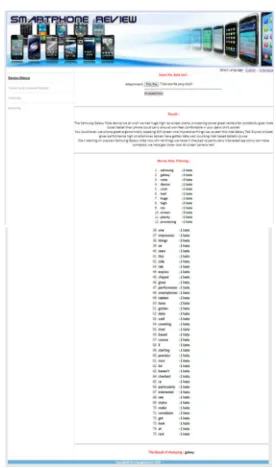
Figure 14: Application Display Results Page Stopword Removal Process
Figure 15: Display Application Process Results Page Stemming
7.
IMPLICATIONS OF RESEARCHThe implications of this study covers several aspects, including:
1) Implications of Systems Aspects
The evaluation results demonstrate the applicability of Particle Swarm Optimization for feature selection can improve the accuracy of Support Vector Machine and is a pretty good method of classifying text smartphone product reviews. Thus the application of this method can help the smartphone candidates users in making the decision to buy smartphone, in addition to reduces the time in reading review and commentary products.
2) Implications for Managerial Aspects
[image:11.612.96.296.310.647.2]ISSN: 1992-8645 www.jatit.org E-ISSN: 1817-3195
200 reviews or reviews as well as from other social media such as Twitter, blogs and others in order to use the application Rapid Miner in building a system.
3) Implications for Further Research Aspects Subsequent research could use the methods of feature selection or database from different domains, such as cosmetics reviews, book reviews, movie reviews, restaurant reviews, reviews of stocks and so forth.
8.
CONCLUSIONSIn this study tested the model using Support Vector Machine and Support Vector Machine-based Particle Swarm Optimization using data smartphone product reviews are positive or negative with 200. Data review and 4 words related to the sentiment of products, namely bad, fail, good and premium. The resulting models were tested to obtain the value of accuracy, precision, recall and AUC of each algorithm to obtain the test by using Support Vector Machine values obtained accuracy is 82.00%. While testing using Support Vector Machine-based Particle Swarm Optimization (PSO) obtained 94.50% accuracy rate. It can be concluded testing smartphone product review data using Support Vector Machine-based Particle Swarm Optimization (PSO) is better than the Support Vector Machine itself. Thus the results of testing the model above it can be concluded that the Support Vector Machine-based Particle Swarm Optimization provide solutions to problems of classification more accurate smartphone product reviews.
REFERENCES:
[1] Basari, A. S. H., Hussin, B., Ananta, I. G. P., & Zeniarja, J. (2013). Opinion Mining of Movie Review using Hybrid Method of Support Vector Machine and Particle Swarm Optimization. Procedia Engineering, 53, 453– 462. doi:10.1016/j.proeng.2013.02.059 [2] Chou, J.-S., Cheng, M.-Y., Wu, Y.-W., &
Pham, A.-D. (2014). Optimizing parameters of support vector machine using fast messy genetic algorithm for dispute classification. Expert Systems with Applications, 41(8), 3955–3964. doi:10.1016/j.eswa.2013.12.035 [3] Dehkharghani, R., Mercan, H., Javeed, A., &
Saygin, Y. (2014). Sentimental causal rule discovery from Twitter. Expert Systems with Applications, 41(10), 4950–4958. doi:10.1016/j.eswa.2014.02.024
[4] Habernal, I., Ptáček, T., & Steinberger, J. (2014). Supervised sentiment analysis in Czech social media. Information Processing & Management, 50(5), 693–707. doi:10.1016/j.ipm.2014.05.001
[5] Haddi, E., Liu, X., & Shi, Y. (2013). The Role of Text Pre-processing in Sentiment Analysis. Procedia Computer Science, 17, 26–32. doi:10.1016/j.procs.2013.05.005
[6] Han, J., & Kamber, M. (2007). Data Mining Concepts and Techniques. San Francisco: Diane Cerra.
[7] Haupt, R. L., & Haupt, S. E. (2004). Practical Genetic Algorithms. Untied States Of America: A John Wiley & Sons Inc Publication.
[8] Huang, K., Yang, H., King, I., & Lyu, M. (2008). Machine Learning Modeling Data Locally And Globally. Berlin Heidelberg: Zhejiang University Press, Hangzhou And Springer-Verlag Gmbh.
[9] Khan, F. H., Bashir, S., & Qamar, U. (2014). TOM: Twitter opinion mining framework using hybrid classification scheme. Decision
Support Systems, 57, 245–257.
doi:10.1016/j.dss.2013.09.004
[10] Khan, K., Baharudin, B., & Khan, A. (2014). Mining Opinion Components from Unstructured Reviews: A Review. Journal of King Saud University - Computer and
Information Sciences.
doi:10.1016/j.jksuci.2014.03.009
[11] Litchfield, Steve. (2010). Defining the Smartphone. (n.d.)
[12] Liu, Y., Wang, G., Chen, H., Dong, H., Zhu, X., & Wang, S. (2011). An Improved Particle Swarm Optimization for Feature Selection. Journal of Bionic Engineering, 8(2), 191–200. doi:10.1016/S1672-6529(11)60020-6
[13] Maimon, O. (2010). Data Mining And Knowledge Discovery Handbook. New York Dordrecht Heidelberg London: Springer [14] Medhat, W., Hassan, A., & Korashy, H.
(2014). Sentiment analysis algorithms and applications: A survey. Ain Shams
Engineering Journal.
doi:10.1016/j.asej.2014.04.011
[15] Moraes, R., Valiati, J. F., & Gavião Neto, W. P. (2013). Document-level sentiment classification: An empirical comparison between SVM and ANN. Expert Systems with
Applications, 40(2), 621–633.
ISSN: 1992-8645 www.jatit.org E-ISSN: 1817-3195
201 [16] Nugroho, Anto Satriyo. (2008). Support
Vector Machine: Paradigma Baru Dalam Softcomputing. Bali : Konferensi Nasional Sistem & Informatika
[17] Vercellis, C. (2009). Business Intelligence Data Mining And Optimization For Decision Making .United Kingdom: A John Wiley And Sons, Ltd.,Publication.
[18] Wahyudi, M., & Putri, D. W. I. A. (2016). Algorithm Application Support Vector Machine With Genetic Algorithm Optimization Technique For Selection Features For The Analysis Of Sentiment On
Twitter, 84(3),
http://www.jatit.org/volumes/Vol84No3/3Vol 84No3.pdf
[19] Weiss, S. M., Indurkhya, Nitin & Zhang, Tong. (2010). Fundamentals of Predictive Text Mining. London: Springer-Verlag [20] Witten, H. I., Frank, E., & Hall, M. A. (2011).
Data Mining Practical Machine Learning Tools And Technique. Burlington: Elsevier Inc [21] Ye, Q., Zhang, Z., & Law, R. (2009). Sentiment classification of online reviews to travel destinations by supervised machine learning approaches. Expert Systems with Applications, 36(3), 6527–6535. doi:10.1016/j.eswa.2008.07.035
[22] Zhang, L., Hua, K., Wang, H., Qian, G., & Zhang, L. (2014). Sentiment Analysis on Reviews of Mobile Users. Procedia Computer
Science, 34, 458–465.
doi:10.1016/j.procs.2014.07.013
[23] Zhang, Z., Ye, Q., Zhang, Z., & Li, Y. (2011). Sentiment classification of Internet restaurant reviews written in Cantonese. Expert Systems with Applications, 38(6), 7674–7682. doi:10.1016/j.eswa.2010.12.147