ISSN: 1992-8645 www.jatit.org E-ISSN: 1817-3195
338
PROTOTYPE EXPERT SYSTEM USING BAYESIAN
NETWORK FOR DIAGNOSE SOCIAL ILLNESS
1
RAHMAD KURNIAWAN, 2AFRIZAL M. NUR, 3RADO YENDRA, 4AHMAD FUDHOLI
1
Department of Informatics Engineering, Faculty of Science and Technology, Universitas Islam Negeri
Sultan Syarif Kasim (UIN Suska) 28293, Pekanbaru, Riau, INDONESIA
2
Department of Quran and Hadith, Universitas Islam Negeri Sultan Syarif Kasim (UIN Suska) 28293,
Pekanbaru, Riau, INDONESIA
3
Department of Mathematics, Faculty of Science and Technology, Universitas Islam Negeri Sultan Syarif
Kasim (UIN Suska) 28293, Pekanbaru, Riau, INDONESIA
4
Solar Energy Research Institute, Universiti Kebangsaan Malaysia,
43600 Bangi Selangor, MALAYSIA
E-mail: 1 [email protected], 2 [email protected], 3
[email protected], 4 [email protected]
ABSTRACT
The social illness has become main problem in Indonesia such as drug addiction, prostitution, game addiction, and so on. Based on Indonesian government, through its anti-drug agency, the National Narcotics Board (BNN) in 2015 the number of drug users are 5 million people. Drugs have caused for as many as 15,000 deaths each year in Indonesia. Peoples did not get information about social ills such as the types of drugs that have the same characteristics. As a largest Muslim country in the world may be reduce the social ills with the Islam approach. Recently, the integration of Islamic science and technology has become popular. At times the people get obstacles to get information and advice directly from expert and scholars in Islamic science. This paper is to develop a prototype expert system by providing prevention and best treatment based on Quran and Hadith. We use some of the data for knowledge base obtained from Selat Panjang, Riau. Based on the preliminary results, it has similar diagnoses with expert. A prototype expert system using Bayesian Network has been successful and capability for early diagnosing and educating the peoples in social ills cases based on Quran, Hadith and advice of experts but still has plenty room for improvement.
Keywords: Bayesian Network; Expert System; Social Illness
1. INTRODUCTION
A social illness is a term synonymous with the phrase social conflict, social problem or social issue. A social illness has become main problems exists areas out of capital city when a condition is undesirable to some members of a community. Like a diseases infection, the social illness also spread quickly. In a society where the permissiveness and promiscuity are encouraged to proliferate. The pressure on individuals is very high indeed. The youth generally lack maturity and are vulnerable to the social ills if they are overwhelming. Some of social ills include drug addiction, free sex, bullying, crime, online games addiction racism, delinquency,
discrimination, family disintegration, poverty, homelessness and so on.
ISSN: 1992-8645 www.jatit.org E-ISSN: 1817-3195
339 west of Singapore across the Strait of Malacca. Poverty stops people in Selat Panjang to get advice from the scholars regularly. Thus, many people did not get the necessary advice from an expert and therefore they do not take the big problems in social ills seriously. Online self-diagnosing is one of the solutions as the Internet is relatively cheap to get more information and cybercafé is one of the prevalent ways for poor people to search about their difficulty. Based on data obtained from the police and hospital in Selat Panjang, it has been found alcohol, methamphetamine, marijuana, game addictions and prostitution cases. Knowledge base acquired from the scholars in Islamic science. However, self-diagnosis is prone to misdiagnosis that may endanger the users health and social if users make a wrong decision.
Actually, there are several online articles, magazines and health books containing about how to recognize the drug abuses based on physical symptoms. There are many symptoms, both physical and behavioral, that indicate drug use. Each drug has its own unique indications, but there are some general signs that a person is using drugs. Building an expert system for the social ills are challenging because it is required to create a knowledge base that is appropriate with desires of scholars in Islam, doctors, psychiatrists and psychologists. Distinction with another cases, the expert system for diagnosing social issues based on different content of knowledge base data that consist of symptoms and treatment instruction based on medical science and Islamic science. It has many expert system integrated with Islamic Science as we have explained in the related works. Nevertheless, an expert system for social ills that integrate with Islamic Science and medical science is still not exist. Thus, the main goal of this project is not just to develop a prototype expert system but for educating the peoples in social ills cases based on Quran, Hadith and advice of experts so that people will get advice and treatment appropriately and as early as possible. In this project, we have developed a prototype expert system for social issue. A prototype expert system had used Bayesian Network. It has proved its capability for educating the peoples in social ills cases based on Quran, Hadith and advices of experts. Based on the preliminary experimental results, it can be concluded that the implementation of Bayesian Network shows a promising result. On the other hand, we have been providing a medium for educating the peoples regarding the risks of social issues, the information to avoid and treat of social ills based on the Quran, the Hadith, psychology and
medical science. Based on the preliminary experimental results, it can be concluded that the implementation of Bayesian Network shows a promising result.
Nowadays, there are many expert systems being used in Islam science such as Classification of Ahadith, Using Social Network on Publishing and Serving Islam, expert system for Inheritance or Fara’id [1]. The scholars give treatment based on the al-Quran and hadith. A method in Quran to treat the social ills namely Al-adabiyijtima’iy method used for knowledge base. In this study, we used the Bayesian Network method for inference engine.
One of the advantages in using Bayesian Network in this project is that Bayesian Network considered more popular as network-based Bayesian inference is consistent when handled with uncertainty. Bayesian networks can facilitate learning about the causal relationship between the variables [2] Bayesian Network Easy to be converted into tools for decision support to assist the management of natural resources [3].
In addition, graphic in Bayesian Networks to clearly show the relationship between different components of the system. Therefore, Bayesian Network comfortable for researchers from different backgrounds to understand the concept of Bayesian Network [4]. The use of Bayesian inference can readily updated for new knowledge and Bayesian networks can produce a good prediction accuracy [2, 5]. Bayesian Network used to determine which type of social illness has the probability to be effecting a user. Bayesian Network calculate the chances based on existing symptoms and the system will later on be able to appropriate preventive, medical solutions advice and treatment based on Quran and Hadits to the type of illness accordingly.
2. RELATED WORK
ISSN: 1992-8645 www.jatit.org E-ISSN: 1817-3195
340 network and be an active member there because they have a big effect on the member as the respondent mention by 80% [7]. Furthermore, Houssen Himeda had discussed web based expert system for Islamic inheritance law for all Muslims, and identify the rules of wealth distribution as stated in the Quran through a knowledge acquisition process with an expert in Faraid [1].
There are several studies in the field of artificial intelligence, especially expert system that has been done. Meigarani [8] using Bayesian Network to diagnose the disease. Bayesian Network used to diagnose leukemia by getting to the positive and negative decisions. Bayesian Network was used for data analysis and knowledge of experts, especially on uncertainty. This method is used as a solution to a problem that is not certain. This method can be used to create a model system for transformation between expert knowledge to computer in difficult medical cases [9-11]. Bayesian networks can be prepared with decision support tools in uncertainty case [12, 13].
Bayesian Network became very popular in the last decade because it is used for a variety of intelligent system applications such as machine learning, text processing, natural language processing, speech recognition, signal processing, bio-informatics, medical diagnosis, forecasting, mobile networks, and other intelligent system applications. A Bayesian Network consists of a directed acyclic graph of ‘nodes’ and ‘links’ that conceptualise a system. Bayesian Network is Probabilistic Graphical Models (PGM) which consists of probabilistic and graph. Probabilistic theory related to the data. The relationships between nodes are described by conditional probability distributions that capture the dependences between variables. Bayes Formula [14]:
P A|B | (1)
Where:
A = a particular state, conditional on the evidence provided.
P(A∣B) = posterior
P(A) = prior probability of the hypothesis P(B∣A) = likelihood
Joint distribution formula:
P A |B P A P B|A (2)
3. RESEARCH METHODOLOGY
We have stated in the paper about the limitation of this research. A self-diagnosis is prone to misdiagnosis that may endanger the user, health and social if user make a wrong decision. Thus, the main goal of this project is not just to develop a prototype expert system but for educating and giving the awareness to the society about social ills cases based on Quran, Hadith and advice of experts so that people will get advice and treatment appropriately and as early as possible. Currently, we just concentrate in drug abuse diagnosis features. Meanwhile for the games addiction, the prostitution, the sexual deviation cases and so on will be done in further research, because of the complexity of rules and need more the data. This study is not the final result of expert system in social ills, for encouraging results we need the additional experimentation and much data for knowledge base (symptoms, kinds of social ills, treatment). It also requires full development of expert systems in the future with a more comprehensive in Islam science and Medical Science. There has plenty work needs to be done before a full-size expert system is constructed with standard expert systems components, improvement of knowledge base by more associating the statistical science, medical science or drug rehabilitation centers with the Islamic laws and scholars in order to avoid a misdiagnosis.
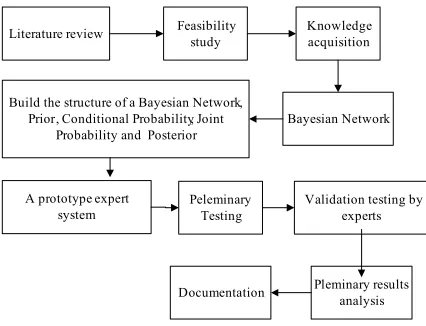
The following are the research methodology of this study. The construct stages of this study are based on the popular evolutionary prototyping. The stages are as follows:
3.1 Literature Review
ISSN: 1992-8645 www.jatit.org E-ISSN: 1817-3195
341 books, journals, and other scientific resources such as web pages and articles related.
3.2 Feasibility Study
This is where the problems are defined, the objectives are stated, the resources, the methods, the experts, the costs and the time frame are clearly identified. This step is the requirement analysis usually carried out in the system development life cycle.
3.3 Knowledge Acquisition
Knowledge acquisition is the step in this study for extracting, organizing and structuring knowledge from the human experts to computer. This is often the major obstacle in building an expert system. Knowledge elicitation is also conducted and test cases were prepared in this time. The type of knowledge gathered in this stage is factual knowledge.
3.4 Prototype Development
In this step, we selected the appropriate method to address the problem. Bayesian Network used in this study is for calculating the possibility of people affected by the social ills. Knowledge base obtained from experts such as doctor in hospital and scholars in Islamic science. The treatment and solutions are presented based on Quran and hadith using Al-adabiyijtima’iy method. Analysis carried out in order to the system worked accordance with expected. First, we build a small system containing few of the features and it will evolves into better system in few cycles.
3.5 Testing
The system testing and validation is based on the black box method and User Acceptance Test (UAT). UAT is conducted by using several cases of social ills. The pleminary results of a prototype expert system will be assessed by an expert. Based on the analysis and advise, the development step will go back to step Knowledge Acquisition to correct and expand the factual knowledge on the basis of the domain expert’s comments. The purpose of this cyclic development is to improve the quality of knowledge base and how the inference mechanism.
3.6 Pleminary Experiment
The special purpose of the pleminary experiment is therefore to study the effectiveness of a cooperation Bayesian Network for a prototype expert system for social ills. The system has been assessed considering the accuracy as the indicator.
For this experiment, 10-case sample extraction was made. Each case was then presented to the system to obtain the corresponding diagnosis. This diagnosis was later compared to the one provided by the expert to determine whether the system’s diagnosis is correct or not.
4. ANALYSIS
Here are some of the process of the analysis which has been carried out:
4.1 Analysis of Interface
Inference used for the construct of this expert system, which is Bayesian Network in the diagnosis process of social ills.
Literature review Feasibility
study
Knowledge acquisition
Bayesian Network Build the structure of a Bayesian Network,
Prior, Conditional Probability, Joint Probability and Posterior
A prototype expert system
Peleminary Testing
Validation testing by experts
Pleminary results analysis Documentation
Figure 1: The Steps to Build Expert System
Bayesian Network provided the diagnostic results use the rule based as the learning. The process was performed using the Bayesian Network method and calculating the probability of each symptom from users. Subsequently, the final diagnosis based on the probabilistic final process. The overview of implementation of Bayesian Network in a prototype expert system process is shown in Figure. 1.
4.2 Implementation of Bayesian Network
[image:4.612.313.526.299.462.2]ISSN: 1992-8645 www.jatit.org E-ISSN: 1817-3195
342 Build the
structure of a Bayesian Network Parameters/ Prior Probability Conditional Probability Joint Probability Distribution Posterior Probability Probabilistic Inference
Figure 2: Analysis of Bayesian Network as Inference Engine
4.2.1 Build the structure of a bayesian network
The structure of Bayesian network formed using graph theory that connects the symptoms or characteristics with the kind of social ills. Bayesian network structure as shown in Figure 3.
Khamar/ Drugs
red eyes loss of interest increase of appetite uncontrolla ble laughter extreme lethargy over excited sickly sweet smell on body, hair and clothes weight gain or
loss of appetitetotal loss
extreme weight loss dilated pupils anxiety sleepiness violence Alcohol Social Issues Marijuana Zina/ Prostitution Crystal Meth
bloody or black/ vomiting clumsiness headache chronic diarrhea difficulty walking excessive dressing
(tabarruj) sexually harassing others/rape/ molestation
Seclusion , nasty (khalwat /ikhtilat) with strangers (not a mahram)
Game Addictions lying to friends or family spend more time gaming anticipation of the next online session blood pressure will increase “meth mouth” hallucinations gastritis
redness of the nose and
cheeks
dating excessively for the ability to have multiple
sexual partners
compulsive masturbation or stimulation
extra-marital affairs or multiple affairs in a non-married relationship
Figure 3: The Structure of Bayesian Network with Certain Symptoms and Kind of Social Ills Based on
Expert Knowledge
4.2.2 Prior probability
Prior probabilities are the original probabilities of an outcome, which be will updated with new information to create conditional, joint and posterior probabilities that is shown in Table 1.
Table 1: Example of Prior Probability.
No. Symptoms Values
1. Total loss of appetite 0.5
2. Meth mouth 0.3
3. Dilated pupils 0.25
4.2.3 Conditional probability
[image:5.612.359.467.220.281.2]The conditional probability of an event B is the probability that the event will occur given the knowledge that an event A has already occurred. This probability is written in formula (1) where event A has no effect on the probability of event B, the conditional probability of event B given event A is simply the probability of event B, that is P(B).
Table 2: Example of Conditional Probability Table (CPT).
4.2.4 Joint probability distribution
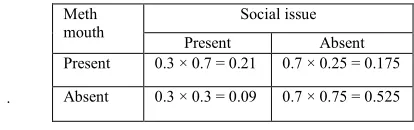
We have used the formula (2) Joint distribution formula to obtain the Joint Distribution Table (JPT). Based on the formula (2), the calculation of joint probability distribution is multiplying the prior probability Alt conditional probability. Suppose the joint probability distribution will be calculated in meth mouth. The meth mouth present probability is 0.7, while absent
[image:5.612.321.528.443.508.2]0.3. The Joint Distribution Table (JPT) is shown in Table 3.
Table 3: Joint Distribution Table (JPT)
.
4.2.5 Posterior probability
In statistical terms, the posterior probability is the probability of event A occurring given that event B has occurred. Based on The Joint Distribution Table (JPT) in meth mouth, The posterior probability is:
0.21
0.21 0.175 0,54
Table 4: Example of Posterior Probability.
No. Symptoms Values
1. Total loss of appetite 0.54
2. Meth mouth 0.4
3. Dilated pupils 0.67
Meth mouth
Social issue
Present Absent Present 0.7 0.25
Absent 0.3 0.75
Meth mouth
Social issue
Present Absent Present 0.3 × 0.7 = 0.21 0.7 × 0.25 = 0.175
ISSN: 1992-8645 www.jatit.org E-ISSN: 1817-3195
343
4.2.6 Probabilistic inference
The Probabilistic inference is done by tracing the relationship of each symptom and kind of Social ills based on Bayesian Network Structure. Sometimes, BN combined with Rule-Based Reasoning (IF-THEN) for assist the probabilistic inference [8]. Example:
P (Crystal Meth |Symptoms of Crystal Meth)
0.54 0.4 0.67
3 0,53
Thus, its can be concluded that a people uses crystal meth that is with belief percentage is 0.53 × 100 % = 53 %.
5. IMPLEMENTATION
The construction phase does two things: constructs and assessments a functional system that fulfills organizational design requirements, and implements the interface between the new expert system and the existing system. We have constructed the knowledge database, inference engine, application programs, user and system interfaces, and networks. We developed the system based on the results of the previous model that has been designed, so that it can be used in the real situation.
6. EXPERT SYSTEM TESTING
System testing and evaluation is the final phase in this study. System testing and evaluation is ran to evaluate the effectiveness of the system. The develop system has to produce the desired outcome in accordance with its objectives with high accuracy without any systemic error. Testing are conducted using the black box method.
User acceptance test was conducted to validate the system output directly to the experts and end-users. 10 cases have been selected and assessed and tested by experts. The following table compares diagnostic results by expert systems and the human expert.
Table 5: Expert System results.
Cases Diagnosis by Expert System and Probability
Diagnosis by Human Expert
1 Marijuana (63%) Marijuana 2 Marijuana (46%) Marijuana
3 Crystal Meth (55.5%) Crystal Meth 4 Game Addictions (52.5%) Game Addictions 5 Crystal Meth (30%) Crystal Meth 6 Alcohol (41%) Alcohol 7 Crystal Meth (42%) Crystal Meth 8 Crystal Meth (45%) Crystal Meth 9 Marijuana (77.5%) Marijuana 10 Marijuana (48.25%) Marijuana
Regarding the preliminary results that have used some of the knowledge base, it has similar diagnoses with human expert. The diagnosis is more accurate if the user selects many of the symptoms. Thus the prototype expert system results according to the expected.
7. CONCLUSION AND FUTURE WORK
We have developed a prototype expert system for social issue. A prototype expert system had used Bayesian Network. It has proved its capability for educating the peoples in social ills cases based on Quran, Hadits and advice of experts. Based on the preliminary experimental results, it can be concluded that the implementation of Bayesian Network shows a promising result.
However, this study is not the final result of expert system in social ills, for encouraging results, additional experimentation and much data for knowledge base (symptoms, kinds of social ills, treatment) are needed. It also requires full development of expert systems with a more comprehensive in Islam science and holistic. There has plenty work needs to be done before a full-size expert system is constructed with standard expert systems components, improvement of knowledge base by more associating the statistical science, medical science or drug rehabilitation centers with the Islamic laws and scholars in order to avoid a misdiagnosis.
ACKNOWLEDGMENT
ISSN: 1992-8645 www.jatit.org E-ISSN: 1817-3195
344
REFRENCES:
[1] H.H.M. Nafed, “Web Based Expert System For i-Faraid,” University Utara Malaysia, 2009.
[2] L. Uusitalo, “Advantages and challenges of Bayesian Networks in Environmental Modelling”, Journal of Ecological
Modelling, Vol. 203, 2007, pp. 312-318.
[3] B.G. Marcot, R.S. Holthausen, M.G. Raphael, M.M. Rowland and M.J. Wisdom, “Using Bayesian Belief Networks To Evaluate Fish And Wildlife Population Viability Under Land Management Alternatives From An Environmental Impact Statement”, Journal of
Forest Ecology and Management, 2001, pp.
153: 29-42.
[4] F.J. Martín De Santa Olalla, A. Domínguez, A. Artigao, C. Fabeiro and J. F. Ortega, “Integrated Water Resources Management of The Hydrogeological Unit “Eastern Mancha” Using Bayesian Belief Networks”, Journal of
Agricultural Water Management, Vol. 77,
2005, pp. 21-36.
[5] J.L. Ticehurst, R.A. Letcher and D. Rissik, “Integration Modelling and Decision Support: A Case Study of the Coastal Lake Assessment And Management (Clam) Tool”, Journal of
Mathematics and Computers in Simulation,
Vol. 78, 2008, pp. 435-449.
[6] K. Bilal, and S. Mohsin, “Muhadith: A Cloud Based Distributed Expert System for Classification of Ahadith”, Frontiers of
Information Technology (FIT), 10th
International Conference on 2012, IEEE, 2012,
pp. 73-78.
[7] I. A. Nassar, J. A. Hayajneh, and M. K. Almsafir, “The Influence of Using Social Network on Publishing and Serving Islam: A Case Study of Jordanian Students”, Advanced
Computer Science Applications and
Technologies (ACSAT), IEEE, 2012 pp.
502-505.
[8] I. Meigarani,“Penggunaan Metode Bayesian network Dalam Sistem Pakar Untuk Diagnosa Penyakit Leukimia”, Jurnal Universitas
Pendidikan Indonesia. 2010.
[9] J. C. E, Kahn, L. M. Roberts, K. A. Shaffer, and P. Haddawy, “Construction of a Bayesian Network for Mammographic Diagnosis of Breast Cancer”, Computers Biol. Med. Vol. 27, 1997, pp. 19–29.
[10] C. Papaconstantinou, G. Theocharous, and S. Mahadevan, “An Expert System for Assigning Patients into Clinical Trials Based on Bayesian Networks,” Journal of medical systems, Vol. 22, 1998, pp. 189-202.
[11] P. J. Lucas, N. C. de Bruijn, K, Schurink, and A. Hoepelman, “A Probabilistic and Decision-Theoretic Approach to the Management of Infectious Disease at the ICU”, Artificial
Intelligence in Medicine, Vol. 19, 2000, pp.
251-279.
[12] S. Kuikka, M. Hildén, H. Gislason, S. Hansson, H. Sparholt, and O. Varis, “Modeling Environmentally Driven Uncertainties in Baltic Cod (Gadus morhua) Management by Bayesian Influence Diagrams”, Canadian Journal of
Fisheries and Aquatic Sciences, Vol. 56, 1999,
pp. 629-641.
[13] T. D. Nielsen, and F. V. JENSEN: “Bayesian Networks and Decision Graphs. Springer,” 2009.