ORIGINAL RESEARCH ARTICLE
THE BEHAVIOR OF NURSES BEFORE THE INTENSIVE CARE UNITS WHEN KEEPING VITAL
FUNCTIONS OF ORGANS AND TISSUES OF POTENTIAL DONORS IN TWO PUBLIC HOSPITALS
1
Fernanda de Barros Patrício,
2Roseane Lins Vasconcelos Gomes,
3 *Liniker Scolfild Rodrigues
da Silva,
4Cristina Albuquerque Douberin,
5Alison Nery dos Santos,
6Maria de Lourdes Pereira,
7
Maria José das Neves Barbosa,
7Flávia Nataly Pereira da Silva Rocha
and
8Iris Nayara da Conceição Souza
1Nurse Resident of Women's Health at the Federal University of Pernambuco (UFPE), Recife (PE), Brazil
2Nurse with PhD in Child and Adolescent Health at the Federal University of Pernambuco (UFPE), Recife (PE), Brazil 3Nurse, Specialist in Obstetrics and Gynecology in the Residency Modality at the University of Pernambuco (UPE), Recife
(PE), Brazil
4 Nurse, Master’s in Nursing at the University of Pernambuco, State University of Paraíba (UPE, UEPB),
Recife (PE), Campina Grande (PB), Brazil 5Nurse (egress), São Miguel College, Recife (PE), Brazil
6Specialist Nurse in Family Health Nursing at the CEFAPP Group (Center for Training and Professional Development), Recife (PE), Brazil
7Nurse Resident of Women's Health at the Federal University of Pernambuco (UFPE), Recife (PE), Brazil
8Nurse, Doctoral Student of Nursing at the Federal University of Pernambuco (UFPE), Recife (PE), Brazil
ARTICLE INFO ABSTRACT
Objective: To examine the actions taken by nurses of Intensive Care Units (ICUs) in keeping the vital functions of potential donors of organs and tissues.
Method: This is a descriptive and exploratory study with a quantitative approach performed with 36 nurses who work in Intensive Care Units (ICU) at the Hospital of Restoration (HR) and Hospital Getulio Vargas (HGV), two public hospitals in the city of Recife (PE), Brazil. Data were collected through a semi structured instrument made by the researchers. The data collected were inserted into a spreadsheet of the Excel program that aimed at its subsequent analysis. From then on, they were arranged in graphs and analyzed in the light of scientific literature.
Results: It was observed the difficulty of nurses to provide quality care because they did not know the changes presented by the potential donor.
Conclusion: It becomes relevant the nurse’s role in understanding the pathophysiology and care of vital and hemodynamic functions, as well as in the complications triggered in this potential donor by the encephalic death. In this way, the nurse will have to draw effective interventions to minimize the damage to the organs to be captured.
Copyright © 2018, Fernanda de Barros Patrício et al. This is an open access article distributed under the Creative Commons Attribution License, which permits unrestricted use, distribution, and reproduction in any medium, provided the original work is properly cited.
INTRODUCTION
The development of scientific research in the health area has supported several innovations in treating diseases and, therefore, prolonging the survival of countless people.
*Corresponding author: Liniker Scolfild Rodrigues da Silva
3Nurse, Specialist in Obstetrics and Gynecology in the Residency Modality at
the University of Pernambuco (UPE), Recife (PE), Brazil
With the advancement of technology in the field of transplants, there was an improvement in the quality of potential donor assistance, aimed at optimizing the capture process and donation of organs and tissues, with the aim of carrying on and upgrading the survival for other receivers (Pestana et al. 2013; Pestana; Erdmann; Souza, 2012). It is characterized as a potential donor (PD) that patient who was diagnosed with brain death, which is defined as total and irreversible
ISSN: 2230-9926
International Journal of Development Research
Vol. 08, Issue, 03, pp.19237-19243, March,2018
Article History:
Received 20th December, 2017 Received in revised form 16th January, 2018
Accepted 23rd February, 2018
Published online 30th March, 2018
ORIGINAL RESEARCH ARTICLE
OPEN ACCESS
Key Words:
Nursing; Encephalic Death; Transplant; Intensive Care Unit.
disruption of brain functions (Freire et al. 2012. The process of collecting and transplanting organs and tissues is seen as a complex procedure, where commonly is executed by a team composed of professionals from various areas who work in Intensive Care Centers (STCS) (Pestana; Erdmann; Souza, 2012). The organs and tissues collected are reserved to individuals who need and are waiting in the queue of the SUS, which should be compatible with the organ and/or tissue extracted (Meneses et al. 2010). This process of organ donation for transplantation begins in the identification of the PD, at the opening of protocol for keeping organs and in clarifying to relatives in the interview about the importance of consent for organ extraction. Going on Consent Notification Center Professional and Catchment Bodies (CNCDs) shall inform the team responsible for the capture of organs and tissues, stating the physiological conditions of the PD and the schedule to begin the capture process-transplant (Moraes et al. 2014).
Nursing in this process gains prestige by the focus on donor-driven body care and his family (Souza et al. 2013). The care carried out by nursing staff in maintaining the PD get control of metabolic and hemodynamic parameters, such as hypothermia, control of changes of blood pressure, electrolyte changes, pH and oxygen in the blood, debt cardiac and renal eliminations, where the nurse has an obligation to recognize early the amendments tabled by the patient in brain death that affects the various organ systems (Freire et al. 2012). The stabilization of the parameters will happen according to the amendment tabled by the patient, where in general the stabilization is done by volume replacement, oxygen therapy, infusion of vasoactive medications, restoration of normal levels and basal temperature antibiotic therapy for prevention and/or treatment of disorders that may harm the process of collection and transplantation of organs and tissues. These factors interfere with the quality and viability of the implant to the receiver (Freire et al. 2012). The nurse who deals with this patient will have to have insight to the relatives at the moment to inform them about the diagnosis of brain death (ME) and start the process of consent to donation; because request organ donation is a painful moment, where at the same time the minds of relatives will have to deal with two separate issues: life and death. Studies show that the badly conducted approach by the nursing professional and the lack of clarification to relatives about what it means to really entail in a response against the consent for donation (Cinque; Bianchi, 2010).
Therefore, it is essential to provide quality assistance to this patient as if the same had chances to live. The individual in this condition should never be watched as if it was just a corpse, as if you didn't need care. All professionals involved in patient care must have the view that there is a patient, not just a body and, therefore, must offer a qualified assistance during maintenance to the PD and capture of their organs and tissues for transplant (Pestana; Erdmann; Souza, 2012). The present study is of paramount importance to nursing, because through the actions performed for keeping the potential organ and tissue donor can achieve viability and quality of the organs to be transplanted and benefit recipients. The source of motivation for the research was acquired by academic experience as a volunteer intern at the Hospital Infection Control Committee (CCIH) of a large hospital in the city of Recife, where one of his assignments was the active search for diseases of compulsory notification in the medical records of
patients admitted to the Intensive Care Unit (ICU) of their hospital. It is hoped that with this study the nursing staff search working properly as advocates and literature, health institutions offering these services come and offer training for their professionals. In this way, it becomes a challenge for nursing developing qualified assistance in order to promote the development of skills for care with the potential donor, thus achieving success in the process of capture and transplant. Aim of the study was to investigate the pipes provided by nurses of intensive care units in the maintenance of the vital functions of the organ and tissue donor potential in two public hospitals.
METHODS
This is a descriptive and exploratory study of a quantitative approach. In a descriptive-quantitative research study the proportion and extent of a phenomenon, an exploratory study of the other natural factors with which it is linked, where it aims to coordinate issues and hypotheses for future research (Martins, 2003; Polit; Bech; Hungler, 2004). Thus, the present study is proposed to apply a questionnaire to investigate the pipes provided by nurses of ICU to two public hospitals of the city of Recife to potential donor of organs and tissues. The study was conducted in UTI's two General State public hospitals located in the city of Recife (Hospital of Restoration/HR e Hospital Getulio Vargas/HGV), which were characterized as A and B respectively. The ICU of the hospital is composed of 20 beds and 20 nurses distributed in shifts night and day. This hospital is characterized as a large general hospital and high complexity, because it presents a physical structure formed by units of hospitalization in several clinical specialties, agreed upon the Unified Health System (SUS), serving the population of the region the Metropolitan Recife, in the State of Pernambuco, as well as the North-East.
mentioned above. The data collection period was between the months of October and November 2013, after approval by the Research and Ethics Committee (REC). The data collected were entered into the spreadsheet Excel program that aimed to your later analysis. From then on, were arranged in charts and analyzed in the light of the scientific literature. The qualitative variables were analyzed through absolute and relative frequency.
The quantitative variables were evaluated by mean and standard deviation. In compliance with the requirements of the Ministry of health in your resolution n.º 466/2012 of the National Health Council (NHC), which regulates research with human beings, the project was transferred to the Hospital's zip code Otavio de Freitas (HOF) for possible approval and prior consent of the Director of HR and HGV; being approved with the CAAE N 21708613.8.0000.5200, by the instrument of consent referred to the direction, the researcher shall attach the FICS, ensuring the confidentiality of information collected. It is worth noting that the only data collection was developed after a favorable opinion from the Committee of Ethics in Research.
RESULTS
[image:3.595.70.253.437.610.2]With respect to the study population of 32 nurses with predominant age of 32 to 40 (n = 13; 41%), average age between respondents was 43.8 years old and the standard deviation was 0.74, being that the lowest age was 32 and their greatest age was of 56.
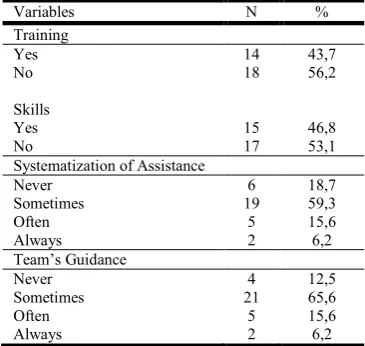
Table 1. Data related to systematic assistance to potential donors of organs and tissues. Recife (PE), Brazil, 2013
Variables N %
Training
Yes 14 43,7
No 18 56,2
Skills
Yes 15 46,8
No 17 53,1
Systematization of Assistance
Never 6 18,7
Sometimes 19 59,3
Often 5 15,6
Always 2 6,2
Team’s Guidance
Never 4 12,5
Sometimes 21 65,6
Often 5 15,6
Always 2 6,2
The majority were female (n = 30; 93%) compared with (n = 2; 6%) were male. About titling, most (n = 18; 56%) had only undergraduate and (n = 14; 44%) had expertise. Over time most of the sample service exercised the profession of 5-9 years (n = 18; 56%), and the minority of 10-14 years (n = 14; 44%). The pros, when asked about being able to watch the potential organ donor (n = 15; 47%) nurses answered that are trained and (n = 17; 53%) responded that they don't feel qualified. About the Systematization of Nursing Care (SAE) of the potential organ donor, the majority (n = 19; 59%) responded that sometimes systematizes, (n = 6; 19%) nurses responded never, (n = 5; 16%) often and (n = 2; 6%) said they always were. According to the degree of guidance offered by the nurses to other team members about how to watch the PD (n = 21; 66%) stated that sometimes guide your team on how to provide quality assistance to potential donors (n = 5; 16%)
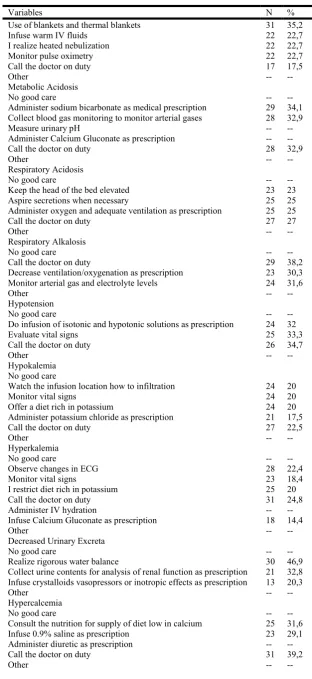
frequently (n = 4; 12%), and never ( n = 2; 6%) ever offered guidance to its staff. When asked about what kind of intervention be carried out on the PD in métabolica acidosis, most nurses (n = 29; 34%) administered sodium bicarbonate as medical prescription, (n = 28; 33%) collected gasemetria to monitor arterial gases, and (n = 28; 33 %) called the doctor on call. The intensivists to answer the question related to PD in respiratory alkalosis, the majority of nurses (n = 29; 38%) reported that they called the doctor on duty, (n = 24; 32%) reported that monitored how arterial gas and electrolyte levels and the minority (30%) of the 23; nurses administered appropriate ventilation and oxygenation as prescription. Regarding assistance given to the nursing patient with decreased blood pressure levels, most of the respondents (n = 26; 35%) called the doctor on duty, (n = 25; 33%) assess vital signs and (n = 24; 32%) were isotonic and hypotonic solutions infusion as medical prescription.
About the intervention provided to potential donor with hypokalemia, where (n = 27; 22%) of respondents reported that they called the doctor on duty, (n = 24; 20%) responded that they watched the infusion site about infiltration, monitored how vital signs, offered diet rich in potassium (n = 21; 17%) administered potassium chloride according to medical prescription. With regard to assistance carried out by potential donor in hyperkalemia, a large portion of the sample (n = 31; 25%) reported that they called the doctor on duty, (n = 28; 22%) observed changes in the ECG, (n = 25; 20%) diet rich in potassium, restricted (n = 23; 18%) monitored how signs vital and (n = 18; 14%) injected Calcium Gluconate as a medical prescription. When questioned about the nursing care to be provided to potential donor with decreased kidney excretes the most nurses (n = 30; 47%) stated that it was strict hydric balance (n = 21; 33%) reported that collected urine for analysis of summary renal function as medical and prescription (n = 13; 20%) were infusion of crystalloid and vasopressors or inotropic agents according to medical prescription.
DISCUSSION
The present study investigated the conduct of nursing care provided to potential donor of organs and tissues. Among the respondents, it was noticed a predominance in females (n = 30) 94%, and the age group of 40 years to 32 (41%). Demonstrating that this prevalence of the female gender is referred to from the early days in the history of nursing in our country. However it was seen as a unique work of women, where the goal was to provide assistance for charity without any remuneration (Lopes; Leal, 2005). According to study by Lima, Batista and Barbosa (2013), the nursing staff carries the utmost importance to provide care to the PDs.
Table 2. Care provided by nurses in the vital changes of potential organ and tissue donors. Recife (PE), Brazil, 2013
Variables N %
Use of blankets and thermal blankets 31 35,2
Infuse warm IV fluids 22 22,7
I realize heated nebulization 22 22,7
Monitor pulse oximetry 22 22,7
Call the doctor on duty 17 17,5
Other -- --
Metabolic Acidosis
No good care -- --
Administer sodium bicarbonate as medical prescription 29 34,1 Collect blood gas monitoring to monitor arterial gases 28 32,9
Measure urinary pH -- --
Administer Calcium Gluconate as prescription -- --
Call the doctor on duty 28 32,9
Other -- --
Respiratory Acidosis
No good care -- --
Keep the head of the bed elevated 23 23
Aspire secretions when necessary 25 25
Administer oxygen and adequate ventilation as prescription 25 25
Call the doctor on duty 27 27
Other -- --
Respiratory Alkalosis
No good care -- --
Call the doctor on duty 29 38,2
Decrease ventilation/oxygenation as prescription 23 30,3 Monitor arterial gas and electrolyte levels 24 31,6
Other -- --
Hypotension
No good care -- --
Do infusion of isotonic and hypotonic solutions as prescription 24 32
Evaluate vital signs 25 33,3
Call the doctor on duty 26 34,7
Other -- --
Hypokalemia No good care
Watch the infusion location how to infiltration 24 20
Monitor vital signs 24 20
Offer a diet rich in potassium 24 20
Administer potassium chloride as prescription 21 17,5
Call the doctor on duty 27 22,5
Other -- --
Hyperkalemia
No good care -- --
Observe changes in ECG 28 22,4
Monitor vital signs 23 18,4
I restrict diet rich in potassium 25 20
Call the doctor on duty 31 24,8
Administer IV hydration -- --
Infuse Calcium Gluconate as prescription 18 14,4
Other -- --
Decreased Urinary Excreta
No good care -- --
Realize rigorous water balance 30 46,9
Collect urine contents for analysis of renal function as prescription 21 32,8 Infuse crystalloids vasopressors or inotropic effects as prescription 13 20,3
Other -- --
Hypercalcemia
No good care -- --
Consult the nutrition for supply of diet low in calcium 25 31,6
Infuse 0.9% saline as prescription 23 29,1
Administer diuretic as prescription -- --
Call the doctor on duty 31 39,2
Other -- --
ignored the COFEN resolution 292/2004. Because the COFEN resolution N 292/2004 Article 1st e) recommends:
[...] To apply systematization of nursing care (SAE) in the process of organ donation.
And regarding the provision of information on the PD, the other members of the team to much of the nurses said they sometimes guides about the care required for a quality assistance and the minority stated that always guides your employees. These data lead us to reflect about the importance of institutional management in working these issues of SAE, because the research data show us that the health organization represented by their managers can’t detect faults arising from lack of planning of the assistance, and neither trace goals and architecting actions that end up with the difficulties that lead professionals to not perform the leaves properly to file (Lima; Batista; Barbosa, 2013).
As the conduct of nursing held the PD with hypothermia most answered correctly (use of blankets and thermal blankets), despite being expensive materials inexistent in reality of public hospitals covered in the study. Therefore the most effective conduct in the treatment of hypothermia in keeping with the reality of the institutions of study was the infusion of IV fluids warm and atomizations heated, because hypothermia brings numerous malfunctions for the capture process of organs that corroborate for decrease in the oxygen supply in these organs, culminating in tissue hypoxia and implant loss (Guido et al. 2009; Guetti, 2008). On issues related to acid-base disorders, nurses were asked about the conduct that were in front of a PD in metabolic acidosis most respondents reported correctly (administered sodium bicarbonate and collected ABG to monitor arterial gases). On the basis of these data it was observed through the review of scientific articles that this is the correct conduct for correction of metabolic acidosis which is regarded as evidenced by decreased pH disorder increase in concentration of hydrogen and bicarbonate, and decrease the
success of ABG regarded as gold standard for analysis of the changes of arterial gases (Smeltzer; Bare, 2009). Study participants when questioned about which were to conduct PD in respiratory acidosis, which has by definition be a change when the pH is below 7.35 and PaCO2 above 42 mm Hg the great part of the sample stated that aspired when secretions necessary, administered oxygen and adequate ventilation as prescription and kept the head high. These responses corroborate with what is observed in the literature that says that the intervention to be performed is directed for removal of secretions, oxygen supply moist to thin the secretions semi patient maintenance. These actions will contribute to improving the lung ventilation-perfusion process (Carlotti, 2013; Smeltzer; Bare, 2009). Based on the analysis of the results on the respiratory alkalosis respondents responded in your most monitored how arterial gas and electrolyte levels according to medical prescription.
Analysis of answers confirms what says Carlotti (2013), that this disorder is due to hyperventilation leading to the excessive output of CO2 and carbonic acid reduction. And monitoring of gases and electrolytes is a determining factor in the diagnosis of respiratory alkalosis, because it helps in the assessment of patient response to treatment (Smeltzer; Bare, 2009). In relation with the changes of blood pressure, related to decrease in SBP and DBP the investigated in your most claimed that they called the doctor on call and the rest of the sample assess vital signs and make isôtonicas and hipôtonicas solutions infusion as medical prescription.
Hypotension is caused by decreased periferica vascular resistance, when the barroceptores note that the fall of pressure they send impulses to the vasomotor center to reverse the fall of pressure by vasoconstriction of the renal arteries. However the conduct that corroborates with the literature reports that the increase in blood pressure levels if the assessment of vital signs, infusion of isôtonicas solutions.
No good care -- --
Call the doctor on duty 24 25,3
Infuse 0.9% saline as prescription 31 32,6 Administer Calcium Gluconate as prescription 21 22,1 Administer diuretic as prescription -- -- Consult the nutrition for supply of calcium-rich diet 19 20
Other -- --
Increased Central Venous Pressure-CVP
No good care -- --
Infuse crystalloids as prescription -- -- Administer Calcium Gluconate as prescription -- --
Call the doctor on duty 32 100
Other -- --
Decreased oxygen saturation
No good care -- --
Call the doctor on duty 29 35,4
Offer ventilator support/oxygenation as prescription 28 34,1 Collect blood for blood gas as prescription 25 30,5
Other -- --
Hypertension
No good care -- --
Administer Beta blockers as prescription 19 15,1
Collect urine contents 23 18,3
Check vital signs 29 112
Realize rigorous water balance 23 18,3
Call the doctor on duty 32 25,4
Infuse 0.9% saline as prescription -- --
Because isôtonicas solutions aims to reverse lower blood pressure by increasing blood volume (Westphal, 2012; Smeltzer; Bare, 2009). According to Dutra (2012) speaks in your article that hypokalemia is characterized when the amount of potassium is serico <3,5mEqL. The most common cause is loss through intestinal gastrica and is observed in 50% of patients after episodes of CA, where the tissues but affected are the kidney cells. Therefore the conduct of nurses is consistent with what the articles reviewed the treatment of by offering potassium rich foods, intravenous replenishment and review of vital signs (Smeltzer; Bare, 2009). When questioned about the nursing care to be provided to potential donor with decreased kidney excretes. The conduct to be adopted in these cases if the vital signs assessment in order to evaluate the amendments on blood pressure measurement, summary collection of urine to investigate the presence of proteins which indicates glomerular injury related to increased pressure (Cardoso, 2013). With regard to assistance carried out by potential donor in A recent study demonstrated that professional this before the patient in hyperkalemia have to analyse the amendments tabled on the ECG and serum potassium levels, because the increase of this cause electrolyte renal cell dysfunction and points out that the infusion of Calcium Gluconate is used to give stability in renal membrane (Dutra et al. 2012).
For the pipes provided to the PD in hypercalcemia administration IV of crystalloids and infusion of diuretics handle that aims to increase diuresis decreasing the reabsorption in the renal calcium sodium tubulos (Copês; Zorzo; Premaor, 2013; Dutra et al. 2012). Where most of the nurses interviewed answered incompletely they called the attending physician showing the lack of management to deal with these PDs. The hypocalcemia is decreased serum calcium levels less than 8, 5 mg/dl, and about this disturbance resulting from ME, the nurses survey stated correctly confirming that reports some authors in their research to the PD with hypocalcemia. If the therapy through slow infusion calcium gluconate and the replacement through nasenteral of probe feeding diet rich in calcium (Dutra et al. 2012; Smeltzer; Bare, 2009). When questioned about the conduct being performs before the PD with decreased levels of PVC 100% of the study population reported that they called the doctor on call, from this statement incorrect notice that the attendants don't know fully what brings the literature. Where it says that the PVC is employed to evaluate the pressure in magazines and further coronary heart veins. A PVC is declining as a result of decrease uses the right ventricular preload and this associated with ADHD.
Thus alternative corroborating with literature would be IV infusion of crystalloids (Smeltzer; Bare, 2009). According to Knobel (2005), before patients with decrease of oxygen saturation must monitor the concentration of oxygen bound to hemoglobin, through ABG who have as reference values pH:7.35 a 7.45 mmHg, PaCO2: 36 a 46 mmHg, PaO2: 75 a 85 mmHg e HCO3: 24 a 28 mEq/L which has the function to evaluate the amount of oxygen to be offered and get parameters for some acid-base disturbance. Comparing these data with the present research showed that nurses in your most reported erroneously, called the doctor on call desmonstrando the lack of preparation to give you with this patient. Blood pressure increase in the potential donor is directly related to autonomic discharge which is a consequence of high vasoconstriction in patients with death brain barrier. This
process of increased pressure when not controlled causes there is ischemia. Where the conduct to be adopted in these cases if the vital signs assessment in order to evaluate the changes presented in SBP and DBP, summary collection of urine to investigate the presence of proteins which indicates glomerular injury related to increased pressure, and the use of Beta blockers that Act decreased the expense of oxygen by cells myocardial and consequently improving the patient's hemodynamics (Cardoso, 2013; Smeltzer; Bare, 2009).
Conclusion
During the implementation of the instrument the author realized that the respondents demonstrated enough State of insecurity to be boarded. From this fact it was observed the need to invest time informing that participation of the study would not interfere in any way in your work environment. It was only collecting data with academic purpose and that it was of paramount importance your participation to the course of the researcher. By analyzing the data the nurses belonging to sample proved to have little scientific basis about the conduct provided to potential donor of organs and tissues, but critical questions were related to application of SAE, hidroeletroliticos disorders and Basic acids and evaluation of parameters of PVC. Showing a lack of interest on the part of professionals to seek through literature grants to provide a systematization of qualified assistance.
The systematization and the direct care of the potential donor is atruibuição of nursing through critical look that begins with the patient's entry on intiuição until the completion of the process of abstraction of organs and tissues. And imprecindivél the addition of technical knowledge to the scientific understanding since the physiopathology of ME, opening of Protocol, the maintenance of essential organs, family approach to the graft with purpose and provide longevity to the receivers. Being of the utmost importance to frequent training to professionals who deal with these patients excluding possible doubts that veham to emerge from the whole process, interior reflection and individual opotunizando of their conduct. Showing that nursing need to take a critical stance and aware in diseminação of knowledge about scientific literature and by applying the principles recommended by the SUS: universality, integrality and fairness, playing with language skills.
REFERENCES
Associação Brasileira de Transplante de Órgãos. 2009. Diretrizes básicas para captação e retirada de múltiplos órgãos e tecidos da Associação Brasileira de Transplante
de Órgãos. São Paulo: ABTO,. Disponível em:
http:<//www.abto.org.br/abtov03/Upload/pdf/livro.pdf9>. Acessado em 13/02/2013.
Brasil. Lei N. 10.211, 23 março de 2001. Altera dispositivos da Lei n. 9.434, de 4 de fevereiro de 1997, que dispõe sobre a remoção de órgãos, tecidos e partes do corpo humano para fins de transplante e tratamento. 2001. Brasil. Lei N. 9.434, de 04 de fevereiro de 1997. Dispõe sobre
a remoção de órgãos, tecidos e partes do corpo humano para fins de transplante e tratamento e dá outras providências. Diário Oficial da União (Brasília), 1997. Cardoso ME. 2013. Emergências hipertensivas. Revista
Hospital Universitário Pedro Ernesto, 12 (3). Disponível
em: http:<//www.epublicacoes.uerj.br/ ojs/index.php
/revistahupe/article/view/7532/5914>. Acessado em: 26/12/2013.
Carlotti APCP. 2012. Abordagem clínica dos distúrbios do equilíbrio ácido-base. Medicina Ribeirão Preto, 45 (2): 244-62. Disponível em: http:<//revista.fmrp.usp.br/2012 /vol45n2/Simp9_Abordagem%20cl%EDnica%20dos%20di st%FArbios%20do%20equil%EDbrio%20%E1cido-base.pdf>. Acessado em: 20/12/2013.
Cinique VM; Bianche ERF. 2010. Estressores vivenciados pelos familiares no processo de doação de órgãos e tecidos para transplante. Rev Esc Enferm USP. [online], 44 (4): 996-1002. Disponível em: <http://www.scielo.br/sc ielo.php?pid=S0080-6234201000040 0020&script=sci _arttext&tlng=pt>. Acessado em: 05 jun. 2013.
Conselho Federal de Medicina. Resolução CFM-1.480/1997.
Critérios para Diagnóstico de Morte Encefálica. Brasília:
CFM, 1997.
Copês RM; Zorzo P; Premaor MO. 2013. Hipercalcemia: avaliação e princípios do tratamento. Revista da AMRIGS.
[online], 57 (4): 328-334. Disponível em:
<http://www.amrigs.com.br/revista/57-04/0000222859-13_1237_Revista%20AMRIGS.pdf>. Acessado em: 10 jan. 2014.
Ferreira ABH. Mini Aurélio: o dicionário da língua
portuguêsa. Curitiba: Positivo, 2005. 895 p.
Freire ILS et al. 2014. Conocimiento del equipo de enfermería sobre la muerte encefálica y la donación de órganos. Enferm. glob. [online], 13 (36):179-193.
Freire ILS. 2012. Morte encefálica e cuidados na manutenção do potencial doador de órgãos e tecidos para transplante.
Rev. Eletr. Enf. [online], 14 (4): 903-912. Disponível em:
<https://www.revistas.ufg.br/index.php/fen/article/view/14 598/13355>. Acessado em: 05 jun. 2013.
Guelber FACP et al. 2011. Cuidando da pessoa com morte encefálica- Experiência da equipe enfermagem. Jornal
Brasileiro de Transplantes, 14 (2). Disponível em
<http://www.abto.org.br/abtov03/Upload/file/JBT/2011/2.p df>. Acessado em: 20 mar. 2013.
Guetti NR; Marques IR. 2008. Assistência de enfermagem ao potencial doador de órgãos em morte encefálica. Rev. bras.
enferm. [online], 61 (1):91-97. Disponível em:
<http://www.scielo.br/scielo.php?pid=S0034-71672008000100014&script=sci_arttext>. Acessado em: 06 fev. 2013.
Guido LA et al. 2009. Estressores na Assistência de Enfermagem ao Potencial Doador de Órgãos. Rev.
Latino-Am. Enfermagem, 17 (6): 1023-1029. Disponível em:
<http://www.scielo.br/pdf/rlae/v17n6/pt_15.pdf>. Acessado em: 21 mai. 2013.
Knobel E. 2005. Terapia Intensiva: Pneumologia e
fisioterapia respiratória. São Paulo: Atheneu.
Lima CSP; Barbosa ACO; Batista, SFF. 2013. Percepções da equipe de enfermagem no cuidado ao paciente em morte encefálica. Revista Eletrônica de Enfermagem, 15 (3): 778-87. Disponível em <https://www.revistas.ufg.br /index. php/fen/article/view/17497/15505>. Acessado em: 14 dez. 2013.
Lopes MJM; Leal SMC. 2005. A feminização persistente na qualificação da enfermagem brasileira. Cad Pagu, 24 (1): 105-25. Disponivél em: <http://www.scielo.br/ pdf/cpa/ n24a06.pdf>. Acessado em: 15 dez. 2013.
Martini M et al. 2008. O papel do enfermeiro na manutenção do potencial doador de órgãos e tecidos. Revista Brasileira
de Ciências da Saúde, ano VI, (18). Disponível em:
<http://seer.uscs.edu.br/index.php/revista_ciencia_saúde/ar ticle/dowload/346/146>. Acessado em: 22 mai. 2013.
Meneses EA et al. 2010. Análise Bioética do Diagnóstico de Morte Encefálica e da Doação de Órgãos em Hospital Público de Referência do Distrito Federal. Revista Bioética, 18 (2): 397-412. Disponível em: <http://www. revistabioetica.cfm.org.br/index.php/revista_bioetica/articl e/view/572/544>. Acessado em: 27 mar. 2013.
Moraes EL et al. 2014. Vivência de enfermeiros no processo de doação de órgãos e tecidos para transplante. Rev.
Latino-Am. Enfermagem, Ribeirão Preto, 22 (2): 226-233.
Disponível em: <http://www.scielo.b r/scielo.php?script =sci_arttext&pid=S0104-1169201400 0200226 &lng=e n&nr m=iso>. Acesso em: 06 set. 2015
Pestana AL; Erdmann AL; Sousa, FGM. 2012. Emergindo a complexidade do cuidado de enfermagem ao ser em morte encefálica. Esc. Anna Nery [online], 16 (4):734-740. Disponível em: <http://www.scielo.br /scielo. php?pid=S 1414-814520120004000 13&s cript=sci_arttext>. Acessado em: 14 set. 2013.
Polit DF., Beck CT., Hungler BP. 2004. Fundamentos de pesquisa em Enfermagem: Métodos, avaliação e utilização. 5.ed. Porto Alegre: Artmed.
RESOLUÇÃO COFEN-292/2004. Publicado Portal do Cofen -
Conselho Federal de Enfermagem. Disponível em: <http://site.portalcofen.gov.br>. Acessado em: 21 mar. 2013.
Roza BA. 2009. Doação de órgãos e tecidos no Brasil: podemos evoluir? Mundo Saúde, 33 (1): 43- 48. Disponível em: <http://www.saocamilo-sp.br/pdf/mundo_saude/ 66/43a48.pdf>. Acessado em: 15 mai. 2013.
Smeltzer SC; Bare BG. 2009. Brunner & Suddarth: Tratado
de Enfermagem Médico-Cirúrgica. 11ª ed. Rio de Janeiro:
Guanabara Koogan, 258-283 p.
Souza SS et al. 2013. Estratégias de enfrentamento da enfermagem no cuidado ao potencial doador de órgãos. Revista da Rede de Enfermagem do Nordeste-Rev
Rene, 14 (1). Disponivél em: <http://www.revista
rene.ufc.br/revista/index.php/revista/article/view/96>. Acessado em 23 abr. 2013.
Teixeira RKC; Gonçalves TB; Silva JAC. 2012. A intenção de doar órgãos é influenciada pelo conhecimento populacional sobre morte encefálica? Rev Bras Ter Intensiva [online], 24 (3):258-262. 2012 – Disponível em: <http://www.scielo.br/pdf/rbti/v24n3/v24n3a09.pdf>. Acessado em: 19 mar. 2013.
Westphal GA et al. 2011. Diretrizes para manutenção de múltiplos órgãos no potencial doador adulto falecido: parte I. Aspectos gerais e suporte hemodinâmico. Rev. bras. ter.
intensiva [online], 23 (3): 255-268. Disponível
em: <http://www.scielo.br/scielo.php?script=sci_arttext&pi d=S0103-507X2011000300003&lng =en&nrm=i so& tlng=pt& ORIGINALLANG=pt>. Acessado em: 23 fev. 2013.