ORIGINAL RESEARCH ARTICLE
CORPORATIVE UNIVERSITY IN NETWORK: INITIAL CONSIDERATIONS TOWARDS
A NEW MODEL OF CORPORATE EDUCATION
Dr. Freire, P.D.S.,
*Dr. Dandolini, G.A., Dr. Souza, J.A.D. and Dr. Silva, S.M.D.
Federal University of Santa Catarina, Brazil
ARTICLE INFO ABSTRACT
This article aims to identify the guidelines that must be considered for the construction of a new model of Corporate University, which responds to the demands of companies and organizations, whether public and private, about the expectations and needs of its multiple stakeholders. To this end, it was conducted a survey with exploratory and descriptive purposes, through a literature review, from electronic database. The essential elements have been identified and the guidelines for the construction of a new model of Corporate University in Network (CUN) were described.
Copyright ©2017,Freire et al. This is an open access article distributed under the Creative Commons Attribution License, which permits unrestricted use, distribution, and reproduction in any medium, provided the original work is properly cited.
INTRODUCTION
For a historical overview, the evolution of training and development (T&D) can be noticed in the area of Corporate Education, and, subsequently, to the Corporate University (CU), when the people management sector was called upon to participate more actively in the organizational strategy (Eboli, 2010). In the Knowledge Society context, the role of the management area has been gradually decentralized, and the managers are pressured to become leaders and develop their employees with autonomy. Especially, in the mid2000s, that area took over strategic responsibilities, in addition to the operational routines of its basic processes to recruit, select, reward, train, maintain and monitor people. The area became responsible for developing highperformance human capital, supporting other areas regarding the development of the intellectual capital needed to reach of organizational strategic goals, and the capacity of its leaders to the staff motivation, especially the talents, including the enhancement of social capital. In recent years, research issues related to "talent management", "learning company", "changing management,
*Corresponding author: Dr. Dandolini, G.A.,
Federal University of Santa Catarina, Brazil.
and cultural transformation." have been emerging as point out Margherita and Secundo (2009, p. 176). There was a change, from focusing on the training of individuals to the development of human capital aligned to the intellectual organizational capital, and to the absorptive capacity of organized knowledge in internal and external relationships networks for the creation, processing, integration, transfer, protection, and exploration of knowledge assets (Teece, 2000). With this contextual understanding, Margherita and Secundo (2009, p. 178) fall into the corporate learning models in three different stages: (1) "formation and training; (2) corporate education; and (3) network learning ". Between so many models which question the gap between traditional university and corporate universities, Jongbloed and Goedegebuure (2001) have developed the model Stakeholder University. This model aligns to the stage three, of corporate learning, named by Margherita and Secundo (2009) “network learning”. In the mid1990s, this stage three was consolidated with the accelerated development of Information and Communications Technologies, that made easier the mapping and acquisition of tacit knowledge. For Meister (1998, pp 15), a model of network learning reinforces that “the decisive competitive differential lies in the training level (...) of its employees, suppliers, customers, and even members of the communities
ISSN: 2230-9926
International Journal of Development Research
Vol. 07, Issue, 11, pp.17207-17216, November,2017
Article History:
Received 17th August 2017
Received in revised form 26th September, 2017
Accepted 19th October, 2017
Published online 30th November, 2017
Key Words:
Corporate University in Network, Stakeholder University, Knowledge Management, Knowledge Engineering, Corporate Education.
Citation: Dr. Freire, P.D.S., Dr. Dandolini, G.A., Dr. Souza, J.A.D. and Dr. Silva, S.M.D. 2017. “Corporative university in network: initial
considerations towards a new model of corporate education”, International Journal of Development Research, 7, (11), 1720717216.
where they operate”. Already in the new century, the performance in learning networks becomes the main path to innovation. Then, it is set up a CU that must include in its programs other stakeholders, in addition to the staff. Its set up, also, starting with the suppliers up to the inclusion of all participants of its collaborative network. In this way, it is noticed that in the 21st century, with the consolidation of a knowledge society context, the corporate education models change from employeefocused to plurality of actors, both for the acquisition and transmission of operational knowledge, and, especially, for sharing and the creation of tactical and strategic knowledge. In short, in each of the models offered by the Academy, the degree of cooperation that must be built between traditional and corporate universities, companies,
Government, students and suppliers, among other
stakeholders, is rethought so that the desired results are achieved for all.
Allen (2002), in his book entitled: The Corporate University
Handbook, presents one of the references for the term CU, and
illuminates, thus, an issue that, until today, has not been presented with a consistent response yet “How do companies, weather of public or private management, join traditional universities to form corporate universities?”. Nowadays, in this Knowledge Society there are five other issues such as: (1) which is the contribution model that must be constructed between traditional and corporate universities, companies, government, students and content providers, and any other stakeholder, in order to reach the results intended for the learning? (2) Which is the referential that should be considered for the constitutions of corporate universities so that public or private organizations can act in complex systems, being able to articulate the creation, acquisition, sharing, structuring, storage and dissemination of strategic knowledge of employees and other stakeholders that permeate their ecosystems? (3) How to promote learning on intra and interorganizational network to the consolidation of governance that strengthens the relationships between the different strategic stakeholders of Corporate University? (4) What is the setting that a contemporary CU must have to be able to promote collective learning of essential knowledge to the success of the organizational strategy in its structural levels – operational, tactical and strategic – as well as interested in its results, whether individuals, groups, organizations or society? (5) Which essential elements must be considered for construction of an alternative model of CU that addresses the network learning?
Each of those questions will generate a specific investigation of this research group. However, it was the fifth issue that gave rise to this article. Thus, this work aims to identify the essential elements that must be considered for construction of a new model of Corporate University which responds to the demands of companies and organizations, public or private, about meeting the expectations and needs of its multiple stakeholders. In this sense, guidelines have been mapped for the preparation of the Corporate University Model in Network. For such, an exploratorydescription research was carried out, by means of a literature review from electronic databases
(Scopus, Web of Science, Base de Teses e Dissertações da
Capes and Scielo) for the survey of theoretical and empirical
publications that deal with education and Corporative University.
Corporate University - History, Concepts And Related Processes
Hawthorne, Libby and Nash (1983, p. 2) were the first authors to identify corporate universities, called by them “corporate colleges”. These corporate colleges were given by educational institutions, for profit or not, and they had the simple function of certification of training offered by companies. In 1985, according to Allen (2002), the Carnegie Foundation for the Advancement of Teaching released the first book on corporate colleges (Eurich, 1985) by presenting them as an umbrella educational entity, which rises without the mission of educating, but with the function of functional training. At the end of the of 1990s, the concept of corporate university was already adopted by public and private organizations around the world, mainly in the United States and Europe, following a vision quite different from traditional university, being less physical and more fluid.
Storey and Bungartz (2005) describe that there is not a single model of CU, emerging many disagreements about concepts, goals, objectives, processes and nature. Broadly speaking, the American models are more descriptive and normative, having a more formative character. On the other hand, the European models of CU respect cultural plurality and the politics of the organizations. The European vision on the phenomenon of CU strengthens the concept that CU is a process, and as such, for its definition it is considered the mission, organizational culture, profile and interests of people, and the availability of technologies. Regarding definitions, even with some different proposals for the conceptualization of CU, we enter the 2000s with the understanding that CU is a necessary macro process for strategic alignment of learning in organizations.
corporate education, and members of the American Society of Training and Development. During their literature review, the authors identified thirteen features of CU processes related to four functional profiles, as Table 1.
Table 1. Profiles of CU
Functional profile Characteristic Organizational Profile Strategy and Mission
Learning governance and leadership Structure
Developmental stages Profile of the desired
learning
Curricular offerings Target audience – apprentices Evaluation and measurement Operational profile Funding sources
Technology to support learning Partnership profile Partnership with the business units
Partnership with human resource management
Partnership with Academia
Partnership with suppliers / Outsourcing Source: Abel and Li (2012, pp 105).
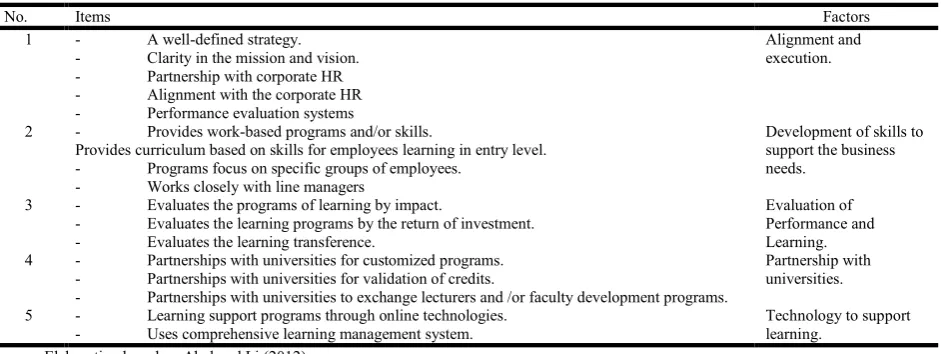
The results of the empirical survey carried through by Abel and Li (2012, pp 122) were used in the search for possible groupings of CU processes. The factor analysis resulted in seventeen items (features) that were grouped into five priority factors for the CU. They are: alignment and execution; development of skills to support the business needs; performance evaluation and learning; partnership with universities, and technology to support learning (Table 2). The essential factors must be implemented and managed, but with different priorities at run time, as the authors point out: [...] the use of technology to support learning has the highest average suggesting that most CU surveyed are using technologies in its operations, compared to other less prominent factors. However, CU needs to identify the applicability of these processes to its own operations and in its partner organizations (Abel and Li 2012, pp 122)
Thus, Abel and Li (2012) came to four conclusions to be considered. The first one is the majority of CU keeps a centered structure, focused on corporate budget. A second finding is the lack of empirical research on CU and its practical implications. The third conclusion is the existence of 13 (thirteen) dimensions of CU in the practice of the studied companies, but with different priorities and applications. “For example, the processes of partnership with business units, and
the use of technology are more prominent than the processes of partnership with the Academy” (Abel and Li 2012, pp 172.) In addition to the already mentioned studies, there are still other possibilities of CU configuration activities (Allen, 2002), the contents (Antonelli, Cappiello and Pedrini, 2013), and the program (Rademakers, 2005). The authors Antonelli, Cappiello and Pedrini (2013, pp 38) organize these settings to taxonomic groups, which can be titled as:
Activity level, Content Comprehensiveness, and Strategic focus of the program.
These taxonomic groups are subdivided, by the authors, in three to four CU possible levels. The transition between levels is neither requirement nor certainty of development, but a definition on what model of people management the organization would like to implement. It is important to note that, when a level is chose, another is not necessarily excluded. In each of these, the authors explain that there is the possibility of the CU offering different packages of courses that can be
positioned individually in any of the levels. Specifically, in the
one called Activity Level (Table 3), developed by Allen (2002), the evolution of the first level to the levels 3 and 4 is attractive for organizations, by the possibility of transporting the CU cost item for manpower training for investment in business management courses with certification by traditional universities partners.
These guidelines for Allen’s (2002) CU describes four evolutionary scales, beginning with the Training Department, internal to the organization, going to a Corporate University structured to compete with traditional universities, once it could certify its students in order to be recognized by the
formal educational system. Through the Antonelli, Cappiello
and Pedrini (2013) studies, in the U.S.A. the models of 3º or 4º
level already exist. Also, some CUs have partnerships with traditional universities for certification.
Other CUs, on the other hand, are authorized by the State’s Government to which they belong to certify by themselves, as for example, the University of Kettering, which began as a General Motors Institute (Thompson, 2000). In Europe, many CUs are already on the 2nd level, overcoming the limitations of training for the task, and advancing to the development of individual alignment with organizational development, but the last two levels are still rare (Andresen and Lichtenberger, 2007).
Table 2. CU factors
No. Items Factors
1 A welldefined strategy. Alignment and
execution. Clarity in the mission and vision.
Partnership with corporate HR Alignment with the corporate HR Performance evaluation systems
2 Provides workbased programs and/or skills. Development of skills to support the business needs.
Provides curriculum based on skills for employees learning in entry level. Programs focus on specific groups of employees.
Works closely with line managers
3 Evaluates the programs of learning by impact. Evaluation of
Performance and Learning. Evaluates the learning programs by the return of investment.
Evaluates the learning transference.
4 Partnerships with universities for customized programs. Partnership with universities. Partnerships with universities for validation of credits.
Partnerships with universities to exchange lecturers and /or faculty development programs.
5 Learning support programs through online technologies. Technology to support learning.
[image:3.595.65.536.515.692.2]Table 3. Elaborated by the authors based in Allen (2002)
For LEVEL OF ACTIVITIES Levels
1 Offer of free training courses and specific formation of task;
2 Offer of free courses of training and formation, and of management development and leaderships;
3 Formalized courses for obtaining some college credits; 4 Formalized courses package that allows one to obtain a
degree at the university. Source: Elaboration by the authors.
CU guidelines drawn up by Antonelli, Cappiello and Pedrini
(2013), which is referred to in this article as
Comprehensiveness Content, points three levels of CU
contents as seen in Table 4. These authors begin from what
[image:4.595.99.227.308.360.2]they call “Generalist”, in which the concern is to develop training for dissemination of organizational culture to as many employees as possible.
Table 4. CU guideline proposed by Antonelli, Cappiello and Pedrini (2013)
Comprehensiveness Content Levels
1 Generalist 2 Management 3 Technique
Source: Elaborated by the authors based on Antonelli, Cappiello and Pedrini (2013).
At this level, the focus is on training of disseminators of cultural characteristics that represent the organizational mission in order to build a shared vision within reach strategic objectives. Thus, each employee becomes a potential "container" of the knowledge provided by the CU. On the other hand, the Administrative CU (2), which focuses on the management level, develops abilities of management with the objective to fortify the linking between the strategy and the operation. This level of CU recognizes the important role of managers as executives from the frontline and their essential function to correct transmission of knowledge between top management and the operation routine. The next one is the CU technique (3), which focuses on developing specific techniques and operational skills to assist and train staff at the operational level of the organization. That is, in this level of CU is recognized the need for training of employees for the execution of the activities and specific tasks aligned to the strategic challenges of the company.
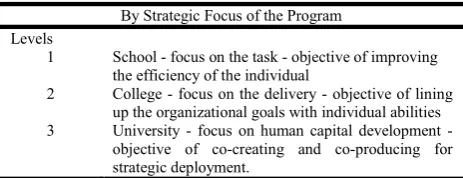
Table 5. Guideline proposed by Rademakers (2005)
By Strategic Focus of the Program Levels
1 School focus on the task objective of improving the efficiency of the individual
2 College focus on the delivery objective of lining up the organizational goals with individual abilities 3 University focus on human capital development
objective of cocreating and coproducing for strategic deployment.
Source: Elaborated by the authors based on Rademakers (2005)
The CU guideline elaborated by Rademakers (2005), which is
called Strategic focus of the program, is subdivided into three
levels: high school, college and university (Table 5). About the level called "School", the Corporate University aims to disseminate knowledge among people, seeking to increase the
efficiency of individual training programs. This way, it has the focus on the task, guided for efficiency.
As for the "College" level, the focus is on the effectiveness of the activities and, to this end, the objective of this level is the alignment of individual competencies to organizational goals. For such, in this level, the CU redistributes knowledge inside the organization, deriving programs from formation of corporative strategy. Finally, at "University" level, the CU drives the creation and development of human capital through the transfer and the creation of knowledge in the individual, group, and organizational dimensions. Moreover, the CU has an important role in the integration of knowledge of the corporate and technical framework of the organization, with the objective of contributing to the competitive advantage through the creation of new knowledge, acting proactively, and establishing a link with a relevant corporate strategy.
However, in this guideline proposed by Rademakers (2005): School, College and University, the boundaries of the organization are not truly outdated, because the CU remains restricted to internal relations believing that, just training, qualification and knowledge management are enough to implement the strategy, already existing in the organization.
In 2009, Alessandro Margherita and Giustina Secundo, from
Salento University, in their book The emergence of the
stakeholder university, establish a new proposal on the role
and strategy of Corporate University, formulating the concept of Stakeholder University. The proposal is a new picture of Corporate University (CU) that, besides taking care of to the functional training and the management qualification of the employees, includes in its mission the development of strategic abilities of these same employees, and of all concerned parties in the organization. Recalling that the parties concerned are all the individuals, groups, and organizations that influence or are influenced by the strategic decisions of the organization. Defined by Margherita and Secundo (2009), the Stakeholder University is the last stage of a corporate education setting, in which the focus is wider, with more extended scope and with rich interconnection, incorporating, comprehensively, the needs and expectations of resources, industry and market, and other interested parties. The authors raise the discussion of the need for a new archetype for corporate learning involving traditional universities, and they feature the traditional University as one of the interested parties (stakeholder) on co creation and coproduction of knowledge assets, which as we know, are indispensable to the desired value aggregation to the main strategies of the 21st century: sustainability, innovation and equity for social development.
Margherita and Secundo’s work (2009) describes another guideline that formed the basis for the identification of the essential elements of the Corporate University in Network. This guideline considers the following classification for CU:
Training Department; Elearning platform; Corporate
Universities, and Stakeholder University (Figure 1).
[image:4.595.46.278.630.719.2]Source: Margherita and Secundo (2009, pp 174).
Figure 1. Corporate learning Archetypes and value creation potential
The E-learning Archetype is a simple learning platform based on distance learning technologies in order to increase the number of actors and the interaction between them, without impacting costs. With technologybased training, greater flexibility and compatibility with work schedules, it makes the training “just in time, just in place”, and appropriate development of skills, resulting in greater flexibility and compatibility with the work schedules. This archetype can broaden the focus, being characterized by both a medium or low focus. The focus is not necessarily on organizational development. For the authors, it can be used to expand, with ease, the number of employees to be reached by learning. Rare participation of external actors to the organization. Medium to high degree of interconnectivity between actors using collaborative technologies.
The Corporate University Archetype encompasses a range of learning initiatives based on different levels of communication and information technologies. This archetype is characterized by a medium/high focus, depending on the level of alignment between curricula and implemented programs, and the organizational strategic objectives. It has obligatory focus on
organizational development. The scope is of
medium/high extension, attending from internal to external public audiences involved in the organizational value chain, such as clients, suppliers and strategic partners. It searches for medium to high degree of interconnectivity, using knowledge management and distance education technology.
The Stakeholder University Archetype is characterized by high focus, high scope and high interconnection. It aims at the development of the social capital as much as the human capital. With the creation of a collective learning and development strategy, it involves high interaction of actors with a focus on the integration of research, skills development and knowledge management. It embraces a wide range of stakeholders when using the “network learning”, and it is based on engineering technologies and knowledge
media which encourage collaboration in the
relationships and interactions of the actors.
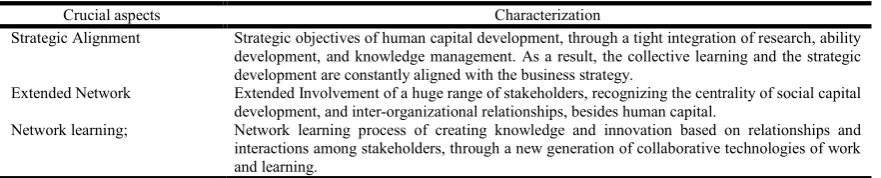
The Stakeholder University is characterized by three crucial aspects, presented in Table 6 (Margherita and Secundo, 2009,
pp 177, our translation): Strategic Alignment, Extended Network, and Network Learning. Ultimately, Allen (2002) points out that a true CU cannot be considered as such when only has one name, one logo, and promotional tshirts (as some existing CU), because if that were the case, “…any entity calling itself a Corporate University, would be a Corporate University” (Allen, 2002, pp 4). Among so many guidelines and possible configurations, the organization must first configure the CU identity, to then consider its implementation and management. Similarly, in order to reach the level of Stakeholder University, a CU must build essential features of its identity on network learning, denouncing the demand for a Corporate University in Network model (CUN).
Knowledge Management For Cun Structuring
In order to achieve the vision of a more comprehensive CU capable of meeting the objective of this study, it is necessary to go beyond the guidelines presented until now. It is appropriate to add two other approaches of knowledge management: (1) the perception of CUN as a memoryforming unit of network,
and (2) knowledge engineering strategy for CUN
operationalization. For Pacheco et. al. (2012), the notion of collective memory originated from studies of sociological School of Durkheim, for whom this type of memory refers to the social process of articulating and communicating information, leading to shared interpretations, which are stored
as social norms and customs (Traugotf apud Stein, 1995).
From this initial formulation emerged the metaphorical notion of memory of a particular social system (Stein, 1995), as an organization or a network.
field (Rowlison et al., 2010). The vision focused on memory processes, also called dynamic view (Stein 1995), seeks to understand the processes of creation, encoding, storage, and use of knowledge of a particular collective (Rau and Argote, 2006; Corbett, 2000).
That is, the form by which knowledge becomes part of the organization and is used in their present activities (Stein, 1995). In a vision of CUN, the procedural or dynamic vision of collective memory must equate the sharing of this learning among members of the collectivity (Rau and Argote, 2006). In order to direct the structure of a CUN, organizational memory can contribute directly to the analytical benchmark of the content produced in CUN, and the relation between its different stakeholders. Also, there is potential for future studies focused on the process of memory formation of the CU (for example, in activities such as the inventory of requirements, design and development of skills, evaluation of courses, assessment and selection of technologies, etc.), as well as for the role of the memory of knowledge produced and shared by stakeholders. For the analysis of the content produced within the CUN area, the approach proposed in this article combines the vision brought by Organizational Memory with techniques from the field of knowledge engineering, as described in the following section. The other approach, the last treated in this study as a guideline to be respected for the structuring of a new Corporate University, is the perception of knowledge engineering to the operationalization of the CUN. The Knowledge Engineering (KE) arose in the 1960s as a discipline dedicated to the development of expert systems (Durkin 1994), a technique of Artificial Intelligence (AI), that establishes computer systems with the ability of representation and logical inference on the rules basis of a given domain. At that time, the work of an engineer of knowledge consisted of transferring knowledge from the head of a specialist to a knowledge base.
Two decades later, based on learning about the limitations of the procedures and techniques of the first phase, and aware of the advances in the areas of software engineering and of sister services disciplines of AI, the KE was restructured as a new discipline, with the objective of providing methods and techniques to develop knowledgebased systems in a
controlled and systematic way (Studer et al., 2000; Schreiber
et al., 2002). This systematization has basis on developing
knowledge models that allow reuse, standardization, semantic representation and inferences in specific fields (i.e., knowledge). Under this perspective, some approaches have been proposed to identify how KE can contribute to each one of the knowledge macro processes observed in organizations. For each macro process, there is a set of possibilities which the KE and the related disciplines offer in terms of methods and techniques for extracting knowledge from data and information sources, such as a model of organizational context
and knowledge (Schreiber et al., 2002), knowledge discovery
about data KDD (Fayad, 1996), engineering of ontologies (Mizoguchi and Ikeda, 1998) and visual representation of concepts with knowledge maps (Davenport and Prusak, 1998), conceptual maps (Novak 1998) or topic maps (Rath, 2003).
In the scope of a CUN, the addition of Knowledge Engineering and its related disciplines can be used with six goals, or its sum: 1) Guide the identification of critical knowledge for the CU and the stakeholders that make up the organizational ecosystem; 2) Support the process of capturing, representing and structuring of the critical knowledge for the CU and its network; 3) Define strategies for the implementation of Information and Communication Technologies to support the activities of the CU and its stakeholders; 4) Guide the practice and intra and interorganizational communication techniques for sharing and dissemination of acquired knowledge; 5) Establish knowledge systems to support the creation processes, sharing, structuring, dissemination and use of the knowledge in the organization, and among the stakeholders that form the
Corporate University in Network; 6) Support the
implementation of the Knowledge Governance that includes the Governance of Learning and Leadership (Abel and Li 2012). One of the paradigmatic beliefs about the implementation of the KE is that a KE objective does not eliminate the other, on the contrary. The KE proposes to meet the six objectives listed previously. However, it is identified that, the more the T&D area is close to work as a Department of Training, the more the KE is called to meet only the objective of guiding the identification of the critical knowledge to be acquired. The more the corporate education model of organization approaches the learning strategies in network, the more the KE requirements are established to meet the six goals, "establishing knowledge systems to support the processes of creation, sharing, structuring, dissemination and use of knowledge in the organization with the stakeholders that form the Corporate University in Network” (goal 5). Also, with the mobilization for sharing and dissemination, the goal number 6 can be achieved, as already pointed out by Abel and Li (2012): “Implementation of the governance of learning and leadership”. With this understanding, the objectives of KE are also treated, in this study, as guidelines for the CUN constitution. In this sense, the essential elements that must be considered for the structuring of the Corporate University in Network model have been identified, given the purpose of this study, in order to meet the demands of its multiple stakeholders. Thus, the guidelines for the elaboration of the Corporate University in Network model were mapped, as presented in the next section.
Guidelines for the Corporate University in Network Model
[image:6.595.80.521.136.225.2]From the studies presented in the previous section, it is noticed that any configuration for a contemporary CU must consider
Table 6. Crucial Aspects of a Stakeholder University
Crucial aspects Characterization
Strategic Alignment Strategic objectives of human capital development, through a tight integration of research, ability development, and knowledge management. As a result, the collective learning and the strategic development are constantly aligned with the business strategy.
Extended Network Extended Involvement of a huge range of stakeholders, recognizing the centrality of social capital development, and interorganizational relationships, besides human capital.
Network learning; Network learning process of creating knowledge and innovation based on relationships and interactions among stakeholders, through a new generation of collaborative technologies of work and learning.
the characteristics determined for the different described guidelines, thus, being capable of promoting the collective learning of essential knowledge to the success of the organizational strategy in its structural levels operational, tactical and strategic –, as well as the interested people in its results, whether these individuals, groups, organizations or
society. Thus, answering the question that gave origin to this
study, one describes the elements to be observed in the structuring (identity) of the Corporative University in Network model.
Essential elements for a contemporary CU
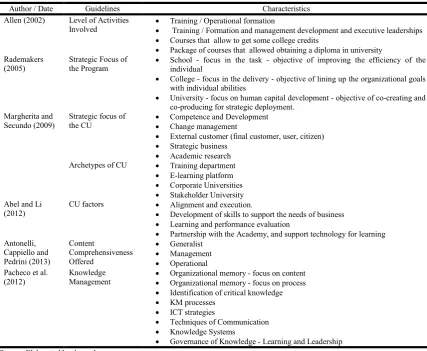
A Corporate University in Network model (CUN) must be established on the basis of the CU guidelines proposed by authors previously analyzed, taking into account the relevant characteristics, aimed at the structuring of collective learning environments and to the promotion of knowledge management at all levels that permeate the relation between organizations and its ecosystems. The elements extracted from the literature can serve as a starting point to guide the setting of a CUN, which are presented in the summaryTable (Table 7), in which can be identified, in chronological order, seven different directives and respective CU features that should be considered.
In order to build an identity of CUN model, it is noted that the guidelines must be considered as filters for decision making concerned on nine basic strategic questions:
What level of activities is intended for the CU?
What is the strategic focus of the CU?
What is the strategic focus of the CU itself?
What is the expected Archetype?
What are the priority factors to be implemented and/or
managed?
What is the content comprehensiveness to be offered?
Which stakeholders should be met?
By what approach should organizational memory be
addressed??
Which objectives of KE should be met?
In conclusion, it is noted that a Corporate University in Network model (CUN), by taking CU guidelines, should be thus configured:
As a collective learning environment oriented to the
demands of the organization and stakeholders that make up its ecosystem;
With principles of knowledge management and focus
on the development of human and social capital through education, training, corporate education and network learning;
For all the different interested in the success of the
organizational strategy, whether external or internal, operational, managerial or strategic;
With high level of confidence, cooperation and
[image:7.595.79.507.371.722.2]connectivity between the organization, the traditional society, the corporate university, and the institutes of science and technology, creating value and social capital;
Table 7. Guidelines of Corporate University in Network Model (CUN)
Author / Date Guidelines Characteristics
Allen (2002) Level of Activities Involved
Training / Operational formation
Training / Formation and management development and executive leaderships
Courses that allow to get some college credits
Package of courses that allowed obtaining a diploma in university Rademakers
(2005)
Strategic Focus of the Program
School focus in the task objective of improving the efficiency of the individual
College focus in the delivery objective of lining up the organizational goals with individual abilities
University focus on human capital development objective of cocreating and coproducing for strategic deployment.
Margherita and Secundo (2009)
Strategic focus of the CU
Competence and Development
Change management
External customer (final customer, user, citizen)
Strategic business
Academic research Archetypes of CU Training department
Elearning platform
Corporate Universities
Stakeholder University Abel and Li
(2012)
CU factors Alignment and execution.
Development of skills to support the needs of business
Learning and performance evaluation
Partnership with the Academy, and support technology for learning Antonelli,
Cappiello and Pedrini (2013)
Content
Comprehensiveness Offered
Generalist
Management
Operational Pacheco et al.
(2012)
Knowledge Management
Organizational memory focus on content
Organizational memory focus on process
Identification of critical knowledge
KM processes
ICT strategies
Techniques of Communication
Knowledge Systems
Aligned content to organizational strategy being able to be operational, administrative or generalist level;
With the prospect of obtaining some university credits
and a diploma in the traditional university;
With the vision of promoting the cocreation and co
production of value for all stakeholders.
Besides, a CUN model, assuming the Collective
Memory and Knowledge Engineering among its structuring elements, must observe the following guidelines:
Retain knowledge, through the establishment of
knowledge bases and channels of interaction and knowledge sharing;
Eliminate geographic barriers in the access to
information and expertise, inside and outside the organization;
Increase the productivity of employees and stakeholders
for ease in finding content and expertise;
Provide greater agility in the communication between
the related areas and units and between the different
stakeholders that make up the organizational
ecosystem;
Implement efficient means to organize and distribute
the information in the network;
Form a computerized database with the expertise and
knowledge produced by stakeholders in the processes that permeate the organizational activities;
Align the application of Information and
Communication Technologies in accordance with the needs of knowledge management processes at all levels of interaction between stakeholders that form the CUN.
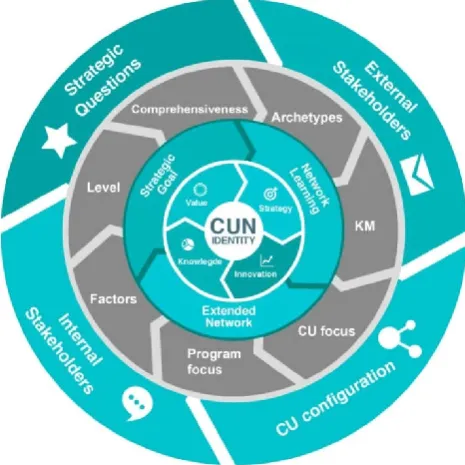
Finally, as a result of this article, it was built a metaphor represented in Figure 2, for the subsequent proposal of a CUN model that has as core the definition of the identity of the model. Figure 2 presents the guidelines for the construction of a CUN model, an initial one, characterized by circular layers, because it does not end in the presented elements, that is, other elements can be integrated into the model. In this sense, several rings are presented showing that levels should be examined, understood and overcome so that the CUN identity may emerge. The initial CUN model is composed of five levels. Read from the outside in, the first level imposes the task to answer strategic questions that will support the definition of the proposal of the CU that must be implemented, and the definition of the internal and external stakeholders that must be met. The second level requires the detailing of the decisionmaking regarding the CU guidelines. At this point, the focus must be to define the level of activities that will be involved; the strategic focus of the corporate education program; the CU strategic focus itself; the archetype of CU that will be implemented; CU factors that will be considered; the comprehensiveness content offered; and the strategies of knowledge management (KM), especially the vision of organizational memory and KE objectives that must be met. The third level of the Initial Model requires the continued verification of the operation of the CUN in relation to: (1) the strategic alignment of collective learning promoted, and the organizational strategy; (2) the development of social capital and interorganizational relationships, besides the human capital; (3) the provision of collaborative technology for work, and network learning. The fourth level of the Initial Model alerts to the necessary attention to the demands of the Knowledge Society: the management of essential “knowledge”
to the organizational “strategy” success in order to add “value” to the products and services, while keeping its “innovation”. By managing the four levels of the Initial Model, the fifth level is reached: the development of the CUN identity. In other words, the organization must enclose the setting of the CUN identity in the center of its attention and manage the different levels of the Initial Model in order to reach it. This Initial Model presents the guidelines for the setting of the CUN model, and therefore, it will be a guide to the subsequent proposition of the CUN model itself. Thus, the model intends to configure the management of the structuring elements of the Corporate University in Network.
[image:8.595.317.550.207.440.2]Source: Elaborated by the authors.
Figure 2. Guidelines of the Corporate University in Network model
Final Considerations
After the literature review, it was identified a possible setting that a contemporary Corporate University should have to promote collective learning of knowledge, which is essential to the success of the organizational strategy. To that end, it should be considered its structuraloperational levels, tactical and strategic – as well as those interested in its results, whether
individuals, groups, organizations or society. The
elements that have not yet been identified in this research, and which must guide future work, are those linked to the achievement of a strategy that guides the implementation of a Knowledge Management in Network program, aligned with the contemporary principles of public governance, and to the actions of training and management in the entity. Regarding future works, it is intended to detail the guidelines for the implementation of Organizational Memory Systems aligned to the basic processes of a CU, and to the processes of co production of knowledge in network recommended by the Corporate University in Network (CUN). The CUN Model is being drawn up with the description of each structural element and its interrelationships, in which the internal consistency check phase has begun.
REFERENCES
Abel, A L, L.L.J. 2012. Exploring the Corporate University Phenomenon: development and implementation of a comprehensive survey. Springcs, Wiley Periodic, Inc. Human Resource Development Quartely, v 23(1).
Allen, M (Ed.) 2002. The Corporate University Handbook e Designing, Managing and Growing a Successful Program. Amacom, New York.
Allen, M. 2007. What is a nextgeneration Corporate University? In: Allen, M. (Ed.), The Next Generation of Corporate Universities. John Wiley and Sons, San Francisco, pp 316.
Anderson, M.H., Sun, P.Y.T. 2010. What have scholars retrieved from Walsh and Ungson (1991)? A citation
context study. Management Learning, v. 41, n. 2, 2010, pp
131–145.
Andresen, M., Lichtenberger, B. 2007. The corporate
university landscape. Germany. Journal of Workplace
Learning, v. 19, pp 109123.
Antonelli, G.A.C., Cappiello, GBC, Pedrini, GAC. 2013. The Corporate University in the European utility industries. Utilities Policy, v. 25, pp 33 – 41.
Buchbinder, H., Janice, N, 1992. The Service University and Market Forces Academe. v. 78(4), pp 1315, julyaugust. Buchbinder, H. 1993. The market oriented university and the
changing role of knowledge. Higher Education:
international journal of higher education and educational
planning, v. 26, pp 331347.
Clark, BR 1998. Creating Entrepreneurial Universities: Organizational Pathways of Transformation. Issues in Higher. New York: Elsevier.
Corbett, JM 2000. Information Technology and People, v. 13, n.4.
Davenport, TH, Prusak, L 1998. Working Knowledge. Harvard Business School Press.
DURKIN, J 1994. Expert Systems: Design and Development. New York: Maxwell Macmillan International.
Eboli, MP 2010. Fundamentos e evolução da educação corporativa. In: Eboli, M, Fischer, A L, Moraes, F C C, Amorim, W A C (Org). Educação Corporativa: fundamentos, evolução e implantação de projetos. São Paulo: Atlas.
Eurich, NP 1985. Corporate Classrooms: The Learning Business Carnegie Foundation for the Advancement of Teaching. Lawrenceville, N.J.: Princeton University Press. Fayad, UM 1996. Data mining and knowledge discovery:
making sense out of data. IEEE Intelligent Systems. v 11, n 5, out.
Hawthorne, EM, Libby, PA, Nash, NS 1983. The Emergence
of Corporate Colleges. Journal of Continuing Higher
Education, 31(2), pp 29.
Jongbloed, B, Goedegebuure, L. 2001. From the
entrepreneurial University to the Stakeholder University. Proceedings of The Internacional Congress on Universities and Regional Development in Knowledge Society.
Universitat Politécnica de Catalunya Barcelona, pp 12 –
14, novembro.
Lehner, F., Maier, RK. 2000. How can organizational memory theories contribute to organizational memory systems?
Information Systems Frontiers, v 2, n. 34, pp 277298.
Margherita, A., Secundo, G. 2009. The Emergence of the Stakeholder University, em Romano, Aldo. Open Business Innovation Leadership The Emergence of the Stakeholder University. Londres: Palgrave Macmillan v. 30 Iss 2, pp 170 – 206.
Marginson, S., Considine, M. 2001. The Enterprise University:
power, governance and reinvention in Australia.
Melbourne: Cambridge University Press.
Mcgee, P. 2006. Corporate Universities: Competitors or
Collaborators? The Journal of Human Resource and Adult
Learning.
Mesteir, J. 1998. Corporate universities: Lessons in building a worldclass work force (2nd ed.). New York, NY: McGrawHill.
Mizoguchi, R, Ikeda, M. 1998. Towards ontology engineering.
Journal-Japanese Society for Artificial Intelligence, 13, pp
910.
Morrison, JL, Meister, JC. 2000. Corporate Universities: An Interview with Jeanne Meister. The Technology Source Archives at the University of North Carolina. vision july
august, 2000. Recovered in 08 jan., 2016 of
http://technologysource.org/article/corporate_universities/ Mort, J 2001. Nature, value, and pursuit of reliable corporate
knowledge. Journal of Knowledge Management, v 5, n 3,
pp 222230.
Nissley, N, Casey, A. 2002. The politics of the exhibition: viewing corporate museums through the paradigmatic lens
of organizational memory. British Journal of Management,
v 13, pp 3545.
Novak, J D 1998. Learning, Creating, and Using Knowledge: Concept Maps as Facilitative Tools in Schools and Corporations. Lawrence Erlbaum Associates (Mahwah). Pacheco, R., Sell, D., Steil, A, Ceci, F. 2012. A Revista
Brasileira de Ciências Ambientais no contexto do Sistema
Brasileiro de CT&I. Revista Brasileira Ciências
Ambientais. v 26, pp 75100.
Phillips, JJ 1999. Corporate Universities HRD Trends Worldwide, pp 7397.
Prochniewski, K 2014. Filling a Need: strategic training for frontline clerk’s office staff. Institute for Court Management – ICM Fellows Program 20132014. Court Project Phase.
Rademakers, M. 2005. Corporate Universities: driving force of
knowledge innovation. Journal of Workplace Learning, v
17, pp 130136.
Rao, RD, Argote, L. 2006. Organizational learning and forgetting: the effects of turnover and structure. European Management Review, v 3, n 2, pp 7785.
Rath, HH 2003. The Topic Maps Handbook. Empolis GmbH, Gütersloh, Germany.
Rowlinson, Booth, Clark, Delahaye, Procter, 2010. Social
remembering and organizational memory. Organization
RenaudCoulon, A. 2008. Corporate Universities: a Lever of Corporate responsibility. Global CCU Publishing, Paris. Schreiber, G., Akkermans, H., Anjewierden, A., De Hoog, R.,
Shadbolt, N., Van De Velde, W., Wielinga, B. 2002.
Knowledge engineering and management: the
CommonKADS methodology. MIT pres.
Storey, J, Bungartz, B. 2005. Using a Corporate University Initiative to Drive Strategic Change. Handbook of Corporate University Development.
Stein, EW. 1995. Organizational memory: review of concepts
and recommendations for management. International
Journal of Information Management, v 15, n 2, pp 1732.
Studer, R, Decker, S, Fensel, D, Staab, S 2000. Situation and
Prospective of Knowledge Engineering. In: CUENA, J. et
al. (Ed.). Knowledge Engineering and Agent Technology.
IOS Series on Frontiers in Artificial Intelligence and
Applications. IOS Press.
Teece, DJ 2000. Managing Intellectual Capital. Oxford University Press, Oxford.
Tierney, WG (org.) 1998. The responsive university:
restructuring for hight perfonnance. Baltimore: Johns
Wopkins University Press, 181 pp.
Thompson, G. 2000. Unfulfilled prophecy: The evolution of
corporate colleges. Journal of Higher Education, 71(3), pp
322–341.
Turban, E, Zhou, D, M A, J 2004. A group decision support
approach to evaluating journals. Information &
Management, 42(1), pp 3144.
Walsh, JP, Ungson, GR 1991. Organizational memory,
Academy of Management Review, v 16, n 1, pp 5790.