Automation of Proactive Risk Control System in
Successfully Managing Projects
Panyam Babu Veera Prasad1 and Dr. Kiran Kumar Reddi2
1
Research Scholar, Rayalaseema university, Kurnool, A.P, India 2
Department of Computer Science, Krishna University, Machilipatnam, A.P, India
Abstract: Project risks results in negative outcome. On contrary opportunities have positive impact on project success. Hence risks are to be identified, prioritised, mitigated and or transferred to third party. Risk Management is highly essential during the project life cycle for successful project management. Proactive risk management is key to the success. Poor risk management results in time, and Cost overruns and poor quality. Risk management needs to be integrated in every phase of the life cycle with adaptive control to suit the situation. Risk events are characterised with the probability ranging from 0 to 1. Risk management is proactive management in successfully managing projects where as reactive approach may result in total project failures or reduction in degree of success.
Keywords: Proactive risk Management, Risk Control System, Risk Manager, Risk index, and Successful Project Management.
I. INTRODUCTION
Risk management research objective is to find different ways and means to eliminate or reduce the occurrence of the negative impact events or conditions by proactive approach contributing to project success. Risk management is certainly not reactive approach. The main reason for failure of projects is mismanagement of risks. Estimate and control risk factors with highly skilled, talented and experienced people are need of the hour.
[image:2.612.184.431.408.464.2]Every effect is produced by cause and risk with uncertainty as shown in the Figure 1.
Figure – 1, Cause, Uncertain event which is Risk it may produces an effort.
A. What is the Need for Risk Management?
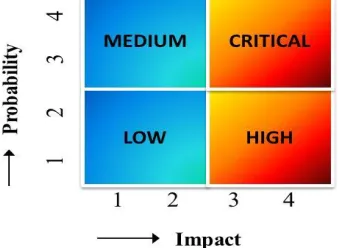
Risk never rests. A risk is something that may happen and if it does, will have a negative impact on the project. A few points here. "That may happen" implies a probability of less than 1, “That will certainly happen” implies a probability equals to 1.
Figure – 2, Probability Vs Impact of Risk
[image:2.612.210.379.539.663.2]comparatively. However with the risk management all the above conditions may be attended to, which will bring certainly better satisfaction to stakeholders.
B. Risk Manager is a Liability or Asset?
Risk manager is a not a liability and definitely an asset to the organisation and to the humanity at large as the risk manager predicts the different types of causes and takes necessary control measures to avoid, transfer or mitigate and minimise residual risk and contributes to the success of the project. Many of them feels risk manager is a liability because, they believe in crisis management rather than proactive approach.
In India, most of the software organisations have not seen the concept of risk management due to small or medium organisation cannot afford to employ them. However risks can be managed by outsourcing the tacit knowledge with mutual trust and confidence, which will definitely bring some more success. However in large software organisations systematic and strategic approach prevails.
C. Who will Identify the Risks?
Identification of the risks is a very vital task and requires highly experienced people to estimate or predict risk. However low and medium types of risks are managed by the team members during the execution phase but high and critical impact risks are to be identified in the early stages so that the same can be attended in time and at low cost without effecting the project deliverables. Every member of the team shall feel that, they are responsible to identify the risks. Whereas some of the software team members may feel risk identification is the job of the project manager or the top management. Hence the need of the agile team is highly required to manage the risks to make the software project success.
D. Impacts of Risk.
Risk has very high impact on the project outcome and it effects broadly on the following. 1) Cost: Overall Cost and Profits
2) Schedules: Project time duration. 3) Scope: Deliverables and Quality.
Excepting to the natural calamities due to act of “GOD ALMIGHTY” which are beyond human control, all other risks can be controlled and managed.
E. 10 Principles of Risk Management [2]
The ten elements of operation that represent the main risk areas to the success of a business are considered to be:
1) Premises: where the firm is located, type of premises available for use,amenities, distribution routes, access for customers. 2) Product : industry sector, features of product or service offered, life cycle and fashion trends, materials used in production,
green issues,quality
3) Purchasing: access to supplies, storage and warehouse facilities, stock control, payment terms, cost.
4) People : the workers in the organization, skills, training needs, motivation and commitment, incentive packages available, employment contracts.
5) Procedures : production procedures, record keeping and reporting systems, monitoring and review, use of standards, emergency procedures
6) Protection : personal protection of workers and others, property and vehicle security, insurance cover, information systems, data security.
7) Processes : production processes, waste and scrap disposal, skills, technology and new materials. 8) Performance: targets set, monitoring, measurement tools, consistency, validity of data.
9) Planning : access to relevant data, management skills, external factors and levels of control, short- and long-term planning, investment options.
10) Policy : range of policies that support the strategic plans of the firm.
II. PROJECT FAILURES AND SUCCESS
A. What is Success? [12]
Is it
1) Huge Financial gain. 2) Public recognition.
3) Internal feeling of achieving something. 4) Promotion
5) Satisfaction.
B. Trends in Project Management - Failures & Success
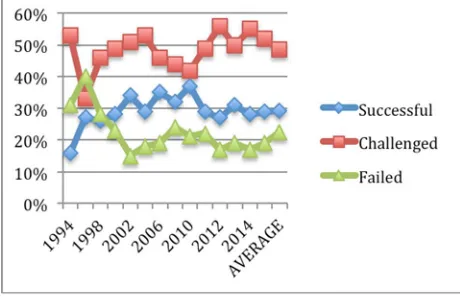
The Standish Group research [7][19] shows a staggering 31.1% of projects will be cancelled before they ever get completed. Further results indicate 52.7% of projects will cost 189% of their original estimates. The cost of these failures and overruns are just the tip of the proverbial iceberg. The lost opportunity costs are not measurable, but could easily be in the trillions of dollars.
[image:4.612.190.420.239.389.2]The following trend shows the Successful, Failed and Challenged projects starting from 1994 to 2015 (Source Standish report)
Figure – 3, Standish report trends(1994-2015).
Projects were classified into three types
1) Project success: The project is completed on-time and on-budget, with all features and functions as initially specified.
2) Project challenged: The project is completed and operational but over-budget, over the time estimate,and offers fewer features and functions than originally specified.
3) Project Failed: The project is cancelled at some point during the development cycle.
On the success side, the average is only 29 % for software projects that are completed on-time and on-budget. In the larger companies, the news is even worse: only 9% of their projects come in on-time and on-budget. And, even when these projects are completed, many are no more than a mere shadow of their original specification requirements. Projects completed by the largest American companies have only approximately 42% of the originally-proposed features and functions. Smaller companies do much better. A total of 78.4% of their software projects will get deployed with at least 74.2% of their original features and functions. This data may seem disheartening, and in fact, 48% of the IT executives in their research sample feel that there are more failures currently than just five years ago. The good news is that over 50% feel there are fewer or the same number of failures today than there were five and ten years ago. The reasons for failures are
4) Untrained.
5) Not matching organization goals with individual goals.
6) Right person in right job doing right thing for achieving organization goals. 7) Accepting unrealistic goals.
8) Lack of control over the activities.
At CHAOS University Martin Cobb, Treasury Board of Canada Secretariat, Ottawa, Canada outlined his paradox: "We know why projects fail; we know how to prevent their failure -- so why do they still fail?"
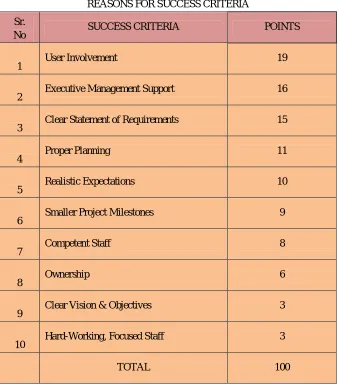
criteria, but with these three elements in place, the chances of success are much greater. Without them, chance of failure increases dramatically.
TABLE I
REASONS FOR SUCCESS CRITERIA
Sr.
No SUCCESS CRITERIA POINTS
1 User Involvement 19
2 Executive Management Support 16
3 Clear Statement of Requirements 15
4 Proper Planning 11
5 Realistic Expectations 10
6 Smaller Project Milestones 9
7 Competent Staff 8
8 Ownership 6
9 Clear Vision & Objectives 3
10 Hard-Working, Focused Staff 3
TOTAL 100
John Manus observes that Managerial issues accounts for 65 % of Project Failures where as Technical issues accounts for 35 % only, which emphasizes the need for Project Leaders.
[image:5.612.194.410.564.711.2]III. RISK PRINCIPLES
A. What is Risk?
Risk[4] is an inherent property of any activity. The dictionary meaning of “risk” is “the possibility of being exposed to danger or loss” (Source: Oxford Dictionary). The term risk has its Etymological origin in the Latin word “resceare”, which means “to cut-off”. It has evolved since then as the French word “risqué”, and the Italian word “risco”.
The term risk is used universally in different contextual domains. For example, it is used in the financial sector to mean the possibility of incurring financial loss, and in the medical sector to mean the possibility of physiological loss to life. In the “software” world, risk is an important issue often referring to the sources of danger to software development, acquisition, procurement, or maintenance.
One of the important considerations challenging any risk management researcher is the definition of risk. In other words, before proposing any risk management framework one needs to specify/quantify the ‘dimensions’ of risks. This is because it is a challenge to unanimously agree on the definition of risk.
There are several formal definitions of risk available in literature, few of which are presented below.
“A possible future event that, if it occurs, will lead to an undesirable outcome” (Leishman and VanBuren, 2003). “Risk is a combination of an abnormal event or failure, and the consequences of that event or failure to a system’s operators, users, or environment. A risk can range from catastrophic (loss of an entire system, loss of life, or permanent disability) to negligible (no system damage or injury)” (Glutch, 1994).
“Risk refers to a possibility of loss, the loss itself, or any characteristic, object, or action that is associated with that possibility” (Konti, 001).
Risks are characterised with the probability ranging from 0 to 1.
B. Definitions [2]
Hazard – something with the potential to cause damage, harm or injury Risk – the likelihood that it will actually cause damage, harm or injury
Risk assessment – the process of identifying hazards and assessing the severity of damage, harm and likelihood it will occur Risk factor – the range of factors that combine to represent the potential for harm, injury, damage or loss to occur
C. Risk Factors [2]
Risk factors are categorised in to the following. 1) Employment risk factor
2) Legislative risk factor 3) Security risk factors 4) Competitive risk factors 5) Financial risk factors.
6) All the above risk factors contains a) Physical Properties
i) Premises b) Product. Or Service, ii) Purchasing
b) People elements
i) People b) Procedure c) Protection c) Actions / Processes
i) Process b) Performance d) Management Issues i) Planning b) Policy
D. What is Risk Management?
E. Origin of Risk Management.
Risk management[4] has its roots in probability theory, and decision making under uncertainty. Three well-known theories in these areas – expected utility theory (Bernoulli, 1954; Hogarth 1987), theory of bounded rationality (Simon, 1979), and prospect theory (Kahneman and Tversky, 1973; Kaheman et al., 1982) – were of the greatest influence. These theories may be considered as disciplines by themselves. Therefore, to put our discussions on risk management in context, we briefly state below only what each of these theories propose.
In brief, the expected utility theory discusses how people make choices from different alternatives, based on their expected utility. The theory of bounded rationality states that for real life events, the outcomes, and their associated probabilities are very limitedly understood by people to make the required decisions to maximize their expected utility. Therefore, people have a tendency to set up targets of aspiration in life by eliminating alternatives from the different options they have. This theory is useful for modelling the behaviour of project management personnel in charge of risk management. Prospect theory, which has its origin in Psychology, helps to model how the perceptions of human beings influence their choices from the given options. It, thus, helps for understanding, and estimating the utility losses of different alternatives while analyzing risks in risk management.
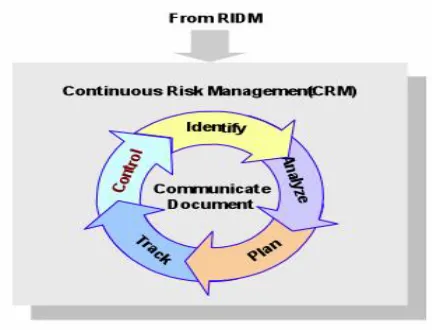
F. Risk Circle [6]
[image:7.612.176.392.293.458.2]Risk cyclic process is described below.
Figure - 5 Risk Circle Process G. Steps in the CRM Process include
1) Identify:Identify contributors to risk (shortfalls in performance relative to the baseline performance requirements).
Note: Sometimes the relationship between an identified risk and performance measures is indirect, but risks within the proper scope of CRM are addressed precisely because they may affect one or more performance measures.
2) Analyze: Estimate the probability and consequence components of the risk through analysis, including uncertainty in the probabilities and consequences and, as appropriate, estimate aggregate risks.
3) Plan: Decide on risk disposition and handling, develop and execute mitigation plans, and decide what will be tracked.
4) Track:Track observables relating to performance measures (e.g., technical performance data, schedule variances).
5) Control:Control risk by evaluating tracking data to verify effectiveness of mitigation plans, making adjustment to the plans as necessary, and executing control measures.
6) Communicate and document: Communicate and document the above activities throughout the process.
H. Risk Score
Risk score is the indicator which is the combination of risk probability of occurrence of and event and the impact of the risk of effect as per the equation given below.
Risk Score = Risk Probability x Risk Impact x 100
IV. GLOBAL RISK MANAGEMENT METHODS
A. Software Risk Management Models [4]
Several software risk management approaches have been proposed in the past, most of which assess risks during all the phases of software development, by integrating risk management practices along with the software development process. As a result, in these approaches, the risk management models follow a disciplined process. These approaches are listed below.
1) Boehm’s Risk Management Model (Win-Win) (Boehm, 1988; Boehm and Ross, 1989; Boehm and Bose, 1994; Boehm et al., 1998)
2) SEI’s Software Risk Management Model (SRE Version 2.0) (Williams et al., 1999)
3) Hall’s Risk Management Model (P
2
I
2
) (Hall, 1998)
4) Karolak’s Risk Management Model (Just-In-Time Software) (Karolak, 1998) 5) Kontio’s Riskit Methodology (Kontio, 1997; Kontio, 2001)
6) 360 degree RISK management model (Subramanian, A & Srividhya, V.S, 2008)
These approaches are summarized below. A “horizontal” comparison of all of these approaches may not be fair because, although each of them address risk management, they were developed under different circumstances for solving may be related but
different issues. For example, Hall’s P
2
I
2
was developed from a risk management capability modeling perspective. On the other hand, Boehm’s Win-Win model was developed primarily as a novel software development process model (“spiral” development) taking a risk-based approach. We provide below a high-level overview of these approaches.
7) Model, referred to as the Original Spiral Model (Boehm, 1988), eliminates risks from the early stages of software development, instead of encountering project barriers at the later stages.
Boehm extended his Original Spiral Model using the Theory W (Win-Win) Model (Boehm and Ross, 1988; Boehm and Bose, 1994), which aims at satisfying the objectives, and concerns of the stakeholders. The Win-Win Model also supports risk identification, resolution, and continuous monitoring of risks. Although the strategy taken by Win-Win may not always be attainable in practice, it is an important contribution towards engaging stakeholders in the risk management process.
Boehm (1991) also proposed a risk management framework, which helps to identify the primary sources of risk, analyze, and resolve them. This risk management framework can be integrated into the Original Spiral, or the Win-Win Model.
8) SEI’s Software Risk Management Approach: SEI provided a comprehensive risk management framework comprising of the following three groups of practices: Software Risk Evaluation, Continuous Risk Management, and Team Risk Management. The Software Risk Evaluation approach concerns the identification, analysis, communication, and mitigation strategies for software risk management. The approach depends on, amongst other elements, the risk taxonomy, which consists of constructs used for organizing risk information. The taxonomy helps in providing with an instrument (questionnaire) to elicit different classes of risks. The entire taxonomy of risks can be found in (Higuera and Haimes, 1996), and is omitted from here. The taxonomy has classification of risks into categories such as Requirements risks, Design risks, Coding and testing risks, Contract risks, Resource risks, and so on.
9) Hall’s P 2
I 2
Approach: Hall (1998) approached risk management by identifying four different factors that have the potential to alter the expected results in any project. These factors are People, Process, Infrastructure, and Implementation.
The People factor is concerned with human resource aspects for risk management. This is important because the success of any risk management activities is dependent on the successful communication of different issues arising while conducting risk management activities.
The Process factor defines the processes that should be taken to manage risks for minimizing uncertainties involved in the project. The Infrastructure factor defines the requirements, resources, and results required to perform risk management activities in an organization.
The Implementation factor concerns the actual implementation of risk management activities such as, establishing the initiatives for risk management, developing the plan, customizing the standard processes to meet the requirements of the project, assessing risks, and controlling risks.
11) Kontio’s Riskit Approach: Kontio (2001) proposed the Riskit methodology, which provides a complete conceptual framework for risk management using a goal-, and stakeholder-oriented approach. It attempts to manage risks by capturing the intentions of stakeholders in the risk management process.The implementation of the Riskit methodology helps project managers with the accurate and timely dissemination of proj information, opportunity, and risk to different stakeholders, thereby enabling to make critical decisions for the overall success of the project. Riskit also helps for systematically managing the project starting from identification, and analysis of risk to the monitoring, and control of them. Management Improvement (PMI) Framework requires an understanding of Experience Repository. Without getting into the details of the Experience Repository, we mention that the essential idea underlying Kontio’s Riskit PMI Framework is utilizing experience, and information from previous software development projects for managing risks in the current project.
12) Degree RISK Management Model: Subramanian, A & Srividhya, V.S, proposed a new model at PMI Global conference in 2008, to rate, mitigate and exploit oppourtunities. Chief constituents of this model includes StakeholdersGovernance model, Services, Process and tools & techniques.360 Degrees risk management process includes Oppourtunity level, Portfolio or Programme level, Reviews and Audits, Risk reporting and Trend analysis.Tools and techniques includes corporate risk database,popup tools and Programme dashboard and money at risk calculator. Benefits of this model are competetive differentiator, protect from financial lss, calculate both positive and negetive impacts, increses trust, enhances brand valus, improves quality of product.expansion of business, diversification, identify oppourtunities, move from unknown-unknown to known- unknown,
13) Recent Advances : After discussing the important software risk management process models, we discuss below recent contributions in the area. They primarily propose risk analysis methodologies, and not a complete risk management framework, unlike other approaches.
a) Foo and Murugananthan’s Approach: Foo and Murugananthan (2000) proposed a questionnaire-based approach for analyzing risks to provide their quantitative assessment. Their approach can be used to quantify risk elements, and use them to estimate a normalized value of the overall project risk. Their model, called the software risk assessment model (SRAM), is based on the use of situational factors to predict project risks. In other words, risk assessment in this model is dependent on the nature of the project, and the situations facing it.
b) Deursen and Kuipers’ Approach: Deursen and Kuipers (2003) proposed a novel risk assessment methodology by identifying the different primary facts, and secondary facts in a project. The primary facts are obtained by analyzing the system, and the secondary facts are obtained by interviewing different stakeholders, reviewing contract documents, project plans, requirements specifications, and design documents. Finally, the primary facts, and the secondary facts are taken in tandem, and compared to observe whether the risks perceived from both the angles are consistent with each other.
c) Roy’s Approach: Roy (2004) developed the ProRisk management framework by extending the AS/NZS 4350 standard. It categorizes the risk management activities into the business domain, and the operational domain. It performs different activities such as, identifying the stakeholders, identifying the risks factors, constructing a risk-free model, calibrating the risk-free model, estimating the probabilities of risk events, evaluating the combined values of risk, developing action plans, and monitoring the progress.
B. Risk Management Standards
The following are some of the important global risk management standards. 1) PMBOK Guide developed by Project Management Institute. [1] 2) Australian and New Zealand Standard AS/NZS 4360 -2004. 3) PRAM (Project Risk Analysis and Management) Guide
4) PRINCE2 (PRojects IN Controlled Environments) methodology.
5) IRM Standard jointly developed by the Institute of Risk Management (IRM) 6) NASA Risk Management Procedure s and requirements – NPG 8000.4
C. Pareto Risk prioritising technique
Project Compl ete Document Estimate Identify Statistics Control Monitor Prioritize Access Re-Prioritise Re-Estimate
Re-Access New Risks
Incl. Tacit
percent of Italian income went to 20 percent of the population.
Today, the Pareto Principle is still relevant to Lean Six Sigma. Richard Koch, a preeminent thinker on the Pareto Principle as it applies to business management, demonstrates in his book the 80-20 Principle how to achieve more with less in a business context. Koch talks with the Process Excellence Network about 80-20 applicability in today's business environment.
Similarly 80-20 principle it can be extended to risk management and can be stated that “80 % of the risks can be managed or mitigated with 20 % of the efforts”. This is the main essence of the proactive risk management strategy.
V. HOW TO CONTROL AND MANAGE RISKS?
A. Difference between Controlling and Managing Risks
Majority of the people feel both controlling and managing risks is synonymous. But there are entirely different concepts.Controlling the risks is bringing the risk in the tolerable range whereas risk management is managing risks minimum possible risks at that time depending on the availability.
B. Risk Ranking Matrix [12].
[image:10.612.187.422.284.414.2]The relation between Impact of risk on project and the probability of occurrence of the events is tabulated below.
TABLE II
RISK RANKING MATRIX
C. Various Software Development Risk Management Processes [3].
Risks associated with software development projects, there are strong indicators that these risks can be managed successfully. Research of failed software projects showed that “their problems could have been avoided or strongly reduced if there had been an explicit early concern with identifying and resolving their high-risk elements” (Boehm, 1991).
IMPACT ON PROJECT LOW
(0.1-0.29)
MEDIUM (0.3 - 0.64)
HIGH ( 0.65 -1.0)
PROBABILITY OF OCCURANCE
HIGH
(0.65 - 1.0) MEDIUM HIGH
UNACCE- PTABLE MEDIUM
(0.3 - 0.64) MEDIUM HIGH
UNACCE- PTABLE LOW
Figure –4 “Soft risk model diagram (adapted from Keshlaf and Hashim (2000))
Effective risk management is the most important management tool a project manager can employ to increase the likelihood of project success. Since risk management is not widely used and understood, this could be a significant competitive advantage to those that implement the risk management processes in their projects.
A large number of processes have been generated in recent years to address the need for more effective risk management. The risk management process provided in the PMBOK (PMI, 2001) is a good overview of the typical processes, yet it is often too generic to meet the specific needs of software projects. The Software Engineering Institute (SEI) has developed the Team Software ProcessTM(TSPTM) for the team as a whole, and the Personal Software ProcessTM (PSPTM) for the individual during software project development (SEI, 2001). Keshlaf and Hashim (2000) have developed models for tools to aid the software risk management process. As shown in Fig. below, it uses an eight-step process during the initial phases of the project. When any new risks are identified throughout the project, a five-step inner process is used to improve earlier estimates and judgments continuously.
‘Team risk management’ is a process that addresses the risks associated with multiple entities (Higuera et al., 1994). Although developed specifically for software contractual relationships, the concept is just as viable for multiple divisions or multiple projects, which is a common paradigm in most organizations.
VI. RISK INSTRUMENTATION
A. Risk Instrumentation
Risk Instrumentation provides the Manual Control , Semi- Automatic Control and Fully Automatic Control systems on Risk management on Process control Instrumentation model.
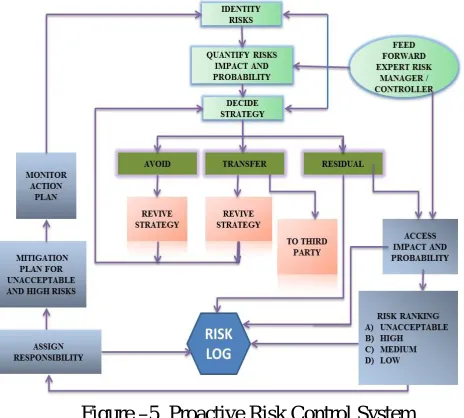
In risk instrumentation, initially risks are predicted, sensed, ,measured and identified and the process is controlled by manipulating the output parameters with different types of control modes to adjust the position of final control elements so that the process parameter is changed to the required value in comparison with the required, set or desired value.
B. Proposed Proactive Risk Control System
[image:11.612.182.414.455.664.2]Risk Control System is like Process Control Closed loop Instrumentation system. In every closed loop risk control system contains
Figure –5, Proactive Risk Control System
1) Risk Identification (Documenting risks based own team experience and also lessons learnt from others expertise in similar field).
4) Rank Risks (Unacceptable, High, Medium, Low 5) Maintain Risk Log
6) Responsibilities
7) Develop Strategy for Mitigation of Unacceptable and High risks. 8) Implement strategy.
9) Monitor action plan and continuously identify and measure risks. Repeat the above 9 steps continuously till the risks are under control. Further risk management can be made easy by providing
Risk Alarms (Automatic), Risk look ahead, Lead time calculations for operations / processes and incorporating risks in Gantt Charts
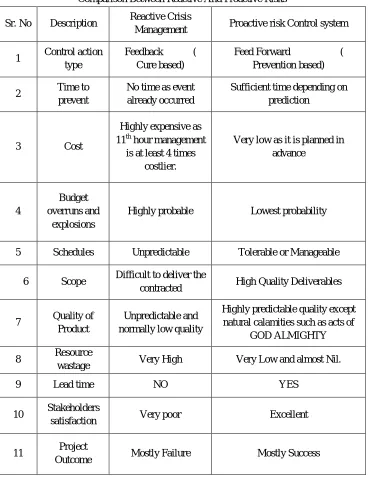
[image:12.612.124.493.241.718.2]C. Difference between Reactive and Proactive risk management. TABLE III
Comparison Between Reactive And Proactive Risks
Sr. No Description Reactive Crisis
Management Proactive risk Control system
1 Control action type
Feedback ( Cure based)
Feed Forward ( Prevention based)
2 Time to prevent
No time as event already occurred
Sufficient time depending on prediction
3 Cost
Highly expensive as 11th hour management
is at least 4 times costlier.
Very low as it is planned in advance
4
Budget overruns and
explosions
Highly probable Lowest probability
5 Schedules Unpredictable Tolerable or Manageable
6 Scope Difficult to deliver the
contracted High Quality Deliverables
7 Quality of Product
Unpredictable and normally low quality
Highly predictable quality except natural calamities such as acts of
GOD ALMIGHTY
8 Resource
wastage Very High Very Low and almost Nil.
9 Lead time NO YES
10 Stakeholders
satisfaction Very poor Excellent
11 Project
Advantages of Proactive Risk Control System over reactive crisis risk management are tabulated above.
VII. FINDINGS
The mentioned risk management measures are accepted by Software people across different organizations. A detailed questionnaire is presented and got answers positive by proving risk management followed by a project manager or risk manager at different phases of the Project Management Life Cycle. Hence Risk Control System was proposed based on proactive and Feed forward approach as presented above for minimising the risks in Project management and thereby increasing successful projects.
VIII. CONCLUSION
Risk management is a concept which can be explored more and there is a scope for future work.Project risks are probable events or conditions, on occurrence will result in negative impact on the project success. On contrary opportunities have positive impact on project success. Hence risks are to be identified, predicted, prioritised, mitigated and attended by elimination as far as possible or transfer the risks to third parties or residual risks are to be reduced by mitigation to minimum possible for project success. Risk Management is highly essential during the project life cycle for successful project management. Proactive approach is key to successfully manage risks and there by projects. Poor risk management results in time, Cost overruns and deliverables quality. Risk management needs to be integrated in every phase and process group of project management with systematic and structured approach continuous risk control system and it is not an optional utility. Risk management is certainly not reactive approach rather it is proactive continuous control system. Risks can no longer be tolerated as mismanagement leads to failure and hence it is high time to implement risk control measures at all levels and phases of the projects.
REFERENCES
[1] @2013 Project Management Institute. A Guide to the Project Body of Knowledge (PMBOK Guide) - Fifth Edition [2] Risk Management 10 Principles by Jacqueline Jaynes P. 10,1
[3] Project risk management : Lessions learned from software development environment by Y’H’Kwak , J Stoddard[4] Software Project Management in Practice by Pankaj Jalote- 2010
[4] Different techniques for risk management in software engineering: A review by Subhas C. Mitra, Vinod Kumar, Uma Kumar. [5] Software Project Management, A Unified Frame work by WALKER ROYCE -2009.
[6] NASA Risk Management Procedure s and requirements – NPG 8000.
[7] www.standishgroup.com/newsroom/chaos_2016
[8] http://en.wikipedia.org/wiki/Project_manager [9] www.projectperfect.com.au
[10] http://pmtips.net/project-control/
[11] K. Beck, M. Beedle, A. van Bennekum, A. Cockburn, W. Cunningham, M. Fowler, J. Grenning, J.Highsmith, A. Hunt, R. Jeffries, J. Kern, B. Marick, R.C. Martin, S. Mellor, K. Schwaber, J. Sutherland & D.Thomas, Principles behind the Agile Manifesto, Available on-line: http://agilemanifesto.org/iso/en/principles.html
[12] Successful Project Management by Trevor L Young – Third Edition- 2010.
[13] http://www.processexcellencenetwork.com/six-sigma- quality/articles/the-pareto-principle-achieving-more-with-less/ [14] Project Manager’s Portable Handbook, 2nd Ed. (2004) David I. Cleland and Lewis R. Ireland
[15] Wall JA Jr, Callister RR. Conflict and its management. Journal of Management(21:3), 1995
[16] Kerzner H. Conflicts. In:Project Management: A Systems Approach to Planning, Scheduling, and Controlling. New York, NY:John Wiley & Sons, 20 [17] SDP. Role description project manager. URL:http://itprojmngt.8m.net/projman/organization/functions/jd_project_manager.htm.
[18] Project Management Institute. Project management-a proven process for success. [19] ] https://www.projectsmart.co.uk/white-papers/chaos-report.pdf