Optimization of Crankshaft Diameter Using
Genetic Algorithm
Amit Solanki #1, P.H.Darji #2, V.K.Jani#3
#
Mechanical Engg.Deptt, C.U.Shah University, Wadhwan city, Gujarat, INDIA
Abstract—Thecrankshaft of the four cylinder four stroke petrol engine is considered here for the design and optimization purpose.. The high performance of engines greatly depends on the overall dimension of the engine itself of which crankshaft dominates considerably and also the lightweight design, component reliability and low through cost manufacturing. Formulation of single objective function is done for the minimization of diameter of crankshaft (ds) using three design variables, 1) diameter of crankpin, 2) length of crankpin,
3) web width A genetic algorithm has been used for the optimum design of crankshaft.
Keywords—Crankshaft design, formulation, Crankshaft diameter, Genetic algorithm, optimization
I. INTRODUCTION
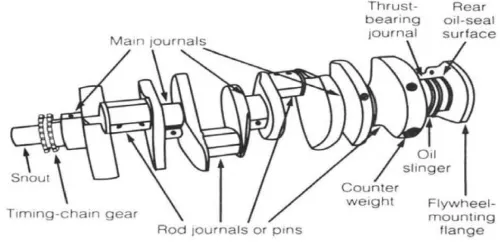
Crankshaft is a large component with a complex geometry in the engine, which converts the reciprocating displacement of the piston to a rotary motion with a four link mechanism. Design developments have always been an important issue in the crankshaft production industry, in order to manufacture a less expensive component with the minimum weight possible and proper fatigue strength and other functional requirements. These improvements result in lighter and smaller engines with better fuel efficiency and higher power output. The crankshaft consists of the shaft parts which revolve in the main bearings, the crankpins to which the big ends of the connecting rod are connected, the crank arms or webs (also called cheeks) which connect the crankpins and the shaft parts.The crankshaft main journals rotate in a set of supporting bearings ("main bearings"), [Fig.1.1] causing the offset rod journals to rotate in a circular path around the main journal centers, the diameter of that path is the engine "stroke": the distance the piston moves up and down in its cylinder. The big ends of the connecting rods("conrods") contain bearings ("rod bearings") which ride on the offset rod journals.
II. DESIGNOPTIMIZATIONMETHOD:GENETIC
ALGORITHMS
Genetic algorithms (GA) are search methods that employ processes found in natural biological evolution. These algorithms search or operate on a given population of
potential solutions to find those that approach some
[image:2.612.329.581.299.421.2]specification or criteria.
Fig. 1.1 Typical Crankshaft with main journals that support the crankshaft in the engine block.5
To do this, the algorithm applies the principle of survival of the fittest to find better and better approximations. At each generation, a new set of approximations is created by the process of selecting individual potential solutions (individuals) according to their level of fitness in the problem domain and breeding them together using operators borrowed from natural genetics. This process leads to the evolution of populations of individuals that are better suited to their environment than the individuals that they were created from, just as in natural adaptation.4
The GA will generally include the three fundamental genetic operations of selection, crossover and mutation. They usually exhibit a reduced chance of converging to local
minima. GAs suffer from the problem of excessive
complexity if used on problems that are too large. Genetic algorithms work on populations of individuals rather than single solutions, allowing for parallel processing to be performed when finding solutions to the more large and complex problems.
chosen.. Although they do not guarantee convergence to the single best solution to the problem, the processing leverage associated with GAs make them efficient search techniques. The main advantage of a GA is that it is able to manipulate numerous strings simultaneously by parallel processing, where each string represents a different solution to a given problem. Thus, the possibility of the GA getting caught in local minima is greatly reduced because the whole space of possible solutions can be simultaneously searched.1
III. FORMULATION
Problem formulation is normally the most difficult part of the process. It is the selection of design variables, constraints, objective function(s), and models of the discipline/design. Good problem formulation is the key to success of an optimization study.
A. Objective Function
The objective function is to minimize the diameter of shaft (ds) and ultimately reduce the weight of crankshaft under the effect of static load and so we can reduce the cost.
where, design vector X= {lc, dc, w}
where, dc–Diameter of the crank pin
lc–Length of the crank pin
w–web width of the crankshaft
This is the required objective function in two variables when crankshaft subjected to maximum bending moment.
B. Formulation of Constraints
According to manual design constraints can be enlisted as follows.
35 ≤dc≤42 30 ≤lc≤43 42 ≤w≤60
where,
dc–Diameter of the crank pin
lc–Length of the crank pin
w=web width of crankshaft
C Optimization problem in Standard format
From above the optimization problem in standard format can be stated as below.6
The design vector X= {lc, dc, w} which minimizes3
Subjected to constraints g1(x) =35-dc≤0 g2(x) =dc-42≤0 g3(x)=30-lc≤0 g4(x) =lc-43≤0 g5(x) =42-w≤0 g6(x) =w-60≤0 where,
ds–Diameter of the crank shaft dc –Diameter of the crank pin
lc–Length of the crank pin
w=web width of crankshaft IV. RESULTS
With the use of MATLAB genetic algorithm tool the fitness function f (x) for the genetic algorithm is calculated with the inequality constraints and the bound limit for the three variables 1)Diameter of the crank pin, dc 2) Length of the crank pin, lc 3) web width of crankshaft.
A. Summary of Manual Design Results
Diameter of the Crank Pin = 42 mm Length of the Crank Pin = 43 mm Diameter of the shaft = 48 mm
Web Thickness (Both Left and Right Hand) = 34 mm Web Width (Both Left and Right Hand) = 60 mm
W lc dc Ds
1 54.890 41.334 41.677 46.018
2 59.525 42.507 41.070 47.488
3 55.117 40.086 41.359 45.710
4 57.436 42.090 39.0290 46.467
5 0.7156 4678 0.15996 0.001
6 58.000 42.500 41.990 47.238
7 59.220 42.550 40.990 47.409
8 58.167 43.000 41.634 47.357
9 59.126 42.990 41.867 47.658
10 59.123 42.960 41.177 47.525
Table 1: Optimized Functional Values
Table 1 shows optimized minimum value of diameter of crankshaft 45.710 mm with the three different variables. i.e. 40.086 mm length of crankpin, 41.359 mm diameter of crankpin, 55.117 mm web width of crankshaft with the help of genetic algorithm.
B. Scatter plot for the fitness function
the diameter of crankshaft is also increase. When diameter of crankpin is approximate 41.35mm, the diameter of crankshaft
[image:4.612.330.582.141.340.2]45.7 mm and from this the optimized value is found for the diameter of crankpin.
Figure 4.2 found that the best fitted value for the length of crankpin. It is shown in to the diagram that the there are three minimized value of the diameter of crankshaft is around 45.7
KN but the best value for suggest the diameter of crankshaft lower value of length of crankpin that is around 40.0860 mm and figure 4.3 found the best fitted results for the diameter of crankshaft to web width of crankshaft into which the minimized value of the web width lies in between 55 mm to
[image:4.612.45.312.352.754.2]60 mm but the minimized value of the web width of crankshaft is around 55.1170 mm
Fig. 4.1 Graph on Diameter of Crankshaft, ds vs. Diameter of Crankpin, dc
[image:4.612.69.309.352.540.2]Fig.4.2 Graph on Diameter of Crankshaft, ds vs. length of Crankpin,lc
Fig. 4.3 Graph on Diameter of Crankshaft, ds vs. Web width,w.
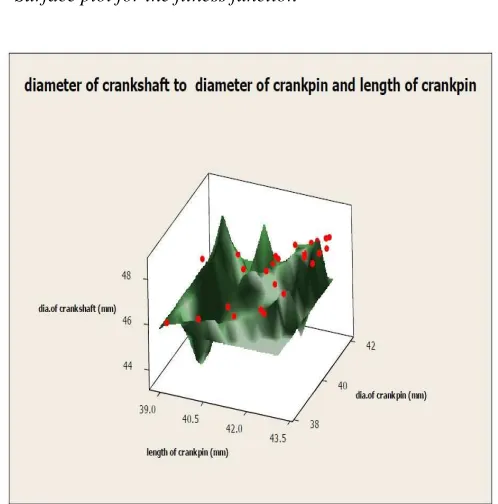
C. Surface plot for the fitness function
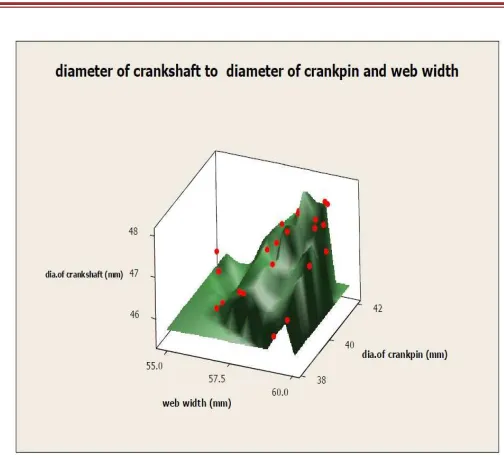
[image:4.612.325.574.377.629.2] [image:4.612.43.294.572.749.2]Fig. 4.5 Diameter of Crankshaft to Diameter of Crankpin and Web Width
Figure 4.4 indicates that the diameter of the crankshaft decreases as the diameter of crankpin decreases and as length of crankpin decreases which is seen in figure as the hill portion. The minimum value of diameter of crankshaft 45.7109 mm when the diameter of crankpin 41.35 mm and length of the crankpin 40.0860 mm.
Figure 4.5 shows that the diameter of the crankshaft decreases as the diameter of crankpin decreases and as web width decreases it will generate wave form and at the end of limit it will increase but as the both value of diameter of crankpin and web width decreases and diameter of the crankshaft is decreases initially and so that it minimize the
[image:5.612.50.314.583.715.2]value of diameter of the crankshaft 45.71mm with diameter of crankpin 41.35 mm and web width 55.117 which is seen in figure as the hill portion
Table 2 : Validation of Results
Validation of Result Genetic Algorithm
Exhaustive Search Method Input Variable :
Diameter of crankpin
(mm)
41.359
The step of 0.1 i.e. -41.1-41.2 leads to
dc=41.600
Length of crankpin (mm)
40.086
The step of 0.20 i.e. -39.20-39.4 leads to
lc=40.200
Web width (mm)
55.117
The step of 0.25 i.e. -. leads to
56.25-57 w=57.25 Output Variable Diameter of crankshaft (mm) 45.71 46.055
V. CONCLUSION
A genetic algorithm has been used for the optimum design of crankshaft. Some examples of optimum design that minimize the diameter of crankshaft under constraints are presented. The numerical results are given in graphical forms of diameter of crankpin, length of crankpin, web width. The optimized results are compared with those of exhaustive search method. All the results have the same tendency. Therefore it has a strong possibility for being used for other optimization problems.
A. Formulation
1. Formulation of single objective function is done for the minimization of diameter of crankshaft (ds) using three design variables, 1) diameter of crankpin, 2) length of crankpin, 3) web width.
B. Genetic Algorithm
1. The genetic algorithm only uses the function value and
doesn’t need derivatives calculated analytically or
numerically.
2. The scatter plot drawn with the data formed by genetic algorithm, as the value of diameter of crankpin, length of crankpin and web width decreases the diameter of crankshaft. 3. The surface plots give the relationship of diameter of crankshaft to the three parameter and it concludes that the diameter of crankshaft is proportional to 1) diameter of crankpin, 2) length of crankpin, 3) web width.
4. Genetic algorithm gives the different solution each time so that more generations need to be created for better and correct solution.
C. Exhaustive search Method
1. Exhaustive search method is the best solution method which gives perfect solution compare to other method.
2. The results are more precise when the less increment is given to the variable for solving the codes of exhaustive search method
D. Comparison of Genetic Algorithm and Exhaustive Search Method
2. The both methods give relatively close solutions for the objective function of minimize the diameter of crankshaft and ensure satisfactory strength and rigidity when the crankshaft is transmitting power under various operating conditions. In addition, it is desired to develop an optimized geometry, which will reduce the weight of the forged steel component for fuel efficiency and reduce the manufacturing cost due to high volume production of this component.
ACKNOWLEDGMENT
I would like to express my gratitude to the many people who have assisted me during the course of this research. The support extended by the C.U.Shah University and college authorities is highly appreciated and acknowledged with due respect
REFERENCES
[1] Goldberg, D.E., 1989, “Genetic Algorithm in Search Optimization and Machine Learning”, Addison-Wesley Publishing Company Inc.,Reading Massachusetts
[2] McCall, J., Genetic algorithms for modelling and optimization, Original Research Article, Journal of Computational and Applied Mathematics, Vol. 184, Issue 1, 1December 2005, Pages 205-222. [3] P.C.Sharma and D.K.Agarwal, A textbook of machine design, 1998,
S.K.Kataria and sons.
[4] Runwei Cheng and Mitsao Gen “Genetic Algorithm and Engineering Optimization” Ashikaga Institute of Technology, John Wiley& sons. Inc.
[5] Sunit Mhasade and Parasram Parihar “Design of crankshaft” NITIE students