1
Examining Children as Web Users: Methodological Considerations
Kiran, K1 and Hasliza, Ali2
1 Associate Professor; 2 PhD scholar
Department of Library & Information Science
Faculty of Computer Science & Information Technology University of Malaya, MALAYSIA
[email protected]; [email protected] Tel: 603-79676402; Fax: 603-79579249
Abstract
Access to the web is increasingly occurring in the home and at younger ages. Early childhood educational policies in some countries have mandated learning through the Web while others are following suit. Though pre-schoolers, between the ages of 3-6 may not yet be skilled readers and writers, they have been shown to have the abilities to engage competently in Web searching. In Malaysia, the National Pre-school Standard Curriculum (NPSC) states that it is mandatory for all preschools to introduce young children to Information and Communication Technology (ICT). To date there has been little research on how these pre-schoolers interact with the technology, specifically the Web. The core research questions driving this study were (i) to what extent do pre-school children engage in web searching as an everyday life activity? and (ii) What are the contents, pathways and practices of children’s web searching?
This paper begins with a discussion of possible dilemmas faced with children as participants in a qualitative research approach. Subsequently it details the design, ethics, participation and task-based methods used in investigating how preschool children engage with web searching. The classroom based study was carried out in a single preschool in Malaysia. Research involving children demands specific aspects to be considered in the research process of understanding children behaviour and actions. In using the task-based approach, several problems were faced and this paper highlights how these issues were handled and further explains how these techniques were beneficial as well. The paper concludes that the choice of methods when children are involved as subjects depends not only on the topic of research, but also their cultural and physical setting. The researcher’s own attitude and behaviour has a great impact on successfully engaging children and creating a setting within which the participants fell safe to interact, especially when their ability at conducting a specific task is being observed. It is hoped the issues highlighted in this paper will enable other researchers to consider the methodological difficulties and how to overcome them when conducting research with children as subjects.
Keywords:
1. Introduction
Research involving children has been scarce. Mainly because it is assumed (i) difficult to get children to participate and (ii) children are not able to provide reliable data. Children tend to say what older people want to hear and thus the trustworthiness of their responses is often questioned. Furthermore the explicit requirement to obtain informed consent from parents often ignore the right of the child herself/himself to
consent to participating in the research. Children of the 21st century are considered much more complex and
multi-faceted, thus require researchers to recognize that every child has his or her own experiences and these experiences may provide valid evidences for considerations in research outcomes.
According to Stephen (2003), children have particular understanding of their world, their own perspectives on their experiences and they make choices between activities based on individual preferences. One such activity is the use of information and technology communication (ICT) tools. The use of ICT in pre-schooling has been advocated by many countries. In Malaysia, the National Pre-school Standard Curriculum (NPSC), introduced in 2010, comprises a syllabus on Use of Information and Communication Technology (Ministry of Education, 2010). Children as young as 3 years old are making themselves familiar with devices such as computers, iPads, mobile phones, tablet, etc. How preschool children interact with these devices and how their technoliteracy develops from an early age is yet to be fully understood, especially in understanding the development of e-literacy.
2. Literature Review
2
Dockett and Perry (2007) used their two studies in Australia involving children to justify why and how data from children can be considered reliable, valid and generalizable. They acknowledge the importance of context in understanding children’s accounts of their experiences. They further suggest that the use of particular protocols and practices can encourage children to engage in expressing their views and perspectives for the researcher to treat them as trustworthy informants.Fargas-Malet et al (2010) discussed at length the issues researchers face with children as the informants.
They made several recommendations to researchers, among others are:
- in some cases active consent may be obtained from the children by argument that they are
capable(Munford & Sanders, 2004)
- the researcher must make sure the quality of the explanation about the study ensures informants are able
to give consent (Bogolub & Thomas, 2005)
- it is important to collect data in the right research context. Children may be influenced by the
environment within which they are being asked questions or observed. Teachers and parents are likely to influence (indirect) children to give the ‘right’ answer (Punch 2002, Clark 2005)
- use a mix of materials and techniques to assist children to open up with their responses. Use of
non-verbal probes and showing the child respect allows them to reveal even sensitive issues.
- ensure children understand the confidentiality of the information gathered and finally reward the
children for their contribution.
More recently Dockett, Einarsdottir and Perry (2015), documented the ethical tensions they faced in their experiences working with children as informants and conclude that there is no one best solution, but researchers are to approach the challenges within each unique context. Their views are based on two projects with preschool and primary school children in Iceland and Australia. The projects involved informal conversations, discussions, keeping journals, reflections on transitions to school, photo and video tours. Among the tensions faced were:
- Issues of consent: though parents’ consent is received, children may not assent. The researchers ability
to gain trust may influence on-going cooperation from the child to continue to cooperate
- Issues of Representation : children’s’ selection is mostly based on parents and teachers consent, thus
some children may have better chances of being selected simply because the parents are willing or the teachers think so, but this causes less represented, but maybe crucial children, to be neglected and important data is lost. This aspects is particularly important as each individual child has unique experiences, perspectives and understanding which ought to be represented.
- Data interpretation: engage children in interpretation of data to ensure the researcher is not restricted by
the boundaries of his research framework. This is important to authentically represent the voices of the children
Keeping these propositions in mind, the researchers embarked on this study to investigate pre-school children’s development of early techno-literacies.
3. Research Design
This study adopted a case study approach. We first conducted a preliminary survey in a single district to explore the attitudes and belief of parents and pre-school teachers on the use of Information & Communication technology (ICT) in pre-school teaching and learning. We originally selected a pre-school in the district with a large number of students and it was a feeder school to the affiliated primary school. This school also fulfilled the criteria of having a computer lab dedicated to teaching the children. We adopted 2 levels of children selection. In the initial method, we employed an activity to gauge the level of ICT knowledge among the children. A total of 50 children were asked to participate in a task oriented activity. Among them were 29 boys and 21 girls, all aged 5 years. The children were selected from 3 different classroom. These children were been assessed on their basic knowledge about Information and Communication Technology (ICT) tools.
3
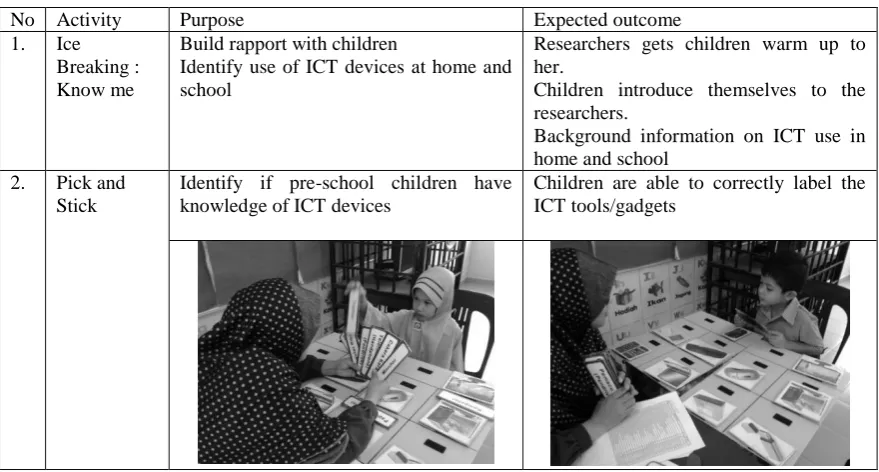
Table 1 Pick and stick taskNo Activity Purpose Expected outcome
1. Ice
Breaking : Know me
Build rapport with children
Identify use of ICT devices at home and school
Researchers gets children warm up to her.
Children introduce themselves to the researchers.
Background information on ICT use in home and school
2. Pick and
Stick
Identify if pre-school children have knowledge of ICT devices
Children are able to correctly label the ICT tools/gadgets
The method used reflects a key aspect in this study, i.e. children in pre-school have the ability to make sense of their experiences and with a little assistance they are able to articulate these experiences as behavioural repertoires (Christensen and James, 2000). The school classroom was used as the research space in accordance to Cook-Sather (2002) who suggested legitimate and valued spaces within which children can speak.
Analysis
Conversations and observations of children involved in task based activities were subject to content analysis. The children’s ability to respond quickly to recognising the respective pictures and labelling them correctly was documented as their knowledge of ICT tools. The time taken to complete the activity was also recorded. Researchers videotaped the sessions and took notes of their observations.
There are several basic assumptions that lead the path to analysis of data gathered from these children:
- Children both construct their worlds and are constructed by their worlds’ as they engage in daily
practices
- (Kincheloe, 2004)
- Internal and external validity : Dockett & Perry (2007) – does not rely on the notion of one accurate
interpretation of data and the generalizability of results – but on research outcome in context – perspective of children that are reflective of their context(s)
- Result focus on comparability, translatability (Wiersma and Jurs, 1995) and confirmability (Guba &
Lincoln, 1989)
- Approaches, methodologies and strategies of research are generalizable (Dockett & Perry , 2007)
4. Seeking Consent
The first and foremost issue we faced was with regards to obtaining consent. We began with the gatekeepers as Cree et al (2002) referred to them. The hierarchy of consent began with the highest authority which was the
foundation that runs the pre-school, the Yayasan Islam Terengganu. A written consent was obtained and this
4
With the help from the teachers, we also manage to get in touch with the second level of authority, the parents. The school allowed me to approach the parents as they came to send or pick up their child from the school. A brief information sheet was prepared to explain the purpose of the study and the parents’ permission was sought. Their child’s name was noted and this list was used for participant selection.When explaining to parents, the researcher felt that they were more easily won over when she informed them that this study was for completion of her PhD degree and that she was a registered student at a prestigious public university. Many parents felt confident with the fact that the study is not done by an independent organization, but rather by a student. They gave their consent easily. However the researcher must say that she felt a majority of the parents were not very curious about the study. Once they established the researcher was a student they immediately trusted her and did not ask for details. Many also just said… “Go ahead’ and were ready to walk away. The researcher had to explain that a written consent is a legal requirement (and only then they signed without much demand for further clarification. The consent form included details of the parents, their contact information, the child(s) name and a statement of agreement for their child to be interviewed and observed by the researcher over the period of study. Confidentiality of the data was assured and any changes in the data collection technique would be referred to again to the parents.
The participants were selected from 3 different classes and teacher were more than willing to let the researchers have time to talk with the children. The teacher walked in with the researcher to the class. The children stood up and greeted her, “Good morning teacher!” They assumed she was a new teacher. The researcher then explained to them that she was a student, just like them. At this point, no effort of a formal consent from the children was taken. Since the children were all aged 5 years old, the researchers made the assumption that the children did not yet understand her authority and would simply say ‘yes’ (give consent) as they would to their teacher. Therefore at this point the researcher decided that she would seek the children’s assent. Cocks (2007) refers to assent as ‘the sensitizing concept of gaining children’s agreement’. The researcher decided that her interactions with the children will let them decide if they wanted to participate or not. Only willing children will be cooperated into the study.
5. Research space
Considering the children’s space as the research site (Moss and Petrie, 2002), the researcher managed to engage with the children and obtain their agreement to cooperate with her. Pre-school children are basically shy and they observe and tend to follow their peers. By meeting the whole class at the same time, the researcher was able to (i) make the children feel comfortable in their own setting – they were not told to leave the class and meet the researcher individually in a separate room -this would have caused high level of anxiety among the children as they would have to meet a total stranger all alone; (ii) some children observed their classmates reactions and used their interaction with the researcher to decide to trust the researcher – this provided gentle prompting. The researcher’s presence in class gave the first impression that she was a teacher and they automatically warmed up to her. She was also seen as an authority and they have been conditioned to respond when questioned.
6. Data collection
Task 1: Ice-Breaking
5
in phones, computers and iPad. As expected, children got excited over the topic of using mobile phones and iPad. It is worth noticing that they behaved in a typical classroom manner – raising their hands to answer or contribute to the topic. This posed a challenge to the researcher as she now had to select the child who may answer. She did not want to discourage anyone, but realised that it did not deter them when not picked the first time. They still raised their hands when someone chosen had spoken. The research believes that the when seeking cooperation from children, pay attention to eager children and give them a chance to speak, but look out for quieter children and approach them to participate. In this manner the research was able to select 50 children who both showed eagerness to participate and were familiar to ICT devices to ascertain degree compared to others.Task 2: Pick and stick activity
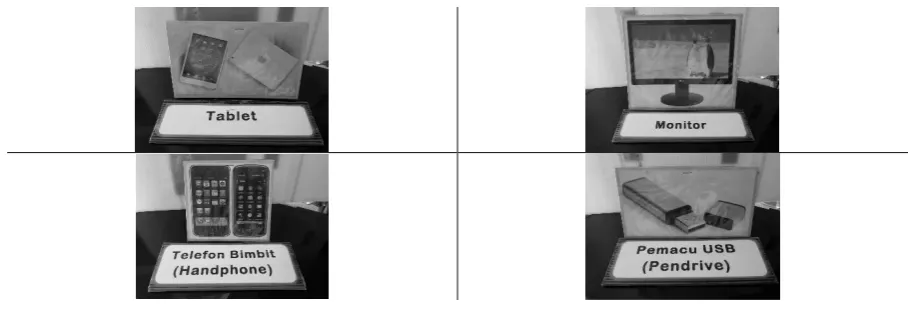
[image:5.595.63.519.416.573.2]For the second task, the researcher prepare a series of pictures and matching name cards. The child was asked to look at the 10 pictures and stick the card which correctly labelled the device. This was to gauge their familiarity with ICT devices. Pick and Stick is a familiar activity at pre-school level. Most children enjoy doing it and are familiar with the rules. Therefore it was not complicated and simple for the children to carry out. When a child finished the activity, he/she was given a small reward, a pencil. The child was happy to be rewarded. This was told to the friends and the others looked forward to the activity. During the activity the child is expected to read. Most were familiar with the words computer, laptop, hand phone, iPad, and mouse; however they were less familiar with the words pen drive and keyboard. The main purpose was to ascertain the child’s knowledge about the devices, as such the researcher did not intervene in the process of selecting the right label for each device. However, as these children were very young, there was a lot of nervousness. Sometimes they were holding the right name card, but they keep looking at the researchers for assurance. To avoid researcher’s influence on the child’s decision, the researcher chose to ‘distract’ the child with another topic, often asking them about games they like to play. After that the child would automatically carry on the activity. Figure 2 shows some of the items used in this task:
Figure 2: ICT devices
Important consideration when communicating with Malaysian pre-school children:
Language: English is not a native language of the children, however the ICT devices were better known by their English names. Sometimes, when the researcher used the English term, the children did recognize the term but managed to make an intelligent guess. For example:
Researcher : “mana satu yer pendrive?” (Which one is the pendrive?). [The pendrive
in Malay language is “pemacu USB”[
Child: Pen? Hok mana cikgu… hok cucuk tu ko? (The one we insert in?)
Researcher: ho.. (yes)
6
The pronunciations also become a problem to the preschool children. They cannot pick up the sound of the word correctly; in many instances, the researcher had to pronounce the words in English according to their dialect. At this age, some of the children could not spell the words right. So the researcher had to read out aloud and then the child could identify the spelling and stick the card to the right device.Experience and confidence: There are differences shown by a children who own a computer compared to
others who have computer at home but do not own it (the computer could be owned by their parents or siblings). Children who own a computer (given by their parents) have shown a high level of confidence. The carried out the task of labelling the devices in a short span of time and also voluntarily offered more information.
Reward: After the completion of the task, the child was rewarded. The reward was not monetary but a pencil.
The researcher noticed an increase in the willingness to be first in participating during the next session. Rewards are not incentives (Bushin, 2007) but were given only after the activity as acknowledgement of their contribution.
Co-construction: this involves developing shared understanding between the researcher and the child. The
children sometimes see things differently than adults. An example is a child who stick the word card ‘hand phone’ into the tablet picture. When the researchers said it was not the right answer, he immediately defended that his mother used it to make a call using the tablet. In this case the child’s explanation reflects his understanding of a hand phone and the researcher has to construct meaning of this.
Frustration: Children often get frustrated easily. In this task they were frustration when they did not recognize
the spelling on the word cards. One child had finished labelling 8 of the 10 pictures but got confused with the ‘pendrive’ and ‘tablet’. She stared at the words and took a long time. The researcher did not intervene. Finally she pointed out the picture of the tablet and said ‘tablet’ and then handed over both cards to the researcher. She then moved away.
Gender: There are differences shown between boys and girls regarding the feedback during the interview
session. It was notable that the boys were more active. The girls were shy and polite in answering the question as compared to the boys who were talkative. To deal with both boys and girls, the researcher has to change her approach accordingly. With the boys, the researcher became talkative and joked, while with the girls the researcher became more motherly. It was more challenging to gain their trust and get them involved in the conversation. However, in the terms of knowledge, the girls obtained higher scores than the boys.
7. Conclusion
7
References
Bogolub, E.B. and Thomas, N. (2005). Parental consent and the ethics of research with foster children:
beginning cross-cultural dialogue, Qualitative Social Work, 4(3), 271-292.
Bushin, N. 2007. Bushin, N. (2007). Interviewing with children in their homes: putting ethical principles into
practice and developing flexible techniques, Children's Geographies, 5(3), 235-251.
Christensen, P.andJames, A. 2000. Research with Children: Perspectives and Practices. London: Falmer Press
Clark, A. (2005). Listening to and involving young children: a review of research and practice. Early Childhood
Development and Care, 175(6), 489-505.
Cree, V.E., Kay, H. and Tisdall, K. (2002). Research with children: sharing the dilemmas. Child and Family
Social Work, 7, 47-56.
Cocks, A. (2007). The ethical maze: finding an inclusive path towards gaining children’s
Agreement to research participation, Childhood, 13(2), 247–266.
Cook-Sather, A. (2002). Authorizing students’ perspectives: Toward trust, dialogue, and change in education,
Educational Researcher, 31(4), 3-14.
Dockett, S. and Perry, B. (2007). Trusting children’s accounts in research, Journal of Early Childhood
Research, 5(1), 47–63.
Dockett, S., Einarsdottir, J., and Perry, B. (2015). Researching with children: ethical tensions. Journal of Early
Childhood Development, 7(3), 283-298.
Fargas-Malet, M, McSherry, D., Larkin, E., and Robinson, C. 2010. Research with children: methodological
issues and innovative techniques. Journal of Early Childhood Research, 8(2), 175-192.
Guba, E.G. and Lincoln, Y.S. (1989). Fourth Generation Evaluation: Beverly Hills, CA: SAGE
Journal Of Early Childhood Development,Kincheloe, J. (2004). Forward in L.D. Soto and B.B. Swadener( eds)
Power and Voice in Research with Children, pp. ix-xiv. New York: Peter Lang.
Munford, R, and Sanders, J. (2004). Recruiting diverse groups of young people to research: agency and
empowerment in the consent process. Qualitative Social Work, 3(4), 486-492.
Punch, S. (2002). Research with children: the same or different from research with adults, Childhood, 9(3),
321-341
Stephen, C. (2003). What makes all day provision satisfactory for 3- and 4- year olds? Early Childhood
Development and Care, 173(6), 577-588.