6
I
January 2018
Review on Effect of Machining Parameters on
Performance Characteristics of Wire EDM Process
V. Ajay 1, Dr. B.Venkateshwarlu2, Dr. T. Vishnu vardhan3, B. Sreenivasulu
1
Research Scholar, SCHOOL OF MECHANICAL AND BUILDING SCIENCES, VIT, VELLORE. T.N 2
Associate professor, SCHOOL OF MECHANICAL AND BUILDING SCIENCES, VIT, VELLORE., T.N 3, 4
Associate professor, MECHANICAL ENGINEERING DEPT, MITS, MADANAPALLE
Abstract: The Wire EDM process has several machining parameters such as pulse on time, pulse off time, supply voltage, peak current, wire speed, wire feed, machining time, and rate of flushing, material and size of the wire, dielectric type, viscosity and other flow characteristics. Several researchers have made an attempt to improve the performance characteristics namely surface roughness, cutting speed, dimensional accuracy, dimensional deviation and material removal rate. Selection of optimal machining parameters plays an important role. Improperly selected parameters may result in serious problems like shot circuit and wire breakage. Hence there is a huge demand for research studies to find out the optimal machining parameters of WEDM. In this paper; a detailed review on effect of machining parameters on performance characteristics of Wire EDM process is presented and effect of optimization of process parameters is discussed.
Keywords:Wire electrical discharge machining(WEDM) , Surface Roughness(SR),Material Removal Rate(MRR), Kerf Width(KW), Pulse on Time(Ton), Pulse off Time(Toff),
I. INTRODUCTION
It is required to produce complex part geometries that cannot be produced by following conventional machining techniques. It is no longer possible to find out tool materials which are sufficiently hard and strong to cut materials like Stainless steels, Titanium, Nimonics and similar other High Strength Temperature Resistant (HSTR) Alloys, fiber-reinforced composites, ceramics and difficult to machine alloys. Other higher level requirements are better finish, précised cut, higher production rates, complex shapes, automated data transmission, miniaturization etc to meet such demands different class of machining named as Advanced machining process have been developed. There is a need for machine tool and processes which can accurately and easily machine. The need of special processes has been responsible for the invention of a number of processes like Ultra Sonic Machine, Electric Discharge Machine, Electro Chemical Machine, Electro Chemical Grinding, Ion Beam Machine, Laser Beam Machine etc. WEDM is the thermo electric non conventional machining process in which heat energy of a spark is used to remove material from the work piece. The two electrodes are separated by the narrowest gap. Whenever sparking takes place between the two electrodes a small amount of material is removed. There are four basic elements of this machine tool 1) Power supply system 2) Dielectric system 3) Positioning system 4) Drive system
II. WORKINGPRINCIPLE
Fig 1: Working principle of WEDM
In this WEDM process, water is commonly used as the dielectric fluid. Filters and de-ionizing units are used for controlling the resistivity and other electrical properties. Wires made of brass are generally preferred. The water helps in flushing away the debris from the cutting zone. The flushing also helps to determine the feed rates to be given for different thickness of materials.The WEDM process requires lesser cutting forces in the material removal. A wire can carry heavier load if it can absorb more amount of heat without breaking. A heavier load means a spark with more energy hence higher MRR resulting in higher cutting speed. The selection of process parameters is very crucial. Improperly selected parameters may result in serious problems like shot circuit and wire breakage. WEDM is a non-conventional process and is very widely used in tool steels for pattern and die making industries. The process is also used for cutting intricate shapes in components used for the electric and aerospace industries. Properties of the wire used in this process have an impact on MRR and quality of the cut surfaces. Nowadays, stratified wires are used as electrodes. These wires are made of copper core with a thin layer of zinc over it.
III. WHYWIREEDM?
The main aim of WEDM manufacturers and users is to achieve a better stability of the process and higher productivity. Due to wide range of developments in materials and complex shapes conventional machining operations are limited upto certain limits. As a result of this the use of non-conventional machining processes are increased to a large extent. Wire electrical discharge machining manufacturers and user main focus is to enhance higher productivity with a desire tolerance and surface finish. However, due to a large number of variables even a highly skilled operator with a state-of the art WEDM is rarely able to achieve the optimal performance.
IV. APPLICATIONSOFWIRECUTEDM
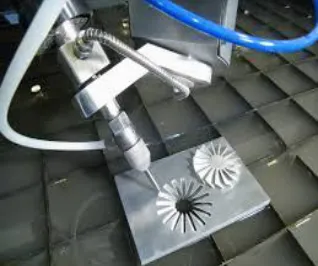
Wire EDM is used for cutting Aluminum (Al), Brass, Copper, Carbides, Graphite, steels and titanium (Ti). The material varies with application required. For Example zinc coated brass wires are used for quicker cutting action, Molybdenum wires are used for accurate applications
[image:3.612.228.387.588.721.2]A. Wedm Is Used In Many Industries Like
1) Aerospace
2) Medical
3) Electronics and Semiconductor.
4) Tool and die making industries.
5) For cutting hard extrusion dies.
6) In making fixtures, gauges and cams.
7) Cutting of gears, strippers punchers and dies
8) Manufacturing hard electrodes.
9) Manufacturing micro cooling for micro-EDM, micro USM and such other micro applications.
V. LITERATUREREVIEW
A. Amitesh Goswami, Jatinder Kumar
[1]et.al. investigates surface integrity, material removal rate and wire wear ratio for WEDM of Nimonic 80A alloy using Grey relational analysis and Taguchi method. The input parameters considered are pulse-on time (Ton), pulse-off time (Toff), Spark gap set voltage (SV), peak current (IP), wire feed (WF) and wire tension (WT). L27 orthogonal array (three levels) with six input variables was selected for experimentation.
1) Increase of Pulse on time and peak current increases the material removal rate. That means 95% of expected MRR is obtained.
2) Decrease of pulse off timeand spark gap voltage improves material removal rate.
3) ANOVA results shows that increase of peak current and pulse off time majorly affects the Wire wear rate.
4) The higher discharge energy results in melting expulsion, leading to the formation of a deeper and larger crater on the surface of
the work piece as observed in the micro structures.
B. B. Rajesh Kumar Lodhi, Sanjay Agarwar
[2]et.al has been found that optimization of machining parameters such as surface roughness in WEDM of AISI D3 steel using Taguchi technique. The input parameters considered in experiment are pulse on time, pulse off time, peak current and wire feed. ANOVA is used to study the optimization of surface roughness by varying input parameters. It was observed that the Taguchi’s parameter design is a simple, systematic, reliable and more efficient tool for optimization of machining parameters. The optimal machining values for SR are resulted as 18µs pulse on time, 51µs pulse off time, 180A peak current, 6mm/min wire feed. The ANOVA test results shows that peak current influences the SR as 61.56% and remaining parameters affects as 27.59, 5.174, and 5.27%.
C. J.B. Saedon, Norkamal Jaafar, Mohd Azman, Nor Hayati Saad
[3]et.al. have been reported on effect of process parameters such as pulse off time, peak current, wire feed rate, wire tension on performance characteristics such as surface roughness, cutting rate and material removal rate using multi objective optimization of Ti alloy through orthogonal array and grey relational analysis in WEDM. The optimal machining parameters of Ti alloy in order to achieve minimum surface roughness, higher cutting rate and material removal rate are, the pulse off time at 3µs, peak current at 12A, wire tension at 16N and wire feed at 4mm/min. The characteristics are improved by using the method.
D. Aniza Alias, Bulan Abdullah, Norliana Mohd Abbas
[4] et.al. Investigates the influence of machining feed rate in machining Ti-6Al-4v using brass wire and constant current. Experimentation would be carried out by varying process parameters such as machine feed rate, wire speed, wire tension and voltage. All experiments were carried out at constant current 4A. The input parameters are varied based on better surface finish and maximum material removal rate. The lowest machine feed rate gives minimum kerf width, feed rate increases the material removal rate, increasing wire tension improves surface quality. The optimal conditions are as machine feed rate (4mm/min), wire speed 8mm/min, wire tension .4Kg, voltage 60v were identified.
E. M. Durairaja, d. sudharsun, n. swamynathan
diameter 16, orthogonal array has been used. The input parameters selected for optimization are gap voltage, wire feed, pulse on time, and pulse off time. Dielectric fluid pressure, wire speed, wire tension, resistance and cutting length are taken as fixed parameters. The optimized input parameter combinations to get the minimum surface roughness are 40V gap voltage, 2mm/min
wire feed, 6 μs pulse on time, 10 μs pulse off time and similarly optimized conditions to get the minimum kerf width are 50V gap
voltage, 2mm/min Wire Feed, 4 μs pulse on time, 6 μs pulse off time. Based on the Grey relational analysis, the optimized input parameter combinations to get both the minimum surface roughness and the nominal KW are 50V gap voltage, 2mm/min wire feed,
4 μs pulse on time and 4 μs pulse off time.
F. G. Ugrasena, H.V. Ravindra, G.V. Naveen Prakash, R. Keshava Murthy
[6]optimized and estimated the machining performances using artificial neural network in wire EDM. Experimentation was performed as per Taguchi’s L’16 orthogonal array. Each experiment has been performed under different cutting conditions of pulse-on, pulse-off, current, and bed speed. Among different process parameters voltage and flush rate were kept constant. Molybdenum wire having diameter of 0.18 mm was used as an electrode. Based on the ANOVA method the highly effective parameters on surface roughness, MRR and accuracy were found. The control factors considered for the studies are Pulse-on, Pulse-off, Current and Bed speed. Process parameters were selected based on Taguchi’s L’16 orthogonal array. Artificial Neural Network is used to predict the response variable viz., surface roughness, MRR and accuracy. It is observed that neural network trained with 70% of the data in training set gives good prediction results when compared to the 50% and 60% of data in training set. Thus, predicted response variables of 70% training set correlates well with the measured response variables.
G. Pujari Srinivasa Rao, Koona Ramji, Beela Satyanarayana
[7] et.al. Investigated and optimized the Wire EDM parameters such as surface roughness, material removal rate on machining of Aluminium alloy by using Taguchi method. Pulse on time, pulse off time, peak current, wire feed rate, wire tension, spark gap voltage, servo feed rate, flushing pressure are taken as input parameters for experimentation. The Aluminium 2014 T6 alloy has converse properties when compared to heavy and other light metals in respect of modulus of rigidity, thermal conductivity & melting point. The developed mathematical models predicted the surface roughness & material removal rate with high regression co-efficient values 0.97 & 0.96.
H. Shivkant Tilekar, Sanka Shuvra Das, P. K. Patowari
[8] et.al. Optimized the process parameters of Wire EDM on Aluminium& Mild steel by using single objective Taguchi method. Pulse on time, pulse off time, input current & wire feed rate are used as input parameters. Wire tension, cutting length, di-electric fluid pressure, spark gap & sensitivity are taken as fixed parameters. Ton is the most effective parameter incase of longitudinal direction having significant effect on surface roughness upto 98% and in transverse direction Toff has significant effect on surface roughness upto 83% for Aluminium. The input variable Input current is the most effective parameter incase of transverse direction having statistical significant effect on surface roughness upto 98% and in longitudinal direction 83%. The Optimum values for minimum surface roughness are Ton 25µs, Toff 6 µs, Input current 1A, wire feed 80 mm/min for Aluminium and for mild steel Ton 39 µs, Toff 6 µs, Input current 1A, wire feed rate 85mm/min. For minimum kerf width Ton 32 µs, Toff 10 µs, Input current 1A, wire feed 75mm/min for Aluminium and for mild steel Ton 25 µs, Toff 10 µs, Input current 1A, wire feed 75mm/min.
VI. SUMMARY
VII. CONCLUSION
A. Taguchi Technique is a simple, systematic, reliable and more efficient tool for optimization of machining parameter.
B. Increase in Pulse on time, peak current and wire tension improves the material removal rate. At this time the number of
electrons striking the work material in a single discharge increases thus the material eroded from the work piece increases.
C. Decrease in pulse off time and spark gap voltage improves the MRR. Long pulse off time leads to decrease the temperature of
material before the next spark starts.
D. The gap between the wire and the work piece should be constant. That can be maintained by computer controlled positioning
system. Disturbances from the upper guide and lower guide generate vibrations in the wire, which ultimately influence the repetitive sparking process in spite of the controlled positioning system. It also influences the breakage of wire and harmful to the worker.
E. A low melting point in the material increases the MRR and improper heat treatment of the metal results in distortion, breakage
of the die and punches while machined by WEDM.
F. Water is used as di-electric fluid in WEDM process. The flushing pressure should be kept constant. When flushing pressure is
less than certain pressure value, it is impossible to do any machining. The increased flushing pressure increases the machining speed, improves the quality of surface and effective removal of debris.
REFERENCES
[1] AmiteshGoswami, Jatinder Kumar Investigation of surface integrity, material removal rate and wire wear ratio for WEDM of Nimonic 80A alloy using GRA and Taguchi method Department of Mechanical Engineering, National Institute of Technology, Kurukshetra 136 119, Haryana, India 14 May 2014
[3] J.B. Saedon, NorkamalJaafar, MohdAzmanYahaya, NorHayatiSaada and MohdShahirKasim Multi-objective optimization of titanium alloy through orthogonal array and grey relational analysis in WEDM 2nd International Conference on System-Integrated Intelligence: Challenges for Product and Production Engineering Procedia Technology 15 ( 2014 ) 833 – 841
[4] Aniza Alias, Bulan Abdullah, NorlianaMohd Abbas WEDM: INFLUENCE OF MACHINE FEED RATE IN MACHINING TITANIUM Ti-6Al-4V USING BRASS WIRE AND CONSTANT CURRENT (4A) International Symposium on Robotics and Intelligent Sensors 2012 (IRIS 2012) Procedia Engineering 41 ( 2012 ) 1812 – 1817
[5] M. Durairaj, D. Sudharsun, N. Swamynathan Analysis of Process Parameters in Wire EDM with Stainless Steel using Single Objective Taguchi Method and Multi Objective Grey Relational Grade International Conference On DESIGN AND MANUFACTURING, IConDM 2013 Procedia Engineering 64 ( 2013 ) 868 – 877
[6] G.Ugrasena, H.V.Ravindra, G.V.NaveenPrakash, R.Keshavamurthy Process optimization and estimation of machining performances using artificial neural network in wire EDM 3rd International Conference on Materials Processing and Characterization (ICMPC 2014) Procedia Materials Science 6 ( 2014 ) 1752 – 1760
[7] PUJARI SRINIVASA RAO, KOONA RAMJI, BEELA SATYA NARAYANA Experimental investigation and optimization of Wire EDM parameters for surface roughness, material removal rate and white layer in machining of Aluminium alloy International conference on advances In manufacturing and materials engineering,2014, 2197-2206