DEMYSTIFY USER CONCEPTION FOR ENHANCING DESIGN-USER KNOWLEDGE
Siti Mastura Md Ishak1, Rahmah Bujang2 & Hazreena Hussein3 1Sociology and Cultural Studies (Aesthetic),
Institute of Graduate Studies, University of Malaya, 50603 Kuala Lumpur, Malaysia 2Department of Socio-cultural and Malay Arts,
Academy of Malay Studies, University of Malaya, 50603 Kuala Lumpur, Malaysia 3Department of Architecture,
Faculty of Built Environment,, University of Malaya, 50603 Kuala Lumpur, Malaysia 1 [email protected] / [email protected], 2[email protected],
Abstract
Designing as a human activity has been extensively studied from a variety of user perspectives. This study investigates on traditional cultural heritage artefact by integrating practical senses to extract the design knowledge in its capability to contribute an effective system in design-user interrelationships. Lawi Ayam is a traditional artefacts with strong in sense of belongings philosophy that distinctively important to the Malays. It has a special characteristic of its capability in realizing the great function. This convergence of design and user interaction in cultural context is drawing on Aesthetic Experience framework by Locher, Overbeeke & Wensveen (2009) underscoring the Shustermen’s idea on Pragmatist Aesthetics, employs pragmatic analysis to bridge the main components; psychomotor, user cognition, usability and analytical value. This study involves exercises completed by participants to foster a vivid sense of user’s potential experience. The main findings in this paper attempts to discuss in demystifying the local sourced design-user interrelationship framework as there is no specific document on Malaysia’s development of product experience or aesthetic experience system. In addition, this study effort to materialize creative substances, bring benefits into Malaysian cultural design productivity and to inspire a maximal design impact to global end user.
Keywords
Aesthetic Experience; User-Design Interaction; Cultural Artefact, Lawi Ayam.
Introduction
User context in product designing supportively arose with putting in line the great indication of consumer sentiment in their acceptance. Margolin (1995), mentioned that the incorporation of experience into a discussion of how user relate to products is one way to fill out our understanding of who a user is. The relation of users to particular product must to be considered in developing a process to converge the priorities between aesthetic interaction and tangible information from physical artefact. Previously Dewey (1934) had stressed the similar arguments on the importance of Dem
ystify User Conce
ption -
Siti Mastura Md Ishak, R
ahmah Bujang & Hazr
eena Hussein
Conference topics
Aspects of improving the artist’s “own” awareness of his/her own practice and the knowledge it incorporates;
Aspects of insight, understanding and knowing in the work; Discussion of the processes of making the work/design/music in the context of own and other practices;
Discovery/definition of values in the process of designing/ making/doing/performing;
Implications of uncovering the aspects considered as tacit; Exploration of the tension between the understanding and emotional experience of the work of art or design;
Forms and frames relevant to represent knowledge based on creative practice;
Investigation of the relation between the creative work and its description – interpretation – explanation;
considering the mutual contributions between object and user, and his theory was also discussed by Goodman (1976) and Wollheim (1973) in capturing the mutual relations.
According to Rompay (2005), these interactions are constrained by the peculiarities of the human body, studies originating in the perspective view cognition as embodied. Respond by a user to specific device give form of behaviour resulting in human-product or human-system interaction to be reciprocal, with multiple parties behaving and influencing each other (Ross and Wensveen, 2010). Human-product interaction also was explained by Hekkert (2006) and Desmert & Hekkert (2007) referring to all the possible affective experiences that is involved, so called ‘product experience’. They discussed the manifestations of this product experience as entire set of effects that is elicited by the interaction between a user and a product such as subjective feelings, behavioural reactions, expressive reactions and physiological reactions. Eventually, previous discussions made mostly cover the tools and techniques that have been used and tested to usually think as an evaluation to be applied at the end of design process. Whereas, these techniques have proved to be powerful means to gains insight about users’ explicit and implicit desires (Laurans, Desmet & Hekkert, 2009).
Thus, to address this challenge towards developing user-centred product by pragmatic analysis, a study on broader social and cultural world from the past idea and target to understand the design knowledge based on its capability to contribute an effective system in future design-user interrelationships. The purpose of this paper is to study the user conception in behaving with traditional cultural heritage artefact as vital in incorporating of practical senses. The contribution in this paper is threefold. First, it is a new effort to establish research on materializing creative substances into Malaysian cultural design system. Second, this paper attempts to demystify the design-user interrelationship framework by specifically documenting on Malaysia’s sustainable development of their peoples’ behaviour or aesthetic experience system. Third, it will provide direction being focussed on the local designer by referring their own knowledge origin apart from depending to the style and identity established by foreign culture.
Aesthetic experience and design interaction in user conception
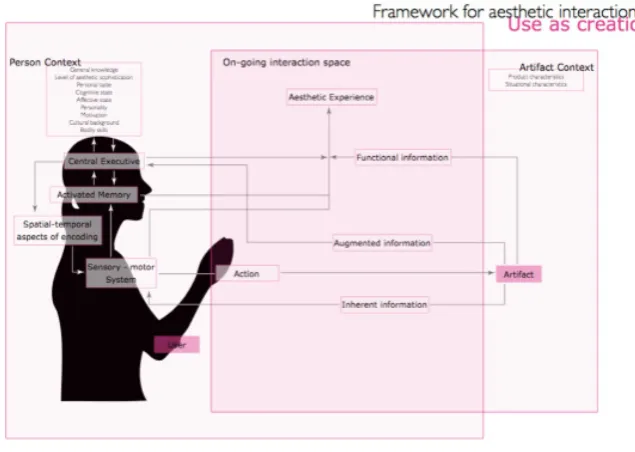
According to the scholars, user conception is commonly related to the relationship of role of experience and several user dimensions which include the social dimension, inventive dimension, operational dimension and aesthetic dimension (Margolin, 1997). Figure 1, shows a Framework for Aesthetic Experience by Locher, Overbeeke & Wensveen (2009) that explains the interaction of artefact-driven and cognitively-driven processes underlying user-product interaction. It provides a comprehensive foundation of the nature of an aesthetic experience and how it able to contribute in complex dynamic ways to influence a user’s experience in the design artefact (Wan Yusmar, 2013). These frameworks are considered to be the referral idea in investigating the topic through identified cultural artefact underscoring the Shustermen’s idea on Pragmatist Aesthetics and supported by Desmet & Hekkert (2007). According to a study of Verbeek (2005) on Technological Mediation it is shown that the way a device
[image:2.907.517.835.113.339.2](product) is influenced by a person’s response to it resulted a discussion of user aesthetic experience which offer pragmatic analysis to bridge the main components of user psychomotor, user cognition, usability and analytical value.
Figure 1
The sample framework of aesthetic interaction by Locher, Overbeeke &Wensveen (2009) used during data analysis on aesthetic experience
In order to incorporate theories discussed above, this paper is to consider several arguments applicable to extract the user conception in selected collection of past artefact. Shusterman (2000) in Pragmatist Aesthetics dwells on the dimension of aesthetic experience. He emphasized the issue in his Pragmatist Aesthetics philosophy, interconnection between aesthetic experiences with components in user dimension results in a relationship argument on intellectual performances and bodily dimension as a potential evolvement in user conception. It is by identifying the often-ignored role of the body in aesthetics evaluation. The user evaluation which involves body dimension especially in operating some particular tool needs to be understood by looking at gathered data from ethnographic approach. Investigating appraisal pattern elicited by product is able to play an important role at the beginning of a design process (Laurans, Desmet & Hekkert, 2009; Wan Yusmar, 2013; Razak Othman, 2013).
According to Margolin (1997), to recognize the value of user experience especially for new product purposes is to consider in bringing back the topic of action into its relation with experience. He also suggested in combining the method and experience rather than the method alone. Hence, user participation in design product could be able to comprehend efficiently in extracting the content of aesthetic experience. The
same practice concept was adapted in case study research by Ross & Wensveen (2010) Dem
ystify User Conce
ption -
Siti Mastura Md Ishak, R
ahmah Bujang & Hazr
wherein they employed specific value principle involving human’s value from Aesthetic Interaction (Schwartz, 1992 in Ross & Wensveen, 2010). Thus, based on previous arguments and theory, a constructive method of understanding the basic interaction in user conception is needed to enhance the knowledge of every local design-user conception.
Creative substance in cultural artefact: Lawi Ayam
[image:3.907.55.395.380.517.2]This study will treat a traditional Malay combat tool, Lawi Ayam from the vantage point of the user based on the inducement to practical action, tactical, visual, and emotional senses. Lawi Ayam is one of the traditional artefacts in weaponry categories that are distinctively important to the Malays, which is invented and widely used since the 15th century in Malay Archipelago (Razak Othman, 2012; Hill, 1956; Gardner, 1936 in Shahrum, 1967). Briefly, ‘Lawi Ayam’ (cock tail’s feather’) is a small and sharply curved weapon used in Malay Silat in Malaysia (Shahrum, 1967) as one of the protection tool. The blade is usually thin, the inner and outer edge is very sharp, and looks like a sickle shape but have unique criteria on handling it due to its small size. The hilt often has a hole or ring on it so that either forefinger (depends on individual ergonomic holding) can be inserted for better grip (refer figure 2). The Lawi Ayam design has brought a special characteristic of capability in realizing the great and awe inspiring function of its use, translates justification of the design itself, which was proven to cause death by upward-stab (radak) and swing-slash (rambit) tactics which rips open the bowels, slashes the limp and could inflict fatal death wound to a person (Gardner, 1936; Zakaria Abdullah, 2007; Wan Yusmar, 2013; Razak Othman, 2013).
Figure 2
Lawi Ayam has a hole in it so that the desired finger can be inserted for better grip
Research method
A review of the literature and ethnographic method was conducted to get into deep understanding the user behaviour and reflective thinking during interacting with the artefact. The study will need Lawi Ayam user from identified participants to be
interviewed with open ended questions and then comprise inducement to video recording and picture caption. Participants were paired to simulate user ability of the Lawi Ayam. It is covering pragmatic simulation which require above mentioned systematic observation and recording that not only to document physical evident but also the behaviours, design interactions, body automatism and perception of participant. The collected data then architected to form a design and user oriented system to link the entire data in relative way to achieve the identified objectives (Boucharenc, 2009). The result is used to determine an effective understanding in user conception knowledge.
The Observation Analysis and Findings
Since the process of ethnographic observation is interactive mode, every detail considering all the level of information process through the interaction framework between user and the design are relatively drawn into further concept comprehension. The researcher employed a framework for aesthetic experience by Locher, Overbeeke & Wensveen (2009). The response to both method (open ended questions and physical simulation) shows the vital point at first stage of core factor in user cognitive and psychomotor. It provides a comprehensive foundation of how the nature of aesthetic experience was able to contribute in complex dynamic ways that influenced user’s experience by the artefact design itself (Wan Yusmar, 2013).
Essence of user geometrical concept
The structure of movement in Lawi Ayam operational process involves intangible concept that focused on logical user body dimension and philosophy. Basic geometric shape such as triangle, square and round which emphasized in user body concept was employed effectively by participants underlying it as the essence of user and usage of Lawi Ayam. This concept needs to be well understood by the user conscious mind from the involvement of Lawi Ayam usage during intimidation environment (menace attack). It then translated unconsciously automatic during unpredicted physical contact.
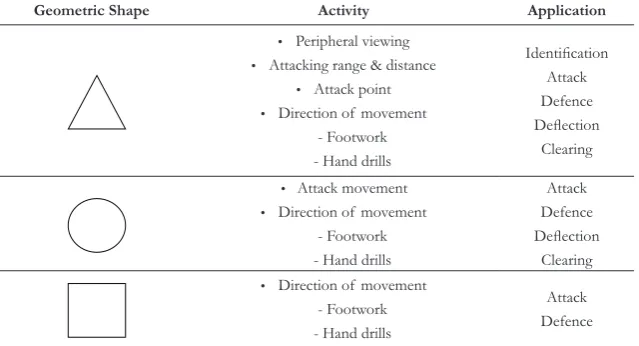
Table 1 shows the geometrical concept involvement as fundamental essence in operating the Lawi Ayam during simulation by participants. An initial evaluation of user based on information obtained from seeing the surrounding of intimidation environment and opponent, resulted triangle concept that was used efficiently through the peripheral view of user. User peripheral view is a wide angle eye viewing approximately 25 degree below direct front area of user to estimate the range for an attack or defend. It follows directed by 3 point attack on opponent body area which normally targeting the fatal cause of body part such as eye, neck and groin obtained by user, that constituted in Spatial-Temporal Aspect of Encoding (Locher, Overbeeke & Wensveen, 2009). Shape of movement such as footwork and pelampas (hand drill movement during operating Lawi Ayam) were used with appropriate high speed timing using triangle and square shape discipline motion and stepping. While direction of
attacking and deflection of attack, was consisted with same geometrical concept which Demystify User Conce
ption -
Siti Mastura Md Ishak, R
ahmah Bujang & Hazr
Range Footwork Hand drills Attack Point
Range of
clearance Peripheral View Range Footing & stepping applicationEffective attack point3 Main
Table 2
Sample of triangle geometric application on Lawi Ayam usage in user conception.
Figure 3 show the level effectiveness in application of triangle geometric concept application by reflective footwork and hand drill movement in user conception through Lawi Ayam operational activity. It shows that 50% of participants extensively use the triangle concept in hand drill movement in very good effectiveness during the simulation. Even though, the footwork movement is 38% in good level, identical percentage in excellent level also shown up to 38% by participants and its makes the triangle concept validated in the body interaction. Nevertheless, none of this both applications was in poor level which shows that triangle concept was positively accepted in user application through Lawi Ayam usage.
Figure 3
Effectiveness in triangle concept application reflective movement on Lawi Ayam operational activities
Figure 4 show the effectiveness in triangle concept application in on-scene evaluation by user on Lawi Ayam operational activities. It shows that 63% of participants extensively used the triangle concept in identifying and targeting the 3 main attack points during the simulation to get an excellent effectiveness. Percentage of effectiveness level is identical at range peripheral view method and the direction of attack with 50% in each good and very good level. Again, there is no participant also comprised round movement in it. Thus, it can be defined that basic geometrical
concept is applicable in nurturing the effectiveness in particular culture based design.
Geometric Shape Activity Application
• Peripheral viewing • Attacking range & distance
• Attack point • Direction of movement
- Footwork - Hand drills
Identification Attack Defence Deflection Clearing
• Attack movement • Direction of movement
- Footwork - Hand drills
Attack Defence Deflection Clearing • Direction of movement
- Footwork - Hand drills
[image:4.907.59.379.111.284.2]Attack Defence
Table 1
Geometrical concept involvement as fundamental essence in user simulation with Lawi Ayam
Table 2 show the usage sample of triangle shape in operating the Lawi Ayam. By using the body size of user, range of clearance is vital to be measured accordingly to initiate an attack. Range factor is important to justify the safest distance and space. Due to Lawi Ayam classified in short range combat weapon category, it is requires a perfect time movement or reaction to result an effective cause in its usage. However, factor of user agility should be considered depends on individual bodily muscle memory. Comprehension of peripheral view range aim to evaluate the surroundings within the range of danger; situation, distance of self-clearing, and even to identify any possible chances in initiating the Lawi Ayam as protection process. Other than using 4 point stepping (square shape), triangle form of footwork supposedly be understood for user to actively dictate their movement application such as attacking, defending, deflecting and self clearing. While, for drills that involves triangle motion hand movement was really effective in order to defend and initiate single attack or more. Finally, in putting the 3 main vital targets to weakening or hamstring the opponent or even could able causing a fatal death, it still working in same triangle area.
Dem
ystify User Conce
ption -
Siti Mastura Md Ishak, R
ahmah Bujang & Hazr
fails to adapted the triangle concept in the Lawi Ayam operational activities. It can be synthesized that essence of user geometric concept are greatly effective in application if it is integrated and well understood in every factor of action. The principle and discipline was interacted well while intending a situation that required a culturally invented tool to be more effective and efficient in usage.
Figure 4
Effectiveness in triangle concept application in on-scene evaluation by user on Lawi Ayam operational activities
Additionally, this research illuminates important differences between high and low effectiveness through identified concept in user-design related evaluations and behaviours and provides suggestions for future research employing the scale (Peter, Brunel & Arnold, 2003).
User experience and dynamic Usability
The relationship of user experiences in complex usage situation has been questioned previously in appraisal theory (Desmet & Hekkert, 2007; Lazarus, 1995 & Parkinson, 2009 in Laurans, Desmet & Hekkert, 2009). However, the identified data in Lawi Ayam physical simulation are potential to be upgraded as sustainable approach and certified as analysis data in usage context according to popular belief that is unconscious experience and automatic cognitive as new point of departure in user research.
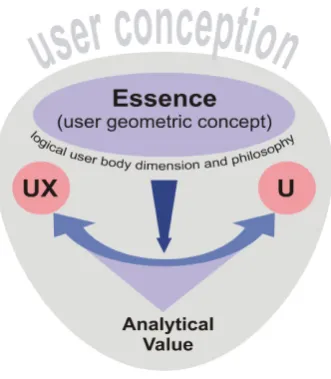
These construct connection of user experience (UX) and usability (U) of Lawi Ayam simulative evaluation was both dynamically rational as an outcome of user concept investigation for enhancing local user-design knowledge. Despite that, implementation of justified geometric concept by logical user body dimension and philosophy, and also their aesthetical visual receptions contributed effectiveness and efficiency in usage and revealing a dynamic analytical value in user conception. Figure 5 providing a schematic representation of this.
Figure 5
The construct connection of user experience and usability of simulative evaluation in user conception
Researcher and designer was introduced with the concept of usability to denote the extent to which a user to achieve effectiveness, efficiency and ease of use. Usability is relevant for user-centred design approaches as it focuses on the relationship between the user, his/her skill or abilities and the product itself (Desmet & Hekkert, 2007), and can be considered as source of product experience which is was the main idea of this paper to attempt.
Conclusion
Idea initiated in movement conception for user knowledge is related to our experience of the physical world from our own anthropomorphic bodies and the way we
understand objects around us is related to our bodily experiences arising from interaction with the spatial world (Larkoff & Johnson, 1999). Through this research, we perceive the world in relation to an intuitive bodily understanding of what we can achieve from it. The external aspect of movement focuses on the structure of the body and physical activity. While, the internal aspect of movement focuses on the mental aspects and movements originating from ‘concept’ understood by the artefact user. It is assumed that product behaviour can be enriched not only with physical movements for optimizing performance but also with mental dimension as a form of user-design knowledge. Hence, the stage to understand the concept in user-design knowledge should not be neglected especially by designer. Local designer should be equipped with information from deep local and past resources without having sceptical thinking like stating that past idea is just for the history. It should be realised that putting in line the systematic indigenous knowledge on science and technology are potential factors in brings a great assimilation for future design industry (Wynche,
Dem
ystify User Conce
ption -
Siti Mastura Md Ishak, R
ahmah Bujang & Hazr
[image:5.907.59.395.139.308.2]Sengers & Grinter, 2006). Process of documentation on cultural or traditional artefact should not serve as just a reporting but also reliable as vital resources to become newly synthesised knowledge instead. It is recommended that designer and researcher from any background and origin need to understand and gather the essential content in user conception of cultural product usage to be produce as a pioneer knowledge featuring local information. Nevertheless, sensitivity to bodily, cognitive & psychomotor aspect was essential to evaluate and then develop the prototypes. In short, sustaining the basic knowledge underscoring the term of ‘back to basic’ is important in user entity towards improvising and improving the user-design knowledge.
Acknowledgements
I would like to thank all my key informants who had kindly let me to get up close to communicate and participate in product simulations especially Guru Wan Yusmar from Silat Harimau Berantai (Chained Tiger Silat). I would also like to thank my PhD supervisor Prof Dr Datin Rahmah Bujang and Dr Hazreena Hussein for their supportive advice on how to construct this paper.
References
Boucharenc, C.: 2008, Design for A Contemporary World, National University of Singapore, Singapore.
Desmet, P. M. A., & Hekkert, P.: 2007, Framework of product experience, International Journal of Design, 1(1), pp. 57-66.
Dewey, J: 1934, Art as Experience. New York, Berkeley Publishing Group. Gardner, G. B,: 1936, Keris & Other Malay Weapon, Progressive Publication,
Singapore.
Gimlette, J. B.: 1936, Malay poisons and Charms Cures. The Malaysian Branch of the Royal Asiatic Society, 5th ed.
Goodman, N.: 1976, Languages of Art, Indianapolis, MN, Hackett Publishing Company.
Hekkert, P. & Leder, H.: 2008, Product Aesthetics, in Product Experience: Issue: September, Elsevier 44(September), pp. 259-286.
Hekkert, P.: 2006, Design Aesthetics: Principles Of Pleasure in Design, Psychology Science, 48(2), pp. 157 – 172.
Heskett, J.: 1988, Industrial Design, New York and Toronto: Oxford University, pp. 190.
Hill, A. H.: 1956, The Keris and other Malay Weapons, The Malaysian Branch of the Royal Asiatic Society, pp. 1-85.
Laurans, G., Desmet, P. M. A. & Hekkert, P. P. M.: 2009, Assessing Emotion in Interaction: Some Problems and A New Approach, International Conference on Designing Pleasurable Products and Interfaces, France.
Larkoff, G. & Johnson, M.: 1999, Philosophy in the fresh: the embodied mind and its challenge to western thought, Basic Books, New York.
Locher, P., Overbeeke, K. & Wensveen, S.: 2009, A Framework for Aesthetic Experience, ACM, Boston, MA, USA, pp. 9-12.
Margolin, V.: 1995, Design History or Design Studies: Subject Matter and Methods, Design Studies, 11(1), pp. 4-15.
Margolin, V.: 1997, Getting To Know the User, Design Studies, 18(3), pp. 227-236. Peter, H. B., Brunel, F. F. & Arnold, T. J.: 2003, Individual Differences in the Centrality
of Visual Product Aesthetics: Concept and Measurement, Journal of Consumer Research, 29(4), pp. 551-565.
Petersen, M. G., Iversen, O. S., Krogh, P. G., & Ludvigsen, M.:2004, Aesthetic
Interaction: A pragmatist’s aesthetics if interactive systems, In D. Benton, P. moody, D. Gruen, & I, McAra-McWilliam (Eds.), Proceeding of the 5th Confernce. Razak Othman, personal communication, April 6, 2013.
Rompay, T. V., Hekkert, P., Saakes, D., Russo, B.,: 2005, Grounding abstract object characteristics in embodied interactions, Acta Pyschologica 119, pp. 315-351. Ross, P. R. & Wensveen, S. A. G: 2010, Designing aesthetic of behaviour in interaction:
using aesthetic experience as a mechanism for design. International Journal of Design. 4(2), pp. 3-13.
Shahrum Yub: 1967, Kerambit dan Senjata-Senjata Pendek, Dewan Bahasa dan Pustaka, Kuala Lumpur.
Shusterman, R.: 2000, Pragmatist Aesthetics: Living Beauty, Rethinking Art, Blackwell, Oxford.
Verbeek, P. P.: 2005, What Things Do – Philosophical Reflections On Technology, Agency, And Design, University Park, PA: Pennsylvania State University Press. Wan Yusmar, personal communication, February 5, 2013.
Wolheim, R: 1973, On Art and The Mind, Cambridge, MA, Harvard University Press. Wooley, G. C: 1998, The Malay Keris; Its Origin And Development, The Malaysian
Branch of the Royal Asiatic Society, Kuala Lumpur, pp. 93-134.
Wyche, S., Sengers, P. & Grinter, R. E.,: 2006, Historical Analysis: Using the Past to Design the Future. P. Dourish & A. Friday (Eds.), Springer-Verlag Berlin Heidelberg, pp.35-51.
Zakaria Abdullah: 2007, Rahsia keris dan Senjata Warisan Melayu Kota Bharu, Warisan Darul Naim, Kelantan.
Dem
ystify User Conce
ption -
Siti Mastura Md Ishak, R
ahmah Bujang & Hazr