Evaluation of the GenoType MTBDR
sl
Version 2.0 Assay for Second-Line Drug
Resistance Detection of
Mycobacterium
tuberculosis
Isolates in South Africa
Y. Gardee,a,bA. W. Dreyer,bH. J. Koornhof,a,bS. V. Omar,aP. da Silva,b,dZ. Bhyat,a N. A. Ismaila,c
Centre for Tuberculosis, National Institute for Communicable Diseases, Johannesburg, South Africaa; Department of Clinical Microbiology and Infectious Diseases, Faculty of Health Sciences, University of the Witwatersrand, Johannesburg, South Africab; Department of Medical Microbiology, Faculty of Health Science, University of Pretoria, Pretoria, South Africac; National Health Laboratory Service, Mycobacterial Referral Laboratory, Braamfontein, Johannesburg, South Africad
ABSTRACT Early detection of resistance to second-line antituberculosis drugs is im-portant for the management of multidrug-resistant tuberculosis (MDR-TB). The Geno-Type MTBDRslversion 2.0 (VER 2.0) line probe assay has been redesigned for molec-ular detection of resistance-conferring mutations of fluoroquinolones (FLQ) (gyrAand gyrB genes) and second-line injectable drugs (SLID) (rrs and eis genes). The study evaluated the diagnostic performance of the GenoType MTBDRsl VER 2.0 assay for the detection of second-line drug resistance compared with phenotypic drug sus-ceptibility testing (DST), using the Bactec MGIT 960 system onMycobacterium tuber-culosis complex isolates from South Africa. A total of 268 repository isolates col-lected between 2012 and 2014, which were rifampin monoresistant or MDR based on DST, were selected. MTBDRsl VER 2.0 testing was performed on these isolates and the results analyzed. The MTBDRsl VER 2.0 sensitivity and specificity indices for culture isolates were the following: FLQ, 100% (95% confidence interval [CI] 95.8 to 100%) and 98.9% (95% CI, 96.1 to 99.9%); SLID, 89.2% (95% CI, 79.1 to 95.6%) and 98.5% (95% CI, 95.7 to 99.7%). The sensitivity and specificity observed for individual SLID were the following: amikacin, 93.8% (95% CI, 79.2 to 99.2%) and 98.5% (95% CI, 95.5 to 99.7%); kanamycin, 89.2% (95% CI, 79.1 to 95.6%) and 98.5% (95% CI, 95.5 to 99.7%); and capreomycin, 86.2% (95% CI, 68.3 to 96.1%) and 95.9% (95% CI, 92.2 to 98.2%). An interoperator reproducibility of 100% and an overall interlaboratory per-formance of 93% to 96% were found. The overall improvement in sensitivity and specificity with excellent reproducibility makes the GenoType MTBDRsl VER 2.0 a highly suitable tool for rapid screening of clinical isolates for second-line drug resis-tance for use in high-burden TB/HIV settings.
KEYWORDS GenoType MTBDRslversion 2.0, drug-resistant TB, MDR-TB, XDR-TB, line probe assay, LPA, fluoroquinolones, second-line injectable drugs, molecular
diagnostic testing, phenotypic drug susceptibility testing,Mycobacterium tuberculosis
T
he 2015 World Health Organization (WHO) Global Tuberculosis Report notes that approximately 3.3% of new cases of tuberculosis (TB) and 20% of previously treated TB cases in 2014 were multidrug-resistant TB (MDR-TB), defined as resistance to isoniazid (INH) and rifampin (RIF). South Africa is listed among the 14 countries that appear in all three WHO 2016 to 2020 revised high-burden country (HBC) lists (1). South Africa, with a high burden of MDR-TB, also experienced an increase in extensively drug-resistant TB (XDR-TB), accounting for 59% of XDR-TB patients reported globally in 2011 (1, 2). XDR-TB is defined as MDR-TB with additional resistance to anyfluoroquin-Received8 September 2016 Returned for
modification9 November 2016 Accepted9
December 2016
Accepted manuscript posted online14
December 2016
CitationGardee Y, Dreyer AW, Koornhof HJ,
Omar SV, da Silva P, Bhyat Z, Ismail NA. 2017.
Evaluation of the genotype MTBDRslversion
2.0 assay for second-line drug resistance
detection ofMycobacterium tuberculosis
isolates in South Africa. J Clin Microbiol 55:791– 800.https://doi.org/10.1128/JCM.01865-16.
EditorGeoffrey A. Land, Carter BloodCare &
Baylor University Medical Center
Copyright© 2017 American Society for
Microbiology.All Rights Reserved.
Address correspondence to Y. Gardee, [email protected].
AEROBIC ACTINOMYCETES
crossm
on May 16, 2020 by guest
http://jcm.asm.org/
olone (FLQ) and at least 1 second-line injectable drug (SLID) among the aminoglycoside (AG) drugs amikacin (AMK) and kanamycin (KAN) and the cyclic peptide capreomycin (CAP) (2–5). Drug resistance in Mycobacterium tuberculosis isolates occurs at a low frequency due to spontaneous chromosomal mutations (6), which are selected through the improper use of anti-TB agents and low patient compliance with treatment, exerting selective pressure for the emergence of drug-resistant mutants (acquired resistance) (7).
In South Africa, despite the emphasis on TB therapy, the HIV epidemic has seriously hampered TB management and severely affected treatment outcomes (8), while the TB-HIV coepidemic has fueled the escalation of both MDR-TB and XDR-TB (9). The introduction of new rapid molecular diagnostic tests in South Africa, notably the Xpert MTB/RIF assay (Cepheid, USA) and line probe assays (LPAs), for the detection of drug-resistant TB has markedly improved patient management with decreased result turnaround times (TATs) for testing. Culture-based phenotypic drug susceptibility testing (DST), considered to be the gold standard for drug resistance determination, is important for MDR-TB confirmation and the assessment of drug resistance to second-line and new drugs in the management of MDR-TB and XDR-TB (10). However, conventional DST is labor intensive, time-consuming, and generally takes between 2 and 3 weeks of incubation to provide meaningful treatment directing results. In addition, second-line DST is fraught with challenges due to variability of methodology, reproducibility in performance, and reliability of results. Currently, there are no rapid genotypic diagnostic tests in the South African TB diagnostic algorithm for the deter-mination of resistance to second-line anti-TB drugs (10). Molecular-based assays de-signed to detect specific drug resistance-encoding mutations inM. tuberculosis have the advantage of achieving faster TATs (within 48 h) for resistance reporting compared to conventional DST, and in the process it alerts clinicians to the emergence of drug resistance in M. tuberculosis strains from individual patients. Early detection of drug resistance is crucial to preventing the transmission of drug-resistant TB and averting mortality, as previously described (9, 11).
A current limitation of molecular assays is that they do not accommodate all mutations conferring resistance to anti-TB agents. A WHO Expert Group determined in 2013 that the GenoType MTBDRsl version 1.0 (VER 1.0) (Hain LifeScience, Germany) cannot replace phenotypic DST, but it may be used as a rule-in test for XDR-TB (12). In a meta-analysis published in 2014, Theron and colleagues (5) reported respective pooled sensitivity and specificity indices of 83.1% (95% confidence interval [CI], 78.7 to 86.7%) and 97.7% (95% CI, 94.3 to 99.1%) for FLQs and 76.9% (95% CI, 61.1 to 87.6%) and 99.5% (95% CI, 97.1 to 99.9%) for SLID for culture isolates using the GenoType MTBDRsl VER 1.0 assay. They concluded that since the assay only targets selected mutations involvinggyrA(FLQ) andrrs(SLID) gene loci, mutations encoding resistance to FLQ and SLID that occur outside these regions would be missed by the assay (5).
GenoType MTBDRslVER 2.0 is redesigned based on GenoType MTBDRslVER 1.0 and accommodates additional mutations for the molecular detection of resistance to FLQ involvinggyrAandgyrBand SLID resistance covering bothrrsandeisgenes (13). The probes target commonly occurring mutations that encode resistance to these agents. ThegyrAprobes target codons 85 to 97 of the gene, andrrsprobes target nucleic acid positions 1401 to 1484. The inclusion of additional targets for selected mutations in the gyrBregion (codons 536 to 541) andeispromoter region (⫺10 to⫺14) for low-level KAN resistance are reported to improve the performance of the assay for the detection of FLQ and SLID resistance (13).
In order to prioritize and facilitate the identification of pre-XDR-TB (resistance to INH, RIF, and to any FLQ or SLID but not both) (8) and XDR-TB in South Africa’s high-burden setting, the implementation of GenoType MTBDRslVER 2.0 would be a fundamental improvement to case detection and management. An evaluation of this assay was undertaken with the objective of assessing diagnostic performance as well as to determine interoperator and interlaboratory performance of GenoType MTBDRsl VER
on May 16, 2020 by guest
http://jcm.asm.org/
2.0 in the detection of second-line drug resistance mutations inM. tuberculosiscomplex culture isolates compared to phenotypic DST.
RESULTS
A total of 268M. tuberculosiscomplex isolates were included in the study, and the frequency of resistance to OFX, KAN, AMK, and CAP among these isolates was detected by the two methods (Table 1). Of these, 42 isolates from the NHLS Braamfontein Laboratory had phenotypic DST performed for OFX and KAN. As the DNA for the 42 isolates was not available, whole-genome sequencing (WGS) could not be performed. Resistance to one or more of the drugs under evaluation was observed in 120/268 (44.8%) of the M. tuberculosis isolates included in the study. All 27 probe bands of GenoType MTBDRslVER 2.0 strips were interpretable in all samples tested with suc-cessful positive and negative quality controls (14). Phenotypically susceptible isolates were correctly classified as susceptible by the assay.
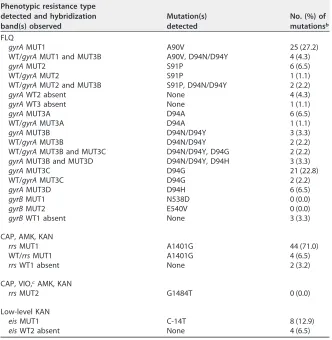
Detection of FLQ resistance.Sensitivity, specificity, and accuracy indices for FLQ (OFX) resistance using the GenoType MTBDRslVER 2.0 assay were determined as 100%, 98.9%, and 99.3%, respectively, compared to the gold standard (Table 2). There were 85/120 (70.8%) isolates resistant to FLQ as tested by DST. GenoType MTBDRslVER 2.0 detected 92 mutations in thegyrAandgyrBgenes among the 85 FLQ (OFX)-resistant isolates. The distribution of mutations is summarized in Table 3. The majority of mutations, 52/92 (56.5%), were observed at codon 94. OthergyrAmutations detected by the assay were at codon 90 (29/92; 31.5%) and at codon 91 (9/92; 9.8%).
The diversity of single defined mutations atgyrAcodon 94 included the following (Table 3):gyrAMUT3C (D94G), 23/52 (44.2%);gyrAMUT3A (D94A), 7/52 (13.5%);gyrA MUT3D (D94H), 6/52 (11.5%); andgyrAMUT3B (D94N/D94Y), 5/52 (9.6%). In 3/52 (5.8%) isolates, bothgyrA mutations MUT3B and MUT3D (D94N/D94Y and D94H) were de-tected. OthergyrAdefined mutations detected at codons 90 and 91 were the following: gyrAMUT1 (A90V), 25/29 (86.2%); andgyrAMUT2 (S91P), 7/9 (77.8%) (Table 3).
Heteroresistance ingyrAwas observed in 14/85 (16.5%) OFX-resistant isolates. Eight isolates among these exhibited two mutation bands involving codons 94, 91, and 90. Results for these isolates were the following: 4/85 (4.7%) wild-type (WT)/gyrAMUT1 and MUT3B (A90V and D94N/D94Y), 2/85 (2.4%) WT/gyrA MUT2 and MUT3B (S91P and D94N/D94Y), and 2/85 (2.4%) WT/gyrAMUT3B and MUT3C, respectively (Table 3).
[image:3.585.42.371.82.168.2]There were 8/85 (9.4%) isolates with undefined mutations that were interpreted as resistant. The following wild-type bands were not detected among these isolates:gyrA TABLE 1Summary of GenoType MTBDRslVER 2.0 LPA and DST results
Drug
(total no. of isolates)
Result [no. (%) of isolates] for:
MGIT SL-DST MTBDRslVER 2.0
Resistant Susceptible Resistant Susceptible
FLQ (OFX) (267) 85 (31.8) 182 (68.2) 87 (32.6) 180 (67.4)
AG (KAN) (268) 65 (24.3) 203 (75.7) 60 (22.4) 208 (77.6)
AGa(AMK) (226) 32 (14.2) 194 (85.8) 33 (14.6) 193 (85.4)
CAPa(226) 29 (12.8) 197 (87.2) 33 (14.6) 193 (85.4)
aExcludes isolates from the NHLS Braamfontein TB Referral Laboratory.
TABLE 2Performance of GenoType MTBDRslVER 2.0 assay
Drug (nⴝ268)
% Sensitivity (95% CI)
% Specificity
(95% CI) % PPV (95% CI) % NPV (95% CI)
Diagnostic efficacy (%)
FQ (OFX) (n⫽267) 100.0 (95.8–100) 98.9 (96.1–99.9) 97.7 (91.9–99.7) 100.0 (98.0–100.0) 99.3
SLID (AG/CAP) 89.2 (79.1–95.6) 98.5 (95.7–99.7) 95.1 (86.3–99.0) 96.6 (93.2–98.6) 96.3
AMKa(n⫽226) 93.8 (79.2–99.2) 98.5 (95.5–99.7) 90.9 (75.7–98.1) 99.0 (96.3–99.9) 97.8
KAN (n⫽268) 89.2 (79.1–95.6) 98.5 (95.7–99.7) 95.1 (86.3–99.0) 96.6 (93.2–98.6) 96.3
CAPa(n⫽226) 86.2 (68.3–96.1) 95.9 (92.2–98.2) 75.8 (57.7–88.9) 97.9 (94.8–99.4) 94.7
aExcludes isolates from NHLS Braamfontein TB Referral Laboratory.
on May 16, 2020 by guest
http://jcm.asm.org/
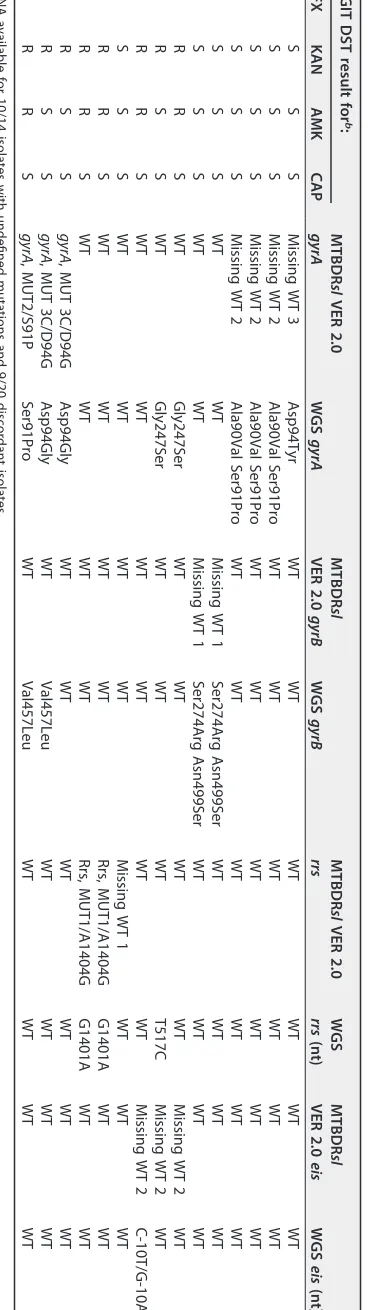
[image:3.585.41.545.657.729.2]WT2, 4/85 (4.7%);gyrAWT3, 1/85 (1.1%); andgyrBWT1, 3/85 (3.3%). WGS performed on 6/8 available isolates confirmed defined mutations at gyrA (A90V, S91P, and D94Y) missed by the assay andgyrBmutations at codons 274 and 499 that are not covered by the assay (Table 4). All 8 of these isolates were phenotypically resistant to OFX. An isolate that harboredgyrAMUT3C (D94G) mutation confirmed by WGS with an A94G mutation was phenotypically susceptible to OFX. In the selection of isolates tested, no defined mutations were detected by the assay in thegyrBregion (i.e., mutations N538D and E540V).
Detection of SLID resistance.The sensitivity, specificity, and accuracy of GenoType MTBDRslVER 2.0 for SLID resistance was 89.2%, 98.5%, and 96.3%, respectively, com-pared with phenotypic DST. The respective individual SLID sensitivity and specificity assessments were the following: 93.8% and 98.5% for AMK, 89.2% and 98.5% for KAN, and 86.2% and 95.9% for CAP (Table 2).
[image:4.585.41.373.94.434.2]GenoType MTBDRslVER 2.0 detected 56 defined mutations and 6 undefined muta-tions in either therrsoreis genes among the 65/120 (54.2%) isolates phenotypically resistant to SLID (Table 3). The most frequently observed mutation (48/56; 85.7%) for SLID resistance wasrrsMUT1 (A1401G), with four of these isolates displaying hetero-resistance. All 48 isolates were confirmed as phenotypically resistant to a SLID (AMK, KAN, or CAP). Two isolates hadrrsWT1 bands absent with no corresponding mutation band observed and 1/2 tested was wild type by WGS, with both being phenotypically susceptible to SLID. Similarly, there were 4/65 (6.2%) isolates that were interpreted as TABLE 3Hybridization patterns observed in strains classified as resistant by LPA using
GenoType MTBDRslVER 2.0 assaya
Phenotypic resistance type detected and hybridization band(s) observed
Mutation(s) detected
No. (%) of mutationsb FLQ
gyrAMUT1 A90V 25 (27.2)
WT/gyrAMUT1 and MUT3B A90V, D94N/D94Y 4 (4.3)
gyrAMUT2 S91P 6 (6.5)
WT/gyrAMUT2 S91P 1 (1.1)
WT/gyrAMUT2 and MUT3B S91P, D94N/D94Y 2 (2.2)
gyrAWT2 absent None 4 (4.3)
gyrAWT3 absent None 1 (1.1)
gyrAMUT3A D94A 6 (6.5)
WT/gyrAMUT3A D94A 1 (1.1)
gyrAMUT3B D94N/D94Y 3 (3.3)
WT/gyrAMUT3B D94N/D94Y 2 (2.2)
WT/gyrAMUT3B and MUT3C D94N/D94Y, D94G 2 (2.2)
gyrAMUT3B and MUT3D D94N/D94Y, D94H 3 (3.3)
gyrAMUT3C D94G 21 (22.8)
WT/gyrAMUT3C D94G 2 (2.2)
gyrAMUT3D D94H 6 (6.5)
gyrBMUT1 N538D 0 (0.0)
gyrBMUT2 E540V 0 (0.0)
gyrBWT1 absent None 3 (3.3)
CAP, AMK, KAN
rrsMUT1 A1401G 44 (71.0)
WT/rrsMUT1 A1401G 4 (6.5)
rrsWT1 absent None 2 (3.2)
CAP, VIO,cAMK, KAN
rrsMUT2 G1484T 0 (0.0)
Low-level KAN
eisMUT1 C-14T 8 (12.9)
eisWT2 absent None 4 (6.5)
aFor FLQ,n⫽85; for SLID,n⫽65.
bFLQ mutations,n⫽92; SLID mutations,n⫽62.
cVIO, viomycin.
on May 16, 2020 by guest
http://jcm.asm.org/
TABLE 4 WGS a results for MTBDRsl VER 2.0 isolates with undefined mutations and discordant DST MGIT DST result for b : MTBDR sl VER 2.0 gyrA WGS gyrA MTBDR sl VER 2.0 gyrB WGS gyrB MTBDR sl VER 2.0 rrs WGS rrs (nt) MTBDR sl VER 2.0 eis WGS eis (nt) OFX KAN AMK CAP R S S S Missing WT 3 Asp94Tyr WT WT WT WT WT WT R S S S Missing WT 2 Ala90Val Ser91Pro WT WT WT WT WT WT R S S S Missing WT 2 Ala90Val Ser91Pro WT WT WT WT WT WT R S S S Missing WT 2 Ala90Val Ser91Pro WT WT WT WT WT WT R S S S WT WT Missing WT 1 Ser274Arg Asn499Ser WT WT WT WT R S S S WT WT Missing WT 1 Ser274Arg Asn499Ser WT WT WT WT S R R S WT Gly247Ser WT WT WT WT Missing WT 2 WT S R S S WT Gly247Ser WT WT WT T517C Missing WT 2 WT S R R S WT WT WT WT WT WT Missing WT 2 C-10T/G-10A S S S S WT WT WT WT Missing WT 1 WT WT WT S R R S WT WT WT WT Rrs, MUT1/A1404G G1401A WT WT S R R S WT WT WT WT Rrs, MUT1/A1404G G1401A WT WT SR S S gyrA , MUT 3C/D94G Asp94Gly WT WT WT WT WT WT RR S S gyrA , MUT 3C/D94G Asp94Gly WT Val457Leu WT WT WT WT RR R S gyrA , MUT2/S91P Ser91Pro WT Val457Leu WT WT WT WT a DNA available for 10/14 isolates with undefined mutations and 9/20 discordant isolates. b R, resistant; S, susceptible.
on May 16, 2020 by guest
http://jcm.asm.org/
[image:5.585.116.300.81.736.2]resistant (absence ofeisWT2 and no mutation band observed), 3/4 were phenotypically resistant to KAN, and 1/4 was phenotypically susceptible to KAN. WGS tested 2/4 isolates as wild type, with a C-10T/G-10A mutation observed in 1/4 isolates. The eis MUT1 (C-14T) mutation was observed in 8/65 (12.3%) of the SLID-resistant isolates and confirmed phenotypically as KAN resistant. In 6/65 (9.2%) isolates phenotypi-cally resistant to KAN, norrsoreismutation was observed. These were interpreted as susceptible to SLID by the assay. DNA available for 3/6 of these isolates tested wild type by WGS (Table 4). Among five isolates (5/65; 7,7%) that were phenotyp-ically susceptible to CAP, 2/5 had therrsMUT1 (A1401G) mutation and 3/5 hadeis missing WT2, and they were interpreted as resistant to SLID by the assay. WGS performed on these isolates revealed no resistance-conferring mutations for gidB andtlyAregions. The mutationrrsMUT2 (G1484T) was not observed among any of the isolates tested.
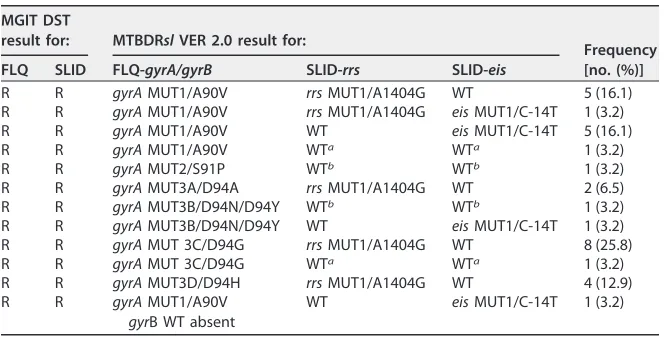
Detection of XDR-TB. Among the isolates tested, 31/120 (25.8%) were XDR by phenotypic DST (Table 5). Agreement between GenoType MTBDRslVER 2.0 and phe-notypic DST was calculated as 97.0% for the detection of XDR-TB. GenoType MTBDRsl VER 2.0 correctly identified 27/31 (87.1%) isolates, missing 4/31 (12.9%) isolates, all of which were phenotypically SLID (KAN) resistant but sensitive by the assay. WGS was performed for 2/4 isolates missed by the assay, and they were wild type forrrsandeis; however, both isolates were phenotypically resistant to KAN (SLID). All isolates with a defined mutation showed phenotypic resistance.
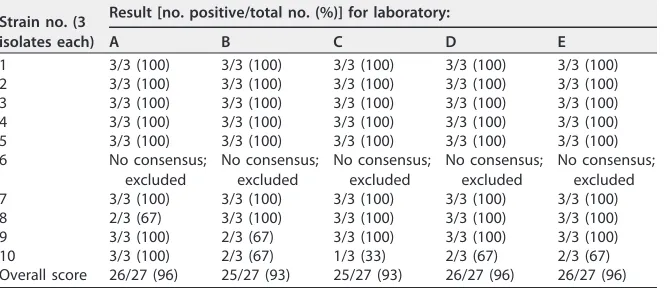
Reproducibility.Among the 5 laboratories that tested the panel of 30 isolates, the overall performance ranged between 93% and 96% (Table 6). The interoperator assess-ment showed 100% agreeassess-ment.
DISCUSSION
[image:6.585.41.375.90.259.2]To our knowledge, the evaluation of GenoType MTBDRslVER 2.0 in conjunction with a reproducibility assessment is the first such study conducted in a high TB-HIV setting in Africa. GenoType MTBDRslVER 2.0 has shown an improvement in sensitivity and specificity for the determination of molecular resistance to both FLQ (100% [95% CI, 95.8 to 100%] and 98.9% [95% CI, 96.1 to 99.9%]) and SLID (89.2% [95% CI 79.1 to 95.6%] and 98.5% [95% CI 95.7–99.7%]) compared with the pooled sensitivity and specificity of GenoType MTBDRslVER 1.0 reported by the WHO Expert Group (12) and a meta-analysis by Theron and colleagues (5). Agreement between the phenotypic gold standard and GenoType MTBDRslVER 2.0 for FLQ (OFX) and SLID was 99.3% and 96.3%, respectively, across a wide distribution of mutations. The assay was found to be highly TABLE 5MGIT DST and GenoType MTBDRslVER 2.0 analysis of XDR isolates identified
(n⫽31)
MGIT DST
result for: MTBDRslVER 2.0 result for:
Frequency [no. (%)]
FLQ SLID FLQ-gyrA/gyrB SLID-rrs SLID-eis
R R gyrAMUT1/A90V rrsMUT1/A1404G WT 5 (16.1)
R R gyrAMUT1/A90V rrsMUT1/A1404G eisMUT1/C-14T 1 (3.2)
R R gyrAMUT1/A90V WT eisMUT1/C-14T 5 (16.1)
R R gyrAMUT1/A90V WTa WTa 1 (3.2)
R R gyrAMUT2/S91P WTb WTb 1 (3.2)
R R gyrAMUT3A/D94A rrsMUT1/A1404G WT 2 (6.5)
R R gyrAMUT3B/D94N/D94Y WTb WTb 1 (3.2)
R R gyrAMUT3B/D94N/D94Y WT eisMUT1/C-14T 1 (3.2)
R R gyrAMUT 3C/D94G rrsMUT1/A1404G WT 8 (25.8)
R R gyrAMUT 3C/D94G WTa WTa 1 (3.2)
R R gyrAMUT3D/D94H rrsMUT1/A1404G WT 4 (12.9)
R R gyrAMUT1/A90V
gyrB WT absent
WT eisMUT1/C-14T 1 (3.2)
aWGS not available.
bWGS result: WT.
on May 16, 2020 by guest
http://jcm.asm.org/
reproducible in terms of interlaboratory (93 to 96%) and interoperator (100%) assess-ment.
FLQ resistance inM. tuberculosisis ascribed mainly togyrAmutations, with 57.5% of mutations detected at codon 94 and 31.5% at codon 90 (15). Consistent with published data, the highest frequency of mutations conferring FLQ resistance was observed in gyrAcodon 94, followed by codon 90 (Table 3). Furthermore,gyrAmutations D94G and D94N were observed in the majority of the isolates tested. Previous studies have indicated that isolates harboring these mutations exhibit high levels of resistance to FLQ (15, 16). ThegyrAMUT3D/D94H mutation, reported as a rarein silicomutant (13, 17), was observed in 9/85 (10.6%) of mutations identified from these clinical isolates. Heteroresistance involving either FLQ or SLID was detected in 18/85 (21.2%) of isolates, with multiple mutation bands observed in some isolates (Table 3), and were confirmed as phenotypically resistant. Cohen et al. reported on mixed-strain infections in a hospital setting in KwaZulu-Natal, South Africa (18). Further investigation is required to elucidate the frequency and clinical relevance of mixed infections across a more widespread South African setting. Based on our findings, interpretation of these strains as resistant was consistent with the phenotypic DST results.
Undefined mutations with the absence ofgyrAwild-type bands were confirmed as phenotypically resistant. WGS results available for four isolates confirmed the presence ofgyrAmutations that the assay missed. The GenoType MTBDRslVER 2.0 guideline for interpretation of results states that “only bands with intensities as strong as or stronger than the amplification control zone (AC) are to be considered” (13). Three out of four of these discordant isolates hadgyrAMUT2/S91P bands with intensities less than that of the AC zone and therefore were interpreted as negative and reported as resistant due to the absence ofgyrAwild-type bands. No weak-intensity mutation bands were detected in the fourth isolate. An isolate phenotypically susceptible to OFX withgyrAMUT 3C/D94G bands and a confirmed Asp94Gly mutation on WGS hadgyrAWT bands with less intensity than the AC control band. The discrepant OFX phenotypic DST is possibly due to a mixed population. The inclusion of selected gyrBprobes offered limited enhancement to the identification of FLQ mutations, as only the absence ofgyrBWT was observed in 3/268 (1.1%) isolates. GenoType MTBDRslVER 2.0 is limited to detecting mutations in selected areas of the quinolone resistance-determining regions (QRDR) of gyrA and gyrB only; therefore, FLQ resistance mechanisms outside these regions are likely to be missed but do not appear to be a major concern in our setting presently.
[image:7.585.42.376.94.238.2]Consistent with published data (17),rrsMUT1 A1401G (translating to high-level SLID resistance) was the most frequently observed mutation (77.5%) among tested isolates. The overall SLID sensitivity has improved in the new assay to 89.2% compared with previously published data (5, 12). The inclusion ofeispromoter region probes improved the detection of SLID resistance, as observed in 8/62 (12.9%) low-level KAN-resistant isolates, all phenotypically KAN resistant and not associated with rrsmutations. Two TABLE 6Reproducibility assessment of participant laboratories for GenoType MTBDRsl VER 2.0
Strain no. (3 isolates each)
Result [no. positive/total no. (%)] for laboratory:
A B C D E
1 3/3 (100) 3/3 (100) 3/3 (100) 3/3 (100) 3/3 (100)
2 3/3 (100) 3/3 (100) 3/3 (100) 3/3 (100) 3/3 (100)
3 3/3 (100) 3/3 (100) 3/3 (100) 3/3 (100) 3/3 (100)
4 3/3 (100) 3/3 (100) 3/3 (100) 3/3 (100) 3/3 (100)
5 3/3 (100) 3/3 (100) 3/3 (100) 3/3 (100) 3/3 (100)
6 No consensus;
excluded
No consensus; excluded
No consensus; excluded
No consensus; excluded
No consensus; excluded
7 3/3 (100) 3/3 (100) 3/3 (100) 3/3 (100) 3/3 (100)
8 2/3 (67) 3/3 (100) 3/3 (100) 3/3 (100) 3/3 (100)
9 3/3 (100) 2/3 (67) 3/3 (100) 3/3 (100) 3/3 (100)
10 3/3 (100) 2/3 (67) 1/3 (33) 2/3 (67) 2/3 (67)
Overall score 26/27 (96) 25/27 (93) 25/27 (93) 26/27 (96) 26/27 (96)
on May 16, 2020 by guest
http://jcm.asm.org/
isolates, withrrsWT1 bands absent, no corresponding mutation band observed, wild type by WGS, and interpreted as resistant to SLID by the assay, were phenotypically susceptible to SLID. The omission of WT bands in the line probe assay is not a reliable indication of phenotypic resistance and would require confirmatory phenotypic DST (19). In 6 phenotypically KAN-resistant isolates that were AMK susceptible, no mutations were detected by the assay or WGS. Although other factors related to phenotypic resistance cannot be excluded, the discrepant results may be due to the inherent challenges of in-house (nonstandardized) second-line drug preparations available for testing (19). Five isolates that were phenotypically susceptible to CAP, interpreted as SLID resistant by the assay and wild type by WGS, displayed resistance only to KAN and AMK phenotypically. As indicated by Georghiou et al. (20),rrsMUT1 A1401G mutation is a moderate predictor of CAP resistance. Therefore, CAP resistance should be con-firmed phenotypically prior to exclusion of the drug from a treatment regimen (21).
There were 31 isolates identified as phenotypically XDR, and the GenoType MTBDRsl VER 2.0 assay achieved 97.0% agreement between the index and gold standard tests. Of the four XDR cases misclassified by the assay, all showed FLQ resistance but missed SLID resistance. All were phenotypically KAN resistant. One isolate was classified as XDR by LPA with gyrA MUT1 (A90V) and a missing eis WT2 only (C-12T/G-10A) but was phenotypically susceptible to KAN. We used strict criteria, and resistance to any one SLID was accepted as a criterion to classify a strain as XDR. Due to limited availability of standardized drug preparations for second-line DST, in routine practice, laboratories would normally only test one drug out of this class for resistance determination. This is a limitation of the data available for this sample set, as mutations in the assay are known to correlate well with OFX resistance and is evident in our observations. As reported, correlation of these mutations with higher FLQs is uncertain and may still show phenotypic susceptibility despite the presence of these mutations; thus, pheno-typic testing remains important for these drugs (22, 23).
The reproducibility assessment of selected routine laboratories showed excellent performance consistent with other data on molecular diagnostics (Table 6) (24). Geno-Type MTBDRsl VER 2.0 LPA performed well with excellent reproducibility and high sensitivity and specificity for FLQ and SLID resistance determination. The average reporting turnaround times for GenoType MTBDRslVER 2.0 LPA varied from 2 to 4 days subsequent to the identification of a positive TB culture, whereas second-line pheno-typic DST results were only available in 14 to 21 days. The longer TAT for DST results is largely dependent on the viability/fitness of the isolate, especially for XDR isolates. It also highlights the importance of direct testing in providing clinically relevant and reliable results.
Furthermore, adoption of the assay in laboratories already performing the Geno-Type assays was relatively easy and quick to implement. GenoGeno-Type MTBDRslVER 2.0 LPA is therefore suitable for testing clinical isolates as a rapid screening tool for detection of second-line drug resistance in countries with a high burden of MDR-TB.
A limitation of the study was that only culture isolates were used and not clinical specimens, as this study was performed to compare directly the GenoType MTBDRsl VER 2.0 assay with the gold standard, phenotypic DST. However, there is a need for further studies evaluating the GenoType MTBDRslVER 2.0 assay on clinical specimens from patients with MDR-TB, thereby enhancing the turnaround time for resistance reporting and pre-XDR/XDR case detection in high-risk settings. Another limitation was that of the FLQs, only OFX was tested and none of the other later-generation FLQs (isolates collected between 2012 and 2014). This probably explains the higher sensi-tivity found in our study compared with other studies (25). Phenotypic DST for later-generation FLQs (moxifloxacin) was introduced in 2015 per WHO recommenda-tions (22, 23). A general limitation of second-line drug testing is the limited availability of standardized drug preparations (19). A further limitation was that samples from the Braamfontein TB Referral Laboratory could not be included for WGS resolution testing, as the DNA was not available.
In a press release by the WHO in May 2016, the use of the GenoType MTBDRslVER
on May 16, 2020 by guest
http://jcm.asm.org/
2.0 assay as “an initial test, instead of phenotypic culture-based DST” to detect FLQ and SLID resistance in confirmed RIF-R and MDR patients was recommended (26, 27). Appropriately trained laboratory staff, quality assurance, and availability of laboratory infrastructure are requisite recommendations of the WHO to implement use of this assay (26, 27). Our study provides support and evidence for these recommendations and the implementation of the assay in South Africa.
MATERIALS AND METHODS
Setting and study design.The evaluation of the GenoType MTBDRslVER 2.0 assay was conducted at the Centre for Tuberculosis, National Institute for Communicable Diseases (CTB, NICD), Johannesburg, South Africa. The laboratory is a designated WHO Supranational Laboratory (SRL) accredited to ISO 15189:2012 (14). The Human Research Ethics Committee of the University of Witwatersrand, Johannes-burg, South Africa, approved the study (M150752). The study was structured with two interrelated components involving the validation of characterized M. tuberculosisisolates and a reproducibility assessment using a subset of these isolates tested by selected National Health Laboratory Service (NHLS) laboratories in South Africa, performing diagnostic tests involving culture ofM. tuberculosis.
Mycobacterial isolates.A total of 268 repository isolates collected between 2012 and 2014 were tested. These were comprised of 92 phenotypically well-characterizedM. tuberculosiscomplex isolates using whole-genome sequencing (WGS) and 176 anonymizedM. tuberculosisclinical isolates exhibiting rifampin monoresistance (RIF-R) or MDR based on phenotypic DST, tested at the CTB or NHLS TB Referral Laboratory, Braamfontein, Johannesburg, South Africa. Phenotypic testing for later generations of FLQ and SLID was introduced in 2015 (2). These isolates originated from Gauteng, Limpopo, Northern Cape, North West, KwaZulu-Natal, and Mpumalanga provinces, collected during surveillance activities for rifampin resistance in South Africa. The fully susceptible ATCCM. tuberculosisH37Rv 27294 reference strain (http://www.atcc.org/Products/All/27294.aspx) was used as the DST and LPA positive quality control culture.
Phenotypic DST.Bactec MGIT 960 DST using EpiCenter software (Becton, Dickinson and Company Diagnostic Systems, Sparks, MD, USA) for interpretation of results was performed according to the manufacturer’s recommendations (28) and considered the gold standard for resistance determination. The following critical concentrations of drugs recommended by WHO for testing of drug-resistant TB using Bactec MGIT 960 DST were used: ofloxacin (OFX), 2.0g/ml; AMK, 1.0g/ml; KAN, 2.5g/ml; and CAP, 2.5g/ml (22).
GenoType MTBDRslVER 2.0.The GenoType MTBDRslVER 2.0 assay was performed according to the manufacturer’s instructions (13). Each strip contains 27 reaction zones with probes for all specific targeted regions. Seven probes forgyrA(A90V, S91P, D94A, D94N/Y, D94G, and D94H) and 2 probes for gyrB(N538D and E540V) were used to detect FLQ resistance. SLID resistance was detected by selected rrs(A1401G, C1402T, and G1484T) andeis(C-14T and C-12T) probes. The presence of all wild-type bands and absence of mutation bands indicated susceptibility. The development of specific mutation bands (defined mutation) or the absence of wild-type bands (undefined mutation) (29) related to a specific gene on the hybridization strip was interpreted as resistance to the respective drug (13). Heteroresistance was demonstrated when both wild-type and/or mutation band(s) were present and was recorded as resistant for interpretation purposes. SLID resistance referred to resistance to at least one of the 3 injectable drugs (AMK, KAN, and CAP) (5).
Discordance resolution by whole-genome sequencing.WGS was used to resolve discordance between phenotypic and genotypic methods. WGS was performed using the MiSeq platform (Illumina, San Diego, CA). Library preparation was performed using the Illumina Nextera XT library preparation kit and sequencing reaction using the MiSeq version 3 cartridge (2 ⫻ 300 bp). Variant detection was performed using the resequencing module with the reference strainM. tuberculosisH37Rv (NC_000962) on CLC Genomics Workbench (v7.5.1).
Reproducibility.In order to evaluate the interlaboratory performance of the assay, a panel of 10M.
tuberculosis complex external quality assurance (EQA) isolates, constituting a subset of the isolates
evaluated in the present study comprised of 10 isolates present in triplicate, was distributed to 5 NHLS laboratories performing diagnostic culture ofM. tuberculosisas well as LPA (30). An overall agreement of
ⱖ90% was deemed an acceptable score. Interoperator reproducibility was performed by comparing findings on 45 EQA isolates tested by two operators at CTB, working independently.
Statistical analysis.Sensitivity, specificity, positive predictive value (PPV), and negative predictive value (NPV), based on agreement between the DST gold standard and the index assay and 95% confidence intervals (95% CIs), were calculated for both the antibiotic class and individual drugs. Agreement between the gold standard and index assay was calculated using the McNemar test. Statistical analyses were performed using Stata release 13 (31).
ACKNOWLEDGMENTS
We thank Hain LifeScience, South Africa, for providing GenoType MTBDRslVER 2.0 reagents and training at participating laboratories, the staff members of CTB NICD/ NHLS, and the participant NHLS laboratories for their assistance during the study.
Funding from the CTB NICD/NHLS supported this study. We have no conflicts of interest to declare.
on May 16, 2020 by guest
http://jcm.asm.org/
REFERENCES
1. WHO. 2015. Global tuberculosis report 2015. WHO, Geneva, Switzerland. 2. WHO. 2014. Global tuberculosis report 2014. WHO, Geneva, Switzerland. 3. WHO. 2011. Guidelines for the programmatic management of
drug-resistant tuberculosis. WHO, Geneva, Switzerland.
4. Imperiale BR, Zumárraga MJ, Di Giulio AB, Cataldi AA, Morcillo NS. 2013. Molecular and phenotypic characterisation of Mycobacterium tubercu-losis resistant to anti-tubercutubercu-losis drugs. Int J Tuberc Lung Dis 17: 1088 –1093.
5. Theron G, Peter J, Richardson M, Barnard M, Donegan S, Warren R, Steingart KR, Dheda K. 2014. The diagnostic accuracy of the GenoType MTBDRsl assay for the detection of resistance to second-line anti-tuberculosis drugs. Cochrane Database Syst Rev. 2014:CD010705. 6. Müller B, Streicher EM, Hoek KGP, Tait M, Trollip A, Bosman ME, Coetzee
GJ, Chabula-Nxiweni EM, Hoosain E, Gey van Pittius NC, Victor TC, van Helden PD, Warren RM. 2011. inhA promoter mutations: a gateway to extensively drug-resistant tuberculosis in South Africa? Int J Tuberc Lung Dis 15:344 –351.
7. Zhang Y, Yew WW. 2009. Mechanisms of drug resistance in Mycobacte-rium tuberculosis. Int J Tuberc Lung Dis 13:1320 –1330.
8. Niehaus A, Milisana K, Gandhi N, Mathema B, Brust J. 2015. High prev-alence of inhA promoter mutations among patients with drug-resistant tuberculosis in KwaZulu-Natal, South Africa. PLoS One 10(9):e0135003.
https://doi.org/10.1371/journal.pone.0135003.
9. Gandhi N, Moll A, Sturm A, Pawinski R, Govender T, Lalloo U, Zeller K, Andrews J, Friedland G. 2006. Extensively drug-resistant tuberculosis as a cause of death in patients co-infected with tuberculosis and HIV in a rural area of South Africa. Lancet 368:1575–1580. https://doi.org/
10.1016/S0140-6736(06)69573-1.
10. National Department of Health. 2014. National tuberculosis manage-ment guidelines 2014. National Departmanage-ment of Health, Pretoria, South Africa.www.nicd.ac.za/assets/files/Acrobat%20Document2.pdf. 11. Barnard M, Albert H, Coetzee G, O’Brien R, Bosman ME. 2008. Rapid
molecular screening for multidrug-resistant tuberculosis in a high-volume public health laboratory in South Africa. Am J Respir Crit Care Med 177:787–792.https://doi.org/10.1164/rccm.200709-1436OC. 12. WHO Expert Group. 2013. The use of molecular line probe assay for the
detection of resistance to second-line anti-tuberculosis drugs. WHO, Geneva, Switzerland.
13. HAIN LifeScience. 2015. GenoType MTBDRsl VER 2.0 instructions for use. Document IFU-317A-01. HAIN LifeScience, Nehren, Germany. http://
www.hain-lifescience.de/en/instructions-for-use.html.
14. International Organization for Standardization. 2012. Medical laboratories–requirements for quality and competence. International Organization for Standardization, Geneva, Switzerland. http://
www.iso.org/iso/catalogue_detail?csnumber⫽56115.
15. Li J, Gao X, Luo T, Wu J, Sun G, Liu Q, Jiang Y, Zhang Y, Mei J, Gao Q. 2014. Association ofgyrA/B mutations and resistance levels to fluoro-quinolones in clinical isolates of Mycobacterium tuberculosis. Emerg Microbes Infect 3:e19.https://doi.org/10.1038/emi.2014.21.
16. Kambli P, Ajbani K, Sadani M, Nikam C, Shetty A, Udwadia Z, Rodwell TC, Catanzaro A, Rodrigues C. 2015. Correlating minimum inhibitory con-centrations of ofloxacin and moxifloxacin withgyrAmutations using the genotype MTBDRsl assay. Tuberculosis 95:137–141. https://doi.org/
10.1016/j.tube.2014.11.003.
17. Ajbani K, Nikam C, Kazi M, Gray C, Boehme C, Balan K, Shetty A, Rodrigues C. 2012. Evaluation of genotype MTBDRsl assay to detect drug
resistance associated with fluoroquinolones, aminoglycosides and ethambutol on clinical sediments. PLoS One 7(11):e49433. https://
doi.org/10.1371/journal.pone.0049433.
18. Cohen T, Wilson D, Wallengren K, Samuel E, Murray M. 2011. Mixed-strain Mycobacterium tuberculosis infections among patients dying in a hospital in KwaZulu-Natal, South Africa. J Clin Microbiol 49:385–388.
https://doi.org/10.1128/JCM.01378-10.
19. Richter E, Rüsch-Gerdes S, Hillemann D. 2009. Drug-susceptibility testing in TB: current status and future prospects. Expert Rev Respir Med 2009:497–510.
20. Georghiou SB, Magana M, Garfein RS, Catanzaro DG, Catanzaro A, Rodwell TC. 2012. Evaluation of genetic mutations associated with Mycobacterium tuberculosis resistance to amikacin, kanamycin and capreomycin: a systematic review. PLoS One 7(3):e33275. https://
doi.org/10.1371/journal.pone.0033275.
21. Kambli P, Ajbani K, Nikam C, Sadani M, Shetty A, Udwadia Z, Georghiou SB, Rodwell TC, Catanzaro A, Rodrigues C. 2015. Correlating rrs and eis promoter mutations in clinical isolates of Mycobacterium tuberculosis with phenotypic susceptibility levels to the second-line injectables. Int J Mycobacteriol 5:1.https://doi.org/10.1016/j.ijmyco.2015.09.001. 22. WHO. 2014. Companion handbook to the WHO guidelines for the
programmatic management of drug-resistant tuberculosis. WHO, Ge-neva, Switzerland.
23. WHO. 2016. Treatment of drug-resistant TB: resources. WHO, Geneva, Switzerland.
24. Fattorini L, Migliori GB, Cassone A, Mustazzolu A, Piccaro G, Filippini P, Cirillo DM, Borroni E, Italian Multicentre Study on Resistance to Antitu-berculosis Drugs Group. 2012. Proficiency testing of first- and second-line anti-tuberculosis drugs in Italy. Eur Respir J 39:1263–1266. 25. Tagliani E, Cabibbe AM, Miotto P, Borroni E, Toro JC, Mansjö M, Hoffner
S, Hillemann D, Zalutskaya A, Skrahina A, Cirillo DM. 2015. Diagnostic performance of the new version (v2.0) of GenoType MTBDRsl assay for detection of resistance to fluoroquinolones and second-line injectable drugs: a multicenter study. J Clin Microbiol 53:2961–2969.
26. WHO. 2016. The use of molecular line probe assays for the detection of resistance to second-line anti-tuberculosis drugs–policy guidance 2016. WHO, Geneva, Switzerland.
27. WHO. 2016. Rapid diagnostic test and shorter, cheaper treatment signal new hope for multidrug-resistant tuberculosis patients. WHO, Geneva, Switzerland. http://www.who.int/mediacentre/news/releases/2016/
multidrug-resistant-tuberculosis/en/.
28. Siddiqi SH. 2007. Bactec MGIT 960 TB system procedure manual. FIND Diagnostics, Cape Town, South Africa. www.finddx.org/wp-content/
uploads/2016/02/mgit_manual_nov2006.pdf.
29. Daum L, Fourie P, Bhattacharyya S, Ismail N, Gradus M, Maningi N, Omar S, Fischer G. 2014. Next-generation sequencing for identifying pyrazin-amide resistance in Mycobacterium tuberculosis. J Clin Microbiol 50: 3831–3837.
30. Laszlo A, Rahman M, Espinal M, Raviglione M, WHO/IUATLD Network of Supranational Reference Laboratories. 2002. Quality assurance pro-gramme for drug susceptibility testing of Mycobacterium tuberculosis in the WHO/IUATLD Supranational Reference Laboratory Network: five rounds of proficiency testing, 1994-1998. Int J Tuberc Lung Dis 6:748 –756.
31. Stata Press. 2013. S Stata: release 13. Statistical software. StataCorp LP, College Station, TX.https://www.stata.com/manuals13/u.pdf.