Spatio Temporal Dynamic Routing Protocol for
Wireless Rechargeable Sensor Network using
Heuristic based Jointly Coupling of Link and
Battery Constrainst
Mrs. R. Carolene Praveena1,Mrs. V. PriyaRanjani2 1
Assistant Professor, Dept. of Computer Science, Sri Jayendra Saraswathy Vidyalaya College of Arts & Science, Coimbatore
2
Research Scholar, Sri Jayendra Saraswathy Vidyalaya College of Arts & Science, Coimbatore
Abstract: The velocity control of the mobile chargers travelling the irregular 2D Trajectories is optimized using the Spatio Temporal Dynamic Routing (STDR) Technique to Rechargeable Wireless Sensor Network in order to extend the life time of the sensor nodes. In this paper, we propose a new protocol, heuristic conditions allowed to optimize the sampling rate and battery level by carefully tackling the spatiotemporally coupled link and battery capacity constraints of the wireless sensor nodes. The Wireless Nodes utilities the dynamic node monitoring model which has to gather the data about energy of the each node as well data sampling rate, Node failure and link failure etc. Each node exhibits different performance, hence it is desirable to represent the movement of the mobile charger using several criteria; therefore we utilize joint heuristic solution to handle to charging movement of the mobile charges based on the network requirement. The Simulation results of proposed system demonstrate that the proposed algorithm always achieves higher network utility than existing approaches. In addition, the impact of link/battery capacity and initial battery level on the network utility is further investigated.
Index Terms – Wireless Rechargeable Sensor Network, network utility maximization, velocity control, mobile charging, Energy Management
I. INTRODUCTION
analysis and finally section 5 is concluded.
II. RELATED WORK
A. Radio Frequency based Charging Controlling Scheme
The Wireless Identification and Sensing Platform (WISP) is an open-source platform that integrates sensing and computation capabilities to the traditional RFID tags. Different from traditional tags, a RFID-based wireless rechargeable sensor node needs to charge its onboard energy storage above a threshold in order to power its sensing, computation and communication components. Consequently, such charging delay imposes a unique design challenge for deploying wireless rechargeable sensor networks. In this paper, we tackle this problem by planning the optimal movement strategy of the RFID reader, such that the time to charge all nodes in the network above their energy threshold is minimized [5]. An optimal solution using the linear programming method is analysed.
To further reduce the computational complexity, a heuristic solution with a provable approximation ratio of (1 + θ)/(1 − ε) by discretizing the charging power on a two-dimensional space.
B. Adaptive and knowledge protocol for Wireless Energy Transfer
In Wireless Rechargeable Sensor Networks (WRSNs) a Mobile Charger traverses the network and wirelessly replenishes the energy of sensor nodes. In contrast to many approaches, we envision methods that are distributed, adaptive and use limited network information using three new, alternative protocols for efficient charging, addressing key issues which we identify, most notably (i) to what extent each sensor should be charged, (ii) what is the best split of the total energy between the charger and the sensors and (iii) what are good trajectories the Mobile Charger should follow. One of our protocols (LRP) performs some distributed, limited sampling of the network status, while another one (RTP) reactively adapts to energy shortage alerts judiciously spread in the network. We conduct detailed simulations in uniform and non-uniform network deployments, using three different underlying routing protocol families. In most cases, both our charging protocols significantly outperform known state of the art methods, while their performance gets quite close to the performance of the global knowledge method (GKP).
III. OUR MODEL
A. Wireless Rechargeable Sensor Network Model
We model N Sensor node which is battery based system and deploy it in the sensing area which is 2 dimensional in space. It is employed to monitor the specified environment. Model is bidirectional in order to enable controlling of senor. Localization method is employed to measure the position of the node in the sensing region which is stored in the routing table. Each Node is enabled with provision of charging its battery in order to avoid network congestion and in order to avoid the energy deficiency. Base Station of sensor node utilizes the charging technology to replenish the energy.
B. Wireless Mobile Charger Model
Mobile charger is cost-efficient and flexible in dealing with network topology changes. Mobile charging scenario, the charger is mounted on a vehicle or a robot which may change its velocity Moreover, the mobile charger can be combined with the mobile base station to help alleviate network congestion and avoid energy hot spots during data collection. In most mobile charging scenarios, the movement of the charger is time and space-constrained. It is modelled to travel in the pre defined trajectories. Travelling time of the Charge is measured using parameter named as patrolling cycle. Also it determines the velocity and acceleration of the sensing nodes. Wireless charging power at different nodes is described as follows
1) The distance between nodes and the charger,
2) The transmission power of the charger.
C. Energy Charging Based on Optimal Velocity Control
To discretize the charging power at node is by increasing the radius. The difference of charging power between neighbouring segments of the nodes is described with spatial discretization. Based on the discrete velocity and discretized trajectory, we design a velocity control mechanism by assigning the patrolling cycle T to different segments of the trajectory is bounded by the threshold.
D. Energy Charging based on Joint Coupling
Jointly optimize the sampling rate and battery level by carefully tackling the spatiotemporally-coupled link and battery capacity constraints. Spatiotemporally-coupled constraints through primal-dual approach with strong duality and convergence guarantee, we jointly optimize the sampling rate and battery level, and then propose a distributed algorithm to obtain the globally optimal solution. The flow to data to the node exceeds the coverage range the energy depletion of the node increase in rapid manner.
Moreover, since the charger can spend most of time charging the central area where the majority of nodes are located, the average charged energy of nodes is maximized
Figure 1- Architecture Diagram of the Joint Coupling based velocity Control
Hence the link constrainst determines the velocity control of the charges to the sensor node as depicted clearly about the architecture of the system.
Algorithm – Joint Scheduling of Charging Velocity Input
En Energy of nth sensor node
Ms – available charge in the Mobile Charger Output
Depletion rate of Sensor Velocity rate to sensor Process
Estimate the Patrolling time T
Determine Time Slot t between the nodes to measure charge level If (link Rate to node n > threshold)
Maximize the Charging velocity Else
Minimize the Charging velocity to fixed range Calculate the depletion rate of the sensing node Velocity Difference =Vi – Vi-1
If (velocity difference < threshold) Replace the Mobile charger Else
The above Algorithm explains the charging velocity of the mobile charger to the sensing node based on the charge depletion on it.
IV. EXPERIMENTAL RESULTS
The Simulation of the Wireless Sensor Node and Mobile Charger is simulated using the development of animation window using Dotnet. The Animation Window is designed with 75 nodes of source to monitor the physical environment in the 300*300m area and length of linear trajectory is 300m. The Proposed Mechanism is defined with information such as residual energy of the sensor node and minimum available bandwidth of each node in the routing table.
A. Simulation Setup
[image:5.612.191.424.264.413.2]In this experiment, simulation results of mobile charging of the sensor node on the arbitrarily shaped moving trajectories. The impact of system parameter such as number of nodes, energy-depletion rate and node distributions, network lifetime and standard deviation of charged energy among the nodes in the network as the performance metrics also considered. The network lifetime is represented by the energy balance of the node with minimum charged energy, and the standard deviation of charged energy among nodes represents charging fairness.
Figure 2 – Sensing rate of the energy charging models
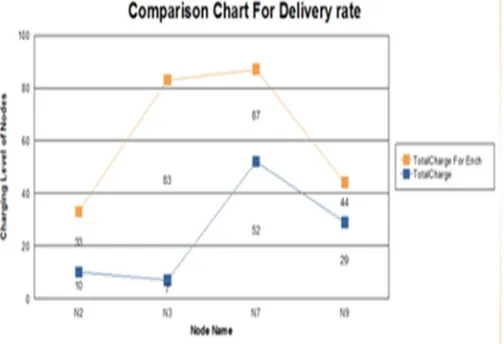
Energy-depletion rates of all nodes are set to 1 and we use charging energy and charged energy interchangeably. The simulation results of the mobile charging based on the joint coupling of link and battery based heuristic constrainst is depicted in the figure 2 The charged energy of the node increases as the patrolling cycle T increases. Higher maximum acceleration of the charger yields more charged energy at the node. However, the impact of incremental maximum acceleration on the charged energy is much less than that of the patrolling cycle.
[image:5.612.181.433.511.683.2]noticeable as depicted in the figure 3.
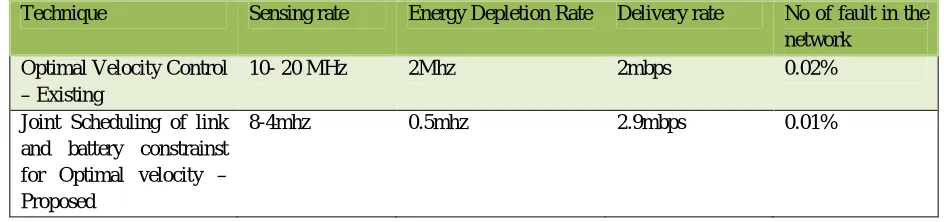
Table 1 – Performance Comparison of Wireless Recharging Model to Wireless Sensor Networks
Technique Sensing rate Energy Depletion Rate Delivery rate No of fault in the
network Optimal Velocity Control
– Existing
10- 20 MHz 2Mhz 2mbps 0.02%
Joint Scheduling of link and battery constrainst for Optimal velocity – Proposed
8-4mhz 0.5mhz 2.9mbps 0.01%
To qualitatively analyze the velocity control performance, we also plot the analysis-based upper bound of the network lifetime. The network lifetime gradually increases with the growing maximum acceleration of the charger and the patrolling cycle. Moreover, the gap between our heuristic method and the upper bound is relatively small and remains stable. The standard deviation of the charged energy of different nodes also increases with the increasing patrolling cycle. The table describes the performance of each node in different aspects to the sensing rate and delivery rate. When the number of nodes increases, given the acceleration constraint and the patrolling cycle requirement, the charger needs to balance the charged energy among all nodes at different positions in order to maximize the network lifetime, thus degrading network lifetime. However, if the number of nodes keeps increasing, the network lifetime remains stable.
V. CONCLUSION
We designed and implemented the joint coupling of velocity controlling using heuristic, heuristic conditions allowed to optimize the sampling rate and battery level by carefully tackling the spatiotemporally coupled link and battery capacity constraints of the wireless sensor nodes. The Wireless Nodes utilities the dynamic node monitoring model which has to gather the data about energy of the each node as well data sampling rate, Node failure and link failure etc. Each node exhibits different performance, hence it is desirable to represent the movement of the mobile charger using several criteria; therefore we utilize joint heuristic solution to handle to charging movement of the mobile charges based on the network requirement. The Simulation results of proposed system demonstrate that the proposed algorithm always achieves higher network utility than existing approaches. In addition, the impact of link/battery capacity and initial battery level on the network utility is further investigated.
REFERENCES
[1] Jiming Chen, Junkun Li, Shibo He, Tian He, Yu Gu, and Youxian Sun. On energy-efficient trap coverage in wireless sensor networks. ACM Trans. Sen. Netw., 10(1):2:1–2:29, December 2013.
[2] Jiming Chen, Junkun Li, and T.H. Lai. Energy-efficient intrusion detection with a barrier of probabilistic sensors: Global and local. IEEE Trans. on Wireless Commun., 12(9):4742–4755, September 2013.
[3] H. Yousefi, M. H. Yeganeh, N. Alinaghipour, and A. Movaghar. Structure-free real-time data aggregation in wireless sensor networks. Computer Communications, 35(9):1132–1140, 2012.
[4] S. He, J. Chen, F. Jiang, D.K.Y. Yau, G. Xing, and Y. Sun. Energy provisioning in wireless rechargeable sensor networks. IEEE Transactions on Mobile Computing, 12(10):1931–1942, Oct 2013
[5] L. Fu, P. Cheng, Y. Gu, J. Chen, and T. He. Minimizing charging delay in wireless rechargeable sensor networks. In IEEE INFOCOM, 2013.
[6] Constantinos Marios Angelopoulos, Sotiris Nikoletseas, and Theofanis P. Raptis. Wireless energy transfer in sensor networks with adaptive, limited knowledge protocols. Computer Networks, 70:113–141, September 2014.
[7] J. Wang, Q. Gao, H. Wang, P. Cheng, and K. Xin, “Device-free localization with multidimensional wireless link information,” IEEE Transactions on Vehicular Technology, vol. 64, no. 1, pp. 356–366, 2015.
[8] S. He, J. Chen, F. Jiang, D. K. Yau, G. Xing, and Y. Sun, “Energy provisioning in wireless rechargeable sensor networks,” IEEE Transactions on Mobile Computing, vol. 12, no. 10, pp. 1931–1942, 2013.
[9] T. J. Kazmierski, L. Wang, G. V. Merrett, B. M. Al-Hashimi, and M. Aloufi, “Fast design space exploration of vibration-based energy harvesting wireless sensors,” IEEE Sensors Journal, vol. 13, no. 11,pp. 4393–4401, 2013.