Technology (IJRASET)
Soret Effect on Radiative Effect Flow and Heat
Transfer over a Vertically Oscillating Porous Flat
Plate Embedded In Porous Medium with
Oscillating Surface Temperature
Sharmilaa. K1, Subhanandhini. V2
1
Assistant Professor, Department of Mathematics, P.S.G.R Krishnammal College for Women, Coimbatore, India
2
Research Scholar, Department of Mathematics P.S.G.R Krishnammal College for Women, Coimbatore, India
Abstract: Soret effect on radiative effect flow and heat transfer over a vertically oscillating porous flat plate embedded in porous medium with oscillating surface temperature is investigated. The analytical solutions of momentum, energy and concentration equations are obtained by Perturbation technique. The velocity, temperature and concentration profile is computed. The dimensionless Skin friction co-efficient, Nusselt number and Sherwood number are also estimated. The effects of few physical parameters Prandtl number Pr, Grashof number for heat transfer Gr, Grashof number for mass transfer Gm, Suction parameter S and radiative parameter R on velocity, temperature and concentration profiles are analyzed through graphs.
Keywords: Radiation, Suction, Heat Flux, Oscillating Porous Plate, Soret Effect.
I. INTRODUCTION
The process of heat and mass transfer is encountered in aeronautics, fluid fuel nuclear reactor, chemical process industries and many engineering applications in which the fluid is a working medium. The wide range of technological and industrial applications has stimulated considerable amount of interest in the study of heat and mass transfer in convective flows. Thermal radiation in fluid dynamics has become a significant branch of the engineering sciences and is an essential aspect of various scenarios in mechanical, aerospace, chemical, environmental, solar power and hazards engineering. For some industrial applications such as glass production and furnace design and in space technology applications such as cosmic flight aerodynamics rocket, propulsion systems, plasma physics and spacecraft re-entry aerothermodynamics which operate at higher temperatures, radiation effects can be significant. Mansour, M.A.[1] has studied Radiation and Free Convection Effects on the Oscillatory Flow Past a Vertical Plate. MHD unsteady Free Convective Flow Past a Vertical Porous Plate is investigated by Helmy, K.A.[2].Hossain, M.A., Alim, M.A. and Rees, D.A.S.[3] have proposed The Effect of Radiation on Free Convection from a Porous Vertical Plate. Kim,Y.J.[4] studied the Unsteady MHD Convective Heat Transfer Past a Semi-Infinite Vertical Porous Moving Plate with Variable Suction. Chandrakala,P. and Antony, R.S.[5] investigated Radiation Effects on MHD Flow Past an Impulsively Started Vertical Plate with Uniform Heat Flux. Effects of Radiation on Unsteady MHD Free Convective Flow Past an Oscillating Vertical Porous Plate Embedded in a Porous Medium with Oscillatory Heat Flux is studied by Manna, S.S., Das,S. and Jana, R.N.[6]. M.Bhavana, D.Chenna Kesavaiah, A.Sudhakaraiah[7]examined The Soret effect on Free Convective Unsteady MHD Flow over a Vertical Plate with Heat Source. C.S.K Raju, M.Jayachandra Babu, V.Sandeep, V.Sugunamma, J.V.Ramana Reddy[8] has studied Radiation and Soret effects of MHD Nanofluid Flow over a moving Vertical Moving Plate in Porous Medium. Dr.B.Lavanya and Dr. P.Sriveni[9] has studied Soret effect and Effect of Radiation on Transient MHD Free Convective Flow over a Vertical Plate through Porous media. Monika Miglani, Net Ram Garg, Mukesh Kumar Sharma[10] investigated Radiative effect on flow and heat transfer over a vertically oscillating porous flat plate embedded in porous medium with oscillating surface temperature. In this we have extended to study the Soret effect and radiative effect flow and heat transfer over a vertically oscillating porous flat plate with oscillating surface temperature.
II. MATHEMATICAL FORMULATION
Technology (IJRASET)
The temperature at the plate is also oscillating and the free stream temperature is constant T∞. A constant suction velocity V0 is applied at the oscillating porous plate. Since the plate is of semi infinite length therefore the variation along x-axis will be negligible as compared to the variation along y-axis.
.
0
x
From the physical description the governing equations are,
0
y
v
x
u
u
B
u
k
y
u
x
p
y
u
t
u
2 0 2 21
y
q
K
y
T
y
T
t
T
r
2 2 2 2 2 2y
T
D
y
C
D
y
C
t
C
T M
The suction parameter normal to the plate is, =− (Constant), where υ is independent of y. From physical description the
governing equations (2) to (5) becomes,
0
y
v
u
B
u
k
y
u
C
C
g
T
T
g
y
u
V
t
u
2 0 2 2 *0
(
)
(
)
Technology (IJRASET)
y
q
K
y
T
y
T
V
t
T
r
2 2 0 2 2 2 2 0y
T
D
y
C
D
y
C
V
t
C
T M
Where, ‘y’ and ‘t’ are the dimensional distance perpendicular to the plate and dimensional time respectively. ‘u’ is the components
of the dimensional velocity along y. g is the acceleration due to gravity, β is the coefficient of thermal expansion, β* is the coefficient of mass expansion, T is the dimensional temperature of the fluid near the plate, T∞ is the dimensional free stream
temperature, U0 is the amplitude of oscillation of the plate, C is the dimensional Concentration of the fluid near the plate, C∞ is the
dimensional free stream concentration, υ is kinematic viscosity, σ is the fluid electrical conductivity, k is the permeability of the porous medium, is the magnetic induction, α is thermal diffusivity of the fluid, K thermal conductivity of the fluid, is the
radiative heat flux,
D
M is the coefficient of chemical molecular diffusivity, andD
T is the coefficient of thermal diffusivity.The Roseland approximation for radiative heat flux is given by,
y
T
q
r
43
4
Where σ and δ are the Stefen-Boltzmann constant and Mean absorption coefficient respectively. By neglecting the higher powers of
Taylor’s series expansion of T4, we have
T
4
4
TT
3
3
T
3The appropriate boundary conditions for velocity, temperature and concentration fields are as follows,
t i w
t i
w
T
e
C
C
C
C
e
T
T
T
t
0;
u
U
cos
;
(
)
;
(
)
y
0
u
T
T
C
C
y
;
0
;
;
We introduce the dimensionless variables as follows,
0 *
U
u
u
2 0 *tU
t
0 *yU
y
k
C
p
Pr
0 0U
V
S
20 *
U
MD
Sc
22 0
U
Da
34
T
K
R
2 0 2 0U
B
M
T
T
T
T
w
4
3
Pr
3
R
R
C
C
C
C
w
3 0)
(
U
T
T
g
Gr
w
3 0 *
)
(
U
C
C
g
Gm
w
)
(
)
(
C
C
T
T
D
So
w w T
Where, Pr is the Prandtl number, S is the suction parameter, Sc is Schmidt number, Da is the Darcy number, R is the radiation parameter, M is the magnetic parameter, So is the Soret number, Gr is the Grashof number for heat transfer and Gm is the Grashof number for mass transfer.
By using non-dimensional quantities (13), the equations (7) to (9) reduces to the following non-dimensional form,
Technology (IJRASET)
2 * 2 * *y
y
S
t
2 * 2 2 * 2 * *1
y
So
y
Sc
y
S
t
The boundary conditions (11) and (12) in the dimensional form can be written as,
* * * *
;
;
cos
;
0
* * ** i t i t
e
e
t
u
y
0
;
0
;
0
;
* *
u
y
III. SOLUTION OF THE PROBLEM
Equations (14) to (16) are coupled non-linear partial differential equations and these equations can be solved in closed form. However, these equations can be reduced to a set of ordinary differential equations, which can be solved analytically. The suitable solutions for the equations are as follows,
t i t i
e
y
f
e
y
f
t
y
u
(
,
)
1(
)
1(
)
t i t ie
y
g
e
y
g
t
y
(
,
)
(
)
(
)
1 1 t i t ie
y
h
e
y
h
t
y
(
)
(
)
)
,
(
1 1Where
f
1(
y
),
f
1(
y
),
g
1(
y
),
g
1(
y
),
h
1(
y
)
andh
1(
y
)
are unknowns to be determined.Substituting (19) to (21) in equations (14) to (16) and equating harmonic and non- harmonic terms, we get the following set of ordinary differential equations.
))
(
)
(
(
)
(
1
)
(
)
(
1 2 1 1 11
f
y
Grg
y
Gmh
y
Da
M
i
y
f
S
y
f
))
(
)
(
(
)
(
1
)
(
)
(
1 1 12 1
1
f
y
Gr
g
y
Gm
h
y
Da
M
i
y
f
S
y
f
0
)
(
)
(
)
(
1 11
y
S
g
y
i
g
y
g
0
)
(
)
(
)
(
1 11
y
S
g
y
i
g
y
g
)
(
)
(
.
)
(
.
.
)
(
1 1 11
y
S
Sc
h
y
i
Sch
y
So
g
y
h
)
(
)
(
.
)
(
.
.
)
(
1 1 11
y
S
Sc
h
y
i
Sc
h
y
So
g
y
h
Where, the primes denote the differentiation with respect to y. The corresponding boundary conditions can be written as,
1
;
0
;
1
;
0
;
2
1
;
0
1
1
1
1
1
1
f
f
g
g
h
h
y
0
;
0
;
0
;
0
;
0
;
0
;
1
1
1
1
1
1
f
f
g
g
h
h
y
Applying the prescribed boundary conditions (28) and (29) to the equations (22) to (27) their solutions are as follows,
0
)
(
1
y
g
)
exp(
)
(
11
y
y
g
0
)
(
1
y
Technology (IJRASET)
)
exp(
)
exp(
)
1
(
)
(
3 2 3 11
y
y
y
h
)
exp(
2
1
)
(
41
y
y
f
)
exp(
)
exp(
)
exp(
)
exp(
2
1
)
(
6 7 8 5 6 1 7 2 8 11
y
y
y
y
f
Substituting the determined unknowns (30) to (35) into the equations (19) to (20), the velocity, the temperature and the concentration distributions in the boundary layer becomes,
t i t i t i t i t i
e
y
e
y
e
y
e
e
y
t
y
u
)
exp(
)
exp(
)
exp(
)
exp(
2
1
)
exp(
2
1
)
,
(
1 8 2 7 1 6 5 8 7 6 4 t ie
y
t
y
(
.
)
(exp(
1))
t i
e
y
y
t
y
((
1
)
exp(
)
exp(
))
)
.
(
3 2 3 1Skin- Friction
The Skin-Friction at the plate, which in the non-dimensional form is given by
t i t
i
y
f
e
e
y
u
C
4 5 6 7 8 1 6 2 7 1 80
2
1
2
1
Nusselt NumberThe non-dimensional co-efficient of heat transfer defined by Nusselt number is obtain and given by
t i
y
e
y
Nu
1 0 Sherwood NumberThe non-dimensional co-efficient of heat transfer defined by Sherwood number is obtain and given by
i ty
e
y
Sh
2 3 1 30
)
1
(
APPENDIX2
4
)
(
.
2 1
S
S
i
Technology (IJRASET)
2 1 4 2 4 Da M i S S 2 1 4 2 5 Da M i S S Da M i S Gr 1 1 2 1 6
, Da M i S Gm 1 ) 1 ( 2 2 2 3 7 Da M i S Gm 1 1 2 1 3 8 Fig 1. . Velocity Profiles for different values of So
[image:7.612.193.409.468.696.2]Technology (IJRASET)
[image:8.612.197.406.281.453.2]Fig. 3. Velocity Profiles for different values of Gr
[image:8.612.188.414.493.691.2]Fig.4. Velocity Profiles for different values of Gm
Technology (IJRASET)
Fig.6. Velocity Profiles for different values of S
Fig.7. Temperature Profiles for different values of R
Technology (IJRASET)
Fig.9. Temperature Profiles for different values of S
Fig.10. Concentration Profiles for different values of Sc
Technology (IJRASET)
Fig.12. Concentration Profiles for different values of So
IV. RESULTS AND DISCUSSION
In order to get physical insight into the problem, we have calculated the velocity field, temperature field, concentration field, co-efficient of skin-friction Cf at the plate, the rate of heat transfer in terms of Nusselt number Nu and the rate of mass transfer in terms of Sherwood number Sh by assigning specific values to the different values to the parameters involved in the problem, viz., Radiative parameter R, Prandtl number Pr, Suction parameter S, Magnetic field parameter M, Grashof number for heat transfer Gr, Grashof number for mass transfer Gm, Soret effect So, Schmidt number Sc, Darcy number Da and time t. In the present study, the following values are adopted. R= 2, Pr=1, S=0.2, So=0.5, Sc=0.3, M=5, Da=0.1, Gr=5, and Gm=3. All graphs therefore correspond to these unless specifically indicated on the appropriate graph. The numerical results are demonstrated through different graphs and table and their results are interpreted physically.
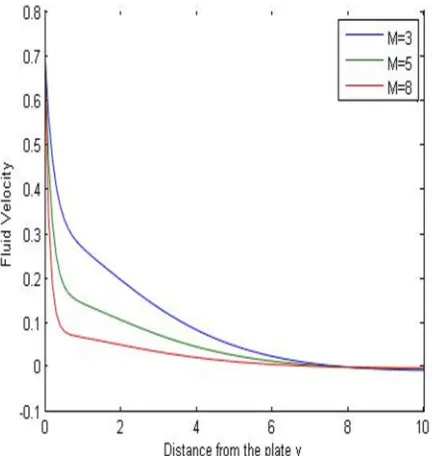
Fig.1 illustrates the dimensionless velocity u for different values of the Soret number So. The analytical results show that the effect of increasing values of Soret number results in an increasing velocity. Fig. 2 plots the velocity profiles against the span-wise coordinate y for different magnetic field parameter M, this illustrates that velocity decreases as the existence of magnetic field becomes stronger. It is observed from Fig.3 and Fig.4 that the positive and negative value of Grashof number for heat transfer Gr and the values of Grashof number for mass transfer Gm lead to increase in the values of velocity u. Fig.5 depict the dimensionless velocity component u for different values of Darcy number. It is noticed that the increase in Darcy number Da results in increase in dimensionless velocity component u. The effect of the suction parameter on the dimensionless velocity u is shown in Fig. 6 shows that velocity component decreases with increasing in suction parameter value. Fig. 7 and Fig. 8 illustrate the temperature profiles of Radiation R and Prandtl number Pr respectively. In the case of increasing R and Pr, the temperature
profile decreases. The influence of Suction parameter S on dimensionless temperature profile
is plotted in Fig. 9, it is noticed that for negative values of S the temperature profile increases and for the positive values of S the temperature profile decreases. The concentration profiles for different values of Schmidt number Sc are plotted in Fig. 10. The analytical results show that the effect of increasing Schmidt number decreases the concentration profile. Fig. 11 displays the effect of suction parameter S on concentration profiles. We observe that concentration profiles decreases with increasing S. For various values of Soret parameter So, the concentration profiles is plotted in Fig. 12. Clearly as So increases, the dimensionless concentration increases.V. CONCLUSION
In this study, we examine the Soret effect on radiative effect flow and heat transfer over a vertically oscillating porous flat plate embedded in porous medium with oscillating surface temperature. The leading governing equations are solved analytically by perturbation method. We presented the results to illustrate the flow characteristics for the velocity, temperature and concentration and have shown how the flow fields are influenced by the material parameters of the flow problem. We can conclude from these results that
An increase in So, M, Gr, Gm, Da and S decreases the velocity field.
Technology (IJRASET)
distribution.
REFERENCES
[1] Mansour, M.A. (1990) Radiation and Free Convection Effects on the Oscillatory Flow Past a Vertical Plate. Astrophysics and Space Science, 166, 269-275. [2] Helmy, K.A. (1998) MHD unsteady Free Convective Flow Past a Vertical Porous Plate. Journal of Applied Mathematics and Mechanics, 78, 255-270. [3] Hossain, M.A., Alim, M.A. and Rees, D.A.S.(1999) The Effect of Radiation on Free Convection from a Porous Vertical Plate. International Journal of Heat and
Mass Transfer, 42, 181-191.
[4] Kim,Y.J.(2000) Unsteady MHD Convective Heat Transfer Past a Semi-Infinite Vertical Porous Moving Plate with Variable Suction. International Journal of Engineering Science, 38, 833-845.
[5] Chandrakala,P. and Antony, R.S. (2008) Radiation Effects on MHD Flow Past an Impulsively Started Vertical Plate with Uniform Heat Flux. Indian Journal of Mathematics, 50, 519-532.
[6] Manna, S.S., Das,S. and Jana, R.N. (2012) Effects of Radiation on Unsteady MHD Free Convective Flow Past an Oscillating Vertical Porous Plate Embedded in a Porous Medium with Oscillatory Heat Flux. Advance in Applied Science Research, 3, 3722-3736.
[7] M.Bhavana, D.Chenna Kesavaiah, A.Sudhakaraiah(2013) The Soret effect on Free Convective Unsteady MHD Flow over a Vertical Plate with Heat Source. International Journal of Innovative research in Science, Enginering and Technology, 1617-1628.
[8] C.S.K Raju, M.Jayachandra Babu, V.Sandeep, V.Sugunamma, J.V.Ramana Reddy (2015) Radiation and Soret effects of MHD Nanofluid Flow over a moving Vertical Moving Plate in Porous Medium.IISTE 9-23.
[9] Dr.B.Lavanya and Dr. P.Sriveni(2016) Soret effect and Effect of Radiation on Transient MHD Free Convective Flow over a Vertical Plate through Porous media. International Journal of Engineering Science Invention. 1-6.