University of Huddersfield Repository
Shaw, Susan AngelaAn analysis of the discourses and discursive devices used to represent learning disability in the stories told in the classroom to students by learning disability nurse teachers
Original Citation
Shaw, Susan Angela (2007) An analysis of the discourses and discursive devices used to represent learning disability in the stories told in the classroom to students by learning disability nurse teachers. Doctoral thesis, University of Huddersfield.
This version is available at http://eprints.hud.ac.uk/id/eprint/373/
The University Repository is a digital collection of the research output of the University, available on Open Access. Copyright and Moral Rights for the items on this site are retained by the individual author and/or other copyright owners. Users may access full items free of charge; copies of full text items generally can be reproduced, displayed or performed and given to third parties in any format or medium for personal research or study, educational or notforprofit purposes without prior permission or charge, provided:
• The authors, title and full bibliographic details is credited in any copy; • A hyperlink and/or URL is included for the original metadata page; and • The content is not changed in any way.
For more information, including our policy and submission procedure, please contact the Repository Team at: [email protected].
An Analysis Of The Discourses And Discursive Devices
Used To Represent Learning Disability In The Stories
Told In The Classroom To Students By Learning
Disability Nurse Teachers
Susan Angela Shaw
15
thAugust 2007
A thesis submitted to the University of Huddersfield In partial fulfilment of the requirements for
The degree Doctor of Education
Acknowledgements
There are many people who have played a part in the production of this thesis
however due to space I am unable to mention them all. I have received support from
colleagues, friends and supervisors over the years all which have contributed and
become sources of inspiration in small and large ways to this final piece of work.
Firstly, I would like to thank my supervisors, Pete Sanderson, Ann Harris and Chris
Ormonroyd for their help in completing this thesis. Their help support and belief in
this work has been greatly appreciated over this last year when I needed it the most. I
also thank Dallas Cliff for his painstaking proof reading and attention to detail.
I owe much to my fellow and extremely busy lecturer colleagues who bravely agreed
to allow me to connect with their world and their professional histories. Without their
total openness to my distracting observations, questions and not to mention my
preoccupations, this thesis would not have been possible; to them I say a big ‘thank
you’. I also need to thank the cohorts of students who allowed me access to their
classes and took an interest in my work.
My acknowledgement extends to my partner Graeme, to my family and to my friends
whose endless support, encouragement and patience has played an important part in
maintaining me as a healthy person whilst I endeavoured to finish this extended piece
Abstract
This study explores the complexities of the social construction of learning disability.
The focus is upon the ways in which learning disability nurse teachers represent their
experiences of learning disability nurse practice in stories. The stories focussed upon
in this study were identified in a series of 20 audio taped teaching sessions with
student learning disability nurses. The research investigations centred upon the
learning disability constructions in some 30 stories and were also supported by 5
subsequent interviews with the teachers and observations of 7 teaching sessions. The
findings highlight some interesting ideas about the social construction of learning
disability by nurse educators and also the personal tensions expressed by learning
disability nurses trained in the past but faced with the dominant discourses of today.
As a qualitative study, this research drew upon the ideas of social construction and
competing discourses most commonly associated with Michael Foucault in his works Discipline and Punish and Madness and Civilisation. In particular the stories were investigated for the influences of medicalising and professionalising discourses which
construct people with learning disability as powerless and the learning disability nurse
with the power to control. The investigations began with a form of Foucauldian
discourse analysis which was used to examine the transcribed storied material,
interviews and observations. Following initial engagement the investigations also
developed with the aid of discourse analysis more heavily influenced by the
discursive psychology of Potter and Wetherell (2004). Both forms of discourse
Contents Page
Acknowledgements ix
Abstract x
Introduction
xiOverview
Why look at narratives and stories? xii
Aims and objectives xiii
What is a story in my study? xv
How and why did I select stories xvi
Outline of the chapters xvii
Chapter one
Literature review: disability and learning disability ideas in
construction
1
Overview 1
Introduction 2
The development of learning disability nursing 2
History in the making 2
The need for the learning disability nurse
4
There were some problems 5
Changes in the NHS 6
Summary 8
Power and Control in Learning Disability 9
The influences of Foucault and power and knowledge 9
Power and the representation
of learning disability 14
Power and links with inclusion 17
Power and social constructions of learning disability 21
Summary 23
Important works in Disability and Learning disability 24
Institutional life and beyond 26
Who is in control? 28
Changes in policy: adding to the discourse 29 Origins of Normalisation as a service principle 31 The development of the political discourse:
The rise of the disability movement 34
The social model develops 36
Summary 39
Education and Learning Contexts 40
Influences of educational encounters 41 Narrative and story as method in teaching 43
Summary 45
Conclusion 45
Chapter Two
Method and Methodologies
47
Overview 47
Introduction 48
The approach taken 48
The starting point: qualitative research 49 Narrative, discourses and stories 50
Summary 52
Taking a methodological approach based upon the analysis of
discursive practices 53
Discursive psychology or Foucauldian analysis? 54
Summary 55
Methods employed: a series of stages 56
The sample 58 Using teachers 59 Willing partners 60 The students 61 The student group demographic 62 The setting 63 Respecting the partners 63 Ethical strengths 64 Introducing the teachers 66
Collecting the sample: Data types 67
Data type 1 69
Key indicators of the particular stories 72
Data type 2 73
Early influences on later design 74
Data type 3 75
Access issues 76
Using story extracts 77
The interview setting 79
Timing is everything 80
Using prompts 80
Ending the interview 82
Data type 4 82
Ethical considerations 83
Summary 84
Data analysis section 84
The Quest 84
Open Coding 87
What is open coding? 87
Self as instrument: Interpretative Authority 88
Categories and themes 89
Turning codes into constructs 91
Analysing the discursive modes: staging the analysis 92
Summary 95
Evaluating: checking out what I checked out! 96
Trying out a framework 97
Summary 103
Mapping the discursive landscape
105
Overview 105
Introduction 105
The four discourses 106
Summary 108
The Medicalised discourse 109
Origins of the discourse 111
Norms and normality 111
Rationality and western science 112
Dualities 114
Sick to be cared for or cured? or clients with rights? 115
Separate oppressions 116
Summary 117
The Professionalising discourse 117
Origins of the discourse 118
Theorising the professional 118
The general versus learning disability nursing discourse 119
Status of the nurse 120
Language and terminology 122
Identities in learning disability nursing 123
A shameful past 124
Summary 127
The Political discourse 127
Origins of the political
in learning disability 127
The legacy of ideal living 128
Changing agendas in learning disability 129
Summary 131
The Exclusion/inclusion discourse 132
Origins of the community in ‘Community Care’
for people with a learning disability. 132 The changing meaning of inclusion 134
Language of the community 135
Stereotypical images 136
Summary 137
Chapter four
You are such a problem!
Learning disability as a case to be managed
138
Overview 138
Introduction 139
Learning disability: as a case 140
Learning disability as a subject
but not a person 140
Ill and in need of care 141
Summary 145
Modes of discourse in a case to be managed 145
Dynamics and devices 145
Uncovering the modes 148
Summary 150
Learning disability
as a case / problem to be managed 151
Procedures at work 154
Cases are strange and different 157
Specialised needs of an oppressed Group 160
Gender discourses 161
Cases are dependant: you need help 165
Summary 168
Managing care
is the job of an learning disability nurse 168
The importance of the learning disability nurse 169 Learning disability nurses are better suited
than other professionals to meeting
the needs of people with learning disability 173
Summary 175
It was real in the past 176
Horrors of the past 176
Regrets? I have a few 177
Conclusion 186
Chapter Five
How it can all go wrong: Cautionary Tales
188
Overview 188
Introduction 188
Things can go very wrong 188
They all got it wrong 189
Learning disability as a challenge 193 Learning disability as victim:
Who do we blame? 196
Summary 199
Learning disability as a victim of professional dominance 199
Women are victims: woman with a learning disability
are greater victims 200
Summary 202
There is a correct way 202
Why do we need protection? 202
Assumptions 205
Summary 205
Problems managed correctly 206
This is how to do it 206
Objects and priorities 210
Summary 212
We need to watch you for your own good 213
Nursing is risky business 213
Summary 218
Promoting independence is a job well done 218
Who is in charge? 219
Summary 222
Good things come from bad 223
Summary 230
People with a learning disability are strange and different:
should they be included in general society? 230
Can you live independently? 231
Is there a problem with normalisation? 234
Summary 237
Conclusion 237
Chapter Six
Final discussions
240
Overview 240
Generating the learning disability discourse 240
Raising some questions about
the social construction of learning disability. 241
Revealing the tensions: A useful process? 243
What can the modes tell us? 246
The medicalised view is right it justifies our place 246
You must challenge the system that’s why you are here 247
I was there at the time 248
Contributions to the wider picture
of learning disability constructions 251
Limitations of the study 251
Impact of this study upon learning disability nursing 252
Impact of this study upon
professional education literature and research 253
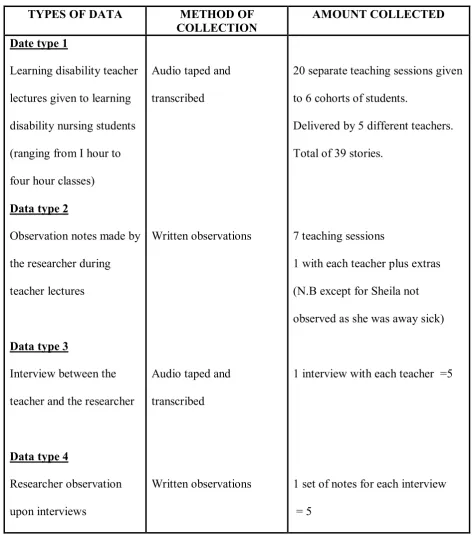
2.1 Data types 68 2.2 Main Learning Disability constructs 93
Figures
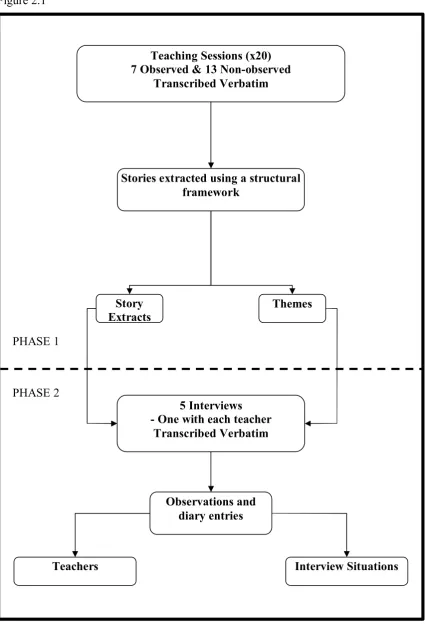
2.1 Phases of the study 57
2.2 The Research Plan 86
Appendices
1 Information letter for teachers 2 Information letter for students 3 Interview schedule
Introduction
Overview
Learning disability is a social phenomenon, but is problematic as it shares many of the
cultural norms we as a society ascribe to sickness and to incapacity (Barnes and
Mercer, 2003). When recognised as a person with a disability, one is constructed by
non disabled people as a problem and judged against a spectrum of normality (Oliver,
1990). These norms are constructed by variants of the language of illness, of
abnormality and of tragedy (Oliver 1990). It is then argued that learning disability is
socially constructed and is promoted by the cultural powers of this discourse (Clegg,
1993). The social construction of learning disability encompasses the language of the
professional (Barnes, 1990; Clegg, 1993; Davis 1997). The professional (e.g. social,
health worker, and physician) often draws upon language which assumes insight and
knowledge and describes learning disability as a special category of people requiring
specialist and therefore highly skilled professional care.
Those aiming for a professional career in learning disability nursing enter higher
education and engage in adult learning practices intended to equip them as students
with the skills and competence of professional practitioners (NMC, 2002). The
curriculum is devised and delivered by experienced professionals, often with a
number of years spent working in learning disability nursing practice. The students of
at exposure to the topic of learning disability care and the transformation of lay ideas
about learning disability into a professional and more informed perspective.
This study is intended to explore the scope of social construction situated in the
language of the one set of learning disability professionals. This exploration engaged
me as a researcher in a quest to identify learning disability constructions and to
develop an understanding of the power of the dominant discourses operating within
the culture of learning disability nursing. I was aware that the learning disability
discourse posed challenges to the assumptions held in society about difference and
exclusion and I was eager to explore how the learning disability nursing profession
might represent learning disability in stories. One insight in particular interested me,
the personal portrayal of learning disability as told through a personal experience,
anecdote or story. My quest to explore learning disability constructions was then
centred upon the tales of the past told by the educators of future learning disability
nurses and what this might reveal about the construction of learning disability today.
Why look at narratives and stories?
Narratives and the study of their presence are difficult to ignore in our general social
world (Connelly and Clandinin, 2000; Lakoff and Johnson, 2003). We, as social and
cultural occupiers of personal and collective histories appear within what the
anthropologist Geertz (1973) described similarly as the hallmark of inevitable
instability and change. Although many of the images within narratives appear
constant in time (i.e. photographs, pictures, appendices), the nature of the narrative
changes according to the context, audience or position of the narrator (Connelly and
continues to be constructed and reconstructed in the narratives of those with interests
inside and outside the field. Examples of this are the stories told about the
relationships between people with learning disabilities and their carers.
As a researcher with an interest in stories in general culture, I was intrigued by in the
idea that narratives are units of language expressing an experience that can help us to
learn (Dewey, 1933) and also what effects this has upon learning disability nursing
education. Gee (2002) suggests there are connections between social language and
cultural models in our society and a sharing between individuals of ethical and moral
beliefs (e.g. the changing moral values and the changing language of sexuality). This
sharing may be also vulnerable to the conditions of time and context, leading to an
everchanging emphasis in social policy and inevitably social and health care. I see
this sharing as the creation of the learning disability discourse which resides almost
exclusively with learning disability professionals.
As a teacher of learning disability nurses myself, I had experience of the
communication methods employed by teachers engaging with students within
classrooms. Many teachers, particularly those with personal professional experience,
engage in the sharing of their own experiences (Dyer and KellerCohen, 2000). The
resulting narrative, as Polkinghorne (1988) reminds us, can be a way in which the
experience of teachers is made meaningful to themselves and to their students. This
interested me in a number of ways and were developed into a research aim and a
series on objectives
To investigate the social construction of learning disability by teachers in the stories they tell to their students within teaching narratives.
This aim was to be realised through a process of qualitative inquiry and I took my
theoretical guide from the ideas of discourse and language which appeared to fit with
the development of such a study.
To meet my research aim I developed a number of research objectives that guided me
through the research process. Initially, the first of these objectives was developed
from the ideas within the literature that dominant discourses assisted the construction
of learning disability. This was further explored and refined through the examination
of various data collected. Objectives 2 and 3 developed out of the need to situate the
research firmly within the classroom and to locate the narratives on which to explore
the investigation and analysis of learning disability construction by teachers accessing
the discourses identified primarily with learning disability care (I called this the
learning disability discourse). All three of these objectives were the subject of
evolution. The final development and regulation of this study were structured around
the following;
1. To explore the use of discourse in learning disability constructions within
teachers’ stories
2. To identify any links between the teachers’ learning disability constructions
and the learning disability discourse
3. To investigate common themes appearing in stories, interviews and
Although this study does not adhere to structuralist conventions (e.g. an indepth
analysis of the linguistic structure of language, conversation and intonation) it was
necessary to begin with a narrative, which was reduced via its structure. The larger
narrative is the teaching session or interview and I endeavoured to extract smaller
units or stories to begin my quest to examine what these units could tell me about the
social construction of learning disability.
This process of deconstruction enabled me to extract what I considered are the
personal stories contained within the larger spoken narrative of the teachers. I had
argued that there is a sense of shared history within both the personal narratives
constructed and revealed by teachers (in various ways) to their students and the wider
social picture painted by writers, theorists and policy makers, yet both can shape the
nature of experience for learning disabled people.
If we consider (as I do) that human beings make sense of their world through a
process of reconstructed and constructed narrative accounts of actions by themselves
and others, narratives therefore become important vessels to understanding the social
worlds past and present. It is important in this study to distinguish between the
‘narrative’ and the ‘story’
What is a story in my study?
In this study I interpreted the personal stories told by lecturers to students in the
classroom. The aim of this research was to investigate how the stories construct
construction can reveal about the nature of the emerging learning disability nursing
practice.
For me, the presence of a discrete story within the larger account (teaching
session/lesson) signifies the narrator’s relationship with a past event. The narrator in
my collection is telling the audience “how it was for them” On most occasions the
event is represented by a sequence in that it has a beginning middle and an end, and
there is entrance and exit talk (Labov and Walezky 1967, Jefferson 1979). The
sequencing and the structure are important factors in the identification of the story,
but also other features are less obvious but equally important. The essence of the
story, which separates it from a simple chronology, is less easy to define and even
more complicated to analyse.
How and why did I select stories?
This section considers how and why this study focuses on the personal stories told by
teachers during teaching sessions. Goffman’s (1963) description of narratives as tapes
or strips of personal experience from the tellers past, acting not only as reporting
function but also as something to reexperience, provides some useful perspectives
which can be applied to this setting. He is further helpful by suggesting that the re
experience may be not confined to the teller but that the audience can join in the
experience also. Taking these ideas; the audio taping of whole teaching sessions are a
way to capture the teaching narrative and what they say in the classroom.
As a teacher and practitioner with a keen interest in language, discourse and more
Robson (2003) “ Starting where you are” (Robson, 2003. p.49.). The nature of the
socially constructed labels of “learning disability “and “nurse” used together by
lecturers as topics for their stories interests me both as a teacher and a nurse myself.
My starting point was based on these interests and as a consequence the aims of this
study were formed.
I will now explain the study outline as whole and how the chapters fit together.
Outline of the chapters
Chapter one. This study is essentially an investigation into the social and political
implications of stories told by teachers about the lives of people with learning
disabilities to student nurses. Social life investigation has undergone changes in both
method and morality and has influenced both the design and analysis of subsequent
research and development in learning disability care. This study is cognisant of this
and is sensitive to the prevailing changes which have occurred in learning disability
care over the past years. This chapter aims to outline the important works which have
contributed to the learning disability discourse. The following intends to provide an
overview of the topics covered.
Importantly, the demise of institutional care for people with a learning disability is
accounted for by the social commentary which has drawn attention to the lives spent
in institutions and the regimes which governed them. As a result of these and other
changes the rise of the political discourse of disability has proved to be a strong
learning disability care have originated in philosophies aimed at the emancipation of
people with a learning disability in society. One theory, namely ‘normalisation’ was a
highly influential movement which helped shape the learning disability discourse and
informed the development of learning disability services (O’Brien and Lyle, 1987;
Wolfensberger, 1972). The influence of normalisation informed the debates which
developed from the need to relocate large numbers of people with learning disabilities
from large hospitals to smaller community units. The debate has continued and
together with social awareness of disability and exclusion, the learning disability
discourse includes questions about rights and citizenship. Coupled with the issues of
rights are the concerns that people with a learning disability experience unequal
power relations with those who care for them. This debate is based upon the analyses
of language, of power and of control in the professional discourse of learning
disability workers and professionals. The challenges posed by those with disabilities
themselves provide a useful background to this study.
Secondly, this chapter looks to the development of learning disability nursing and the
professionalising discourse emanating from a long history of caring for people with a
learning disability in the UK. As the principal health care providers for more than half
a century learning disability nurses view themselves as experts in the field of learning
disability care (Mathews, 2006; Mitchell, 2000b). Their contribution to the learning
disability discourse is considerable and many policy changes for people with a
learning disability have been advocated by this group of professionals.
Chapter two then moves on to consider the theoretical approach that underpins the
upon. The ontological position I took as researcher and the questions I wrestled with
are explained. I also expand the discussion to illustrate the resulting research design,
which followed my deliberations, and the reflections which formed the important
decisions I made.
The three sections in this chapter uncover the research approach taken, the sample and
the data analysis which followed. Each of the sections relates my reasons for the
decisions taken and the arguments for and the arguments against.
In this chapter I situate my role as a researcher and the positive part active (or
reflexive) involvement in research can make. Here I explain how the various facets of
the research fit together and are informed by the social construction of learning
disability. Finally, I explain the process and function of data analysis in this study and
detail the steps taken to interpret the data. At this point I also detail the main social
constructions I noticed and was influenced by in my engagement with the open coding
of the data and the basis for the analysis and uncovering of the four discourses used to
construct learning disability in this way.
Chapter three provides a significant examination of the four main discourses which
became important to me on examination of the social construction of learning
disability by the teachers. This chapter provides a framework on which the analysis of
and interpretation of the stories is based. I identify the discursive practices as I saw
them which are associated with the dominant discourses of medicalisation.
Chapter four begins the first of two chapters discussing the analysis and the
interpretation of the learning disability constructions as ‘Cases to be managed’. This firstly explores the dominance of the medicalising discourse, which constructs
learning disability, together with the other three main discourses. The analysis which
follows provides an insight into my interpretation of the three modes of discursive
device used by teachers to construct learning disability. I interpret these three modes
as; ways of reaffirming (or agreeing with) established or dominance discourses, ways
of refuting (or encouraging criticality) the discourse, and finally, ways of identifying
personally (self) with elements of the learning disability construction. These modes
are used to provide my analysis of the learning disability construction drawn upon by
the teachers in their story telling.
Chapter five further explores the language/discursive modes used to construct
learning disability, and in particular my analyses reveal the interpretation of
constructions which involve the dominance of the professionalising and the
inclusion/exclusion discourses. This analysis explores the many ways in which
teachers construct learning disability in the stories as cases to be managed but also as ‘strange and different ‘and ‘victims of professional domination’.
Chapter six discusses some of the concluding comments arising out of this work and
attempts to unify the study by discussing the findings of the research with respect to
It is my intention that this study is presented both as an exploration of the
phenomenon of learning disability construction and also as a story about the research
process I embarked upon. The process was not intended to be seen as a linear
progression and indeed much of the work explored has been revised and revisited in
accordance with the interpretive nature of this type of study.
The chapter that now follows, an exploration of the learning disability discourse, is
documented in a number of ways, mostly by those seeking to find some explanations
in the history of learning disability nursing. It is my aim however to provide an
analysis of the learning disability discourse from a unique and under researched
Chapter one
Literature review:
Disability and Learning Disability ideas in
Construction
Overview
This chapter reviews literature concerning learning disability with a view to
explaining the socially constructed nature of the learning disability discourse. This
begins my journey to meet my main aim; To investigate the social construction of learning disability by teachers in the stories they tell to their students within teaching narratives. This chapter will support the subsequent objectives of the study; To identify any links between the teachers’ learning disability constructions and the learning disability discourse and;To investigate common themes appearing in stories, interviews and observations.
Introduction
The following four sections introduce the influential themes in this study. The first
theme charts the development of learning disability nursing and extends the
discussions particularly towards the professional role and identity. The second theme,
power and control in learning disability, outlines the important debate between carers
of disabled people and their clients and the considerations that have arisen with this
story is intended to set the scene for the history of learning disability care and the
context of the discussions about the lives of people with learning disabilities. Finally
the fourth theme; the education and learning context for adult students, contextualises
the context of the study in an educational setting. These themes provide a theoretical
platform on which I can begin to investigate the construction of learning disability by
nurse teachers within classroom stories.
The development of learning disability nursing
This section provides a historical description of the development of learning disability
nursing and the education that has emerged. I will chart the rise of learning disability
nursing through history and its relevance to the main professional nursing model that
developed. I will also detail the social examination and criticism lodged against
learning disability nursing and the reforms in health care that have followed.
The history of learning disability nursing is complex and closely linked to the history
of health care policy for people with learning disability (Atkinson et al. 1997;
Dingwall et al. 1988). It is often argued that the relationship between learning
disabled people and their professional carers has encouraged the care and control of
people with learning disabilities at the expense of their independence and self
determination (Mitchell, 2000a). Factors affecting the development of these
relationships are of particular relevance to this study, together with the development
of these in the context of the learning disability nurse role.
In the early part of the twentieth century most nursing, and in particular learning
disability nursing, was unregulated and much work with people with learning
disabilities was unpaid or low paid, attracting very low status and low social position.
Mitchell (2003) describes the role of institutional worker in his analysis of the
development of the learning disability profession. These descriptions detail routine
and ordered work in a tightly regulated system not unlike other institutional health
regimes of the time such as mental health asylums, isolation and general hospitals.
Although the location of what were called learning disability colonies mirrored that of
the isolation hospital or asylum the nature of early provisions did not. The early work
in the learning disability colonies of the first part of the twentieth century however,
tended to be less regulated with more informal and community like routines not unlike
those of a small village or large family.
This informality of the work continued throughout the first decades of the twentieth
century although some training schemes and development courses were accessed via
the Medico Psychological Association (MPA) an organisation which catered for the
small number of workers in institutions. .The Mental Deficiency Act 1913 prompted
the MPA to offer some separate training schemes (none as nursing courses) for what
were the developing mental deficiency hospitals (Mitchell, 2000a).
This continued until the establishment of the General Nursing Council in the 1920’s,
which attracted the affiliation of some but not all nurses for people with learning
disabilities (Mitchell, 2000b). The rise of professionalism in nursing and the advent of
statutory regulation by the General Nursing Council created a regulatory system for
1985). Although learning disability nursing embraced the professionalism of nursing
it struggled with inferior status, compared with the larger majority of general trained
nurses.
Although many personal stories of life in the closed institutions where people with
learning disabilities lived and learning disability nurses worked, describe harsh
treatment (Atkinson et al, 1997), the analysis of the nurse role within the institution
reveals influences by the social situations of the time as a result of social attitudes
(Mitchell, 2000a). Commenting on the many prevailing and changing social attitudes
towards people with learning disabilities Mitchell (2003) attributes links between the
low social status of the resident with learning disability to the low status of their
carers the nurses.
As societal attitudes changed as a result of political and economic developments
(Finkelstein, 1994), the need for nursing (including learning disability nurses) across
the broad health spectrum increased. The expansion of the professional was strongly
led by the General Nursing Council (GNC).
The need for learning disability nurses
Initially some role expansion of the learning disability nurse was driven by the mid
twentieth century view of physically and mentally disabled people as in need of care
and control (Brigham et al, 2000). This view is reflected by the development of large
scale hospital type asylums which housed up to 1000 learning disabled and mentally
For many in society the disabled individual (physically or intellectually) was viewed
as either a menace or similarly as a diseased organism in need of protection or
incarceration. This together with other socioeconomic factors (Richardson, 2005)
increased the growth of institutionalisation for many people with learning disabilities.
As Ryan and Thomas (1995) write, many definitions of difference have led to many
variations in attitudes over the years towards the social and medical treatment of
people with learning disabilities. One attitude in particular demonstrated some of
these negative values experienced by people with learning disabilities; this was the
large scale residential housing of people with various disabilities in provision ranging
from isolated hospitals to working village communes.
Since the early days of the National Health Service in 1948 the learning disability
specialism of nursing has forged a difficult path through the ever changing social
statuses and political priorities for the learningdisabled client group. As institutional
care proliferated during the 1950’s and 60’s learning disability nurses expanded their
role to include generic health worker, educationalist and therapist. These roles,
dependent on the constraints of the institutional environment, became firmly defined
and defensible (Brigham et al, 2000).
There were some problems
Major reviews of learning disability nursing such as the Report of the Committee of
Nursing (Briggs, 1972) and the Report of the Committee of Enquiry into Mental
Handicap Nursing (Jay, 1979) concluded that there was a need for major changes in
the profession. The debate centred on the question of health versus social care for
growing concerns and recommendations arising in Wolfensberger’s (1972)
normalisation ideology. The concerns of those advocating better health care through
improvements in social and health care policy has continued over time. As some of
the social reforms have progressed, promoted by the modernising agenda of the
present government, learning disability nurses have seen a return to the challenges of
change, with many role alterations advocated by the white paper Valuing People (DOH, 2001)
It is the extremes of opinion which have driven many reformers to campaign for a
greater acceptance of difference of all kinds as opposed to a preoccupation with the
differences between the nondisabled and disabled (Atkinson et al, 1997; Walmsley,
2001b). As a result of these and many other political changes, learning disability
nursing has been charged with the majority of health care for people with learning
disabilities in the last fifty years. The changing health care agenda in particular has
impacted greatly on the profession.
Changes in the NHS
Politically, The National Health Service (NHS) of the 1970’ and 1980’s was
undergoing a series of technological and demographic changes increasing the demand
for a highly skilled workforce. Socially, clients and patients empowered by
technology and consumerist tools such as Patients Charter placed heavy demands for
information upon the NHS and nurses in particular. Professionally, nursing, although
slow to respond was quick to recognise the need for change at clinical, managerial and
develop all qualified nurses to a higher education diploma level, and eventually lead
to nurse education within higher education sites, a move away from health sited
schools of nursing.
However, it can be argued that learning disability nursing has suffered at the hands of
the majority position that is general nursing. Notably the education of qualified nurses
in the UK has changed undeniably in the last twenty years. Developed from
traditional hospital based and controlled training schools to integrated programmes in
universities and higher education institutions, nurse education is now exclusively
subject based within the HE sector. Traditionally, nursing, including learning
disability nursing, was taught to students in an apprenticeship style with the emphasis
of skill development through ‘doing’ and throughout specific clinical experiences
(Davis, 1996). This style had proliferated through out the 1960’s and the 1970’s
without amendment, but as the demands on nursing changed the profession was under
pressure to accommodate reform from a number of sources.
For many (mainly in the general nursing field) the recent policy developments in
health and the move to higher education status have had a positive effect on the
profession. The move is questioned by others for example the geographical distance
from clients and practice, and the continued influences of medicalised nursing have
perpetuated problems for learning disability nursing education (ElliotCannon and
Harbinson, 1995; Kay, Rose and Turnbull 1995; White et al, 2003).
The initial reforms to learning disability nurse education should be seen in the context
training and education of learning disability nurses have followed reluctantly in the
wake of the general nursing population (Norman, 1998), many challenges for role
reform have come from within the learning disability nursing profession in an attempt
to meet the changing needs of the learning disabled population. The learning disability
nursing profession is often highly selfcritical and many critiques of care for people
with a learning disability are often from learning disability nurses themselves
(Mitchell, 2003). Many debates within the profession have generally centred on who
should provide support for clients and in what format. (Kay, Rose and Turnball,
1995). More recently DOH (2001) has debated the learning disability nurse as the
major support provider. A generic versus specialism debate has continued in learning
disability nursing before and since the development of the Project 2000 Diploma in
Higher education (UKCC, 1996).
Summary
This section has set the scene for the historically situated learning disability nurse
which has developed as a result of the social processes of health care and political
reform. The development of the learning disability nurse profession has been strongly
dominated by the larger and more medicalised group of general (adult) nurses. As a
profession the group is relatively small in number but has a presence within the larger
health and social care picture for people with learning disabilities receiving care.
The positioning of learning disability nurses as the main professional group working
with people with learning disabilities is controlled by nurses aware of the stories told
Power and control in Learning disability
The issue of power and the power relations between client and professional has
become something of a political focus in the present government’s modernisation
programme (Gilbert, 2003). The focus, although primarily upon patient and health
professional relations, has raised some awareness of issues of power and inequalities
in both health and social care for some people considered vulnerable (DOH, 2000).
This section considers the visibility of power relations within the learning disability
discourse and the changing constructions of people with learning disabilities from
passive patients to individual advocates for inclusion. The three issues considered to
be important issues in the analysis of power and control in learning disability are the
influences of Foucault, the representation of learning disability, and the inclusion
debate.
Introducing the Influences of Foucault and power and knowledge
The work of Michel Foucault (see, 1967, 1991 and 2004) provides a framework
through which to view the paradigms that have interacted with the discourses of
learning disability. The questions asked about power by Foucault in Discipline and
Punish (1991) ‘what are the effects of power ’? and ‘how is it exercised’? are not
exhaustive but do provide this study with a lens through which to begin the analysis
of power relations between people with learning disabilities and learning disability
professionals. Alternatively, other analyses of power could have been drawn upon as
the work of Foucault is not unchallenged. In particular the work of Agamben and
work) to the effects and the structures of power in bio power, and ideas that all
humans are born as subjects of sovereign power (Agamben, 1998).
For Foucault, power does not reside in the dominant classes or in the state or
sovereign control it is more a technology or strategy by which domination is achieved.
…this power is exercised rather than possessed; it is not the ‘privilege’, acquired or preserved, of the dominant class, but the overall effect of its strategic positions an effect that is manifested and sometimes extended by the position of those who are dominated. Furthermore, this power is not exercised simply an obligation or prohibition on those who ‘do not have it’; it invests them, is transmitted by them and through them; it exerts pressure upon them, just as they themselves, in their struggle against it, resist the grip it has on them (Foucault, 1991, p. 2627).
The power imbalance and resulting oppression of people with learning disabilities is
widely debated. This study draws on the debates, which inform past and present issues
of social and personal power for clients of learning disability services. The work of
Foucault and other postmodern writers present a focus for the many issues pertinent
to clients of services and in particular those who have been in institutions. A brief
summary of some of the work is provide which enables a debate issues of power and
influence between clients and their carers constructed in the stories told by teachers.
Foucault and discourse
For the purpose of this study, learning disability discourses are the practices
developed over periods of time and which have and continue to have influence over
the way learning disability is constructed in the language of learning disability
professionals (Foucault, 1991). Foucault provides some guidance about possible
… by discourse, then I meant that which was produced (perhaps all that was produced) by the groups of signs. But I meant a group of acts of formation, a series of sentences or propositions… (Foucault, 1991. p. 120)
Foucault’s (1975) work concerning agents of social control and the vested interests of
powerful medicalising discourses has strengthened the social model debate amongst
disabled people and has highlighted their own struggles with professional agencies
such as medical practitioners and associated professionals acting as social gate
keepers (Finkelstein, 1980; Stone, 1985; Zola, 1972).
For Foucault, the relationship between power and knowledge and discourses, resides
in questioning the role played by science in the field of knowledge.
Knowledge is that of which one can speak in a discursive practice, and which is specified by that fact. (Foucault, 2004. p.201)
In the Archaeology of Knowledge (2004) Foucault details four thresholds from or
through which a discursive formation might emerge to form knowledge.
Threshold one, is positivism and this sees the initial development of a practice as
individualised through a system of statements (e.g. fashions or terms used). Threshold
two, of epistemologisation, starts at the point when statistics, figures or validation
(e.g. facts and figures publicised and disseminated) claims begin to form a model of
knowledge. Threshold three, of scientifity is crossed when new laws and rules are
produced as result of the belief system. Finally, at Threshold four the formalisation of
For Foucault, the relationship between the formations of the human sciences over a
period of two hundred or so years is related to the field of medical knowledge
developed from originally the observation, and more latterly, the description of the
human body. This move, from purely an observation, to a discursive practice has
informed the more general debate about the emergence of the language of science (in
particular medical science) and is a useful discussion when analysing discourses.
Western man could constitute himself in his own eyes as an object of science…grasped himself within his language and gave himself, in himself and by himself, a discursive existence, only in the opening created by his own elimination: from the experience of Unreason was born psychology, the very possibility of psychology; from the integration of death into medical thought is born a medicine that is given as a science of the individual. (Foucault, 1975. p.197)
One theory of power offered by Foucault (1991) concerns the way society governs the
behaviour of citizens. Hierarchical observation, according to Foucault (1991),
encourages citizens as (objects of observation and discourse) to act in a disciplined
manner because of the actual or perceived act of being watched or gazed upon by
those with authority to punish. Those being watched are encouraged to act in a
normalised way which is described by those with the ability (and therefore the power)
to watch and regulate. The apparatus of this observation is further described by
Foucault as a central architectural structure or ‘Panoptican’ from which those being
watched are unsure if they are being observed or not but act as if they under constant
The efficiency of power, its constraining force have’ in a sense, passed over to the other side – to the side of its surface of application. He who is subjected to the field of visibility, and knows it, assumes responsibility for the constraints of power; he makes them play spontaneously upon himself; he inscribes in himself the power relation in which he simultaneously plays both roles; he becomes the principle of his own subjection. (Foucault, 1991, p. 2023)
Simply interpreted, this has assisted social theorists to comment upon the disciplines
imposed by social networks such as hospitals, schools and long stay institutions on
pupils, patients and residents. In particular the theories have assisted the analysis of
the power relations between people living in long stay institutions (such as mental
handicap hospitals or nursing/residential homes) and those (the nurses) who care for
them (Walmsley, 1994, 2001).
Additionally the work of Foucault has also contributed to the analyses of the
relationships between people with disabilities and the welfare state. This wider view
that power influences the lives of people reliant upon the state for their general
welfare is useful when considering the development of the learning disability
discourse. Firstly, Foucault suggests that the processes of government goes beyond
the state and policies and enters social practices (Foucault, 1984). Gilbert (2003) and
also Jolly (2003) suggest that the ‘governmentality’ of disability creates powerful
structures or webs of administration and professional activity which are then dispersed
through local social practices. These structures or relationships are described by
Foucault as inevitably involving a struggle or resistance by one group over another.
The central thesis is that a series of oppositions have emerged in modern western
societies that cannot be ascribed to the dynamo of class struggle, namely concerning
Men over women, of parents over children, of psychiatry over the mentally ill, of medicine over the population, of administration over the ways people live. (Dreyfus and Rabinow, 1982. p. 211).
These are sanctioned and encouraged by society as legitimate ways of controlling and
regulating (normalising) certain groups of people, for example people with learning
disabilities. Secondly, the lived experiences of people with learning disabilities
accounted through stories and personal biographies detail the medicalising effects of
the welfare state upon their abilities to join society in a meaningful way (Walmsley,
2001b) and their struggles to effect the social constraints imposed by powerful
professional groups employed by statutory agencies.
Power and the representation of learning disability
The representation of learning disability in wider society also influences the learning
disability discourse. For many the medicalised discourse affects the abilities of
societies to represent the body (disabled or nondisabled) as an object. Post
structuralist (and more recently postmodern writers) writers preoccupied with the
social production of medical knowledge, have influenced the movements concerned
with the representation of disability and the influences upon the discourse of learning
disability , by encouraging the deconstruction of definitions applied to the body
(Haraway, 1990). Many groups draw upon the lessons learnt from the suppression (by
medicalised language) and liberation (through the mobilisation of discourses) of
women’s and gay rights movements to highlight representation of marginalised
Although many attribute differing notions about the ways the body is viewed by
society to the suggestions made by Foucault, the central notion in some disability
literature is of the social constructed or created body (Morris, 1991). These ideas
suggest that our image of our own and that of others’ bodies is dependent on the
social, cultural and historical context. (Greenway, 2003). For Oliver (1990) this
representation of the medicalised body through the effects of a reductionist,
mechanistic approach to science tends to encourage observation, categorisation and
exclusion, leading to the inevitable discrimination and disadvantage experienced by
many disabled people at the hands of a welfare society.
It is then argued that the biological focus (from the past) as the major view of the
body has now collapsed, and is replaced with a meaning attributed to the linguistic
cultural and social analysis of the body (Shilling 1993). This growing bank of
literature sees the body as an unfinished product offering a site for seemingly personal
and social control, in a sense the body has also become politicised offering to the
world an opportunity in Foucault’s (1991) terms to be observed and looked upon . The
pathologising of difference in the field of disability studies originates in the idea that
the medicalising discourse describes those with obvious impairments with the
language of illness, deficit and problems (Oliver, 1990).
The idea of disability as individual pathology only becomes possible when we have an idea of individual ablebodiedness, which is itself related to the rise of capitalism and the development of wage labour. (Oliver, 1990. p. 47.)
The idea of the medical gaze and the preoccupation with the body as a subject was
developed by writers concerned with both the identities and representations of the
For some, parallels exist between the social meanings given to the female body by
society and those given to the disabled body. Mairs (1986) presents some powerful
and highly critical viewpoints based upon the disabled body as a brutal truth to be
acknowledged, defended and not ignored. This and many other feminist contributions
have politicised the position of disabled people against what are considered
established norms of image, beauty, representation and usefulness (Hughes and
Paterson, 1997; Morris, 1991). How these norms are communicated culturally and
technologically add to the complexity of the disability discourse debate and are
vividly demonstrated in the visual works of Hevey (1992) in the representation of
disabled people in all forms of media. These highly emotive and explicit photographs
and works of visual art illustrate graphically the ‘tragedy principle’ often seen as a
main contributor to the construction of disability and learning disability as a medical
problem requiring prolonged skilled intervention (Oliver, 1990).
Deeply rooted in historic European stories such as the ‘Hunch Back of Notre Dame’,
disability has afforded a characteristic image in the minds of society. The freak show,
once a novel and popular Victorian sight, interplays with cultural stereotypes of
difference, fear, and flawed bodies (Bogdan, 1990; Morris 1991). Contesting these
images and those of latter day media and institutional portrayal, Zola (1991) and
Hevey (1992) have drawn interest to the metaphoric use of tragic and saintly disabled
images to sell and endorse charitable appeals, thus perpetuating the tragic image of
the disabled person and reinforcing the medicalising discourse. Hevey extends his
discussion from visual images to literature and film, therefore considering the many
Social policy and practice, influenced by the prevailing imagery and attitudes towards
people with learning disabilities has developed from a view that asylum and
incarceration was the preferable option, to an admission that mistakes were made by
enforced institutional living (Barnes, 1990). The vested power of care and health
professionals has never been more challenged with many groups now called to
account for their previously unquestioned knowledge status (Brechin et al, 2000).
More recently, some organisational changes in the health service and social care
sectors have relieved professional groups such as psychiatrists and nurses or powerful
decision making over people with learning disabilities and this has challenged their
domination (Gilbert, 2003).
The legacy of Foucault and his followers has highlighted the power, domination and
influence of social attitudes to historic and contemporary issues. These threads
continue to inform the development of the learning disability discourse as spoken and
discussed by professionals. A different disco