University of Huddersfield Repository
Batsakis, Sotiris, Antoniou, Grigoris and Tachmazidis, Ilias
Reasoning over Spatial Orientation Relations Using Rules
Original Citation
Batsakis, Sotiris, Antoniou, Grigoris and Tachmazidis, Ilias (2014) Reasoning over Spatial
Orientation Relations Using Rules. In: 18th EastEuropean Conference on Advances in Databases
and Information Systems (ADBIS 2014), September 710, 2014, Ohrid, Republic of Macedonia.
(Unpublished)
This version is available at http://eprints.hud.ac.uk/id/eprint/20910/
The University Repository is a digital collection of the research output of the
University, available on Open Access. Copyright and Moral Rights for the items
on this site are retained by the individual author and/or other copyright owners.
Users may access full items free of charge; copies of full text items generally
can be reproduced, displayed or performed and given to third parties in any
format or medium for personal research or study, educational or notforprofit
purposes without prior permission or charge, provided:
•
The authors, title and full bibliographic details is credited in any copy;
•
A hyperlink and/or URL is included for the original metadata page; and
•
The content is not changed in any way.
For more information, including our policy and submission procedure, please
contact the Repository Team at: [email protected].
Reasoning over Spatial Orientation Relations Using
Rules
Sotiris Batsakis, Grigoris Antoniou, and Ilias Tachmazidis
Department of Informatics University of Huddersfield
Queensgate, Huddersfield, West Yorkshire, HD1 3DH, UK e-mail:{S.Batsakis,G.Antoniou,Ilias.Tachmazidis}@hud.ac.uk
Abstract. Representation of spatial information for the Semantic Web often in-volves qualitative defined information (i.e., information described using natural language terms such as “Left”), since precise arithmetic descriptions using coor-dinates and angles are not always available. A basic aspect of spatial information is directional relations, thus embedding directional spatial relations into ontolo-gies along with their semantics and reasoning rules is an important practical is-sue. This work proposes a new representation for directional spatial information in ontologies by means of OWL properties and reasoning rules in SWRL embed-ded into the ontology. The proposed representation is based on the combination of object orientations (e.g., same direction or opposite) and cone shaped direc-tional relations of positions using an egocentric reference (e.g., left or right of an object). The proposed representation is to the best of our knowledge a novel one, and in this work, the proposed representation is analysed, implemented and evaluated.
1
Introduction
Understanding the meaning of Web information requires formal definitions of concepts and their properties, using the Semantic Web Ontology definition language OWL. OWL provides the means for defining concepts, their properties and their relations, and allows for reasoning over the definitions and the assertions of specific individuals using reason-ers such as HermiT. Furthermore, reasoning rules can be embedded into the ontology using the SWRL rule language.
Spatial information is an important aspect of represented objects in many appli-cation areas. Spatial information in turn can be defined using quantitative (e.g., using coordinates) and qualitative terms (i.e., using natural language expressions such as “Be-hind”). Qualitative spatial terms have specific semantics which can be embedded into the ontology using reasoning rules. In previous work [1, 6], such a representation is proposed for allocentric (i.e., using an external reference frame, such as North-South) directional relations in OWL.
points of reference. Egocentric orientation relations are analysed into two sets of rela-tions; The first set represents the directional orientation relation between two objects (e.g., “same” or “opposite” direction). This set of relations is a modified form of the re-lations proposed in [7]. The second set represents the positional orientation rere-lations in terms of the egocentric reference frame of each object (e.g., “front” or “behind”). This set is a modified form ofOPRAcalculi proposed in [8]. Thus, for example if object B is in front of object A and is directed towards it, the following relations hold:B oppo-site AandB front-of A. Both relations correspond to cone shaped regions in the plane, and their definitions and semantics are introduced in the current work. Reasoning is ap-plied on directional orientation relations separately, since orientation of directed objects does not depend on the position of one wrt the other (e.g., an object can be directed to an opposite direction wrt another, and simultaneously can be left, right, front or back of it). On the other hand, reasoning over positional orientation relations combines di-rectional orientation relations as well. Current work proposes a reasoning mechanism for the proposed representation. Properties of the reasoning mechanism are analysed and the mechanism is implemented and evaluated. Furthermore, the implementation is based on OWL axioms and SWRL rules embedded into an ontology, thus it is suitable for Semantic Web applications, since reasoning can be achieved using only standard reasoners that support SWRL such as HermiT [9].
Current work is organized as follows: related work in the field of spatial knowledge representation is discussed in Section 2. The proposed representation is presented in Section 3 and the corresponding reasoning mechanism in Section 4 followed by evalu-ation in Section 5 and conclusions and issues for future work in Section 6.
2
Background and Related Work
Definition of ontologies for the Semantic Web is achieved using the Web Ontology Language OWL1. The current W3C standard is the OWL 22 language, offering in-creased expressiveness while retaining decidability of basic reasoning tasks. Reasoning tasks are applied both on the concept and property definitions into the ontology (TBox) and the assertions of individual objects and their relations (ABox). Reasoners include among others Pellet3, and HermiT4. Reasoning rules can be embedded into the ontology
using SWRL5. To guarantee decidability, the rules are restricted toDL-safe rulesthat
apply only on named individuals in the ontology ABox.Horn Clauses(i.e., a disjunc-tion of atoms with at most one positive literal), can be expressed using SWRL, since Horn clauses can be written as implications (i.e.,¬A∨ ¬B...∨C can be written as
A∧B∧...⇒C).
Qualitative spatial reasoning (i.e., inferring implied relations and detecting incon-sistencies in a set of asserted relations) typically corresponds to Constraint Satisfaction problems which areNP-hard, but tractable sets (i.e., solvable by polynomial algorithms)
1http://www.w3.org/TR/owl-ref/ 2
http://www.w3.org/TR/owl2-overview/ 3
http://clarkparsia.com/pellet/ 4
http://hermit-reasoner.com/
are known to exist [2]. Formal spatial representations have been studied extensively within the Semantic Web community. Relations between spatial entities in ontologies can be topological, directional, or orientation relations. Furthermore, spatial relations are distinguished into qualitative (i.e., relations described using lexical terms such as “Behind”) and quantitative (i.e., relations described using numerical values such as “45 degrees Right”).
Embedding spatial reasoning into the ontology by means of SWRL rules applied on spatial object properties forms the basis of the SOWL model proposed in [1, 6]. Based on the representation proposed in [1] the dedicated Pellet-Spatial reasoner [3] has been extended for directional relations in the CHOROS system [4] (Pellet-Spatial supports only topological relations). None of the above supports orientation relations which typ-ically appear in natural language scene descriptions and in robotics among others. In this work, a representation of orientation relations based on a combination of modified versions of the relations proposed in [7, 8] is proposed. The proposed representation is combined with a tractable reasoning mechanism over specific sets of relations, con-taining basic relations of both sets that are parts of the mechanism. Furthermore, the reasoning mechanism is implemented by means of OWL axioms and SWRL rules that are fully compliant with existing Semantic Web standards and tools.
3
Spatial Representation
Orientation relations in this work are represented as object properties between OWL objects representing spatial entities. For example ifObject1isLef t Of Object2, user asserts the binary relationObject1 Lef t Object2, or equivalentlyLeft(Object1, Ob-ject2). This approach is similar to the approach used in [1] for cardinal directional relations, as part of the SOWL model. In [7] and [8] orientation relations are defined between objects based on cone-shaped regions around objects. In both cases lines sep-arating the cone-shaped regions are also different relations, similar to thestar calculus proposed in [5]. Reasoning over star calculus have been proven to beNP-complete, even if reasoning is restricted over basic relations. On the other hand, lines separating cone-shaped regions can belong to one of these regions instead of being separate basic relations. This calculi is called therevised star calculusand it is also presented in [5]. Furthermore reasoning over basic relations of the modified calculi is decided by path consistency and is tractable [5]. This approach is also used for representing cardinal directional relations in [1, 6]. In this work, orientation relations correspond to cone-shaped regions, and lines separating the regions belong to only one of these regions. This is the basic difference to relations proposed in [7] and [8].
(a) Directional Orientation of Objects (b) Directional Orientation Relations
Fig. 1.(a) Egocentric Directional Orientation of Objects (b) Egocentric Directional Orientation Relations
only the relationLef tholds, which is conceptually right according to the way humans usually refer to orientation relations.
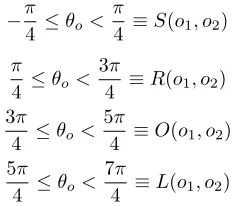
The basic directional orientation relations are:Same, Opposite, Left and Rightas presented in Figure 1(b). These relations are abbreviated asS,O,L,Rrespectively. The relations are defined as follows, if 2D vectorsv1 andv2 represent the orientation of
objectso1ando2on the 2D plane, then the angleθobetween vectorv1andv2specify the
egocentric orientation relation betweeno1ando2as illustrated in Figure 1(a). Note that
lines separating the cone shaped regions belong only to one of these regions according to definitions of relations. Specifically:
−π
4 ≤θo<
π
4 ≡S(o1, o2)
π
4 ≤θo< 3π
4 ≡R(o1, o2) 3π
4 ≤θo< 5π
4 ≡O(o1, o2) 5π
4 ≤θo< 7π
4 ≡L(o1, o2)
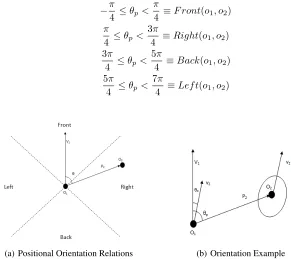
Positional orientation relations areFront, Back, Left and Right, presented in Figure 2(a) (note that termsBackandBehind can be used interchangeably). Lines separating the cone-shaped regions belong to only one of the adjacent regions, as in the case of direc-tional orientation relations. By convention, they also belong to the region to the right of the line, moving clockwise (but other conventions are valid as long as each line belongs to exactly one adjacent cone shaped region). Although positional orientation relations seem similar to directional orientation relations, their definition and semantics are dif-ferent. Specifically, positional orientation relations are defined as follows, if 2D vector
p2represents the position (and not orientation, as for directional orientation relations)
of objecto2on the 2D plane, that haso1position as reference frame, y-axis defined
vectorv1andp2specify the egocentric positional orientation relation betweeno1and
o2as illustrated in Figure 2(a). Relations are defined as follows:
−π
4 ≤θp<
π
4 ≡F ront(o1, o2)
π
4 ≤θp< 3π
4 ≡Right(o1, o2) 3π
4 ≤θp< 5π
4 ≡Back(o1, o2) 5π
4 ≤θp< 7π
4 ≡Lef t(o1, o2)
[image:6.612.142.433.148.407.2](a) Positional Orientation Relations (b) Orientation Example
Fig. 2.(a) Positional Orientation Relations (b) Orientation Example
An example presenting both relations is illustrated in Figure 2(b). Directional orien-tation relation is defined by angleθobetween vectorv1representing the orientation of
objecto1and vectorv2representing the orientation of objecto2. Positional orientation
relation is defined by angleθp between vectorv1representing orientation of objecto1
and vectorp2representing position of objecto2. In this example, objecto2has the same
orientation as objecto1and it is located at the right of objecto1.
Additional OWL axioms required for the proposed representation; basic relations of each set are pairwise disjoint e.g.,Lef tis disjoint withF ront. AlsoLef tisinverse
ofRight(in both sets) andF rontisinverseofBack. On the other hand, directional orientation relationssameandoppositeare symmetric. Note also that if two objects are identical then the equality relation holds between them. Instead of using a separate equality relation the OWLsameAskeyword can be used instead for this case as in [1].
4
Spatial Reasoning
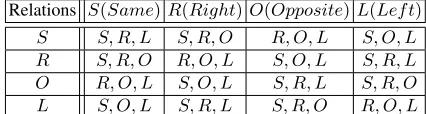
consistency checking over orientation relations. Defining compositions of relations is a basic part of the spatial reasoning mechanism. Table 1 represents the result of the composition of two directional orientation relations of Figure 1(b) (relations Same,
Right,OppositeandLeft, are denoted by “S”,“R”,“O”, “L” respectively).
Relations S(Same) R(Right)O(Opposite)L(Lef t)
S S, R, L S, R, O R, O, L S, O, L
R S, R, O R, O, L S, O, L S, R, L
O R, O, L S, O, L S, R, L S, R, O
[image:7.612.200.413.193.250.2]L S, O, L S, R, L S, R, O R, O, L
Table 1.Composition Table for Directional Orientation Relations.
Composition Table can be interpreted as follows: if relationR1 holds between object
o2and objecto1and relationR2holds between objecto3and objecto2, then the entry
of the Table 1 corresponding to lineR1and columnR2denotes the possible relation(s)
holding between objecto3 and objecto1. For example, if objecto2is atSame
direc-tion to objecto1and objecto3isRight (in terms of directional orientation) to object
o2then objecto3isright, same direction or oppositeto objecto1. Entries in the above
composition table are determined using the following observation: composition of two relations corresponds to the addition of two angles representing the relative directional orientation ofpoint2topoint1andpoint3topoint2, forming anglesθ1andθ2
respec-tively with the reference (vertical) axis. Combining this observation with the definition of relations in Section 3 the above compositions of Table 1 are defined. So for exam-ple composition ofsame andoppositeis interpreted as adding 74π ≤ θ1 < π4 and
3π
4 ≤ θ2 < 5π
4 which yields 2π
4 ≤ θ12 < 6π
4 which corresponds to a cone shaped
region into the region defined by the disjunction ofRight, Opposite, Left.
Composing positional orientation relations (Figure 2(a)) requires combining also directional orientation relations (Figure 1(b)). Specifically, composing orientation rela-tions can be defined as follows: if objecto1is related with objecto2with directional orientation relation Ro21 and positional orientation relationRp21 and objecto2is
re-lated with objecto3with directional orientation relationRo32and positional orientation relationRp32 then between objecto1and objecto3the directional orientation relation
Ro31 is defined using the compositions of Table 1 as:Ro31 ≡Ro21 ◦Ro32 (◦denotes composition).
Composition of positional relations is more complex: when composing relations
Rp21 andRp32, the fact that objecto2may have a different directional orientation wrt
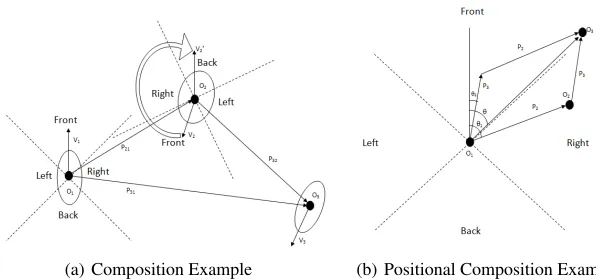
objecto1must be also taken into account. For example, if objecto2isRightof object
o1, object o3 is Lef t of object o2, but because object o2 is opposite of object o1
(see Figure 3(a)), directional orientation of objectso1ando2must be aligned, before composing positional relations. Specifically, after rotating objecto2wrt objecto1(i.e., aligning their directional orientation, by changing direction of objecto2fromv2tov20),
Backof objecto2(see Table 2). Then we can compose positional orientation relations and infer possible relations holding between objectso1ando3.
Intuitively, for the composition ofRp21 andRp32 objecto1 is now the reference point for both objecto2and objecto3, thus before composing the two relations,Rp32
must be adjusted to the reference frame of objecto1and this is achieved by perform-ing the rotation specified by relationRo21. The result of this rotation, which will be described in detail is denoted by Ro21♦Rp32. The resulting relation which is a po-sitional orientation relation of Figure 2(a) can be composed with relation Rp21, thus
Rp31≡Rp21◦(Ro21♦Rp32). Since rotation is defined as an addition of two angles, the result of the rotation is similar to compositions of Table 1. Specifically, rotations are de-fined in Table 2. Given a directional orientation relationRoand a positional orientation
relationRp, each entry in Table 2 corresponding to rowRoand columnRprepresent
the result of the rotation of relationRp with respect to relationRo, yielding a set of
positional orientation relations.
Relations F(F ront)R(Right)B(Back)L(Lef t)
S(Same) F, R, L F, R, B R, B, L F, B, L
R(Right) F, R, B R, B, L F, B, L F, R, L
O(Opposite) R, B, L F, B, L F, R, L F, R, B
[image:8.612.148.446.432.572.2]L(Lef t) F, B, L F, R, L F, R, B R, B, L
Table 2.Rotation Table for Positional Orientation with respect to Directional Orientations
(a) Composition Example (b) Positional Composition Example
Fig. 3.(a) Composition Example (b) Positional Composition Example
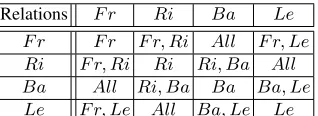
BackandLeft, are denoted by “F r”,“Ri”,“Ba”, “Le” respectively, andAlldenotes the disjunction of all relations).
Relations F r Ri Ba Le
F r F r F r, Ri All F r, Le
Ri F r, Ri Ri Ri, Ba All
Ba All Ri, Ba Ba Ba, Le
[image:9.612.230.389.163.221.2]Le F r, Le All Ba, Le Le
Table 3.Composition Table for Positional Orientation Relations.
Composition Table can be interpreted as follows: if relationR1holds betweenpoint2
andpoint1and relationR2holds betweenpoint3andpoint2, then the entry of the
Ta-ble 3 corresponding to lineR1and columnR2denotes the possible relation(s) holding
betweenpoint3 andpoint1 (points represent the centroid of corresponding objects). For example, ifpoint2 is F rontof point1 andpoint3is Lef t topoint2 (after ro-tating object o2 to so as to point to the same direction as objecto1) then point3 is
F rontorLef ttopoint1. Entries in the above composition tables are determined us-ing the followus-ing observation: composition of two relations corresponds to the addition of two vectors representing the relative placement ofpoint2topoint1 andpoint3to
point2(after performing the aforementioned rotation) forming anglesθ1andθ2
respec-tively with the reference axis. The resulting vector represents the relative placement of
point3 to point1, i.e., the composition of two vectors, as illustrated in Figure 3(b). When adding the two vectors the resulting vector forms an angleθwith the reference axis such thatθ2 ≤θ ≤θ1. Angleθdefines the relation betweenpoint1andpoint3.
Using this observation it can be concluded for example that composing relationsRight
andF rontyields the disjunction of these two relations as a result.
A series of compositions of relations may yield relations which are inconsistent with existing ones (e.g., the above example will yield a contradiction ifpoint3 back of of point1has been also asserted into the ontology). Consistency checking is achieved by ensuring path consistency by applying formula:
∀x, y, k Rs(x, y) Ri(x, y)∩(Rj(x, k)◦Rk(k, y))
representing intersection of compositions of relations with existing relations (symbol∩ denotes intersection, symbol◦denotes composition andRi,Rj,Rk,Rsdenote direc-tional relations). The formula is applied until a fixed point is reached (i.e., the applica-tion of the rules above does not yield new inferences) or until the empty set is reached, implying that the ontology is inconsistent. Implementing path consistency formula re-quires rules for both compositions and intersections of pairs of relations.
Compositions of relationsR1,R2yielding a unique relationR3as a result are
ex-pressed in SWRL using rules of the form:
Note that for directional orientation relations of Figure 1(b), rules of the above form apply, but for positional orientation relations of Figure 2(a), rules are of the form:
R1(x, y)∧Ro1(x, y)∧R2(y, z)R3(x, z)
whereRo1is a relation of the set presented in Figure 1(b).
The following is an example of such a composition rule:
F ront(x, y)∧F ront(y, z)F ront(x, z)
Rules yielding a set of possible relations cannot be represented directly in SWRL, since disjunctions of atomic formulas are not permitted as a rule head. Instead, disjunctions of relations are represented using new relations, whose compositions must also be defined and asserted into the knowledge base. For example, the composition of relationsF ront
andRightyields the disjunction of two possible relations (FrontandRight) as a result:
F ront(x, y)∧Right(y, z)→(F ront∨Right)(x, z)
If the relation F ront Rightrepresents the disjunction of relations Front andRight, then the composition ofF rontandRightcan be represented using SWRL as follows:
F ront(x, y)∧Right(y, z)→F ront Right(x, z)
A set of rules defining the result of intersecting relations holding between two points must also be defined in order to implement path consistency. These rules are of the form:
R1(x, y)∧R2(x, y)R3(x, y)
whereR3can be the empty relation. For example, the intersection of relationsLef tand
Rightyields the empty relation, and an inconsistency is detected:
Lef t(x, y)∧Right(x, y)⊥
Intersection of relationsRightandRight Back(representing the disjunction ofRight
andBackyields relationRightas a result:
Right(x, y)∧Right Back(x, y)Right(x, y)
Thus, path consistency is implemented by defining compositions and intersections of re-lations using SWRL rules and OWL axioms for inverse rere-lations as presented in Section 3. Another important issue for implementing path consistency is the identification of the additional relations, such as the above mentionedRight Backrelation, that represent disjunctions. Specificallyminimalsets of relations required for defining compositions and intersections of all relations that can be yielded when applying path consistency on the basic relations of Figures 1(b) and 2(a) are identified. The identification of the additional relations is required for the construction of the corresponding SWRL rules.
are yielded forming a set closed under composition, intersection and inverse. Since compositions and intersections are constant-time operations (i.e., a bounded number of table lookup operations at the corresponding composition tables is required) the run-ning time of closure method is linear to the total number of relations of the identified set. This method is applied over both sets of relations.
[image:11.612.190.430.196.313.2]Input: Set S of tractable relations Table C of compositions WHILE S size changes
BEGIN
Compute C:Set of compositions of relations in S S=S∪C
Compute I:set of intersections of relations in S S= S∪I
END RETURN S
Table 4.Closure method
A reduction to required relations and rules can be achieved by observing that the disjunction of all basic relations when composed with other relations yields the same relation, while intersections yield the other relation. Specifically, given thatAll repre-sents the disjunction of all basic relations andRxis a relation in the supported set, then the following holds for everyRx:
All(x, y)∧Rx(x, y)→Rx(x, y)
All(x, y)∧Rx(y, z)→All(x, z)
Rx(x, y)∧All(y, z)→All(x, z)
Since relationAllalways holds between two points, because it is the disjunction of all possible relations, all rules involving this relation, both compositions and intersections, do not add new relations into the ontology and they can be safely removed. Also, all rules yielding the relationAllas a result of the composition of two supported relations
Rx1,Rx2:
Rx1(x, y)∧Rx2(y, z)→All(x, z)
can be removed as well. Thus, since intersections yield existing relations and the fact that the disjunction over all basic relations must hold between two objects, all rules involving the disjunction of all basic relations, and consequently all rules yielding this relation, can be safely removed from the knowledge base. After applying the closure method and optimizations the required number of relations for representation and rea-soning (basic and disjunctive) is 23 (14 directional and 9 positional).
5
Evaluation
5.1 Theoretical Evaluation
The required expressiveness of the proposed representation is within the limits of OWL 2 expressiveness. Reasoning is achieved by employing DL-safe rules expressed in SWRL that apply on named individuals in the ontology ABox, thus retaining decidability.
Specifically, any object can be related with every other object with two basic direc-tional relations (one of each set presented in Figures 1(b) and 2(a)). Since relations of each set are mutually exclusive, betweennobjects, at most2n(n−1)relations can be asserted. Furthermore, path consistency hasO(n5)time worst case complexity (with
n being the number of points). In the most general case where disjunctive relations are supported, in addition to the basic ones, any object can be related with every other object by at mostkrelations, wherekis the size of the set of supported relations. There-fore, fornobjects, usingO(k2)rules, at mostO(kn2)relations can be asserted into the
knowledge base.
TheO(n5)upper limit for path consistency running time referred to above is
ob-tained as follows: At mostO(n2)relations can be added in the knowledge base. At each
such addition step, the reasoner selects 3 variables amongnobjects which corresponds toO(n3)possible different choices. Clearly, this upper bound is pessimistic, since the
overall number of steps may be lower thanO(n2), because an inconsistency detection
may terminate the reasoning process early, or the asserted relations may yield a small number of inferences. Also, forward chaining rule execution engines employ several optimizations, thus the selection of appropriate variables usually involves fewer than
O(n3)trials. Nevertheless, since the end user may use any reasoner supporting SWRL, a worst case selection of variables can be assumed in order to obtain an upper bound for complexity. Also, retaining control over the order of variable selection and application of rules yields anO(n3)upper bound for path consistency [3].
5.2 Experimental Evaluation
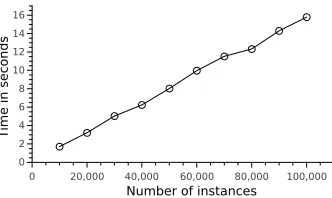
Measuring the efficiency of the proposed representation requires the spatial ontology of Section 3, containing instances, thus a data-set of 10K to 100K objects generated randomly was used for the experimental evaluation. Reasoning response times of the spatial orientation reasoning rules are measured as the average over 10 runs. HermiT 1.3.8 running as a library of a Java application was the reasoner used in the experiments. All experiments where run on a PC, with Intel Core CPU at 2.4 GHz, 6 GB RAM, and Windows 7.
Measurements illustrate that the proposed approach can efficiently represent thou-sands of objects and reason over them in a few seconds, without using specialized soft-ware besides a standard OWL reasoner such as HermiT.
6
Conclusions and future work
T
im
e
i
n
s
e
co
n
d
s
0 2 4 6 8 10 12 14 16
Number of instances
[image:13.612.223.389.121.220.2]0 20,000 40,000 60,000 80,000 100,000
Fig. 4.Average reasoning time for orientation relations as a function of the number of objects
The proposed representation is fully compliant with existing Semantic Web stan-dards and specifications, which increases its applicability. Being compatible with W3C specifications, the proposed framework can be used in conjunction with existing edi-tors, reasoners and querying tools such as Prot´eg´e and HermiT, without requiring any additional specialized software. Therefore, information can be easily distributed, shared and modified. Directions of future work include the development of applications based on the proposed mechanism. Such applications could combine temporal and topolog-ical spatial representations with the proposed orientation representation and reasoning mechanism.
References
1. S. Batsakis and E.G.M. Petrakis. “SOWL: A Framework for Handling Spatio-Temporal Information in OWL 2.0”. 5th International Symposium on Rules: Research Based and Industry Focused (RuleML’ 2011), pages 242–249, 2011.
2. J. Renz, and B. Nebel. “Qualitative Spatial Reasoning using Constraint Calculi”. In Hand-book of Spatial Logics, Springer, Netherlands , pp. 161-215, 2007.
3. M. Stocker, and E. Sirin “PelletSpatial: A Hybrid RCC-8 and RDF/OWL Reasoning and Query Engine” In: CEUR Workshop Proceedings, vol. 529-OWLED 2009, pp. 2-31, 2009. 4. G. Christodoulou, E.G.M. Petrakis, and S. Batsakis “Qualitative Spatial Reasoning using
Topological and Directional Information in OWL” In Proc. of 24th International Conference on Tools with Artificial Intelligence (ICTAI 2012), November 7-9, 2012.
5. J. Renz, and D. Mitra “Qualitative Direction Calculi with Arbitrary Granularity” In PRICAI 2004: Trends in Artificial Intelligence: 8th Pacific Rim International Conference on Artificial Intelligence, Auckland, New Zealand, August 9-13, 2004.
6. S. Batsakis “Reasoning over 2D and 3D directional relations in OWL: a rule-based approach” In Theory, Practice, and Applications of Rules on the Web (RuleML2013), p.37-51, 2013. 7. R. Baruah, and S. M. Hazarika “Qualitative directions in egocentric spatial reference frame.”
Intelligent Systems Design and Applications (ISDA), 2012 12th International Conference on. IEEE, 2012.
8. T. Mossakowski, and R. Moratz “Qualitative reasoning about relative direction of oriented points.” Artificial Intelligence 180 (2012): 34-45.