sciences
Article
An Integrated Cyber Security Risk Management
Approach for a Cyber-Physical System
Halima Ibrahim Kure1,*ID, Shareeful Islam1,*ID and Mohammad Abdur Razzaque2
1 School of Architecture, Computing and Engineering, University of East London, London E16 2RD, UK 2 School of Computing, Media and Arts, Teesside University, Middleborough TS1 3BX, UK;
* Correspondence: [email protected] (H.I.K.); [email protected] (S.I.); Tel.: +44-208-223-7273 (H.I.K. & S.I.)
Received: 30 March 2018; Accepted: 16 May 2018; Published: 30 May 2018
Abstract: A cyber-physical system (CPS) is a combination of physical system components with cyber capabilities that have a very tight interconnectivity. CPS is a widely used technology in many applications, including electric power systems, communications, and transportation, and healthcare systems. These are critical national infrastructures. Cybersecurity attack is one of the major threats for a CPS because of many reasons, including complexity and interdependencies among various system components, integration of communication, computing, and control technology. Cybersecurity attacks may lead to various risks affecting the critical infrastructure business continuity, including degradation of production and performance, unavailability of critical services, and violation of the regulation. Managing cybersecurity risks is very important to protect CPS. However, risk management is challenging due to the inherent complex and evolving nature of the CPS system and recent attack trends. This paper presents an integrated cybersecurity risk management framework to assess and manage the risks in a proactive manner. Our work follows the existing risk management practice and standard and considers risks from the stakeholder model, cyber, and physical system components along with their dependencies. The approach enables identification of critical CPS assets and assesses the impact of vulnerabilities that affect the assets. It also presents a cybersecurity attack scenario that incorporates a cascading effect of threats and vulnerabilities to the assets. The attack model helps to determine the appropriate risk levels and their corresponding mitigation process. We present a power grid system to illustrate the applicability of our work. The result suggests that risk in a CPS of a critical infrastructure depends mainly on cyber-physical attack scenarios and the context of the organization. The involved risks in the studied context are both from the technical and nontechnical aspects of the CPS.
Keywords:cybersecurity; risk management; cyber-physical systems; cybersecurity attack scenario; supervisory control and data acquisition (SCADA) systems; cascading effect
1. Introduction
Generally, cyber-physical systems are real-time and robust independent systems with high performances requirements [1]. They are used in many application domains, including critical infrastructures, such as the national power grid, transportation, medical, and defense. These applications require the attainment of stability, performance, reliability, efficiency, and robustness, which require tight integration of computing, communication, and control technological systems [2]. CPSs of critical infrastructures have always been the target of criminals and are affected by security threats [3] because of their complexity and cyber-physical connectivity. These CPSs face security breaches when people, processes, technology, or other components are being attacked or risk management systems are missing, inadequate, or fail in any way. The attackers target confidential
data, such as customer information or other valuable records [4]. It is likely that the threats of CPSs will only increase in the future as the use of these systems become widespread. However, there are sensible safety measures that organizations can consider to minimize losses from their destruction. It is possible to control damages and recover from an attack and its consequences with the appropriate insight through research and a domain expert’s assistance [5]. Managing CPS security risk is not about eliminating all risks; it is about determining and understanding the risk rating of events and putting the right processes or controls in place to manage them in accordance with the organization’s risk tolerance level. Risk management is a continuous process, not a one-time event [3]. In response to an event(s), there is an urgent need for organizations to truly understand their cyber-physical security status and employ the necessary and urgent corrective actions to rectify weaknesses [6].
Risk can be defined as an uncertain event that may occur due to a system malfunction or failure that could harm assets, such as human beings or the environment, and also influence the organization’s achievement on strategic, operational, and financial objectives [7]. Risk management is a key discipline for making effective decisions and communicating the results within organizations. It proactively identifies potential managerial and technical problems so that appropriate actions can be taken to reduce or eliminate the probability and/or impact of these problems [8]. There are many existing risk management methods for CPSs [9–12] However risk management in CPSs is challenging because of the increased complexity of the systems, the evolution of risk levels, human factor threats comprising of unintentional breaches of security, the unsuspicious use of infected information media giving away sensitive information, and lack of awareness and human errors [13]. In addition, cascading failures occur because of interdependencies among components and infrastructures. Importantly, threats affecting one part of a CPS can propagate to other parts through the network, which interconnects different parts of the CPS and affects other parts. As security threats grow, the organization needs a comprehensive cybersecurity risk management system to identify unique cybersecurity threats and their trends. The authors of a previous paper [14] discussed the challenges for securing CPS and analyzed security mechanisms for prevention, detection and recovery, resilience, and deterrence of attacks for securing CPS. A previous work [15] proposed a layered approach for evaluating risk based on security to prevent, mitigate, and tolerate attacks both on physical power applications and cyber infrastructures. The paper identifies the importance of combining both power application security and supporting infrastructure security into the risk assessment process and provides a methodology for impact evaluation. Also, another paper Ref. [11] provides an overview of a number of important real-life issues of cybersecurity and risk assessment for supervisory control and data acquisition (SCADA) and distributed control systems (DCS). The paper discussed the various compromise graphs and augmented vulnerability trees that quantitatively determine the probability of an attack, impact of the attack, and the reduction in risk as a result of a particular countermeasure. All these works, and more, are presented in the related work section emphasize: the importance of cybersecurity risks management for CPSs. However, comprehensive and integrated risk management practice is not sufficiently addressed in these works.
The novel contributions of this paper are: (i) A comprehensive integrated cybersecurity risk management framework that explicitly considers risk from a holistic perspective of the stakeholder model, cross functions risks, and existing risk management frameworks; (ii) the integration of the cascading effect from interdependent CPS components considering vulnerability, threats, and risks to an asset; and (iii) an evaluation of the proposed integrated risk management approach into a real cyber physical system. The result from this case study outlines the applicability of the proposed approach. We also compared the identified results with the existing results to demonstrate the impact of integrated risk management as approach to the CPS.
algorithms. Section5demonstrates the evaluation results of the implementation of the proposed approach into a real smart grid system. This section also discusses of the various parts of the approach and compares it with other works. Section6provides the validity of the study, and finally Section7 concludes the work and presents a few directions for future work.
2. Related Work
Cybersecurity risk management in CPSs is a very active research area, and a significant number of research works have been published in this area. We divided these works into three categories: (1) security risks management methods for CPS; (2) cyber security in smart grid; and (3) security risk management frameworks/standards/guidelines and presented the summary in the following.
2.1. Security Risks Management for Cyber-Physical System
A Risk Breakdown Structure (RBS) approach was proposed for managing the risks of CPS as previously described [16]. Countermeasures were proposed on the basis of the risk matrix method and classified. Risk values were introduced in an information security management system (ISMS) and quantitative evaluation was conducted for detailed risk assessment. The quantitative evaluation showed that the proposed countermeasures could reduce risk to some extent. Investigation into the cost-effectiveness of the proposed countermeasures is an important future work. Cherdantseva et al. [9] reviewed the state-of-the-art practices in cybersecurity risk assessment of the SCADA systems using aim, application domain, stages of risk management, risk management concepts, impact measurement, and sources of probabilistic data, evaluation, and tool support. Despite a large number of risk assessment methods for SCADA systems, the need for a comprehensive method that would cover all stages of risk management process is missing. The authors of a previous paper [10] proposed a new approach for assessing the organization’s vulnerability to information-security breaches using the threat-impact index and cyber-vulnerability indexes based on vulnerability trees. This helps managers determine the current level of security and helps them select security mechanisms. However, probability added to each damage category would help to further quantify the risk associated with information systems. Hahn et al. [11] provided an overview of smart grid security, including the set of controls, communication, and physical system components required to provide an accurate cyber-physical environment. Several attack-impact evaluations were performed on the system such as availability and integrity attacks. There are other works that [12] focus on detecting computer attacks which change the behavior of the targeted control systems by understanding the consequences of the attack for risk assessment. Wu et al. [1] proposed a quantitative risk assessment model that focuses on the CPS running conditions and calculates risk in real-time using users’ responses to risk at certain times. It provides users with attack information such as the type of attack, frequency, and target host ID and source host ID. Ten et al. proposed a cyber-security framework of the SCADA system as a critical infrastructure using real-time monitoring, anomaly detection, and impact analysis with an attack tree-based methodology, and mitigation strategies [17].
2.2. Cyber Security in Smart Grid
operations (FHE-BO) model was proposed Ref. [20] which focuses on calculating encrypted real numbers. The encryption-decryption approach successfully acquired correct outputs from decrypting cypher-results of blend operations. The authors of a previous paper Ref. [19,21] discussed different unified approaches for security risk management in the context of the smart power grid. Risk assessment methodologies proposed included threat and vulnerability modeling schemes which help in identifying and categorizing threats, analyzing their impacts, and prioritizing them. A previous work Ref. [22] surveys the risk assessment methods, major challenges, and controls for various aspects of the smart grid such as SCADA systems and communication networks, in order to address the challenges facing the smart grid technologies. However, smart grids, as a provider, require a comprehensive cyber security solution by supporting stakeholders and assessing vulnerabilities and cyber threats and integrating systems to provide guidelines for effective risk management. The authors of Ref. [23] discussed the risk of cyber-attack on smart metering systems by applying methods and concepts from cyber-attack scenarios in a smart grid system.
2.3. Frameworks/Standards/Guidelines
There are widely accepted risk management standards such as ISO 31000 that provide guidelines for risk management activities which also consider risk management as an integral part of the overall organizational processes, including strategic planning and management processes [24]. IEC 31010 is also another recognized risk management method and technique [25]. The NIST framework focuses on managing cyber-security risk and NERC CIP standards for the identification and protection of critical cyber assets that support the reliable operation of the electric power grid. The NIST framework [26] is a risk-based approach for managing cyber-security risk. It is applied to deliver a complete platform that identifies relevant paths, providing guidance that ranges from requirements to implementation. Critical infrastructure organization can use the NIST framework alongside their existing frameworks to systematically identify, manage, and assess cybersecurity risk. It can serve as the basis for a new cybersecurity program or a mechanism for improving its existing programs. The outcome of the framework will serve as the basis for the on-going operation of the system, which includes reassessment to verify that the cybersecurity requirements are fulfilled [27]. A particular goal driven risk management approach [28,29] emphasizes the identification of goals as objectives specific to the organization mission. Risks are considered as an obstruction to the goal so that identified risks are assessed based on which goals they oppose. The approach is applied in various domains such as software development project and cloud computing.
Several observations were made from reviewing the existing works.
• Cherdantseva et al. [9] reviewed existing cyber security risk assessment works and concluded that it is necessary to have a comprehensive risk management method which will cover all stages of the risk management process.
• Different risk management approaches for smart grid were also discussed in a previous work [21]. However, risk management from a holistic perspective that incorporates all aspects of a smart grid and their interdependencies is needed.
• Most of the risk management approaches emphasize assessing vulnerabilities and identifying threats but lack emphasis on the cascading effect of vulnerabilities and threats to the asset. • The existing works provide limited efforts in considering the estimation of an accurate risk level
for the organization.
a cyber-attack scenario and the impact of the risks are considered from the CPS organization’s key performance indicators (KPIs) to generate the accurate risk levels.
3. The Rationale for an Integrated Risk Management Approach
An integrated risk management includes a combination of various components of a CPS which are interdependent and necessary for successful risk management. It needs to be a part of an organization’s strategy in order to address the organization’s risk management principles. Critical infrastructure organizations (i.e., health, financial, telecommunications, transportation, energy, and water) are always the targets for attackers and face different types of risks [30]. An integrated risk management scheme enforces a constant assessment of potential risks at every level in an organization and gathers the results at the corporate level to enable priority setting and minimize risk. The identification, assessment, and management of risks throughout the organization help to avoid greater risks and foster improvement of the organization. Traditional security risk assessment methods only address IT security risk or compliance risk. The integrated risk management framework will build a holistic solution considering the technical and nontechnical aspects of the organization. Figure1shows several areas that will incorporate into an integrated risk management approach. The main components of the integrated risk management framework are:
• Integration of stakeholder’s model: The integration of the stakeholder’s model for risk management is a means of achieving greater inclusivity in an organization, and it is important for an organization to understand its own security risk management practices. This approach shows the importance of security from each and every area of the business enterprise of a critical infrastructure organization by making it clear to managers and subsequently enhancing employee commitment. In a traditional security risk assessment having just one stakeholder, which could be the compliance manager or security director, the value of the security risk assessment process is limited. An integrated risk management approach seeks to relate vulnerability findings and IT control gaps in the context of how such findings may affect attackers, users, government, shareholders, regulatory authorities, numerous individuals, or groups across an organization. It also deals with the human issues for risk management.
• Measurement of cross-functional risks from organizational context: An effective risk management method renders a successful management of various factors that prevent organizations from achieving their desired security objectives. Risks depicted through an integrated risk management approach become cross-functional (i.e., a system whereby people from different areas of an organization work together as a team considering both technical and nontechnical perspectives), and the approach draws an obvious conclusion on how risks affect regulatory requirements, the supply management chain, and the goals or KPSs of the organization and its security objectives. The approach will provide a better understanding of cross-functional risks amongst control objectives that may have been impacted by technical or process-based vulnerabilities and will give attention to any higher risks. Cross-functional risks include technical risks and nontechnical risks such as software risk, system complexity and vulnerabilities, environmental risk, legal security, etc. As the approach captures different information from different stakeholders, security issues are shared across the organization and weighed appropriately in light of the management’s level of criticality for each business and control function.
will provide guidelines for risk management activities and also considers risk management as an important aspect of the overall organizational process [24,25,28,29].
[image:6.595.107.492.134.330.2]Appl. Sci. 2018, 8, x FOR PEER REVIEW 6 of 28
Figure 1. An integrated risk management approach.
4. An Integrated Risk Management Approach
The scope of the proposed integrated risk management approach is to understand, manage, monitor and communication of risks during operation in CPS for the benefit of a critical infrastructure organization. It includes many concepts that serve as a common language for describing the properties necessary for cybersecurity risk management. These concepts help us to systematically assess and manage risks proactively. In particular, we consider assets and their criticalities, relevant vulnerabilities and threats to model the cybersecurity attack scenario so that risk level can be quantified for the suitable countermeasure. This section presents an overview of the integrated risk management concepts of the proposed approach.
4.1. Modeling Concepts
The proposed approach includes a set of modeling concepts that are essential to understand, manage, and express cybersecurity risks. We have identified a few concepts necessary for the development of the cybersecurity risk management approach. Based on those concepts, an in-depth exploration of the numerous methods, tools, and techniques that can be used for a risk management approach in the CPS has been performed. An overview of the concepts used by the proposed approach is explained below:
• Actor: An actor is an entity, generally a human user, a system, an organization, or a process each with a specific strategic goal within its organizational setting and carries out specific activities to generate cybersecurity risk management actions or receive the generated cybersecurity risk management actions by another actor [31]. This requires the organization to appoint efficient actors to carry out various tasks to guide and lead in achieving its goals. The actors are identified as stakeholders, such as government employees, IT providers, and utilities, employees, consumers, owners and operators, customers, users, and providers with skills within a particular location.
• Goals: Goals signify the overall aims and objectives of an actor which supports the interest and continuity of the business. There are expectations to support the organization and include the KPIs of the organization, security, and organizational goals. KPIs allow the critical infrastructure organization actors to make a keen decision about the organization’s continuity; they include confidentiality, availability, and integrity.
• Risks: Risk can be defined as the possibility of an unwanted outcome as a result of an incident, event, or occurrence, as determined by its likelihood and the associated consequences. The risk is inevitable in a business, however, it is the role of the actors to ensure that risks are kept to a minimum to achieve the goals. Once the risk has been identified, it is necessary to have a
Figure 1.An integrated risk management approach.
4. An Integrated Risk Management Approach
The scope of the proposed integrated risk management approach is to understand, manage, monitor and communication of risks during operation in CPS for the benefit of a critical infrastructure organization. It includes many concepts that serve as a common language for describing the properties necessary for cybersecurity risk management. These concepts help us to systematically assess and manage risks proactively. In particular, we consider assets and their criticalities, relevant vulnerabilities and threats to model the cybersecurity attack scenario so that risk level can be quantified for the suitable countermeasure. This section presents an overview of the integrated risk management concepts of the proposed approach.
4.1. Modeling Concepts
The proposed approach includes a set of modeling concepts that are essential to understand, manage, and express cybersecurity risks. We have identified a few concepts necessary for the development of the cybersecurity risk management approach. Based on those concepts, an in-depth exploration of the numerous methods, tools, and techniques that can be used for a risk management approach in the CPS has been performed. An overview of the concepts used by the proposed approach is explained below:
• Actor: An actor is an entity, generally a human user, a system, an organization, or a process each with a specific strategic goal within its organizational setting and carries out specific activities to generate cybersecurity risk management actions or receive the generated cybersecurity risk management actions by another actor [31]. This requires the organization to appoint efficient actors to carry out various tasks to guide and lead in achieving its goals. The actors are identified as stakeholders, such as government employees, IT providers, and utilities, employees, consumers, owners and operators, customers, users, and providers with skills within a particular location. • Goals: Goals signify the overall aims and objectives of an actor which supports the interest and
• Risks: Risk can be defined as the possibility of an unwanted outcome as a result of an incident, event, or occurrence, as determined by its likelihood and the associated consequences. The risk is inevitable in a business, however, it is the role of the actors to ensure that risks are kept to a minimum to achieve the goals. Once the risk has been identified, it is necessary to have a mitigation plan or any other solution to counterattack the risk. Risks are the potential consequences of the system and could possibly compromise the security of the CPS and not meet the actor’s expectations. A CPS risk could be classified under security, operational, nontechnical, technical, and governance or regulatory parameters. These risks could obstruct the security of the CPS and require an appropriate assessment. The risk assessment will be based on likelihood, impact, and residual analysis, which helps in identifying which risk needs to be controlled by following different control strategies.
• Assets. Assets are defined as tangible or intangible entities which are necessary and have values to the CPS organization. Identification of key assets, and putting a value on each key asset, is an important process of risk management. These key assets could be people, services, facilities, processes, etc. It is important to identify critical assets as well as estimate their critical failure modes or impact of the loss. An asset has two features: (i) criticality and (ii) category. Criticality is defined as a measure of the consequences associated with the degradation or loss of an asset. It is the major indicator used by organizations to determine which asset is of more value to the business continuity. Category classifies assets according to its level of sensitivity and security requirements. The criticality of an asset category can be high, medium, or low, which means that assets with high rating are the most valuable to the organization.
• Controls. The set of security protections or countermeasures to avoid or minimize security risks in CPS critical infrastructure are called controls. Controls are also the mechanism used to provide security to the CPS, and they are characterized by combining technical and nontechnical controls which are used to deter anticipated and unanticipated threats from exploiting known vulnerabilities. They also describe the vital components and actions taken to protect the assets. The overall goal of risk assessment will be partly defeated if relevant controls are not applied. • Compliance Programs: These are sets of requirements designed to secure the CPS to operate
without any form of disturbance. Critical infrastructures are increasingly using compliance programs as a mechanism for demonstrating cybersecurity for CPS protection. The North American Electric Reliability Corporation Critical Infrastructure Protection (NERC CIP) is a compliance program designed to secure the assets necessary for operating a bulk electric system. In this case, the SCADA system of the CPS is an asset. Therefore, a significant sum of their budget and time is necessary to ensure security compliance with standards such as NERC CIP, NIST, NIPP, and other relevant standards.
• Cyber-attack scenario: A cyber-attack scenario is an event that leads to a negative impact on the organization’s assets when it occurs. There are some certain components that determine a cyber-attack on a CPS. They include threat types, actor’s skill, capability and location, assets, events, and time. With certain scenarios, the organization tends to think broadly by developing a range of possible outcomes to increase their readiness for a range of possibilities in the future. • Policy: Policies are the principles of action adopted or proposed by an organization. There are a
number of security policies, such as access control and backup that are necessary to formulate and implement the CPS security program.
• Threats and vulnerabilities: Vulnerability is the weakness in an organization security program that is exploited by a threat to gain unauthorized access to an asset. It has three properties. i.e., impact, type, and weight score.
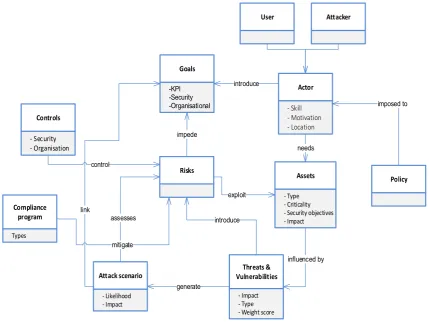
such as business continuity and reputation of the organization and the key performance indicators such as authenticity, consistency, resilience, etc., and the attainment of one or more is always their focus. As concerns are raised in regards to risk which may impede the fulfilment of the goals, controls regarding security and the organization are introduced to help mitigate the risks. The actor has full control over its assets and needs to keep the assets secure for the continuity of the business, but these assets are prone to weaknesses in their systems, known as vulnerabilities. These vulnerabilities, when not addressed on time, can lead to a threat which will introduce risk, and this risk is likely to lead to the exploitation of the assets. Once the risk factors have been identified, risk assessment is carried out to mitigate them.
Appl. Sci. 2018, 8, x FOR PEER REVIEW 8 of 28
the exploitation of the assets. Once the risk factors have been identified, risk assessment is carried out to mitigate them.
Assets - Criticality Threats & Vulnerabilities Risks Actor - Motivation Goals -Organisational introduce Controls - Organisation impede control needs exploit influenced by introduce Attack scenario generate assesses - Skill - Location User Attacker - Type
- Security objectives - Impact
[image:8.595.83.513.220.543.2]- Type - Impact - Weight score - Likelihood - Impact link -Security -KPI - Security Policy imposed to Compliance program Types mitigate
Figure 2. Metamodel.
4.2. Risk Management Process
The process of risk management comprises a systematic collection of activities. We follow the guidelines identified in the existing risk management standards ISO 310000 [32], NIST SP800-30 framework [26], and NERC CIP standards [33] to define our risk management process. The process consists of six different sequential activities which are linked with each other and every activity includes steps to support specific tasks relating to risk management.
4.2.1. Activity 1: Risk Management Context
The risk management context formally triggers the risk management activities. The purpose of this activity is to define the system and its components, scope, the KPI, and the risk acceptance level in which an organization will tolerate the residual risk to the overall business continuity. Active involvement of the actor’s requirement is taken into account, risk managers and management representatives are also considered for successfully planning of risk management activities that focus on the cybersecurity of the CPS. The initiation of risk management is determined by the implementation of the risk management scope, schedule, available resources, risk monitoring strategy, and risk treatment, based on the critical infrastructure organizations’ objectives. It includes three steps which are given below.
Step 1: Identify the system and components and existing risk management practice
This step identifies the system and its associated components of a critical infrastructure. This step also identifies the current risk management practice for the CPS organization. We follow the NIST cyber security framework’s implementation tiers for this purpose framework [28]. In particular, according to the framework, tiers range from 1 (partial) to 4 (adaptive). This allows us to understand
Figure 2.Metamodel.
4.2. Risk Management Process
The process of risk management comprises a systematic collection of activities. We follow the guidelines identified in the existing risk management standards ISO 310000 [32], NIST SP800-30 framework [26], and NERC CIP standards [33] to define our risk management process. The process consists of six different sequential activities which are linked with each other and every activity includes steps to support specific tasks relating to risk management.
4.2.1. Activity 1: Risk Management Context
of the risk management scope, schedule, available resources, risk monitoring strategy, and risk treatment, based on the critical infrastructure organizations’ objectives. It includes three steps which are given below.
Step 1: Identify the system and components and existing risk management practice
This step identifies the system and its associated components of a critical infrastructure. This step also identifies the current risk management practice for the CPS organization. We follow the NIST cyber security framework’s implementation tiers for this purpose framework [28]. In particular, according to the framework, tiers range from 1 (partial) to 4 (adaptive). This allows us to understand the organization’s current risk management practice and desired practice for future practice. Critical infrastructure is a unique system because of its complex, diversified, mutual interrelations among its systems, components, and other systems [34]. Due to the relationship between other components and systems, the state of one system is highly dependent on the state of the other system or component and thus these factors are called interdependencies. Interdependencies among the systems or components can be classified into four categories, as explained below.
• Physical interdependency: This refers to two or more infrastructures that are physically interdependent if the operation of one infrastructure depends on the physical output of the other. • Cyber interdependency: Refers to the state of an infrastructure depending on the information
communicated through the information infrastructure.
• Logical interdependencies: This type of interdependency occurs when the state of each infrastructure depends on the state of the other through controls, mechanisms, regulatory or otherwise, that cannot be considered cyber, physical, or geographical.
• Geographical independencies: This kind of interdependency occurs when elements of multiple infrastructures are in the same remote area. In this case, natural disasters can cause an element of one infrastructure to create failure in one or more infrastructures within close vicinity.
Step 2: Determine goals and key performance indicators (KPI)
This step identifies the organizational and security goals. The main goals are general confidentiality, integrity, availability, and reputation. Based on these goals, the key performance indicators for the organizational context are considered, as well as the strengths and weaknesses of the organization, which help to explain the need for cybersecurity risk management. It is also necessary to identify the key operational responsibilities of the critical infrastructure in order to support the cybersecurity activities. Key performance indicators play an integral role in risk management. They are the benefits and targets set by organizations and these goals must be achieved. A secure CPS should be able to provide the below KPI:
• Confidentiality (C): This KPI deals with the disclosure of sensitive data against unauthorized users, CPS internal users, external users, and malicious attackers. It involves the deletion and transfer of data between authorized users in a secure environment to prevent data leakage. • High availability (A): Availability refers to ensuring that the assets of the critical infrastructure
are made available and accessible to the end users as agreed, or when and where they need it. It defines the degree or extent to which the asset is readily usable along with the necessary IT and management procedures, tools, and technologies required to enable, manage, and continue to make it available.
• Resiliency (R): This KPI allows for the CPS to be able to work on an acceptable level of efficiency even when external or internal disturbances occur.
• Reputation (RE): Reputation is the trust and confidence the organization has gained by the public or given to the public.
• Authenticity (AUT): This KPI improves the identification and verification technology of an authorized user in order to provide security, ease of use, and administration. It has the capacity to identify an authorized user to its specific appropriate information and service type.
• Nonrepudiation (NR): This KPI provides certifiable evidence of a message being delivered to both communication endpoints in order to ensure that either the sender or the receiver does not deny sending and/or receiving the message.
• Maintainability (M): Maintainability is associated with the mean time to repair (MTTR) an asset and get it to work perfectly within a specified period of time. The time could be categorized as less than a day, several days, one week, several weeks, month(s), or even a year.
Step 3: Risk acceptance level
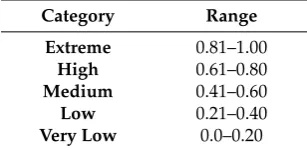
[image:10.595.220.374.477.552.2]The risk acceptance level gives an organization a guideline with which risk needs to be controlled based on management decision linking with residual risks. With a proper risk management process, risk can be eliminated, but not to a zero level, therefore, the remaining risk is referred to as the residual risk and should be accepted to a certain level with reference to Table1below. Accepting risk to a certain level is really important for a critical infrastructure and organization and its surrounding context. There are no risk-free systems; therefore, the need to understand which level of acceptance of risk after control is important for an organization. A well secured CPS can resist any form of disturbances either internally or externally and is able to continue working on an acceptable efficiency level [34]. Based on the probability of occurrence and impact, the risk level will be categorized into five different risk levels. Therefore, the risk management approach decides what level of risk can be accepted for the organization.
Table 1.Asset weight score.
Category Range
Extreme 0.81–1.00
High 0.61–0.80
Medium 0.41–0.60
Low 0.21–0.40
Very Low 0.0–0.20
4.2.2. Activity 2: Assets Identification and Criticality
This activity identifies the assets of the critical infrastructure organization which require more attention. For a successful risk management process, asset identification is critical due to the threats that impact on the assets. The activity identifies the assets and determines their criticality so that critical assets obtain adequate protection. We aware that threats are becoming more forward-thinking and attacks are targeted against CPS, with vulnerabilities are being exploited and attempts being made to destroy CPSs [35]. Therefore, the identification and protection of critical assets is necessary to avoid cyber-attacks on them and their subsequent destruction.
Step 1: Criticality identification
and an investment is made on those assets if the disruption could have a serious impact on national security, public health, safety, or business continuity. Asset criticality is determined based on the weight score and the impact value score. However, if a selected asset is considered more important, the weighting factor should be greater, but if the asset is considered less important, then it should be less. The asset critical level will be considered based in the description of following three categories: Noncritical, Reasonably Critical, and Extremely Critical. The categories are defined below.
• Noncritical level 0.01–3.99.
• A reasonably critical level 4.00–7.99. • An extremely critical level 8.00–10.00.
Step 2: Asset weight
The asset weighting score is determined according to the level in which an asset is important to the continuity of the CPS objective. The category does not fully define criticality; however, the criticality of an asset can be categorized into high, medium, or low depending on the asset weight assigned. Assets with high rating are considered more valuable to the continuity of CPS, those with a medium rating represent moderate value, and those with a low rating mean that the asset is of minor value to the CPS continuity. A weight score will be assigned to each asset based on the subjective judgment given by the organization’s stakeholders. Weight scoring allows the allocating of scores to achieve a total score indicating the assets criticality as shown in Table1below; Equation (1) determines the asset criticality.
Asset criticality(AC)= Asset weight score×Impact value score
AC = n10
∑
i=1(WiVi) (1)
Using a Simple Additive Weighting (SAW) method, asset criticality level can be determined for each asset. Where a summation of the:
• IV= Impact value will range from 1.00–10.0. • W= Weight score will range from 0.01–1.00.
4.2.3. Activity 3: Vulnerability Assessment and Threat Identification
Step 1: Vulnerability Impact Rating
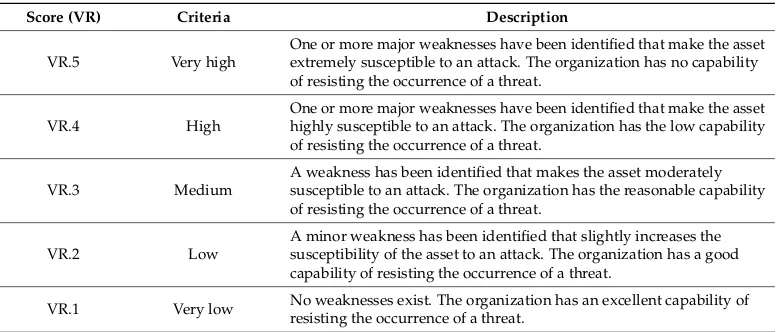
[image:12.595.104.494.195.361.2]The impact of vulnerability on critical assets will be assigned a vulnerability rating score of VR.1 to VR.5 from very high to very low for the vulnerability found on each critical asset. In the case of multiple vulnerabilities, vulnerability is assessed and a score is given. Description of the various levels of VR (Vulnerability Rating) will be explained in Table2below:
Table 2.Vulnerability rating table.
Score (VR) Criteria Description
VR.5 Very high
One or more major weaknesses have been identified that make the asset extremely susceptible to an attack. The organization has no capability of resisting the occurrence of a threat.
VR.4 High
One or more major weaknesses have been identified that make the asset highly susceptible to an attack. The organization has the low capability of resisting the occurrence of a threat.
VR.3 Medium
A weakness has been identified that makes the asset moderately susceptible to an attack. The organization has the reasonable capability of resisting the occurrence of a threat.
VR.2 Low
A minor weakness has been identified that slightly increases the susceptibility of the asset to an attack. The organization has a good capability of resisting the occurrence of a threat.
VR.1 Very low No weaknesses exist. The organization has an excellent capability of resisting the occurrence of a threat.
Step 2: Asset Vulnerability Impact Assessment Model (A-VIAM)
We propose an Asset Vulnerability Impact Assessment Model (A-VIAM) to determine the vulnerability impact on an asset. The model is built upon mathematical multi-value theory and structured as a value model [38]. A-VIAM is an additive preference model that assigns a value on a scale of 0.01–10.0 for vulnerability impact. The Vulnerability Rating (VR) on a scale of 1–5 is used to assess the vulnerability of a critical asset component and will be divided by the total number of a vulnerability discovered. The total impact value of all the critical asset components will be summed together and divided by the total number of the critical assets considered to assess the vulnerability of the entire system. The different vulnerabilities identified for a software asset, for example, theVR score will be assigned based on its impact on the software critical asset. All theVRvalues will be summed together to get an impact value for the Software asset and divided by the total number of vulnerabilities identified. The same method is applied to every other critical asset. The calculation for the A-VIAM model is shown below;
V I(CA) = n
∑
VR=1VVR1+VVR2. . .+nvrn
total number o f vulnerability (2)
where: VI = Vulnerability Impact. Scores range between 1.00 and 10.0, and will be assigned to a vulnerability impact on to the critical asset. Where 1.00–3.99 = low, 4.00–6.99 = medium and 7.00–10.0 = high.VR= Vulnerability Rating. A score of 1–5 is given for theVRas shown in Table2. V= Vulnerability type, this will be the various vulnerability types associated with each critical asset as shown in Table 7. CA = Critical Asset.
For example, if three vulnerabilities (V3.1, V3.2, and V3.4) from the checklist above were identified as a Software asset, the vulnerabilities will be rated using theVRscore to get the vulnerability impact on the software asset using Equation (3):
In this case, the vulnerability impact of the software asset is low, therefore there is little possibility of a threat occurring. The more the vulnerability is identified as an asset, the higher the vulnerability impact on the asset. To calculate vulnerability impact of an entire system, the total Vulnerability Impact of eachCA,VI(CA) will be summed together and divided by the total number of assets identified using the equation below:
V I(S) n
∑
VA(CA)=1V I(CA1) +V I(CA2). . .+V I(CAn)
total number o f assets (3)
whereS= Overall Critical Infrastructure System.
The category of the overall vulnerability system will have a range between 10 and 100% indicating vulnerability.
Step 3: Identify threats
The final step of this activity identifies the threat caused by the existence of a vulnerability which affects the critical assets of a critical infrastructure and its ability to deliver its services. Critical Infrastructures can be remotely controlled over the internet by the implementation of IT systems [39]. This implementation of IT systems on critical infrastructures and the interconnection between the two has given room for cyber threats leading to security concerns. Vulnerabilities such as the denial of service or malware attacks, which are famous in Critical Infrastructures, can lead to threats thereby, causing security challenges to the interconnected devices [40]. This task will also look at the different threats that affect critical assets, consequently, creating the occurrence of a risk or risks.
4.2.4. Activity 4: Risk Assessment
Risk assessment is a challenging task for the overall risk management process due to difficulties in quantifying the risk, specifically in CPS domain. We advocate to identify and evaluate the critical assets and vulnerabilities of the assets so that it eases the risk assessment activity. The first step of this activity generated the cybersecurity attack scenario based on the asset and threat from the previous activity, followed by other steps which are given below.
Step 1: Generate cyber-security attack scenario
This step generates the cyber-security attack scenario based on the identified assets, threats, and potential vulnerabilities. The cyber-security attack scenario is a combination of threats, vulnerabilities, and assets. Typically those vulnerabilities and threats that have cascade-linked with each other are included in order to generate an attack scenario. Every attack scenario will have an impact to oppose the organizational goals of the critical infrastructure. Therefore, the cybersecurity attack scenario has interdependency between the vulnerabilities and threat to exploit risk. Due to the interdependency between components of a critical infrastructure organization, cascading effects are likely to occur. Vulnerabilities cascade through each other to trigger threat which eventually turns into a risk. In terms of the cascading effect, it could be a logical, cyber, physical, or geographical cascade subject, depending on its type of interdependency. The concept of the cyber-security attack scenario is used in the approach to clearly define the type of activities that occur during risk assessment.
Step 2: Determine the likelihood of a cyber-security attack scenario
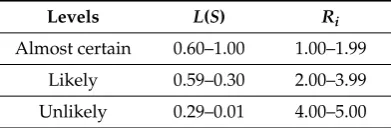
its impact as shown in Equation (4), whereirefers to the number of each type of incident that could result in scenarioSoccurring and affecting the system. The Table3below shows three different levels that will determine the likelihood of the attack scenario occurring and theRilikelihood.
Ri= L(Si) × V I (4)
where,
• L(S) = the likelihood of the occurrence of the scenarioS.
[image:14.595.200.396.275.339.2]• i= 1, 2, 3 . . . n. The number of each incident that could result in a scenario occurring. • Ri= risk;S= a scenario;L= likelihood;VI= vulnerability impact.
Table 3.The likelihood scale.
Levels L(S) Ri
Almost certain 0.60–1.00 1.00–1.99
Likely 0.59–0.30 2.00–3.99
Unlikely 0.29–0.01 4.00–5.00
Step 3: Attackers’ skill and location
The location and skill of the attacker are based on their knowledge and expertise in organizing, executing, and succeeding in an attack. The attacker’s characteristics, capability, and possible location will be explained below. The attacker’s location could be internal, end-to-end, external, or physical. An internal attacker’s location is usually found within the network of the organization. We consider three different levels of attacker skill which are given below and a general procedure to determine the likelihood
• Level 1: At this level the attacker has insufficient knowledge, skill, and/or resources to perform a successful attack. This attacker is most likely to be found in any of the three locations mentioned above.
• Level 2: At this level, the attacker has moderate skill level and resources to exploit one known vulnerability successfully, and the attacker is most likely to be found in the three locations mentioned above.
• Level 3: In this level, the attacker is an expert with sufficient level of skills and resources to exploit at least one known vulnerability successfully and the attacker is most likely to be found within the network as an internal attacker, end-to-end, an external attacker, or a physical attacker.
Likelihood identification procedure L(Si)= likelihood of the scenario Ri= risk
VI= vulnerability impact of vulnerabilityVi AL= attacker level
For each identified vulnerabilityVi Determine vulnerability impactVI
Measure the likelihood of the scenarioL(Si) For eachRi,
CalculateRi=L(Si) * VI
If (Ri≤1.99) ANDAL=1 then L(S)is unlikely to occur
L(S)is likely to occur
If (Ri≤5.00) ANDAL= 2 or 3 then L(S)is almost certain to occur.
Step 4: Determine the impact of the cyber-security attack scenario
The impactIof a cyber-security attack scenarioSis determined based on the likelihoodLof the scenarioSoccurring and its impact on the organizations KPIK. For example, in a power grid system, if a cyber-security attack scenario should occur, there is a higher likelihood that its impact will be on the critical infrastructure organizations KPI (availability). Risk impact will depend on the affected KPI. If risk affects KPI impact will certainly be high. The relative importance of the KPI depends on its level of risk impact on the business. If there is a risk on the KPI of the system that has a high impact on the business, the risk impact will be high. Therefore, KPI, measured based on a subjective judgment of the actors, is needed to provide previous records of risk events that must have occurred and the impact of the cyber-security attack scenario. KPI importance level will follow a weight score scale of 0.01–1.00; extreme (1.00–0.81), high (0.80–0.61), medium (0.60–0.41), low (0.40–0.21) and very low (0.20–0.01) to identify the relative weight of each KPI. The impact of overall risk scale will be; low (0.01–3.99), medium (4.00–7.99), high (8.00–10.0).
I= n10
∑
w=1(LS+Kw1. . .Kwn) (5)
where KPI (K): Key Performance Indicator;W: Weight score;L: Likelihood;I: Impact;S: Scenario;Kn: number of KPIs;Kw: weight ofKPI; C = confidentiality, A = availability, I = integrity, R = resilience, AUT = authenticity, REP = reputation, NR = Nonrepudiation, M = maintainability.
In order to determine the impact of a cyber-security attack scenario, several preassumptions have been made for this purpose:
Preassumption 1.Attacker is an expert and familiar with one of the vulnerabilities and exploits it for the attack. Preassumption 2.Attacker is an expert and familiar with all possible vulnerabilities and exploits them all for the attack.
Preassumption 3.The attacker is an expert and familiar with all possible vulnerabilities and exploits one for the attack.
Preassumption 4. Attacker is an intermediate and familiar with possible vulnerability and exploits all for the attack.
Preassumption 5. The attacker is a novice and familiar with only one of the vulnerabilities and therefore exploits just that one for the attack.
Preassumption 6.The attacker is a novice and familiar with none of the vulnerabilities and therefore exploits nothing for the attack.
Step 5: Identify the risk level
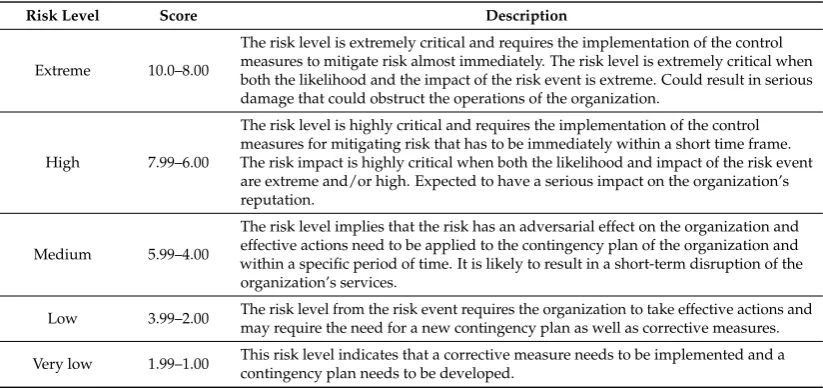
This final step identifies the risk level for each cyber-security attack scenario generated, the likelihood of the scenario occurring and the impact of the Scenario on KPI when it occurs. Risk level value is the addition of the likelihood of the cyber-security attack scenario resulting in a risk event and the impact of the risk event on the KPI of the organization using the Equation (6). We consider various risk level as shown in Table4.
Table 4.Risk level description.
Risk Level Score Description
Extreme 10.0–8.00
The risk level is extremely critical and requires the implementation of the control measures to mitigate risk almost immediately. The risk level is extremely critical when both the likelihood and the impact of the risk event is extreme. Could result in serious damage that could obstruct the operations of the organization.
High 7.99–6.00
The risk level is highly critical and requires the implementation of the control measures for mitigating risk that has to be immediately within a short time frame. The risk impact is highly critical when both the likelihood and impact of the risk event are extreme and/or high. Expected to have a serious impact on the organization’s reputation.
Medium 5.99–4.00
The risk level implies that the risk has an adversarial effect on the organization and effective actions need to be applied to the contingency plan of the organization and within a specific period of time. It is likely to result in a short-term disruption of the organization’s services.
Low 3.99–2.00 The risk level from the risk event requires the organization to take effective actions and may require the need for a new contingency plan as well as corrective measures.
Very low 1.99–1.00 This risk level indicates that a corrective measure needs to be implemented and a contingency plan needs to be developed.
4.2.5. Activity 5: Risk Control
This activity identifies the possible control measures that could mitigate and eliminate identified risk related to the critical assets. No system is risk-free, therefore, in order to reduce security breaches to protect assets from the various types of threats and vulnerabilities, effective controls must be applied. In some cases, weaknesses in the controls make it impossible to protect the assets completely. Therefore, risk assessment is a crucial step for the management of risk in Critical Infrastructures. We follow five main risks control strategy as shown below:
• Avoidance: Risk avoidance involves eliminating risks that can negatively affect an organizations asset. Risk avoidance looks for ways to avoid compromising events completely by taking measure to ensure that threats do not occur. However, it is almost impossible to avoid all risks completely. • Reduction: Risk reduction involves the lessening of vulnerabilities and threats events that affect the continuity of a critical process by creating contingency plans to enable critical infrastructure organizations to continue operating under recovery management. With risk reduction, the impact of a risk is limited so that it does not occur, and if it does occur, the problem will be easier to repair. The reduction can be against the impact and likelihood of the event occurring and implementing controls to reduce the risk to an acceptable level.
• Prevention: This measure should deter or avoid the risk event that can cause a negative impact on the critical infrastructure organization. Realistic preventive actions such as business continuity are put in place for effective risk control during cybersecurity risk management.
• Acceptance: This control strategy mainly involves taking no action by accepting the present level of the evaluated risk. Risk acceptance is a good strategy when the impact of the risk to the organization is very small.
• Transfer: The risk transfer measure basically shifts risks to other contract partners or enterprises, mainly to reduce the financial impact on the critical infrastructure organization or the responsibility of implementing the mitigating controls.
4.2.6. Activity 6: Risk Monitor and Residual Risk
and therefore, the risk assessment will have to be initiated from the start considering the influence of the controls to reduce the likelihood and impact of an incident. Residual risks are tightly connected to the acceptable level of risk, if the risk level is below acceptable risk, then nothing is done, and the management accepts those risk. If the risk level is above the acceptable level of risk, then new ways to mitigate those risk must be implemented.
5. Evaluation
We follow an empirical investigation through a case study and action research to determine the usefulness of the integrated risk management approach. We follow an empirical investigation through a case study and action research to determine the usefulness of the integrated risk management approach. For any empirical investigation, it is necessary to confirm the various factors, such as availability of resources, appropriate investigation questions relating to the method and study context, participant knowledge towards the study area, and many more. In our case, we confirmed all these factors and action research for this context contributes to the understanding of the risks and provides solutions to mitigate the risks. We investigated the study context and compared the study results with other studies to generalize our findings and validity of the research results.
5.1. Study Goal
The goal of the study is to:
• understand the risks associated with a CPS.
• identify suitable control management methods for the risks in a proactive manner. • achieve feasibility of the integrated risk management method for CPS.
5.2. Data Collection and Analysis
The data collection process started with understanding the system context and interviewing the selected staff. We also reviewed various organizational documents in order to understand the existing policies and practices relating to risk management and information security. Note that, we provided an overview of the integrated risk management approach before starting any data collection. The collected data were analyzed by following both qualitatively and quantitatively methods. In particular, the unit of analysis considered the existing risk management process, no of identified risks and effectiveness of risk control. Finally we have taken the participants” view relating to the integrated risk management approach.
5.3. Study Context
The Power Holding Company of Nigeria (PHCN), formerly the National Electric Power Authority (NEPA), is an organization that generates, distributes, and transmits electricity in Nigeria. DIStribution COmpany (Disco) has acquired a license to distribute electricity and currently has 11 branches across Nigeria that serves at least 30,000 customers within an area. The main business process of Disco is to provide last-mile services in the electricity supply value chain, transforming or stepping down electricity from high voltage at the transmission level to lower voltage depending on the category of the customer, and is responsible for the marketing and sale of electricity to customers, providing tax to the government, collecting bills, and collection and customer care functions its geographical area.
and scheduling while at work or at home, remote access and project planning. There are Local Area Networks (LANs) within Disco for conducting business operations (i.e., file sharing, emails, databases, and web portals), operating the SCADA system. It consists of components such as the workstation, alarm management, and data control (gateways). Finally, the secondary LAN is used for stimulation, testing, and development. The existing systems (computers and servers) and the SCADA use a Windows-based operating system.
Recently, several incidents happened at Disco. All branches of Disco deployed a new SCADA system in order to improve power reliability, cyber security, and resilience to disruption. These use a SCADA consisting of 5 generic machine types connected to a local Ethernet LAN to support their services. There was a vulnerability found in the RTU (remote terminal unit) of the SCADA system in one of the branches. The RTU that controls the physical state of the equipment in the field lacked firewall up-gradation that caused data loss and operational disruption. For that reason, the other branches have decided to perform a risk management to assess vulnerabilities, such as the lack of firewalls, lack of identification and authentication mechanism, unprotected communication lines, single point of failure, flooding of local network from external sources, and to also identify other vulnerabilities that might affect its assets in the present or future. So our work focuses on assisting the mitigation of the risks and improving the cybersecurity practice. The first author of the paper and two members of Discos, including the head of IT, investigated the situation as part of a common research interest.
5.4. Introduction to the Integrated Risk Management Process
5.4.1. Activity 1: Risk Management Context
Appl. Sci.2018,8, 898 19 of 29 two members of Discos, including the head of IT, investigated the situation as part of a common research interest.
5.4. Introduction to the Integrated Risk Management Process
5.4.1. Activity 1: Risk Management Context
[image:19.595.152.443.85.281.2]The risk management context identified the system components and determined its goals and KPI for the Disco Company. The systems include SCADA systems, communications and networks, SCADA users and operators, smart devices, software’s, server systems, database, operating systems, and field devices. These systems are physical, geographically, and logically independent to support overall business operations (Figure 3). The KPIs (i.e., Confidentiality, Integrity, Availability, Authenticity, Maintainability, Resiliency, Reputation, and Nonrepudiation) were discussed and agreed with the management team. Currently, the risk management practice at Disco follows an ad hoc approach mainly in a reactive manner, there is a very limited awareness among the staff relating to cyber security risk management, the risk management process is not comprehensive and Disco does not collaborate with any of its external stakeholders relating to risk management. The risk management team ranked the existing practice as tier 1 partial. The management team agreed that, depending on the discussion, those risks having risk a level of more than three are considered the controls and those risk levels below three are considered within the acceptance level.
Figure 3. Geographical interdependency.
5.4.2. Activity 2: Assets Criticality
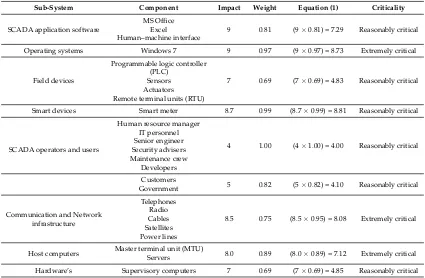
Based on the risk management context and identified main systems, the following Table 5 shows the asset criticality of the system components:
Table 5. Asset criticality.
Sub-System Component Impact Weight Equation (1) Criticality
SCADA application software
MS Office Excel Human–machine interface
9 0.81 (9 × 0.81) = 7.29 Reasonably
critical
Operating systems Windows 7 9 0.97 (9 × 0.97) = 8.73 Extremely critical
Field devices
Programmable logic controller (PLC) Sensors
Actuators Remote terminal units (RTU)
7 0.69 (7 × 0.69) = 4.83 Reasonably
critical
Smart devices Smart meter 8.7 0.99 (8.7 × 0.99) = 8.81 Reasonably
[image:19.595.85.510.398.676.2]critical
Figure 3.Geographical interdependency.
5.4.2. Activity 2: Assets Criticality
Based on the risk management context and identified main systems, the following Table5shows the asset criticality of the system components:
Table 5.Asset criticality.
Sub-System Component Impact Weight Equation (1) Criticality
SCADA application software
MS Office Excel Human–machine interface
9 0.81 (9×0.81) = 7.29 Reasonably critical
Operating systems Windows 7 9 0.97 (9×0.97) = 8.73 Extremely critical
Field devices
Programmable logic controller (PLC)
Sensors Actuators Remote terminal units (RTU)
7 0.69 (7×0.69) = 4.83 Reasonably critical
Smart devices Smart meter 8.7 0.99 (8.7×0.99) = 8.81 Reasonably critical
SCADA operators and users
Human resource manager IT personnel Senior engineer Security advisers Maintenance crew
Developers
4 1.00 (4×1.00) = 4.00 Reasonably critical
Customers
Government 5 0.82 (5×0.82) = 4.10 Reasonably critical
Communication and Network infrastructure Telephones Radio Cables Satellites Power lines
8.5 0.75 (8.5×0.95) = 8.08 Extremely critical
Host computers Master terminal unit (MTU)
Servers 8.0 0.89 (8.0×0.89) = 7.12 Extremely critical
Hardware’s Supervisory computers 7 0.69 (7×0.69) = 4.85 Reasonably critical
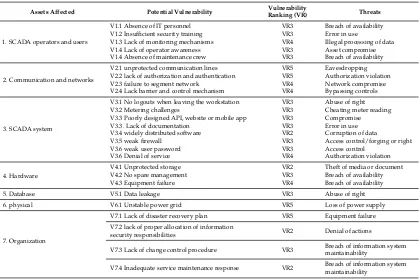
5.4.3. Activity 3: Vulnerability Assessment and Threat Identification
affected critical assets and caused the existence of a threat which led to risk. Table7highlights the impact of vulnerability for the Disco.
Table 6.Vulnerability identification checklist.
Assets Affected Potential Vulnerability Vulnerability
Ranking (VR) Threats
1. SCADA operators and users
V1.1 Absence of IT personnel VR3 Breach of availability
V1.2 Insufficient security training VR3 Error in use
V1.3 Lack of monitoring mechanisms VR4 Illegal processing of data
V1.4 Lack of operator awareness VR3 Asset compromise
V1.4 Absence of maintenance crew VR3 Breach of availability
2. Communication and networks
V2.1 unprotected communication lines VR5 Eavesdropping
V2.2 lack of authorization and authentication VR5 Authorization violation
V2.3 failure to segment network VR4 Network compromise
V2.4 Lack barrier and control mechanism VR4 Bypassing controls
3. SCADA system
V3.1 No logouts when leaving the workstation VR3 Abuse of right
V3.2 Metering challenges VR3 Cheating meter reading
V3.3 Poorly designed API, website or mobile app VR3 Compromise
V3.3. Lack of documentation VR3 Error in use
V3.4 widely distributed software VR2 Corruption of data
V3.5 weak firewall VR3 Access control/forging or right
V3.6 weak user password VR3 Access control
V3.6 Denial of service VR4 Authorization violation
4. Hardware
V4.1 Unprotected storage VR2 Theft of media or document
V4.2 No spare management VR3 Breach of availability
V4.3 Equipment failure VR4 Breach of availability
5. Database V5.1 Data leakage VR3 Abuse of right
6. physical V6.1 Unstable power grid VR5 Loss of power supply
7. Organization
V7.1 Lack of disaster recovery plan VR5 Equipment failure
V7.2 lack of proper allocation of information
security responsibilities VR2 Denial of actions
V7.3 Lack of change control procedure VR3 Breach of information system
maintainability
V7.4 Inadequate service maintenance response VR2 Breach of information system
maintainability
Table 7.Vulnerability impact assessment.
Asset Name Vulnerability
Type
Vulnerability
Rating Score (VR) Equation (3)
Vulnerability Impact (VI)
Hardware V4.1, V4.2 3, 4 7/2 = 3.50 Low
SCADA system V3.1, V3.3, V3.5 3, 2, 4 9/3 = 3.00 Low
Communication and networks V2.3 5 5/1 = 5.00 Medium
People V1.2, V1.3 3, 4 7/2 = 3.50 Low
5.4.4. Activity 4: Risk Assessment
Step 1: Generate cyber-security attack scenario
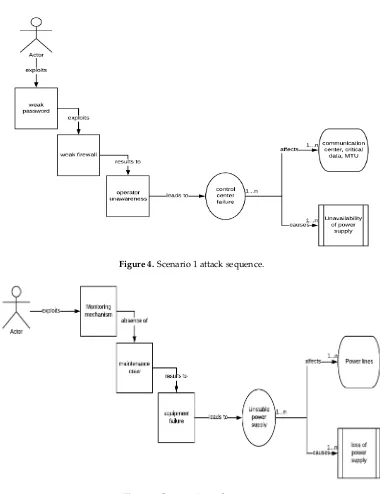
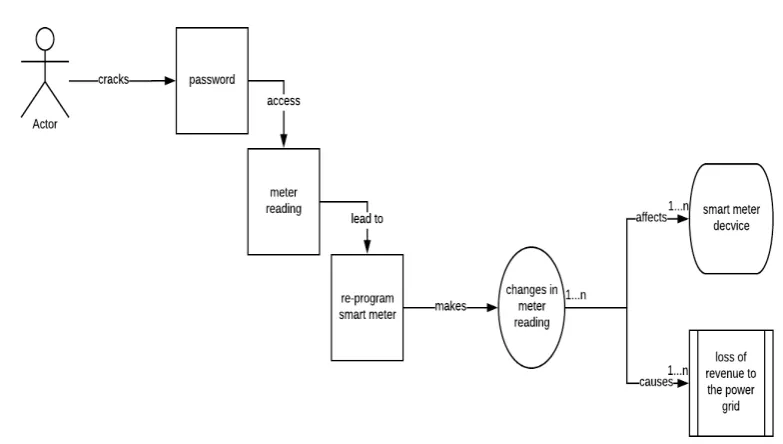
After the identification of vulnerabilities and threats, we noticed some weaknesses in the system, including the lack of firewalls and improper/irregular systems updates. We focused on the most critical vulnerabilities to demonstrate some cyber-attack scenarios. Seen in Figures4–6.
• Scenario 1: A highly skilled external attacker gained access to the master terminal unit (MTU) of the power grid system through a remote access point exploiting the weak password and firewall. The attacker was able to disrupt communications, access critical data such as passwords and operating plans, and thereby, monitor the status of the system and inject malicious control commands as well as forge data into the control center. This action led the system operators into taking inappropriate actions that interrupted the availability of electricity.
[image:20.595.86.511.464.529.2]Appl. Sci.2018,8, 898 21 of 29
breaker trip and therefore did not assign the maintenance crew to the specific area of the faulty network; this left customers without supply for 18 h.
• Scenario 3:An endpoint skilled customer who has a bakery and requires (uses more electricity), the biggest running cost for such an operation is the electricity bill. The customer, therefore, modifies the meter reader by cracking the smart meter password and was able to reprogram and reset the smart meter. The dishonest customer was able to change the meter reading to a lower value than the actual one to reduce his electricity bill.
Table 7. Vulnerability impact assessment.
Asset Name Vulnerability
Type
Vulnerability
Rating Score (VR) Equation (3)
Vulnerability Impact (VI)
Hardware V4.1, V4.2 3, 4 7/2 = 3.50 Low
SCADA system V3.1, V3.3, V3.5 3, 2, 4 9/3 = 3.00 Low
Communication and networks V2.3 5 5/1 = 5.00 Medium
People V1.2, V1.3 3, 4 7/2 = 3.50 Low
5.4.4. Activity 4: Risk Assessment
Step 1: Generate cyber-security attack scenario
After the identification of vulnerabilities and threats, we noticed some weaknesses in the system, including the lack of firewalls and improper/irregular systems updates. We focused on the most critical vulnerabilities to demonstrate some cyber-attack scenarios. Seen in Figures 4–6.
• Scenario 1: A highly skilled external attacker gained access to the master terminal unit (MTU) of the power grid system through a remote access point exploiting the weak password and firewall. The attacker was able to disrupt communications, access critical data such as passwords and operating plans, and thereby, monitor the status of the system and inject malicious control commands as well as forge data into the control center. This action led the system operators into taking inappropriate actions that interrupted the availability of electricity.
• Scenario 2: Due to a heavy rainfall, a fallen tree branch damaged the overhead power lines feeding the substation. This interrupted the supply causing the socket breaker for this line to trip at the primary substation, leading to a total power outage to some parts of the area including the local ports and few hospitals. However, the operator did not get any notification of the socket breaker trip and therefore did not assign the maintenance crew to the specific area of the faulty network; this left customers without supply for 18 h.
• Scenario 3: An endpoint skilled customer who has a bakery and requires (uses more electricity), the biggest running cost for such an operation is the electricity bill. The customer, therefore, modifies the meter reader by cracking the smart meter password and was able to reprogram and reset the smart meter. The dishonest customer was able to change the meter reading to a lower value than the actual one to reduce his electricity bill.
Figure 4. Scenario 1 attack sequence. Figure 4.Scenario 1 attack sequence.
[image:21.595.106.486.190.684.2]Appl. Sci. 2018, 8, x FOR PEER REVIEW 21 of 28
Figure 5. Scenario 2 attack pattern.
Figure 6. Scenario 3 attack pattern.
Step 2: Determine the likelihood of a cyber-security attack scenario
This step determines the likelihood, by estimating the potential attack scenario occurring multiplied by the vulnerability impact when it occurs by following Equations (2) and (4).
• Scenario 1:
VI = V3.5VR5 + V3.6VR4 + V1.4VR3/3 VI = 13/3 = 4.33
Ri = 0.93 × 4.33 = 3.85
Based on scenario 1, three vulnerabilities were identified and the impact of the vulnerability is 4.33, which means that the vulnerability is medially rated. Therefore, the likelihood of the attack scenario occurring is 3.85 and it is almost certain to occur.