2017 3rd International Conference on Artificial Intelligence and Industrial Engineering (AIIE 2017) ISBN: 978-1-60595-520-9
A Novel Blind Image Watermark Detection Algorithm Based on
Generalized Gaussian Distribution
Zhi-ming LI
1and Tai-yue WANG
2,*1School of Mathematics and Physics, China University of Geosciences, Wuhan 430074, P.R. China
2School of Mathematics and Physics, Hubei Polytechnic University, Huangshi 435003, P.R. China
*Corresponding author
Keywords: GGD, Blind image watermark, Asymptotic relative efficiency.
Abstract. The technique of blind watermark is one of key technology for copyright protecting. Applying Generalized Gaussian Distribution to statistically model the Alternating Current coefficient of discrete cosine transform, an adaptive blind watermark detection algorithm is proposed on the basis of sign detector and linear correlate detector and its probability efficiency is deduced. The experimental results show that the performance of the proposed detector is better than that of linear correlate detector.
Introduction
With development of the multimedia technique and the computer network, copyright protection problem of the digital medium becomes more and more outstanding, digital watermark technology which has a specific mark hidden in digital products can play an important role in copyright protection, so the digital watermark became the research hotspot in the field of signal processing and information security in recent years
The digital watermark technique means the method of using the signal processing which embeds conceal signal into the multimedia data, the kind of signal is invisible and robust. According to the assumption of additive white Gaussian noise model, the existing watermark algorithms adopt linear correlation mostly to detect watermark[1], it is only superior for the watermark carrier signal obey Gaussian distribution[2]; As Gaussian assumption is unreasonable in the additive white Gaussian noise model and transformation domain method can distribute the watermark information to the whole carriers. In 1985 Cox etc. presented expand frequency digital watermark algorithm [3], it concealed the watermark information in the DCT domain of the image. Based on Cox’s
investigation, the digital watermark became the main current of the research gradually in the DCT
domain. But Cox’s algorithm need the original image while detecting watermark, then carry on a related operation to judge watermark in existence. As a result, it was not adapted to a blind watermark algorithm; Hernandez presented the watermark detection algorithm of likelihood ratio in the DCT domain based on Generalized Gaussian model [4]. Barni presented a watermark algorithm
that the carrier image which obeys Wiggler distribution in the DFT domain [5], the concealed
watermark strength is assumed in these algorithms, therefore, they were not suited to the blind watermark detection.
In the paper, Applying generalized Gaussian distribution to statistically model the alternating current coefficient of discrete cosine transform, we present an adaptive detection algorithm for blind watermark and calculate its asymptotic relative efficiency, prove the detector provided with higher detection efficiency, the experimental result show that the performance of the proposed detector is superior to that of linear correlate detector.
Embed Blind Watermark and Algorithm The Blind Watermark Embedded
scope; the information of high frequency scope usually will be losing in the transform process. Watermark which be embedded the alternative current coefficient in the medium frequency segment can satisfy not only invisible and robust, but also improve security of the embed position [6].
Suppose watermark signal is random series Ww w1, , ,2wn,whose length is n, the original image I is divided into 8×8 blocks, the image description D=DCT(I) after DCT, using some medium
frequency coefficient to range a series in order X
x x1, ,2xn
,constitute the hosts series(watermark carrier). The watermark series W is embedded into the medium frequency coefficient
series X by adding embedded mode get the new transformation domain image descriptionD,
namely:
i i i
y x w , i1, 2, , n (1)
where ( 0)is strength parameter, inverse transform forDcan get image. IDCT D1( ) If the hosts
[image:2.612.81.518.284.334.2]seriesX have been looked as noise and watermark W have been looked as weak signal, the watermark embedded process had equaled to add a weak signal to the strong noise. So, flow of blind watermark embedded on DCT as Figure 1.
Figure 1. Flow of blind watermark embedded on DCT. Blind Watermark Algorithm
From statistics theories of the signal: the optimum detector is selected according to alternative current coefficient X follow different distribution in DCT. If the host series X follow Laplacian
distribution, then the optimum detector is sign related detector [7] , that is
1
1
sgn( )
n
i i
i
T w x
n
(2)where sgn(.) is signum function, namely
1 0
sgn( )
1 0
i i
i
y y
y
(3) if the host series X obey Gauss distribution, the optimum detector is linear related detector [7],
namely
1
1 n
i i
i
T x w n
(4)if T exceed certain a threshold, existing watermark would be judged in image.
The Adaptive Blind Watermark Detector
The Adaptive Blind Watermark Detector of DCT
The research result in image compress and coded realm show that the alternative current coefficient obey the generalized Gaussian distribution in DCT for image, probability density function have as
follows of form [8] :
( )
2 (1 / )
x
x
p x e
(5)
inverse transform on DCT
imageIof embedded watermark
original image
I 8
×8 blocks on DCT
watermark W adjust depth embedded
draw out home series
where 2 (1/ ) (1/ )
(3 / ) (3 / )
0,
1 0 ( ) t z
z e t dt
is gamma function, , 2, , is mean,variance, shape parameter, scale parameter, respectively. Zero mean Gaussian distribution and Laplacian distribution is its especial form, note that for 2, the density of GGD reduces to the
Gaussian density and for 1, the density of GGD becomes the Laplacian density. The estimate
value of the shape parameters of large images in DCT can be obtained, they mostly concentrated
in1~2 [9], this indicated that the Alternating current coefficient of discrete cosine transform locate between Laplacian and Gaussian distribution. Invisible of digital watermark decides the watermark signal is a weak signal; it will not alter the Alternating current coefficient of DCT during embedding
watermark. Based on different selection to the optimum blind watermark detectors for Laplacian distribution and Gaussian distribution, an adaptive blind watermark detector is designed. For the watermark host series X and the watermark signal W, we propose an adaptive blind watermark
detector as follows:
1 1
1
sgn( ) (1 )
n n
i i i i
i i
T t w x t x w
n
(6) where t used for controlling ratio of the signum detector and linear relative detector in adaptivedetector, it is a function of the shape parameter estimation, namely ˆ
0 2
ˆ ˆ
2 1 2
ˆ 1 1 t Performance Evaluation
The performance evaluation of the nonlinear detector is compare with the linear detector generally, the common index is asymptotic relative efficiency (ARE) [10], it denotes the extreme limit value of its ratio of the number of samples detector requires achieving same false alarm probability and detection probability, namely
1 2 1 2 ( , ) lim ( , )
F A D
N
F A D
N
N P P A R E
N P P
(7)
if the noise probability density function px(x) satisfy following two conditions:
2 ( ) 2 1
0 var( ) , 0 [ ]
( )
x
x
dp x
x dx
dv p x
then
2 [ ( )]2 1 ( )
x
x
dp v
ARE dv
dx p v
(8)for GGD, let0, put formula (5) into formula(8) , we can obtain:
2 2 3
2 3
2 (1/ )
x
x
ARE e dx
2 2 2 110
(1/ )
t e t dt
2 2 3 1( ) (2 )
1 ( ) (9)
whereis the shape parameter of the watermark host series. For the shape parameterat 1~2, the
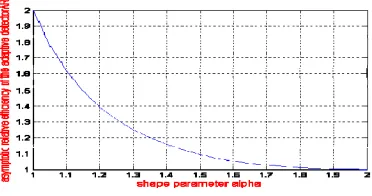
Figure 2. The relation between ARE of the adaptive detector and shape parameter.
Figure 2 shows that the shape parameter vary from one to two, the efficiency of the adaptive detector is always higher than that of linear relative detector; for 1, the ARE of adaptive detector is 2, at this time, the ARE of signum detector with respect to linear detector is 2, along with increasing of , the efficiency of adaptive detector near to linear relative detector more and more.
Experiment and Analysis
The Parameter Estimation of Image
The experiment carrier is the Lena image(512×512) as Figure 5 (a), the image is descripted as
D=DCT(I) after carrying through 8×8 pieces in DCT, the medium frequency coefficients of each
piece arrange a series to constitute the hosts series, then estimate the shape parameter of modeling the Alternating current coefficient. Since GGD is symmetry distribution and its one-order moment
is 0, so adopt one-order absolute moment to replace its one-order moment, where
1 1
1
ˆ n i
i
m x
n
, 2 21
1
ˆ n i
i
m x
n
, 2 1 1 1ˆ n ( i ˆ )
i
x m n
so the estimation of shape parameter can be obtained
2 1 1
2 ˆ ( )
ˆ m R
m
(10)
where ( ) 2(2/ ) (1/ ) (3/ )
x R x
x x
. AlthoughR x( )is obtained, but the inverse function
1( )
R x is difficult to
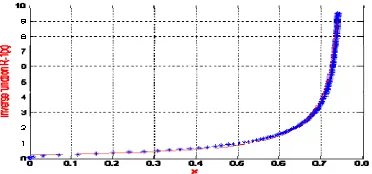
obtain directly. The curves of the origin and inverse function (Figure 3 (a) and Figure 3 (b)) is simple, they can be simulated as follows:
Figure 3. (a) Image of original function R(x). Figure 3. (b) Image of inverse function 1( ) x R .
Curves of original function R x( ) and inverse function R1( )x as above, we can simulate respectively them by exponential and hyperbola, the variance is smaller by hyperbola than exponential and effect better, so might as well simulate inverse function(Figure 4.) directly, model is ( ) 1
ya x m b, inverse function can be simulated as follow
1247 . 0 7697 . 0
2718 . 0 ) (
1
x x
[image:4.612.197.490.506.601.2]Figure 4. Simulation of inverse function by hyperbola.
Figure 5. (a) Origin image of Lena. Figure 5. (b) PDF of origin image.
The shape parameter1.352and standard variance 0.066can be obtained by curve fitting, the probability density function of GGD for Lena’s image, such as Figure 5 (b).
Experimental Analysis
The random normal distribution series W ii( 1, 2, 1024) be produced, which can be looked as watermark, embedding them into the host series. Use 1024 random numbers to detect watermark respectively by the linear related detector and detector. Response of adaptive detector as Figure 6 (a) and response of linear related detector as Figure 6 (b).
Figure 6. (a) Response of adaptive detector. Figure 6. (b) Responseof linear relative detector.
Conclusions
The design difficulty of the watermark detector is enlarged because of having no original image as a reference, it is the essential direction of the digital watermark study for the blind watermark algorithm in DCT domain. Since GGD statistic model is between Laplacian distribution and Gaussian distribution for the alternative current coefficient in DCT, then, we propose an adaptive blind watermark algorithm based on signum detector and linear relative detector, theoretically, the proposed detector have a higher detection efficiency, and the experimental insults also show that the performance of adaptive detector is better than that of linear relative detector
Acknowledgments
[image:5.612.96.516.407.511.2]Tai-yue WANG are the first authors, that is, they are the co-authors, corresponding author is Tai-yue WANG.
References
[1] R. Thanki, V. Dwivedi, K. Borisagar. A hybrid watermarking scheme with CS theory for security of multimedia data [J]. Journal of King Saud University - Computer and Information Sciences, 2017.
[2] V. Nanammal, B.M. Abirami, J Venugopalakrishnan. VLSI based design of an efficient hybrid watermarking scheme for multimedia content protection [J]. Indian Journal of Science & Technology, 2015, 8(19). 45-57.
[3] I.J. Cox. J. Kilian, Secure spread spectrum watermarking for multimedia [J]. IEEE Tans on Image Processing, 1997, 12(6): 1673-1697.
[4] J.R. Hernandez, M. Amado, Fernando Perez. DCT-domain watermark technique for still images: Detector performance analysis and a new structure [J]. IEEE Trans on Image Processing, 2000, 9(1): 55-68.
[5] F. Boncinelli, F. Bartolini, L. Casini, et al. On farm non-agricultural activities: geographical
determinants of diversification and intensification strategy [J]. Letters in Spatial & Resource Sciences, 2017, 10(1): 17-29.
[6] M. Barni, F. Bartolini, V. Cappellini, et al. A DCT domain system for robust image
watermarking Signal Processing, 1998, 66(3): 357- 372.
[7] M.R. Mirzaei, M. Karimi, N. Karimi, et al. Blind image watermarking based on local analysis
ofgradients [C]// Iranian Conference on Electrical Engineering. 2017:1891-1894.
[8] H.A. Bayoud Admissible Minimax Estimators for the Shape Parameter of Topp-Leone Distribution [J]. Communications in Statistics - Theory and Methods, 2016, 45(1): 71-82.
[9] A. Bossavy, R. Girard, G. Kariniotakis. An edge model for the evaluation of wind power ramps characterization approaches [J]. Wind Energy, 2015, 18(7): 1169-1184.