2018 International Conference on Modeling, Simulation and Analysis (ICMSA 2018) ISBN: 978-1-60595-544-5
Impact Analysis of Payment Model on Logistics Information Platform
Based on System Dynamics
Yi-hui CHEN
1, Jian-xin DENG
2,*, Lu-bao SHAN
1and Xiao-gen SU
11School of Mechanical Engineering, Guangxi University, China
2Guangxi Key Lab of Manufacturing System & Advanced Manufacturing Technology, China
*Corresponding author
Keywords: Logistics information platform, Third-party payment model, Impact analysis, System dynamics.
Abstract. To explore whether or not the problems caused by the payment model drawback of Lo-gistics Information Platforms (LIPs) relates to themselves, the system dynamics (SD) was intro-duced and constructed the systematic causal relationships among the offline-pay mode drawback and the LIPs described by the causality diagram. It shows the current offline-pay mode used by LIPs would cause decline of their user volume and operational reputation. Accordingly online mod-el was suggested. Furthermore, an system dynamics modmod-el to prove whether the online payment model improve the platform operation was established by using VENSIM DSS, where the im-provements were denoted by impact of online payment model on the credit value of LIPs. A couple of simulations has been carried out through the model above and verified that the online payment model with different scales can improve the credit value on platform.
Introduction
In China, logistics information platforms are considered as an effective way to realize infor-mation sharing, symmetry and increase resource utilization. The development of LIP has also be-come one of the important measures to respond to the national policy of "Internet + Transportation". All levels of governments and enterprises are involved in establishing LIPs. From the end of 2013, the Transport Apps started to go into everyone's vision. Currently more than 200 Transport Apps
are on the market, which promote the application of LIPs [1]. To some extent, LIPs solved the
dock-ing of vehicles and other information matchdock-ing, despite of the various levels of the platforms. However, due to a lack of technology and credit system, there are still many credit problems on their operation, such as some carrier got a transaction by APP but was cheated up to thousand Yuan, carriers disappeared with the collected money[2-3]. In face of these incidents, most of the corre-sponding platforms expressed that they were not responsible for the transactions due to their plat-form is just an inplat-formation intermediary. For instance, "First Logistics" said that "First Logistics" as a freight platform, only established a communication channel for shippers and carriers. In the dis-pute between shippers and carriers, "First Logistics" should not bear the corresponding responsibili-ties, because the essence of the cargo information platform was similar with the functions of QQ. We could not blame on QQ for the economic disputes of chatting with others through QQ, when it was interviewed by the reporter of "Modern Logistics News"[4].
There are similar problems occurred on the other platforms like the marriage platforms. The founder of "WePhone" committed suicide [5]. The falsity of parties' authentication information on the platform revealed that the relevant marriage platform did not fulfill the information review ob-ligation. With the penetration of the Internet, Platform-based economy not only plays an increas-ingly active role in people's production and life, but also gradually reveals more problems. These issues not only caused by low credit value of relevant users, but also revealed the platforms’ flaws on the design. And the above credit problems on LIPs exposed the shortcomings of their current payment models due to they are offline payment ways.
con-structed to analyze the harmful effects of existing offline payment mode on LIP operations. After that, a SD model about online payment model and LIPs was built too. Then the favorable influence of online payment model on the credit value and user amounts of LIPs was proved by simulation and comparisons.
Effect Analysis of Existing Payment Mode of LIPs on Their Operations
As an emerging mode of information matching transaction, LIPs have developed just for a short time. Most of them can only provide a simple exchange of information, that is to say, where practi-cal transaction and payment transfers to offline after getting a matching information. Although some of LIPs have set up online payment system, the total number is small and their level is still low. The majority payments are through receipting payment, gas card, cash and their combinations.
Offline payment model has disadvantages to the logistics industry, like lowering the operation ef-ficiency. What’s more, it has adverse effects on the platform itself, which can be described by Fig-ure 1. (i) It lets the platform lose the ability to manage counterparties, which can easily cause lots of financial credit security issues. (ii) More importantly, payment mode with a majority of offline payment has a negative effect on platform later transaction volume and income. Consider platform payment modes and platform development as a system. Let coefficient of offline payment represent the proportion of online payment mode of settlement. Via the system dynamic causality diagram as Figure1, the existing mode of payment to the carriers, shippers, and its influence on the platform operation were described.
Figure 1. Effects of the existing payment model on operations of LIPs.
As is shown in Figure.1, there are two positive loops between offline payment model and the platform. It noted that offline payment model is the source of financial credit issues on the platform. Offline payment model can easily cause credit problems such as default on freight, money ab-sconded because the platform is short of the reasonable control of cash flow. Accordingly, the in-come of platform relying on cumulative amount of users would drop much. Furthermore the plat-forms would gradually decay because a lack of users and funds to upgrade. Thus, the problem like default on freight occurs in the logistics counterparties, the platform may not be responsible. But it is necessary to take measures to help counterparties solve problems and avoid risk.
Establishing overall online payment model is a task which brooks no delay for the development of LIPs which aims to reduce the credit problems related to cost on the platform and protect the ef-fectiveness of the platform function. In order to simulate the utility of the online payment model to the operation on the platform, the model of the online payment model is constructed and described by the analysis of simulation and comparison.
Impacts of Online Payment on the Operation of LIP
Simulation Model
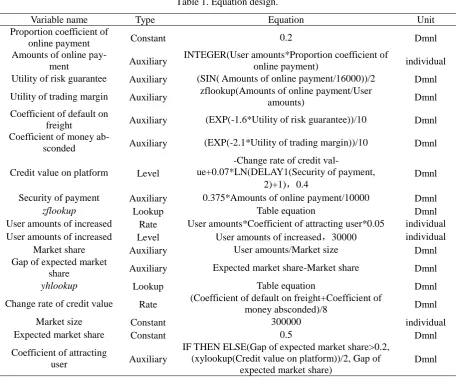
online payment” indicates the user amounts proportion who using online payment; “Utility of risk guarantee” indicates guarantee utility which brought by online payment model. “Utility of trading margin” indicates constraint utility value when involved in trading margin function; “Coefficient of money absconded” indicates the proportion of such credit problem happening on platform; “Coeffi-cient of default on freight” indicates the proportion of such credit problem happening on platform; “Coefficient of attracting user” is determined between credit value on platform and gap of expected market share and is shown in table equation and condition equation. “Security of payment” is af-fected by positive feedback from the number of online payment; “Credit value on platform” indi-cates the trust of the market to the platform. The main equations are described in Table 1.
[image:3.595.70.531.402.782.2]Figure 2. SD model of online payment model.
Table 1. Equation design.
Variable name Type Equation Unit
Proportion coefficient of
online payment Constant 0.2 Dmnl
Amounts of online
pay-ment Auxiliary
INTEGER(User amounts*Proportion coefficient of
online payment) individual Utility of risk guarantee Auxiliary (SIN( Amounts of online payment/16000))/2 Dmnl
Utility of trading margin Auxiliary zflookup(Amounts of online payment/User
amounts) Dmnl
Coefficient of default on
freight Auxiliary (EXP(-1.6*Utility of risk guarantee))/10 Dmnl Coefficient of money
ab-sconded Auxiliary (EXP(-2.1*Utility of trading margin))/10 Dmnl
Credit value on platform Level
-Change rate of credit
val-ue+0.07*LN(DELAY1(Security of payment,
2)+1),0.4 Dmnl
Security of payment Auxiliary 0.375*Amounts of online payment/10000 Dmnl zflookup Lookup Table equation Dmnl User amounts of increased Rate User amounts*Coefficient of attracting user*0.05 individual User amounts of increased Level User amounts of increased,30000 individual
Market share Auxiliary User amounts/Market size Dmnl
Gap of expected market
share Auxiliary Expected market share-Market share Dmnl yhlookup Lookup Table equation Dmnl
Change rate of credit value Rate (Coefficient of default on freight+Coefficient of
money absconded)/8 Dmnl
Market size Constant 300000 individual
Expected market share Constant 0.5 Dmnl
Coefficient of attracting
user Auxiliary
IF THEN ELSE(Gap of expected market share>0.2, (xylookup(Credit value on platform))/2, Gap of
expected market share)
Dmnl
Coefficient of attracting user
Coefficient of default on freight
Coefficient of m oney absconded Utility of risk
guarantee
Utility of trading margin User amounts
User amounts of increased Market share
Market size
Credit value on platform Change rate of
credit value xylookup
Gap of expected market share Expected market share Amounts of online payment zflookup Security of payment Proportion coefficient of
Determination of the initial coefficient of online payment: the author obtained the initial coeffi-cient of online payment is 0.2, and offline payment model is widely used by most LIPs through the investigation and research on the LOGINK, Transfar Logistic Co., Ltd. and Baijun Supply Chain Management Co., Ltd. in Guangxi. Determined the initial value of the credit value on platform is 0.4 by consultation with the relevant experts.
[image:4.595.179.420.222.353.2]Utility of trading margin was restricted by the ratio of the users who using online payment, as shown in Figure 3. It represents the table equation between the users of online payment and the user amounts. Utility of trading margin increased with the rise of the users who using online payment model on the platform. Its utility increased slowly due to the small proportion of users in the early stage, but the more obvious the utility played with the increase of user volume ratio.
Figure 3. Table equation of zflookup.
Referring to the description relation between "customer attractiveness" and "market share" by Yang [6], the relationships between coefficient of attracting user and credit value on platform and gap of expected market share were determined through condition equations and table equations. Coefficient of attracting user is increased at the early stage by the promotion of credit value on platform, but with the increase of user amounts, the increase of saturation and the decrease of gap of expected market share will be reduced. At this time, the coefficient of attracting user will be leveled down due to the constraint of the gap of expected market share. The condition equation is added to the coefficient of attracting user, and the binding force of the gap of expected market share to the coefficient of attracting user is expounded. The relation between the credit value on platform and the coefficient of attracting user is expressed by the table function, as shown in Figure 4.
Figure 4. Table equation of xylookup.
The tests like dimension showed the model was right. Thus simulations can be carried out.
Simulation Results and Analysis
Based on the above model, we observed the trend of the credit value on the platform along one year under different online payment ratios through simulation. (Reflecting the occurrence trends of related credit problem indirectly). As a result, the model initial parameters are set to: INITIAL TIME=0, FINAL TIME=12, TIME STEP=, UNITS FOR TIME: MONTH.
[image:4.595.179.420.527.665.2]on the platform credit problems. The credit performance due to the payment model is reflected by the Coefficient of default on freight and Coefficient of money absconded. Increased proportion co-efficient of online payment from 0.2 to 0.4 and 0.6 respectively, indicating that 40% and 60% amounts of the users using online payment. (Because promote application will have a process, we cannot rule out other payment models). Comparative analysis of simulation results is shown in Fig-ure 5.
Figure 5. Simulation result comparison of credit value on platform.
[image:5.595.182.414.436.545.2]As shown in Figure 5, when the coefficient of online payment is 0.2, the credit value on platform basically maintains between 0.3 and 0.4, and slow drive off flooding, indicating that the credit problems caused by the existing payment modes and their ratios reducing credit value on platform; When the coefficient of online payment is 40%, the credit value on platform starts to improve. After one year, it can rise from the initial value 0.4 to 0.52 in December, and the increase ratio of credit value reaches 30%; When the coefficient of online payment is 60%, the credit value on platform improves significantly, which can be increased from the initial value 0.4 to 0.73 within one year. It can be seen that the online payment has a significant improvement on the credit value on platform. The constantly increasing of the coefficient of online payment can obviously enhance the credit value on platform and the credit problems on platforms are correspondingly reduced.
Figure 6. Simulation result comparison of User amounts.
As shown in Figure 6, in these three cases, user amounts on platform are rising continuously. However, it can be clearly observed that with the increase of proportion of online payment, the growing speed of user amounts on platform is accelerating. It can be proved that the mode of online payment can promote the platform operation and attract more users.
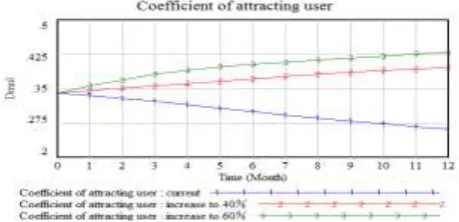
Figure 7. Simulation result comparison of Coefficient of attracting user.
[image:5.595.182.412.635.746.2]on platform decreases, the coefficient of attracting user also decreases. It means the attractiveness of the platform is indeed declining. As is shown in Figure 6, it can be inferred that with the irreversible trend of platform-based development of logistics, more and more users depend on the platform, and the crazy push mode of subsidies also increases the users on platform. With the increase of the co-efficient of online payment, the coco-efficient of attracting user gradually increases, and the higher the proportion is, the faster in the increase.
Conclusions
The emergence of LIPs has solved the shortcomings of asymmetric information in the field of tradi-tional highway freight transportation. Carrying out standardized, multi-functradi-tional and intelligent logistics platform is the trend [7]. The platform should be responsible for these credit problems such as "shippers default on freight", "the owners of the collection money absconded" and "cheated by paying information costs" which occurred frequently on LIPs. This paper attributed the main reason to the defect of the payment method, and reveals the impacts of payment defects on LIP develop-ment based on system dynamics. It is found from the simulations that the introduction of the online payment has a significant effect on the accumulation of the credit value, the growth of user amounts and the improvement of ability of attracting users. This paper provides ideas and decision-making basis for LIPs to improve credit and promote development.
Acknowledgements
The authors would like to take this opportunity to thank Natural Science Foundation of China (Grant No.71562002), Guangxi Natural Science Foundation (Grant No.2014GXNSFBA118281) for supporting this work.
References
[1] Chinese road transport online, freight APP is fiercely competition, information distortion trou-bled development. China Road Transportation Online, 2015-02-08.
[2] X. Lian. The middleman devour 7000 Yuan the freight lost, and the Cargo driver goes 2000 km. Wuhan EveningNews, 2016-08-05.
[3] Y. H. Luo. Cargo driver APP looking for job cheated thousands of dollars. Information Times. 2016-06-01.
[4] J. Rong. Cargo APP "a cargo of two owner" shows signs of logistics fraud. The first logistics network, 2015-09-22.
[5] C. J. Zhu. Programmer suicide: exposure marriage network chaos, called marriage information sharing. Law and Life, 2017(19).23-23.
[6] W. B. Yang. Research on Enterprise Growth Based on System Dynamics, Fudan University, 2006.