Open Access
Research article
Discontinuation of hypnotics during cognitive behavioural therapy
for insomnia
Lucie Zavesicka*
†1,2, Martin Brunovsky
†1,2, Milos Matousek
†1and
Peter Sos
†1,2Address: 1Prague Psychiatric Center, Ustavni 91, 18103 Prague 8, Czech Republic and 23rd Faculty of Medicine, Charles University, 100 00 Prague 10, Czech Republic
Email: Lucie Zavesicka* - [email protected]; Martin Brunovsky - [email protected]; Milos Matousek - [email protected]; Peter Sos - [email protected]
* Corresponding author †Equal contributors
Abstract
Background: In practical sleep medicine, therapists face the question of whether or not to discontinue the ongoing use of hypnotics in patients, as well as the possible effects of discontinuation. The aim of this study was to evaluate the effects of discontinuing third-generation hypnotics on the results of cognitive-behavioural therapy (CBT) for primary insomnia in patients after long-term abuse.
Methods: Twenty-eight outpatients were treated by CBT for 8 weeks. The treatment outcome was estimated by means of differences among subjective clinical scales and polysomnography variables assessed before and after the treatment period. The therapeutic effect in a subgroup of 15 patients who had previously received hypnotics and were successively withdrawn during weeks 2–6 was compared to the effect achieved in patients who had not used hypnotics before CBT.
Results: There were no significant differences in baseline subjective and objective sleep characteristics between the hypnotic abusers and non-abusers. According to clinical scales and most polysomnographic measures, CBT was highly effective in both groups of subjects; it produced the greatest changes in total sleep time, REM sleep and sleep efficiency. Unexpectedly, discontinuation of hypnotics, as a factor in the analysis, was followed by an additional improvement of sleep efficiency and wake after sleep onset parameters.
Conclusion: Our study confirmed the efficacy of CBT in both hypnotic-abusing and non-abusing patients with chronic insomnia. The results of this study suggest that tapered withdrawal of third-generation hypnotics during CBT therapy for chronic insomnia could be associated with improvement rather than worsening of sleep continuity.
Background
Many patients suffering from chronic insomnia are pre-scribed various types of hypnotics, particularly if treated by non-psychiatrists. Thus, there is an increasing group of
people in the common population who subscribe to daily, and often long-term, use of hypnotics. In many patients, insomnia continues despite increases in daily hypnotic dose. As a result, specialists are confronted with
Published: 18 September 2008
BMC Psychiatry 2008, 8:80 doi:10.1186/1471-244X-8-80
Received: 14 September 2007 Accepted: 18 September 2008
This article is available from: http://www.biomedcentral.com/1471-244X/8/80 © 2008 Zavesicka et al; licensee BioMed Central Ltd.
the difficult task of improving patients' insomnia while concurrently abolishing hypnotic abuse. Some therapists select hypnotics with lower risk of tolerance and depend-ence. Among these drugs, third-generation hypnotics have become increasingly popular [1-3]. However, it is com-monly agreed that psychological and behavioural inter-ventions represent the most effective treatment option for the management of persistent insomnia, as reviewed by Morin et al. [4]. Cognitive-behavioural therapy (CBT) is the mainstay of nonpharmacologic treatments for insom-nia, with efficacy that lasts beyond the duration of treat-ment [5]. The therapist then must decide whether or not to discontinue the administration of hypnotics during CBT. Discontinuation can be particularly difficult in patients of higher age [6]. Although the benzodiazepine-type hypnotics are associated with a higher risk of abuse, the discontinuation of drug intake seems to be facilitated by CBT [7]. On the other hand, some authors may choose to continue the administration of hypnotics in order to facilitate the therapeutic effect of CBT [8-10].
Therefore, there is no commonly agreed method of treat-ment for patients who seek CBT after several years of daily use of hypnotics. The uncertainty particularly concerns the long-term use of third-generation hypnotics with a low risk of abuse. The intention of the present study was to elucidate some of the questions that confront the ther-apist. Thus, the aim was to contribute to the answers to the following questions:
1. Does treatment outcome with CBT for insomnia vary between subjects with respect to hypnotic abuse?
2. Do baseline sleep characteristics, including sleep conti-nuity and sleep architecture differ significantly with respect to the abuse of third-generation hypnotic thera-pies?
3. What is the CBT treatment outcome for insomnia in patients after discontinuation of long-term hypnotic med-ication, compared with treatment outcome in patients who have used no hypnotics at all?
To clarify these questions, two subgroups of patients who had or had not abused third-generation hypnotics for a long time before CBT for insomnia, were examined. In the subgroup of patients who had abused hypnotics, medica-tion was discontinued during the first part of the CBT period. This investigation was not a comparative study, and should be considered as a clinical case series that had two primary factors of interest: 1) Group (hypnotic abus-ers [n = 15] vs. subjects without hypnotic abuse [n = 13]), and 2) Time (baseline vs. end of treatment). The effect of CBT was estimated according to differences among clini-cal sclini-cales and sleep indicators obtained by means of
poly-somnography recordings before and after the CBT treatment period.
Methods
Patients
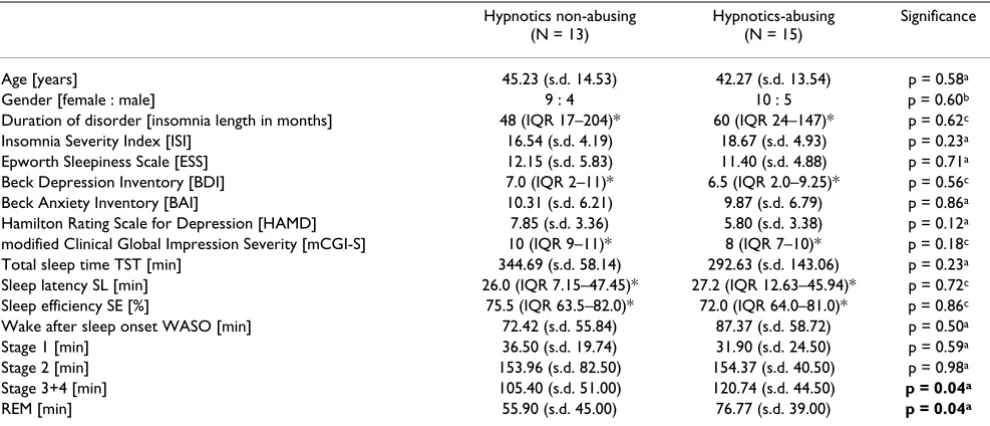
The study was based on 28 consecutive outpatients (19 females and 9 males) aged 25 to 74 years (mean 44.35 years, s.d. 13.87) who had been diagnosed with primary insomnia (F 51.0) according to ICD-10 [11]. The mean duration of the disorder was 4.75 years (s.d. 1.60). Patients with psychotic disorder, bipolar disorder, major depression, personality disorders, chronic alcoholism, dementia or other organic brain disorders were not included in the study. All patients were in good physical health. According to the polysomnography examination conducted as part of the study, no signs of sleep-disor-dered breathing could be found in any of the patients. Among the patients, 15 had used zolpidem for more then one year in doses of 15–20 mg daily (n = 12), 30–40 mg daily (n = 2), and 70 mg daily (n = 1). The patients did not use any another drug (such as benzodiazepines) for at least two months before beginning the study. The charac-teristics of this subgroup ("hypnotic abusers"), compared with the subgroup of patients without hypnotics abuse ("hypnotic non-abusers", n = 13) can be found in Table 1.
The Prague Psychiatric Centre Institutional Review Board reviewed and approved this study, and written informed consent to participate in the research was obtained from all subjects. The study was carried out in accordance with the latest version of the Declaration of Helsinki.
Clinical examination
modified Clinical Global Impression Improvement scale (mCGI-I), which evaluate patient's improvement or wors-ening with the range from 2 (very much improved) to 14 (very much worse), was performed in similar way. Sepa-rate baseline scores for each subgroup can be found in Table 1.
Study design
This investigation was based on the comparison of data obtained from patients who were hypnotic abusers, and patients without abuse potential. The examination and therapy were the same in both subgroups. The study began with an initial one-week observation period during which the patients were asked to fill in their sleep logs. Afterwards, a polysomnographic examination ("adap-tive") was done. On the following day, the subjective scores were registered and another polysomnographic examination ("baseline") was performed. CBT (see below) was then applied over the next 8 weeks. Fifteen hypnotics abusing patients were provided with a step-by-step withdrawal schedule, with the goal of eliminating abuse of third-generation hypnotics by the 2nd to 6th week (mostly in the 4th week) of treatment. We used several principles (according to [7]), including 1) setting goals, 2) stabilization with use of a single type of third-generation hypnotic, 3) reduction of the initial dose by roughly 25% per week until the lowest available dose was reached, and 4) introduction of an increasing number of medication-free nights. The initial plan was to decrease medication by 25% at week 1, by 50% at week 2, and by 100% at week
4. The day after the treatment period ended, subjective scores were registered and a third polysomnographic examination ("post-treatment") was conducted.
Polysomnographic recording
The polysomnography concerned electroencephalogram (EEG) derived from 9 channels (F3-T3, T3-T5, T5-O1, F8-T4, T4-T6, T6-O2, Fz-Cz, T3-Cz, and Cz-T4), electrocardi-ogram (ECG), naso-oral airflow, chest movements, oxy-gen saturation, electrooculogram (EOG), and electromyogram (EMG) from the submandibular, tho-racic, and anterior tibialis muscles. The time to switch the light off was chosen by the patient. Recording was then started and continued until spontaneous awakening in the morning. The polysomnographic records were scored "blind" by an expert according to Rechtschaffen and Kales' criteria [19].
Psychotherapy
Psychotherapy consisted of 8 sessions (each lasting 1 hour) of cognitive-behavioural group treatment for chronic insomnia. Each group consisted of 5 patients. The purpose of this treatment was to help the patients to iden-tify and modify their dysfunctional insomnia-related thoughts, beliefs, and behaviour, and to break the recur-ring cycle of anticipatory anxiety. The major components of CBT were:
(a) sleep education and cognitive restructuring concern-ing sleep (i.e., recognizconcern-ing, challengconcern-ing, and changconcern-ing dis-Table 1: Baseline demographics and characteristics, and clinical and comparative polysomnographic data from two subgroups of subjects.
Hypnotics non-abusing (N = 13)
Hypnotics-abusing (N = 15)
Significance
Age [years] 45.23 (s.d. 14.53) 42.27 (s.d. 13.54) p = 0.58a
Gender [female : male] 9 : 4 10 : 5 p = 0.60b
Duration of disorder [insomnia length in months] 48 (IQR 17–204)* 60 (IQR 24–147)* p = 0.62c Insomnia Severity Index [ISI] 16.54 (s.d. 4.19) 18.67 (s.d. 4.93) p = 0.23a Epworth Sleepiness Scale [ESS] 12.15 (s.d. 5.83) 11.40 (s.d. 4.88) p = 0.71a Beck Depression Inventory [BDI] 7.0 (IQR 2–11)* 6.5 (IQR 2.0–9.25)* p = 0.56c Beck Anxiety Inventory [BAI] 10.31 (s.d. 6.21) 9.87 (s.d. 6.79) p = 0.86a Hamilton Rating Scale for Depression [HAMD] 7.85 (s.d. 3.36) 5.80 (s.d. 3.38) p = 0.12a modified Clinical Global Impression Severity [mCGI-S] 10 (IQR 9–11)* 8 (IQR 7–10)* p = 0.18c Total sleep time TST [min] 344.69 (s.d. 58.14) 292.63 (s.d. 143.06) p = 0.23a Sleep latency SL [min] 26.0 (IQR 7.15–47.45)* 27.2 (IQR 12.63–45.94)* p = 0.72c Sleep efficiency SE [%] 75.5 (IQR 63.5–82.0)* 72.0 (IQR 64.0–81.0)* p = 0.86c Wake after sleep onset WASO [min] 72.42 (s.d. 55.84) 87.37 (s.d. 58.72) p = 0.50a Stage 1 [min] 36.50 (s.d. 19.74) 31.90 (s.d. 24.50) p = 0.59a Stage 2 [min] 153.96 (s.d. 82.50) 154.37 (s.d. 40.50) p = 0.98a Stage 3+4 [min] 105.40 (s.d. 51.00) 120.74 (s.d. 44.50) p = 0.04a
REM [min] 55.90 (s.d. 45.00) 76.77 (s.d. 39.00) p = 0.04a
* Data are presented as median (interquartile range) due to non-normal data distribution. Characters in bold indicate significance (p < 0.05). a – One-way ANOVA; b – Fischer Exact Test; c – Mann-Whitney U Test;
torted or inaccurate attitudes and beliefs about sleep requirements, attributions, effects of sleep loss, and sub-jective perception of amount of sleep obtained),
(b) information on sleep hygiene (i.e., reducing alcohol, caffeine, and nicotine use; increasing daytime exercise but not within 4 hours of bedtime; establishing a regular wind-down period prior to bedtime; avoiding stimulating mental and physical activities before bedtime; maintain-ing a quiet, cool, and dark bedroom; etc.),
(c) behaviour therapy, sleep restriction, and stimulus con-trol (employing a regular arising time; limiting time in bed to 1.5 hours beyond the average sleep length, as cal-culated from weekly sleep diaries, to improve sleep effi-ciency; using the bedroom for sleep or relaxing activities only; going to bed only when drowsy; and, if not asleep within 20 to 30 minutes, opening eyes and engaging in relaxing activity in bed or another room with no attempt to sleep until drowsy again, with repetition as necessary),
(d) cognitive therapy, work with autonomic negative though, work with behaviour, emotion, thoughts, physi-cal reaction and cognitive restructuring (i.e., recognizing, challenging, and changing distorted negative cognitive appraisals concerning daily stressors), and
(e) progressive relaxation (a set of integrated physiologic changes that are consistent with reductions in sympa-thetic nervous system activity and that are elicited when an individual engages in a repetitive mental activity – muscular relaxation and breath focusing, while passively ignoring distracting thoughts) [20-22].
Sessions were supplemented with educational and direc-tive reading materials.
Statistical analysis
To compare the pre- and post-treatment variables, the paired t-test and ANOVA were applied. For data with non-normal statistical distribution, nonparametric statistical tests were used to perform within group (Wilcoxon Sign Rank Test) and between group (Mann-Whitney U Test and Fisher Exact Test) analyses (statistical software SPSS v.12.0). The intention was to examine the changes in sleep variables achieved by therapy. The influence of hypnotics' discontinuation was investigated, as a possible factor regarding various sleep parameters by General Linear Model completed by post-hoc t-test. Differences between the pre- and post-treatment values were used as input data for investigating changes during therapy.
Results
Effects of hypnotic abuse on subjective and objective sleep variables
At the beginning of the treatment period, both subgroups of patients were examined using traditional whole-night sleep polysomnography. In this part of the study, pre-treatment data obtained from the hypnotic abusing patients were compared to data obtained from the non-abusing patients. The mean values of the sleep indicators (subjective and objective clinical scales, sleep continuity, and sleep architecture) for both subgroups are displayed separately in Table 1. While sleep was clearly disturbed in all patients, there were no significant differences in base-line subjective and objective clinical scales values between hypnotic abusers and non-abusing patients. Among poly-somnographic parameters the proportion of slow wave sleep of stages 3 and 4 was relatively increased in those patients abusing third-generation hypnotics. Similarly, the proportion of REM sleep was higher in hypnotic-abus-ing patients than in non-abushypnotic-abus-ing ones.
Effects of CBT on clinical scales and sleep variables
The differences between pre- and post-treatment sleep var-iables served as indicators of treatment outcome. In this part of the study, the therapeutic result was evaluated in all 28 patients, with both subgroups combined. The base-line data obtained by subjective clinical scales and polys-omnography before therapy are displayed in the second column of Table 2. The table shows the means/medians and standard deviations/interquartile ranges as registered in the entire group, including both hypnotic-abusing and non-abusing patients. Sleep disturbance was reflected, for example, in the measure of sleep efficiency, with a mean value of 77.58% (± 19.28). The other polygraphic varia-bles, obtained before therapy, are also revealed in the sec-ond column ("pre-treatment"). The mean/median values of the same clinical scales and sleep variables, obtained after CBT are displayed in the third column ("post-treat-ment"). A statistical comparison between the pre- and post-treatment data reveals a significant improvement in almost all sleep parameters after therapy. The exceptions was the amount of sleeping time spent in sleep 2 and sleep 1 stages, which were somewhat lower after CBT, but the difference was not statistically significant.
Effects of hypnotic discontinuation on sleep variables
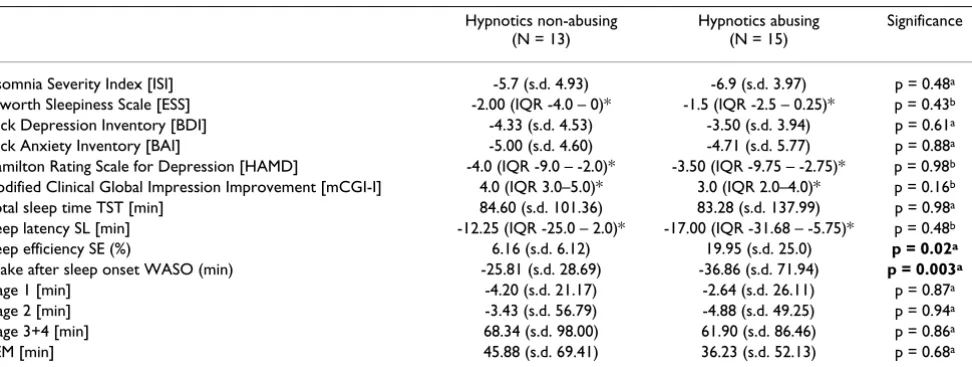
period. Improvement could be seen in all patients in both subgroups, and possible additional effects of the with-drawal of hypnotic were investigated. Sleep efficiency (SE) and wake after sleep onset (WASO) improved signifi-cantly after the discontinuation of third-generation hyp-notics (Table 3).
Effects of discontinuation of hypnotics on clinical variables
The above described results were obtained by means of polysomnography. It was of interest to determine whether changes in polysomnographic variables were paralleled
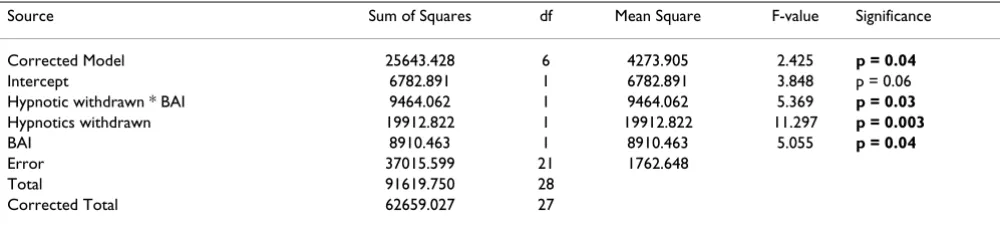
[image:5.612.54.557.98.285.2]by changes in clinical variables. Parallel changes would suggest a possible relationship between improvement in sleep variables and improvement in clinical scores. A par-allel relationship was found between diminished anxiety (Beck Anxiety Inventory) and a decrease in WASO. A detailed analysis of this result, as displayed in Table 4, revealed that the decrease in WASO was actually influ-enced by a combination of two factors: decrease of anxi-ety, and discontinuation of hypnotics.
Table 2: Comparison of clinical symptom scales and sleep parameters before and after CBT, n = 28.
Pre-treatment Post-treatment Significance
Insomnia Severity Index [ISI] 17.68 (s.d. 4.49) 10.89 (s.d. 5.40) p < 0.001a
Epworth Sleepiness Scale [ESS] 11.75 (s.d. 5.25) 8.64 (s.d. 5.07) p = 0.03a
Beck Depression Inventory [BDI] 7.0 (IQR 2.0–10.0)* 2.0 (IQR 0–6.0)* p < 0.001b
Beck Anxiety Inventory [BAI] 10.07 (s.d. 6.41) 5.39 (s.d. 4.43) p = 0.002a
Hamilton Rating Scale for Depression [HAMD] 6.5 (IQR 3.0–10.5)* 1.0 (IQR 0–1.5)* p < 0.001b
modified Clinical Global Impression [mCGI]
(mCGI-Severity for pre-treatment and mCGI-Impression for post-treatment conditions)
9.0 (IQR 8.0–10.0)* 4.0 (IQR 2.0–4.5)* p < 0.001b
Total sleep time TST [min] 361.80 (s.d.113.20) 454.12 (s.d.59.37) p = 0.01a
Sleep latency SL [min] 26.0 (IQR 11.98–46.10)* 7.25 (IQR 3.83–13.0)* p = 0.004b
Sleep efficiency SE [%] 77.58 (s.d. 19.28) 89.60 (s.d. 8.43) p = 0.004a
Wake after sleep onset WASO [min] 80.42 (s.d. 56.85) 48.27 (s.d. 37.17) p = 0.02a
Stage 1 [min] 28.5 (IQR 22.0–41.75)* 22.75 (IQR 16.5–37.0)* p = 0.29b Stage 2 [min] 154.48 (s.d. 51.43) 149.12 (s.d. 55.72) p = 0.72a Stage 3+4 [min] 112.52 (s.d. 80.62) 175.09 (s.d. 94.09) p = 0.01a
REM [min] 65.59 (s.d. 43.49) 107.91 (s.d. 49.12) p = 0.001a
In most cases data are expressed as the mean (standard deviation). Characters in bold indicate significance (p < 0.05). * Data are presented as median (interquartile range) due to non-normal data distribution
a – Paired-Samples T test; b – Wilcoxon Sign Rank Test;
IQR – interquartile range; s.d. – standard deviation; N.S. – non significant
Table 3: Changes in clinical symptom scales and sleep parameters after CBT presented for the separate subgroups.
Hypnotics non-abusing (N = 13)
Hypnotics abusing (N = 15)
Significance
Insomnia Severity Index [ISI] -5.7 (s.d. 4.93) -6.9 (s.d. 3.97) p = 0.48a Epworth Sleepiness Scale [ESS] -2.00 (IQR -4.0 – 0)* -1.5 (IQR -2.5 – 0.25)* p = 0.43b Beck Depression Inventory [BDI] -4.33 (s.d. 4.53) -3.50 (s.d. 3.94) p = 0.61a Beck Anxiety Inventory [BAI] -5.00 (s.d. 4.60) -4.71 (s.d. 5.77) p = 0.88a Hamilton Rating Scale for Depression [HAMD] -4.0 (IQR -9.0 – -2.0)* -3.50 (IQR -9.75 – -2.75)* p = 0.98b modified Clinical Global Impression Improvement [mCGI-I] 4.0 (IQR 3.0–5.0)* 3.0 (IQR 2.0–4.0)* p = 0.16b Total sleep time TST [min] 84.60 (s.d. 101.36) 83.28 (s.d. 137.99) p = 0.98a Sleep latency SL [min] -12.25 (IQR -25.0 – 2.0)* -17.00 (IQR -31.68 – -5.75)* p = 0.48b Sleep efficiency SE (%) 6.16 (s.d. 6.12) 19.95 (s.d. 25.0) p = 0.02a
Wake after sleep onset WASO (min) -25.81 (s.d. 28.69) -36.86 (s.d. 71.94) p = 0.003a
Stage 1 [min] -4.20 (s.d. 21.17) -2.64 (s.d. 26.11) p = 0.87a Stage 2 [min] -3.43 (s.d. 56.79) -4.88 (s.d. 49.25) p = 0.94a Stage 3+4 [min] 68.34 (s.d. 98.00) 61.90 (s.d. 86.46) p = 0.86a
REM [min] 45.88 (s.d. 69.41) 36.23 (s.d. 52.13) p = 0.68a
In most cases change is expressed as the mean difference (standard deviation) between values obtained after and before therapy. Characters in bold indicate significance (p < 0.05).
* Data are presented as median (interquartile range) due to non-normal data distribution a – One-way ANOVA; b – Mann-Whitney U Test;
[image:5.612.67.553.497.680.2]Discussion
Many patients suffering from chronic insomnia partici-pate in long-term daily use of hypnotics. Those who are inadequately treated have a tendency to increase their daily dose in an effort to combat their continuing insom-nia. Such patients are clearly at risk for hypnotics abuse and dependence. Application of CBT for insomnia is the best way to avoid such developments and to ensure proper therapy in these patients. Therapists are less cer-tain, however, what to do regarding the ongoing hypnotic regimen during CBT. Discontinuation of hypnotic admin-istration is not always possible, because both the patient and the therapist may be concerned about worsening insomnia. There is a fear that abrupt withdrawal of hyp-notics could result in worse therapeutic outcomes. How-ever, practical experience with discontinuation of hypnotics does not justify this concern. There are reports on long-term outcomes of discontinuing hypnotics, par-ticularly benzodiazepines [7,10].
On the other hand, experience concerning other types of hypnotics is rather limited. Therefore, a study aiming to contribute further observations regarding therapeutic out-comes after discontinuing hypnotics has been initiated. In contrast to previous studies, this study was focused on third-generation hypnotics [8,10,23]. Although the risks of abuse and dependence seem to be lower in third-gener-ation hypnotics than in other hypnotic drug classes, with-drawal of third-generation hypnotics is also often desirable. The study should elucidate which changes in sleep characteristics are caused by a long-term intake of the drugs and, in particular, what the therapeutic outcome would be after their discontinuation.
In this study, two subgroups of patients, with and without a history of hypnotic abuse, were examined. To shed light on the effect of a long-term hypnotics regimen, pre-treat-ment sleep indicators were considered. In hypnotics-abus-ing patients a relative increase in sleep stage 3, sleep stage 4, and REM sleep could be demonstrated in comparison
with the hypnotic non-abusing subgroup. Both subgroups of patients were then treated with CBT while the long-term hypnotic regimen was gradually discontinued. After-wards, the therapeutic outcomes were evaluated, using the differences between pre- and post-treatment sleep varia-bles as indicators. Sleep was significantly improved in both subgroups after CBT. The only exception was the proportion of sleep stages 1 and 2, in which statistical sig-nificance could not be confirmed. As a next step, the pos-sible effects of discontinuing hypnotics were investigated. Statistical analysis revealed an additional improvement of sleep efficiency and WASO in the abusing group after ther-apy.
One possible objection is that several factors influencing sleep in parallel could not be studied separately because it was necessary to respect the patients' interests to obtain efficient therapy by means of CBT [9]. These drawbacks are certainly compensated for by using an objective method to follow the quality of sleep as well as changes in sleep quality. Many studies are based on the subjective reports of patients, even though, as shown in our previous study, subjective data may be less reliable than expected [24]. Researchers are well aware of the fact that evaluation of subjective variables is to be expected in a study of this type. However, considering that the unreliability of sub-jective sleep data variables has been previously demon-strated, it would certainly be improper to continue to use them in future studies of this type. To avoid any confusion due to the use of insufficient data, it was decided to base findings and conclusions on objective variables obtained by means of polysomnographic examination.
[image:6.612.55.555.110.223.2]Several questions remain unanswered, and a new study, conducted independently and with a more extensive study population, will be necessary to confirm these find-ings. However, enrolment of a large patient population, particularly of patients without any previous medication history, is a difficult task. Of course, results for which the statistical significance was confirmed can hardly be Table 4: Effect of hypnotic discontinuation and reduced anxiety as possible factors reducing wake after sleep onset. Dependent variable: WASO (wake after sleep onset).
Source Sum of Squares df Mean Square F-value Significance
Corrected Model 25643.428 6 4273.905 2.425 p = 0.04
Intercept 6782.891 1 6782.891 3.848 p = 0.06
Hypnotic withdrawn * BAI 9464.062 1 9464.062 5.369 p = 0.03 Hypnotics withdrawn 19912.822 1 19912.822 11.297 p = 0.003
BAI 8910.463 1 8910.463 5.055 p = 0.04
Error 37015.599 21 1762.648
Total 91619.750 28
Corrected Total 62659.027 27
explained by insufficient statistical power. On the con-trary, it is only plausible to expect more pronounced changes and higher significance with a larger patient pop-ulation. Another possible objection concerns therapeutic outcomes. This study does not provide information regarding the durability of therapeutic effects, and a fol-low-up study will therefore be necessary. Furthermore, considering the practical consequences of the study, it should be emphasized that these findings concern third-generation hypnotics only. Possible interference with other medications was avoided in this study. Thus, the experience gained from this study is not necessarily appli-cable to all types of patients or hypnotic medications.
Conclusion
In summary, the present findings extend those from pre-vious studies in documenting the efficacy of CBT in treat-ing chronic primary insomnia. Summariztreat-ing all the positive and negative points of our study, it seems indis-putable that the discontinuation of long-term daily hyp-notic regimens can be done without any hesitation in patients with primary insomnia. The results of the study suggest that withdrawal of third-generation hypnotics can improve rather than worsen the results of CBT in treating chronic insomnia.
Competing interests
The authors declare that they have no competing interests.
Authors' contributions
LZ was the principal investigator of the study. LZ, MB, and MM wrote the manuscript. All authors contributed to the manuscript. MM made substantial contributions to data analysis and interpretation, as well as manuscript prepara-tion. LZ and MB designed sleep protocols, trained sleep technicians, and supervised sleep studies. LZ and PS car-ried out CBT treatment and supervised medication taper-ing, conduct of the clinical study itself, and data collection. MM supervised and participated with great impact at all stages of manuscript preparation, and con-ducted the statistical analyses together with PS. All authors read and approved the final manuscript.
Acknowledgements
This study was supported by a grant from The Ministry of the Health of the Czech Republic (MZ0PCP2005) and by a project from The Ministry of Edu-cation, Youth and Sports of the Czech Republic (VZ 0021620816).
References
1. Monti JM: Effect of zolpidem on sleep in insoniac patients. Eur J Clin Pharmacol 1989, 36:461-466.
2. Declerck A, Smits M: Zolpidem, a valuable alternative to ben-zodiazepine hypnotics for chronic insomnia? J Int Med Res
1999, 27:253-263.
3. Voderholzer U, Riemann D, Hornyak M, Backhaus J, Feige B, Berger M, Hohagen F: A double-blind, randomized and placebo-con-trolled study on the polysomnographic withdrawal effects of
zopiclone, zolpidem and triazolam in healthy subjects. Eur Arch Psychiatry Clin Neurosci 2001, 251:117-123.
4. Morin CM, Bootzin RR, Buysse DJ, Edinger JD, Espie CA, Lichstein KL:
Psychological and behavioral treatment of insomnia:update of the recent evidence (1998–2004). Sleep 2006, 29:1398-1414. 5. Mendelson WB: Combining pharmacologic and
nonpharmaco-logic therapies for insomnia. J Clin Psychiatry 2007, 68:19-23. 6. Sivertsen B, Omvik S, Pallesen S, Bjorvatn B, Havik OE, Kvale G,
NIlesen GH, Nordhus IH: Cognitive behavioral therapy vs zop-iclone for treatment of chronic primary insomnia in older adultrs: a randomized controlled trial. JAMA 2006,
295:2851-2858.
7. Morin CM, Bastien CH, Guay B, Radouco-Thomas M, Leblanc J, Val-lières A: Randomized clinical trial of supervised tapering and cognitive-behavior therapy to facilitate benzodiazepine dis-continuation in older adults with chronic insomnia. Am J Psy-chiatry 2004, 161:332-342.
8. Belleville G, Guay C, Guay B, Morin CM: Hypnotik taper with or without self-help of insomnia: a randomized clinical trial. J Consult Clin Psychol 2007, 75:325-335.
9. Jacobs GD, Pace-Schott EF, Stickgold R, Otto MW: Cognitive behavior therapy and pharmacotherapy for insomnia: a ran-domized controlled trial and direct comparison. Arch Intern Med 2004, 164:1888-1896.
10. Morgan K, Dixon S, Mathers N, Thompson J, Tomeny M: Psycholog-ical treatment for insomnia in the regulation of long-term hypnotic drug use. Health Technol Assess 2004, 8(8):iii-iv, 1-68. 11. World Health Organization: The ICD-10 Classification of Mental and
Behavioural Disorders: Diagnostic Criteria for Research Geneva: WHO; 1993.
12. Morin CM, Espie CA: Insomnia: a clinical guide to assessment and treat-ment New York: KluwerAcademic/Plenum Publishers; 2003. 13. Johns MW: A new method for measuring daytime sleepiness:
the Epworth sleepiness scale. Sleep 1991, 14:540-545. 14. Beck AT, Rial WY, Rickels K: Short form of depression
inven-tory: cross-validation. Psychol Rep 1974, 34(3):1184-1186. 15. Beck AT, Steer R, Garbin M: Psychometric properties of the
Beck depression inventory: twenty-five years of evaluation.
Clin Psychol Rev 1988, 8:77-100.
16. Beck AT, Epstein N, Brown G, Steer RA: An inventory for meas-uring clinical anxiety: psychometric properties. J Consult Clin Psychol 1988, 56:893-897.
17. Hamilton M: The assessment of anxiety states by rating. Br J Med Psychol 1959, 32:50-55.
18. Guy W: Clinical Global Impression. In ECDEU Assessment Manual for Psychopharmacology, revised 1976 Rockville, MD: National Institutes of Mental Health; 1976.
19. Rechtschaffen A, Kales A: A manual of standardized terminology, tech-niques and scoring system for sleep stages of human subjects Washington, DC: U.S. Government Printing Office; 1968.
20. Jacobs GD, Benson H, Friedman R: Perceived benefits in a behav-ioral medicine insomnia program: a clinical report. Am J Med
1996, 100:212-216.
21. Jacobs GD, Benson H, Friedman R: Home-based central nervous system assessment of a multifactor behavioral intervention for chronic sleep-onset insomnia. Behav Ther 1993, 24:159-174. 22. Means MK, Lichstein KL, Epperson MT, Johnson CT: Relaxation therapy for insomnia: nighttime and day time effects. Behav Res Ther 2000, 38:665-678.
23. Morin CM: Combined therapeutics for insomnia: should our first approach be behavioral or pharmacological? Sleep Med
2006, 1:S15-19.
24. Matousek M, Cervena K, Zavesicka L, Brunovsky M: Subjective and objective evaluation of alertness and sleep quality in depressed patients. BMC Psychiatry 2004, 26:14.
Pre-publication history
The pre-publication history for this paper can be accessed here: