THE LONDON SCHOOL OF ECONOMICS AND
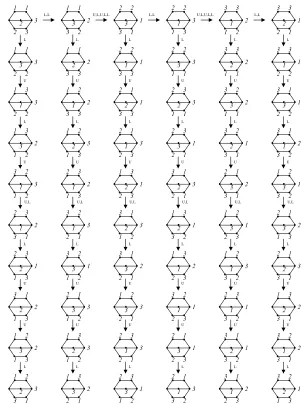
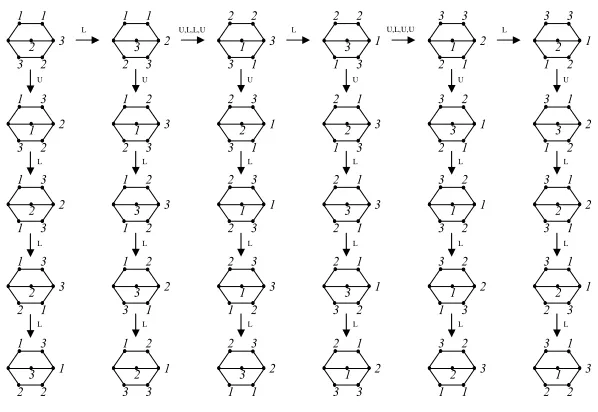
POLITICAL SCIENCE
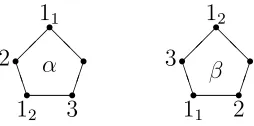
Connectivity Properties of Some
Transformation Graphs
Somkiat Trakultraipruk
A thesis submitted to the Department of Mathematics
of the London School of Economics
Declaration
I certify that the thesis I have presented for examination for the MPhil/PhD degree
of the London School of Economics and Political Science is solely my own work
other than where I have clearly indicated that it is the work of others (in which
case the extent of any work carried out jointly by me and any other person is
clearly identified in it).
The copyright of this thesis rests with the author. Quotation from it is permitted,
provided that full acknowledgement is made. This thesis may not be reproduced
without my prior written consent.
I warrant that this authorisation does not, to the best of my belief, infringe the
Abstract
Many combinatorial problems can be formulated as “can we transform
configu-ration 1 into configuconfigu-ration 2 if certain transformations are allowed?” In order to
study such questions, we introduce a so-called transformation graph. This graph
has the set of all possible configurations as its vertex set, and there is an edge
between two configurations if one configuration can be obtained from the other
by one of the allowed transformations. Then a question like “can we go from one
configuration to another one” becomes a question about connectivity properties
of transformation graphs.
In this thesis, we study the following types of transformation graphs in particular:
Labelled Token Graphs: Here configurations are arrangements of labelled tokens on a given graph, and we can go from one arrangement to another one by moving
one token at a time along an edge of the given graph. We classify all cases when
labelled token graphs are connected, and classify all pairs of arrangements that are
in the same component. We also look at the problem how hard it is to determine
the length of the shortest path between two arrangements.
Strongk-Colour Graphs: For this transformation graph, the configurations are the
proper vertex-colourings of a given graph with k colours, in which all k colours
are actually used. We call such a colouring a strong k-colouring. We study the
problem when we can transform any strong k-colouring into any other one by
certain classes of graphs, we can completely determine when the transformation
Acknowledgements
This thesis would not have been possible without the guidance and help of several
individuals who in one way or another contributed and extended their valuable
assistance in the preparation and completion of this study.
First, I would like to thank my first and second supervisors, Professor Jan van den
Heuvel and Professor Graham Brightwell (Department of Mathematics, London
School of Economics and Political Science, United Kingdom), whose
encourage-ment and assistance helped me to complete this study.
Professor Mark Ellingham, Professor Ralph McKenzie, and Professor Michael D.
Plummer (Department of Mathematics, Vanderbilt University, United States),
who supported me through my Master’s degree.
Associate Professor Wanida Hemakul and Assistant Professor Chariya Uiyyasathian
(Department of Mathematics, Chulalongkorn University, Thailand), who offered
constant support and guidance, and are the people who made it possible for me
to study in both the US and UK. I will always owe them a huge debt of gratitude.
Mr Somsak Anansuvanchai, Ms Tassanee Arayatragullikit, Mr Banchar
Arnonki-jpanich, Assistant Professor Vannee Netsinghanart, Mr Somkiat Panoi, Associate
Professor Tiang Poomsa-ard, and Mr Jirayuth Wathveerapong (Department of
Mathematics, Khon Kaen University, Thailand), who were a big influence on me
during my first degree, and I will always be grateful to them for their advice and
Mr Som Prangnakhon, Mr Suthep Prasong, Ms Kobkue Ratchakit, and Mr Manote
Ratchakit (Nangrong School, Buriram, Thailand), who encouraged my interest in
Mathematics and English through their excellent teaching, fostering in me the
desire to pursue both to a higher level.
Development and Promotion of Science and Technology Talents Project (DPST),
Higher Education Strategic Scholarships for Frontier Research Network (SFR),
and The Royal Thai Government, who have supported me throughout my studies,
and without their assistance, it would not have been possible for me to have gone
as far as I have in my academic career.
Jorge, Ahmad, Yavor, Pa Van, P’Noi, all my friends in London and Leeds, and
friends at Old Siam, Thai Cottage, Thai Square, Manorom, The Cos Bar, and
The Bok Bar, who made my time in the UK unforgettable. Thank you for your
support and friendship.
P’Mee, P’Phong, P’Noi, P’Jang, P’Top, P’Aekk, and all my friends at Siam
Cui-sine and Siam Cafe, who helped and advised me in personal and professional
matters. Thank you for making my time in the US so enjoyable.
Noi, Joe, Yok, Saaw, Nui, Palm, and David, who are my best friends forever.
Thank you for always being there, and for always making me smile. (”,)
Ming and Oomimm, I will never forget the time we spent together and the
happi-ness that brought me.
Jeck Heng and Sim Muay, who have always given me good advice.
Finally, I would like to thank the people I love the most, Tia, Maa, Ree, Mart,
and Pen, whose support and love have guided me through the good times and the
Contents
Abstract 3
Acknowledgements 5
Contents 7
1 Introduction 8
1.1 Preliminaries . . . 10
1.2 Outline of the Thesis . . . 18
2 Labelled Token Graphs 19 2.1 Literature . . . 21
2.2 Main Results on Connectivity of Labelled Token Graphs . . . 23
2.3 Proof of Theorem 2.2 . . . 28
2.4 Proof of Theorem 2.3 . . . 42
3 Miscellaneous Results on Labelled Token Graphs 50 3.1 Complexity of Finding Shortest Paths in Labelled Token Graphs . . 50
3.2 Connectivity of Labelled Token Graphs and Forbidden Minors . . . 57
4 Strong k-Colour Graphs 63 4.1 Literature . . . 65
4.2 General Results on Connectivity of Strong k-Colour Graphs . . . . 66
4.3 The Strongk-Colour Graph of Paths . . . 71
4.4 The Strongk-Colour Graph of Cycles . . . 76
4.5 The Strong 3-Colour Graph of Trees . . . 83
4.6 Discussion . . . 86
Bibliography 87
Chapter 1
Introduction
The primary focus of this thesis is to study “Transformation Graphs”. But what
are they? And why should we study them? It might be good to start the thesis
by answering these two questions. We may answer the first question by using the
following definition.
LetO be a collection of objects and T a collection of transformations, where each
transformation changes one object into another object. The transformation graph
has O as its vertex set, and there is an edge between two objects if one object can
be obtained from the other by some transformation from T.
With the definition above, it may not be that clear what transformation graphs
really are. So here we give some examples of transformation graphs.
The graph T G(v, e)
Let G(v, e) be the class of all graphs with v vertices and e edges. Define the
graph T G(v, e) to be the graph having G(v, e) as its vertex set, and two vertices
are adjacent if one vertex can be obtained from the other by adding an edge and
deleting another edge.
The (∆, n)-Graph
LetG(∆, n) be the class of all graphs withnvertices, and with maximum degree ∆.
Define the (∆, n)-Graph to be the graph havingG(∆, n) as its vertex set, and two
vertices are adjacent if one vertex can be obtained from the other by either adding
We can see that these two examples have the vertex sets coming from the class of
graphs with some specific properties. However, there are some other
transforma-tion graphs, getting the vertex sets from different ways, e.g., Token Graphs.
Token Graphs (Fabila-Monroy et al. [11])
For a graph G and positive integer k, let the token graph Fk(G) be the graph
whose vertices are k-subsets of V(G), and two k-subsets are adjacent in Fk(G) if
their symmetric difference (the set of vertices which are in either of the sets but
not in both sets) is a pair of adjacent vertices in G.
We have extended the study of Fabila-Monroy et al. by generalising the problem
to any number of tokens. Additionally, tokens can be identical or different. For
more details, see Labelled Token Graphs in Chapter 2.
Next, we will answer the second question, “why should we study transformation
graphs?”. A possible answer is the following. In some problems, we cannot solve
them directly, or they are not easy to be solved directly, but when we transform
them to other problems, they might be solved easier.
The 15-puzzle is a sliding puzzle that consists of 15 squares numbered from 1
to 15 that are placed in a 4×4 box leaving one position out of the 16 empty. The
object of the puzzle is to reposition the squares from a given arrangement into the
configuration β shown in Figure 1.1 by making sliding moves that use the empty
space.
Example 1.1
Letα and β be the two configurations of the 15-puzzle problem, which are shown
in Figure 1.1. Is it possible to reach β from α?
This question can be easily answered by using labelled token graphs, and the
2 1 4 3
6 5 8 7
10 11 12 9
14 15 13
[image:11.596.145.532.93.300.2]1 2 3 4
5 6 7 8
9 10 11 12
13 14 15
Figure 1.1: Configurationsα and β of the 15-Puzzle
1.1
Preliminaries
In this section we present some mathematical terminology and notation, which
are used in this thesis. Most of them will be standard and can be found in any
textbook on graph theory, such as [10] and [27].
Basic Concepts in Graph Theory
A graphGis defined by two finite setsV(G) andE(G), where an element ofV(G)
is called a vertex, and an element of E(G) is called an edge. Each edge is a
two-element subset of V(G). An edge between verticesuand v is denoted byuv. The
degree of a vertex v inG, denoted bydG(v), is the number of edges of G incident
with v. We omit the subscript G when it is clear from the context. The numbers
of vertices and edges in G are denoted by n(G) and e(G), respectively.
A walk on n vertices is a sequence v1, v2, . . . , vn of vertices where any two
con-secutive vertices are adjacent. A path on n vertices, denoted by Pn, is a walk
of Pn are n and n −1, respectively. A cycle on n vertices, denoted by Cn, is a
sequence v1, v2, . . . , vn, vn+1, where any two consecutive vertices are adjacent, and
the vertices are all different except v1 =vn+1.
The distance between two vertices in a graph is the length of a shortest path connecting them.
A graph is connected if for any two vertices there is a path between them. A
subgraph of a graphG is a graph H such thatV(H)⊆ V(G) and E(H)⊆E(G). Aspanning subgraph ofGis a subgraph with vertex setV(G). Aninduced subgraph
of a graphGis a graph H such that for any pair of verticesx andyof H,xyis an
edge of H if and only if xy is an edge of G. Acomponent is a maximal connected
subgraph.
Avertex cutof a graphGis a set of verticesSsuch thatG\Shas more components
than G, where G\S denotes the graph obtained after deleting the vertices in S,
together with the edges incident with these vertices. If S = {v} is a vertex cut,
we call v a cut-vertex. An edge e is a cut-edge of G if G\{e} (the graph obtained
after deleting the edge e) has more components than G.
A block is a maximal connected subgraph without cut-vertices.
A graph is k-connected if it has at least k+ 1 vertices and there is no vertex cut
with k−1 or fewer vertices. Here is a theorem about k-connected graphs, which
can be found in any textbook of graph theory.
Theorem 1.2 (Global Version of Menger’s Theorem)
The graph Cartesian product GH of graphs G and H is the graph such that V(GH) = {(u, v) : u ∈ V(G) and v ∈ V(H)}, and two vertices (u1, v1) and
(u2, v2) are adjacent in GH if and only if either u1 = u2 and v1 is adjacent
with v2 in H, or v1 = v2 and u1 is adjacent with u2 in G. A grid graph is the
graph Cartesian product of two paths.
A complete graph is a graph where any two vertices are adjacent. We denote a
complete graph with n vertices by Kn. A bipartite graph is a graph without odd
cycles. For a bipartite graph, we can partition the vertices into two setsX and Y
such that every edge has one end vertex in X and one in Y. A complete bipartite
graph has an edge from every vertex in X to every vertex in Y. We denote the
complete bipartite graph withpvertices inXandqvertices inY byKp,q. Aplanar
graph is a graph that can be drawn on the plane such that its edges intersect only
at their endpoints. Atree is a connected graph with no cycles. And the graph θ0
is the graph shown in Figure 1.2.
r r
r r r
r r
v2 v3
v1 v
0 v4
v6 v5
J J
J J
Figure 1.2: The graphθ0
Permutation Groups
A permutation of a set is a bijection from that set onto itself. The set of all
permutations of any given set S forms a group, with composition of functions as
product and the identity as identity element. This group is the symmetric group
of S. A transposition is a permutation which exchanges two elements and keeps all others fixed. Note that every permutation can be written as a product of
number of transpositions; otherwise, it is an even permutation. Since bijections
have inverses, so do permutations. The inverse of a permutation α, denoted
by α−1, is the permutation such that α(x) = y if and only if α−1(y) = x for any
elements x, y.
Complexity and Algorithms
In this thesis we need a number of concepts from algorithmic complexity theory.
The formal definitions of these concepts would be beyond the scope of this thesis.
In this section we give some informal descriptions only; more formal definitions
can be found in any textbook such as [9] and [14].
The time complexity of an algorithm quantifies the amount of time taken by the algorithm to run as a function of the length of the string representing the input.
The time complexity of an algorithm is commonly expressed usingbig O notation,
which is defined as the following.
For functions f, g : Z+ → R, we say that f(n) = O(g(n)) (pronounced f(n) is
big O g(n)) if there are constants N ≥ 1 and C >0 such that for all n ≥ N we
have |f(n)| ≤ C|g(n)|. For example, if the time required by an algorithm on all
inputs of size n is at most 7n3+ 5n, its time complexity is said to beO(n3).
An algorithm is said to be ofpolynomial time if its running time is upper bounded
by a polynomial expression in the size of the inputs for the algorithm, i.e., if the
time complexity is O(nk) for some constant k, wheren is the size of the inputs.
A decision problem is a problem whose output is a single Boolean value: YES or NO.
Let A and B be two decision problems. A reduction from A toB is a functionf
to the problem A, f will produce an input f(x) to the problem B, such that x
is a “YES” input of A if and only if f(x) is a “YES” input ofB. This reduction
can be used to define complexity classes on a set of problems. Intuitively, if a
problem Ais reducible to a problemB, then an algorithm for solvingB efficiently
(if it existed) could also be used as a subroutine to solveA efficiently provided the
reduction can be done efficiently as well. Thus solving A cannot be harder than
solving B.
The set P is the set of decision problems that can be solved in polynomial time,
and the set NP is the set of decision problems with the following properties: if
the answer is “YES”, then there is a certificate of that yes-answer which can be
checked in polynomial time. A problem isNP-hard if a polynomial-time algorithm
for the problem would imply a polynomial-time algorithm for every problem inNP.
A problem is NP-complete if it is both NP-hard and an element of NP.
Note that to prove a problem is NP-complete, all we need to do are:
(1) showing that the problem is in NP,
(2) reducing a known NP-complete problem to it, and
(3) showing that the reduction is a polynomial-time computable function.
To give some examples ofNP-complete problems, we define a Boolean formula to
be an expression written using only AND, OR, NOT, variables, and parentheses;
e.g., (a∨b∨¯c)∧((a∧¯b)∨(c∧d)). A¯ literal is either a variable or its negation.
A Boolean formula is in conjunctive normal form if it is a conjunction (AND) of
several clauses, each of which is a disjunction (OR) of one or more literals; e.g.,
(a∨b∨c)¯
| {z }
clause
∧(b∨¯c)∧(¯a∨d)∧(a∨¯b∨d).
SAT
Input: A Boolean formula;
Question: Is there a truth assignment for the variables which satisfies the formula?
3-SAT
Input: A Boolean formula which is in conjunctive normal form with 3 literals per
clause;
Question: Is there a truth assignment for the variables which satisfies the formula?
3-Exact-Cover
Input: A set U ={ui}3i=1n and a collection S ={sj}mj=1 of 3-element subsets of U;
Question: Is there a subcollection S0 ⊆ S such that every element in U occurs in
exactly one member of S0?
Thecomplement of a decision problem is the decision problem, which results from replacing the problem by the negation of that problem. For example, one
impor-tant problem is to consider if a number is a prime number. Its complement is to
ask if a number is a composite number (a number which is not prime).
A decision problem is a member of coNP if and only if its complement is in NP.
Each coNP-complete problem is the complement of an NP-complete problem.
A decision problem is inPSPACE if it can be solved by an algorithm using
poly-nomial storage space. A decision problem isPSPACE-complete if it is inPSPACE,
and every problem in PSPACE can be reduced to it in polynomial time.
Minors
Let G be a graph. A vertex-deletion of G means removing a vertex from the
removing an edge from the edge set ofG. Anedge-contraction of an edgeuv means
replacing the vertices u and v by a new vertex w, then joining w to all vertices
that were adjacent to u orv, and finally replacing any multiple edges which arise
by a single edge.
A graph H is a minor of a graph G if H can be obtained from G by a sequence
of vertex-deletions, edge-deletions, and edge-contractions. Note that in the
defini-tion, we allow a sequence of length zero, so every graph is a minor of itself.
In this thesis, it is common to assume that all graphs are connected. Then if H
is a minor of a connected graph G, H can be obtained from G by a sequence of
edge-deletions and edge-contractions only (since a vertex-deletion can be obtained
by an edge-contraction and some edge-deletions in a connected graph).
Orderings
A relation ≤on a set X is aquasi-ordering if it is reflexive (x≤x for all x∈X)
and transitive (if x ≤ y and y ≤ z, then x ≤ z for all x, y, z ∈ X). And ≤
is a well-quasi-ordering if it is a quasi-ordering, and for any infinite sequence of
elementsx0, x1, x2, . . . fromX, there are two indicesi < j such thatxi ≤xj. Note
that sometimes we use x ≥ y to denote y ≤ x, and y < x to denote y ≤ x and
y6=x.
A quasi-ordering iswithout infinite descent if there are no infinite strictly
decreas-ing sequences x1 > x2 > x3 > · · ·. An antichain A ⊆X is a subset such that no
two elements inA are comparable.
LetP be a property defined on elements of a setX. We say thatP isclosed under
a quasi-ordering ≤ (or ≤-closed ) if for every two elements x, y ∈X we have that
Let ≤ be a well-quasi-ordering on a set X, and P a ≤-closed property on X.
Then an element x ∈X is said to beP-forbidden if it is a minimal element in X
under ≤, which does not have property P.
Labelled Token Graphs
LetGbe a graph, andk1, k2, . . . , kp positive integers for somep∈Z+. We assume
we have k1 +k2+· · ·+kp labelled tokens, where there are ki tokens with label i,
for i= 1,2, . . . , p. A token configuration is an arrangement of all these tokens on
the vertices of Gsuch that no two tokens are placed on the same vertex.
Thelabelled token graph ofGwith a multiset of tokens (k1, k2, . . . , kp) is the graph
whose vertices correspond to all possible different token configurations, and two
token configurations are adjacent if one token configuration can be reached from
the other by moving one token along an edge of G. We denote the labelled token
graph by T(G; (k1, k2, . . . , kp)).
Strong
k
-Colour Graphs
For a positive integerk, ak-vertex-colouring of a graphGis a functionf :V(G)→
{1,2, . . . , k}. A colouring is proper if adjacent vertices have different labels. A
graph is k-colourable if it has a proper k-vertex-colouring. The smallest number
of colours needed to colour a graph is called its chromatic number.
The strong k-colour graph of a graph G and integer k, denoted by Sk(G), is the
graph that has the proper k-vertex-colourings of G using exactly k colours as its
vertices, and two such colourings are joined by an edge if they differ in the colour
1.2
Outline of the Thesis
In Chapter2, we work on labelled token graphs, and we prove two main theorems.
The first theorem gives sufficient and necessary conditions of labelled token graphs
being disconnected. The other main result tells exactly the situation whether two
given token configurations are in the same component of a labelled token graph
or not.
Chapter 3 contains some miscellaneous results on labelled token graphs. We first
consider the computational hardness of finding the shortest path between two
token configurations in labelled token graphs. Then we propose another way to
prove being disconnected of labelled token graphs by considering whether a given
graph contains certain forbidden minors or not, and we prove that the number of
these forbidden minors is finite for all the numbers of tokens.
In the last chapter, we study strongk-colour graphs. We give some general results
and characterise when strong k-colour graphs are connected for some classes of
graphs.
In the appendix, we talk about the graphθ0again because it is the only 2-connected
non-bipartite graph so that not all its labelled token graphs are connected. We
show the components of labelled token graphs ofθ0 in a compact form, which will
be described later.
The results in Chapter 2 are joint work with Professor Graham Brightwell and
Professor Jan van den Heuvel, whilst the results in Chapter 3are joint work with
Professor Jan van den Heuvel. Chapter4can be found in [25], and we are preparing
Chapter 2
Labelled Token Graphs
There are many problems and games, concerned with moving objects around.
Examples are puzzle games, transportation, manufacturing, scheduling, control
flow and management of memory in computing systems. These problems have
been extensively studied.
Let G be a graph, and k1, k2, . . . , kp positive integers for some positive integer p.
We have a number of classes of tokens, say k1 tokens with label 1, k2 tokens
with label 2, etc. Tokens with the same label are indistinguishable. A token
configuration is an arrangement of all tokens on vertices of G such that no two
tokens are placed on the same vertex. We use Greek letters α, β,. . . for token
configurations, and we denote by α(v) = t that in the token configuration α, the
vertex v contains a token with labelt. A vertex which does not contain any token
is said to be unoccupied, and we sometimes say that it contains an empty token,
denoted by φ.
The labelled token graph of G with a multiset of tokens (k1, k2, . . . , kp) is the
graph whose vertices correspond to token configurations, and two token
config-urations are adjacent if one token configuration can be reached from the other
by moving one token along an edge of G. We denote the labelled token graph
as T(G; (k1, k2, . . . , kp)), and we always assume that k1 ≥ k2 ≥ · · · ≥ kp. For
convenience purposes, when the tokens are all different (k1 =k2 =· · · =kp = 1),
To calculate the number of vertices in T(G; (k1, k2, . . . , kp)) of a given graph G
and positive integers k1, k2, . . . , kp, let k = k1 +k2 +· · ·+kp. We assume that
k ≤n(G)−1 to avoid trivial cases. Then
n(T(G; (k1, k2, . . . , kp))) =
n(G)!
(n(G)−k)!k1!k2!· · ·kp!
.
When all tokens are different, we have that
n(T(G;p)) = n(G)!
(n(G)−p)!.
Next, we calculate the number of edges in labelled token graphs. Here we consider
only the case that all tokens are different. For general cases, we cannot find a
similar formula easily. Since moving a token along each edge of G represents
(p
1)(n(G)−2)!
((n(G)−2)−(p−1))! edges inT(G;p), we have that
e(T(G;p)) = e(G)·
p·(n(G)−2)!
(n(G)−p−1)!
.
With only one token, the resulting labelled token graph is isomorphic to G, i.e.,
T(G; 1)∼=G.
When there are n(G)− 1 different tokens, a token configuration is a bijective
mapping f :
v1, v2, . . . , vn(G) → {1,2, . . . , n(G)−1, φ}. Thus we may consider
a token configuration as a permutation of the set of tokens. As standard, we
denote the inverse of a permutation α byα−1, and use the same notation for the
2.1
Literature
In this thesis we use the term “token” as a description for a moveable object.
Other literatures looking at similar problems use terms such as agent, pebble,
bean, robot, or vehicle to describe the moveable object. Some papers consider
problems in which the tokens are all different [1, 18, 28], whilst others consider
problems where all tokens are the same [11]. We study problems in which tokens
can be identical or distinct, which can be also seen in [13, 16]. And the rules of
moving tokens in those studies may be the same or different. For example, in
[1,11,16,18,28], a token can be moved from one vertex to one of its unoccupied
neighbours.
Wilson [28] generalised the classic problem, the 15-Puzzle, on 2-connected graphs
with n vertices and n−1 different tokens.
Theorem 2.1 (Wilson [28])
Let G be a 2-connected graph, which is not a cycle or the graph θ0. Then the token graph T(G;n(G)−1)is connected, unless G is bipartite. In the latter case, T(G;n(G)−1)has exactly two components, and token configurations α and β are in the same component if and only if they have unoccupied vertices at even distance in G and αβ−1 is an even permutation, or they have unoccupied vertices at odd distance in G and αβ−1 is an odd permutation. The labelled token graph T(θ0; 6) has six components.
Kornhauser et al. [18] followed on from Wilson’s study by generalising the problem
for all graphs and any number of tokens. They also presented a polynomial time
algorithm and gaveO(n3) upper and lower bounds for deciding the reachability of
Auletta et al. [1] also studied on the reachability of any two token configurations,
but focused on trees. They gave a linear decision algorithm for those cases.
Goraly and Hassin [16] studied problems where tokens can be identical or
dis-tinct, as described earlier. They proved that the reachability of any two token
configurations can be decided in linear time.
Fabila-Monroy et al. [11] introduced the word “Token Graph”, which we use in
this thesis although they only consider the case that all tokens are identical. They
gave tight lower and upper bounds on the diameter, and tight lower bounds on
the connectivity of their token graphs. They also gave some results on cliques,
chromatic numbers, and Hamiltonian paths of their token graphs.
Fujita et al. [13] generalised the problems of moving tokens by defining a move
to be an exchange of two tokens with distinct labels on the two endvertices of a
common edge (where an unoccupied vertex is supposed to have an empty token).
They studied connectivity properties of such token graphs.
Wu and Grumbach [29] studied on motion planning on directed graphs (graphs
whose every edge has a direction from one vertex to the other). Their objective is
to move a special token (called robot) from a source vertex to another destination
vertex while the other tokens are considered as just obstacles. They proved that
this problem on acyclic (without any directed cycles) strongly connected directed
graphs can be decided in time O(nm), where n andm are the numbers of vertices
and edges, respectively. And it can be decided in time O(n2m) on any directed
2.2
Main Results on Connectivity of Labelled
Token Graphs
One of our main results is showing and proving sufficient and necessary conditions
of being disconnected of labelled token graphs. If p = 1, then the tokens are all
the same. Thus the labelled token graph is disconnected if and only if the original
graph is disconnected. So we always assume that p≥2. Under that assumption,
if n(G) = 2, the labelled token graph is disconnected. Hence we also assume that
n(G)≥3.
LetGbe a connected graph. Aseparating path of size one inGis a cut-vertex. A
separating path of size two inGis a cut-edgeP =v1v2 such that both components
of G−v1v2 have at least two vertices. A separating path of size l ≥ 3 in G is
an induced pathP =v1v2. . . vl−1vl such thatG\{v2, v3, . . . , vl−1} has exactly two
components, one contains v1 and the other contains vl, and each of which has at
least two vertices. When a separating pathP is of size at least two, we say thatG
has twoP-components (the components described above).
Theorem 2.2
Let Gbe a graph with n(G)≥3, andk1 ≥k2 ≥ · · · ≥kp positive integers for some
integer p ≥ 2. Then T(G; (k1, k2, . . . , kp)) is disconnected if and only if at least
one of the following conditions holds:
1. G is disconnected;
2. k1+k2+· · ·+kp =n(G);
3. G is a path;
5. G is the graph θ0 (shown in Figure 2.1), and (k1, k2, . . . , kp) is one of the
following: (2,2,2), (2,2,1,1), (2,1,1,1,1), or (1,1,1,1,1,1);
6. G is a 2-connected bipartite graph other than a cycle, k1 +k2 +· · ·+kp =
n(G)−1, and k1 =k2 =· · ·=kp = 1 (tokens are all different);
7. G is a connected graph with connectivity 1 other than a path, containing a separating path of size n(G)−(k1+k2+· · ·+kp).
r r
r r r
r r
v2 v3
v1 v
0 v4
v6 v5
J J
J J
Figure 2.1: The graphθ0
The other main result answers whether two given token configurations α and β
are in the same component of the labelled token graph or not. We can see that α
and β are in the same component if and only if on each component Gi of G,
α|Gi (the token configuration on Gi induced by α) is reachable from β|Gi. Hence
without loss of generality, we can again assume that G is connected. Next, if
k1+k2+· · ·+kp =n(G), different token configurations are in different components
of the labelled token graph. So we also suppose thatk1+k2+· · ·+kp ≤n(G)−1.
According to the graph θ0 in Figure2.1, a token configuration α of θ0 is standard
if v1 is unoccupied inα, and it is (s,t)-standard if it is standard and the tokens s
andtare placed on the verticesv6 andv5, respectively. We call the cyclev1v2v3v4v0
onθ0 as thelower 5-cycle, the cyclev1v0v4v5v6 as theupper 5-cycle, and the cycle
v1v2v3v4v5v6 as the outside 6-cycle.
Let G be a connected graph with connectivity 1, n(G)−(k1 +k2 +· · ·+kp) =
l ≥ 2, and P1, P2, . . . , Pm all the separating paths of size l in G. For each i =
configuration α, let αi be a token configuration obtained from α by moving some
tokens (if necessary) to make all the vertices on Pi unoccupied.
LetG be a connected graph with connectivity 1,n(G)−(k1+k2+· · ·+kp) = 1,
andBa block inG. ThenB contains at least one cut-vertex ofG. LetvBbe one of
these cut-vertices. Given a token configurationα, letαvB be a token configuration
obtained from α by moving some tokens (if necessary) to makevB unoccupied.
We denote the multiset of all the tokens used in a token configuration α byτ(α).
For example, if α is any of the token configurations in Figure 2.4, then τ(α) =
{1,1,2,2,3,3}= (2,2,2).
Theorem 2.3
Let G be a connected graph with n(G) ≥ 3, k1 ≥ k2 ≥ · · · ≥ kp positive integers
for some integer p ≥ 2, and k1 +k2 +· · ·+kp ≤ n(G)− 1. Then two token
configurations α and β are in the same component of T(G; (k1, k2, . . . , kp)) if and
only if at least one of the following conditions holds:
1. T(G; (k1, k2, . . . , kp)) is connected;
2. G is a path, and the orders of tokens on G of α and β are the same;
3. G is a cycle, and the cyclic orders of tokens on G of α and β are the same;
4. G is the graph θ0, and
(a) (k1, k2, . . . , kp) = (2,2,2) or (2,2,1,1), and for any (1,1)-standard
Groupa1: (1,1)-standard token configurations of which the cyclic order of tokens on the lower 5-cycle is (2,2, s, t), where s, t ∈ {3,4}. I.e., token configurations which have the following forms:
r r
r r r
r r
2 s
2 t
1 1
J J
J J
r r
r r r
r r
2 2
t s
1 1
J J
J J
r r
r r r
r r
t 2
s 2
1 1
J J
J J
r r
r r r
r r
s t
2 2
1 1
J J
J J
Groupa2: (1,1)-standard token configurations of which the cyclic order of tokens on the lower 5-cycle is (2, s,2, t), where s, t∈ {3,4},
(b) (k1, k2, . . . , kp) = (2,1,1,1,1), and for any (1,1)-standard token
config-urations α0 and β0 which can be reached from α and β, respectively, we have α0 and β0 are in the same group from the following three groups:
Group b1: (1,1)-standard token configurations of which the cyclic order
of tokens on the lower 5-cycle is (2,3,4,5) or (2,5,4,3);
Group b2: (1,1)-standard token configurations of which the cyclic order of tokens on the lower 5-cycle is (2,4,3,5) or (2,5,3,4);
Group b3: (1,1)-standard token configurations of which the cyclic order of tokens on the lower 5-cycle is (2,3,5,4) or (2,4,5,3);
(c) (k1, k2, . . . , kp) = (1,1,1,1,1,1), and for any (1,6)-standard token
con-figurations α0 and β0 which can be reached from α and β, respectively, we have α0 and β0 are in the same group from the following six groups:
Groupc1: (1,6)-standard token configurations of which the cyclic order of tokens on the lower 5-cycle is (2,3,4,5);
Groupc2: (1,6)-standard token configurations of which the cyclic order of tokens on the lower 5-cycle is (2,5,4,3);
Groupc4: (1,6)-standard token configurations of which the cyclic order of tokens on the lower 5-cycle is (2,5,3,4);
Groupc5: (1,6)-standard token configurations of which the cyclic order of tokens on the lower 5-cycle is (2,3,5,4);
Groupc6: (1,6)-standard token configurations of which the cyclic order of tokens on the lower 5-cycle is (2,4,5,3).
5. G is a 2-connected bipartite graph other than a cycle, there are n(G)−1 different tokens, and one of the following holds:
(a) αandβ have their unoccupied vertices at even distance inG, andαβ−1 is an even permutation;
(b) α and β have their unoccupied vertices at odd distance in G, and αβ−1 is an odd permutation.
6. Gis a connected graph with connectivity 1 other than a path,n(G)−(k1+k2+ · · ·+kp) = l ≥ 2, P1, P2, . . . , Pm are all the separating paths of size l in G,
and τ(αi|Gi,1) =τ(βi|Gi,1) and τ(αi|Gi,2) = τ(βi|Gi,2) for all i= 1,2, . . . , m.
7. G is a connected graph with connectivity 1 other than a path, n(G)−(k1+ k2+· · ·+kp) = 1, for each block B in G, τ(αvB|B) =τ(βvB|B), and at least one of the following conditions holds:
(a) T(B;τ(αvB|B)) is connected;
(b) B is a cycle, and the cyclic orders of tokens ofαvB|B and βvB|B are the same;
(c) B is the graphθ0, andαvB|B andβvB|B satisfy 4(a), 4(b), or 4(c) above;
(d) B is a 2-connected bipartite graph other than a cycle, there aren(B)−1 different tokens in αvB|B and βvB|B, and αvB|B·(βvB|B)
−1 is an even
2.3
Proof of Theorem
2.2
In some figures which follow, we add a subscript to a label to see how the tokens
are moved; however, tokens with the same label (but with different subscripts)
should be interpreted as being indistinguishable.
Let α be any token configuration of a graph G, and v1 and v2 vertices on G.
Let β be a token configuration of G such that β(v1) = α(v2), β(v2) = α(v1),
and β(v) = α(v) for all v 6= v1, v2. We say that tokens α(v1) and α(v2) can be
improperly swapped in α if there is a sequence of moves to get β from α. We call
such a swap an improperly empty-token swap when we improperly swap a token
with an empty token. Note that if the tokens are all different, an improper swap
of two tokens is just swapping the positions of them.
In Figure2.2, we can see that in αthe tokens 2 and 3 can be improperly swapped
by moving the tokens on the cycle until we get the token configuration β.
r r
r r
r
12 3
2 11
α
B B
@ @
r r
r r
r
11 2
3 12
β
B B
[image:29.596.252.379.450.513.2]@ @
Figure 2.2: Token configurations α andβ
Lemma 2.4
Let G be a connected graph, and k1, k2, . . . , kp positive integers for some integer p.
Then T(G; (k1, k2, . . . , kp)) is connected if and only if any two tokens in any token
configuration can be improperly swapped.
Proof. If the labelled token graph is connected, then any two tokens in any token configuration can be improperly swapped since improper swap is a special case
token graph. On the other hand, we suppose that any two tokens in any token
configuration can be improperly swapped. Given any two token configurations α
and β, we can assume that the sets of all unoccupied vertices in α and β are the
same (otherwise, we move some tokens in β to get another token configuration
which we want and then call it β). Then β is reachable from α by a sequence of
improper swaps of two tokens.
Since we can improperly swap two tokens by doing three consecutive improperly
empty-token swaps, we get the following lemma.
Lemma 2.5
Let G be a connected graph, and k1, k2, . . . , kp positive integers for some integer p.
Then T(G; (k1, k2, . . . , kp)) is connected if and only if any token and any empty
token in any token configuration can be improperly empty-token swapped.
The following Properties are easily proved by using Lemma 2.4.
Proposition 2.6
Let p≤q, and ki ≤li for alli. If T(G; (l1, l2, . . . , lq))is connected, then the token
graph T(G; (k1, k2, . . . , kp)) is connected.
Proposition 2.7
For each i = 1,2, . . . , p, we refine ki as a summation of positive integers, say
ki = ki,1 + ki,2 +· · · +ki,ni for some positive integer ni. Let (l1, l2, . . . , lq) be the non-increasing reordering of (k1,1, k1,2, . . . , k1,n1, . . . , kp,1, kp,2, . . . , kp,np), where
q=n1+n2+· · ·+np. IfT(G; (l1, l2, . . . , lq))is connected, thenT(G; (k1, k2, . . . , kp))
Proposition 2.8
Let H be a connected graph, which contains a subgraph G. If T(G; (k1, k2, . . . , kp))
is connected, then T(H; (k1, k2, . . . , kp)) is connected.
Lemma 2.9
Let G be a cycle. Then T(G; (k1, k2, . . . , kp)) is connected if and only if p= 1, or
if p= 2, k1 ≤n(G)−2, and k2 = 1.
Next, we consider the graphθ0. According to Figure 2.1, we call v1 and v4 middle
vertices of θ0. Applying an operation U (respectively, L) on a standard token
configuration αis making 5 moves of the tokens on the upper (respectively, lower)
5-cycle anti-clockwise to get another standard token configuration (see Figure2.3
for examples).
r r
r r r
r r
31 32
21 22
11 12
J J
J J
-U
r r
r r r
r r
31 32
11 21
12 22
J J
J J
r r
r r r
r r
31 32
21 22
11 12
J J
J J
-L
r r
r r r
r r
21 31
22 32
11 12
J J
J J
Figure 2.3: OperationsU and L
On a standard token configuration, making 6 moves of the tokens on the outside
6-cycle anti-clockwise can be replaced by using the operationU and thenL. Thus
two standard token configurations are in the same component of the labelled token
graph if and only if one configuration can be obtained from the other by a finite
sequence of operations U and L.
Lemma 2.10
The labelled token graphs T(θ0; (2,2,2)), T(θ0; (2,2,1,1)), T(θ0; (2,1,1,1,1)), and
Proof. By Proposition2.7, ifT(θ0; (2,2,2)) is disconnected, then the other labelled
token graphs are also disconnected. So it suffices to show that T(θ0; (2,2,2)) is
disconnected. Note that every token configuration in T(θ0; (2,2,2)) has a path to
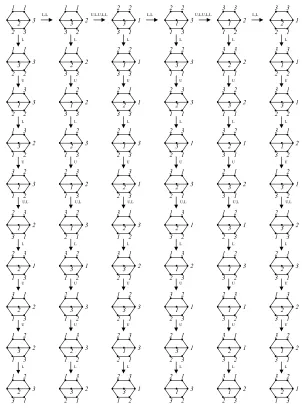
some standard token configuration. There are 2!2!2!6! = 90 standard token
configu-rations in total, which are shown in Figures2.4 and 2.5.
1 3 1 3 2 2
1 2 1 2 3 3
2 1 2 1 3 3
2 3 2 3 1 1
3 2 3 2 1 1
3 1 3 1 2 2 1 3
3 2 1 2
1 2 2 3 1 3
2 1 1 3 2 3
2 3 3 1 2 1
3 2 2 1 3 1
3 1 1 2 3 2 3 2
1 3 1 2
2 3 1 2 1 3
1 3 2 1 2 3
3 1 2 3 2 1
2 1 3 2 3 1
1 2 3 1 3 2 2 3
1 2 3 1
3 2 1 3 2 1
3 1 2 3 1 2
1 3 2 1 3 2
1 2 3 1 2 3
2 1 3 2 1 3 2 3
2 1 1 3
3 2 3 1 1 2
3 1 3 2 2 1
1 3 1 2 2 3
1 2 1 3 3 2
2 1 2 3 3 1 3 1
2 2 1 3
2 1 3 3 1 2
1 2 3 3 2 1
3 2 1 1 2 3
2 3 1 1 3 2
1 3 2 2 3 1 1 2
3 2 1 3
1 3 2 3 1 2
2 3 1 3 2 1
2 1 3 1 2 3
3 1 2 1 3 2
3 2 1 2 3 1 1 2
2 3 3 1
1 3 3 2 2 1
2 3 3 1 1 2
2 1 1 3 3 2
3 1 1 2 2 3
3 2 2 1 1 3 1 1
3 3 2 2
1 1 2 2 3 3
2 2 1 1 3 3
2 2 3 3 1 1
3 3 2 2 1 1
3 3 1 1 2 2 1 1
2 3 2 3
1 1 3 2 3 2
2 2 3 1 3 1
2 2 1 3 1 3
3 3 1 2 1 2
3 3 2 1 2 1
U,L,U,L,L
L,L L,L U,L,U,L,L L,L
[image:32.596.164.469.226.640.2]L U L U U,L L U U L L U L U U,L L U U L L U L U U,L L U U L L U L U U,L L U U L L U L U U,L L U U L L U L U U,L L U U L
Figure 2.4: The 60 standard token configurations of Groupa1inT(G; (2,2,2))
We can see that standard token configurations in the same figure are in the same
1 1 1 1 3 2 2 3
2 2 1 3 3 1
2 2 3 1 1 3
3 3 1 2 2 1
3 3 2 1 1 2
1 3 2 2 1 3
1 2 3 3 1 2
2 3 1 1 2 3
2 1 3 3 2 1
3 2 1 1 3 2
3 1 2 2 3 1 1 3
2 3 2 1
1 2 3 2 3 1
2 3 1 3 1 2
2 1 3 1 3 2
3 2 1 2 1 3
3 1 2 1 2 3 1 3
3 1 2 2
1 2 2 1 3 3
2 3 3 2 1 1
2 1 1 2 3 3
3 2 2 3 1 1
3 1 1 3 2 2 1 3
1 2 3 2
1 2 1 3 2 3
2 3 2 1 3 1
2 1 2 3 1 3
3 2 3 1 2 1
3 1 3 2 1 2 2 3
3 2
U,L,L,U
L L U,L,U,U L
[image:33.596.169.468.102.308.2]U L L L U L L L U L L L U L L L U L L L U L L L
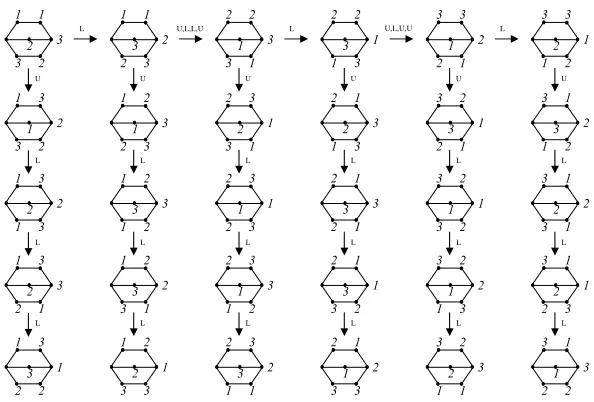
Figure 2.5: The 30 standard token configurations of Groupa2inT(G; (2,2,2))
operations. Thus T(θ0; (2,2,2)) has at most 2 components. As described
previ-ously, two standard token configurations are in the same component if and only
if one can be obtained from the other by using operations U and L only.
How-ever, by applying the operationsU and L to each standard token configuration in
Figures 2.4 and2.5, we always get another token configuration in the same figure.
Therefore,T(θ0; (2,2,2)) is not connected and has 2 components.
By considering all the standard token configurations, we find thatT(θ0; (2,2,1,1))
has 2 components, T(θ0; (2,1,1,1,1)) has 3 components, andT(θ0; (1,1,1,1,1,1))
has 6 components. The last case was already proved by Wilson [28].
Lemma 2.11
The labelled token graph T(θ0; (3,1,1,1)) is connected.
Proof. We prove by using Lemma 2.4. Let {11,12,13,2,3,4} be the multiset of
First, we show that a token 1 can be improperly swapped with a token different
from 1. The following are the steps to improperly swap the tokens 11 and 2. For
other pairs, we can do in a similar way.
Step 1: Move tokens so that 3 occupies v0.
Step 2: Move tokens on the 6-cycle until 4 is on a middle vertex, and the other
middle vertex is unoccupied. Then move 3 to this vertex.
Step 3: Move tokens on the 5-cycle which 2 is on until 1 and 2 are on the middle
vertices, so we now have that 11,12,13, and 2 are on the same 5-cycle.
Step 4: Improperly swap 11 and 2.
Step 5: Move all the tokens we moved in the previous steps backward to make 3
and 4 go back to their initial positions.
Next, we show that any two tokens i, j ∈ {2,3,4} can be improperly swapped.
Here we show only that the tokens 2 and 3 can be improperly swapped. For other
pairs, we can so do in a similar way. Let α(vx) = 11, α(vy) = 2, andα(vz) = 3 for
some x, y, z ∈ {0,1, . . . ,6}. We first improperly swap 11 and 2. Note that now 11
may or may not be on vy. We then improperly swap the token 1 occupying vy
with 3. Finally, we improperly swap the token 1 occupying vz with 2.
Lemma 2.12
The labelled token graph T(θ0; (1,1,1,1,1)) is connected.
Proof. We prove by using Lemma 2.4. Let α be any token configuration in
T(θ0; (1,1,1,1,1)), and t1 and t2 tokens in α. We first move some tokens to
make t1 occupy v0. Then rotate the tokens on the outer cycle until there is an
now can easily swapt1 andt2. Then move all the tokens we moved in the previous
steps backward until we get the token configuration, which is the same asαexcept
that t1 and t2 are swapped.
We now have all the lemmas which we need for the case Gis the graph θ0. Next,
we consider 2-connected graphs, and finally just connected graphs.
Lemma 2.13
Let Gbe a 2-connected graph different from a cycle or the graphθ0, k1+k2+· · ·+
kp ≤n(G)−1, and k1 ≥2. Then T(G; (k1, k2, . . . , kp)) is connected.
Proof. It is enough to show the case k1 +k2 +· · · +kp = n(G)−1 only. By
Theorem 2.1, we only have to consider the case that G is bipartite, and we have
thatT(G; (k1, k2, . . . , kp)) has at most two components. Letα andβ be any token
configurations in T(G; (k1, k2, . . . , kp)). By considering all tokens are different,
let α0 and β0 be token configurations in T(G;n(G) − 1) induced by α and β,
respectively.
Case 1: α0 and β0 have their unoccupied vertices at odd distance.
Ifα0(β0)−1is an odd permutation, we are done. Suppose this is not the case. Letα
0
be the same token configuration asαexcept that the tokens 11 and 12 are swapped.
Thus α0 and β are in the same component of T(G; (k1, k2, . . . , kp)). Then we are
done since α and α0 are the same token configuration in T(G; (k1, k2, . . . , kp)).
Case 2: α0 and β0 have their unoccupied vertices at even distance.
Similar to Case 1, ifα0(β0)−1is an even permutation, then we are done. Otherwise,
let α0 be the same token configuration as α except that the tokens 11 and 12 are
Lemma 2.14
Let Gbe a 2-connected graph different from a cycle. If k≤n(G)−2, thenT(G;k) is connected.
Proof. By Lemma 2.12, we have that T(θ0; (1,1,1,1,1)) = T(θ0; 5) is connected.
Then, by Proposition2.6, we are done ifGis the graphθ0. Now we suppose thatG
is not θ0. By Lemma 2.13, T(G; ( 2,1, . . . ,1
| {z }
n(G)−2 terms
)) is connected. ThenT(G;k) is also
connected by Proposition 2.6.
Lemma 2.15
Let H be a 2-connected graph, and G the graph obtained from H by adding one vertex, which is connected to a vertex of H. Then T(G;n(G)−2) is connected.
Proof. Let uv be the added edge, where d(u) = 1 and d(v)≥2, and α any token
configuration in T(G;n(G)−2).
Case 1: The graph H is a cycle.
We may assume that inαall tokens are on the cycle (otherwise, we can move some
tokens to get it since G is connected). It is enough to show that any two
consec-utive tokens on the cycle can be swapped. Suppose we want to swap consecconsec-utive
tokenst1 and t2. Then we move the tokens on the cycle untilv is unoccupied and
is betweent1 and t2. Note that uis now unoccupied. Then we can easily swap t1
and t2 by moving through the vertex u.
Case 2: The graph H is not a cycle.
By Lemma2.14,T(H;n(H)−2) is connected. Thus any two tokens in α|H can be
swapped. SinceH is 2-connected,dH(v)≥2. Letx andy be neighbors of v inH.
inα. We can see that the tokens onuand onycan be swapped by moving through
the vertexx. Hence any two tokens in α can be swapped, so we are done.
Lemma 2.16
Let G1 and G2 be 2-connected graphs containing a vertex v1 and v2, respectively, andG the graph resulting from combiningG1 andG2 by identifying the verticesv1 and v2. Then T(G;n(G)−2) is connected.
Proof. Let u1 be a vertex in G1 which is adjacent to v1, and u2 a vertex in G2
which is adjacent to v2. Let v be the vertex in G, which results from identifying
the vertices v1 and v2. Thus v is adjacent to u1 and u2 in G. Let H1 and H2
be the subgraphs of G induced by V(G1)∪ {u2} and V(G2)∪ {u1}, respectively.
By Lemma 2.15, T(H1;n(H1)−2) and T(H2;n(H2)−2) are connected. Let α
be any token configuration in T(G;n(G)− 2). We can assume that v and u1
are unoccupied in α; otherwise, we can move some tokens in α to get another
token configuration such that v and u1 are unoccupied. SinceT(H1;n(H1)−2) is
connected, any two tokens on the vertices ofH1 inα can be swapped. Also, since
T(H2;n(H2)−2) is connected, any two tokens on the vertices of H2 in α can be
swapped. Since H1 and H2 share the token on u2, any two tokens in α can be
swapped.
The block-cutvertex graph of a connected graphG, denoted bybc(G), is the graph
whose vertices are the blocks and cut-vertices of G, and the edges of bc(G) join
cut-vertices with those blocks to which they belong. An endblock ofG is a block,
which is of degree 1 in bc(G). Thus every endblock contains only one cut-vertex
of G.
Lemma 2.17
not contain a separating path of size l, then there exists an endblock B in G such
thatG\(V(B)\{vB}) is connected and does not contain a separating path of sizel,
where vB is the cut-vertex of G in B.
Proof. Let B0 be any endblock in G. Take an endblock B of maximum distance
fromB0 inbc(G). Thus G\(V(B)\{vB}) is connected, wherevB is the cut-vertex
of G in B. Suppose for a contradiction that G\(V(B)\{vB}) has a separating
path P of size l. SinceG has no separating path of sizel, vB is an interior vertex
of P. Then there are two P-components. One component contains B0, and the
other contains another endblock, which is farther from B0 than B is. This is a
contradiction.
We call an endblockB according to Lemma 2.17, agood endblock.
Proof of Theorem 2.2. (⇐) It is easy to see that if G is disconnected, k1 + k2 +· · ·+kp = n(G), or G is a path, then T(G; (k1, k2, . . . , kp)) is disconnected.
By Lemmas 2.9, 2.10, and Theorem 2.1, we are done when the fourth, fifth, or
sixth condition holds.
Next, we suppose that G is a connected graph with connectivity 1, other than
a path, n(G)−(k1 +k2 +· · ·+kp) = l ≥ 1, and G contains a separating path
P = v1v2. . . vl. If l = 1, let G1∗ be any component of G\v1, and G1 and G2 the
subgraphs ofGinduced byV(G1∗)∪{v1}andV(G)\V(G1∗), respectively. Ifl≥2,
let G1 and G2 be the two P-components of G such that G1 contains v1 and G2
contains vl.
We prove the labelled token graph is disconnected by showing that there are two
token configurations, which are in different components of T(G; (k1, k2, . . . , kp)).
Let α be a token configuration such that v1, v2, . . . , vl are all unoccupied, and all
the tokens with label 1 are in G1\v1. Letu be a vertex such that α(u) = 1, and v
a vertex in G2\vl. Thus α(v) = c for some c 6= 1. Let β be the same token
configuration as α except that β(u) = c and β(v) = 1. Since the token 1 on u
inα cannot be moved to the vertexv (it can go as far as tovl),β is not reachable
fromα.
Case 2: n(G1)< k1.
Letαbe a token configuration such thatv1, v2, . . . , vl are all unoccupied, and each
vertex in G1\v1 contains a token 1. Let u ∈ V(G1)\{v1} (so α(u) = 1), and v
a vertex in G2\vl such that α(v) = c for some c 6= 1. Let β be the same token
configuration asα except thatβ(u) = candβ(v) = 1. Since the tokenconv inα
cannot be moved to the vertex u (it can go as far as to v1), β is not reachable
fromα.
(⇒) We prove necessity by contrapositive. Suppose that all the conditions 1-7 do
not hold. ThusGis connected, k1+k2+· · ·+kp ≤n(G)−1, andGis not a path.
Lemma 2.9 completes the proof when G is a cycle. If G is the graph θ0, we have
T(θ0; (3,1,1,1)) and T(θ0; (1,1,1,1,1)) are connected by Lemmas 2.11 and 2.12.
For the other numbers of tokens, we are done by Properties 2.6 and 2.7. If G is a
2-connected graph, then we are done by Theorem2.1 and Lemmas2.13 and 2.14.
We now suppose that Gis a connected graph with connectivity 1, which does not
contain a separating path of size l, where l =n(G)−(k1+k2+· · ·+kp). Since G
has connectivity 1, G contains a separating path of size 1. Thus l ≥ 2. We will
prove thatT(G;n(G)−l) is connected by induction on the number of blocks inG,
and then we will have T(G; (k1, k2, . . . , kp)) is connected by Proposition 2.7.
Since G is not a path, G has to be a graph in Lemma 2.15 or 2.16. Then
T(G;n(G)−2) is connected. Since l ≥2, T(G;n(G)−l) is also connected.
Induction Step: There are m≥3 blocks inG.
LetBbe a good endblock inGandHthe subgraph ofGinduced by [V(G)\V(B)]∪
{vB}, where vB is the cut-vertex of G in B. By Lemma 2.17, we have that H is
connected and has no separating path of size l. It is easy to see that H has
m−1 ≥ 2 blocks, so H has connectivity 1. Then by the induction hypothesis,
T(H;n(H)−l) is connected.
Letv0Bbe a vertex of Hwhich is adjacent tovB, andB0 the subgraph ofGinduced
byV(B)∪{v0
B}. By Lemma2.15,T(B0;n(B0)−2) is connected, soT(G;n(B0)−2)
is connected by Proposition2.8.
Case 1: n(H)≤l.
Thenn(G)−l= (n(H)+n(B0)−2)−l≤(l+n(B0)−2)−l =n(B0)−2. Therefore,
T(G;n(G)−l) is connected by Proposition 2.6.
Case 2: n(H)≥l+ 1.
We claim that H is not a path. Indeed, if H is the path v1v2· · ·vl+1· · ·vm for
some m ≥ l+ 1, then v2v3· · ·vl+1 is a separating path of size l in G, which is a
contradiction.
If dH(vB) ≥ 2, choose u = vB, x = v0B, and y another neighbour of vB in H.
Otherwise, let u be the vertex nearest to vB in H such that dH(u) ≥ 3 (u exists
since H is not a path). Then there is only one path from u tovB, and it is of size
less thanl since G does not contain a separating path of size l. Then let xand y
Let α be any token configuration in T(G;n(G)−l). We can assume that in α,
there are n(B0)−2 tokens on B0 such that vB and vB0 are unoccupied, and there
are n(H)−l ≥ 1 tokens on H such that x and the vertices on the path from u
tovB are all unoccupied while the vertexyis occupied. Otherwise, we can always
move some tokens to get a token configuration with such properties fromαsinceG
is connected. Since T(B0;n(B0)−2) and T(H;n(H)−l) are connected, any two
tokens on B0 and any two tokens on H can be improperly swapped in α. So we
need to show only that in α there is a token on B0 and a token on H which can
be swapped.
Lett1be the token which occupiesy, andt2 the token onB0which is on a neighbour
of vB. We now can improperly swap the tokens t1 and t2 by moving through the
vertex x. This completes the proof of Theorem 2.2.
We go back to Lemma2.14now. The proof of this lemma as previously given uses
the result of Theorem2.1, which was proved by using algebraic methods. Here we
give another proof, using graph theoretical methods only.
Another Proof of Lemma 2.14. We prove the lemma by using Lemma 2.5.
Let G be a 2-connected graph different from a cycle, α any token configuration
with at most n(G)−2 different tokens, v any unoccupied vertex in α, and u any
occupied vertex inα, sayucontains a tokent. We will show that inα, the tokenst
and φ (the empty token on v) can be improperly empty-token swapped.
SinceGis 2-connected, there are two internally disjoint pathsP1 andP2betweenu
and v. If one of these two paths does not contain any token, then we can easily
movetfromutov, so we are done. Suppose this is not the case. Sincek ≤n(G)−2,
there is an unoccupied vertex w such that w 6= v. Let s1 and s2 be the tokens
Case 1: There is a vertex of G which is not onP1∪P2.
Subcase 1.1: The vertex wis not on P1∪P2.
Take a path Pw from w to some vertex x on P1 ∪P2. Let y be the vertex on Pw
which is adjacent to x. Then do the following (if necessary),
(1) move the tokens on Pw forward to w to make y unoccupied,
(2) move the tokens on P1∪P2 in anticlockwise direction untilt is at x,
(3) move t fromx to y alongPw,
(4) move the tokens on P1 ∪P2 in anticlockwise direction until x is between the
tokens s1 and s2,
(5) move t fromy back to x alongPw,
(6) move the tokens on P1 ∪ P2 in clockwise direction until they are at their
destination positions,
(7) move the tokens which we moved in (1) back to their initial positions.
Subcase 1.2: The vertex w is on P1∪P2, but there is another vertex z which is
not on P1∪P2.
We can suppose that the vertices which are not on P1 ∪P2 are all occupied by
tokens. Otherwise, we are done by Subcase 1.1. Take a path Pz from z to some
vertex x on P1 ∪P2. Let s be the token on Pz which is the nearest to x but not
onx. To use Subcase 1.1, we will move s to the vertex w.
We do the following (if necessary),
(1) move the tokens onP1∪P2 in anticlockwise direction until the free space on w
(2) move s tox along Pz,
(3) move the tokens on P1∪P2 in clockwise direction untils arrives at w.
Now we can use Subcase 1.1 to move tfromu tov, and then we move the token s
back to its initial position.
Case 2: All vertices are on P1∪P2.
SinceGis not a cycle, there exists a chordxyonP1∪P2 for somex, y ∈V(G). We
move the tokens onP1∪P2 in anticlockwise direction until the tokentarrives atx
or the empty token φ (on v initially) arrives at y. At the time of arrival, we may
assume that t is on a vertex z1, and φ is on a vertex z2. If z1 =x and z2 =y, we
can easily movetfromxtoyalong the chord, and then move the tokens onP1∪P2
in clockwise direction until we get the wanted token configuration. Otherwise, we
can find two internally disjoint paths P10 and P20 from z1 to z2 such that there is
another vertex which is not on P10 ∪P20. By Case 1, we can move t from z1 to z2.
Finally, we move the tokens on P1∪P2 in clockwise direction until t arrives at v,
and the other tokens are back to their initial positions.
2.4
Proof of Theorem
2.3
Note that in this section, we use some terminology and notation from the previous
section. According to the graphθ0 in Figure2.1, we denote a token configurationα
ofθ0 which hasα(vi) =ti for alli= 0,1, . . . ,6, by [t0, t1, t2, t3, t4, t5, t6]. For
exam-ple, ifαis the top left token configuration in Figure2.4, thenα= [2, φ,2,3,3,1,1].
LetG be a connected graph with connectivity 1,n(G)−(k1+k2+· · ·+kp) = 1,
see that even though αvB is not unique, τ(αvB|B) is unique. This means tokens in
τ(αvB|B) can be moved to vertices in B only. We get the following lemma.
Lemma 2.18
Let G be a connected graph with connectivity 1, n(G)−(k1 +k2+· · ·+kp) = 1,
and α and β token configurations of G. Then α is reachable from β if and only if αvB|B is reachable from βvB|B for every block B in G.
Proof of Theorem 2.3. (⇐) It is easy to see that α and β are in the same
component of T(G; (k1, k2, . . . , kp)) if one of the first three conditions holds.
Suppose thatGis the graphθo and (k1, k2, . . . , kp) = (2,2,2). We have proved that
T(θ0; (2,2,2)) is not connected and has 2 components. One component contains 60
standard token configurations, shown in Figure2.4(and some other token
configu-rations). We can see that all the (1,1)-standard token configurations of which the
cyclic order of tokens on the lower 5-cycle is (2,2,3,3) are in this component. The
other component contains 30 standard token configurations, shown in Figure 2.5
(and some other token configurations), and all the (1,1)-standard token
configu-rations of which the cyclic order of tokens on the lower 5-cycle is (2,3,2,3) are in
this component. Thus, if α0 and β0 are in the same group (stated in 4(a) in the
theorem), then α and β are in the same component of T(θ0; (2,2,2)).
Next, we suppose that (k1, k2, . . . , kp) = (2,2,1,1). We relabel the two tokens
with label 3 in all standard token configurations in Figure 2.4 into two possible
ways, say using labels 3 and 4. Then we get two copies of Figure 2.4. One copy
contains the standard token configuration [2, φ,2,3,4,1,1], and the other
con-tains [2, φ,2,4,3,1,1]. We do a similar relabelling in Figure 2.5, so we get two
copies of Figure 2.5. One copy contains [2, φ,3,2,4,1,1], and the other contains
two copies of Figure 2.4 are in the same component of T(θ0; (2,2,1,1)) by
show-ing a path from [2, φ,2,3,4,1,1] to [2, φ,2,4,3,1,1]. This path can be obtained
by the following sequence of operations: L, L, U, L, U, L, U, L, U, U, L, L, U, U, U.
Similarly, we give a path from [2, φ,3,2,4,1,1] to [2, φ,4,2,3,1,1] to show that
the standard token configurations from the two copies of Figure 2.5 are in the
same component. This path can be obtained by the following sequence of
op-erations: L, U, L, L, U, L, U, L, U, U, L, U, L, L, L, U, U, U, L, U, U, U. Thus we have
two groups of standard token configurations inT(θ0; (2,2,1,1)) such that standard
token configurations which are in the same group are in the same component of
T(θ0; (2,2,1,1)). We can see that one group, called Group A1, contains all the
(1,1)-standard token configurations of which the cyclic order of tokens on the lower
5-cycle is (2,2,3,4) or (2,2,4,3). And the other group, called GroupA2, contains
all the (1,1)-standard token configurations of which the cyclic order of tokens on
the lower 5-cycle is (2,3,2,4) or (2,4,2,3). Hence, if α0 and β0 are in the same
group (stated in 4(a) in the theorem), then α and β are in the same component
of T(θ0; (2,2,1,1)).
Now we suppose that (k1, k2, . . . , kp) = (2,1,1,1,1). Then we relabel the two
tokens with label 2 in all standard token configurations in Group A1 into two
possible ways, say using labels 2 and 5. So we get two copies of standard token
configurations from Group A1, called Groups B1 and B2, and two copies of
stan-dard token configurations from GroupA2, called GroupsB30 andB300. Without loss
of generality, we suppose that Group B30 contains [2, φ,4,5,3,1,1], and Group B300
contains [5, φ,4,2,3,1,1]. Then we show that there are three groups of standard
token configurations inT(θ0; (2,1,1,1,1)) such that standard token configurations
in the same group are in the same component. For this, it suffices to show a path
from [2, φ,4,5,3,1,1] to [5, φ,4,2,3,1,1], obtained by the sequence of operations:
L, L. Then we use B3 to denote the group formed from the combination of B30
and B300. Again, if α0 andβ0 are in the same group (stated in 4(b) in the theorem),
then α and β are in the same component of T(θ0; (2,1,1,1,1)).
We next suppose that (k1, k2, . . . , kp) = (1,1,1,1,1,1). By relabelling the two
tokens with label 1 in all standard token configurations in GroupsB1, B2, andB3
into two possible ways, say using labels 1 and 6, we get two copies of standard
token configurations from eac