2016 International Conference on Mathematical, Computational and Statistical Sciences and Engineering (MCSSE 2016) ISBN: 978-1-60595-396-0
The Design of Remote Analog Electronic Circuit
Lab System Based on LabVIEW
Juan WU
1, Xiao HAN
1, Wei LEI
2, Yi-yi QING
2and Chang-yuan LV
11School of Instrument Science and Engineering, Southeast University, Nanjing, China
2Academic Affair Office, Southeast University, Nanjing, China
Keywords: Analog electronic circuit, Remote lab System, Virtual and actual combination, B/S
structure, LabVIEW.
Abstract. The paper presents the design and prototype of a remote Analog Electronic Circuit Lab System. The lab system includes local and remote sites, which is built based on B/S (Browser/Server) structure. On local site, the operator can access into the lab website and do circuit designing and simulation. On the remote site, simulated circuit is represented and worked, and the site image as well as the actual parameters is feedback to the operator through network. A lab reservation management function is provided by synthesizing the Web Technology and database. The HTML page generated by virtual simulation and practicality experiments is embedded into the lab management system. After registering, users can log into the experiment and implement the experiment within the prescribed time. The online experiment test showed that the remote lab system proposed in this paper is stable in operation with strong practicability and expandability.
Introduction
Nowadays, experiment course plays an important role in engineering education[1]. However difference specialties have varied constraints to the conduct of lab. Some experiments require complicated and expensive instruments, which could not be supplied to every experimenters. Some of the experiments involving the living culturing, which last for long period, are time-consuming. With the rapid development of virtual instrument, network technology and virtual simulation technology, the remote and virtual laboratories appeared. Previous problems could be partly solved with remote or virtual lab system. As for the remote lab, the experimental facilities could be visited and shared by the remote users utilizing the online interface. It can solve the problems like lacking of special instruments, limited experimental sets and improve effectiveness. The hardware practicality experiment can bring the sense of presence to users, and the experiment result is close to the actual experiment. But it has the trouble on updating and maintaining the equipment[2,3]. Compared with real laboratories, virtual labs usually simulate the experiment procedures on the computer sever. Operator could do some design or parameters adjustment and see the simulated experimental results on the graphic interface. It is relatively safe, visualized and multi-user support[4]. More importantly, it has no physical space occupation and is high efficient. While the shortcoming is that the user can hardly achieve the perceptual knowledge about the operation on the realistic apparatus.
Polytechnic University of Catalonia[14], and the remote teaching system developed by Saga University and Chiba Institute of Technology[15]. iLab brings a lot of convenience on experiment teaching. However, there are still some things can be improved from the following respects: (1) Not strong generality of experiments[16]; (2) Simple experiment subjects; (3) Lack of experimental management system; (4) Lack of creativity in experiments[17].
The analog electronic circuit is one of the basic courses of the electronic engineering major, it has strong theorization and practicability. Therefore, the lab is essential part of the analog electronic circuit course and should be presented simultaneously. To help the students to prepare the lab and review the class, the analog electronic MOOCs are developed at Southeast University. While for the present online courses, which mostly focus on the theoretical part of the online courses. The establishment of the analog electronic circuit remote lab system can effectively utilize the experimental resources, save the investment cost of experiment equipment, and improve students’ learning efficiency.
The system designed has the following functions: virtual simulation and real remote operation; remote observation and feedback; online booking and experiment report submitting. Under the virtual simulation mode, the user can regulate any circuit parameters he interested in, and obtain the waveform of data change at any time quantum. Under the hardware practicality mode, users can control the experimental circuit board remotely, run the actual analog experiment circuit, send the key parameter to the experimental circuit board and receive the feedback of result. The rest of the paper are organized as that: The system work flow are presented in Section two. Then the virtual simulation part and remote physical lab are respectively introduced in Section three to six. In addition, the lab reservation management system and real experiment platform are showed in the rest sections.
Scheme for Remote Lab System
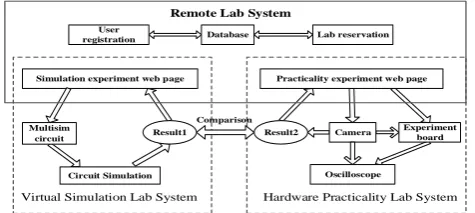
The flow chart of the remote lab platform function is shown in Figure 1, which mainly consists of virtual simulation lab system and the hardware practicality lab system. Through the management, the simulation experiment and practicality experiment are released in the form of web page. The content of virtual simulation experiment is generally the same as the practicality experiment, but in different experiment form. With different experiment modes, the user can get the different experiment results so as to further finish the comparison of the experiment results.
Currently there are two main modes for the remote lab system structure: Client/Server (C/S) mode, and Browser/Server (B/S) mode. For later upgrading and maintenance as well as the experimental content expansion and flexibility of the system, this remote lab system is established with the B/S structure. The structure of system network topology is shown in Figure 2.
Simulation experiment web page
Remote Lab System
Virtual Simulation Lab System Hardware Practicality Lab System
Comparison
Practicality experiment web page User
registration Database Lab reservation
[image:2.595.63.301.585.691.2]Experiment board Oscilloscope Camera Circuit Simulation Result1 Result2 Multisim circuit user2 userN user1 Internet virtual simulation experiment hardware practicality experiment USB Webcam Web Server Database Application server . ..
Figure 1. Flow chart for the remote lab platform function. Figure 2. System network topology.
Virtual Simulation Lab System
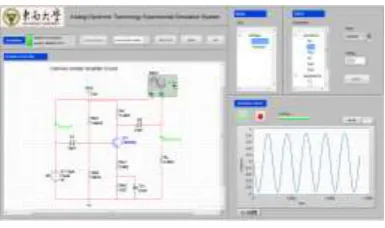
Toolkit. The simulation experiment panel is shown in Figure 3. Under this system, there are two important functions for experiment study.
Automatic Generation of Experiment Report
[image:3.595.202.395.191.305.2]Users can record the experiment procedure and obtain the results by experiment report. For this system, it is important to record the simulating experiment results and supplementary information of experiments simultaneously. The function of automatically forming the experiment report is realized by the LabVIEW Report Generation toolkit.
Figure 3. Simulation experiment panel.
Publishing the Virtual Simulation Experiment on Network
This function is helpful for users who have no LabVIEW installed at the client end to run the VI program at the far end through browser. LabVIEW provides a simple method for users to access the remote VI on network. It can be realized by setting the relevant configuration for the LabVIEW Web Server.
Hardware Practicality Lab System
The experiment circuit board provides the real modularized circuit which could be rebuilt and runs the simulated circuit. The hardware itself is an ARM controlled system, and has the functions of experiment circuit selection, key parameter alteration, modular access, experiment result feedback responding to the command from the remote end.The structure diagram for the substance hardware experiment circuit is shown in Figure 4. By using the modular concept, 6 experiment circuits can be designed in the same circuit board.
STM32
control unit
1. common-emitter amplify circuit 2. negative feedback circuit 3. integral circuit 4. sinusoidal oscillation circuit 5. window comparator circuit 6. power amplifying circuit 7. extension circuit I 8. extension circuit II
oscilloscope serial
PC
SPI port
I/O port
D A C
signal source switching
circuit
Digital potentiometer control circuit
Relay and light control circuit
analog analog
switch switch
Figure 4. Structure diagram of hardware experiment circuit.
Experiment Circuit Selection
[image:3.595.105.489.531.624.2]Key Parameter Alteration and Function of Modular Access
By changing key parameters, users can obtain different experiment results and have deep understanding of the operating mechanism of the circuit. Resistance value amendment is controlled by digital potentiometer to realize the alteration of parameters. As for upgrading of hardware, modular access need to be applied. It is realized by two interfaces: digital potentiometer control interface and signal source input/output control interface.
Experiment Result Feedback
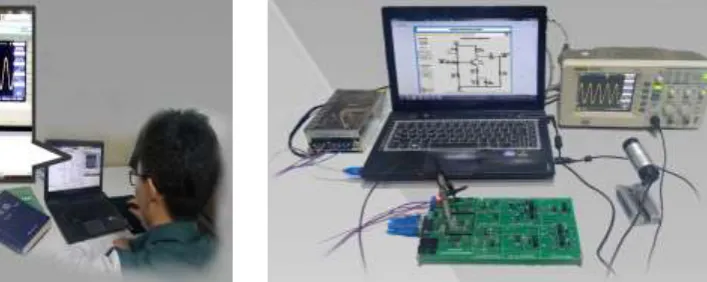
After finishing experiment, users need to get the feedback of result. The video monitoring system is an key part of the realization of result feedback. The video monitoring system is built based on the NI visual development module. Fig.5 shows that the user on the client end is just using the remote lab system to perform the hardware practicality experiment. Fig.6 shows the scene of remote experiment.
Experiment Reservation Management System
The experiment reservation management system performs the standardized management on the teaching resource of remote experiment. Users in management system are mainly in three roles: administrator, teacher and student. Each user has their own user name and password. Through the management system, administrator takes in charge of user management and daily maintenance; teacher may review the teaching news and upload the experiment teaching materials and assist the student to finish their remote experiment; student can download the experiment course materials, make the experiment reservation and finish the remote experiment course. In order to avoid long-time occupying the experiment resource, the safety of the system operation is improved. The control mechanism on the experiment rights and authorities is provided. Within the specific time period, the experiment can only be accessed to one user and others have no right to access.
[image:4.595.70.360.442.583.2] [image:4.595.172.526.443.584.2]
Figure 5. The operation from a user on the client end. Figure 6. Scene of remote experiment.
Real System Description (an Example of Common-emitter Amplifier Circuit)
connected. After that, user opens the video monitoring to observe the state of the running experiment circuit as well as the oscilloscope waveform on the remote real lab site.
[image:5.595.194.403.114.249.2]Figure 7. Index page of remote lab system.
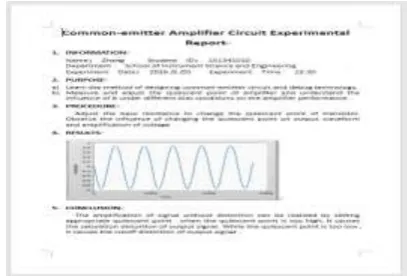
Figure 8. Common-emitter amplifier circuit experiment report.
Conclusions
This system was tested in campus network. It runs well and meets the teaching requirement of the remote experiment. The analog electronic circuit remote lab system designed in this paper has the following advantages: web page accessing, convenient operation, no need to install the complicated client software; inexpensive cost and strong universal property; the reserved experiment expansion interface for both the virtual simulation and substance experiment, the convenience for further integration. The experiment mode combining the virtual and practical situations is beneficial to the optimization of experiment arrangement. Comparing virtual situation with realistic situation, students can realize the difference between the theorization and practicality of the experiment. It provides users with experiment course resources and solution of experiment authorization by constructing the experiment reservation management system. The remote lab could also be applied to other engineering courses, especially to the online courses such as digital electronic circuit and DSP. It helps to improve the learning efficiency of students and save physical space occupation for universities.
Acknowledgement
[image:5.595.194.398.297.435.2]References
[1] Bao Y, Jiang X. Application of virtual instrumentation which based on labview in electronic measurement technology course[C]//Electronics and Optoelectronics (ICEOE), 2011 International Conference on. IEEE, 2011:215-218.
[2] C.A. Jara, F.A. Candelas and S.T. Puente, “Hands-on experiences of undergraduate students in Automatics and Robotics using a virtual and remote laboratory,” Computers & Education, vol. 57, No. 4, 2011, pp. 2451-2461.
[3] X. Chen, G. Song and Y. Zhang, “Virtual and Remote Laboratory Development: A Review,” Proceedings of Earth & Space, 2010, pp. 3843-3852.
[4] B. Balamuralithara and P.C. Woods, “Virtual laboratories in engineering education: The simulation lab and remote lab,” Computer Applications in Engineering Education, vol. 17, No. 1, 2009, pp. 108-118.
[5] Grimaldi D, Rapuano S. Hardware and software to design virtual laboratory for education in instrumentation and measurement[J]. Measurement, 2009, 42(4):485-493.
[6] Hardison J L, DeLong K, Bailey P H, et al. Deploying Interactive Remote Labs Using the iLab Shared Architecture[C]. 38th ASEE/IEEE Frontiers in Education Conference, 2008:S2A-1-S2A-6.
[7] University of Southern California, home page.[Online].Available: http://ilab.usc.edu/
[8] Macquarie University, “IT Services-iLAB”, Apr.06, 2016.[Online].
Available: https://wiki.mq.edu.au/display/iLab/About.
[9] University of Essex, “Creative meeting space (iLab)”, [Online]. Available:
http://www.essex.ac.uk/business/facilities/ilab/.
[10] UniQuest, homepage, [Online]. Available: http://uniquest.com.au/ilab.
[11] Yun Wang, Design and Implementation of Virtual Instrument Based on JAVA[D]. Beijing University of Posts and Telecommunications, 2010.
[12] Gadzhanov S D, Nafalski A, Nedic Z. LabVIEW based remote laboratory for advanced motion control[C]//International Conference on Remote Engineering and Virtual Instrumentation. 2014:129-136.
[13] Jinghe Yang, Qian Xu, Pengfei Chen, et al. Development of X-ray diffractometer remote network laboratory[J]. Experimental Technology and Management, 2015, 32(6):251-253.
[14] Martinez-Garcia H. Implementation of a remote laboratory for distance training in robotic applications[C]//IEEE International Conference on Industrial Informatics. IEEE, 2015:282-287.
[15] Ishibashi M, Fukumoto H, Furukawa T, et al. Development of a web-based remote experiment system for electrical machinery learners[C]//2014 International Power Electronics Conference (IPEC-Hiroshima 2014 ECCE-ASIA). 2014:724-729.
[16] Xi He, The Design of the virtual remote experiment system based on LabVIEW [D]. Hunan University of Technology, 2014.