University of Huddersfield Repository
Hall, Stuart, Maclachlan, Kathy, Tett, Lyn and Edwards, Vivien
Mapping Youth Literacies Practice with The 16 25 Age Group
Original Citation
Hall, Stuart, Maclachlan, Kathy, Tett, Lyn and Edwards, Vivien (2008) Mapping Youth Literacies
Practice with The 16 25 Age Group. The Scottish Government, Edinburgh, Scotland. ISBN
9780755955206
This version is available at http://eprints.hud.ac.uk/id/eprint/13401/
The University Repository is a digital collection of the research output of the
University, available on Open Access. Copyright and Moral Rights for the items
on this site are retained by the individual author and/or other copyright owners.
Users may access full items free of charge; copies of full text items generally
can be reproduced, displayed or performed and given to third parties in any
format or medium for personal research or study, educational or notforprofit
purposes without prior permission or charge, provided:
With The 16 - 25 Age Group
Mapping Youth Literacies Practice
Final report
University of Glasgow:
Stuart Hall
Kathy Maclachlan
University of Edinburgh:
© Crown copyright 2008 ISBN: 978-0-7559-5520-6 The Scottish Government St Andrew’s House Edinburgh
EH1 3DG
Produced for the Scottish Government by RR Donnelley B52967 5/08 Published by the Scottish Government, May, 2008
Further copies are available from Blackwell’s Bookshop
53 South Bridge Edinburgh EH1 1YS
Contents
Foreword iii
Executive Summary iv
1. Introduction 1
1.1 Scope of the report 2
1.2 Aims and objectives of the study 2
1.3 Context of the research 3
2. Methodology and timescale 5
2.1 Introduction 6
2.2 Identifying youth literacies providers 6
2.3 Questionnaire survey 6
2.4 Distributing the questionnaire 7
2.5 Questionnaire analysis 7
2.6 Survey responses 7
2.7 Case studies 9
2.8 Developing case study schedules 11
2.9 Analysis of case studies 11
2.10 Case study summaries 11
3. Findings from the survey of providers 13
3.1 Introduction 14
3.2 The nature of youth literacies provision 14
3.3 Implementing theLiteracies in the Community (LiC)pack 19
3.4 Staffing 25
3.5 The profile of staff working in youth literacies 25
3.6 The young people engaging in literacies learning 26
3.7 Providers’ views on the nature of youth literacies 28
3.8 Concluding comments 35
4 Case study findings 37
4.1 Introduction 38
4.2 The organisations 38
4.3 Getting young people involved 39
4.4 Engaging and sustaining learner involvement 40
4.5 Facilitating learning and achievement 40
4.6 The impact of learning 41
5. Conclusions 45
5.1 Introduction 46
5.2 Mapping youth literacies 46
5.3 Youth literacies staff 47
5.4 Recruiting and retaining young people 47
5.5 Delivering youth literacies through non-disclosure 48
5.6 The role of ICT in youth literacies 48
5.7 NRDC research 49
5.8 Concluding comments 50
References and Appendices 53 Appendix 1:Survey questionnaire 55
Appendix 2:Case studies 71
Appendix 3:Comparison of Key Findings from the NRDC Research and the
Foreword
Mapping Youth Literacies Practice in Scotland with the 16-25 Age Group.
This report, commissioned by Learning Connections,1Lifelong Learning Division of the Scottish
Government, provides an overall picture of youth literacies learning in Scotland together with case studies of effective practice. It complements the 2004 Learning Connections-funded report Youth Literacies Practice in Scotland: an initial explorationand ‘To the Max’, the 2006 national collaborative project with YouthLink Scotland.
The report paints a diverse picture of literacies learning and teaching with young people, across a variety of settings, while highlighting common principles. It also identifies some of the positive ways in which youth literacies services provide opportunities for young people to engage with literacies learning, and how this engagement supports them to make important life choices.
Executive Summary
Introduction
This report presents findings from a Learning Connections, Scottish Government, funded
investigation into literacies practice in Scotland with young people aged 16-25, otherwise known as youth literacies practice. The research took place between October 2006 and May 2007.
Research Aims
This research had three aims, which were to:
1. Carry out a mapping exercise of youth literacies provision across Scotland to identify the scope and diversity of practice and capture examples of effective practice.
2. Inform developments in youth literacies in Scotland and provide case studies to share effective practice.
3. Explore the lessons for Scotland from the recent NRDC2research project: ‘Success factors in
informal learning: young adults’ experiences of literacy, language and numeracy’by Bethia McNeil and Linda Dixon, NIACE/NYA (2005).
Methodology
The project methodology comprised a combination of research approaches using postal/email survey and interviewing. This mixed methods approach was regarded as the most appropriate way to address the project aims and to provide a broad picture of youth literacies provision in Scotland (the questionnaire survey), and at the same time give an insight into the nature of specific types of youth literacies provision (the case studies).
Ninety-four survey questionnaires were returned. Although the total number of providers who completed the survey was relatively small, the overall quality of the responses was good. Indeed, most respondents took the time to provide answers, and in many cases quite lengthy answers, to most of the open questions.
Findings from the questionnaire survey
Understanding of the term ‘youth literacies’
The responses relating to providers’ understanding of youth literacies suggest that these include the development of a broad range of personal and communication skills (often through the ‘hook’ of activities that are of particular interest and relevance to young people), which will enable them to become active, confident participants in the different areas of life highlighted inAdult Literacy and Numeracy in Scotland(ALNIS) report (2001).3Mention of the youth literacies component of
a course may be ‘hidden’ (i.e. delayed until later in the programme). Respondents’ experiences suggest that theexplicitpromotion of a youth literacies agenda is the least productive way of recruiting, engaging and retaining young people in learning. However, what was also apparent from the survey (and subsequent case study visits) is that a great deal of youth literacies provision combines a mix of undisclosed work with dedicated and one-to-one support.
The aims of provision
The main aims of providers of youth literacies work were to raise the self-esteem of the young people and to increase their engagement with society. Employment-related aims followed closely, with continuing study being the least cited of the key aims. These results match closely with providers’ understanding of youth literacies as cited above, so there appears to be a close fit between how they understand the concept of youth literacies and what they hope to achieve through their work.
The nature of provision
• Providers used a number of approaches in delivering literacies to young people. The majority used integrated and hidden approaches (94% and 54%, respectively), also 84% employed some form of dedicated/open or disclosed provision
• A majority of providers offered a mix of one-to-one and group provision
• The most popular types of dedicated provision were of no fixed length and offered no formal qualifications. Integrated provision was more likely to be of fixed length but still offered no formal qualifications.
Staffing
• Almost two-thirds (63%) of youth literacies staff were female
• Thirty-four per cent of youth literacies staff were aged between 41 and 50; 27% were aged 31 to 40; 20% were 51 years or over; and the remaining 19% were 30 or younger
• The majority of staff engaged in youth literacies work were employed full-time (52%), though not necessarily employed full-time on youth literacies
• Just under half (46%) of the staff had been employed in literacies work for 5 years or less. 40% had experience of five years or more, while 14% had less than one year’s experience
The young people
• Young people aged 16 to 19 were more frequently engaged with than those aged 20-25. Young males were the most commonly engaged group
• Sixty-one per cent of providers targeted particular groups of young people: those in need of more choices and more chances,4single sex groups of ‘young men’ or ‘young women’ being
the three most frequently cited
• Retention rates for fixed duration courses were high, with 36 providers recording a completion rate in the range of 76-100%, and 17 recording a completion rate in the range of 51-75%
• Providers who offered courses leading to a qualification typically expected young people to achieve the qualification: 72% reported that more than half of their young learners would secure the qualification
• The most successful recruitment methods appeared to be through word of mouth, referrals from other agencies, and working with other providers.
What constitutes effective youth literacies practice?
Providers gave a wide range of responses concerning what constitutes effective youth literacies practice:
Content should:
• be relevant and tap into youth culture, issues, interests and have a youth outlook
• build confidence and self-esteem
• emerge from listening and responding to young people
• be youth led, where young people can control their own learning.
Atmosphere should:
• be positive, fun and enthusiastic
• echo young people’s environments and ‘comfort zones’
• offer equal relationships.
Learning and teaching approaches should:
• be informal and experiential
• use a social practice (contextualised) approach
• incorporate ongoing reflection, recording and review of achievements, no matter how small
• integrate/embed literacies learning within youth activities.
Staff should:
• be good listeners
• be non-judgemental
• have an understanding of young people’s issues
• be able to develop quality resource materials
• recognise very small progress steps
• be flexible.
For young people to progress staff should:
• encourage young people to think of progression very early in their programmes
• encourage ongoing reflection on how to further develop the skills they are currently building
• establish personal links with key staff in organisations offering opportunities for progression
• provide attainable, first steps certificates
• celebrate all progress steps, no matter how small.
Learners’ planned outcomes should include being able to:
• perform at levels demanded in work
• apply their learning in their everyday lives
• have and use their voice
Critical success factors
• Providers reported success in implementing a number of organisational aspects of their provision. These included:
– having systems which allow tutors to influence the design and delivery of programmes
– having staff with the appropriate expertise, experience and commitment, and
– supporting and encouraging self-directed learning.
• Providers reported success in implementing a number of aspects of theirlearning programmes, including ensuring that learning is presented as a positive and enjoyable experience, that individual needs are recognised and responded to, that programmes offer choices and are negotiated, and that approaches are relevant to learners’ chosen contexts and goals.
Case study findings
Nine youth literacies initiatives across Scotland were selected as case studies for the project. These represented a geographical spread and reflected different types of youth literacies provision.
The organisations
Seven of the organisations specifically targeted vulnerable young people, many of whom were either homeless or had addiction and/or behavioural or health related issues. One was based in a college and of the eight remaining community-based initiatives, only one classified itself as primarily a literacies project. The remainder integrated their literacies work into the core work of the organisation.
Getting young people involved
Although all of the projects took referrals from partner agencies, the ‘hooks’ for getting young people involved were the activities they offered which had an appeal to the young people, or an end goal that articulated with their ambitions. Popular ‘hooks’ were ICT, media activities, visits to places of interest, and outdoor pursuits and activities.
Engaging and sustaining learner involvement
All providers offered aflexiblechoice of activities inside and outside the learning centre. These were negotiated with, and ultimately chosen by, the learners.
Flexible methods of teaching and learningalso helped to engage the learners.
Facilitating learning and achievement
All but one of the projects specifically mentioned the importance of learners’ progress files in indicating achievement and developing learners’ awareness of their own thinking and learning styles. The young people frequently referred to their progress files and to regular discussions using them.
Guidance during and at the end of the programmes was seen to be an important element of the work of most projects.
Summary of the impact on areas of young people’s lives as a result of undertaking
literacies learning
Personal lives
• Increase in self confidence and/or self esteem
• More structure in their life
• Better prepared for independent living.
Family lives
• Improved relationships with family members
• Helping other family members improve their literacies skills.
Working lives
• Improved job prospects
• More ideas for future employment.
Educational lives
• Aspiring to go to college/university
• Aiming for apprenticeship.
Wider world
• More aware of current issues
Conclusions
This mapping exercise has revealed that there is a substantial variety and amount of youth literacies learning taking place across Scotland. From the research, we see that it can be
exclusively aimed at young people, or can be provided as part of an adult literacies programme. It takes place in a range of community and college settings. It is provided by traditional youth services, by community learning and development services, voluntary providers and dedicated youth literacies services, including training for employment. It takes place in one-to-one and group work situations, and can take an integrated, dedicated or hidden (stealth) approach to literacies. Moreover, it can be explicitly set up to target particular groups of young people (for example, young people in need of more choices and more chances (MC/MC), or ex-offenders), or can be open to all young people. Further, it can include programmes offering formal
qualifications and programmes of fixed duration or those which are open-ended. In short, youth literacies practice in Scotland is diverse in terms of learner need, setting and practice.
Time and again respondents indicated that the ability of providers to identify need and interest among young people was crucial in recruiting and engaging learners in literacies provision. Moreover, flexibility in provision was also felt to be of prime importance in allowing literacies provision to adapt and respond quickly enough to such interest.
1.1
Scope of the report
This report presents findings from a Learning Connections, Scottish Government-funded investigation which aimed to map youth literacies practice for young people aged 16–25. The research took place between October 2006 and May 2007.
The report comprises six sections, beginning with an Executive Summary. Chapter 1 provides an overview of the project aims and objectives; Chapter 2 describes the methodology and timescale; Chapter 3 presents findings from the national survey of providers; Chapter 4 presents findings from the case studies; and Chapter 5 discusses some of the key findings and draws some conclusions.
1.2
Aims and objectives of the study
This research had three major aims, which were to:
1. Carry out a mapping exercise of youth literacies across Scotland to identify the scope and diversity of provision and capture examples of effective practice.
2. Inform developments in youth literacies in Scotland by providing case studies to share effective practice.
3. Explore the lessons for Scotland from the recent NRDC research project:‘Success factors in informal learning: young adults’ experiences of literacy, language and numeracy.’by Bethia McNeil and Linda Nixon, NIACE/NYA (2005).
Specific objectives were to identify:
• The providers of youth literacies in Scotland
• The type of youth literacies provision offered by different providers, such as awareness raising, dedicated, integrated and hidden (stealth)
• The key components of the provision (including length of literacies interaction) and critical success factors
• Whether there is a common understanding of the term ‘youth literacies’ among providers
• The range of partner organisations and agencies delivering youth literacies
• The type of support young people prefer, for example, one-to-one, group support or a mixture of these
• The most effective methods for engaging/recruiting young people with literacies issues
• The most likely subjects/activities to engage young people with literacies
• The main age group of young people currently participating in youth literacies provision (by sector)
• The retention rate for youth literacies participants
• Providers’ views on what constitutes effective youth literacies practice.
The research also set out to:
1. Compile a checklist for effective youth literacies practice, based on the information collected
2. Identify and compile nine effective practice case studies from a diverse range of providers
3. Explore common understanding of ‘youth literacies’.
1.3
Context of the research
TheAdult Literacy and Numeracy in Scotlandreport (ALNIS, 2001) identified ‘people with limited initial education, particularly young adults’ (p13) as one of seven priority groups. Since 2001 many high-profile and lesser-known youth literacies initiatives have flourished (for example, The Discovery Game, ‘Write n Rap’, football coaching, Her Majesty’s Young Offenders Institution (HMYOI) Polmont’s Peer Literacy Programme, ‘Positive Futures’ and ‘To the Max’). Nevertheless, Learning Connections’ reportYouth Literacies Practice in Scotland(Wallace, 2004) recognised that, although there “appears to be an embryonic ‘community of practice’ in Scotland, there is a limited overview of this area of practice and limited literature on literacies work with young people generally” (p 12). This research aims to make a significant contribution to filling our knowledge gap in relation to this specific area of adult literacies work in Scotland, and complements the broader youth work consultationYouthwork: Opportunities for all,sponsored by the Scottish Executive (2006).
It builds upon the knowledge and understanding generated from Learning Connections’Youth Literacies Practice in Scotlandresearch (Wallace, 2004), ‘To the Max’ project, YouthLink Scotland’s collaborative project with Learning Connections and McNeil and Dixon’s National Institute of Adult Continuing Education (NIACE)/National Research and Development Centre (NRDC) parallel research in England (McNeil & Dixon, 2005).
2.1
Introduction
The project methodology comprised a combination of research approaches using postal/email survey and interviewing. This mixed methods approach was regarded as the most appropriate way to address the project aims and provide a broad picture of youth literacies provision in Scotland (the questionnaire survey) and, at the same time, give an insight into the nature of specific types of youth literacies provision (the case studies). The research comprised four main phases:
• Preparation of the inception report and instrument design
• Survey of providers
• Case studies
• Analysis, validation and reporting of findings.
2.2
Identifying youth literacies providers
The project team put considerable effort into identifying the relevant range of youth literacies providers across Scotland. By mid-October 2006, a project leaflet and covering letter had been emailed to ALN Partnerships informing them of the project, its aims and objectives, timescale and outputs. It requested that they provide contact details of youth literacies provision taking place in their area (a template was attached for ease of completion). Partnership responses were used to begin the construction of a database of youth literacies providers for the postal
questionnaire. Email reminders were sent out to those Partnerships who did not respond by the end of October.
It was evident from early returns that responses from Partnerships varied, some included
Scotland’s Colleges and/or voluntary provision, whilst others did not. Some Partnerships did not identify individual projects, but referred the researchers to the ALN Co-ordinator. Partnerships were contacted again in early November to check that both college and voluntary sector provision had been considered in their return and to provide contact details for individual projects as required.
In addition to contacting ALN Partnership Co-ordinators, 29 national organisations, identified as potential youth literacies providers, were also approached. Communities of Practice in Adult Literacies (CoPAL) was also used to help ensure that the college coverage was as complete as possible. CoPAL provided assistance by identifying college contacts and also forwarding copies of the questionnaire to them.
2.3
Questionnaire survey
The research objectives were used as a basis for developing a questionnaire. In seeking to maximise the survey response rates and speed up the process of analysis it was decided that, wherever possible, questions should be closed. However, it was also recognised that the range of potential literacies providers and the complexity of the issues involved were better suited to open-ended questions. Therefore, the final questionnaire included a combination of closed and open questions.
Draft copies of the questionnaire were distributed to members of the Advisory Group and Learning Connections for comment. Following suggested revisions, the questionnaire was piloted with literacies tutors in two local Glasgow projects before final revisions were made. The questionnaire is reproduced in Appendix 1 of this report.
2.4
Distributing the questionnaire
By 1st February 2007, 550 questionnaires had been mailed to potential youth literacies providers. In addition to completing a paper copy of the questionnaire providers could, if they so wished, complete an online version via The Scottish Council for Research in Education (SCRE) website.
2.5
Questionnaire analysis
Returned questionnaires were processed and analysed using SPSS (Statistics Package for the Social Sciences). Since the overall number of responses was relatively small, analysis of the questionnaire data was primarily restricted to the production of frequencies for each question. However, in a number of instances ‘cross-tabulations’ were conducted to explore whether responses differed by, for example, organisational type.
Given that most respondents made additional, and in many case substantial, open comments it was decided to import this material into a separate database which would better allow
responses to remain contextualised.Due to the effects of rounding percentage totals may not add exactly to 100.
2.6
Survey responses
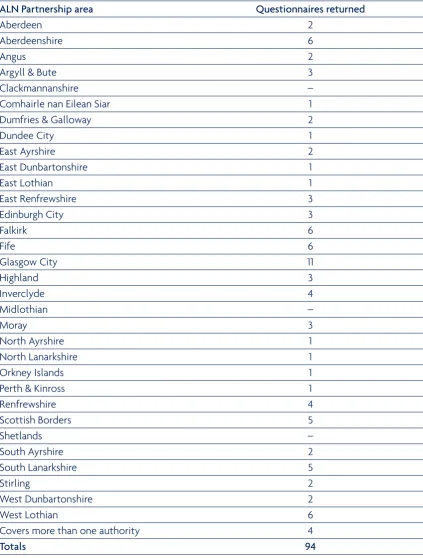
Although the research team made a substantial effort to identify the full range of youth literacies providers across Scotland, we cannot be certain that all providers were contacted. Ninety-four completed questionnaires were returned, with just over half of these (48) completed online.
Table 2.1 Provides a summary of responses by ALN Partnership area.
ALN Partnership area Questionnaires returned
Aberdeen 2
Aberdeenshire 6
Angus 2
Argyll & Bute 3
Clackmannanshire –
Comhairle nan Eilean Siar 1
Dumfries & Galloway 2
Dundee City 1
East Ayrshire 2
East Dunbartonshire 1
East Lothian 1
East Renfrewshire 3
Edinburgh City 3
Falkirk 6
Fife 6
Glasgow City 11
Highland 3
Inverclyde 4
Midlothian –
Moray 3
North Ayrshire 1
North Lanarkshire 1
Orkney Islands 1
Perth & Kinross 1
Renfrewshire 4
Scottish Borders 5
Shetlands –
South Ayrshire 2
South Lanarkshire 5
Stirling 2
West Dunbartonshire 2
West Lothian 6
Covers more than one authority 4
2.6.1 Organisational responses
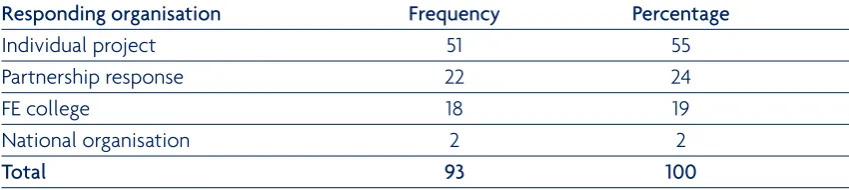
[image:25.595.141.566.298.393.2]More than half of the responses (55%) were from individual projects, while just under a quarter (24%) were from ALN Partnerships. Table 2.2 give details of the organisations and projects that responded. While there were only two responses from national organisations, we were aware that a number of them had passed the questionnaire directly to relevant local groups, or provided the research team with local project contact details.
Table 2.2 Responding organisations
Responding organisation Frequency Percentage
Individual project 51 55
Partnership response 22 24
FE college 18 19
National organisation 2 2
Total 93 100
* One anonymous response did not indicate organisation.
2.7
Case studies
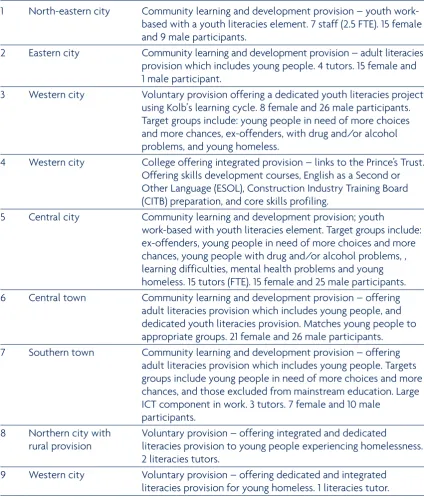
Informed by questionnaire returns and discussions with the Advisory Group, members of the research team carried out nine case studies of youth literacies practice, chosen to reflect the geographical spread and range of types of provision across the country.
Table 2.3 Details of case studies
1 North-eastern city Community learning and development provision – youth work-based with a youth literacies element. 7 staff (2.5 FTE). 15 female and 9 male participants.
2 Eastern city Community learning and development provision – adult literacies provision which includes young people. 4 tutors. 15 female and 1 male participant.
3 Western city Voluntary provision offering a dedicated youth literacies project using Kolb’s learning cycle. 8 female and 26 male participants. Target groups include: young people in need of more choices and more chances, ex-offenders, with drug and/or alcohol problems, and young homeless.
4 Western city College offering integrated provision – links to the Prince’s Trust. Offering skills development courses, English as a Second or Other Language (ESOL), Construction Industry Training Board (CITB) preparation, and core skills profiling.
5 Central city Community learning and development provision; youth
work-based with youth literacies element. Target groups include: ex-offenders, young people in need of more choices and more chances, young people with drug and/or alcohol problems, , learning difficulties, mental health problems and young homeless. 15 tutors (FTE). 15 female and 25 male participants.
6 Central town Community learning and development provision – offering adult literacies provision which includes young people, and dedicated youth literacies provision. Matches young people to appropriate groups. 21 female and 26 male participants.
7 Southern town Community learning and development provision – offering adult literacies provision which includes young people. Targets groups include young people in need of more choices and more chances, and those excluded from mainstream education. Large ICT component in work. 3 tutors. 7 female and 10 male
participants.
8 Northern city with Voluntary provision – offering integrated and dedicated
rural provision literacies provision to young people experiencing homelessness. 2 literacies tutors.
In each case, the research team:
i) Interviewed the project manager/organiser and up to three literacies tutors/group workers. Interviews took place in either individual or group settings, depending on local circumstances, and in some instances tutor interviews took place via telephone. Tutor interviews afforded the researchers the opportunity to collect examples from practice and explore in greater depth interviewees’ views on, for example:
• Their understanding of the term youth literacies
• Effective engagement and recruitment methods
• Effective youth literacies practices
• Impact of youth literacies
• Sustainability and barriers to development.
ii) Conducted a focus group to interview up to 10 young people. Previous Scottish Centre for Research in Education (SCRE) experience of interviewing young people (for example, Wilson et al, 2004; Powneyet al, 2000; Furlonget al, 1997) demonstrates that young people, including those with low self-confidence, generally respond well to a group interview setting (when supported by an able facilitator). These interviews focused on young people’s engagement with the provision, their evaluations of it, and their views on the support they received there. In a few instances, individual interviews were conducted with young people receiving one-to-one support. Young people were reimbursed any ‘out-of-pocket expenses’ incurred by taking part in the research. Again previous research experience (for example, Tettet al, 2006; Powneyet al, 2000) has shown this to be useful in encouraging participation in research.
2.8
Developing case study schedules
Case study schedules were initially derived from the project objectives and the LiC pack
(Literacies in the Community: The good practice framework).5Draft schedules were distributed to
Advisory Group members for comment and, following suggested revisions, piloted with a youth literacies project before final revisions were made. Interviews with tutors generally took
between 45-60 minutes, while the group discussions with young people averaged 40 minutes.
2.9
Analysis of case studies
3.1
Introduction
This chapter presents findings from the survey of providers. 94 providers returned questionnaires, either paper-based or electronically. Throughout this chapter findings are generally reported as percentages. This allows for easier comparison of data, especially where there is variation in the number of responses. However, where the total number of responses is below 100 (as in this survey) a degree of caution should be exercised in comparing findings, since a small variation in terms of individual responses can produce larger changes in percentage terms.The results tables, due to the effects of rounding percentages total, may not add exactly to 100.
The chapter is organised under the following headings:
• The nature of youth literacies provision
• Implementing the LiC pack
• Staffing
• The young people
• Providers’ views on the nature of youth literacies.
3.2
The nature of youth literacies provision
Respondents provided information on the nature of their youth literacies provision.
3.2.1 Approaches to youth literacies
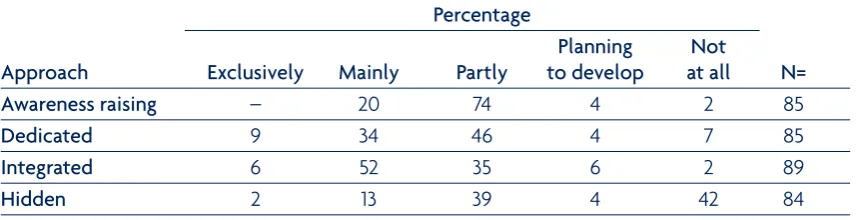
[image:30.595.113.543.575.685.2]Providers used a number of approaches in delivering literacies to young people. The majority used integrated/‘stealth’ approaches to some extent (94% and 54%, respectively), while 84% offered some form of dedicated provision. See Table 3.1.
Table 3.1 Approaches to youth literacies work
Percentage
Planning Not
Approach Exclusively Mainly Partly to develop at all N= Awareness raising – 20 74 4 2 85
Dedicated 9 34 46 4 7 85
Integrated 6 52 35 6 2 89
Hidden 2 13 39 4 42 84
Responses to the use of ‘stealth’ approaches – where the literacies element is, to some extent, hidden from or not made explicit to the learner – were polarised, with just over half of the providers (54%) indicating that they used hidden approach in their delivery of literacies, while 42% reported never using this approach. It is important to note that the survey did not set out to explore providers’ understanding of what constituted ‘stealth’ so we cannot assume
respondents shared the same understanding of stealth nor implemented it in similar ways.
A number of providers also made open comment on their approach to youth literacies work.
Working in partnership
Twenty or so respondents mentioned working in partnership with other agencies. For some this involved raising awareness of their services, for others it was about receiving referrals, and in some cases it was about delivering literacies work. For example:
“Increasingly I work with other youth service providers to identify ‘literacies elements’ in their work and develop appropriate programmes around themes and issues.”
Literacies worker (ID 40)
Responding to perceived need and interest
Literacies work that responded to the needs and interests of young people was highlighted by 26 providers. Their comments often made reference to the use of particular activities with young people or, in some instances, the importance of young people producing their own development/learning plan. For example:
“We conduct an initial discussion with learners to establish needs and identify strengths, and to get some idea of their particular interests to use as a ‘hook’ for learning. Thereafter comes a period of assessment leading to the negotiation of an individual learning plan. Assessment is continuous and the learning plan is organic.”
Head of Education and Employability (ID 36)
A number of providers’ comments stressed the importance of approaches that used assessment, not only for identifying need but also for reviewing progress.
3.2.2 The format of youth literacies provision
3.2.3 The nature of literacies programmes offered to young people
[image:32.595.116.538.276.361.2]Integrated literacies programmes were most likely to be of fixed length (53%), while dedicated literacies programmes were most likely to be of no fixed length (48%) (see Table 3.2). With both types of programme, only a minority of providers offered formal qualifications.
Table 3.2 Literacies programmes offered
3.2.4 Fixed duration courses and retention rates
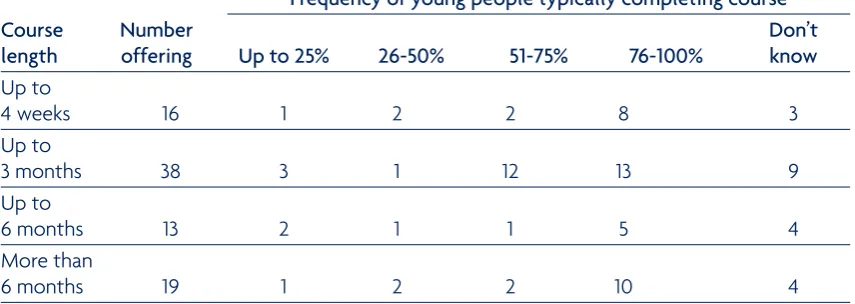
Retention rates for fixed duration courses were high, with 36 providers recording a completion rate in the range of 76-100%, and 17 recording a completion rate in the range of 51-75%. However, 20 respondents were unable to provide an estimate of their completion rates. See Table 3.3.
Table 3.3 Retention on fixed duration courses
Frequency of young people typically completing course
Course Number Don’t
length offering Up to 25% 26-50% 51-75% 76-100% know
Up to
4 weeks 16 1 2 2 8 3
Up to
3 months 38 3 1 12 13 9
Up to
6 months 13 2 1 1 5 4
More than
6 months 19 1 2 2 10 4
Moreover, there was little evidence to suggest that retention rates varied by course length; retention rates for shorter courses were similar to those of longer duration.
Dedicated literacies programmes(N=90) Integrated literacies programmes(N=90)
of no fixed length 48%
offering no formal qualification 38%
offering formal qualification 29%
of fixed length 24%
of fixed length 53%
offering no formal qualification 48%
of no fixed length 38%
[image:32.595.113.541.473.625.2]3.2.5 Courses leading to qualification
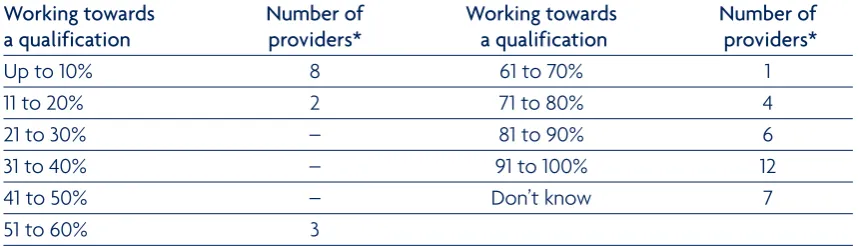
[image:33.595.140.570.284.407.2]Providers who offered courses leading to a qualification typically expected young people to achieve the qualification. 72% of those offering courses leading to a qualification reported that more than half of their young learners would secure the qualification, and 37% of providers expected 80% or more of their young learners to achieve the qualification. See Table 3.4.
Table 3.4 Percentage of young people working towards a qualification
Working towards Number of Working towards Number of a qualification providers* a qualification providers*
Up to 10% 8 61 to 70% 1
11 to 20% 2 71 to 80% 4
21 to 30% – 81 to 90% 6
31 to 40% – 91 to 100% 12
41 to 50% – Don’t know 7
51 to 60% 3
* Total number of providers is 43, two providers gave incomplete information.
3.2.6 Aims of literacies work
The main aims of providers of youth literacies work were to raise the self-esteem of the young people and to increase their engagement with society. Employment-related aims followed closely, with continuing study being the least cited of the key aims. See Table 3.5.
Table 3.5 Aims of literacies work with young people
Percentage of providers
Substantial Minor Not a
Aim Key aim aim aim formal aim N=
To raise their self esteem 60 37 1 2 90
To support them into employment 41 43 10 7 91
To support them into training 38 43 10 9 90
To support them in undertaking
further education 42 39 17 3 90
To increase their engagement
A considerable majority of providers regarded each of the pre-set aims as important in their literacies work. For example, 97% of respondents regarded the ‘raising of self-esteem’ as either a key or substantial aim, while 81% saw ‘supporting them in undertaking further education’ as similarly important.
Other aims
Thirty providers listed other formal aims in their literacies work. Nine mentioned helping to develop young people’s confidence, although others implicitly referred to this. Five providers noted young people becoming independent learners and developing more critical thinking skills as a key aim of their organisation, while five others highlighted developing young people’s social skills and their ability to work in a team.
A few providers had more specific aims to pursue. These included:
• Reducing re-offending
• Making progress on further education courses
• Increasing knowledge of health issues and access to health services
• Supporting young people to complete job applications.
3.2.7 Recruitment methods
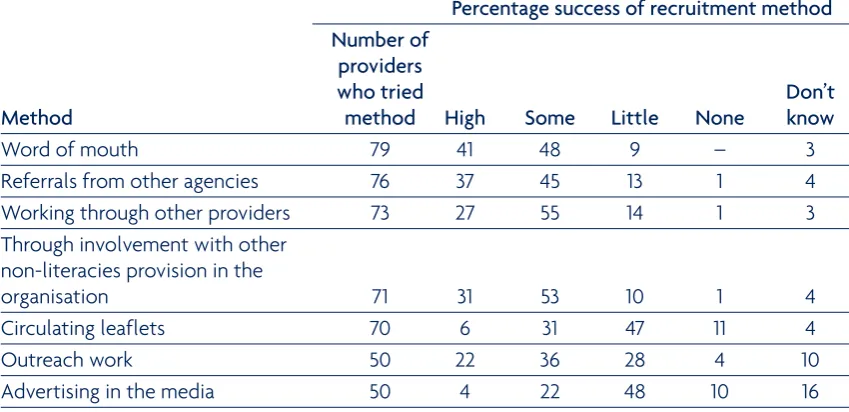
[image:34.595.113.538.529.735.2]The majority of providers used more than one method to recruit young people. Table 3.6 details the frequency of recruitment methods and gives an indication of their success.
Table 3.6 Recruitment methods
Percentage success of recruitment method Number of
providers
who tried Don’t
Method method High Some Little None know
Word of mouth 79 41 48 9 – 3
Referrals from other agencies 76 37 45 13 1 4
Working through other providers 73 27 55 14 1 3
Through involvement with other non-literacies provision in the
organisation 71 31 53 10 1 4
Circulating leaflets 70 6 31 47 11 4
Outreach work 50 22 36 28 4 10
The most successful recruitment methods appeared to be through word of mouth, referrals from other agencies and working with other providers. Media approaches seemed to have little impact at all and outreach work provided very mixed responses. ‘Advertising in the media’ was most likely to produce a ‘don’t know’ response in relation to its success.
Other recruitment methods
Thirteen providers identified other methods of recruitment that they had tried. Four reported recruiting through partner agencies, while three recruited from taster sessions or open days. Two others mentioned recruiting through local employers.
3.3
Implementing the
Literacies in the Community (LiC)
pack
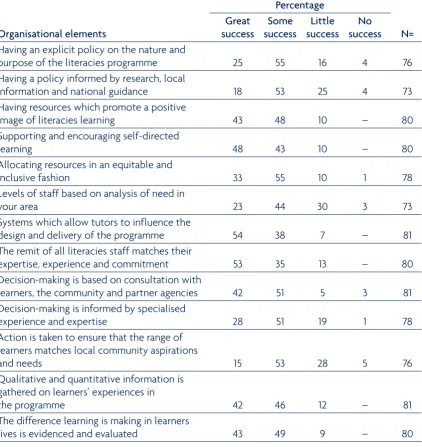
Overall, providers reported some achievement in implementing the elements for achieving a successful youth literacies organisationand asuccessful learning programme. Interestingly, the data suggests that providers were more likely to indicate achievement in developing a successful learning programme than they were in developing a successfulyouth literacies organisation.
3.3.1 Developing successful youth literacies organisations
Table 3.7 Key elements in developing a successful youth literacies organisation
Percentage
Great Some Little No
Organisational elements success success success success N=
Having an explicit policy on the nature and
purpose of the literacies programme 25 55 16 4 76
Having a policy informed by research, local
information and national guidance 18 53 25 4 73
Having resources which promote a positive
image of literacies learning 43 48 10 – 80
Supporting and encouraging self-directed
learning 48 43 10 – 80
Allocating resources in an equitable and
inclusive fashion 33 55 10 1 78
Levels of staff based on analysis of need in
your area 23 44 30 3 73
Systems which allow tutors to influence the
design and delivery of the programme 54 38 7 – 81
The remit of all literacies staff matches their
expertise, experience and commitment 53 35 13 – 80
Decision-making is based on consultation with
learners, the community and partner agencies 42 51 5 3 81
Decision-making is informed by specialised
experience and expertise 28 51 19 1 78
Action is taken to ensure that the range of learners matches local community aspirations
and needs 15 53 28 5 76
Qualitative and quantitative information is gathered on learners’ experiences in
the programme 42 46 12 – 81
The difference learning is making in learners
3.3.2 The most important elements in developing a successful youth literacies organisation
Providers identified supporting and encouraging self-directed learning, evidencing the difference that learning makes to young people’s lives, promoting a positive image of literacies and
[image:37.595.150.564.309.608.2]consultation-led decision-making as the most important elements in developing a successful youth literacies organisation, and decision-making informed by specialist experience and expertise as the least important. Table 3.8 summarises providers’ views on the relative importance of LiC pack elements concerned with developing a successful youth literacies organisation.
Table 3.8 Most important elements in developing a successful youth literacies organisation
Organisational elements Frequency
Supporting and encouraging self-directed learning 41
The difference learning is making in learners’ lives is evidenced
and evaluated 35
Having resources which promote a positive image of literacies learning 35
Decision-making is based on consultation with learners, the community
and partner agencies 33
The remit of all literacies staff matches their expertise, experience and
commitment 26
Systems which allow tutors to influence the design and delivery of the
programme 21
Qualitative and quantitative information is gathered on learners’ experiences
in the programme 11
Having an explicit policy on the nature and purpose of the literacies programme 10
Having a policy informed by research, local information and national guidance 8
Allocating resources in an equitable and inclusive fashion 7
Levels of staff based on analysis of need in your area 7
Action is taken to ensure that the range of learners matches local community
aspirations and needs 7
3.3.3 Developing successful learning programmes
[image:38.595.118.539.321.769.2]Providers reported success in implementing a number of aspects of theirlearning programmes, including ensuring that learning is presented as a positive and enjoyable experience, that individual needs are recognised and responded to, that programmes offer choices and are negotiated, and that approaches are relevant to learners’ chosen contexts and goals. Some success was reported for efforts to contextualise knowledge and skills based on real life situations. Providers reported least success in developing critical competence, offering pro-active guidance, making access prompt and easy, and encouraging lifelong learning. See Table 3.9.
Table 3.9 Key elements in developing a successful youth literacies programme
Percentage
Great Some Little No
Learning programme elements success success success success N=
Access is prompt and easy 43 52 5 – 84
The programme is open to potential learners
with needs and aspirations in any area of life 47 46 5 2 86
Perceived stigma attached to literacy and
numeracy is challenged 45 48 7 – 83
Approaches are relevant to learners’ chosen
contexts and goals 62 36 2 – 84
Literacies programme is negotiated and offers
choices to learners 63 25 12 – 85
Preferred learning styles are identified and
respected 55 40 5 – 83
Interaction and dialogue between learners
are actively promoted and purposeful 54 38 8 – 84
Learning options are responsive to diverse
needs and aspirations 51 44 5 – 84
Literacies learning with young people is based
on everyday real life situations 56 42 2 – 84
Knowledge, skills and understanding are
developed in context 57 42 1 – 82
Learning is presented as a positive and
enjoyable experience 70 29 1 – 84
Lifelong learning is promoted 49 43 7 – 83
Guidance is pro-active so learners reflect on learning, make informed choices and plan
for progression 41 49 10 – 79
Competence and confidence as a lifelong learner
Table 3.9 Key elements in developing a successful youth literacies programme – cont’d
Percentage
Great Some Little No
Learning programme elements success success success success N=
Support is inclusive, so individual strengths
and needs are recognised and responded to 66 32 2 – 84
Feedback informs the design and delivery of
programmes 55 36 9 – 86
Learning is presented as a self-directed lifelong process where participation in the programme
is a stage 35 51 14 – 81
Confidence and competence as a critical user of
literacies are developed 40 51 9 – 82
Confidence in transferring learning to new roles
and contexts is developed 46 46 8 – 85
3.3.4 The most important elements in developing a successful learning programme
Providers identified the following factors as the most important elements in developing a successful youth literacies learning programme:
• Approaches that are relevant to learners’ chosen goals and contexts
• Learning as a positive and enjoyable experience that is, based on everyday, real life situations
• Prompt and easy access
• De-stigmatising literacies
• Offering negotiated choices to learners.
The least successful elements were felt to be:
• Promoting lifelong learning
• Pormative feedback on programmes
• Pro-active guidance to enable learners to make informed choices.
Table 3.10 Most important elements in developing successful youth literacies provision
Learning programme elements Frequency
Approaches are relevant to learners’ chosen contexts and goals 32
Learning is presented as a positive and enjoyable experience 30
Access is prompt and easy 24
Literacies learning with young people is based on everyday real-life situations 20
Perceived stigma attached to literacies learning is challenged 17
Literacies programme is negotiated and offers choices to learners 17
Knowledge, skills and understanding are developed in context 11
Confidence in transferring learning to new roles and contexts is developed 11
Confidence and competence as a critical user of literacies are developed 8
Preferred learning styles are identified and respected 8
Learning options are responsive to diverse needs and aspirations 8
Interaction and dialogue between learners are actively promoted and purposeful 7
Support is inclusive so individual strengths and needs are recognised and
responded to 7
Competence and confidence as a lifelong learner are developed 7
Learning is presented as a self-directed lifelong process where participation in
the programme is a stage 6
The programme is open to potential learners with needs and aspirations in any
area of life 6
Guidance is pro-active so learners reflect on learning, make informed choices
and plan for progression 4
Feedback informs the design and delivery of programmes 4
Lifelong learning is promoted 3
3.4
Staffing
3.4.1 Numbers involved in youth literacies
Eighty-four providers gave details of the total number of staff working on youth literacies in their organisation – this ranged from 1 to 151. To some extent this range reflected the different status of respondents, some answered on behalf of small individual projects, while others represented ALN Partnership or national organisational responses. The most frequently reported scenario was one in which two staff members were employed to work on young people’s literacies.
3.4.2 Full-time equivalence (FTE)
The number of staff involved in youth literacies does not reveal how much staff time is actually dedicated to the work. To provide some insights into this we asked respondents to calculate the FTE of staff engaged in youth literacies. On average, 2.5 FTE staff were engaged in youth
literacies (based on 60 responses).
3.5
The profile of staff working in youth literacies
Based on information from this survey the typical youth literacies worker is female, works full-time (though not necessarily full-time in youth literacies), is aged between 41 and 50, has an ALN qualification and has less than five years’ experience in literacies work.
3.5.1 Sex
Almost two-thirds of youth literacies staff were female (63%) (based on 266 staff profiles).
3.5.2 Age
Youth literacies staff were fairly evenly spread across age groups. Of 237 staff profiles, 34% were aged 41 to 50; 27% were aged 31 to 40; 20% were over 51; and the remaining 19% were 30 or younger.
3.5.3 Capacity of employment
The majority of staff engaged in youth literacies work were employed full-time (52%) (though not necessarily employed full-time on youth literacies). 42% were part-time and the remaining 6% were employed on a voluntary basis (based on 262 staff profiles.)
3.5.4 Length of experience in literacies work
3.5.5 Qualifications
Each electronic questionnaire allowed respondents to record information on up to six members of staff although those who completed paper based questionnaires could also provide data on any additional staff.
The majority of staff working in youth literacies had some form of relevant qualification only 5% were recorded as having ‘no qualification’; 45% had an ALN qualification; 24% had a youth work qualification; and 45% had some other relevant qualification (based on 257 staff profiles).
3.6
The young people engaging in literacies learning
[image:42.595.113.541.397.474.2]Young people aged 16 to 19 were more frequently engaged with than those aged 20-25. Young males were the most commonly engaged group, while older males were least frequently engaged. See Table 3.11.
Table 3.11 Young people engaged with
Sex and age of young people Number engaged with Number of providers
Males 16 to 19 1,167 74
Females 16 to 19 942 72
Females 20 to 25 532 72
Males 20 to 25 492 73
3.6.1 Target groups
Table 3.12 Youth target groups and success in engagement
Percentage success in engaging group Number
of Don’t
Target group providers Great Part Little None know
Young people in need of
more choices and more chances 45 29 49 9 4 9
Young men 39 36 46 5 3 10
Young women 39 33 49 8 3 8
Youth at risk of offending 32 16 47 22 3 13
Excluded from mainstream education 31 23 48 19 – 10
Learners with learning difficulties
or disabilities 30 33 30 10 10 17
Young people with drug/alcohol
problems 29 21 45 17 3 14
Young homeless 28 18 43 21 11 7
Young people in training 28 32 25 25 7 11
Young parents 27 22 44 15 11 7
Young offenders 26 15 35 35 8 8
Mental health difficulties 25 32 32 8 16 12
Young people in employment 22 18 32 27 18 5
Ex-offenders 17 24 18 41 6 12
English not first language 14 14 21 21 29 14
Refugees/asylum seekers 13 8 8 15 46 23
Minority ethnic groups 12 8 25 33 17 17
Lesbian, gay, bisexual or transgender
3.7
Providers’ views on the nature of youth literacies
This section summarises the findings from a number of open questions aimed at providing additional insights into the nature of youth literacies work in Scotland. Given the overlapping nature of many comments made by providers, we have grouped the material under the following questions:
• What are providers’ understandings of youth literacies?
• What constitutes effective youth literacies practice?
• How do providers evaluate their practice?
In total, just under 400 comments were received regarding these questions.
3.7.1 What are providers’ understandings of the term ‘youth literacies’
The responses relating to providers’ understanding of ‘youth literacies’ suggest that it encompasses the development of a broad range of personal and communicative skills through the ‘hook’ or medium of activities that are of particular interest and relevance to young people, so that they can become active, confident participants in the different areas of life as highlighted inAdult Literacy and Numeracy in Scotland(ALNIS) 2001.
Respondents’ definitions or understanding of the term ‘youth literacies’ clustered into four broad categories that focused on: 1) the age range; 2) skills; 3) the outcomes of provision; or 4) the particular processes that give youth literacies a distinctive character.
Age range
Sixteen responses offered explanations that defined provision primarily in relation to the age range of the participants, with the majority of these providers providing no further detail on literacies. They wrote of‘literacies that are relevant to young people’, ‘literacies provision for people 16-25 years old’, and‘improving and building on literacies skills in those under 25’. Although some mentioned the importance of provision being relevant to young people, this cluster of responses did not appear to offer any insight into the distinctive nature of the literacies work itself.
Skills-related
Twenty-three respondents spoke only of youth literacies being about the development of functional, core skills. They suggested‘developing reading, writing and numeracy skills’,
‘communication, numeracy, ESOL and ICT skills’, ‘support with reading, writing and numbers’,and developing young people’s core skills. 26 responses, however, offered a more expansive
interpretation of the range of skills that they saw as defining youth literacies. These included:
• Confidence
• Self-esteem
• Openness to new experiences and the ability to reflect upon them
• Forming positive relationships with others
• Negotiating effectively
• Working together
• Developing ‘transitional skills’ outwith a classroom environment
• Decision-making
• Awareness of text and genre
• And the skill and desire to continue learning.
Outcome-related
The third category of definitions focused on the purposes or outcomes of youth literacies learning. In other words, they perceived youth literacies as a tool or vehicle for the achievement of a range of outcomes that would enhance the lives of young people and of society in general. 25 providers defined ‘youth literacies’ as work with young people that would enhance their quality of life and their relationships within families and with the wider world, that would foster greater participation and inclusion in society. Several described it as helping young people to become‘effective citizens’, to get‘the most from society’, and to‘engage in society’s opportunities without the need to feel undervalued or excluded’.
Others talked about enabling young people‘to have a voice’,to‘express themselves[and their views]more clearly’, ‘to realise their potential’,‘to share the resources and joy that are available’, and to ‘participate fully and happily in their families, communities, workplaces, places of learning and whatever’. So literacies learning here is a means to an end; the end point being engaged, articulate and confident young people.
Process-related
The final category, mentioned by 14 of the respondents, relates to specific processes that they saw as defining the distinctiveness of youth literacies. They felt that it should be informal,‘easy, realistic and fun’, ‘flexible and open’, ‘using innovative projects’, using topics that are‘young people friendly, relevant to youth culture and issues, and therefore of interest to young people’. These, they suggested are the‘hooks to engage young people who are normally sceptical and disenfranchised from education’. Examples of such interests were: chat rooms, the internet, graffiti, texting, Bebo, cartoons, comics, fashion, piercing, skateboarding, drug culture, outdoor activities, sport in general and music.
3.7.2 What constitutes effective youth literacies practice?
Content of the programme
Many providers’ comments suggested that if the content of programmes is not appropriately geared to young people they will be unlikely to participate and gain the benefits that programmes offer. Respondents suggested that programme content should:
• be relevant and tap into youth culture, issues, interests and have a youth outlook
• build confidence and self-esteem
• emerge from listening and responding to young people
• be youth-led where they can control their own learning
• have clear, attainable goals
• arise from and feed into real-life contexts
• be flexible.
Programme atmosphere
According to many respondents, programmes should create a positive, fun experience; in contrast to the negative learning experiences that many will have had in the past. for example, a community learning officer (ID41) commented:
“It must be delivered in a way that is as far removed as possible from school. Needs to address literacy needs in as fun a way as possible. Has to have immediacy and be informal to engage young people.”
Other provider comments suggested that programmes should:
• be positive, fun and enthusiastic
• be a contrast to formal schooling
• be positive and encouraging
• echo young people’s environments and ‘comfort zones’
• have equal relationships
Learning and teaching approaches
Generally providers’ comments stressed the importance of informal, experiential learning delivered by staff who approached young people on equal terms. Many comments suggested that learning and teaching approaches should:
• be informal and experiential
• be a slow, ‘toe-dipping’ into adult literacies
• be social practice (contextualised)
• incorporate ongoing reflection, recording and review of achievements, no matter how small
• integrate/embed literacies learning within youth activities.
A number of these respondents also gave details of how they incorporated ICT into their practice. It was evident that technology was being used in many different ways. For some, it was about recognising that applications of ICT such as mobile phones were a major part of young people’s lives and could be used as a means for engaging young people with literacies. Others documented the use of computers and various software packages, and noted how these provided an interest for some young people.
Staff characteristics – An employment development advisor (ID2 commented )
“Committed staff who listen to learners and are non-judgemental – after all these young people are not in school anymore. Staff who can develop resources and materials to use. Staff who recognise the smallest things as progress.”
According to providers, staff should:
• be committed and relate well to young people
• be good listeners
• be non-judgemental
• understand young people’s issues
• be able to develop quality resource materials
• recognise very small progress steps
• be flexible
Making progress
A number of providers commented on the importance of progression in effective youth literacies practice. Effective practice should:
• encourage young people to think of progression very early in their programmes
• encourage ongoing reflection on how to further develop the skills they are currently building
• establish personal links with key staff in progression organisations
• provide attainable, first-steps certificates
• celebrate all progress steps, no matter how small.
Outcomes
A number of comments were made regarding the relationship between outcomes and effective practice. Providers suggested that young people should be able to:
• perform at levels demanded in work
• apply their learning in their everyday lives
• have and use their voice
• actively participate in society
• communicate, negotiate, and live and work with others
Holistic definitions
Several respondents gave broad definitions of what they saw as effective practice, the key elements of which are summarised below.
Effective practice:
• Involves a genuine partnership between learners and workers. This can be difficult to quantify, particularly if there is none of the usual tangible outcomes in terms of jobs and money, or entry into the formal education sector.
• Makes full use of cutting-edge resources such as ICT and digital technologies, music, art and sport – youth literacies has the potential to reach young people who may not be inclined to take up provision delivered using more traditional methods.
• Engages young adults in activities which increase their confidence in using words. It is very important that the activity brings about a development or progression in skills and confidence.
• Engages young people in learning that captures their interest and motivates them to learn more, recognises their progress, how their skills are developing and the potential of where this might lead them.
3.7.3 Evaluating youth literacies
Providers gave details of the methods and/or approaches used in evaluating their work with young people. In many cases it was evident that they used a number of different approaches in their evaluations, although evaluations were normally carried out by providers themselves, rather than by a third party.
Most commonly, providers used Individual or Group Learning Plans (ILPs/GLPs) in their evaluations. Although ILPs were the most frequently cited evaluation approach, other evaluative tools were also used. A number of respondents noted the use of questionnaires/schedules and group discussion with young people, while others made reference to the use of a reflective diary (in a few cases this was recorded by video or audio recorder). In some instances, respondents also gave some indication of the stage and/or frequency of the use of such methods. Typically, respondents carried out their evaluations at the end of a course or session, although this was not always the case. A few respondents mentioned the use of general and or informal feedback from young people in their responses, while a few others noted the use of one-to-one
3.8
Concluding comments
4.1
Introduction
This chapter presents thematic findings from case study visits. Nine youth literacies initiatives across Scotland were selected as case studies for the project from those organisations which had indicated, in their questionnaire responses, a willingness to take part as a case study. Case studies were chosen to give both a geographical spread and to reflect different types of youth literacies provision. (Summaries of individual case studies are contained in Appendix 2.)
The case studies allowed for an exploration of some of the issues and findings which emerged -in the questionnaire survey. However, and perhaps of greater importance, they provided the opportunity to document young people’s opinions on the provision they experienced and the impact of their involvement in other areas of their lives.
Cases were not selected because they necessarily exemplified effective practice, but rather because they represented examples of current youth literacies practice in Scotland. Although each project included learners within the relevant age range (16 to 25), several were not exclusively targeted at this age group. Therefore, it was not always possible to confine the focus group interviews to 16 to 25 year olds.
In each project the researcher sought to interview one or more staff members, and conduct a discussion group with young people involved in the literacies provision. In a few instances individual interviews were conducted with young people who had attended literacies learning. The research instruments were derived from the research objectives and structured around LiC. Interviews with tutors generally took between 45 and 60 minutes, while discussions with young people averaged 30 to 40 minutes.
4.2
The organisations
Seven of the organisations specifically targeted very vulnerable young people, many of whom were either homeless or had addiction and/or behavioural or health-related issues. They all took referrals from partner agencies such as social work, health or housing. One of the projects aimed at young people in need of more choices and more chances made attendance a
compulsory part of its programme for those deemed to be in need, but for the rest enrolment was voluntary whether the young people had been referred or not. Only one was based in a college and of the eight remaining community-based initiatives, only one classified itself as primarily a literacies project. The remainder integrated their literacies work into the core work of the organisation, which for many concerned life and communication skills. Several were upfront about the literacies elements of their work, but the majority admitted to adopting a more hidden approach to literacies. Four worked exclusively in groups with the young people,
whereas the others combined a mix of group and one–to-one provision which included learners outwith the age range of the research.
All of the projects spoke emphatically about the need to de-stigmatise adult literacies work, and the strategies they used to portray it in a positive manner. Three aspects of work emerged as critical de-stigmatising factors, they were:
• the activities
• methods and modes of teaching and learning
• staff/learner relationships.
Each of these areas will be examined in the sections below.
Only one project did not employ staff with some level of ALN qualification. However, it provided all of its staff with initial training in working with, and developing the skills of, young people. Only one case had staff with any expertise in learning difficulties, the others referred young people on to other services if they had specific needs.
4.3
Getting young people involved
Although all of the projects took referrals from partner agencies, the ‘hooks’ for getting young people involved were the activities they offered which had an appeal to the young people, or an end goal that articulated with their ambitions. Popular ‘hooks’ were ICT, media activities, visits to places of interest, and outdoor pursuits and activities. Examples of these included digital
photography, video-making, music, using MP3 players, creative arts, magazine-making, local visits to places of interest (for example, Science Centre and family history projects), and visits to the cinema. End-goal activities included those that would improve young people’s health,
employment, housing and educational prospects. All again stressed the importance of
4.4
Engaging and sustaining learner involvement
All providers offered aflexible choice of activitiesinside and outside the learning centre. These were negotiated with, and ultimately chosen by, the learners; although two providers offered absolute free choice in the light of their specific aims and the expertise of available staff. ICT, outdoor pursuits and visits appeared to be very popular choices, particularly when the young people selected them themselves.
Flexible methods of teaching and learningalso helped to engage the learners, especially where t