2016 International Conference on Computer, Mechatronics and Electronic Engineering (CMEE 2016) ISBN: 978-1-60595-406-6
A Research on Landscape Design of Boundary Space of Urban Forest
Park – Take the Olympic Forest Park for Example
Xin-yue YANG, Yong-gang AN* Xiao-yan MA
Department of Landscape Architecture, Beijing University of Agriculture, Beijing 102206
Beijing Rural Landscape Planning and Design Engineering Technology Center, Beijing 102206
Beijing Laboratory of Urban and Rural Ecological Environment, Beijing 100083
Keywords: Forest park, Boundary space, Landscape design.
Abstract: From the perspective of landscape design elements and usable functions of boundary space of urban forest park, this paper has carried out research and analysis on Beijing Olympic Forest Park. It has firstly analyzed vegetation and sculptures in boundary-space landscape design of urban forest park, then analyzed as well as summarized the design method and principles for boundary-space landscape of urban forest park, and lastly generalized the methods for designing boundary-space landscape of urban forest park: The principle of wholeness, People-oriented principle, Ecological compound principle.
Introduction
With the rapid social and economic development in China, people’s living standard is continuously improving. As people’s lifestyle and attitude towards life change, their requirements for living environment also keep enhancing. In recent years, the city is constantly strengthening the improvement of urban environment. Urban forest park is of great significance for urban environment. As an important constituent of urban open space, boundary space of urban forest park has played an important role in improving urban ecological function. Reasonable boundary-space landscape design will affect the performance of function of green field in park, overall balance, stability and usage of green field in the park.
Nowadays, on the basis of researches on boundary-space landscape of urban forest park, this paper has explicitly summarized the design method and usable function of boundary-space landscape of urban forest park, and analyzed landscape elements, spatial form and plants’ cultivation characteristics in the area through investigation and studies on the boundary space of Beijing Olympic Forest Park.
The Concept, Characteristics and Functions of Landscape Design for Boundary Space of Urban Forest Park
The Concept of Boundary Space of Urban Forest Park
Alexander Christopher once remarked: “If the boundary no longer exists, space will lose its vitality.” [1] For urban forest park, boundary space has played an important role for the entire park and surrounding urban green fields. The boundary space of urban forest park refers to different spaces directly connected with forest park. Boundary space in the park refers to the transitional space with certain width, which is directly influenced by edge effect. Such space is exactly a transitional space between city and surrounding construction lands.
Characteristics of Boundary Space of Urban Forest Park
Continuity and Transitivity. Continuity of boundary space refers to the continuity of spatial interface. In addition to bring about visual sense of space, it can also form flow and interlude of space and thus integrate the space. The boundary space of park is not only the boundary between park and other surrounding construction land, but also a link to surrounding environment.
Marginality. The boundary of space identifies the limit and scope of a certain spatial field. Relative to adjacent space, it can be the basis for people to distinguish different spaces. The boundary space is usually the margin between two or more than two different but interconnecting spaces, and the special location has given boundary space the characteristic of marginality.
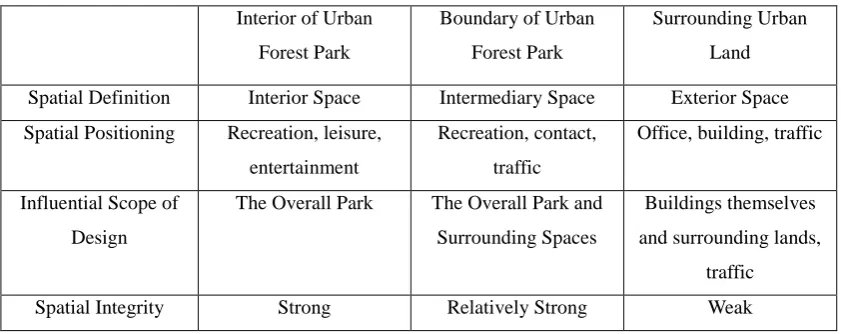
[image:2.595.88.509.291.458.2]Vagueness. The boundary space of urban forest park is situated between the park and other urban construction lands, which results from the interaction between them. It not only belongs to the category of urban forest park, but also interconnects with surrounding urban lands. Two adjacent spaces penetrate and fuse with each other here. The transitional spatial characteristic has brought about vagueness in property, function and ownership to boundary space of the forest park, as is shown in Table 1.
Table 1. Internal-or-External Vagueness of Interior, Exterior and Boundary Spaces of Urban Forest Park.
Interior of Urban
Forest Park
Boundary of Urban
Forest Park
Surrounding Urban
Land
Spatial Definition Interior Space Intermediary Space Exterior Space
Spatial Positioning Recreation, leisure,
entertainment
Recreation, contact,
traffic
Office, building, traffic
Influential Scope of
Design
The Overall Park The Overall Park and
Surrounding Spaces
Buildings themselves
and surrounding lands,
traffic
Spatial Integrity Strong Relatively Strong Weak
Functions of Boundary Space of Urban Forest Park
Isolation and Protection Function. By physical division and restriction between boundary space and surrounding heterogeneous space, urban forest park can separate interior activities aiming at visiting, resting and recreation from exterior activities like accessing and shopping, and can thus avoid exterior environment’s interference in park activities to a certain extent. Besides, the boundary space has also played a protective role in freeing the fragile ecological environment of core space from being interfered by adverse factors.
Ecological Protection Function. Urban forest park refers to an open park with a certain area of natural scenery and high forest coverage in city or in the suburb, satisfying the needs of the general public to return to nature and go for a holiday outing. However, the wild ecological environment of forest park is relatively fragile. Creation of plant community enclosure and landscape on the border of urban forest park has certain enclosing effects on internal space of the park, preventing damages from surrounding environment on ecological environment of the park.
Case Study: Landscape Design of Boundary Space of Beijing Olympic Forest Park
An Overview of Beijing Olympic Forest Park
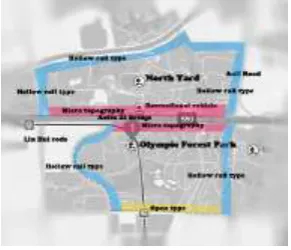
[image:3.595.225.371.200.325.2]The Olympic Forest Park is located on Lincui Road of North 5th Ring Road, Chaoyang District in Beijing City, reaching Anli road in the east, Lincui road in the west, Qinghe in the north and Kehui road in the south. The North 5th Ring Road passes through the park and divides it into southern and northern parts: the southern park includes mainly artificial landscape, leisure and entertainment facilities, the northern park features ecological garden and natural wild phenomena, and these two parts are linked by an ecological corridor on the central axis across the 5th Ring Road.
Figure 1. Planar Graph of Beijing Olympic Forest Park.
Investigative Analysis of Boundary Space of Beijing Olympic Forest Park
Beijing Olympic Forest Park has adopted open boundary-space design by a variety of design means. To be specific, it has utilized a design combining hollow-type iron railings, compact-planted hedge with terrain as the boundary space.
[image:3.595.142.480.429.543.2]
Figure 2. Photos of the Boundary Space.
(1) Eastern and western boundaries of the Olympic Forest Park are respectively enclosed by Anli Road and Lincui Road, with Aolin East Road and Aolin West Road separating the southern park into three parts. The boundary space of these four road sections have utilized hollow-type iron railings to define the space; Multi-layer vegetation and micro-terrain have been adopted to create spatial landscape inside and outside the railings, so that continuous visual landscape points have formed in the park’s boundary space, which greatly promotes experience of pedestrians in walking, visiting and lingering.
Through field investigation, the Olympic Forest Park is enclosed with four separation zones and five green belts in the east, west and middle. Vehicle flow is usually heavy, especially during rush hours in the morning and evening. Emissions of noise and automobile exhaust will affect the surrounding environment and comfort of tourists. Multi-layer vegetation setting adopted in the boundary space of Olympic Forest Park can not only bring a sense of beauty to visitors outside the park, but also absorb exhaust and noise pollution caused by surrounding roads along the boundary.
one. Public seats are provided for visitors to rest. By enclosure of interior vegetation and tree grates, semi-private recreational space has been formed outside the park, which can satisfy people’s division of private, semi-private and public spaces.
Figure 3. South Gate of Beijing Olympic Forest Park.
(3) There are 7 entrances in the Olympic Forest Park. The entrance space is the highlight of the park’s boundary space, which has defined the interior and exterior parts of park space. Design of entrance zone should not only take various factors like road traffic, crowd, stream of vehicles and dispersal into account, but also attract visitors with its fine appearance and unique character as well as increase utilization rate of green field in park [2]. Main entrance of the southern part is rather large, with two distributing squares for visitors to rest. The other six entrances are smaller, without any such square but with centralized parking lots which are enclosed by banded hedges, and thus ecological parking space with both landscape and functions has been generated. Vehicles cannot enter the park, so as to realize separation of pedestrians from vehicles.
Figure 4 South Gate of Beijing Olympic Forest Park.
Investigative Analysis of Design Elements of Boundary-Space Landscape of Beijing Olympic Forest Park
According to field investigation in Beijing Olympic Forest Park, due to characteristics of urban forest park, surrounding plants, terrain and landscape settings in the park can be therefore determined.
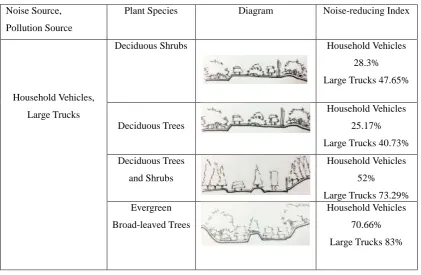
Vegetation. Vegetation in the boundary space of park can create comfortable microclimate: due to difference in land surface properties between park’s vegetation and surrounding cities, diversity of thermal property has been aroused and thermal exchange has thus been formed, which can improve the microclimate to a certain extent. [3] Robinette has summarized the functions of
Noise Source,
Pollution Source
Plant Species Diagram Noise-reducing Index
Household Vehicles,
Large Trucks
Deciduous Shrubs Household Vehicles
28.3%
Large Trucks 47.65%
Deciduous Trees
Household Vehicles
25.17%
Large Trucks 40.73%
Deciduous Trees
and Shrubs
Household Vehicles
52%
Large Trucks 73.29% Evergreen
Broad-leaved Trees
Household Vehicles
70.66%
[image:4.595.101.501.547.634.2]vegetation into four aspects in Plants, Human and Environmental Quality: building function, engineering function, climate-regulating function and aesthetic function.
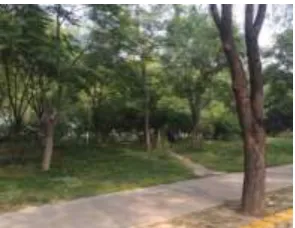
In Olympic Forest Park, plants should be selected according to the degree of isolation and protection required by the design. As surroundings of the park have been mostly enclosed by traffic lines, under such high requirement for isolation and protection, basic-tone tree species which has usually been adopted is higher than 2m, and thus branch point of plants is relatively high. In terms of requirements of the isolation and protection functions, high-branch-point shrubs should be mainly planted under the trees in order to achieve isolation and protection functions. Aolin West Road has collocated 6-meter poplars, 8-meter scholar trees with 2-meter Chinese pines, with shrubs at the bottom. A 10-meter-width boundary space for isolation and protection should be enclosed to isolate and protect inner space of the park. Moreover, through construction and combination of compound plant community with graceful canopy line and rich layers, ornamental effects of Olympic Forest Park can be further strengthened.
[image:5.595.115.488.271.392.2]
Figure 5. Plants in the Boundary Space of Beijing Olympic Forest Park.
Terrain. To use terrain to isolate space is the most common way of boundary space. The slope of micro-terrain is generally 8%-12%, which can satisfy people’s free activities, so as to create landscape environment of boundary space through shaping topographic height difference and combining with other landscape elements like plants and hollow railings. According to field investigation, the terrain slope of boundary space of Olympic Forest Park is quite reasonable at 9.1%-11.5% and can meet people’s activity demands. The park’s boundary space has overall adopted the combination of two methods in terrain design: shaping of natural terrain and changes of vertical height difference. The shaping of natural terrain has utilized the collocation of a large number of tall plant clusters and low shrubs, so as to realize spatial division and height difference of terrain as well as make city roads seem more beautiful against the plants.
Figure 6. Micro-terrain of the Boundary Space of Beijing Olympic Forest Park.
[image:5.595.224.372.565.679.2]Design Methods and Principles of the Boundary-Space Landscape of Urban Forest Park
Design Methods of the Boundary-Space Landscape of Urban Forest Park
In the boundary of urban forest park, men are the main users of boundary-space environment. Therefore, design of the park’s boundary space shall investigate and study on people’s behaviors, but design should not only be subject to demands of human activities, but also implement positive guidance and regulation for people’s behaviors and activities.
Design Principles of the Boundary-Space Landscape of Urban Forest Park
The Integrity Principle. Boundary space belongs to the park, and they two constitute the relationship between the locality and entirety. In dealing with design of urban forest park, we should not only set up the holistic concept but also emphasize the role of locality. The boundary space of urban forest park, as a part of the park, shall be subject to overall style of the park in design and extend the spatial style of the subject.
The People-oriented Principle. People are the using object of the park’s boundary space, and demands of different groups of people should be paid special attention in design. Design of the boundary space of urban forest park should adhere to the people oriented principle, reflect and satisfy varied behaviors and psychological needs of people. To promote participatory property of boundary space of urban forest park, security and ratio scale of environmental landscape facilities as well as the compatibility between functions and effects of boundary space should also be taken into account and studied. Specific design should be adopted to embody the humanized principle in landscape design of boundary space of urban forest park.
The Ecological Compound Principle. As a green lung of the city, forest park can provide fresh air and beautiful environment for the city and reduce environmental pollution. Therefore, the ecological design principle for the landscape of the park’s boundary space has played a role in improving microclimate of the city and creating a beautiful city. Suitable and comfortable plant collocation can construct an ecologically-complex boundary space landscape.
Conclusions
As an important constituent of urban open space, the boundary space of urban forest park plays an important role in improving urban ecological function. Researches on the boundary space of urban forest park should be deepened from various perspectives, for example, expansion of its functions, diversification of design ideas. A systematic overall research on the boundary space of urban forest park is expected to be conducted in order to provide visitors a nice environment for enjoyment.
Project funding: Science and technology innovation service capacity construction of urban and
rural ecological Beijing laboratory project:PXM2016_014207_000003
This project is supported by Beijing Rural Landscape Planning and Design Technology Research Center 2015. Open Research Project: Beijing Rural Recreational Planning and Design Theoretical Research, Beijing-Tianjin-Hebei-Coordinated Development of Rural Landscape Planning and Design Model.
References
[1] [America] Alexander. A Pattern Language [M]. translated by Wang Tingdu and Zhou Xuhong, Beijing: Intellectual Property Publishing House, 1989.
[2] Wan Qian. Boundary Design of Open Urban Park [A] // Chinese Society of Landscape Architecture. Proceedings of Chinese Society of Landscape Architecture in 2009’s Annual Conference [C]. Beijing: China Building Industry Press, 2009.281-286.
[3] Sun Shijie, Edge Effect and Urban Planning [M], City Planning Review, 2001.