G
ETTING IT
R
IGHT
:
A
N ACCOUNT OF THE MORAL AGENCY OF
NGO
S
By Alice Obrecht
A thesis submitted to the Department of Philosophy, Logic and Scientific Method of the London School of Economics and Political Science, for the
D
ECLARATION
I certify that the thesis I have presented for examination for the MPhil/PhD degree of the London School of Economics and Political Science is solely my own work other than where I have clearly indicated that it is the work of others (in which case the extent of any work carried out jointly by me and any other person is clearly identified in it).
The copyright of this thesis rests with the author. Quotation from it is permitted, provided that full acknowledgement is made. This thesis may not be reproduced without the prior written consent of the author.
A
BSTRACT
This thesis provides an outline for how we should think of the ethics of Non-Governmental Organisations (NGOs) by giving sense to what it means to treat an NGO as a moral agent. That is, it aims to answer the following question: Which special moral obligations do NGOs have in virtue of the distinctive type of organisation that they are? In brief, the answer provided by this thesis is that NGO agency is defined by the multiple relationships that threaten to undermine its unity. Obligations are identified as what an NGO must do in order to maintain such a unified organisational self.
In Chapter 1, I define an NGO as an autonomous, norm-enacting organisation not motivated by profit and reliant on voluntary interaction. The idea of NGOs as unique agents is then developed indirectly in the middle four chapters. Each chapter engages with a central topic pertaining to NGO ethics, arguing for a particular position with respect to the topics of accountability (Chapter 2), resource allocation (Chapter 3), contributions to domestic and global justice (Chapter 4), and NGOs’ impact on the viability of universal welfare rights (Chapter 5). The second task performed by each chapter is the identification of a particular ability, or power, possessed by NGOs as agents.
A
CKNOWLEDGMENTS
If there is anything I have learned from years of researching NGOs, it is that projects cannot be measured only by their immediate outputs: they have stories, processes, and broader, deeper effects. In the process of creating this output, I have benefitted greatly from the support, guidance and collegiality of many.
My supervisors Alex Voorhoeve and Hakan Seckinelgin provided insightful and trenchant feedback that was invaluable to me throughout the writing process. When I thought I had defended everything, they uncovered assumptions that needed supporting and new lines of criticism. Without Hakan, my understanding of NGOs as social actors would be significantly impoverished. His efforts at seeing these issues through the perspective I was attempting to defend helped me to articulate it more clearly, and provided me with much-valued encouragement.
Alex provided the kind of detailed edits that are the dream of many PhD students. I will miss having someone who is willing to pick through my arguments so carefully. He taught me many skills necessary for building a good philosophical argument, which I will endeavour to develop further in years to come.
Luc Bovens provided me with crucial supervision and personal guidance throughout my master’s degree and the first half of my PhD. He is a skilled and inspiring instructor from whom I have learned very much. Also, Ilina Singh of the Methodology Institute was incredibly generous with her time in directing me to resources on grounded theory methodology and assisting me with the design of my research project in Mongolia.
Research Fund, and the Department of Philosophy, Logic, and Scientific Method at LSE.
I am indebted to the NGO staff who gave me their time and insight into the nature of their work. Without its qualitative component, this thesis would suffer from an impoverished understanding of NGO agency; I hope that the final chapter reflects in at least some degree the deep value of their participation. While in Mongolia, I was generously hosted by the Department of Philosophy at the University of Mongolia and would like to express my thanks to Professor Otgonbayar M. and Professor Dorjdagva T. for their support of my research.
My interest in the topic of NGO ethics began during a very cold November in Mongolia in 2002. As my first introduction into the world of aid NGOs, I am grateful to the Tsaatan for sharing their homes and their stories with me. Without them, the course of the past decade of my life would have been significantly different.
I would also like to express my deep appreciation to my grandmother Betty Garner, as well as Melissa Dattalo, Laura Farmer, Camillia Kong, Anastasia Piliavsky, Kirril Shields, Miloney Thakrar, and Kate Vang for their unwavering kindness and patience.
Better colleagues could not be found than in Marilena Di Bucchianico and Conrad Heilmann. I am very grateful for their friendship throughout this journey. I am also grateful to Ben Ferguson, to whom I am indebted for his careful proofreading and generous support.
Finally, I would like to express deep thanks to my mother, Virginia Garner, father, Christopher Obrecht, and sister, Julie Obrecht. They have supported me throughout an often arduous process in ways I can never repay.
Taking ourselves seriously means that we are not prepared to accept ourselves just as we come. We want our thoughts, our feelings, our choices, and our behaviour to make sense. We are not satisfied to think that our ideas are formed haphazardly, or that our actions are driven by transient and opaque impulses or by mindless decisions. We need to direct ourselves—or at any rate to believe that we are directing ourselves—in thoughtful conformity to stable and appropriate norms. We want to get things right.
Harry Frankfurt, Taking Ourselves Seriously & Getting it Right
UFC is just so big. And, what, we target indirectly 50% of the population here. And we can have a huge impact. So I guess we’re trying to get it right too. That responsibility to—you know, we have so many resources—let’s get it right.
T
ABLE OF
C
ONTENTS
Acknowledgments ... 4
Table of Contents ... 7
List of Acronyms ... 10
Introduction ... 11
Chapter 1 What is an NGO? ... 31
Introduction ... 31
1.1 Why there is no simple answer to ‘What is an NGO?’ ... 33
1.2 NGO: A working definition ... 50
1.3 Establishing uniqueness ... 76
Conclusion ... 82
Chapter 2 The Value of NGO Accountability ... 84
Introduction ... 84
2.1 Accountability and value: the instrumental view ... 88
2.2 Mechanism and relationship ... 94
2.3 Ability and responsibility ...100
2.4 To control and to appraise ... 110
Conclusion ... 133
Chapter 3 INGOs As Intermediary Agents ... 135
Introduction ... 135
3.1 Pogge on the obligation to aid ... 138
3.2 The (ABCD*) Principle ...149
3.3 INGOs and the supposed transfer of obligation ... 155
3.4 Are NGOs intermediary agents? ... 171
Conclusion ... 182
Chapter 4 The Capacities of Voluntary Associations For Justice ... 184
Introduction ... 184
4.1 Nagel on sovereignty and justice ... 187
4.2 Agent-capacities ... 204
4.3 Capacity as a causal power ... 226
Conclusion ... 247
Chapter 5 Broadening The Claimability of Rights ... 250
Introduction ... 250
5.1 Claiming welfare rights: Against whom? For what? ... 252
5.2 Ashford’s complex causal chains ... 263
5.4 NGOs and claimability: rectifying epistemic deficiencies ... 280
Conclusion ... 287
Interlude: Four NGO Causal Capabilities and Their Corresponding Obligations ... 289
Chapter 6 A Grounded Theory of The Ethical Standpoint of NGOs ... 297
Introduction ... 297
6.1 Methodology and research design ... 299
6.2 Validity and the importance of relationship frames... 307
6.3 Two frameworks for the guidance of NGO obligation ... 336
Concluding Remarks: Framing relationships for validity and NGOs as norm-enacting agents... 343
Appendix A: List of Interviews ... 346
L
IST OF
A
CRONYMS
BONGO business-organised non-governmental organisation CSO civil society organisation
GONGO government-organised non governmental organisation GRO grassroots organisation
HRBAP/D human rights based approach to planning/development IEI international economic institution
IGO inter-governmental organisation IMF International Monetary Fund
INGO international non-governmental organisation NGO non-governmental organisation
QUANGO quasi-non governmental organisation TNC transnational corporation
I
NTRODUCTION
Consider three stories of change:
In the period between 1796—1805, British slavers traded an average of 50,000 slaves per annum, the greatest level in the 300-year history of Britain’s slave trade.1 Yet, in 1808, this number dropped to zero with the abolishment of the slave trade.2 Within 15 years, public opinion shifted from an acceptance of slavery as an entrenched institution to a rejection of the practice as “an Evil so derogatory to the dignity of Christianity and the true interests of a people who value themselves on their sentiments of Liberty.”3 Within another 15 years, slavery was abolished entirely.
Until the late 1970s, driving while intoxicated did not incur serious social or legal sanction in the United States. In the 1980s, the enforcement and severity of punishment for impaired driving increased significantly. Here again, public opinion had shifted to support the implementation of new, stricter legislation. One consequence of these changes was a 49% decrease in the number of deaths caused by drunk driving in the U.S. between 1980 and 2009.4
The Mt. Makiling Forest Preserve is one of the most significant ecosystems remaining in the Philippines. By 1960, 45% of the preserve had been logged and appropriated for farmland and settlements.5 A decades-long engagement that provided livelihood assistance to forest dwellers, and granted access to forest resources in exchange for a commitment to principles of conservation, resulted in the reforestation of 45 hectres and a significant increase in biodiversity.6 Mt. Makiling is today considered a prime example of successful locally-based forest management.7
1
Eltis et al., Slave Trade Database.
2
Drescher (2009); C. Brown (2006); Hochschild (2005).
3 C. Brown (2006, p. 412). 4 Century Council (2010). 5
Duthy & Bolo-Duthy (2003, p. 23).
6
Ibid.; Lasco, et al. (2001).
These disparate changes in the areas of economics, social policy, and environment share a common feature: they were realised largely through the activities of groups that have come to be known today as non-governmental organisations, or NGOs. British abolitionism was propelled at the turn of the 19th century by the Society for Effecting the Abolition of the Slave Trade8 and several women’s societies, which were instrumental in organising mass boycotts of slave-grown sugar.9 It was the NGO, Mothers Against Drunk Driving (MADD), that Senator John Danforth spoke of when explaining how significant changes in drunk driving legislation and enforcement had come about during the 1980s: “This organization has made the public realize that drunk driving is not a victimless crime. This change in public attitude has made it possible for those of us in Congress and in state legislatures to pass stronger drunk driving laws.”10 And NGOs were the actors credited with fuelling the community-based approach to forest protection and reforestation that was integral to the successful conservation of the Mt. Makiling Forest Preserve.11
Those who work for NGOs aim to improve the world they inhabit. They pursue this aim through the collectively-created identity of an organisation defined by a set of values. In virtue of these characteristics, one of the classic monikers associated with NGOs is that of the “do-gooder.”12 But the label can be a curse as much as a compliment when NGOs are perceived as failing to live up to this reputation.13 For example, INGOs14 assisting victims of the 2004 tsunami in Southeast Asia came under fire for what many observers felt was a
8
This group arose out of joint discussions between the Society of Friends (Quakers) in the U.S. and U.K., but later included non-Quaker participants. See: Drescher (2009, p. 151); C. Brown (2008, chp. 7).
9
Hochschild (2005, p. 327); Drescher (2009, pp. 220-1).
10
McCarthy & Ziliak (1990, p. 1223).
11 Duthy & Bolo-Duthy (2003). 12 Fisher (1997).
13
Ibid.; Gibelman & Gelman (2004).
14
mismanaged humanitarian effort that wasted funds and lacked sufficient coordination.15 Greenpeace’s successful campaign against plans to sink the Brent Spar oil rig off the U.K. coastline in 1995 was marred by the later revelation that their estimates of the oil on the rig were 55 times greater than the actual amount.16 INGOs advocating a change in the policies of the World Bank, IMF, and WTO have long been criticised for their own perceived lack of accountability.17
NGOs’ successes in achieving change highlight their power as social actors. At the same time, their perceived failures highlight questions about the moral justification of this power and what we can expect of such organisations. Together, the successes and failures of NGOs indicate the importance of exploring their ethical status and obligations.
This thesis aims to contribute to a better understanding of the moral obligations of NGOs. Its central claim is that such an understanding cannot be reached without an account of the moral agency of NGOs. An attempt to formulate a set of NGO obligations or guiding principles without attention to what characterises them as agents will fail to provide a full justification for the relevance of such requirements. This is because consideration of what NGOs ought to do, with respect to whom, and how, are necessarily grounded in a perspective on the kind of agents NGOs are.
We can illustrate the importance of agency by considering three main perspectives through which the topic of NGO ethics is currently problematized. These are:
15 Ossewaarde, et. al (2008, pp. 48-51); Logister (2007); Tsunami Evaluation Coalition (2006). 16
Schoon, N. (1995 Sept 6). Greenpeace’s Brent Spar Apology. The Independent, p. 16.
17
(1) The perspective of the third sector and development literatures on the role and value of NGOs.
(2)The views on INGOs by moral and political philosophers working on topics pertaining to justice and obligations of assistance.
(3)The growing practical scrutiny of the justifiability and value of NGO activity by donors, governments, media, and the public.
(1) The perspective of the third sector and development literatures on the role
and value of NGOs.
After ten years of positive characterisation, in the mid-1990s NGOs as research subjects began to be treated with greater scepticism within the fields of third sector/civil society research, political science, and development studies.18 This critical stance has now become dominant, especially for NGOs engaged in development.19 Much of this criticism stems from the perception that researchers had initially studied NGOs with too much optimism regarding their comparative effectiveness, their significance as social actors, and their ability to fulfil or promote certain values and norms.20
Taking a more realistic approach to the study of NGOs has led to an emphasis on three main normative issues.21 First, a large sub-literature on empowerment and participatory methodology has emerged from the view that NGOs ought to address power imbalances and ownership issues within their relationships
18
Lewis & Opoku-Mensah (2006); Bebbington, et al. (2007).
19
See, for example: Tvedt (2002; 2005); Chandhoke (2005); Bebbington, et al. (2007); Lewis (2005); Hilhorst (2005); Seckinelgin (2006).
20 Bebbington, et al. (2007); Lewis (2005). 21
to “beneficiaries,” that is, those targeted by their projects.22 Second, accountability has been addressed as a major issue for NGOs, with a central question being what model and mechanisms of accountability are most suitable for NGOs. Answers to this question range widely, from technical processes of reporting and accounting, to democratic modes of internal decision-making, or detailed self-regulation schemes. Finally, NGO effectiveness has risen to the fore in recent years, as several donors and academics have argued that performance measurement ought to be the primary standard used in identifying “good” NGOs.23
These are normative issues insofar as their discussion has involved a deep examination of the value of participatory methods, accountability, and performance for NGOs.24 Rarely, however, are these topics addressed as truly ethical questions. When prescriptions are offered, they are couched in terms of organisational strategy or pragmatic choice, rather than as a matter of what NGOs are morally prohibited from doing or are required to do.25
This pragmatic perspective is embodied most strongly in discussions of NGO legitimacy. Legitimacy is the fundamental normative issue that underpins the discussion of participatory methods, accountability mechanisms, and
22 The term “beneficiaries” has fallen out of favour with some, as it is taken to imply a
relationship in which the NGO worker sees herself as providing benefits to a passive recipient. My view is that the alternatives, such as “client” or “participant” or “target group,” entail equally questionable assumptions. One might specify what is meant by opting for the term “intended beneficiaries,” but this is cumbersome. Throughout the thesis I therefore simply use the term “beneficiary” as a technical term, not as a claim that NGOs in every instance provide benefits to those targeted by their projects.
23
Ebrahim & Rangan (2010).
24
See, for example: Cooke & Kothari (2001); Jordan & van Tuijl (2006); Ebrahim (2007); Ebrahim & Rangan (2010).
25
improved performance: all three are cited as ways in which an NGO can legitimise itself. However, NGO scholarship tends to use a descriptive, instead of normative, conception of legitimacy: an NGO is legitimate insofar as others actually perceive (or believe) it to be justified in doing what it does.26 This means legitimation can pose a significant operational challenge when different stakeholders demand different things from an NGO. In order to achieve legitimacy, it is argued, NGOs must attempt to navigate competing and contradictory sets of expectations, a task that in some cases seems impossible.27
An account of an NGO’s moral agency can help resolve these issues by providing the basis for a normative account of NGO legitimacy. Others’ expectations regarding what NGOs should be or do may be wildly inaccurate or unjustifiable. For example, it is not clear that emergency aid NGOs such as MSF should lose legitimacy if they concentrate on a fast distribution of life-saving care over processes of empowerment. While a descriptive conception of legitimacy explains the conflicts and tensions NGOs experience in attempting to meet the varied expectations of different stakeholders, a set of moral standards for NGO activities, supported by argument, gives these organisations an essential tool for resolving these conflicts. Armed with an account of what can be justifiably expected of them, NGOs can better respond to criticisms and questions regarding their legitimacy.
26
Descriptive legitimacy is often contrasted with the normative conception of legitimacy more commonly found in political philosophy. The former refers to the perception of
appropriateness, while the latter refers to a set of standards that justifies a set of powers exercised by an agent, or, in other words, establishes the “right to rule.” See: Beetham (1991); also Lister (2003); Vedder (2007).
(2) The views on INGOs by moral and political philosophers working on topics
pertaining to justice and obligations of assistance.
Until recently, non-governmental organisations received little attention within moral and political philosophy. Political philosophy of the 1980s and 90s, heavily influenced by the work of John Rawls, focused on the concepts of justice and legitimacy as these pertained to the state. As voluntary organisations, NGOs qualify as “associations,” a type of organisation Rawls and those who followed him explicitly excluded from the domain regulated by principles of justice.28
One might have expected to see NGOs attract greater attention in the field of applied ethics, which emerged during this same period as a prominent area of research within moral theory. However, no body of literature comparable to the work on bioethics, business ethics, or animal welfare developed around NGOs. The closest attention they received during this time was through Peter Singer’s (1972) influential argument for obligations of assistance to the poor, which drew attention to the work of Oxfam International and similar organisations. However, since Singer’s focus was on persuading individuals in the developed world to donate to NGOs, little attention was given to their inner workings or ethical obligations.
These matters have begun to change, due largely to the important debates concerning global justice and the moral imperatives elicited by the persistence of severe poverty. While institutional reform tends to be the favoured solution for rectifying global injustice, INGOs are seen as providing an opportunity for important medium-term assistance that can reduce suffering and improve the
livelihoods of the global poor.29 They are also cited by some as possible players in bringing about long-term institutional reform.30
The influence of the ethics of poverty on philosophical approaches to NGOs is reflected in the three volumes that currently constitute the bulk of philosophical thinking on NGO ethics. All three focus on the ethical challenges and problems faced by INGOs working on emergency relief or development aid.31 Many contributions to these volumes take a situation- or principle-based perspective to NGO ethics, classifying the field in terms of types of situations or decisions NGO staff face in their work. In these cases, the “NGO” in NGO ethics takes a back seat to a general moral analysis, and consideration of the NGO as a special type of moral actor is not given significant attention. Elsewhere, others have attempted to work INGOs into a framework of justice, arguing that the international aid system constitutes a “basic structure,”32 or that we ought to take more seriously “non-ideal” theories of justice in which INGOs can play a significant role.33 The most widespread perspective, however, is that INGO obligation ought to be understood through the obligations of their affluent donors.34 INGOs are the “executors of the obligations of their contributors and supporters” and, therefore, are “constrained by the content of the obligations in question.”35 Either implicitly or explicitly, these discussions of NGO ethics rely on premises concerning their roles and morally relevant functions. A more direct
29
For example, see Pogge (2005a; 2005b).
30 O’Neill (2001). 31
Bell & Coicaud (2007); Horton & Roche (2010). Both of these volumes were the products of separate workshops held between philosophers and NGO practitioners who then contributed chapters based on these dialogues. Illingworth, et al. (2011) also features contributions from multiple disciplines and includes several chapters on NGOs, though its overall theme is the ethics of philanthropy.
32 Rubenstein (2009).
33 Fuller (2006). Also O’Neill (2001)’s idea of INGOs as secondary agents of justice could fit this
description.
34
Horton & Roche (2010); Pogge (2007a); Wenar (2006); Illingworth, et al. (2011).
examination of NGO agency can be useful here, as it would allow us to work out which roles are most relevant to an NGO’s obligations. Are INGOs indeed agents of justice? Or are they simply a group of individuals free to select and pursue their aims as they please, so long as they do so lawfully?36 Should they be understood as agents acting on behalf of their contributors, or as agents acting on behalf of the poor? Or as a broker between the two? Without an argument for how NGOs ought to be understood as moral agents, the principles and obligations elicited by a particular account can be rejected by those who disagree fundamentally with the characterisation of NGO agency upon which they are based.
(3) The growing practical scrutiny of the justifiability and value of NGO activity
by donors, governments, media and the public.
Finally, outside of academia, NGOs increasingly face scrutiny and criticism by their donors, members of the public, and sometimes even the intended beneficiaries of their projects. Organisations focused on aid and emergency relief are regularly entrusted with large pools of resources, prompting concerns over NGO executive pay, the lack of sufficient performance measurement, and the perceived mismanagement of funds in humanitarian emergencies.37 Advocacy-focused NGOs enjoy access to the processes of policy making at both the domestic and global levels. The powers that they wield, however, are often informal and difficult to concretely identify, making it unclear who can make claims on an NGO, for what, and on what grounds. Publications such as The Economist have been particularly outspoken critics of such organisations, contending that they advocate policies that are not in the best interest of the global poor, that they are wasteful and too dependent upon
36
Charnovitz (2005).
governments for their funding, and that they use a lexicon of vague buzzwords to justify and guide their work.38
Part of what makes these criticisms so difficult for NGOs to respond to is that there is no broad consensus as to what can be justifiably demanded of them. This connects to the previous two points: an account of what NGOs ought to do must explain why a set of obligations or principles is relevant to an NGO, or, more strongly, why it has normative force for such organisations.
Reaching a better understanding of NGO moral agency is, therefore, a timely aspiration, as the topic of NGO ethics cannot adequately be addressed without considering what kind of agent an NGO is. Such considerations are morally relevant, as they reflect how an NGO relates to others in ways that can impinge upon its rights and responsibilities.
In pursuing an account of NGO moral agency, this thesis takes as a starting assumption the view that collective agents can and do exist, and that they can be held morally responsible.39 My aim here is not to explore the intricacies of the nature of collective agency, but to examine how an NGO’s collective agency differs from that of the state, the corporation, other civil society organisations, and international institutions of economic policy and governance.
With that in mind, Chapter 1 begins with the question, ‘What is an NGO?’ There, I provide an empirical definition of an NGO as an autonomous, norm-enacting organisation not motivated by profit and reliant on voluntary
interaction. This empirical definition gives an idea of the type of organisation to which this thesis applies, and also forms the basis for a theoretical definition of NGO agency. I argue that, in virtue of the five empirical features
38
See above, ff. 17.
39
above, NGOs are distinguishable from other types of actor by their reliance on multi-party collaborative activity for the exercise of their agency. Specifically, this collaborative activity is shaped by the other parties’ perceptions of the NGO as norm-enacting, that is, as identifying and justifying its activities through moral rules. This serves as the theoretical definition of an NGO: while states, corporations, other civil society organisations, religious institutions and individuals engage in types of collaborative activity that overlap with those of an NGO (e.g. provision of goods or services, joint voluntary action centred on a shared value), only NGOs utilise multiple types of activity with actors that perceive them to be norm-enacting.
The idea of NGOs as unique agents is then developed indirectly in the remaining chapters. The middle chapters 2, 3, 4, and 5 may be read as performing two tasks. Each chapter engages with a central topic pertaining to NGO ethics, arguing for a particular position with respect to the topics of accountability (Chapter 2), resource allocation (Chapter 3), contributions to domestic and global justice (Chapter 4), and NGOs’ impact on the viability of universal welfare rights (Chapter 5). The second task performed by each chapter is the identification of a particular ability, or power, possessed by NGOs as agents.
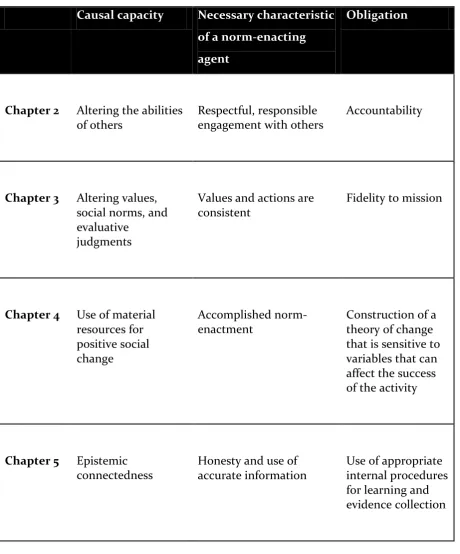
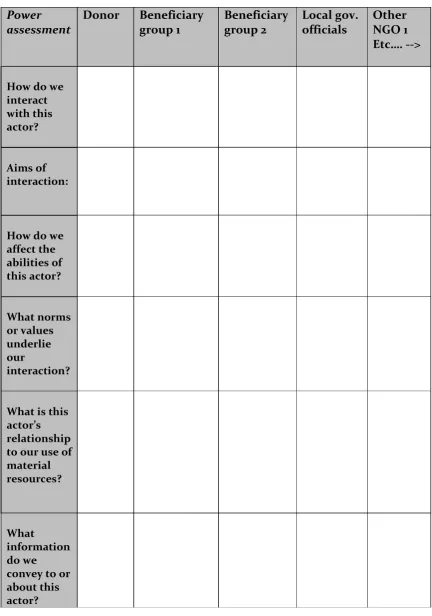
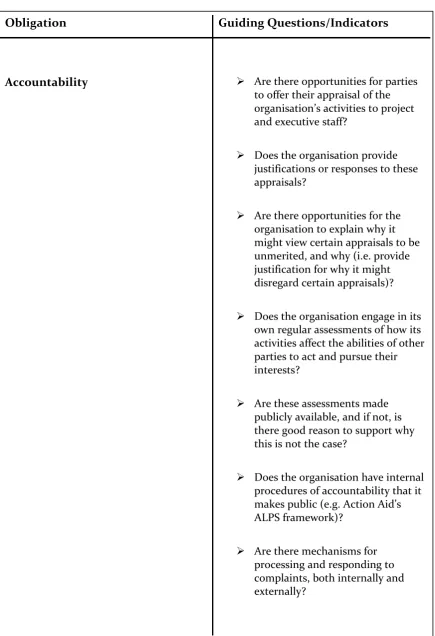
As I argue at the end of Chapter 5, and summarise in the interlude preceding Chapter 6, these four abilities characterise the moral agency of an NGO and form the basis for identifying four types of NGO obligation: 1) accountability, 2) acting consistently with organisational norms, 3) demonstration of positive social change, and 4) epistemic procedural virtue. In Chapter 6 I produce a basic framework for NGOs to use as a way of assessing themselves with respect to these four obligations. This framework is then connected to the findings from a 10-month qualitative research project, conducted from 2007-2008, on the ethical perspectives of NGO workers in Mongolia.
In Chapter 2, I examine the concept of accountability, one of the most common normative requirements applied to NGOs. Both academics, such as Leif Wenar (2006), and NGO practitioners have largely considered accountability to consist in a set of control mechanisms that are valuable only in so far as they contribute to further goals such as effectiveness or improved public trust. Opposing this view, I argue that accountability can have intrinsic value for an NGO, and outline a conception of accountability as the responsibility to create opportunities for the moral appraisal of oneself by others.
The need for accountability is triggered, I argue, by an NGO’s ability to affect the abilities of other agents to act and pursue their own goals and projects. Some contend that NGOs do not need to be accountable to corporations or states whose harmful activities they attempt to limit. Against this, I argue that, if we understand accountability as a form of moral appraisal instead of as an evaluation coupled with the ability to sanction, then NGOs can indeed be accountable—even to those with whom they have an adversarial relationship—without exposing themselves to material loss or punishment. Moreover, this form of accountability possesses value for an NGO as an end in itself, as it is constitutive of the relationships that comprise an NGO’s own agency.
supporting the institutions that violate the latter’s negative rights. The primary means by which private citizens can provide this compensation is through donations to INGOs. These considerations, Pogge argues, support the conclusion that INGOs have a moral obligation to systematically prioritise certain projects over others.40 He then contends that these priorities should be directed by a consequentialist concern for maximising cost-effective harm reduction.
I argue in Chapter 3 that Pogge’s approach to INGO moral priorities is multiply flawed. First, his deontic argument for the obligation to assist is in tension with his consequentialist principle for the guidance of INGO resource allocation. The consequentialist principle can direct INGOs away from helping those most seriously harmed by unjust global institutions, as the latter may suffer from harm that cannot be reduced cost-effectively. Second, Pogge’s claim that INGOs act as intermediary agents for their donors is not sufficient to ground a transfer of obligation from donor to INGO simply via a transfer of funds. Unless the INGO makes a promise to the donor, it is under no obligation to spend the donation in a manner that provides a maximally effective fulfilment of the donor’s obligation. Drawing on the discussion from Chapters 1 and 2, I argue that Pogge’s view of INGOs as intermediary agents incorrectly assumes an economic model of agency, in which NGOs are generally compared to private companies acting on behalf of shareholders. I argue that this model of agency is inadequate because, as discussed in the previous two chapters, the economic model of agency ignores some of an NGO’s relationships and distorts others.
As an alternative, I argue that the particular abilities an NGO draws on in its relationships should serve as the basis for considering their obligations. As an example, I discuss Pogge’s problem of the “discriminating contributor”—what
an NGO ought to do when faced with a potential contribution from a racist individual—and argue that the relevant ability here is an organisation’s power for altering the moral beliefs of others and creating new norms. To the extent that an NGO relies on this ability for the exercise of its agency, it ought not to engage in collaborations, such as the acceptance of funding, with actors that espouse values inconsistent with those the NGO advocates.
Chapter 4 engages with the statist positions of Thomas Nagel (2005) and Saladin Meckled-Garcia (2008) in order to examine whether it is appropriate to assign responsibility to NGOs for fulfilling principles of justice. Nagel contends that justice is limited to the domain of domestic state institutions in virtue of the special nonvoluntary manner in which they engage with citizens’ wills. I argue that an appeal to nonvoluntary relations in-and-of-itself is not sufficient to preclude the possibility of applying similar principles to voluntary associations such as NGOs. Nagel, I suggest, may be arguing that the grounds
for political legitimacy—state coercion and imposition onto citizens’ wills— also serves as the necessary means for justice.41 However, he does not make this line of argument explicit. Therefore, I turn to Saladin Meckled-Garcia, who offers a statist argument similar to the one Nagel requires for his view to succeed.
Meckled-Garcia’s argument ties the means for justice to the grounds for justice through an appeal to agency and agential capacity: only agents with the necessary capacities to satisfy principles of justice can be responsible for justice, he claims. He then argues that the key necessary capacity for justice is the ability to assign rights and duties, something which only state institutions can do, and only with respect to domestic distributions.42 Therefore, he concludes that justice is limited to individual states.
41
Nagel (2005, p. 115).
While the notion of agential capacity is important, I believe Meckled-Garcia is unclear on his definition of this term, and ultimately conflates two different conceptions of capacity. Therefore, I distinguish between capacity as a causal power, i.e. the ability of an agent to bring about an effect in the world, and capacity as a moral power, i.e. the ability of an agent to alter the normative status of others.43
In the remainder of Chapter 4, I focus on capacity as a causal power, arguing there is no institution-based distinction between the causal powers of states and NGOs to effect a just distribution. Rather, the powers of both vary drastically based on the surrounding institutional environment. However, states do uniquely possess the moral power to assign and enforce rights and duties. In contrast, the comparable causal power of an NGO is to manipulate and use material resources to achieve positive normative change. The measurement of NGO performance ought to emphasise the “theory of change”44 an NGO uses to justify and explain its projects, and the degree to which this theory is sensitive to changes in the NGO’s environment. NGOs, I argue, also possess a moral power comparable to that of the state, insofar as they can alter the status of rights-holders in a given institutional setting and enable others to act more capably as duty-bearers.
The impact of NGOs on the ability of others to act as duty-bearers is further developed in Chapter 5. There, I identify a final NGO ability: the ability to increase citizens’ awareness of facts relevant to rectifying institutional injustices and meeting the welfare rights of others. To introduce this topic, I examine the role of epistemic conditions in setting the stringency of obligations by reviewing Onora O’Neill’s critique of universal welfare rights.45
43 This phrasing is borrowed from Raz (1986, chps. 2 and 3), who uses it to describe in general
terms the powers exercised by an authority.
44
Connell, et al. (1995, p. 11); Weiss (1995).
O’Neill argues that, without institutions that recognise welfare rights, such rights are not claimable by those who hold them because it is unclear which duty-bearers are morally responsible for providing specific recipients with access to basic goods and services.46 She concludes that welfare rights are not universal, and that, therefore, the corresponding duty to provide assistance is, without institutions, an imperfect obligation that individuals owe to no one and may exercise great latitude in fulfilling.
I then introduce two cases presented by Elizabeth Ashford (2006; 2007) to refute O’Neill’s account of rights. Ashford discusses two types of complex causal chains, in which large groups of people collectively cause serious harms to others in a manner that is foreseeable and avoidable.47 In such cases, where moral responsibility for a rights violation is shared by many perpetrators, it is impossible to link the harm suffered by any individual victim to the actions of any individual perpetrator. Therefore, victims cannot make the claims against specified others that O’Neill says are necessary for the establishment of a universal right. Ashford’s cases pose a dilemma for O’Neill: either she can accept that they qualify as rights violations, in which case her basis for distinguishing between liberty and welfare rights disappears, or she can claim, implausibly, that such cases do not qualify as human rights violations, despite the foreseeable and avoidable cause of serious injury to others.
While I agree that Ashford’s examples of complex causal chains can undermine O’Neill’s account, I argue that they require further modification in order to do so. O’Neill provides multiple characterisations of her claimability condition for the existence of a right. Specifically, she discusses claimability in terms of both antecedent and post hoc perspectives; Ashford’s cases address only the latter. I therefore modify Ashford’s cases to defeat O’Neill’s antecedent version of her claimability condition, showing that complex causal
46
O’Neill (1996, chp. 5).
chains can obscure both the content of our obligations and to whom they are owed before any violation or harm occurs. In such cases, foreseeing and avoiding the violation is still possible, thereby allowing us to maintain the position that our actions constitute a rights violation.
NGOs, I argue, can assist duty-bearers in navigating complex causal chains to meet the universal liberty and welfare rights of others. A primary way in which they do so is to convey necessary information across epistemic boundaries and raise awareness of how we can contribute to beneficial causal chains and reduce our contributions to those that cause serious harm. Chapter 5 concludes with a discussion of the abolitionist movement as an example of the potential impact of exercising such an ability, and of the importance of exercising it with honesty and accuracy.
Following Chapter 5, I present a brief ‘Interlude’ that summarises the four key NGO abilities identified in the previous four chapters, and I argue that these abilities generate four corresponding obligations: 1) accountability, 2) consistency across actions and norms, 3) building a theory of positive normative change, and 4) implementing internal procedures to ensure accurate collection and transfer of information (epistemic procedural virtue).
While the literature on NGOs is immense and detailed, most research on NGOs does not provide an idea of the day-to-day experiences and broader system of relationships within which NGOs constantly operate.48 Nor was there, in 2007, much of a literature identifying ethical challenges and problems faced by NGOs. In order to understand what issues constituted real ethical problems for NGO staff, I conducted a 10-month interview-based research project in Mongolia, using the method of grounded theory. Grounded theory methodology was selected in view of its goal of “discovering”49 an
48
A notable exception to this is Hilhorst (2005).
explanatory or predictive theory through deep, systematic analysis of qualitative data. The data for my study consisted of transcripts from 38 interviews conducted with staff from Mongolian and foreign NGOs and a handful of executives from donor organisations, as well as field notes from observations of NGO projects and workshops. Early transcripts were coded while still in the field. These codes were grouped and connected in initial theoretical models using nVivo7 software, and then tested through further rounds of interviews.
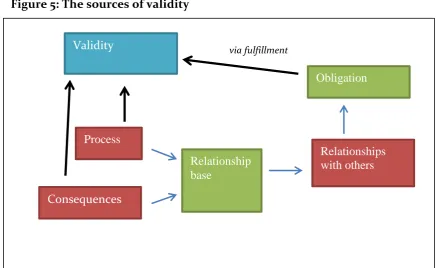
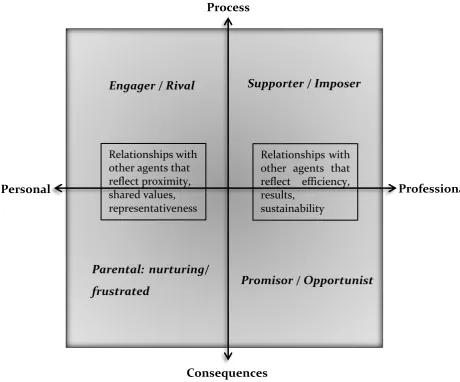
Using a grounded theory approach maximises the informative potential of qualitative research for a philosophical account of NGO moral agency, as it pushes the researcher to go beyond mere description to arrive at a more abstract understanding of key concepts and meanings that are conducive to generalisation. In brief, the findings I discuss in Chapter 6 identify two core phenomena that explain the ways in which NGO staff experienced the topics of ethical obligation, accountability, and organisational value: 1) the process of validation, and 2) the framing of relationships with others.
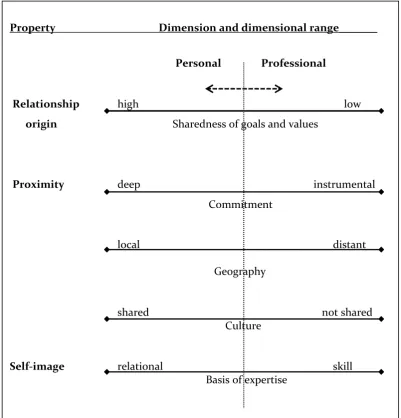
staff identified these obligations to others by characterising, or framing, their relationships based on two factors: the focus of the relationship (process or consequences), and the relationship base, namely, whether the relationship was personal or professional.
Using the framework presented in the Interlude, I conclude with two frameworks that I suggest can help NGOs navigate their relationships by better orienting NGO staff with respect to what their activities and collaborations obligate them to do.
While the qualitative research is discussed primarily in Chapter 6, the impact of this study on my thinking about NGOs can be found throughout the thesis. The importance of engaging directly with the realities through which problems in applied ethics are experienced cannot be understated. A persistent methodological concern amongst those working on practical or applied moral issues is locating right principles or actions along a range between what is possible and what is best.50 One of the main purposes of engaging in inter-disciplinary research was to identify how NGO staff themselves draw ‘best’ or ‘right’ principles or actions out of a set of possible activities, and what strategies they use when faced with their own limitations. This, I believe, has afforded my analysis in this thesis a better appreciation of the difficulties of finding a justified path of action in contexts that are subject to swift changes, interference from other actors, and internal conflict.
In considering the problems that constitute “NGO ethics,” particularly in light of how NGO staff spoke of these problems, it became clear that their solution is precluded by questions regarding what, morally speaking, NGOs are perceived as being. Therefore, this thesis provides an outline for how we
50 For example, see the growing literature on the distinction between “ideal” and “non-ideal”
should think of applied NGO problems by giving sense to what it means to treat an NGO as a moral agent. In brief, the answer provided by this thesis is that NGO agency is defined by the multiple relationships that threaten to undermine its unity. Obligations are identified as what an NGO must do in order to maintain such a unified organisational self.
As for why employees of an organisation would (or should) be compelled to seek such unity, Harry Frankfurt’s comments on the agency of individuals provide a compelling answer: engaging in reflective self-direction and seeking coherence in an organisation’s activities and values is what it means for NGO staff to take their organisation seriously as a social actor. Frankfurt talks of the stability and sense-making sought by individuals in the avoidance of haphazardly-formed ideas and actions “driven by transient and opaque impulses or by mindless decisions.”51 Similarly, NGOs must seek a similar stability in order to ensure that their activities and relationships with others are not simply a hodgepodge of ad hoc decisions, but instead reflect a thoughtful and responsible attempt to engage positively with the world. That is, NGOs should care about their agency in so far as they care about getting things right. I turn now to considering what this entails.
C
HAPTER
1
W
HAT IS AN
NGO?
Introduction
Non-governmental organisations are a major topic of interest across policy and legal settings, as well as several academic disciplines including development theory, organisational management, political science and social policy. Because the type of actor identified by this term can vary significantly, “NGO” has enjoyed wider use than any of its particular definitions, threatening to render it “a virtually meaningless label.”52
This issue has not gone unnoticed: the “definitional problem” and/or the “classificational”53 problem have received considerable scrutiny in the NGO literature. NGOs, it is said, “remain terra incognita; the term NGO has become a commonly accepted phrase within the academic world, but it is unclear what this phrase actually encompasses."54 This analysis has led to a further debate over what exactly the absence of a consensus on what is an NGO portends for the vitality of NGO research. Discussions about definitions55, about the discussions about definitions56, and about the discussions about the discussions about definitions57 overlay and nest into one another like Matryoshka dolls. Some find the absence of a unified definition to be a threat
52
Lewis & Wallace (2000, p. x).
53 Lester Salamon and Helmut Anheier (1992a; 1992b) distinguish between the two, with the
definitional problem being that of defining the sector as a whole in terms of commonalities, and the classificational problem being that of distinguishing or classifying particular types of organizations within the sector.
54 Martens (2002, p. 272). 55
Ibid.
56
Vakil (1997).
to the possibility of any meaningful, rigorous study of NGOs.58 Others, taking a more optimistic view, point to the broad interest in NGOs across many disciplines as a testament to their importance as objects of inquiry which unfortunately, but necessarily, acts as a detriment to any shareable definition.59 Still others contend that NGOs are more the products of specific institutional settings than an important category of social actor.60
The aim of this chapter is to provide a characterisation of an NGO that will serve as a foundation for the remainder of the thesis. Section 1.1 identifies three primary factors that explain why there is no common definition of an NGO at present: its use of definition-by-negation, the diversity of charitable associations produced by different cultural and historical traditions, and the multi-disciplinary nature of NGO research that uses different types of definition. Each of these factors both explains why there is a lack of consensus on a definition, and poses a challenge for what a successful definition must accomplish. I suggest these challenges may be met if we maintain a clear distinction between an empirical and a theoretical definition of an NGO. This way, we may be able to both pick out actual organisations in the world that qualify as NGOs, as well as provide a theoretical account of what it means to be an NGO, which will, in turn, be instrumental for developing an account of NGO moral agency.
Section 1.2 begins with an overview of the early work of Lester Salamon and Helmut Anheier in their research on defining what they called the “third sector”61: organisations that were neither part of the market or the government. While Salamon and Anheier were interested in identifying a broader group of actors than the ones that are the focus of this thesis, I
58 Edwards & Hulme (1997, pp. 3-4). 59
Bebbington, et al. (2006, p. 327).
60
Tvedt (2002; 2006).
develop my account in contrast to theirs because their definition has since become the paradigmatic characterisation of “third sector” organisations, NGOs included. Moreover, their approach was rigorous, using a set of criteria to assess proposed definitions. I therefore adopt their criteria-driven approach in order to develop a new working empirical definition of an NGO. I present both this definition and a theoretical characterisation of NGO agency at the end of 1.2.
Finally, in 1.3, I demonstrate the explanatory strength of both definitions by illustrating how they distinguish an NGO from five other types of agent: the state, market, religious institutions, other civil society/nonprofit organisations, and the individual.
1.1 Why there is no simple answer to ‘What is an NGO?’
I believe the definitional problem is the product of three primary factors hindering consensus on what counts as an NGO:
1) The term itself is vague and defined negatively;
2) Different cultural and historical traditions produce a diverse set of associations which are difficult to generalise and categorise systematically;
3) Research interests in NGOs employ definitions for divergent purposes, and these differences are not often clearly indicated.
multi-disciplinary research interests in NGOs, and highlight recent scepticism regarding whether a meaningful solution to the definitional problem can be identified. The challenge posed by (3) to a unified definition is fortified by the use of separate types of definition in the literature. Consensus is inhibited not simply out of disagreement over what is an NGO, but also different ideas about what we mean when we ask this question.62 Distinguishing between different types of definition can, I argue, point the way to overcoming the challenges posed by each of the above factors.
1.1.1 Nature of the term
The term ‘NGO’ has its origins in the 1947 charter establishing the United Nations. At the behest of the American delegation, Article 71, included in the chapter laying out the function and powers of the Economic and Social Council, designated a unified consultative status for a variety of international groups and organised social movements. These groups were referred to under the general label, “non-governmental organization”:63
“The Economic and Social Council may make suitable arrangements for
consultation with non-governmental organizations, which are concerned with
matters within its competence. Such arrangements may be made with
62
To use Rawls’ (1971, pp. 5-6) terminology: there is disagreement over both the conception of an NGO (a particular characterisation) and the concept of an NGO (the role that this
characterisation plays, or, the problem that a conception is supposed to solve. See also: Korsgaard (2003, pp. 116-7).
63 The Roosevelt administration, aiming to avoid the fate that befell the League of Nations two
international organizations and, where appropriate, with national organizations
after consultation with the Member of the United Nations concerned.”64
As such, the term had a broad scope and narrow use: within a prescribed institutional setting it gave recognition to a wide variety of organisations grouped under a catch-all phrase that defined them only in terms of what they were not: representatives of states.65 This definition by negation allowed the term to be easily extended beyond its original use, with different parties left to fill in additional, mutually exclusive, characteristics.
The type of organisation now called NGOs have a longer history than the term itself. Given a rather generic account of NGOs as forms of socially-minded associational activity, they have their roots in the labour unions and abolitionist and peace movements of the 18th and 19th centuries, and further back to the church and traditional practices of charity and alms-giving.66 Before the invention of the NGO moniker, such organisations existed under other terms, including “international organizations,”67 “associations,”68 “voluntary agencies,”69 and “private organizations.”70
Since the U.N. convention, however, NGO has become the common term used to refer to this broad class of associational, charitable organisations. A notable exception is the counterpart term, “non-profit organisation.” While “NGO” tends to be the term used for non-profit organisations engaged in international development and relief or advocacy, NPO, or non-profit, is more frequently used in the U.S.71 Elsewhere, NPO is also used interchangeably with
64
Charter of the United Nations, Chapter X, Article 71.
65 Martens (2002, p. 15). 66
Charnovitz (1997); Lewis (2005).
67
Charnovitz (1997, p. 190).
68 Ibid.
69 Martens (2002, p. 272). 70
Ibid.
71
the term “charity,” to describe non-governmental, non-profit organisations operating domestically within a given country.
As discussed in 1.2, I identify a non-profit-making motivation as one of the defining features of an NGO. One could presumably take the opposite approach, using the term NPO and including a non-governmental attribute as one of its defining features. However, since this term is less common overall, particularly with respect to international types of such organisation, I have opted to use “NGO” for the purposes of this thesis. Regardless, both terms face problems stemming from their definition by negation.
1.1.2 Different cultural and historical traditions
Whereas “Northern” NGOs have their roots in centuries of associational activity and Euro-American social movements, NGOs of the developing world draw from their own culture-specific histories of charitable giving and association. Examples include the peasant movements and church-based charitable projects in South America, shared-household credit groups in South Asia, burial societies and self-help groups based on kinship ties in Africa, almsgiving as a core Islamic practice in the Middle East, and anti-communist, pro-democratic grassroots organisations in Eastern Europe.72
concerns with private property have influenced the development of U.S. charity law is interestingly complex. Charitable trusts, a well-established legal entity in England since the 17th century, were regarded with hostility by the 18th and 19th century American judicial system, and as a result, private gifts to such trusts were often ruled as invalid transfers of property in court. This was due to the belief “that charities, religious or otherwise, trampled individual rights by depriving future heirs of property to which they were entitled” (Fishman 1985, p. 626). Charitable giving therefore became increasingly directed towards not-for-profit
corporate actors in U.S. law.
72
This presents a challenge similar to the one mentioned above. Just as definitions based on negation allow for a term’s overextension to a variety of organisations, the diversity of associational and charitable enterprise across cultures leads to even further disparities amongst the organisations and groups that the term “NGO” is often meant to capture.73 Some suggest that the notion of an NGO is an organisational model particular to western, developed democracies and, as such, its application to associational movements in other cultures is ill-suited.74 Still others charge that the application of the NGO model to groups in the developing world through foreign-financed “civil society building” contributes to an “NGO-ization” of local grassroots initiatives which weakens their closeness to the people with whom they work.75 Therefore, like the issues addressed by current research on NGOs discussed below, cultural diversity challenges the idea that a unified characterisation is something we ought to aim for.
1.1.3 Differing research interests and their definitions
Research on NGOs is represented in a large body of literature that spans multiple disciplines. Because NGO research is a relatively new subject, there has been very little time for taking a systemised look at the voluminous amount of empirical data, case studies, frameworks, and conceptualisations that have been offered in the past three decades. That said, greater strides have been made recently in taking stock of the original aims of NGO research and how these aims, as well as the mainstream assumptions and ideas of NGO researchers, have evolved over the decades. Here, I am unable to give the kind of detailed account that would do justice to this complex history. Rather, I
73 Lewis & Kanji (2009). 74
Jad (2004). This sentiment is expressed even more strongly with respect to the general notion of civil society (Parekh 2004, pp. 23-4).
shall summarise briefly what has been given greater attention elsewhere, focusing on two broad areas of research: technical-legalistic and social scientific. Each employs their own type of definition of an NGO. As I argue below, social scientific research on NGOs employs two types of definition, leading researchers in some cases to talk past one another.
1.1.3.1 Technical-legalistic
For technical-legalistic definitions, the meaning of a term lies in how it is defined and used within a legal and/or policy-related context. It is technical in so much as the term operates as nomenclature for a specific linguistic community, and is legalistic if the community in question is defined by a bounded system of law. In the technical-legalistic sense, “what an NGO is” comprises both the set of criteria an organisation must meet to be considered by law to be an NGO, as well as what privileges, protections, responsibilities, etc. accord to such a legal standing—in short, its legal status. Issues pertaining to the technical-legalistic study of NGOs can be grouped according to whether they arise in reference to domestic charity law or the international legal system.
At the domestic level, a primary topic of interest is how the state defines its non-profit or charitable sector and relates to it through law, giving way to questions regarding the function, content and effects of such laws.
One can inquire about how charity law functions: what are the conceived purposes of the law?76 Generally, what does charitable status consist in? Specifically, what sort of special relationship to the state is being established,
e.g. tax exemption?77 In what way is the law regulatory versus facilitative of charitable activity?78
Attention is also drawn to the content of charity law: what demarcations, if any, are made between different forms of charitable giving?79 If charities are defined, and thus allocated tax exempt status, on the basis that they serve a “public benefit,” what constitutes such a benefit? This last question is of considerable importance. Recent revisions of centuries-old charity law in Europe and North America have raised questions regarding what social topics and activities should be considered as contributing to the public benefit and which criteria the state should use in classifying a gift as under charitable giving. An interesting aspect of this second question that is relevant to our later discussion is whether such gifts should be judged objectively or subjectively. Legal systems using an objective determination of public benefit must include an official list of sanctioned causes towards which donations count as charitable gifts. Systems in which subjective determination is used instead will base the classification of the gift as charitable on the proven intention of the donor—if it can be shown in court that the donor gave the gift with the intention and belief that it was for a charitable cause, then it qualifies as charitable giving under the law.80
Finally, the effects of different types of charity law are important areas of research, particularly in the form of cross-country comparisons. Charity law has been studied to understand its effects on perceptions of social justice and
77
O’Halloran (2007).
78 Lee (2009, pp. 347-78).
79 For example, in British charity law there has historically been a distinction between
philanthropy, charity, and benevolent giving, though the actual difference between these three categories has not always been clear. See: O’Halloran, et al. (2008, pp. 9-11).
charity,81 on the level of social inclusion of disadvantaged groups within a society,82 and on the level and quality of NGO activity in general.83
At the international level, the main concern is not with how boundaries are drawn, but rather with their absence. Individual Intergovernmental organisations (IGOs) engage in consultative and classificatory activities through which they define an NGO for their own purposes. As such, there is no coherent, internationally recognised “legal personality” or status for non-governmental organisations.84 NGOs instead continue to be defined based on the law of the state in which they originated or are registered. This creates some difficulties, most evidently the lack of any clear understanding of exactly what kinds of powers are being accorded to which unelected agents and on what basis. There are also complications associated with the schizophrenic legal personalities of INGOs, whose individual branches are defined differently across different countries of operation.
Here, a desire to have a clearer and more centralised standing laid out for NGOs in their international activities is balanced against the view that the absence of any such definition is ultimately a boon, allowing for greater diversity and freedom in global civil society. On one hand, the flexibility that the lack of a definition affords not only NGOs, but also IGOs and other actors that relate to them is highly valued by all actors85 On the other, this same flexibility allows for a variety of questionable organisations—such as Government-Organised-NGOs (GONGOs)86, or NGOs set up by businesses (BONGOs)87 to lobby governments for corporate interests—to “hide behind an
81
O’Halloran (2007); O’Kelly, (2004/05, pp. 2437-2500).
82
O’Halloran (2007).
83 Lee (2009); O’Halloran, et al. (2008); Wiktorowicz (2002). 84 Martens (2003); Merle (1995).
85
Bakker & Vierucci (2008, p. 12).
86
Vakil (1997, p. 2059).
NGO façade.”88 An answer to the definitional problem for NGOs in international law must find some balance between these two concerns.
1.1.3.2 Social Scientific
Concerted interest in the “nonprofit sector” within the areas of sociology, political science and organisational management, amongst others, arose in the early 1980s.89 The aim was to better understand associational organisations and their impact, based on the idea that such organisations, comprising a “third sector,” had been significantly under-researched (or, as some saw it, completely ignored) in comparison to the two other main sectors of politics and the market.90
Later in the same decade, NGOs emerged as a major topic of interest within development studies, a phenomenon that ran in tandem with their dramatic rise in popularity as the “magic bullet”91 or “favoured children”92 of donor states and organisations. This popularity was based on the view that NGOs were more effective “development alternatives,”93 facilitating successful aid through close relationships to the poor and disadvantaged. Research questions came packed with weighty assumptions about NGOs. If they were viewed as complementary to the neo-liberalism favoured by many donor organisations, the question was how to confirm that NGOs were in fact more effective than the state. If they were taken to be outspoken critics of such donor
88
Lindblom (2005, p. 45).
89
Anheier (2005, pp. 10-15). Since the 1990s, other fields have also turned their attention to NGOs, including accounting, anthropology and environmental science, each offering their own interpretation of what an NGO is and what are the most relevant issues to understanding them and how they ought to operate. Here, however, I focus primarily on the sociological and development literatures on NGOs.
90 Salamon & Anheier (1992a). 91
Edwards & Hulme (1996).
92
Lewis & Opoku-Mensah (2005, p. 666), paraphrasing Hulme & Edwards (1997a).
organisations and states, the question was how they had such authority, and whether NGOs were as close to the disadvantaged as they claimed.94
Both lines of research intersected in the revival of the concept of civil society in the 1990s.95 From the perspective of third sector researchers, civil society could operate either as a competing or a complementary concept to the notion of a third sector.96Within development studies, conceptualising NGOs as civil society actors accompanied an interest in how development work could strengthen democratic processes and empower people at the grassroots level.97 Recently, NGO scholarship, particularly within the field of development studies, has reflected critically on the trajectories of NGO research, in particular taking issue with how NGOs have been portrayed as social actors.
One of the most widely cited problems is the prevalence of “normative assumptions” amongst researchers that has allegedly affected how NGOs are approached as objects of study. This worry arises almost exclusively in the development literature, in part because there is sufficient evidence there for the charge that researchers were too close to development practices, resulting in bias. Many researchers conducted their work as consultants with NGOs or on grants from donor organisations.98 Others working within NGOs left to pursue PhDs, after which they published material as they returned to work with their organisation.99 Thus, much research, particularly in the 1980s and 1990s, has been entangled with assumptions about the positive value of NGOs—as development “alternatives”100 or efficient agents of empowerment,
94 Bebbington, et al. (2007). 95
The definitive publication on civil society research, the Global Civil Society Ye