2017 2nd International Conference on Computational Modeling, Simulation and Applied Mathematics (CMSAM 2017) ISBN: 978-1-60595-499-8
Adaptive Sampling Rate Allocation Based on Image Entropy
for Block-Based Compressed Sensing of Video
Deng-yin ZHANG
1, Jiao-jiao LU
2and Fei DING
1,* 1School of Internet of Things, Nanjing University of Posts and Telecommunications, Nanjing, China
2
School of Telecommunications & Information Engineering, Nanjing University of Posts and Telecommunications, Nanjing, China
*Corresponding author
Keywords: distributed video, Compressed sensing (CS), Adaptive sampling, Image entropy.
Abstract. The traditional block-based compressed sensing (BCS) of video is measured at a fixed sampling rate. In these schemes, when the video is reconstructed, the block effect occurs due to the spatial redundancy of the image. To solve this problem, we proposed the image entropy as allocation condition of sampling rate for each block. This method calculates the entropy of the difference between the key frames and the non-key frames. Simulation results show that the proposed method has superior performance of the reconstructed video and subjective vision in comparison to the adaptive scheme based on variance and the time of reconstruction is also reduced.
Introduction
In recent years, there has been a great deal of interests in compressed sensing (CS) with the signal recovered without distortion[1]. Image acquisition equipments based on CS as compressive imaging (CI) have been produced out to reduce the cost[ 2]
. Compressed sensing of video is faced with a number of problems, including large computational burden of reconstruction and high storage of random measurement matrix. We use BCS to reduce the cost of random measurement. BCS uses the same measurement matrix to sample each block. However, in the block method, each image block has the same sampling rate, ignoring the different characteristics of each block. In order to overcome this defect, we use the variance of block to measure the details of the complexity and set different sampling rate of each block[3]. However, it is necessary to obtain the original digital image firstly for calculating the variance of the image block, which seriously deviates from the basic spirit of CS while compressing the image directly.
In this paper, we propose a new adaptive sampling rate setting method to adaptively set the sampling rate of blocks. In this method, the sampling rate is allocated adaptively according to the entropy calculated with the measured value of the pre-sampling.
Image Entropy
In the adaptive block compressed sensing (ABCS) framework, variance is used as a measurement condition. Image entropy is a statistical form of characteristics, which reflects the amount of information in the average amount of the image. The neighborhood gray value of the image is chosen as the spatial feature of the gray scale distribution and is composed with the pixel of the image to a characteristic bigram, which is denoted as (i, j), where i denotes the gray value of the pixels (0<=i<=255) and j denotes the neighborhood gray scale mean (0<=j<=255).
2
( , ) /
ij
P f i j N (1)
255
0
log
ij ij
i
H p p
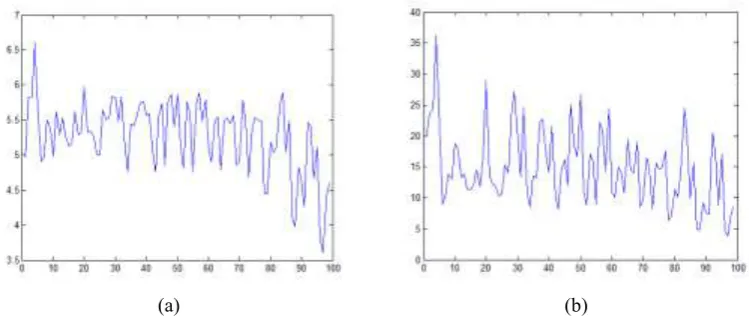
(2)We select the images with the size of 512×512, the measured value distribution of the variance (Var=0.506) and information entropy (Ent=7.832) of images.
[image:2.595.111.486.142.303.2](a) (b)
Figure 1. Distribution of image variance (a) and information entropy (b).
In Fig. 1, the difference in entropy distribution of image blocks is more obvious than the variance, and the data difference is bigger. So entropy can better distinguish between complex blocks and smooth blocks and then allocate the corresponding sampling rate. In this paper, we use the information entropy of image block to optimize the sampling and make a better performance on the gathering condition of the information of image block.
Adaptive Sampling Rate Allocation of Video
Framework
In this paper, the information entropy is used to identify the image block pixel distribution and optimize the sampling in block-based distributed compressive video sensing (DCVS) framework[ 4] shown in Fig. 2.
BCS Sampling
judegment Block CS reconstruction
Block CS reconstruction
Side informantion
block Key frame
CS
frame reconstruction
Video
BCS Sampling (adaptive sampling
rate) Pre-sampling
Video
Figure 2. Proposed block-based DCVS framework.
[image:2.595.103.487.505.612.2]Adaptive Sampling Rate Allocation Based on Entropy
Key frames have the information for the following CS frames, so we use a fixed block sampling rate in this paper. The sampling rate for the key frame is a and the pixel of each frame is N, then the total number of sampling is known asM=aN.
The difference represents the temporal relevance of image, and the entropy represents spatial correlation. For CS frames, since the key frames have been previously decoded and reconstructed, we can perform the entropy processing on the difference between the key frames and CS frames. The total sample rate is preset consistently with the key frame in advance. The total sampling number is M, pre-sampling rate is d (a>d) and the sum of all blocks’ adaptive sampling rate is ( a-b).
We set Y as the reconstruction matrix of the key frames and X as the pre-sampling matrix of the CS frames, and the dimension of X isM.
U Y X (M =d N ) (3)
U in Eq. 3 represents the changes of gray value. As the difference between the range (-256,256), the Eq. 4
256
U U (4) ensures that we can do hash to the data and get the probability of the change of pre-sampled pixels for each measurement domain. The information entropy of frame block k in the measurement domain asUU256
(k) ijlog ij
h
p p . (5) The number of measurements in per block is formulated according the proportion of the entropy of each piece to the sum of all the entropy values ash(k) (a ) =M +
( )
k
d N M
h k
. (6)We set the maximum number of sampling times for the block as 2
0.9
upper B and limit the number of measurements beyond the upper bound to the upper value, and then distribute the remaining of measurements evenly to the unbounded blocks. After the allocation, the measures of some blocks may be out of bounds again, and the above steps are repeated until all the blocks are not over the border. Then the final measurements can be obtained.
The measured values of each block will be transmitted to the decoder end after finishing the processes above, and then we use the appropriate CS reconstruction algorithm to reconstruct the frame blocks. The value of the measurement is often larger to ensure the accuracy of the variance of the samples. Therefore, this scheme will increase a little of the computational complexity than traditional scheme.
Simulation Results
frames of football sequence are CS frames. We take the average of 5 measurements of peak signal to noise ratio (PSNR) of reconstructed CS frames.
(a) (b)
[image:4.595.97.497.96.370.2]
(c) (d)
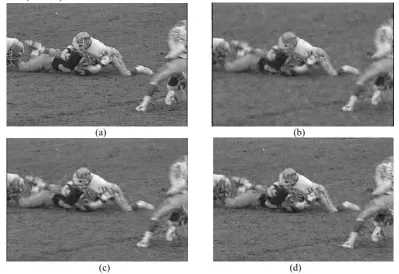
Figure 3. Subjective visual comparison of the 59th frame of football sequence (a) Original frame (b) Non-adaptive frame (29.26dB) (c) Variance adaptive frame (30.26dB) (d) This program (31.23dB).
[image:4.595.96.500.510.679.2]Fig. 3 shows the subjective visual quality comparison of the 59th frame of the football sequence by each scheme at the total sampling rate of 0.7 and the pre-sampling rate of 0.4. It can be clearly seen that the adaptive scheme proposed in this paper can effectively alleviate the block effect and obtain superior subjective viewing performance compared with the non-adaptive scheme. The PSNR value of this paper’s adaptation program is increased by 0.97db.
Table 1. Objective performance comparison (PSNR in dB).
samples methods
the pre-sampling rate
0.2 0.3 0.4 0.5 0.6
boat
Non-adaptive
Variance adaptive
proposed
26.94
29.33
29.96
27.61
29.94
30.61
29.26
30.26
31.23
29.96
31.03
32.04
31.09
32.22
33.07
football
Non-adaptive
Variance adaptive
proposed
21.72
22.17
22.43
22.07
23.21
23.69
23.06
24.29
25.38
23.94
24.21
27.14
25.06
26.43
28.07
more intense the sequence moves, the less pixel information of key frame can provide for CS frames. The less the pre-sampling information is obtained when the pre-sampling rate is low, the greater the impact on allocating subsequent rate. As the pre-sampling rate increases, the more information we get from each block, the more reasonable allocation on sampling rate and then PSNR values increase faster. Therefore, the pre-sampling rate should be sufficient to reduce the error between the true value and the sampled value and ensure the effectiveness of the program.
Summary
In this paper, we present an adaptive sampling rate allocation scheme, aiming at the existing traditional block compressed sensing and variance-based adaptive compressed sensing algorithms. We allocate CS frame sampling rate with the information entropy of the pre-sampled frames. Simulation results show that the CS frames reconstructed by our scheme is of higher quality on subjective vision. The use of the hash algorithm makes the algorithm complexity lower than the variance-based scheme.
There are still shortcomings that future work should consider. In this paper, the improvement of PSNR values is worthy of increasing the amount of calculation. So only when the pre-sampling rate is large enough, the error between pre-sampled and the original information can be reduced. Therefore, how to shorten the measurement time and analyze the relationship between the pre-sampling rate and the error to properly set the pre-pre-sampling rate are also worthy of further analysis.
Acknowledgements
This work was supported by the National Natural Science Foundation of China [61571241], Major projects of Jiangsu Province university natural science research [15KJA510002], The Communication Soft Science Research Project of Ministry of Industry and Information Technology (MIIT), China (2017-R-34 and BJ217013), Natural Science Foundation of the Higher Education Institutions of Jiangsu, China (17KJB510043), the Open Project of Remote Measuring and Control Key Lab of Jiangsu, China (2242015k30005) and Postgraduate Research & Practice Innovation Program of Jiangsu Province [SJCX17_0221].
References
[1] Candes E, Tao T. Robust uncertainty principle: exact signal reconstruction from highly incomplete frequency information [J]. IEEE Trans Inform Theory, 2006, 52(2): 489-509.
[2] Duarte M F, Davenport M A, Takhar D, et al. Single-pixel imaging via compressive sampling [J]. IEEE Signal Processing Magazine, 2008, 25(2): 83-91.
[3] Wang A, Liu L, ZENG B, et al. Progressive image coding based on an adaptive block compressed sensing [J]. IEICE Electronics Express, 2011, 8(8): 575-581.
[4] Kang W, Lu C S. Distributed compressive video sensing. Proceeding of 2009 IEEE Int. Conf. on Acoustics Speech and Signal Processing, Taipei, Taiwan, April 2009.
[5] Gan L. Block compressed sensing of natural images [A]. Proceedings of the International Conference on Digital Signal Processing [C], Cardiff, UK, 2 007, 403-406.