University of Huddersfield Repository
Alvarez Munoz, Pedro
A situational approach to composition
Original Citation
Alvarez Munoz, Pedro (2013) A situational approach to composition. Doctoral thesis, University of
Huddersfield.
This version is available at http://eprints.hud.ac.uk/id/eprint/23450/
The University Repository is a digital collection of the research output of the
University, available on Open Access. Copyright and Moral Rights for the items
on this site are retained by the individual author and/or other copyright owners.
Users may access full items free of charge; copies of full text items generally
can be reproduced, displayed or performed and given to third parties in any
format or medium for personal research or study, educational or notforprofit
purposes without prior permission or charge, provided:
•
The authors, title and full bibliographic details is credited in any copy;
•
A hyperlink and/or URL is included for the original metadata page; and
•
The content is not changed in any way.
For more information, including our policy and submission procedure, please
contact the Repository Team at: [email protected].
A SITUATIONAL APPROACH TO COMPOSITION
Pedro Ramón Álvarez Muñoz
Portfolio of compositions and commentary submitted to the University of Huddersfield in partial fulfilment of the requirements for the degree of Doctor of Philosophy (PhD)
Copyright Statement
i. The author of this thesis (including any appendices and/or schedules to this thesis) owns any copyright in it (the “Copyright”) and he has given The University of Huddersfield the right to use such Copyright for any administrative, promotional, educational and/or teaching purposes.
ii. Copies of this thesis, either in full or in extracts, may be made only in accordance with the regulations of the University Library. Details of these regulations may be obtained from the Librarian. This page must form part of any such copies made.
Abstract
This commentary presents my compositional work of the last two years. It consists of musical pieces that follow a formal approach emphasising static, self-enclosed musical situations. Designed to avoid processual ways of formal organisation, these pieces present collections of rich instrumental textures that do not evolve; they point toward a music of 'being' rather than 'becoming'.
Drawing on conceptual traces from discussions of Karlheinz Stockhausen's 'moment form' and Helmut Lachenmann's ideas of 'sound as state'; on musical traces from Morton Feldman and Aldo Clementi, and reflecting on similar approaches by contemporary referents such as Harald Muenz and Bryn Harrison, I seek to contextualise the formal aspects of my own compositional practice comprised in what I call a 'situational' approach.
A detailed observation of the musical material and modes of inner organisation used in the construction of these pieces will be necessary in order to reveal the features that give situations their characteristic sense of stasis.
I also seek to explore different effective ways of formal organisation based on the co-existence of situations. I do this by means of juxtaposing either single such situations, or several instances of them, reoccurring in different combinations. Both formal approaches seek to emphasise the syntactic independence and lack of relations of consequence between such segments.
Acknowledgments
I am deeply grateful to all who have guided me, with generosity and patience, through different stages of this musical path in the last twenty years: Millapol Gajardo, Sanjay Bhadoriya, Mauricio Valdebenito, Gabriel Matthey, Cirilo Vila, Rolando Cori, Aliosha Solovera, James Dillon, and especially to Prof. Liza Lim, for her support and dedicated supervision of this work.
I shall also express my gratitude to all the musicians who have believed in my work and committed to performing it, and with whom I have been honoured to work, especially Bettina Berger, Anna D’Errico, Scott Voyles, Heather Roche, Filip Rathé, Noriko Kawai, Mark Knoop, Klaasje Nieuwhof, Elision Ensemble, Ensemble Interface, Hand Werk, Ensemble CrossingLines, Distractfold Ensemble and Spectra Ensemble.
Thanks to Dr Aaron Cassidy and all CeReNeM staff and fellows, for providing a stimulating artistic and academic environment wherein to carry out my work for the past two years.
Table of Contents
Copyright Statement...1
Abstract...2
Acknowledgments...3
Portfolio...5
Introduction...6
1. Musical Situations and their Background...10
1.1 Situations...11
1.2 Moment form...14
1.3 Sound as state...17
1.4 Acoustic Situations...23
1.5 Surfaces and repetition...27
2. The Construction of Situations...32
2.1 Ibid...35
2.2 Two Surfaces...39
2.3 Ver...45
2.4 Últimos...52
2.5 Instead...56
2.6 Debris...60
2.7 Other Pieces...69
Final Considerations...73
Bibliography...76
Appendix I: Biography...81
Appendix II: CD contents...82
Portfolio
Fragments after Cioran (2012)
For bass flute, clarinet, violin, piano, vibraphone and piano. Ca. 9 min.
[Premiered on 09.03.2012 by Ensemble Interface conducted by Scott Voyles at Dampfzentrale Bern, Switzerland]
Ibid (2012)
For flute and piano. Ca. 30 sec.
[Premiered on 20.07.2012 by Bettina Berger and Anna D'Errico at the OpenSpace, Darmstadt, Germany]
Fosforesciamo (2012)
For solo harpsichord. Ca. 5 min.
Debris (2012)
For 1/4-tone flugelhorn, tenor trombone, electric guitar, percussion and electronics. Ca. 20 min.
[Premiered on 08.02.2013 by Elision Ensemble, St Paul's Hall Huddersfield, UK]
Two Surfaces (2013)
For alto flute, clarinet, violin, cello and percussion. Ca. 9 min.
[Premiered on 26.04.2013 by ensemble Hand Werk at the Wittener Tage für neue Kammermusik, Germany]
Instead (2013)
For solo clarinet. Ca. 7 min.
[Premiered on 25.09.2013 by Heather Roche in Berlin, Germany]
Ver (2013)
For solo piano. Ca. 17 min.
[Premiered on 05.12.2013 by Mark Knoop at University of Huddersfield, UK]
Últimos (2013)
For string trio. Ca. 7 min.
[To be premiered in 2014 by Distractfold Ensemble]
Introduction
In his Aesthetic Theory, Adorno characterised artworks as having an “immanent processual quality” (1997, p.176). In his view, they are essentially “not being but a process of becoming” (ibid),1 their processual qualities resting on an inner dialectical tension: “Whatever in the artifact may be called the unity of its meaning is not static but processual, the enactment of antagonisms that each work necessarily has in itself” (ibid).
During my studies in composition I have come across many different formulations of similar ideas, applied in a more-or-less concrete way to the discussion of musical construction and pointing towards the aesthetic need for a processual unfolding as a core factor of 'coherence'. In my compositional work of recent years I seek to problematise this view attempting alternatives to it: How can we do without such dialectics of process in composition? This inquiry is not intended directly as a response to Adorno's claim, but more generally, as a way of exploring alternatives to received compositional criteria that have sustained understandings of musical form since late 18th Century classicism.
Through my portfolio of compositions, I attempt to address ways of replacing the 'enactment of antagonism' that Adorno mentions for a simple display of contrasting situations, among which no relation of causality is at play in order to avoid processual
1 It is important to note that, in this sentence, the word 'process' is an addition of the translator,
as the German original reads: „Daß Kunstwerke kein Sein sondern ein Werden seien...”
traces on a larger scale. Over the past two years, I have focused on defining a compositional practice around an exploration of limited arrays of material. In so doing, I have narrowed the possibilities for a developmental form of internal organisation in order to convey a sense of inner stasis. I arrived at the term 'musical situations' as a key to understanding such formal prioritisations, looking to highlight both the inner static qualities of the musical segments at play, and their independent coexistence within a musical work.
The 'processual' aspects that I seek to avoid refer to music based on series of changes at the formal level – not necessarily continuous – directed towards a goal; a change from A to B, where both terms are different from each other, and B could be seen as a consequence of A. On the contrary, by 'non-processual' or 'static', I refer to the lack of intelligible relations of consequence between different situations or between any parts within a situation; whichever musical segment we observe exists without becoming anything different from itself. This dichotomy processual/static finds to some extent a parallel in Jonathan Kramer's (1988) conception of linearity in its multiple forms and non-linearity, yet applied here to any musical segment, rather than – as he does – to entire pieces.
The idea of static musical segments, and of pieces composed with them, suggests the need for a new kind of attention that is different from the sort of 'story-following' usually at play in music of written tradition. These non-narrative musical situations, we might speculate, through their static character somehow minimise the role of memory and expectation as coordinates of subjective orientation, rather focusing one's attention on the musical situation as a form of a sheer 'present'.2 As such, a music based on a
2 For an insightful account on the role of attention, memory and expectation in the experience
situational approach points at a new way of experiencing musical time, not proceeding linearly from expectations of the future, via present enactment, to become memories of the past that inform new expectations, but as discrete blocks of 'pure present', as it were, that succeed one another discontinuously. A detailed study of the reception of the music here presented, nevertheless, exceeds the scope of the present commentary, and so the discussion will remain focused on the 'poietic' dimension, i.e. the creative, generative aspects of this music, in both a speculative and practical way.
The pieces included in the portfolio respond to this quest for stasis at diverse levels and with different degrees of radicalness. Some of them might even be seen at times as failing to reflect appropriately such ideas, at which point we must bear in mind that they are not laboratory tests to prove a hypothesis, but rather self-sufficient artworks that attempt different ways of reflecting creatively on the ideas presented in this commentary. The model followed is then not one of theoretical ideas applied to composition, nor a subsequent exegesis to what I have composed, but one of aesthetic concerns arising from the compositional praxis, being researched and thereby historically/theoretically contextualised, feeding back into further compositional undertakings in a rapport of mutually informing practice-research.
I must also mention that the instrumentation of the included pieces responds to concrete opportunities of collaboration with performers and ensembles, in order to have the music performed in public, thus completing the cycle of music making. These collaborations, besides the gratifying experience of working with excellent musicians, in some cases informed the compositional process by means of providing technical feedback on the sound result of the materials chosen. This was especially so in
1. Musical Situations and their Background.
In this chapter I will introduce the concept of 'situation' that I employ to refer to the characteristic static formal units in the construction of my music. I will also contrast this approach with similar ones from composers that I consider relevant to such a concept, as means of contextualisation. My intent is not to follow a musicological methodology, but rather to provide a creative dialogue with some selected musical referents.
1.1 Situations
In a general sense, the term 'situation' is understood as a 'state of affairs': a determined set of conditions or circumstances that characterise a certain time/space as a unity. The idea of musical situations, as presented through this commentary, refers to segments of instrumental activity that appear as utterly static on a large scale. They can contain a rich detailed definition, with changes in different levels that nevertheless do not affect the general sense of stasis. Such situations hold to a determined identity by elaborating on a restricted set of musical possibilities that ‘remain the same’.
It is the variety within the chosen sets of possibilities, as well as the regularity in their deployment in time, that determines the degree of homogeneity of a situation. On the other hand, the more heterogeneous a situation is, the more time it needs to reveal the regularity of its construction, and thereby its static character. Once this aspect is established, the content starts being perceived as redundant. Henceforth it could be argued that a situation's actual duration is arbitrary: rather than being derived from inner considerations regarding the behaviour of materials, it is imposed externally, since such a static continuum cannot have a 'reason' for its beginning or end.
of arbitrariness in both a situation's placement and duration is, therefore, a key factor to my music, as will be discussed through this commentary.
Despite not referring to 'situations' at the time, the first piece I wrote addressing similar ideas of formal discontinuity was 'Umbral' for ensemble (2003), where I presented a collection of textures juxtaposed in a random order, in an attempt to get rid of smooth transitions as a compositional problem to be tackled. Further endeavours in similar directions were pursued in the frame of my Master of Arts' portfolio (2008), though these rather focused the discussion on the structural aspects of paradigmatic and syntagmatic organisation of the material, as well as procedures for overlapping different musical segments. Later on, I addressed ideas of static, non-narrative textural music in the portfolio of my Master of Philosophy (2012), and particularly in the work titled Interalia for large ensemble, which presented – in a fragmented way – a unique textural construction characterised by the restriction of parametric elements.3
I deliberately refer to this compositional approach as 'situational' rather than 'situationist' not only to take distance from all the 'isms' and the doctrinal resonances of such denominations, but more specifically to avoid confusion with the artistic/political movement of the same name. With Guy Debord as one of their founding members, the Situationist International “formed in 1957, found their métier as inspired provocateurs during the insurrectionary 'events' of May 1968 in Paris, and disbanded in 1972” (Danchev, 2011, p.347).
The situationists defined the concept of 'constructed situation' as "a moment of life concretely and deliberately constructed by the collective organization of a unitary ambience and a game of events" (Knabb, 2006, p.51). Given the considerably different
scope of the situationist movement's agenda when compared to my much narrower use of the term 'situation' in this musical context, an elaborate attempt to link their ideas to mine would be futile. That said, I do find that their concept of a 'constructed situation', taken in a rather abstract way, offers a resounding affinity with the musical approach that I present here. Beyond the mere coincidence in the denomination, the idea of an organised 'game of events' towards the construction of a 'unitary ambience' does indeed overlap with what I pursue in music.
Of additional interest is the use of the word 'moment' in that situationist definition, which carries temporal implications. Taking this idea back to the field of music concretely, I shall consider Stockhausen's use of that term in relation to his famous concept of 'moment form' first introduced in his work Kontakte (1966), which seems similar to my idea of 'situations' and their role in my compositional practice. Although at some point in my studies in composition many years ago4 I became aware of his conception of discontinuous, self-enclosed sections, these ideas seemed to have stayed submerged in my unconscious until re-discovered at a rather late stage of this research.
1.2 Moment form
In his article titled 'Moment Form in Twentieth Century Music', Jonathan Kramer explains such form as "a succession of self-contained sections that do not relate to each other in any functionally implicative manner" (1978, p.179). Similarly, musicologist Arnold Whittall described Momentform as “a concept of Stockhausen's which sought to focus maximum weight on the individual structural segments that make up larger wholes” (2008, p.275).
From these definitions, it can be derived that such segments, whilst forming part of larger constructions, do not imply a functional role, but rather remain independent of each other. Sheer juxtaposition seems then the way for 'moments' to coexist within a piece. At least in theory, these ideas coincide with my own to a great extent. The similarities also include the seemingly static qualities of a moment, as Stockhausen himself, when explaining his ideas about these musical forms says that they:
do not aim toward a climax, do not prepare the listener to expect a climax, and their structures do not contain the usual stages found in the development curve of the whole duration of a normal composition: the introductory, rising, transitional, and fading stages. On the contrary, these new forms are immediately intensive, and the main point which is made at once remains present at an equal level to the very conclusion (quoted in Kramer, 1988, p.201).
Often I refer to these static aspects as a 'non-narrative' quality of my compositional approach (Alvarez, 2012), something to which Stockhausen explicitly points regarding his work Momente:
Following this idea, it becomes evident that, insofar as there is no musical need to listen to a 'moment' for its whole duration, its actual length is arbitrary. The idea of arbitrariness that I repeatedly mention with regard to both situations' durations and their placement is understood not in absolute terms (pure chance, randomisation), but simply refers to not being derived from any rational calculation. Intuition, nonetheless, can have an incidence in these decisions to some degree, as long as the result can be perceived as arbitrary. In this sense Kramer's account of arbitrariness in the articulation of moment form is insightful:
Since there is no linear logic that connects moments, their order of succession
seems arbitrary. Actually, the order may or may not be arbitrary, but it must seem so on the surface if the piece is to be heard in moment time (Kramer, 1988, p.50).
These apparent similitudes of my musical situations with Stockhausen's moments stand only partially, since, differently from my approach, he considers that a 'moment' can be either a state (as in a situation) or processual: “[Kontakte] is composed in 'moment form'. Each moment, whether a state or a process, is individual and self-regulated, and able to sustain an independent existence” (Stockhausen, quoted in Wörner, 1973, p.46, italics are mine). My idea of a situation, on the contrary, aims to exclude any sort of processual unfolding both at the formal level, and within individual situations.
Furthermore, even a moment's self-containment and independence seem only to be relative, as can be observed in Stockhasuen's London lectures of 1972.5 There he explained the parts of his work Momente, suggesting a precisely controlled web of inter-referential and mutually influencing parts. Although not operating in a linear way, these seem to take different functions in the construction of an overall dramaturgy by
5 13th February 1972 at the Institute of Contemporary Arts, filmed and released by Allied
keeping under strict control the degree and direction of change from one moment to the next. This aspect not only seems at odds with Kramer's description, but also provides a major point of difference from my idea of 'situation'. In any case, all these apparently contradictory aspects of moment form could perhaps be explained by taking into account Robin Maconie's suggestion that Stockhausen's work followed a general “trend away from static structure to dynamic process that began with Kontakte” (Maconie, 2005, p.259).
1.3 Sound as state
Often when describing the musical situations I write as 'textural', I do not only point at their sensuous characteristics, but also seek to make manifest an aspect that links them, at least partially, to Lachenmann's concept of 'texture-sound' or 'sound-texture' encompassed within what he calls 'sound as state'. In his 1966 article Klangtypen der neuen Musik, Lachenmann (2004a) organised a taxonomy of sound – understanding this term in a wide sense, from a single event to a complex sound-construction – that included the category of 'sound as state' (Klang als Zustand). He described such a category as having an arbitrary length, independently of its content, as opposed to 'sound as process' (Klang als Prozeß), whose duration is equivalent to the development of its properties in time.
The different types of sound-states explained in that article include the so-called 'Colour-sound' ('Farbklang'), namely a sustained, homogeneous sound, for example a held chord or a drone; 'Fluctuation-sound' ('Fluktuationsklang'), i.e. a sound-state composed of a periodically repeating behaviour; and the most complex of these, which he calls 'Texture-sound' ('Texturklang'): “a static experience of time built of a multiplicity of heterogeneous single events, which gives a general impression, virtually a characteristic chaos” (ibid, p.57, my translation)6. A texture, under this perspective, is composed of a variety of details that are unpredictable and structurally irrelevant (ibid, p.15). Nonetheless these details add up to the statistical properties of the whole. The dissociation between a texture's overall formal level and its detail is explained by Lachenmann:
6 „...aus einer Vielfalt von heterogenen Einzelereignissen gebildete statische Zeiterfahrung,
[T]he general property of a texture is not anymore necessarily identical with the momentary innerly audible detailed properties; indeed in the particular sense that the degree of complexity of the resulting general character . . . is mostly smaller than that of the rather casually merging shapes inside the texture, insofar as the mass is usually more primitive than its individual components (ibid, p.17).7
A key concept to understand Lachenmann's sound types is that of 'proper-time' (Eigenzeit), namely the time that is necessary to convey the properties of a sound (ibid, p.8). Differently from the processual sound, in which its actual duration coincides with such proper time, in the texture-sound the latter could be considered as virtually endless, “...when at some point, eventually the attention on the constantly new detail would not change anymore, in a static experience of statistic general properties” (Ibid, p.14).8 This finds a parallel in Kramer's idea of a texture's 'consistency':
Eventually the expectation for consistency turns into virtual certainty, and (in information-theoretic terms) the texture and surface rhythm become redundant. But in retrospect we realize that an unchanging principle of organization, not a progressive linearity, has been determining the texture and surface rhythm . . . Once this consistency of rhythmic and textural pattern becomes a certainty, we start to notice the nonlinearity of the texture (Kramer, 1988, p.42).
Despite their different inner characteristics, all three 'state-sounds' – colour, fluctuation, and texture – are somehow determined by the same kind of proper-time, “which remains undeterminable given the variety of individual cases”, and after which such sound constructions are “experienced not anymore as process, but as a state that can be prolonged arbitrarily” (Lachenmann, 2004a, p.15).9 In this sense of arbitrary duration
7 „...(daß) die Gesamt-Eigenschaft einer Textur nirgends mehr notwendig identisch ist mit den
momentan darin zu hörenden Detail-Eigenschaften, allerdings in dem besonderen Sinn, daß der Komplexitätsgrad des resultierenden Gesamtcharakters, [als oft eher statistisch zu bewertendes Resultat von Häufungen,] meist geringer ist als derjenige der im Textur-Inneren eher beiläufig sich zusammenschließenden Gestalten - so wie eben die Masse meist primitiver ist als ihre einzelnen Komponenten.“ (N.B.: All translations are mine)
8 „So könnte man die Eigenzeit dieses Typs für unendlich ansehen, wenn nicht schließlich
doch irgendwann die Aufmerksamkeit auf das permanent neue Detail wieder umschlagen würde in ein statisches Erlebnis statistischer Gesamteigenschaften.“
9 „Er wird - nach einer gewissen, unbestimmbaren, weil individuell verschiedenen, Eigenzeit
beyond a critical time that reveals their redundancy, another crucial overlap between 'state-sound' and my concept of musical situation is found.
However, as can be seen in the musical examples that Lachenmann presents in the cited article, i.e. short fragments selected from Ligeti's Apparitions and from Stockhausen's Gruppen, the characteristic stasis of a Texturklang is just relative in practice. If we consider those examples in the broader formal context of the pieces to which they belong, their transitory properties emerge. Under this perspective, a 'state' implies a static-yet-transitory condition, in the same sense that water, for instance, is in a liquid state only whilst its temperature does not go below 0º or above 100ºC.10
It is curious to observe that, whilst presenting several examples of 'sound-as-process' drawn from his music, Lachenmann does not include any of his own regarding 'state-sounds' (introducing instead the examples of Ligeti and Stockhausen mentioned above, alongside others as diverse as Penderecki, Beethoven, Chopin, Debussy, Bruckner, and Berg). This, one could speculate, signals to a certain identification of his own work with dynamic, processual compositional procedures, and consequently a distancing from more static ones.
Although it is not entirely clear from the text whether Lachenmann uses the term 'texture' in a general sense or specifically referring to the 'sound-type' mentioned before, he points, in the 1994/95 analysis of his second string quartet, to “an ordinario -bowed tutti texture that draws (real and imitated) overtone-glissando figures out of a polytonal field, and from there into tonelessness (see the score, mm. 85-112)” (Lachenmann, 2004b, p.62). The score shows how, instead of directing such texture
10 The German word that Lachenmann uses is 'Zustand', same that is commonly used to
towards tonelessness through a linear process, the composer establishes acontinuous ebb and flow between pitched and pitch-less sound qualities by means of changes in the bow position going all the way through 'sul ponticello'.11 However, it can also be seen how some elements break the homogeneity of the texture. The sudden articulation change in bar 90, for example, from legato to détaché, together with an increase in dynamics and a single, characteristic ascending figure in the first violin towards bar 93a constitute a sort of unique gesture, that escapes the general textural definition (see Example 1). The dynamic 'fff' in bar 95 also presents a unique recognisable deviation from an otherwise homogeneous sound construction.
Similar to the previous examples of Texturklang that Lachenmann cites, whichever static characteristics we find in this 'texture' seem only relative, always on the verge of stasis. Taking some distance and looking with a broader perspective, such static traces tend to appear at least blurred by larger heterogeneous processes, or even disrupted by contrasting individual elements.
My compositional attempts, on the contrary, seek to minimise the formal relativity of stasis. Textural situations then appear as an extrapolation of the ideal characteristics of the 'Texturklang' into the formal level, adopting a more radical approach to their stationary, non-processual aspects. They display a sort of utterly static self-containment and general homogeneity, which ultimately derive in their duration being imposed arbitrarily, rather than as a response to an inner structural necessity.
11 Lachenmann means the 'sul ponticello' indication in a literal sense, actually on the bridge,
However incidental, it may be worthwhile to mention the use of the term 'situation' in Lachenmann's writings. When he briefly comments on his work 'Ausklang' from 1984/85, the composer describes the music as “going through a course of situations, that – continuing, contrasting, or qualitatively switching – follow each other” (2004a, p.396),12 thus implying the possibility for their discreet formal organisation in a somehow similar way to the formal approach I propose. Also when describing the idea behind his work from 1971 'Kontrakadenz' in its programme notes, he mentions a “'Cascade' of acoustic situations” (ibid, p.385).13 This description, as far as I know, remains unexplained, and does not seem to establish a specific concept in the frame of his theoretical apparatus.
12 „Die Musik durchläuft so einen Parcours von Situationen, die – fortsetzend, kontrastierend
oder qualitativ umschlagend – auseinander hervorgehen...“
1.4 Acoustic Situations
German composer Harald Muenz employs the term 'acoustic situation' in a much more specific sense than Lachenmann, in order to make manifest his “dealing with the mere physical changes inside a sound” (Muenz, personal communication, 07 April 2013) in some of his works. This is done by exploring a sheer sensorial experience of acoustic changes, rather than an intentionally deployed musical dramaturgy. Far from similar concerns found in the ambit of 'sound-installations' or 'sonic art', he deals with such problems from a compositional perspective, hence his approach seeming relevant to this discussion.
By attempting to untie sensorial attention from a compositionally designed 'plot' to be followed, Muenz points at a “sharpening of the attention by focusing on the individual acoustic event, on the pure presence of 'sounds being themselves'” (ibid). In this way, he also seeks to distance his work from “the 'grand' tradition of European concert music, in which composers stage dramatic courses in their pieces” (ibid), a tradition that would certainly include both Stockhausen and Lachenmann. Such an agenda, whilst evoking some strong Cagean resonances, is nonetheless carried out through the technical resources of that tradition – namely precisely notated, 'composed' music. In one of his articles dedicated to the composer, musicologist Rainer Nonnenmann gives insight into the scope of this approach:
[Muenz] describes a great part of his pieces as 'acoustic situations' in order to replace the historically-affectively loaded concept of music through a 'physical' neutral description, and in this way preventing listeners from becoming artificially and externally emotionalised from the beginning by retrieving traditional musical categories, instead of through the unprejudiced and therefore perhaps more varied perception of the inner sonic course of instruments, speeches, voices (Nonnenmann, 2004, p.35, my translation).14
14 “Einen Großteil seiner Stücke bezeichnet er als „akustische Situationen“, um den
The way in which such situations are presented can be observed, for example, in his piece 'dietro V avanti' (Muenz, 2011b). In the central section – measures 202 to 273 – a restriction in the pitch and rhythmic materials allows one to focus the attention on aspects of sound such as changing rates of vibrato, timbral modulations and subtle variations in dynamics, as can be seen in the example below.
Example 2: Harald Muenz, dietro V avanti (2011b), mm. 202-214.
This idea of 'acoustic situations' thus points towards an objectivisation of the listening experience, seeking to avoid an apparent imposition of the composer's intention – in the traditional form of a 'dramatic plot' to be followed – onto the auditor's attention. Instead, the composer pursues a more self-reflective focus on the material's own physical qualities, hence his use of such a neutral denomination, in order to signal a distance from traditional musical categories.
These concerns coexist in Muenz's work with other aspects that, in contrast, go beyond the 'purely sonic' characteristics mentioned above. Such is the case of material loaded with cultural connotations, as can be seen in his 2006 work »schönes klavierstück«.15 Besides the ironic resonances of the title, the passage shown in the example below is presented as if it was a self-enclosed object, disconnected from the rest of the music. The characteristic figuration not only alludes to “the German mocking term
'Quintolenmusik' ('quintuplet music') for intricate rhythms in new music” (Muenz, 2011d, liner notes), but contrasts it with a banal figuration, seemingly evoking the mechanical, unrefined characteristics of cheap electronic keyboard music, as the composer explains in the programme notes to the piece.
Example 3: Harald Muenz, »schönes klavierstück« (2006) bar 24.
Besides the mere terminology used, it is the creative purposes sought by Harald Muenz through his concept of 'acoustic situations' that coincides to some extent with my compositional endeavours presented here. In very general terms, both approaches look for a new form of aesthetic experience, less pre-determined by traditional conceptions of what 'a good composition' ought to be like, and more open to an objectivisation of musical material. What differs, however, is the means by which this is carried out, in my case done through a strict avoidance of processual characteristics in the generation of static segments of textural qualities. These segments, in their turn,
1.5 Surfaces and repetition
The idea of rather static musical textures and furthermore of composition as the design of patterns of textural qualities are by no means new. An unavoidable name from recent music history that consistently addressed such ideas is Morton Feldman. The static, textural aspect of his work is especially patent in his late period, from the late 1970's until the end of his life, which is characterised by increasingly long pieces and a close association with the visual arts that led him to express his musical ideas with a strong emphasis on visual/spatial metaphors:
My obsession with surface is the subject of my music. In that sense, my compositions are really not 'compositions' at all. One might call them time canvasses in which I more or less prime the canvas with an overall hue of the music (Feldman, 1988, p.4).
This lack of differentiation in an ongoing 'undisturbed time' is mainly what relates these ideas to those of stasis that I seek through the concept of musical situations. Personally, I approach this not only by avoiding a processual organisation, as explained before, but also by preventing 'signposts' that may direct our attention towards the interpretation of formal tendencies within situations. Any element that stands out of the general, statistical web of materials at play must then be neutralised, so as to be devoid of a critical function that may imply formal consequences. An effective way of doing this is through the sustained repetition of such elements, which can be exact, unsystematically varied, or systematically varied (the latter implies a process, and therefore would be excluded from a situational approach). Thus, by repeating an element or behaviour that initially stands out, its potential formal meaningfulness is hindered, transforming it into just a recurring component of the general situation. This solution, however, conflicts with Lachenmann's concept of textural sound presented before, as recursiveness would rather point to a fluctuation type: “It is characteristic of a Texturklang that it can constantly change in its acoustic individual properties . . . without repeating itself like the Fluktuationsklang” (Lachenmann, 2004a, p.14).16
This tension between texture and repetition, which underlies the construction of most musical situations in my works – as will be seen in their detailed analysis in the next chapter – is a key feature in the music of Aldo Clementi. His work exerted an immediate fascination when I first came across it more than a decade ago in Chile, and has been an important point of reference for my compositional practice ever since.
16 „Charakteristisch für den Texturklang ist, daß er sich in seinen akustischen
In an article from the early seventies, Clementi described his music of that time as consisting of a rather 'optical-illusory', densely chromatic counterpoint, “eliminating the perception of individual internal movements, which in turn ensured a constant vibrancy” (Clementi, 2009, p. 508). This is meant as a way of avoiding the focus on single details, and thus favouring a “kind of static materiality” (ibid). The dialectics between structured detail and general form is thereby clearly inclined towards the latter by means of a dense polyphonic texture that renders its content difficult to grasp individually. As Clementi himself described it, his music is composed of “mixed-up microscopic details, a continuum without direction, a texture” (ibid, p.509). The composer explains the creative motivations behind his music's tendency to stasis by pointing out that “The reality around us already moves too much for us to desire to imitate it” (ibid).
As composer Bryn Harrison explains, Clementi's conception relates to that of Feldman in “the ways in which the music asserts its own objectified presence through the repetitive nature of the music” (Harrison, 2011, p.271). This idea, common to both composers, seems close to my way of achieving formal neutralisation via repetition. However, these two composers' approaches to this issue differ from each other in the way time operates in their work: “because each engages our faculties of musical memory to differing degrees” (ibid). This is further explained in the same article:
The figurative and reiterative aspect of [Feldman's] music and the process of segmentation that ensues allows the listener to remember past events, albeit in a rather uncertain and distorted way, and thus creates a sense of déjà entendu: have I heard this event before and, if so, was it exactly the same? Clementi, in comparison, gives the listener no such recourse, creating instead a sense of an endless succession of the same event on an ever-slowing temporal plane. When Clementi writes a repetition, he is always suggesting the whole (ibid, p.272).
time” (Harrison, 2012, p.61). This form of objectivisation of the musical construction lies at the core of my work too. However, my compositional practice points in a different direction by aiming to exclude recourse to processual techniques that form an integral part of Harrison's music, as described in the same text: “these materials become progressively slower and more repetitive as time goes on, generating greater degrees of magnification” (ibid, p.62), a process that can be clearly seen through the score these quotations refer to, namely his ensemble piece Repetitions in Extended Time
(2008).
The recourse to repetition that is central to the way these composers deal with issues of texture, surface and stasis has a different scope in my work, as will be shown next. In my practice, repetition takes place at the level of partial aspects of sound (single 'parameters') that can fluctuate in a dissociated manner, affecting the inner construction of a texture rather than directly articulating iterations of a sound 'Gestalt', and therefore remaining submerged within such general texture. This is consequently carried out in a more speculative way than Feldman's approach, for instance, which deals more intuitively with the concrete sounding result as a whole.
Further to all these differences, a strong recourse to discontinuity – articulating the musical form through sheer juxtaposition of different situations – distances my compositional approach here presented from those of Feldman, Clementi or Harrison. In contrast, theirs can be characterised – admittedly resorting to an over-simplified description – as subtly changing, rather continuous sound streams that combine processual, textural and fluctuating features.
* * *
2. The Construction of Situations
This chapter will demonstrate how I implement the idea of situations in my own work through the analysis of particular cases. I will do this by observing the materials and compositional procedures used in their inner construction, as well as the organisation of different situations in non-processual musical forms. As such, a negation of processual qualities is not the ultimate goal of my compositional endeavours, but a stimulating impulse to creatively explore aspects of music construction. I approach this by attempting to find ways to neutralise or countermand a sense of teleological process both within situations and in the relations among them.
The construction of such situations often involves a superposition of independently structured layers defining, in a highly speculative way, different aspects of the musical material. The very concept of 'material', in its turn, is understood here as the universe of parametric possibilities made available for the design of a particular situation. It will be noticeable through the analysis of the works that the materials chosen are both limited to very narrow ambits and restricted in their flexibility to change. By these means, situations present a strong identity that remains static despite their varying degrees of inner diversity.
are confined to such small ambits that their incidence on a formal dimension becomes negligible. This 'purposeful irrelevance' can be favoured compositionally by structuring changes in a recursive manner, in order to neutralise the formal weight that the unique occurrence of an event might entail. Throughout this chapter I will show how these strategies have been applied to the design of parametric aspects, explaining in detail the inner construction of situations in the pieces of the portfolio.
Despite the approach adopted – that of separately focusing on different aspects of the material such as rhythmic definition, articulation, pitch, etc. – loosely resembling that of historic serialism, here the structuring of parameters does not aim to override poles of attraction by giving equal weight to every unit in a set of possibilities. On the contrary, the occurrence of such poles is actively pursued. In the same way, the pitch material used here does not assume the total chromatic scale as the ultimate universe of available possibilities.
It is necessary to bear in mind that these pieces have not been composed following a defined methodology, and so they respond in different ways to the creative concerns discussed in this commentary. They do not seek to prove or refute a hypothesis, but to address in a sensorial, non-verbal form, the issues underlying this way of thinking. These works thus seek to cast new light and explore different perspectives on questions such as: Can musical forms do without a processual organisation? What defines the 'static forms' upon which this non-processuality relies?
instances of situations, such as Debris and Instead. The possibility of hybrid forms, in which some situations may reoccur whereas others appear only once, remains problematic, since such a differentiation could result in a hierarchisation of situations according to their 'ability' to reoccur (bringing into play the formal function that a
ritornello implies in a traditional sense). This is to some extent the case of Últimos, which presents individual situations in alternation with other recurrent segments.
2.1 Ibid
The most basic instance of situational composition in the included pieces is Ibid. A miniature for flute and piano, it is composed of just two contiguous, short textural situations. Following a parametric construction organised in layers that are defined independently from each other, the resulting musical texture is seen as a remnant of accumulated parametric forces. I have been developing this procedure since my piece
De Mares Antiguos for saxophone quartet (2009), and it features most notably in
Interalia for large ensemble (2010).17
According to this approach, the rhythmic structures involved are the first to be defined, going from the most general aspects to the more specific. Consequently, in Ibid the starting point is the bar sequence of numerators: 3, 4, 3, 4, 5, 4, 5, 6, 5, 6. This sequence, when divided in groups of three, shows an increasing pattern as follows: 3-4-3, 4-5-4, 5-6-5, (6-7-6, 8-7-8, etc.)
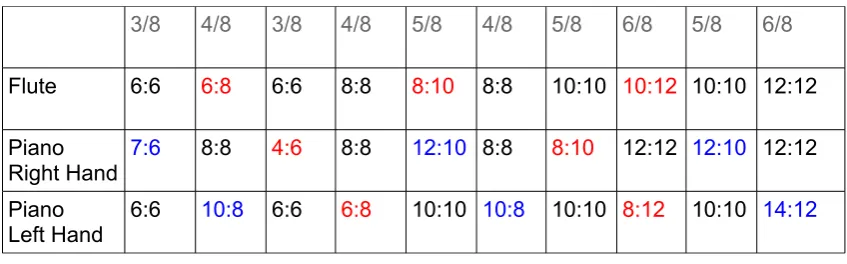
On top of this, different pulsation ratios were defined for the flute and the piano. In the former, an alternation of basic (1:1, abbreviated 'B') and slower pulsations (abbreviated 'S') takes the form of a repeated sequence [B, S, B]. The two hands in the piano present, in their turn, a pattern alternating Basic, Faster (abbreviated 'F'), Basic and Slower pulsations, yet in different phase, namely [B, F, B, S] in the left hand, aligned with [F, B, S, B] in the right, as shown schematically in the table below.
3/8 4/8 3/8 4/8 5/8 4/8 5/8 6/8 5/8 6/8
Flute 6:6 6:8 6:6 8:8 8:10 8:8 10:10 10:12 10:10 12:12
Piano Right Hand
7:6 8:8 4:6 8:8 12:10 8:8 8:10 12:12 12:10 12:12
Piano Left Hand
[image:38.595.114.538.82.214.2]6:6 10:8 6:6 6:8 10:10 10:8 10:10 8:12 10:10 14:12
Table 1: scheme of bars and their subdivision in Ibid. (2012) Basic subdivisions are shown in black, faster ones in blue, and slower in red.
The resulting pulsation grid serves as a continuum of basic units, onto which actual rhythmic values are superimposed following the sequence:
bar 1 to 5 [: 1 1 2 1 1 1 2 :] bar 6 to 10 [: 2 1 3 1 1 :]
In the piano these have been slightly modified when necessary so that a rhythmic unit always begins on the first beat of every bar. This responds to a compositional decision of having always accentuated chords with all available pitches in every downbeat, as a way of rendering apparent the bar’s frame. Here we evidence what I call a 'tension' between different, conflicting structures, i.e. the ongoing stream of rhythmic values versus bars' frame, where the latter imposes its definition over the former.
Example 4: first three bars of Ibid.
The situation comprising the first five bars unfolds within an ambit of a minor third (F♯ 4-A4). The actual sequence of notes used in the piano divides the four chromatic pitches in that ambit, giving the upper two (G♯, A) to the right hand, and the lower pair (F♯, G) to the left one. These pairs follow a simple distribution whereby both notes appear on every downbeat and then alternate individually in the following iterations.
The flute, in its turn, alternates chromatic pitches with a quarter-tone lowering of them, so that G is always followed by a G-1/4flat, G♯ is followed by G-1/4sharp, and A always precedes an A-1/4flat. F♯, being the lowest note of the defined ambit, is excluded from this behaviour. Different permutations of these seven quarter-tone pitches define then the actual notes. These are occasionally preceded by grace-notes that alternate both extremes of the ambit, namely F♯ and A.
2.2 Two Surfaces
In Two Surfaces I planned to construct a form similar to that of Ibid, namely a simple juxtaposition of two different situations, yet magnified here. These situations are expanded both inwards – to gain depth from a more elaborate inner construction – and in their extension in time. The two parts were written for the same instrumental combination, and constructed with similar organisational procedures, on which each takes different perspectives, especially through their deployment in time and general textural qualities. Their order of succession was only decided once both situations were fully written.
The construction of the first situation began by defining its rhythmic structure, in what is perhaps the most elaborate case of a rhythmic grid among the pieces in the portfolio. Framed by a recursive structure of bars following the sequence: 3/4, 4/4, 9/8, 4/4; it takes semiquavers as basic units, which are successively grouped in irregular sets of prime numbers. For example, the 12 semiquavers contained in a 3/4 bar can be grouped in the pairs 7+5 or 5+7. Each part, in its turn, can be further grouped into symmetric subsets:
5 = [1+3+1] or [2+1+2] 7 = [1+5+1] or [3+1+3]
Moreover, numbers bigger than 1 can be further divided18 by the subsequent prime number, so that:
5 = [7:5] or [1+(5:3)+1] or [(3:2)+1+(3:2)] 7 = [11:7] or [1+(7:5)+1] or [(5:3)+1+(5:3)]
18 The conventional way of expressing 'tuplets' has been adopted in the examples below to
Different combinations of such subdivisions can be observed in the score. For example in the first bar, the flute part divides the 12 semiquavers as 5+(11:7), the clarinet as [1+(7:5)+1]+[(3:2)+1+(3:2)], the violin as (7:5)+7 and the cello as [(5:3)+1+(5:3)] +[1+(5:3)+1].
Example 5: first bar of Two Surfaces.
Unlike in most other pieces, no further layer of rhythmic values is superimposed onto the pulsation grid. Only a segmentation of 'melodic phrases' was carried out by deleting some notes, following patterns that alternate groups of 5, 7 or 11 semiquavers with rests of either 2 or 3 semiquavers' duration.
parts. The resulting micro-polyphonic textural quality characteristic of this situation is precisely what differentiates it from the following one in the same piece. There the measures have a different function, constituting basic units for longer sounds to be switched on and off, as if the rhythmic grid was hugely upscaled and rhythmic units became whole bars. The inner subdivisions of these longer sounds define only the varying speed rates in the placement of regular accents, like sudden short increases of air/bow pressure along a continuum. This upscaling of rhythmic dimensions thus allows for textural qualities within the sound to be revealed: a temporal zooming in, as it were.
In a similar way to Ibid, this work's initial situation occupies the very narrow register of a minor third (D4-F4) shared by all four melodic instruments, with subdivisions of quarter-tones within it. The second situation, in its turn, splits into two ambits of a major second each (G3-A3, and A♭4-B♭4). Despite all written notes in these two registers being defined in quarter-tones, numerous slow glissandi in the strings contribute to blur this definition within the ambits.
When situations are held for a short duration, like in Ibid, such a restricted pitch material does not present per se much of a compositional challenge. The present work's considerably longer time-scale, though, in view of this narrow pitch ambit made it necessary to introduce other means of inner differentiation in order to enrich the texture and give it more depth. This is accomplished by contrasting sound qualities that encompass, in an integrated way, aspects such as articulation, dynamics, and timbre, adding a further layer of inner organisation.
In the first situation, it can be observed how the relative textural homogeneity of the first six measures is suddenly broken by a change from legato to detached 'ben marcato'
articulation. Simultaneously with this change, the constant timbral alternation between
'poco premuto, poco sul ponticello' and 'flautato, sul tasto' sounds in the strings gives way to a stable 'ordinario' in bar seven, as well as a jump in the dynamics from a fluctuating average mezzo-piano, to a steady forte. Although described as simultaneous changes in different parameters, these are integrated as unified sound qualities that change as a whole.
extended recursiveness (occurring every seventh measure), as alternating textural features within a unitary situation, which can be understood as a 'meta-fluctuation'.
Similarly, an overall fluctuation superimposed onto the second situation's instrumental texture modifies it, although here limited to dynamics. Unlike the sound-quality changes in the previous situation, which occur abruptly, this general fluctuation is 'smoothed-out' by means of crescendi and diminuendi between piano and forte. The resulting 'meta-fluctuation' unfolds irregularly, alternating cycles of eleven and twelve bars. Other smooth transitions occur locally in both string instruments, namely long glissandi and timbral transitions between sul ponticello and sul tasto. By being more extended in time than those in the detail of the first situation, they somehow have the effect of reducing the gap between local and general changes.
Sharing narrow coordinates between alto flute, clarinet, violin and cello, the instrumental writing of both situations results in textures that can be perceived as compact wholes, submerged wherein instrumental differences become irrelevant. The effect is that of a single 'meta-instrument', as it were. As a counterpart, the percussion line consists of a stream of impulses running in parallel to such a 'meta-instrument'. This is not only organised and distributed independently from the rest, but also makes use of a completely different palette of sounds, i.e. non-pitched, resonant, extremely bright metallic impulses (with the addition of a bass drum in the second situation).
could be called a 'meta-fluctuation'. This fluctuating aspect in the percussion, however, is not superimposed onto other aspects of this instrumental part as a modifier, but actually structures its own utterances. Despite such a degree of independence, the sudden change in the percussion instruments used and in their rhythmic structure, coordinated in time with the rest of the ensemble at the turning point from the first situation to the second, denotes its belonging to the general situational definition.
Two Surfaces was premiered by Cologne-based ensemble Hand Werk at the Wittener Tage für neue Kammermusik (26th of April, 2013). Subsequent performances have taken place in Vienna (Hand Werk, on 26th of October, 2013), Santiago (Compañía de
2.3 Ver
This piece for solo piano presents a sequence of individual situations in a similar fashion to the pieces previously commented on. What is new in Ver, however, is a different formal perspective achieved through the highly dissimilar proportions of the situations at play, which to some extent respond to considerations about their inner construction.
Example 7: Formal scheme of Ver.
The initial five situations appear as rather homogenous textures, with durations ranging from eight to thirty-three seconds. These durations seemed intuitively appropriate for the characteristics of the material and its organisation into a textural continuum to be realised.19 At the same time, they have not been over-extended beyond their exhaustion, this is, the subjective duration-threshold beyond which a situation's redundancy may seem excessive.
Comparatively, the following 'Situation VI' – with a duration of thirteen and a half minutes – is constructed with a much wider variety of elements, which are also deployed in a more irregular way. Three different registral strata running in parallel articulate this situation's structure.
(A) In the lowest register, three chromatic clusters spread at intervals of a minor sixth, as shown in the figure below.
Example 8: Lower-register material of Ver:Situation VI.
Their temporal placement has been defined taking whole 2/4 bars as basic units, i.e. they only appear on the downbeat of bars. These rhythmic units are grouped following a sequence of prime numbers that can be read either horizontally or vertically:
1 3 7 2 5 7 2 3 5 1 3 5 2 1 7 2 1 5 7 3 5 7 1 3 2
(B) In the middle register, two tetrads described by the sets [0, 1, 3, 4] and [2, 3, 5, 6], i.e. two quasi-clusters separated by a whole tone:
Example 9: Middle-register material of Ver: Situation VI.
Further to this, the resulting continuous stream of alternating chords in this stratum has been subjected to periodic deletion, following a pattern that interrupts fragments of 5, 3, 11, 2, 5 bars' duration, with pauses of durations in the sequence 5, 2, and 11 bars, which combined result in the pattern:
7 (5) 3 (2) 11 (11) 2 (5) 5 (2) 7 (11) 3 (5) 11 (2) 2 (11) 5 (5) 7 (2) 3 (11) 11 (5) 2 (2) 5 (11)
By taking whole bars as units, such a pattern never matches an exact number of whole rhythmic units as defined by the previous structure. This mismatch, together with the continuous use of the sustain pedal that fills with resonance both the long rhythmic durations and deleted bars equally, contributes to blur the contours of this pattern. The actual sounding result then is a residual product of the accumulation and conflict of all the forces involved, and therefore does not reflect clearly these underlying structures.
(C) In the upper register, four pairs of alternating dyads run in parallel, like independent fluctuations superposed at different ratios and hugely spread over time.
Example 10: Higher pitch material of Ver: Situation VI.
numbers of vastly dissimilar magnitudes determine the actual rhythmic values of the dyads:
First pair: 17, 41, 11, 31, 5, 23, 2 Second pair: 3, 29, 7, 37, 13, 43, 19
Third pair: 19, 43, 13, 37, 7, 29, 3 (retrograde version of the second) Fourth pair: 2, 23, 5, 31, 11, 41, 17 (retrograde version of the first)
Further to their rhythmic definition, three variations to the form of attack of a dyad succeed each other in the sequence shown below, using the first dyad as example.
Example 11: Attack variants in higher pitch material of Ver:Situation VI.
By offering a wide range of changes and contrasts to focus the attention on at a local level, this greater variety in the inner construction of Situation VI has the effect of concealing its static aspects to some extent. It appears then, at least in its beginning, not so much as a homogeneous texture but as somewhat closer to a 'sound-structure'.20 Such ambiguity is especially favoured by the occasional concentration of particular elements (or negatively, their absence), for example only high dyads in bars 116-121, 'empty' bars like 90-91 or 104-105, etc. These, however, do not correspond to stages in a process, but are simply statistical results of the mechanisms of rhythmic distribution at play. Hence this situation's 'proper time' being necessarily longer than that of simpler ones, so that the listener is given enough time to evaluate it with such a statistical perspective, beyond its local diversity. Only after such a longer time do the limitations of the materials used and of the way they behave, as well as their lack of
significant formal consequences in the long term become evident. It then allows the sum of all the elements at play to be understood as static, encompassed within a 'super-texture', as it were.
With a duration more than twenty times longer than the longest of the previous situations, Situation VI has been extended deliberately – beyond just the necessary time to gain a statistical perspective – into the realm of its exhaustion. This turn in its extension is further enriched by yet another turn, namely the introduction of new material on top of the ongoing situation at about eleven minutes through this section. The comparatively extreme length for which Situation VI is held before the introduction of this new material allows the former's identity to be firmly established, and therefore favours the perception of the latter as something independent running in parallel, rather than a modification to the ongoing situation.
What in principle seems like an intrusion of alien material consisting of a repeated whole-tone-dyad of decreasing intensity, when re-iterated as a whole several times at intervals of nearly one minute, allows us to realise its regularity and thereby establish its identity. Moreover, such a widely spread placement of every iteration makes these characteristic figures seem ambiguous as to whether they are individually inserted recurring events, or the constitution of a continuous situation spread in time.
It is not until after the sudden change of Situation VI into subsequent, altogether different ones (numbers VIII and IX) that the sustained repetition of such material, keeping the same pace over the new situations, can be understood as an independent, continuous situation superimposed onto the rest. This situation – labelled VII – is comparable to a 'fluctuation-sound' in Lachenmann's nomenclature, yet expanded in time into the formal sphere; a 'meta-fluctuation' not as part of an ongoing situation – as was the case in Two Surfaces – but constituting a parallel Situation on its own.
As discussed in Chapter I, one of the characteristic features of my initial idea of musical situations is the creation of a sense of ‘arbitrary’ duration. However, as has been shown in this piece, it is no coincidence that Situation VI occupies the longest duration whilst also being the most heterogeneous. What can be inferred from this piece is that the more heterogeneous a musical situation is, the more time it needs to be perceived as static, and therefore it can be maintained for a longer time before its exhaustion. Simpler, more homogenous situations, on the contrary, have a much shorter 'proper time', consequently exhausting themselves more quickly.
situation. In doing so, contradictions to my original situational idea, such as the possibility of a differentiated formal hierarchy among situations and consequently the possible emergence of a perceived 'narrative' out of such hierarchy may arise. Far from a failure in my conception of a situational approach to composition, I see the result as full of forces in tension: an essential feature of an artistic praxis that does not seek to exemplify or prove theoretical ideas, but rather test them, even beyond the 'safe zone' of tautology.
2.4 Últimos
Últimos is a piece for string trio that consists of a recurrent formal construction labelled
Context, interspersed between single segments, labelled Situation I, Situation II, and
Situation III.
Context's rhythmic organisation, as well its general appearance and function, resembles the similarly deployed chordal sections of Fragments after Cioran.21 It consists of ‘downbeats’ only, in different permutations of a sequence of 3/16, 4/16, and 5/16 bars: a slightly irregular, constant pulsation. It contains four chords repeated in different permutations, three of which correspond to the pitch material at play in the three situations respectively. All four chords are concentrical, having E♭5 as their axis – which is, however, never present as an actual note.
The function of this 'contextual' construction is to provide very short hints of the situations, constantly re-iterated in a pseudo-random way. Implied within each chord is the possibility of a situation to be triggered, which becomes concrete at seemingly arbitrary points and that is pursued for arbitrary durations. I see these sections not only as asserting the contextual space in which situations exist, but also as expressions of the potentiality for their existence. The one chord used in Context that has no corresponding situation (m. 3, 5, 9, etc.) remains then as an open question. This conveys a sense that something is missing, making the established relation between
Context's chords and situations remain partially unfulfilled, and thus it avoids the formal obviousness that such fulfilment would entail.
Situation I elaborates on double-stops, presenting constant quarter-tone portamenti
between tritone-dyads, descending a whole tone and rising back in a fluctuating sequence that takes eight iterations to complete.
Example 13: Pitch content of Últimos: Situation I.
The rhythmic structure is constructed following a sequence of durations: 5, 7, 11 demisemiquavers, which alternate with rests in the sequence 2, 3 for the violin; 2, 4 for the viola, and 3, 4 for the cello, each thus taking six iterations to complete:
Violin: 5 (2) 7 (3) 11 (2) 5 (3) 7 (2) 11 (3) = 61 demisemiquavers. Viola: 5 (2) 7 (4) 11 (2) 5 (4) 7 (2) 11 (4) = 64 demisemiquavers. Cello: 5 (3) 7 (4) 11 (3) 5 (4) 7 (3) 11 (4) = 67 demisemiquavers.
The timbral aspect is defined by a sequence of four discrete points of bow action, namely Sul Tasto, Ordinario, Poco Sul Ponticello, and Sul Ponticello (numbered 1 to 4). Also integrated into this structure is the possibility of deletion (D) of a dyad. Sequences of seven iterations of these elements are then applied to each instrument respectively:
Violin: 1 2 3 4 3 2 D Viola: 1 2 3 4 D 3 2 Cello: 1 2 D 3 4 3 2
Violin: 427 quavers. Viola: 448 quavers. Cello: 469 quavers.
The Least Common Multiple of these three parallel cycles – expressed in quavers – is 1,830,976. This means that only after such a duration would the combination of rhythmic sequence, pitch, and timbre repeat as a whole, coordinated in all three instruments (however displaced within 3/8 bars).
On a different level – taking whole 3/8 bars as unit – a series of dynamics was defined:
ppp, p, mf, ff, organised in four different permutations:
ff, p, mf, ppp mf, ff, ppp, p ppp, mf, p, ff p, ppp, ff, mf
Groups of five measures were split in different proportions following the sequence 4+1, 3+2, 2+3, 1+4, 2+3, 3+2. Each of the sub-groups then takes one dynamic of the sequence above. This results in four measures ff, one measure p, three measures mf, two measures ppp, and so forth. The sequence completes its cycle after 120 measures – i.e. 360 quavers.