University of Huddersfield Repository
Savage, Christopher J., Fransman, Logan and Jenkins, Andrew Kevin
Logistics in Namibia: issues and challenges, reengineering for competitiveness
Original Citation
Savage, Christopher J., Fransman, Logan and Jenkins, Andrew Kevin (2013) Logistics in Namibia:
issues and challenges, reengineering for competitiveness. In: LRN Annual Conference and PhD
Workshop 2013, 4th6th September 2013, Birmingham, UK.
This version is available at http://eprints.hud.ac.uk/id/eprint/19209/
The University Repository is a digital collection of the research output of the
University, available on Open Access. Copyright and Moral Rights for the items
on this site are retained by the individual author and/or other copyright owners.
Users may access full items free of charge; copies of full text items generally
can be reproduced, displayed or performed and given to third parties in any
format or medium for personal research or study, educational or notforprofit
purposes without prior permission or charge, provided:
•
The authors, title and full bibliographic details is credited in any copy;
•
A hyperlink and/or URL is included for the original metadata page; and
•
The content is not changed in any way.
For more information, including our policy and submission procedure, please
contact the Repository Team at: [email protected].
LOGISTICS IN NAMIBIA: ISSUES AND CHALLENGES,
RE-ENGINEERING FOR COMPETITIVENESS
C.J. SAVAGE1, L. FRANSMAN1, AK. JENKINS2
1.
The Polytechnic of Namibia, Windhoek, Namibia,
2.
The Business School, The University of Huddersfield, Huddersfield, West Yorkshire, UK. [email protected], [email protected]
Abstract
Logistics is perceived to be important for Namibia’s growth and development, but it is a matter of conjecture as there is a dearth of documented information about the industry in Namibia. Furthermore,
it is uncertain what the understanding of “logistics” is for key stakeholders in the country. This
project’s objectives are to address some of these issues and lay the foundation for a more thorough investigation. The findings from key stakeholders of the logistics industry in Namibia include: universal agreement on the importance of logistics to Namibia, the variety in the understanding of the term logistics, the strength of the continuing influence of South Africa as the dominant economic power in southern Africa and contrasting views on the main factors limiting logistics development, including: infrastructure, attitude, government, customs, training, railways, corruption and driver shortage. The conclusions were published in the form of a conference paper showing the challenges and opportunities facing logistics in Namibia in 2012 (Jenkins et al., 2012). They were also disseminated as a report (Savage et al., 2012) and at a workshop in Walvis-bay, Namibia in September 2012. These reports, additional interviews and subsequent discussions highlighted some potential opportunities and problems. This paper summarises the initial phases of the project showing the methodology and findings; it then builds on that work to prioritise measures required to re-engineer Namibia’s logistics industry.
Keywords: Logistics, Namibia, Development, SADC, Matrices
Introduction
The purpose of this paper is to explore contemporary issues and trends in the Namibian logistics industry with a view to identifying measures to help the industry become more dynamic and competitive. The initial research endeavoured to address the overarching research question:
“What is the current state and potential for the development of logistics in Namibia?”
To do so it attempted to answer three subsidiary questions:
1. What are the stakeholders’ views on the current state of the Namibian logistics industry and
the principal logistical issues in their firm/organisation?
2. What do stakeholders believe are the barriers and key issues affecting the operations and development of the logistics industry in Namibia?
3. What are stakeholders’ views on the sustainability of the Namibian logistics sector?
The findings from this phase were then used as a basis for discussion with stakeholders to suggest measures to help re-engineer Namibia’s logistics industry and move it towards a dynamic future. For the purpose of this research, stakeholders are defined as users, logistics companies, freight forwarders, the state, logistics service providers (LSPs) and transport firms. This paper will present an overview of Namibia, discuss the research methodology and present the key findings of the initial research. It will then draw conclusions and make recommendations whilst acknowledging the limitations of the research.
Namibia
but has one of the highest levels of income inequality in the world (African Development Bank, 2007) with a Gini coefficient estimated at 0.58 by the latest (2009/10) household survey; one of the highest figures of any country in the world (World Bank, 2012a).
The economy of Namibia is closely linked to that of South Africa (African Development Bank, 2007) with the Namibian Dollar being pegged at a ratio of 1:1 to the South African Rand (World Bank, 2009). South Africa plays an important role for logistics in Namibia because it has the most developed infrastructure and logistics skills in Africa as well as functioning as a gateway for southern Africa (Cilliers & Nagel, 1994). Approximately 80% of Namibia’s total imports are from or through South Africa (African Development Bank, 2007), which is claimed to exercise a great deal of pressure on Namibia through monopoly control, restrictive purchasing, over-pricing and dumping (Clerck, 2008) . The Republic of Namibia’s (2004) Vision 2030 strategy (Republic of Namibia, n.d.) “Framework for the development of the country”, recognises the importance of a well-developed infrastructure to the
industrialisation of the country. Furthermore, the 3rd National Development Plan (Republic of Namibia,
2008), identifies the goal of establishing and sustaining a well-developed and reliable infrastructure in order to improve competitiveness, reduce production costs and increase productivity. This
infrastructure includes roads, railways, airports and seaports (Republic of Namibia, 2008). The 4th
National Development Plan (NDP_4) sets logistics and infrastructure as one of four key priority areas (National Planning Commission, 2012) showing that the Namibian government considers logistics to be important for the development of the country.
Methodology
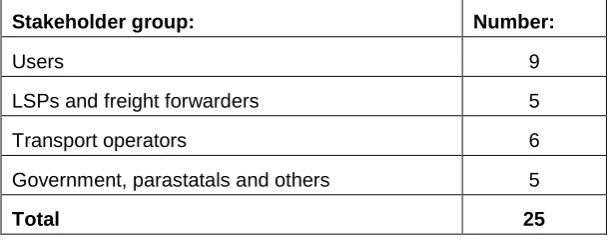
This study focuses on exploring the contemporary issues and trends in the Namibian logistics industry. As there was a dearth of published information on the state of the logistics industry in Namibia, the initial research design was primarily explorative with the objective of establishing a focus for future work (Blumberg et al., 2011). Semi-structured interviews were used to collect primary, qualitative data from the stakeholders. The major questions were the same in each interview but the interviewer was free to alter the sequence of questions and probe for greater detail to explore emergent issues in greater depth (Fielding & Thomas, 2003). To ensure consistency, an interview schedule was developed that elicited general information about the organisation, operations, cost and time management, technology and infrastructure as well as future issues for the organisation and the country. Where appropriate, the questions featured a semi-quantitative section to determine where the interviewee felt their company or the country fitted on the continuum of the facet being examined. Suitable organisations were selected from the 2010/2011 Transport Directory for Southern Africa (transport operators and freight forwarders) and telephone directories (users and other non-transport specific stakeholders) with organisations being purposively selected to reflect the type of stakeholder and geographical diversity. The use of such a non-probability sampling design is suitable for exploratory research (Blumberg et al., 2011), as its objectives do not require generalisations and statistical estimations (Saunders et al., 2007). 25 interviews were undertaken in the first phase of the research and were classified by the different stakeholder groups – see Table 1.
Stakeholder group: Number:
Users 9
LSPs and freight forwarders 5
Transport operators 6
Government, parastatals and others 5
[image:3.595.65.372.589.710.2]Total 25
Table 1: Number of interviews per stakeholder group
and analysed using the data matrices approach as recommended for cross-site, qualitative data analysis by Cassell and Nadin (2008). The aim of this method is to produce a matrix, analysing similarities or differences by row or column to provide accessibility to large amounts of qualitative data. In this case, although each interview was provisionally associated with a stakeholder group, the data was then examined in its entirety to determine factors that related to categories and sub-categories, irrespective of the source of those data. Subsequently, it was possible to compare the responses by stakeholder group to check for commonality and differences. Further, by creating “cross-category codes” and re-examining the matrices, it was also possible to see if the data contained other relevant groupings besides those of the initial stakeholders identified by the team.
Triangulation was carried out between interviews, with published data and, where appropriate, with established logistics theory. Although the sample was not large, its results were remarkably consistent. The Phase I report was published in various forms and the findings presented at the 4th NGCL Annual Logistics & Transport Walvis-Bay, September, 2012, which gave an opportunity for interested parties to provide input to the subsequent stages. Although the presentation generated great interest and animated comment, none of the stakeholders disputed the findings, which, in turn, tends to further support their credence. Many of the stakeholder comments have been incorporated into this paper to modify or expand on the initial conclusions.
Findings
There was general agreement on the high importance of logistics to Namibia. Most people seem to be quite optimistic, believing that Namibia has the potential to act as the main supply channel for imports to itself and other countries in the region. Some people, however, were very concerned about the lack of government knowledge about the role and importance of logistics.
As with any country, some of the factors affecting logistics relate to its geography and history. The most frequently occurring issues related to the continuing influence of South Africa although others seemed more concerned with technical factors such as IT & accounting systems.
Other geographical factors affecting Namibian logistics include those related to borders such as, customs, delays, control paperwork and charges. There are signs of potential improvement such as a system that shares border control data and a ‘Transport Observations’ system that reports KPIs. Although opinions varied both across and within the stakeholder groups, the key issues affecting the operations and development of the logistics industry in Namibia were found to be:
The absence of an effective rail network.
Road capacity and conditions
Limited harbour capacity
Lack of qualified staff, education & training
Racial issues, legislation and corruption
Attitude, service and culture
Cross-border issues & customs
Costs (e.g. transport rates)
Other
Another area of concern was sustainability. Although most respondents were aware of the environmental issues, their attitude was extremely variable and usually showed low commitment to action. Some interviewees did show interest in recycling and in-house green practices where there was an immediate cost saving.
Whilst the importance of commercial sustainability was almost universally acknowledged, views on the degree of that sustainability varied and often showed concern, e.g. some people recognised their interdependence with other companies for commercial continuance, which led to a feeling of vulnerability, especially to transport operators and LSPs.
Conclusions
The state, understanding & views of logistics.
reinforced by the emphasis placed on logistics by the Namibian government in its latest National development Plan (NDP_4). The degree of importance ascribed to logistics varies across the stakeholder groups, as does the understanding of its concepts. In general, the greater the understanding of logistics, the greater is the appreciation of its importance and, the higher up the logistics “food chain” the individual sits, the more likely they are to view that importance from the altruistic point of view of national development rather than that of self-interest and short term profit. Views of the state of logistics varied. Almost all respondents recognised that the current system works and delivers goods across the country as well as to and from its neighbours. The difference becomes apparent in the assessment of the efficiency and effectiveness of that system, its potential for development and, importantly, whether it has the capability to be an enabler of, or a barrier to, Namibia’s future development. In many cases such differences appeared to align either with the stakeholder category or with the size of the organisation.
In a pseudo-quantitative sense the World Bank logistics indicators for 2012 rank Namibia in 69th place overall (out of 155), which places it above the other SADC countries with the exception of South Africa (19th), (World Bank, 2012a). This also suggests that she is “doing well”, but has plenty of scope for improvement.
Geography & infrastructure
Namibia has a key position on the west coast of southern Africa between Angola and South Africa. She has the potential to service land-locked countries such a Botswana and Zambia, but her geographical positioning and size also impose difficulties because of the distances involved, which make the haulage costs and times high.
Furthermore, the vast size of the country, combined with the low population and very limited industrialisation, poses problems in terms of the cost of maintaining the infrastructure. This is exemplified by the high road density per head of population. At 22km/1000 people, this is the highest in the SADC region and represents a significant funding problem. The low critical mass in terms of trade volumes also reduces opportunities to benefit from economies of scale. One way of ameliorating these problems is to boost volumes and potential revenue by increasing the through trade to the landlocked countries as well as to / from South Africa and Angola. Facilitating such trade is one of the key functions of the Walvis-bay Corridor Group. The volume of goods moved along the corridors grew by 33% between 2005 and 2009, despite a dip in 2010 (World Bank, 2012b). According to (Boois, 2012) a great deal of the increase has occurred in the outbound rather than inbound volumes, despite the current perception that general trade is unidirectional. These figures are extremely encouraging and support the views of some respondents who affirmed that the attraction of Walvis-bay comes not just from its location, but from the ease of doing business there and the fact that, until recently, there was little port congestion.
To exploit this positional opportunity further will require considerable development. The most obvious immediate restriction concerns the limitations of the existing port, road & rail infrastructure, which are now being placed under strain as the recent congestion suggests (Boois, 2012). The bigger prize can only be obtained by exploiting the regional location by establishing a network of logistics hubs at the port, key Namibian locations and in the other SADC countries. This would have the potential to attract increased international shipping and trade, which in turn could help change the economy of scale and provide an opportunity to address productivity issues. To be successful would require massive, coordinated infrastructure development, international cooperation and, importantly, a significant change of attitude / culture within the industry. Infrastructure here includes the development of terminals with intermodal capability which would need major capital investment in port equipment, road and, especially, rail development as well as associated systems that should incorporate port management, customs and load scheduling. It is clear that the effort and costs involved would almost certainly require international investment and public / private partnerships. Timing is also key; even if the perfect system were to be created, there is no guarantee that the resulting connectivity would
produce sufficient international traffic to ensure a payback in a viable time – but, it is certain that the
Importantly, whatever approach is followed it is unlikely to be successful unless it is accompanied by a sea-change in culture and attitude within the industry.
Service, education & training
The “gateway & hub” option seems to represent the greatest potential for the development of Namibia through its logistics industry. Whether the challenge it represents is accepted or not, it is clear that there are a number of issues that need to be addressed for that industry to grow. There is no doubt that the existing system works, but it lacks efficiency and does not seem to have the capacity to absorb a great deal of additional volume or to successfully compete with international rivals, whether at home or abroad. In a sentence, “It is good, but not good enough”.
Increased volumes will not be attracted unless some basic issues are addressed. Key amongst these is the attitude to service. Clearly, the service offered is the choice of the provider and, if local
operators wish to provide only a “modest” level, that is their concern. However, if Namibia wishes to
compete internationally and win greater global trade, the country must provide the service standards expected by the global community. In Namibia it appears that operators and, in some cases users, often do not appreciate the concept of service, especially that expected in international markets. Since “the whole purpose of logistics is to provide customers with the level and quality of service that
they require and to do so at less cost to the total supply chain” (Christopher, 1998), it is essential to
identify, and supply, the necessary service level. “Globally, the successful output of customer service considerations will be a satisfied customer, which should lead to increased profitability”, (Grant et al.,
2006). If Namibia wishes to compete, this challenge must be faced.
To support this there is a need for training and education. Training is needed to enable drivers, warehousemen and other operators to work as effectively and efficiently as possible. Whereas education is needed to allow supervisors and managers to develop sound systems for those operations and help their organisations evolve. It is also essential to foster understanding of the concepts of service and of process flows at all levels. Many organisations make use of qualified overseas staff, which helps boost operating practices whilst local capacity is being built. Unfortunately, this is often frustrated by government red-tape and other issues which need to be addressed.
Operations & connectivity
Connectivity, whether at a local, national or international level is essential, as is interaction between stakeholders. This requires strong communication and IT systems, but these cannot be designed and will not be used effectively unless there is a better level of understanding of what is possible and needed. This again requires education and training. Systems, both operational and IT, whilst designed to suit logisticians’ needs, must not be restricted to their obvious immediate requirements. Rather, where appropriate, they must encompass other stakeholders: manufacturers, retailers, importers and the like as well as related service providers such as customs and the parastatals. Parastatals and similar bodies must be integrated into all project plans. It is easy to criticize their apparent recalcitrance, slowness and siloism, but unless they and private companies are made jointly responsible, projects will always fail or arrive at sub-optimal solutions. It is also essential that projects are implemented, rather than simply mooted. Further, their output must be subject to evaluation, monitoring and review. Without feedback, none of the parties concerned with project outcomes could make informed decisions about whether and how to adjust the design or implementation arrangements to better achieve the intended objectives (Mosse & Sontheimer, 1996). This will require education and may necessitate changes in management appointments and practises in both the public and private sectors, but again, unless such measures are taken, success will be limited.
On the operational front there is a need for specialist systems at company, group and national levels.
Such “community” systems can be costly to initiate and require open cooperation, but have great
Sustainability
Perhaps the final piece of the jigsaw concerns the green agenda. As Mangan, Lalwani, & Butcher, (2008) suggest, one must consider the question; “How can a firm survive and grow in a sustainable manner without having adverse impacts on future generations, and specifically; what is the role of logistics and SCM in this context?”. The findings show that there is a tendency to postpone addressing environmental issues in favour of projects with a more immediate financial benefit. This is a very short-sighted approach because: firstly green thinking often brings financial benefits, secondly legislation from neighbouring or overseas countries may force the issue, thirdly international requirements may make non-compliant companies un-competitive and lastly much of Namibia’s attraction as a tourist venue is its flora, fauna and lack of pollution. Logisticians, like everyone else, have a duty to improve efficiency and effectiveness without jeopardising the future of the country and, ultimately, the planet.
Limitations
This paper represents the output from a study into the current state of logistics in Namibia. As with all research, it is subject to limitations, which in this case includes the initial number of interviews carried out. These were targeted in a “purposeful” manner to try to capture the views of a broad cross-section of the stakeholder groups rather than targeting a specific sector. Whilst it is not possible to ascertain the success of this tactic in statistical terms, it has enabled the researchers to put together an overall picture of Namibian logistics with its strengths and weaknesses that, as well as being informative in its own right, can direct future investigations and serve as a “benchmark” for comparison. Although the sample was not large, its results were remarkably consistent.
A further key limitation is implied by the nature of the data collected, which is qualitative rather than quantitative and is essentially opinion based. As mentioned already, findings have been validated by internal comparison using the analysed matrices and, where possible / appropriate, with available quantitative data. Further, subsequent comparison between this project’s findings and those of the World Bank’s “policy note” (World Bank, 2012b) show a remarkable degree of correlation.
Future work.
This paper is based on the findings of the first phase of a study modified by additional interviews and discussion. The next priority is to carry out and analyse further interviews to increase the sample size. As well as increasing the volume of the sample, this will give more depth to some stakeholder groups. The results so far have suggested a number of areas that would warrant a dedicated research including: rail & intermodal transport, “green logistics” and the environment, “hubs” and supply chain linkages, logistics related information technology (including customs, border and brokerage systems). This would require careful focus and more quantitative data. There may also be scope for some “soft skills” type work in areas such as attitude assessment, change management, education or cultural issues and their impact. Where appropriate this work could be carried out in collaboration with other academic institutions, government or industry.
Recommendations Opportunities and issues
There are reasons to be optimistic about the state of logistics in Namibia and the potential
opportunities for its future development. Namibia’s government and businesses would like to build a
Priorities
For both financial and practical reasons, it is impossible to mount a successful attack all of the problems simultaneously; therefore, there is a need to prioritize. Based on the initial research modified by subsequent stakeholder comments and discussions, the writers of this article suggest the following approach:
1. Attitudes to service level.
Instigate a programme of education to make Namibian logisticians, associated businesses and people aware of the implications and impact of poor attitude and service.
2. Attitudes to corruption.
There is a need to address corruption in all forms and at all levels. The person complaining bitterly about government or ministerial misappropriation of funds may themselves be using or influencing resources in a manner that benefits them, their tribe or others without apparently realizing that this is both corrupt and damaging to the future of the logistics industry and the country.
3. Addressing processes and “siloism”
Throughout the industry and the country as an whole there is a prevalence of bureaucracy that encourages inefficiency and poor service. Often this is because individuals have no appreciation of the real purpose of their task or its role in an overall process.
This can only be addressed by studying complete processes / organisations and subjecting them to
critical examination to develop efficient and effective methods before instigating training.
4. Infrastructure, major projects and collaboration
There is a need to carry out a review of the network infrastructure needed to support the gateway / hub concept. Where necessary, this must extend beyond national boundaries to include cooperation with other SADC countries to enable the development of a prioritised and sequenced series of infrastructure projects that can be addressed logically rather than at the “whim” of government, individual companies or interested investors. Any major projects accruing from such reviews will require extensive cooperation between government, industry, other stakeholders and investors which would most probably be achieved through public / private investment. Whatever the investment mechanism, it is essential that such projects be governed to international standards that would include evaluation based on measurable, time and cost based targets.
5. Funding and government commitment.
Priorities should be based on importance and potential yield. The latter is not always obvious or simple to calculate: For example, education and training have the potential to pay dividends whether or not they are associated with a specific project or even if a planned project is not completed. By contrast, incomplete or inappropriate infrastructure work will simply absorb cash and effort whilst not improving efficiency, and may even make matters worse.
Timing for success
Timing is of the essence and positioning on this list should not be used as an excuse to delay other work. It could be possible to start various projects simultaneously, but the resource allocation also needs to be prioritised. It is vital that projects requiring capital outlay are fully researched before funds and effort are committed. Modelling, especially of infrastructure projects can check for optimal outcomes and avoid waste. As Poole and Szymankiewicz (1977) point out “we [modellers] rub out our mistakes with an eraser, not a bulldozer!”.
For the moment, one can conclude that Namibia’s logistics industry serves its purpose and has a number of good features. It cannot, however, afford to stand still and, with government / international
support, must address the issues identified in this paper. If Namibia’s leaders can make the right
decisions and gain the support of commerce to action them in a timely manner, the country may engineer a dynamic logistics industry. Further, she may have the potential to build a successful logistics hub, become the gateway to southern Africa by hosting supply chains fit to serve the global trading community and thus reap the rewards of increased trade and inbound investment. If she fails
to develop, does so half-heartedly or too late, or ignores service levels she will “miss the boat”. The
Bibliography
African Development Bank, (2007), ‘African Economic Outlook: Namibia’, Abidjan: AIBD.
Blumberg, B., Cooper, D. & Schindler, P., (2011), Business Research Methods, London:
McGraw-Hill.
Boois, G., (2012), ‘Comment on World Bank policy note’, In Policy Note Seminar, Windhoek, 8
June 2012.
Cassell, C. & Nadin, S. (2008). Matrix Analysis. In R. Thorpe, & R. Holt, The Sage Dictionary
of Qualitative Management Research. London: Sage
Christopher, M., (1998), Logistics & Supply Chain Management, 2nd ed, Financial
Times/Prentice Hall.
Cilliers, W. & Nagel, P., (1994), ‘Logistics Trends in South Africa’, International Journal of
Physical Distribution & Logistics Management, 24(7), pp.4-14.
Clerck, G., (2008), ‘Industrial relation in Namibia since independence: Between neo-liberalism
and neo-corporatism? Employee Relations’, 30(4), pp.355-71.
Fielding, N. & Thomas, H., (2003), Qualitative Interviewing, In Gilbert, G. Researching social
life. London: Sage Publications.
Grant, D., Lambert, D., Stock, J. & Ellram, L., (2006), Fundamental of Logistics Management.
European ed Edition, McGraw-Hill Higher Education.
Jenkins, A., Fransman, L. & Savage, C., (2012), ‘Logistics in Namibia: Issues and challenges’,
In 2nd Carpathian Logistics Congress (CLC), Jesenik, Czech Republic, 2012.
Mangan, J., Lalwani, C. & Butcher, T., (2008), Global logistics and supply chain management.
1st ed, Chichester: John Wiley & Sons Ltd.
Mckinnon, A. & Ge, Y., (2006), ‘The potential for reducing empty running by trucks: a
retrospective analysis’, International Journal of Physical Distibution & Logistics Management,
36(5), pp.391-410.
Mosse, R. & Sontheimer, L., (1996), ‘Performance monitoring indicators handbook’, Technical
Paper 334, Washington D.C: The World Bank.
National Planning Commission, (2012), ‘NDP_4: Changing gear towards vision 2030’,
Windhoek, Namibia.
Poole, T. & Szymankiewicz, J., (1977), Using simulation to solve problems, London, New
York: McGraw-Hill.
Republic of Namibia, (2008), ‘Third National Development Plan (NDP_3)’, [Online] Available
at: http://www.npc.gov.na/docs/NDP3_Executive_Summary.pdf [Accessed 2012 July 05].
Republic of Namibia, n.d. ‘Namibia Vision 2030’, [Online] Available at:
http://www.npc.gov.na/vision/pdfs/Chapter_3.pdf [Accessed 28 September 2012].
Saunders, M., Lewis, P. & Thornhill, A., (2007), Research methods for business students,
Harlow: Financial Times / Prentice Hall.
Savage, C., (2013), ‘Becoming a regional gateway by developing logistics hubs: A blessing or
a curse’, In International conference on Business Innovation and Growth (Botswana).
Gaborone, 2013.
Savage, C.J., Fransman, L. & Jenkins, A., (2012), Logistics in Namibia: Issues and
Challenges, Windhoek: Polytechnic of Namibia.
World Bank, (2009), ‘Namibia Country Brief’, [Online] Available at: http://site.ebray.com/lib/uoh
[Accessed 2012 July 10].
World Bank, (2012a), Gini Index, [Online] Available at:
http://data.worldbank.org/indicators/SI.POV.GINI/ [Accessed 07 May 2012].