Munich Personal RePEc Archive
Variable-population voting rules
Pivato, Marcus
Department of Mathematics, Trent University
28 June 2011
Online at
https://mpra.ub.uni-muenchen.de/31896/
Variable-population voting rules
Marcus Pivato, Trent University, Canada
June 28, 2011
Abstract
LetX be a set of social alternatives, and letV be a set of ‘votes’ or ‘signals’. (We do not assume any structure on X or V). A variable population voting ruleF takes any number of anonymous votes drawn from V as input, and produces a nonempty subset of X as output. The rule F satisfies reinforcement if, whenever two disjoint sets of voters independently select some subset Y ⊆ X, the union of these two sets will also selectY. We show thatF satisfies reinforcement if and only ifF is abalance rule. If F satisfies a form of neutrality, thenF is satisfies reinforcement if and only if F is a scoring rule (with scores taking values in an abstract linearly ordered abelian group R); this generalizes a result of Myerson (1995). We also discuss the sense in which the balance or scoring representation of F is unique. Finally, we provide a characterization of two scoring rules: formally utilitarianvoting and range voting.
1
Introduction
Suppose a group of voters must collectively choose some policy from a set of alternatives,
using a voting ruleF. Suppose we split the voters into two subgroups, and each subgroup,
using rule F, selects the alternative x. Then it seems desirable that the combined group,
using F, should also select alternative x. We say the rule F satisfies reinforcement1 if it
has this property. Smith (1973) and Young (1974b, 1975) showed that ‘scoring rules’ are
the only preference aggregation rules2 which satisfy reinforcement and are anonymous and
neutral (i.e. invariant under relabeling of the voters and/or alternatives). These results have led to characterizations of the Borda rule (Young, 1974a, 1975; Nitzan and Rubinstein, 1981), Kemeny rule (Young and Levenglick, 1978), and plurality rule (Richelson, 1978; Morkelyunas, 1982; Ching, 1996; Yeh, 2008) each as the only preference aggregation rule which satisfies reinforcement along with certain other axioms.
Myerson (1995) generalized the Smith-Young results from preference aggregators to abstract voting rules. In Myerson’s framework, there is a finite set of social alternatives
1Smith (1973) calls this condition ‘separability’, while Young (1974b, 1975) calls it ‘consistency’. Dhillon
(1998) and Dhillon and Mertens (1999) refer to an analogous property as ‘extended Pareto’.
2Smith (1973) and Young (1974b) consider rules which produce social preference relations as output,
X and a finite set of ‘signals’V. A ‘profile’ assigns a signal to each voter, and an abstract
voting rule selects some nonempty subset of X for each profile. A scoring rule is a voting
rule where each element of V assigns a real-valued ‘score’ to each element of X; the rule
then selects the alternative(s) with the highest total score.3 Myerson showed that if an
abstract voting rule satisfied reinforcement, universal domain (i.e. it is defined for all profiles), a form of neutrality (i.e. all social alternatives are treated equally), and an
Archimedean/continuity condition he called overwhelming majority, then it was a scoring
rule. For example, approval voting (Brams and Fishburn, 1983) is a scoring rule —indeed, it is the only abstract voting rule which satisfies reinforcement along with certain other axioms (Fishburn, 1978; Morkelyunas, 1981; Al´os-Ferrer, 2006).
In section 2, I extend Myerson’s representation theorem, by considering infinite signal sets, and removing the hypotheses of universal domain and overwhelming majority. I do this by considering scoring rules where the scores can range over an abstract linearly
or-dered abelian group, instead of ranging over the real numbers.4 I also characterizebalance
rules (another class introduced by Myerson (1995)), the formally utilitarian voting rule,
and the range voting rule. Next, section 3 shows that the ‘neutrality’ (i.e.
permutation-equivariance) properties of a voting rule can be reflected by corresponding neutrality prop-erties of its balance representation or scoring representation. Section 4 considers the sense in which a real-valued balance representation or scoring representation of a voting rule is unique up to some set of ‘rescalings’. Section 5 studies the relationship between balance and scoring rules in more detail. Section 6 concludes with some open problems. Appendix A provides some background on linearly ordered abelian groups. Appendix B contains the proofs of all results in the paper. Appendix C contains further uniqueness results.
2
Model and main results
LetX be a set of social alternatives, and letV be the set of possible signals which could be
sent by each voter. (The setsX andV could be finite or infinite.) Let N:={0,1,2,3, . . .} and Z :={±n; n ∈N}. For any n ∈ZV, letknk :=P
v∈V |nv|. Define NhVi :={n∈ NV;
knk <∞}. If n ∈NhVi, thenn represents an anonymous profile of voters: for each v ∈ V,
we interpret nv as the number of voters sending the signal v, while knk is the size of the
whole population. Note that we do not fix knk in advance. A domain is any collection of
profilesD ⊆NhVisuch that0∈ D. (The setNhViitself is theuniversal domain.) A(variable
population, anonymous) voting rule is a correspondence F : D ⇉ X such that F(0) = X.
Thus, for all d∈ D, the outcome F(d)⊆ X is a nonempty set (typically a singleton).
A linearly ordered abelian groupis a triple (R,+, >), whereRis a set, “+” is an abelian
group operation, and “>” is a complete, antisymmetric, transitive binary relation such
that, for all r, s∈ R, if r > 0, then r+s > s. (For example: the set R of real numbers
is a linearly ordered abelian group, with the standard ordering and addition operator. So
is any subgroup of R. For any n ∈ N, the space Rn is a linearly ordered abelian group
3Zwicker (2008) has shown that such scoring rules can also be interpreted as ‘mean proximity rules’:
each element ofV andX is represented as a vector inRN, and the social choice is the element ofX which
is closest to the vector average of the signals of the voters.
under vector addition and the lexicographic order.) Such groups are useful for representing infinite-horizon intertemporal preferences, non-probabilistic uncertainty, and preferences where some decision variables have lexicographical priority over others (Pivato, 2011).
For any r = (rv)v∈V ∈ RV, we define a group homomorphism r : ZhVi−→R by setting
r(z) := Pv∈Vzvrv for all z ∈ ZhVi.5 An R-valued score system on (X,V) is an X-indexed
collection S:={sx}
x∈X ⊂ RV. For any domainD ⊆NhVi, the scoring ruledetermined byS
is the voting rule FS :D⇉X defined as follows:
FS(d) := argmax
x∈X s
x(d), for all d∈ D.
Intuitively, sx(d) is the ‘score’ which alternative x receives from the profile d; each voter
who sends the signalvcontributessx
v ‘points’ to this score. The alternative with the highest
score wins.
For example, plurality vote is a scoring rule with V = X, and R = Z, and sx
v = 1 if
x = v, while sx
v = 0 if x 6= v. Approval vote is a scoring rule, where V is the set of all
subsets of X, and R = Z, and sx
v = 1 if x ∈ v, while sxv = 0 if x 6∈ v. The Borda rule is
a scoring rule where V is the set of all strict preference orders over X, and R = Z, and
sx
v = r if x is ranked rth place from the bottom in the preference order v. If (Y, d) is a
metric space, and X,V ⊆ Y, then the median rule is the scoring rule where R = R, and
sx
v =−d(x, v) for allx∈ X and v ∈ V. This rule picks the element(s) ofX which minimize
the average distance to the signals sent by the voters. (If X = V ⊆ R with the standard
metric, then this is the usual notion of the median of a collection of real numbers.) For
example, the Kemeny rule is a median rule where X =V is the set of all strict preference
orders over some setA of alternatives, and dis the Kendall metric onX (sod(x, v) is the
number of pairwise comparisons on which the orderings x and v disagree).
There are also several scoring rules where R = R and V is some subset of RX, and
sv
x := vx for all v ∈ V and x ∈ X. Formally utilitarian voting is obtained by setting
V :=RX.6 Range votingis obtained by setting V := [0,1]X
(Smith, 2000; Gaertner and Xu, 2011). Relative utilitarianism is obtained by setting V :={v ∈ [0,1]X; minx∈X vx = 0 and
maxx∈X vx = 1} (Dhillon, 1998; Dhillon and Mertens, 1999). Finally, cumulative voting is
obtained by setting V :={v∈[0,1]X; Px∈X vx = 1}.
Now suppose we first apply one scoring rule Fa, and then use a second scoring rule Fb
onlyto break any ties which arise inFa. This can be modelled as anR-valued scoring rule,
where R = R2 with the lexicographical order. For example, the procedure, “first apply
approval vote; then break any ties using the Borda rule” can be modelled by defining
V =Va× Vb, whereVa :={all subsets of X }and Vb :={all preference orders overX }. For
any (va, vb) ∈ Va× Vb, we set s(va, vb) := (sa(va), sb(vb)) ∈ R2, where sa is the approval
score system andsb is the Borda score system (as described above).
5Thus, ifR=R, thenr(z) =r•z, where “•” is the inner product operation onRV. 6‘Formally’ utilitarian voting corresponds to the
Hahn’s Embedding Theorem says thatanylinearly ordered abelian group is isomorphic
to an ordered subgroup of a lexicographically ordered vector spaceRI, whereI is (possibly
infinite) linearly ordered set.7 Thus, any scoring rule can be interpreted as a (possibly
infinite) chain of real-valued scoring rules, each acting as a tie-breaker for the prior ones. Let (R,+, >) be a linearly ordered abelian group. LetD ⊆NhVibe a domain of profiles. AnR-valued balance systemon (X,V,D) is anX2-indexed collectionB:={bx,y}
x,y∈X ⊂ RV
such that bx,y = −by,x for all x, y ∈ X (in particular, bx,x = 0 for all x ∈ X), and such
that,
max
x∈X miny∈X b
x,y
(d) ≥ 0, for all d∈ D. (1)
We then define the balance rule FB : D ⇉ X as follows: for all d ∈ D and x ∈ X, we let
x ∈ FB(d) if and only if bx,y(d) ≥ 0 for all y ∈ X. (The condition (1) is equivalent to
stipulating that FB(d)6=∅ for all d∈ D.)
Example 2.1. (a) Let S = {sx}
x∈X be an R-valued score system on (X,V). For all
x, y ∈ X, define ∇x,yS:= sx−sy ∈ RV, to obtain a balance system ∇S :={∇x,yS} x,y∈X. Then F∇S(n) =FS(n) for all n∈NhVi.
(b) LetV be the set of all nonstrict preference orders overX. For allx, y ∈ X and v ∈ V,
define bx,y
v := 1 if v prefers x to y, while bx,yv :=−1 if v prefers y to x, and bx,yv := 0 if v
is indifferent between x and y. Then FB is the Condorcet rule: for any n ∈ NhVi, we have
x ∈F(n) if and only if x is a Condorcet winner in the profile n (i.e. for any other y∈ X,
at least as many voters strictly preferx overyas the number who strictly prefery overx).
Unfortunately, F(n) = ∅ for some n ∈ NhVi (the ‘Condorcet paradox’). Let D ⊂ NhVi be
the set of all profiles having a Condorcet winner. Then FB :D ⇉X is a balance rule. ♦
Let D ⊆ NhVi. A voting rule F :D ⇉X satisfies reinforcement if the following is true:
for any n,m∈ D, ifF(n)∩F(m)6=∅, then n+m∈ D, and F(n+m) = F(n)∩F(m).8
Here, the profile (n +m) represents a union of two disjoint subgroups, represented by
profiles n and m. Reinforcement says: if x ∈ X and both n and m endorse x (i.e.
x∈F(n) and x∈F(m)), then we should have x∈F(n+m). Furthermore, in this case,
F(n+m) should consist of only those x ∈ X which receive this joint endorsement. We
now come to our first main result:
Theorem 2.2 Let X and V be arbitrary sets, let D ⊆ NhVi be any domain, and let F : D⇉X be a voting rule. Then F satisfies reinforcement if and only if F is a balance rule.
Not every balance rule is a scoring rule, even if we require D = NhVi (see Example
5.2 below). Thus, we must add some other hypotheses to reinforcement to characterize
scoring rules. Let ΠV be the group of all permutations of V. For any n ∈ NhVi and
π ∈ ΠV, we define π(n) := m, where mv := nπ−1(v) for all v ∈ V. Let ΠX be the group
of all permutations of X. A voting rule F : D ⇉ X is neutral if there exists a group
homomorphism ν : ΠX−→ΠV (the neutralizer) such that, for all π ∈ ΠX, if πe := ν(π),
7See Hausner and Wendel (1952). 8Note that we do
then the domain D is eπ-invariant, and F (eπ(d)) = π(F(d)) for all d ∈ D. Thus, every
alternative in X is treated equally: for any x, y ∈ X, and every profile d ∈ D such that
x∈F(d), there exists some permutationd′ of d such that y∈F(d′).
For any π ∈ ΠV and any r ∈ RV, we define rπ ∈ RV by (rπ)v = rπ(v) for all v ∈ V.
Let ν : ΠX−→ΠV be a homomorphism. A score system S={sx}
x∈X is ν-neutral if, for all
π ∈ ΠX and x, y ∈ X, if π(y) = x and eπ := ν(π), then sx
e
π = sy. Except for abstract
median rules, all the scoring rules mentioned above (including the Kemeny rule) have
neutral score systems, with the obvious neutralizers. A domain D ⊆ NhVi is a cone if
d1 +d2 ∈ D whenever d1,d2 ∈ D, and also, d ∈ D whenever nd ∈ D for some n ∈ N.
(For example, the universal domain NhVi is a cone.) Here is our second main result:
Theorem 2.3 Let X be a finite set, let V be any set, let D ⊆ NhVi be a cone, and let
F : D ⇉X be any voting rule. Then F is neutral and satisfies reinforcement if and only
if F is a scoring rule with a neutral score system.
Thus, combining reinforcement with neutrality yields a scoring rule with a neutral score system. By combining reinforcement with weaker (but more technical) hypothesis, we can also obtain scoring rules with non-neutral score systems (see Proposition 5.3).
Theorem 2.3 considers a rule F defined on a domain D ⊆ NhVi. Given a score system
S, we have FS(n) 6= ∅ for all n ∈ NhVi; thus, the scoring representation offers a way to
‘extend’F fromD to all ofNhVi. However, we might still wish to restrict FS to the smaller
domain D. For example, suppose we have adopted F on the basis of certain normative
criteria which only make sense inside D (e.g. Condorcet consistency). If n ∈ NhVi\ D,
then we might regard the value of FS(n) as a meaningless artifact; the normative criteria
which justifyF inside D do not apply at n.9
A voting rule F satisfies overwhelming majority10 if, for any n,n′ ∈ NhVi, there exists
some M ∈ N such that, for all m > M, we have F(mn+n′)⊆F(n). This means: if one
sub-population of voters (represented bymn) is much larger than another sub-population
(represented by n′), then the choice of the combined population should be determined
by the choice of the larger sub-population —except that the smaller sub-population may act as a ‘tie-breaker’ in some cases. Myerson (1995) showed that, if the voting rule in Theorem 2.3 satisfies overwhelming majority, then not only is it a scoring rule, but the score system is real-valued. Our next result makes an analogous statement for the balance
rule in Theorem 2.2, without assuming neutrality. A voting rule F : NhVi ⇉ X satisfies
the tie condition (TC) if, for all distinct x, y ∈ X:
(TC1) There exists some n ∈NhVi with F(n) ={x, y}.
(TC2) For any finiteW ⊆ V, there exists somem∈NhVisuch thatm
w >0 for allw∈ W,
and F(m)⊇ {x, y}.
9
A similar remark applies to a balance ruleFB :D⇉X. There may exist other profiles n∈NhVi\ D
which satisfy the nontriviality condition (1), so that FB(n) 6= ∅. But the fact that FB is well-defined
outsideDdoes not imply that society is normatively compelled to apply FB outsideD.
For example: any nontrivial neutral balance rule satisfies TC (see Lemma B.9).
Proposition 2.4 Let F : NhVi ⇉ X be a balance rule satisfying TC. Then F satisfies overwhelming majority if and only if F =FB for some real-valued balance system B.
Theorem 2.3 makes the class of scoring rules quite attractive. What is the ‘best’ scoring
rule? Our last two major results offers two possible answers to this question. Let V and
W be two sets, and letα :W−→V. Defineα∗ :NhWi−→NhVias follows: for any n∈NhWi,
and any v ∈ V, α∗(n)v := P{nw; w ∈ W and α(w) = v}. Given two voting rules
F : NhVi ⇉ X and G : NhWi ⇉ X, we say that F is at least as expressive as G if there
is a some function α : W−→V such that, for all n ∈ NhWi, F(α∗(n)) = G(n). Thus, for
any w ∈ W, voting for w in the rule G is effectively equivalent to voting for α(w) in F.
Thus, the voters can express any profile of opinions viaF which they could have expressed
via G. The rule F is the most expressive member of some class of rules if it is at least as
expressive as every other element of that class.11
Proposition 2.5 Let X be a finite set. Formally utilitarian voting is the most expressive X-valued voting rule which satisfies reinforcement, neutrality, and overwhelming majority.
For anyv ∈ V, define1v ∈NhVi by (1v)
v := 1, whereas (1v)w := 0 for allw ∈ V \ {v}. A
voting rule F :NhVi ⇉X admits minority overrides if, for anyn∈NhVi, there is somev ∈ V
such thatF(n+1v)6=F(n). Thus, regardless of the size of the populace and the weight of
existing public opinion, a single voter can always cast a vote which changes the outcome. Such ‘overrides’ not only generate political instability; they are arguably undemocratic.
It might be better if F did not admit minority overrides.12 If V is finite, then any rule
satisfying overwhelming majority will not admit minority overrides.13 However, we will be
interested in the case when V is infinite. For neutral voting rules, an absence of minority
overrides is effectively equivalent to imposing upper and lower bounds on the scores which voters can assign to alternatives (see Lemma B.11). For example: formally utilitarian voting admits minority overrides, but all of the other aforementioned scoring rules do not.
Proposition 2.6 Let X be a finite set. Range voting is the most expressive X-valued voting rule which satisfies reinforcement, neutrality, overwhelming majority, and does not admit minority overrides.
Despite Propositions 2.4, 2.5, and 2.6, overwhelming majority is not always normatively compelling. In some cases, a non-real-valued scoring system may be more appropriate.
11If we are interested in maximizing expressiveness, then it does not make sense to impose domain
restrictions. That is why we have assumed the universal domainD=NhViin this paragraph and the next
two results.
12Of course, there will always be
someprofiles where a single voter can change the outcome; the point is that this should not be true forallprofiles.
13Proof. Findn∈NhVi such that |F(n)|= 1. IfM ∈N is large enough, then overwhelming majority
Example 2.7. Let X be a two-dimensional policy space. That is: X ⊂ X1 × X2, where
X1 is a space of alternatives in one ‘policy dimension’, while X2 is a space of alternatives
along some other dimension. Note that X is a proper subset of X1× X2 —not all policy
combinations are feasible. Suppose X1 is considered to be lexicographically prior to X2
(e.g. X1 represents basic human rights, while X2 represents GDP). For j = 1,2, let Vj
be a space of signals, and suppose we have decided to use the R-valued score system
jS = {js
x}
x∈X ⊂ RVj on (Xj,Vj). If we simply apply the scoring rules F1S : N
hV1i ⇉ X
1
andF2S :N
hV2i⇉X
2 separately, then we may end up selecting an element of (X1× X2)\ X
—an infeasible policy. We could combine 1S and 2S into a single, R-valued score systemS
on (X,V1× V2) by defining svx11,v,x22 :=1s
x1
v1 +2s
x2
v2 for all (x1, x2)∈ X and (v1, v2)∈ V1× V2.
But this would not respect the lexicographical priority of X1 overX2.
Instead, letR:=R2with the vector addition operation ‘+’ and the lexicographical ordering
‘≻’ (i.e. (r1, r2) ≻ (s1, s2) if and only if either r1 > s1, or r1 = s1 and r2 > s2). Then
(R,+,≻) is a linearly ordered abelian group. Define an R-valued score system S on (X,V1× V2) by setting svx11,v,x22 := (1s
x1
v1,2s
x2
v2) for all (x1, x2)∈ X and (v1, v2)∈ V1× V2. ♦
3
Generalized neutrality
The two results of this section show how the neutrality properties of a voting ruleF can be
‘encoded’ in a balance system or scoring system for F. They are also key technical steps
in the proof of Theorem 2.3. Let Π′
X ⊆ΠX be any subgroup of permutations of X, and letν : Π′X−→ΠV be a group
homomorphism. For any domainD ⊆NhVi, a voting ruleF :D⇉X isν-neutralif, for all
π ∈ Π′
X, if eπ = ν(π), then D is πe-invariant and F (eπ(d)) = π(F(d)) for all d ∈ D. (For
example: let X = V be a metric space, let Π′
X be the set of all self-isometries of X, and
letν : Π′
X−→ΠX = ΠV be the inclusion map. Then the median rule on X is ν-neutral.)
A balance system B is ν-neutral if, for all x, y, x′, y′ ∈ X and π ∈ Π′
X, if x′ := π−1(x) and y′ := π−1(y) and πe = ν(π), then bx,yeπ = bx′,y′
. A score system S = {sx}
x∈X is
ν-neutral if, for all π ∈ Π′
X and x, y ∈ X, if π(y) = x and eπ := ν(π), then sxeπ = sy. A
voting rule, balance system, or score system is Π′
X-neutralif it is ν-neutral for some group
homomorphism ν : Π′
X−→ΠV (called the neutralizer).
Proposition 3.1 LetX be a finite set, letV be an arbitrary set, letD ⊆NhVi be a domain, and let F : D⇉ X be a scoring rule. Let Π′X be any group of permutations of X, and let
ν : Π′
X−→ΠV be a homomorphism. Then F is ν-neutral if and only if F = FS for some ν-neutral score system S.
The corresponding result for balance rules is a bit more complicated. Let Π′
X be a group
of permutations of X. We say that Π′
X is doubly transitive if, for all x, y, x′, y′ ∈ X with
x6=y and x′ 6=y′, there exists some π ∈Π′
X such that π(x) = x′ and π(y) = y′.
A balance system B is perfect on the domain D if, for any d∈ D, any x ∈FB(d) and
any y ∈ X \FB(d), we have bx,y(d) > 0. (For instance: Example 2.1(a) is perfect, but
Example 2.1(b) is not perfect.) Perfection simplifies the computation of F(d): once we
Proposition 3.2 LetX be a finite set, letV be an arbitrary set, letD ⊆NhVi be a domain, and let F :D⇉X be a balance rule. Let Π′X be a doubly transitive group of permutations
of X, and letν : Π′
X−→ΠV be a homomorphism. ThenF isν-neutral if and only ifF =FB
for some ν-neutral perfect balance system B.
4
Uniqueness
Theorems 2.2 and 2.3 characterize when a voting rule admits a balance representation or scoring representation. Now we consider the uniqueness of these representations. Let S := {sx}
x∈X and eS := {esx}x∈X be two real-valued score systems on (X,V). Say eS is an
affine transformofSif there existsr >0 andt∈RV such thatesx = rsx+t, for allx∈ X.
Proposition 4.1 Let X and V be finite sets, and let Π′
X be a transitive group of permu-tations onX. Let S andeS be two real-valued score systems on (X,V). Suppose the vectors {sx}
x∈X are linearly independent in RV, and FS is Π′X-neutral. Then:
(a) FS =FeS on N
V if and only if eS is an affine transform of S.
(b) IfS andeSareΠ′
X-neutral, thentπe=t for allπ ∈Π′X. In particular, if the group
e
Π′
X ={πe; π∈Π′X} acts transitively on V, then t is a constant vector.
Example 4.2. Let V :={all preference orders over X }. For any π ∈ΠX, define eπ ∈ΠV such thatπe(v) prefersπ(x) toπ(y) if and only ifvprefersxtoy. ThenΠXe acts transitively onV. Thus, if SandeSare neutral, real-valued score systems on (X,V), andFS =Fe
S, then
there exists r >0 and t∈R such that esx
v =r sxv +t for all x∈ X and v ∈ V. ♦
Suppose V is finite and B = {bx,y}
x,y∈X is a real-valued balance system on V. Given
a domain D ⊆ NV, let R
+[D] be the set of all R+-linear combinations of elements of D;
this is a convex cone in RV
+. The domain D is thick if D is closed under addition (i.e.
d1+d2 ∈ D wheneverd1,d2 ∈ D) and R+[D] has nonempty interior inRV. (For example,
the universal domain NV is thick.) For any x∈ X, define
RCx := {r∈R+[D] ; b
x,y(r)≥0, for all y∈ X }. (2)
This is a convex cone which is relatively closed inR+[D]. A subsetH ⊂RV is ahyperplane
if there is a nontrivial linear functionφ :RV−→Rsuch that H= ker(φ). A subsetB ⊂ RV
is hyperplanar if there exists a unique hyperplane H such that B ⊆ H. For any x, y ∈ X, let Bx,y := RCx ∩RCy; write “x ∼B y” if Bx,y is hyperplanar. The structure (X, ∼B ) is the
graph of the ruleFB. (This graph can be nontrivial only if the domain D is thick.)
A voting rule F : D ⇉ X is nondegenerate if, for all x ∈ X, there exists d ∈ D
with F(d) = {x}. (For example: any nontrivial, neutral balance rule is nondegenerate;
see Lemma B.8.) A balance system B is nondegenerate on D if the rule FB : D ⇉ X is
nondegenerate. We say B has no zeros if bx,y 6= 0 for any x, y ∈ X with x ∼
B y. (For
example, if Sis a scoring system, andB=∇Sas in Example 2.1(a), thenBhas no zeros if
sx 6=sy for all distinctx, y ∈ X, which holds if FS is nondegenerate.) The next result says
that, subject to these mild conditions, aR-valued balance systemBis uniquely determined
Proposition 4.3 LetX andV be finite sets, and letD ⊆ NV be a thick domain. Let Band
e
Bbe R-valued balance systems on X with no zeros, with FB nondegenerate. ThenFB =Fe
B
on D if and only if, for everyx ∼
B y∈ X, there is some rx,y >0 such that eb
x,y =r
x,y·bx,y.
Let Sbe a real-valued score system on (X,V). For anyx, y ∈ X, write “x ∼
S y” if x ∇S∼ y,
where ∇S is as in Example 2.1(a). For any z ∈ X, if x∼
S y, y
∼
S z, and x
∼
S z, then write
“(x∼
S y) ≡(y ∼S z)”. Thus, “≡” is a symmetric binary relation on the edges of the graph
(X, ∼
S ). Let “∼=” be the transitive closure of “≡”; then “∼=” is an equivalence relation on
the edges. Say S issimple if every edge is equivalent to every other edge via this relation.
(For example: if x ∼
S y for all x, y ∈ X, then S is simple.)
Proposition 4.4 Let X and V be finite sets, and let D ⊆ NV be a thick domain. Let S be a simple, nondegenerate real-valued score system on X, and let eS be another real-valued score system. Then FS =FeS on D if and only if eS is an affine transform of S.
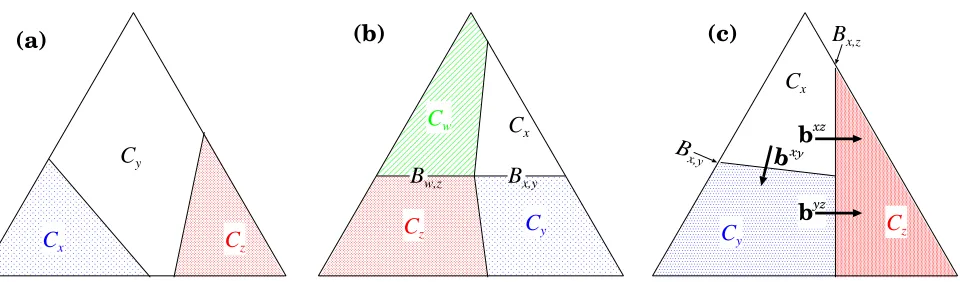
Example 4.5. IfSis not simple, then the conclusion of Proposition 4.4 does not hold. For example, supposeV ={1,2,3},X ={x, y, z}, andRCx, RCy, andRCz are as shown in Figure
1(a). Then x∼
S y and y ∼S z, but x
6∼
S z. (Thus, (x ∼S y) 6≡(y ∼S z).) Definees
x := sx+sy,
esy := 2sy, and esz = 2sz. Then: esx −esy = sx −sy and esy −esz = 2(sy −sz), so Example
2.1(a) and Proposition 4.3 imply thatFeS=FS. ButeSis not an affine transformation of S.
For another example, suppose V = {1,2,3}, X = {w, x, y, z}, and RCw, RCx, RCy, and RCz
are as shown in Figure 1(b). Then w ∼
S x
∼
S y
∼
S z
∼
S w, but w
6∼
S y and x
6∼
S z. Suppose
further that sw − sz = sx − sy (as indicated by the fact that the boundaries B
w,z and
Bx,y are coplanar in R3). Define esw := sw +sx, esx := 2sx, esy := 2sy, and esz = sz +sy.
Then clearly, esw −esx = sw −sx, esz −esy = sz −sy, andesx −esy = 2(sx−sy). Finally,
esw−
esz = (sw+sx)−(sz+sy) = (sw−sz) + (sx−sy) = 2(sw−sz). Thus, Example 2.1(a)
and Proposition 4.3 imply that FeS=FS. But eSis not an affine transformation of S. ♦
Appendix C contains an analogue to Proposition 4.3 whereBis not necessarily real-valued,
and X and V can be infinite. We do not yet have analogues for Propositions 4.1 and 4.4.
5
From balance rules to scoring rules
Not every balance rule is a scoring rule.
Lemma 5.1 Let D ⊆NhVi be a domain. A voting rule F :D ⇉X is a scoring rule if and only if F is a balance rule with a balance system B={bx,y}
x,y∈X satisfying:
bx,y(d) +by,z(d) = bx,z(d), for all x, y, z ∈ X and d∈ D. (3)
Example 5.2. LetX :={x, y, z}, letV be finite, and letD:=NV. LetL⊂RV be a proper
linear subspace, and consider an R-valued balance system B such that bx,z,by,z ∈ L, but
bx,y 6∈L, and such thatx ∼
B y ∼B z ∼B x, as shown in Figure 1(c). If Be is any other R-valued
balance system such that FBe = FB, then Proposition 4.3 implies that eb
x,z,bey,z ∈ L, but
e
bx,y 6∈L. Thus, Be cannot satisfy condition (3); thusFB is not a scoring rule.14 ♦
14Myerson (1995, Example 2) gives another, more complicated example of a balance rule which is not a
Cx
Cy Cz
bxz
byz
bxy
Cz
Cy
Cx
Cx
Cz Cy
Cw
(c)
(a) (b)
Bx,y
Bx,z
[image:11.595.67.547.92.233.2]Bw,z Bx,y
Figure 1: Let V = {1,2,3}. These pictures are projections of NV onto the ‘rational unit simplex’
∆Q:={q∈Q3+; q1+q2+q3= 1}. (Thus, eachd-dimensional feature in these pictures actually represents
a (d+ 1)-dimensional cone inR3
+). If a ruleF :NV⇉X satisfies reinforcement, then it is homogeneous:
F(Mn) =F(n) for all M ∈N. Thus, if we define f(n/knk) :=F(n), then we obtain a correspondence
f : ∆Q ⇉ X, which completely encodes the structure of F. (a,b) Nonsimple scoring rules with non-unique scoring representations; see Example 4.5. (c) A balance rule which is not a scoring rule; see Example 5.2.
LetBbe a real-valued balance system on (X,V). Recall the relation ‘ ∼
B ’ onX defined
in section 4. Let E :={(x, y) ∈ X2; x∼
B y}; thus, E represents all (directed) edges in the
graph (X, ∼
B ). The setZ
E is an abelian group under componentwise addition; an element
of ZE is called a chain on (X, ∼
B ). If R is a linearly ordered abelian group, and B is an
R-valued balance system on (X,V), then we define a group homomorphismB:ZE−→RV
by setting B(c) := P
(x,y)∈Ecx,ybx,y for any chain c = (cx,y)(x,y)∈E in ZE. For any c ∈ ZE, itsboundary∂cis the element ofZX defined by setting (∂c)
x :=P(x,y)∈E(cy,x−cx,y), for all
x∈ X. The chainc is acycleif ∂c= 0. IfZ(X, ∼
B ) is the set of all cycles, thenZ(X, ∼B )
is a subgroup ofZE.
For example, for any x ∈ X, define [x] ∈ ZX by [x]
x := 1, whereas [x]y := 0 for
all y 6= x. Likewise, for any x ∼
B y ∈ X, define [x, y] ∈ Z
E by [x, y]
x,y := 1, whereas
[x, y]w,z = 0 for all (w, z) 6= (x, y). Then ∂[x, y] = [y]− [x]. Next, consider a path
x0 ∼B x1
∼
B x2
∼
B · · ·
∼
B xN (for some x0, x1, x2, . . . , xN ∈ X). This path can be represented
by the path chain c := [x0, x1] + [x1, x2] +· · ·+ [xN−1, xN]. (Observe that −c represents
the reversed path xN ∼B · · ·x3 ∼B x2 ∼B x1.) In this case (∂c)x = [xN]−[x0] for (so∂c picks
out the endpoints of the path). Thus, c is a cycle if and only if xN =x0 (i.e. the path is
closed). Any chain is a sum of path chains, and any cycle is a sum of closed path chains.
Proposition 5.3 LetX and V be finite sets, let Bbe a nondegenerate, real-valued balance system on (X,V), and consider the balance rule FB : NhVi ⇉ X. If B(z) = 0 for all z∈ Z(X, ∼
B ), then FB is a scoring rule.
Example 5.4. A graph (X,∼) is a treeif Z(X,∼) is trivial. This means (X,∼) contains no nontrivial closed paths. (The graph in Figure 1(a) is a tree, but the graphs in Figures
For instance, suppose the elements of X can be arranged on a line.15 Then it makes sense
to design the voting rule so thatx∼y if and only ifxandyare adjacent in the line. Then
(X,∼) is a tree, so any nondegenerate R-valued perfect balance rule is a scoring rule. ♦
6
Open problems
The conditions of reinforcement and neutrality are sufficient to obtain a scoring rule (The-orem 2.3), but neutrality is not necessary (Proposition 5.3). Are there normatively com-pelling conditions which are both necessary and sufficient for a scoring rule? Are there
normatively compelling balance rules which are not scoring rules? Most of our results
as-sume X is finite —can this hypothesis be eliminated? Many of our results (e.g. Theorems
2.2 and 2.3) allow score systems or balance systems ranging over an abstract linearly or-dered abelian group. But in all the natural examples, the score system is real-valued. This is due to the overwhelming majority property, but in some cases, this property may be inappropriate (Example 2.7). Is there a normatively compelling scoring or balance system
which is notreal-valued?
Appendix A: Homogeneous orders on abelian groups
Let (R,+) be an abelian group, and let () be a binary relation on R. We say that ()
ishomogeneous if, for all r, s∈ R, we have (rs) ⇐⇒ (r−s 0). Thepositive conoid16
of () is the set P := {r ∈ R; r 0}. The conoid P completely encodes the relation
(): for anyr, s∈ R, we have
r s ⇐⇒ r−s∈ P
. (A1)
Conversely, given any subset P ⊆ R, we can use formula (A1) to define a unique
homo-geneous binary relation () such that P =P. Thus, there is a bijective correspondence
between homogeneous binary relations on R and subsets of R.
Let P ⊆ R. Recall that P is additively closed if p1 +p2 ∈ P whenever p1, p2 ∈ P. We
say that P isdivisible if, for allr∈ R and n∈N, ifn r ∈ P, thenr∈ P also. Thus, P is a
cone if it is both additively closed and divisible. A preorder conoid is an additively closed
subset of R which contains 0. A partial order conoid is an additively closed subset of R
which does not contain 0. (Equivalently: for all r ∈ R, at most one of r or −r is in P).
A preorder or partial order conoid P is complete if, for all r ∈ R \ {0}, at least one of r
or−r is in P. (Any complete preorder or partial order conoid is divisible.) A linear order
cone is a complete partial order conoid. (Thus, for allr ∈ R \ {0}, exactlyone of r∈ P or
−r∈ P.) Properties of () correspond to properties of the conoid P as follows:
15For exampleX could be a linearly ordered set of ‘grades’ which we could assign to some object. Or,X
could be the set of possible locations for a facility in a one-dimensional geography, such as along a highway or river. OrX could be a set of political parties, arranged from ‘right’ to ‘left’. Or X could represent a one-dimensional policy variable, such as the central bank interest rate.
16This object is are often called the positive
Lemma A.1 Let (R,+) be an abelian group. Let () be a homogeneous binary relation on R.
(a) ()is transitive iff P is additively closed. Likewise, ()is a preorder iff P is a preorder conoid. Also, () is a partial order iffP is a partial order conoid. Finally, () is a linear order iff P is a linear order cone.
(b) Suppose () is a homogeneous preorder; let (≻) be its asymmetric part, and let (≈) be its symmetric part. The set O := {r ∈ R; r ≈ 0} is a subgroup. Let R′ := R/O be the quotient group, let φ : R−→R′ be the quotient map, and define P′ :=φ(P)\ {0′}. Then P′ is a partial order conoid on R′.
Let (≻′) be the homogeneous partial order on R′ defined by the conoid P′. Then for all r, s∈ R, we have φ(r)≻′ φ(s) if and only if r≻s.
The proof is straightforward. Next, we extend a classic result about partial orders to
the setting of homogeneous orders. If () and (′) are two relations on R, we say that
(′)extends() if, for allr, s∈ R, we have (r s) =⇒(r′ s). An abelian group (R,+) is torsion free if n r 6= 0 for any n∈Z\ {0} and r∈ R \ {0}.
Homogeneous Szpilrajn Lemma. Let (R,+) be a torsion free abelian group. Any homogeneous partial order on R can be extended to a homogeneous linear order.
Proof: Let (≻) be a homogeneous partial order on R, and letP :=P≻. Then P ⊆ R is a
partial order conoid. We must construct a linear order cone L ⊆ R such that P ⊆ L.
DefineD0 :={r ∈ R; n r ∈ P for some n∈N}.
Claim 1: D0 is a divisible partial order conoid.
Proof: Let d1, d2 ∈ D0. Then n1d1 = p1 ∈ P and n2d2 = p2 ∈ P for some n1, n2 ∈ N.
Thus, (n1n2) (d1+d2) = n2n1d1+n1n2d2 = n2p1+n1p2 ∈ P also, because P is
closed under addition. Thus, (d1 +d2)∈ D0. Thus, D0 is additively closed. Clearly,
06∈ D0, because 06∈ P. Thus, D0 is a partial order conoid. Finally,D0 is divisible by
construction. ✸ Claim 1
Let D := {D ⊆ R; D is a divisible partial order conoid and P ⊆ D}. Then D is
nonempty, because Claim 1 saysD0 ∈D.
Claim 2: Every ascending chain inD has an upper bound.
Proof: LetC⊆Dbe a chain. (That is: for allC1,C2 ∈C, eitherC1 ⊆ C2, orC2 ⊆ C1.) Let
C :=SC∈CC. It suffices to show thatC ∈D also. Clearly,P ⊆ C. Also, 06∈ C because
06∈ C for all C ∈ C. It remains to show that C is additively closed and divisible.
Additively Closed. let c1, c2 ∈ C. Then there exist some C1,C2 ∈ C such that c1 ∈ C1
and c2 ∈ C2. Without loss of generality, suppose C1 ⊆ C2. Then c1 ∈ C2 also. Thus,
c1+c2 ∈ C2, becauseC2 is additively closed. Thus, c1+c2 ∈ C also.
Divisible. Let r ∈ R and n ∈ N, and suppose n r ∈ C Then there exist some C ∈ C
such thatn r ∈ C. Thenr ∈ C (becauseC is divisible becauseC ∈ C⊆D); thus,r ∈ C
Zorn’s Lemma and Claim 2 imply that D has a maximal element —call it L. Clearly, P ⊆ L. It remains only for us to show that L is a linear order cone.
Now, L ∈ D, so it is a partial order conoid. Let s ∈ R \ {0}. We must show that
either s ∈ L or −s ∈ L. By contradiction, suppose neither were true. Then let Qs :=
L ∪ {ℓ+n s; ℓ ∈ L and n ∈ N} ∪ {n s; n ∈ N and n 6= 0}. Clearly, L ⊂ Qs. Thus,
P ⊂ Qs (becauseP ⊆ L becauseL ∈ D). Also, L 6=Qs, because s∈ Qs whereas s6∈ L
by hypothesis.
Claim 3: Qs is a partial order conoid.
Proof: Clearly,Qs is additively closed. We must show that 06∈ Qs. Now, 06∈ L because
L is a partial order conoid. Also, n s 6= 0 for any nonzero n ∈ N, because s 6= 0 and
(R,+) is torsion free. It remains to show that ℓ+n s6= 0, for any ℓ ∈ L and n ∈N.
By contradiction, suppose ℓ+n s= 0. Thus, n(−s) = ℓ. But then −s ∈ L, because
L is divisible, becauseL ∈ Dby construction. But this contradicts our hypothesis on
s. ✸ Claim 3
Now, let D′
s := {r ∈ R; n r ∈ Qs for some n ∈ N}. Then an argument identical
to Claim 1 shows that D′
s is a divisible partial order conoid containing Qs, and hence,
containing P. Thus, D′
s ∈ D. But clearly, L ( Qs ⊆ D′s. But this contradicts the
presumed maximality of L in D.
By contradiction, eithers ∈ L or−s ∈ L. This argument works for all s∈ L. Thus, L
is a linear order cone. SinceP ⊆ L, the homogeneous linear order defined byL extends
the homogeneous partial order (≻). ✷
Corollary A.2 Let (A,+)be an abelian group.
(a) If (A,+) is torsion free, then A has a homogeneous linear ordering.
(b) Let B ⊂ A be a divisible proper subgroup. Then there exists a complete, homoge-neous preorder () on A such that B={a∈ A; a≈0}.
Proof: (a) Let a ∈ A be arbitrary. Let P :={n a; n ∈ N}. Then P is additively closed
and 0 6∈ P (because A is torsion free), so P is a partial order conoid on A. If (≻) is
the homogeneous partial order defined by P, then the Homogeneous Szpilrajn Lemma
extends (≻) to a homogeneous linear order on A.
(b) Let Q := A/B, and let q : A−→Q be the quotient map. Then Q is a torsion
free group, because B is divisible. Thus, part (a) yields a linear order (>) on Q. Now,
define () on A by stipulating that a1 a2 if and only if q(a1) ≥ q(a2). It is easy
to check that () is a complete, homogeneous preorder, and clearly, B = {a ∈ A;
q(a) = 0} = {a∈ A; a ≈0}. ✷
Let (R,+, >) be a linearly ordered abelian group, and letr, s∈ R be positive. We say
r is infinitesimal relative to s if N r < s for all N ∈ N. We say (R,+, >) is Archimedean
H¨older’s theorem. (R,+, >) is Archimedean if and only if it is isomorphic to a sub-group of (R,+, >).
Appendix B: Proofs
Proof of Theorem 2.2. “⇐=” is straightforward.
“=⇒” is an immediate consequence of Lemma B.1, which we prove next. ✷
Lemma B.1 Let D ⊂ NhVi be a domain. If F : D ⇉ X satisfies reinforcement, then
F =FB for some perfect balance system B.
Proof: Let ZhVi :={n ∈ ZV; knk < ∞}. For all x ∈ X, let C
x := {d ∈ D; x ∈ F(d)}.
ThenCx is a preorder conoid in the abelian groupZhVi. (We have 0∈ Cx because 0∈ D
andF(0) = X by definition. Meanwhile,Cx is closed under addition becauseF satisfies
reinforcement).
For any x, y ∈ X, let Px,y := {cx−cy; cx ∈ Cx and cy ∈ Cy}. Then Px,y is a preorder
conoid. (Px,y is closed under addition because Cx and Cy are closed under addition.)
Note thatPy,x =−Px,y.
Let () be the homogeneous preorder on ZhVi defined by P
x,y. Let Ox,y :={z ∈ ZhVi;
z≈0}, and let Rx,y :=ZhVi/Ox,y, with the homogeneous partial order (≻) described in
Lemma A.1(b). Use the Homogeneous Szpilrajn Lemma to extend (≻) to a homogeneous linear order ( >
x,y ) onRx,y. Letb
x,y :ZhVi−→R
x,ybe the quotient map (i.e. bx,y(z) :=z+
Ox,y for allz∈ZhVi). Note thatOy,x =Ox,y, soRy,x =Rx,y as groups, and by,x =bx,y.
However, ( >
x,y ) is the negative ordering to ( y,x> ) (i.e. (r x,y> r
′) ⇐⇒ (−r >
y,x −r
′)).
Thus, without loss of generality, we can redefine ( >
y,x) to be identical with ( x,y> ), and
redefine by,x to be −bx,y (or vice versa; it doesn’t matter whether we reverse bx,y or
by,x, as long as we reverse only one of them). Finally, definebx,x:= 0 for all x∈ X.
Claim 1: Letd ∈ D and letx∈F(d). Then:
(a) bx,y(d)≥0 for all y∈ X (hence, x∈F
B(d)).
(b) Furthermore, ify 6∈F(d), then bx,y(d)>0 (hence, y6∈F
B(d)).
Proof: (a) If x ∈ F(d), then d ∈ Cx. Meanwhile 0 ∈ Cy; thus, d = d−0 ∈ Px,y, so
d0, so bx,y(d)≥0.
(b) (by contradiction) Suppose bx,y(d) = 0. Then d ∈ O
x,y. Thus, d 0, so
−d 0, so −d ∈ Px,y. Thus, −d = cx−cy for some cx ∈ Cx and cy ∈ Cy. But
then cy = cx +d. Now, x ∈ F(d) and x ∈ F(cx), so F(d) ∩ F(cx) 6= ∅; thus
F(cy) = F(d+cx) = F(d)∩F(cx), by reinforcement. But y 6∈ F(d) by hypothesis,
so y 6∈ F(d)∩F(cx), so y 6∈ F(cy). But this contradicts the fact that cy ∈ Cy. By
For all d ∈ D, Claim 1(a) implies that F(d) ⊆ FB(d), while Claim 1(b) implies that
F(d) ⊇ FB(d). We conclude that F = FB. Furthermore, Claim 1(b) implies that the
balance systemB is perfect.
Now we must construct a single linearly ordered abelian group R and a collection of
functionsbex,y :V−→R(for all x, y ∈ X) such thatFB =FBe. LetR:=Qx,y∈X Rx,y with
the ‘Pareto’ order it gets from the linear orders on the components. Then extend this
to a homogeneous linear order onR using the Homogeneous Szpilrajn Lemma. ✷
The proof of Theorem 2.3 depends upon Propositions 3.1 and 3.2, so it is deferred.
Lemma B.2 Let b∈ RV.
(a) For any n∈NhVi and π∈ΠV, we have (bπ)(n) = b(π(n)).
(b) For any π, φ∈ΠV, we have (bπ)φ = b (πφ).
Proof: (a) (bπ)(n) = X
v∈V
nv(bπ)v =
X
v∈V
nvbπ(v) (∗)
X
v′∈V
nπ−1(v′)bv′ = X
v∈V
π(n)v′bv′ =
b(π(n)). Here, (∗) is the change of variablesv′ :=π(v).
(b) For any v ∈ V, if w :=φ(v), then ((bπ)φ)v = (bπ)φ(v) = (bπ)w =bπ(w) = bπφ(v) =
(b(πφ))v, as desired. ✷
Proof of Proposition 3.1. “⇐=” is obvious.
“=⇒” Let S = {sx}
x∈X be a score system such that F = FS. Define the score system
S={sx}
x∈X by setting
sx := X π∈Π′ X
sπ(x)
e
π, for all x∈ X.
Claim 1: FS =F.
Proof: “⊇” Letd∈ D andx∈ X. Suppose x∈F(d); we will show thatx∈FS(d). For
any π ∈ Π′
X, neutrality implies that π(x) ∈ F(eπ(d)). Thus, sπ(x)(eπ(d)) ≥ sy(eπ(d))
for all y ∈ X and π ∈ Π′
X. Equivalently, sπ(x)(eπ(d)) ≥ sπ(z)(eπ(d)) for all z ∈ X
and π ∈ Π′
X. Thus, Lemma B.2(a) says (sπ(x)πe)(d) ≥ (sπ(z)eπ)(d) for all z ∈ X and
π ∈Π′
X. Thus,
sx(d) = X π∈Π′ X
(sπ(x)
e
π)(d) ≥ X
π∈Π′ X
(sπ(z)
e
π)(d) = sz(d),
for all z ∈ X. Thus, x∈FS(d), as desired.
“⊆” (by contrapositive) Now suppose x 6∈ F(d); we will show that x 6∈ FS(d) .
Let y ∈ F(d). Then for any π ∈ Π′
π(y)∈F(eπ(d)). Thus,sπ(x)(πe(d))<sπ(y)(eπ(d)) for allπ∈Π′
X. Thus, Lemma B.2(a)
says (sπ(x)eπ)(d)<(sπ(y)πe)(d) for all π∈Π′
X. Thus,
sx(d) = X
π∈Π′ X
sπ(x)eπ(d) < X
π∈Π′ X
sπ(y)eπ(d) = sy(d),
Thus,x6∈FS(d), as desired. ✸ Claim 1
It remains to check that the systemS:={sx}x∈X isν-neutral. To see this, let x, y ∈ X, letφ∈Π′
X, and suppose φ(y) = x. Then
sxφe =
X
π∈Π′ X
sπ(x)
e
π
eφ (∗) X
π∈Π′ X
sπ(x)(
e
πφe) (⋄) X
π∈Π′ X
sπ(x)πφf
(†)
X
π′∈Π′ X
sπ′φ−1(x)πe′ = X
π′∈Π′ X
sπ′(y)eπ′ = sy,
as desired. Here, (∗) is by linearity and Lemma B.2(b), (⋄) is because ν is a group
homomorphism, and (†) is the change of variables π′ :=πφ. ✷
Proposition 3.2 is a consequence of the following more technical result.
Proposition B.3 Let X, V, ν : Π′
X−→ΠV, and D ⊆ NhVi be as in Proposition 3.2. Let R be a linearly ordered abelian group, and let Be be a R-valued perfect balance system on
(X,V). The balance rule FBe : D ⇉ X is ν-neutral if and only if FBe = FB for some
R-valued, ν-neutral, perfect balance system B on (X,V).
Proof: “⇐=” Let B be aν-neutral balance system. Let d∈ D and let π∈Π′
X. We must
show thatFB(eπ(d)) =π(FB(d)).
“⊇” Let x∈FB(d), and let y=π(x). For allz ∈ X, if w=π−1(z), then
by,z(
e
π(d)) (∗) (by,z
e
π) (d) (†) bx,w(d) ≥
(⋄)
0. (B1)
Here, (∗) is by Lemma B.2(a), (†) is becauseBisν-neutral, and (⋄) is becausex∈FB(d).
Since this holds for all z ∈ X, we conclude that y∈FB(πe(d)).
“⊆” (by contrapositive) Now suppose x6∈FB(d). Then there is some w∈ X such that
bx,w(d)<0. Thus, ify=π(x) andz =π(w), then the inequality “≥
(⋄)
” in equation (B1)
changes to “<”; thus, y 6∈FB(eπ(d)).
Thus FB(eπ(d)) = π(FB(d)). This holds for all d ∈ D and π ∈ Π′X. Thus, FB is
ν-neutral.
“=⇒” Fix x, y ∈ X with x 6= y. Double transitivity yields some α ∈ Π′
X such that
α(x) =yandα(y) =x. LetN be the order ofα (soαN = Id). ThenN is finite, because
X is finite. Also, N is even, because α(x) =y and α2(x) =x. Let M =N/2. Define
bx,y :=
MX−1
m=0
e
bx,y
e
α2m−ebx,y
e
Claim 1: bx,yαe=−bx,y.
Proof: We have
bx,yαe (B2)
MX−1
m=0
e
bx,y
e
α2m− MX−1
m=0
e
bx,y
e
α2m+1
! e
α =
MX−1
m=0
e
bx,y
e
α2m+1−
MX−1
m=0
e
bx,y
e
α2m+2
(∗)
MX−1
m=0
e
bx,y
e
α2m+1−
MX−1
m′=1 e
bx,y
e
α2m′ − bex,y
e
α2M
(†)
MX−1
m=0
e
bx,y
e
α2m+1−
MX−1
m′=1 e
bx,y
e
α2m′ − bex,y
=
MX−1
m=0
e
bx,y
e
α2m+1−
MX−1
m′=0 e
bx,y
e
α2m′
(B2) −b
x,y
, as desired.
(∗) is the change of variablesm′ :=m+ 1, while (†) is because αe2M = Id.
✸ Claim 1
Claim 2: Letd ∈ D.
(a) If x∈FBe(d), then b
x,y
(d)≥0.
(b) If x6∈FBe(d), but y∈FBe(d), thenb
x,y
(d)<0.
Proof: (a) If x ∈ FBe(d), then for all m ∈ [0. . . M), the neutrality of FeB implies that x ∈ FBe(αe
2m(d)), while y ∈ F
e
B(αe
2m+1(d)) (because α2m(x) = x, while α2m+1(x) =
y). Thus, ebx,y(αe2m(d)) ≥ 0, while ebx,y(αe2m+1(d)) ≤ 0. Thus, Lemma B.2(a) says
(bex,y
e
α2m)(d)≥0, while (ebx,y
e
α2m+1)(d)≤0. Thus,
bx,y(d) (B2)
MX−1
m=0
e
bx,y
e
α2m(d)−bex,y
e
α2m+1(d) ≥ 0.
(b) If x 6∈ FBe(d) and y ∈ FBe(d), then for all m ∈ [0. . . M), neutrality implies that x6∈ FBe(αe2
m(d)) and y∈F
e
B(αe2
m(d)), while y6∈ F
e
B(αe2
m+1(d)) and x∈F e
B(αe2
m+1(d))
(because α2m(x) =x and α2m(y) =y, while α2m+1(x) =y and α2m+1(y) = x). Thus,
e
bx,y(αe2m(d)) < 0, while bex,y(αe2m+1(d)) > 0, because Be is perfect. Thus, Lemma
B.2(a) says (ebx,y
e
α2m)(d)<0, while (bex,y
e
α2m+1)(d)>0. Thus,
bx,y(d) (B2)
MX−1
m=0
e
bx,y
e
α2m(d)−bex,y
e
α2m+1(d) < 0,
because every summand is negative. ✸ Claim 2
Let Πx,y :={π ∈Π′X; π(x) =x and π(y) =y}(a subgroup of Π′X). Then Πx,y is finite,
because Π′
X is finite, becauseX is finite. Define
bx,y := X π∈Πx,y
bx,yπe. (B3)
Claim 3: bx,y
e
Proof: bx,y e α (B3) X
π∈Πx,y
bx,yπe
eα = X
π∈Πx,y
bx,yeπ αe (⋄) X
π∈Πx,y
bx,yπαf
= X
π∈Πx,y
bx,y (αα^−1πα)
(⋄)
X
π∈Πx,y
bx,yαe α^−1πα
(∗)
X
π′∈Π x,y
bx,yαe eπ′
(†)
X
π′∈Π x,y
−bx,yeπ′ = − X
π′∈Π x,y
bx,yeπ′
(B3) −b
x,y.
Here, both (⋄) are by Lemma B.2(b) (and the fact thatν is a homomorphism).
Mean-while, (∗) is by the change of variables π′ :=απα−1 for all π ∈Π
x,y (observe that the
map (π 7→απα−1) is a permutation of Π
x,y, becauseα(x) = yand α(y) = x). Finally,
(†) is by Claim 1. ✸ Claim 3
Claim 4: For anyφ ∈Πx,y, we have bx,yφe=bx,y.
Proof: bx,yφe(B3)
X
π∈Πx,y
bx,yeπ
eφ (⋄) X
π∈Πx,y
bx,yπφf (∗) X
π′∈Π x,y
bx,yeπ′ (B3) bx,y.
Here, (⋄) is by linearity and Lemma B.2(b), while (∗) is the change of variablesπ′ :=πφ
(the map (π 7→πφ) is a permutation of Πx,y, because φ∈Πx,y). ✸ Claim 4
Now, for allw, z ∈ X, define Πw,z :={π ∈Π′X; π(w) =x and π(z) = y}; then Πw,z 6=∅
by the double-transitivity of Π′
X. Define bw,z :=bx,yeπw,z, for any πw,z ∈Πw,z
Claim 5: bw,z is well-defined independent of the choice of π
w,z ∈Πw,z.
Proof: Supposeπw,z ∈Πw,z and φw,z ∈Πw,z. Then πw,zφ−w,z1 ∈Πx,y. Thus,
bx,yeπw,z
e
φ−w,z1 (∗) b
x,y
(πw,z^φ−w,z1) (†) b
x,y
, (B4)
where (∗) is by Lemma B.2(b), and (†) is by Claim 4. Multiplying both ends of (B4) by φew,z, we obtain: b
x,y
e
πw,z =b x,y e
φw,z, as desired. ✸ Claim 5
Claim 6: For any w, z, w′, z′ ∈ X and φ∈Π′
X, if φ−1(w) =w′ and φ−1(z) =z′, then
bw,zφe=bw′,z′.
Proof: Let πw,z ∈ Πw,z. Then bw,z =bx,yeπw,z by definition (and Claim 5). But πw,zφ ∈
Πw′,z′ (because πw,zφ(w′) =πw,z(w) =x and πw,zφ(z′) =πw,z(z) = y). Thus,
bw,zφe = (bx,y
e
πw,z)φe (∗) bx,y(π]w,zφ) (†) bw
′,z′
,
as desired. Here, (∗) is by Lemma B.2(b) and (†) is by definition (and Claim 5).
✸ Claim 6
Proof: Letπw,z ∈Πw,z. Then απw,z ∈Πz,w (because απw,z(z) = α(y) =x, etc.). Thus,
bz,w
(∗) b
x,y(απ]
w,z) (‡) (bx,yαe)eπw,z (⋄) −bx,yeπw,z (†) −bw,z.
Here, (∗) is by definition of bz,w (and Claim 5). Next, (‡) is by Lemma B.2(b), (⋄) is
by Claim 3, and (†) is by definition ofbw,z (and Claim 5).
✸ Claim 7
Now defineB:={bx,y}
x,y∈X. ThenBis a balance system by Claim 7, andBisν-neutral
by Claim 6. The “⇐=” direction of the theorem (already established) then implies that
the balance ruleFB isν-neutral.
Claim 8: FB(d) = FBe(d)for all d ∈ D. Also, B is a perfect balance rule onD.
Proof: “⊇” Letd∈ Dand letw∈FeB(d). Fixz ∈ X and letπw,z ∈Πw,z. Thenπ(w) =x
and π(z) = y. Since FeB is ν-neutral, we have FeB(eπw,z(d)) = πw,z(FeB(d)); thus x ∈ FBe(eπw,z(d)). Now, for any φ∈Πx,y, neutrality implies that x∈FBe
e
φπew,z(d)
; thus,
Claim 2(a) says thatbx,yφeeπw,z(d)
≥0. But Lemma B.2(a) saysbx,yφeeπw,z(d)
=
bx,yφe(eπw,z(d)). Thus, we have
bx,yφe(eπw,z(d)) ≥ 0, for all φ ∈Πx,y. (B5)
Thus, bw,z(d)
(∗) (b
x,y
e
πw,z)(d) (†) bx,y(πew,z(d))
(B3)
X
φ∈Πx,y
bx,yφe(πew,z(d)) ≥
(B5)
0. (B6)
Here, (∗) is by definition of bw,z (and Claim 5), while (†) is by Lemma B.2(a).
Inequality (B6) holds for any z ∈ X. Thus, w∈FB(d).
“⊆” (by contrapositive) Suppose w 6∈ FBe(d). Let z ∈ FBe(d). We will show that
bw,z(d)<0, thereby showing both thatw6∈FB(d) and that Bis perfect.
If πw,z ∈ Πw,z, then the neutrality of FBe implies that x 6∈ FBe(πew,z(d)), while y ∈
FBe(eπw,z(d)). Thus, for allφ ∈Πx,y, we havex6∈FBe
e
φπew,z(d)
, whiley∈FBe
e
φeπw,z(d)
.
Thus, Claim 2(b) says thatbx,yφeeπw,z(d)
<0; hence Lemma B.2(a) saysbx,yφe(πew,z(d))<
0. This holds for all φ ∈ Πx,y; thus, an argument similar to equation (B6) yields
bw,z(d)<0. Thus, w6∈F
B(d). ✸ Claim 8
✷
Proof of Proposition 3.2. “⇐=” follows immediately from Proposition B.3 “⇐=”.
“=⇒” If F is a balance rule, then F satisfies reinforcement (by Theorem 2.2). Then
F =FBe for someperfect balance systemBe (by Lemma B.1). Now apply Proposition B.3