A Design Method with Knowledge Modeling for Complex
Product Based on Ontology
Haibin Liu1, Qian Shi1, Huan Xiong2 1
China Aerospace Engineering Consultation Center, Beijing, China
2
China Academy of Launch Vehicle Technology, Beijing, China Email: [email protected]
Received January 17, 2013; revised February 22, 2013; accepted April 11, 2013
Copyright © 2013 Haibin Liu et al. This is an open access article distributed under the Creative Commons Attribution License, which permits unrestricted use, distribution, and reproduction in any medium, provided the original work is properly cited.
ABSTRACT
Innovation design for complex products is a difficult issue in the military manufacturing industry. Ontology may pro- vide a feasible way to rebuild the design process for complex products via sharing and reusing of design knowledge. In this paper, a design method used in the innovation design process of the complex products with knowledge modeling is proposed. Knowledge modeling is realized through ontology construction by combining the cycling evolutional theory of constructing ontology and OWL (Ontology Web Language)-based knowledge representation. As a case study, the satellite is selected as one of the complex products. The application domain of the satellite ontology is analyzed. Ac- cording to the analysis result, the knowledge structure of satellite ontology is put forward based on OWL. The applica- tion of satellite product design shows that the method can effectively organize and reuse the knowledge resources in the innovation design of complex product and help companies to create more competitive products based on the existing knowledge and experience.
Keywords: Complex Product; Satellite; Ontology; OWL; Knowledge Modeling; Innovation Design
1. Introduction
Improving the capability of fast design and development innovation of complex products is important to raise the level of technology and competition in the military in-dustry. Currently, knowledge-based design has become a new means for the leading companies to improve the products innovation design capability. Ford Motor Com-pany, Chrysler Company and many other leading com-panies which adopt the knowledge-based fast design method have shortened their product development cycle by 30% - 60%. The Boeing Company has built up their knowledge management system based on PDM, which managed the experienced cases using for the design of new products. Boeing 777 developed by utilizing the knowledge management system created a recode of most successful and non-mistake development in the history of Boeing Company.
Compared to the advanced countries, the product de- sign based on knowledge is in the developing stage in China. There exist some theories, methods and practical problems that shall be studied and resolved for the inno- vation design of complex products, such as the knowl- edge organization and reuse, innovation technology and
method for the product innovation design. Therefore, in this paper, a study is made to combine the Ontology evolution cycle of the construction technology and the knowledge expression way based on OWL. Also, an on- tology construction method which drives the multi-field knowledge integrated innovation is proposed for the complex products design. As a validation, the knowledge structure of satellite ontology is put forward and used for the product design.
The paper is organized as follows. Section 2 describes the product innovation design process and structure of design knowledge. Section 3 details about definition and modeling method of ontology. Section 4 provides know- ledge modeling of innovation design for satellite pro- ducts. Section 5 concludes the work.
2. Innovation Design Process Based
on Knowledge
2.1. Product Innovation Design Flow of Self-Organizing
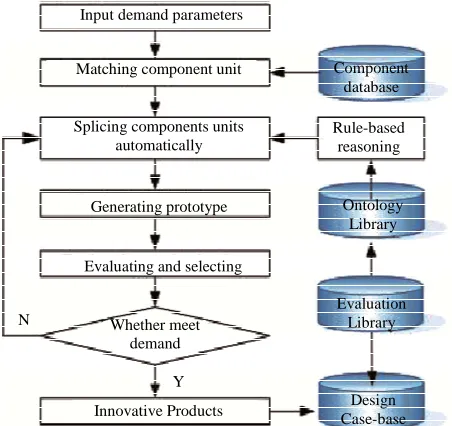
presented by a serial of characteristic parameters of the component units of expression, by a number of genera- tional rules to combine and exchange via recombinants, which make the product be newly created quickly. The establishment of generating self-organizing rules is criti- cal in the process. In the process of product concept de- sign, it is described as: inputting the demand parameters, matching component unit automatically, generating pro- duct prototype according to the matched generated self- organizing rules to recombine the component product units using the Ontology Library, evaluating and se- lecting the prototype by using the Evaluation Library. Until satisfying the demand the process of recombining, evaluating and selecting is repeated to create a new product. The design method can be illustrated in Figure
1.
In the process of product self-organization evolution of innovative design, it is important to build Ontology Li-brary that can support product to generate self-organizing rules with reasoning calculation and evaluation. The de-sign ontology contains all kinds of knowledge, such as principle function, component information, the associ-ated constraint relation among them, and the innovation product cases.
2.2. Demands and Structure of Design Knowledge
During the whole life cycle of complex product, the product design is the important stage which decides the most of the performance and cost. The process of pro- duct innovation and design is carried out by using the ac- quired knowledge, according to the user requirement, based on the analysis and decomposition of product
Input demand parameters
Matching component unit
Generating prototype Splicing components units
automatically
Evaluating and selecting
Whether meet demand
Innovative Products
Component database
Rule-based reasoning
Ontology Library
Evaluation Library
Design Case-base Y
N
functionality. Designing, creating and compositing pro- duct function principle make the matched product struc- ture.
The process of complex product design contains many kinds of knowledge source, such as dominant and reces- sive knowledge. According to the condition of design assignment, the designer usually needs to find all kinds of acquired materials and the matched information given by vendors, and do the selected design of matching pieces. The existence of all those materials and informa- tion may be kept in the files, personal computer, all kinds of paper, and electronic copy or drawing paper. All those usually are dominant knowledge, but large of tacit Knowledge also exists in database and the mind of de- signer, such as the design experience and good practice of experts, and the tacit relations among the acquired explicit knowledge.
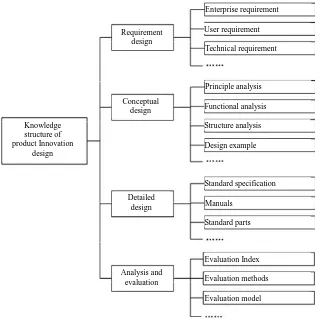
The knowledge resources of complex product design can be summarized as: design specification, design wiz- ard, design manuals, computer programs, product model, design experience, case, outsourcing pieces of knowl- edge, as well as user demands, etc. Except design ex- periences, all the others are explicit knowledge. The his- torical data of products exist in company’s PDM; the design experience usually exists in the personal note and memory of designers which is tacit Knowledge. The de- mand of designer is to store and fetch the acquired ex- plicit knowledge easily, at the same time explore tacit knowledge and transfer it into explicit knowledge, by using some knowledge manage tools and methods, to find out the correct knowledge resources, and reuse it by appropriate form to support the design work. Therefore, the knowledge ontology top-level structure of complex product innovation design process is shown in Figure 2.
3. Definition and Modeling Method
of Ontology
3.1. Definition of Design Knowledge Ontology
Ontology is a formal specification of a shared conceptu- alization. Shared conceptualizations include conceptual frameworks for modeling domain knowledge, content- specific protocols for communication among inter-ope- rating agents, and agreements about the representation of particular domain theories. In the knowledge sharing context, ontologies are specified in the form of defini-tions of representational vocabulary.
Expanding the design ontology to eight-tuple [1]: : , C, C, , R, R, ,
O C P R P A .
In the formula, ① is a concept set. ② is the set which contains many concept sets. ③ C is a partial
order based on C. ④ is a relationship set, R:
C PC
R
1 2 n
[image:2.595.58.284.499.712.2]3.2. The Ontology Construction Method of Cycle Evolution
which contains many relationship sets. ⑥ Function
:R C
known as the signature. ⑦ R is a partial
order based on R, whenr1R r2, i:1 i
ri have
ri
r2Referring to Uschold&King[2], TOVE[3], METHON- TOLOGY [4] and many other ontology construction methods, an applicable and feasible method for ontology construction is found out through our self-experience during building ontology, which is called cycle evolution for knowledge engineering method. The processes are shown as follows in Figure 3.
, and i
r1
c i
r2
. ⑧As-suming L is a logic lan- guage,L Axiom System A of ontology O is a dual: in A:
AI,
, AI is the set of Axiom identifier, :AIL is a mapping, the ele-ments in A:
AI known as an axiom.Requirement design
Conceptual design
Detailed design
Analysis and evaluation
Enterprise requirement
User requirement
Technical requirement
Principle analysis
Functional analysis
Structure analysis
Design example
Standard specification
Manuals
Standard parts
Evaluation Index
Evaluation model Evaluation methods Knowledge
structure of product Innovation
[image:3.595.140.460.211.530.2]design
Figure 2. Structure of design knowledge.
Indentify the domain of ontology
Access domain knowledge
List relations among the most important definitions in the domain
The confirmation and evaluation of ontology ontology
Choose description language and editing tools of ontology
T
h
e op
ti
mi
za
tio
n
an
d
r
eus
e of
On
to
lo
gy
Th
e e
sta
bl
ish
a
fra
me
wo
rk
fo
r
on
to
log
y
s
tru
ct
ur
e
Ontology encoding and formation
Add cases for the class
The definition of class and class hierarchy The definition of class
properties and attributes for the type of constraint
[image:3.595.90.487.555.722.2]
Step 1. Identify the domain of ontology
The first step to construct ontology is to decide onto- logy application needs, including information typies con- tained by ontology and users & defenders of ontology, etc. According to the application needs, identify the do-main of ontology construction.
Step 2. Choose description language and editing tools of ontology
According to practice, choose the proper description language and editing tools, which can speed up the proc- ess of constructing ontology, and promote the late onto- logy reuse, integration and knowledge sharing among various systems. At the same time, make the research of the advantages and disadvantages of chosen tools of lan- guage, and the characteristics expressed during con- structing ontology.
Step 3. Access Domain knowledge
Accessing the domain knowledge is the base and premise for ontology construction. By collecting filed information, we can know the present filed knowledge situation fully, to lay a foundation for the ontology con- struction. To attain field information we need to combine two methods: one is of reuse and transformation of the existing ontology, the other is to attain by using the re- lated methods and ways, such as organizing the filed expert’s construction or by using the knowledge acquisi- tion tools to extract related fields classification system and knowledge from subject databases and network re- sources.
Step 4. List relations among the most important definitions in the domain
After totally knowing of filed knowledge, refine the most important definitions in the filed, and set out to state or explain it. The set out definition, after the con- firmation of filed experts to become the core concept of sets for the filed ontology which will be constructed later. Meanwhile, the preparation of “set of terms” is to de- scribe the process of choice of terminology, the final list of selected terms and their natural language description.
Step 5. Establish a framework for ontology struc- ture
According to certain logical rules and relevance, di- vide a large number of domain concepts, and form dif- ferent areas of work. In addition, estimate the importance of each concept, select key terms, express the knowledge in the field as accurate and concise as possible, and ulti- mately establish a domain ontology framework.
Step 6. Ontology encoding and formation
Ontology encoding and formation consist of three steps: the definition of class and class hierarchy, the definition of class properties and attributes for the type of constraint and added examples. The definition of class and class hierarchy is an important step in the ontology construction. There are three kinds of building methods:
top-down method, bottom-up method and synthesis me- thod. Choose terminology which describes independent existence object to be the categories in ontology, and can also refer to the previous established framework in last step to establish Class Hierarchy. And then describe the internal structures among concepts, once decide the ob-ject and the matched described attributes, in addition, we need to add constraints for some attributes. In this proc-ess, it can refer to relationship among descriptors and descriptors word limit in the field of thesauri, the mean-ing of the notes, and the relationship between words, such as in the field of type to add attributes and attribute constraints. Finally, add examples for categories, by de- scribing the concept of the individual fields, their attrib- utes and assignment constraints, we can gradually estab- lish a knowledge base in this field. In this step if finding out the added examples which can be defined into cate-gories, we need to re-started classes and class hierarchy of the establishment, until there is no conflict between examples and types. Enter the next step.
Step 7. The confirmation and evaluation of ontology According to the clarity, consistency, scalability, com- pleteness criteria and many other ontology construction guidelines, combine the views of experts in the field to confirm and evaluate the ontology prototype.
Step 8. The optimization and reuse of ontology After confirmation and evaluation the core ontology is made as the final point of the initial constructions and the first point of ontology evolution, the knowledge engi- neering method with the cycle of evolution can be used to build core ontology and expand in the use process. Ontology evolution in many different ways can form a new body supported by computer systems. Furthermore, it can be defined new concepts and new relationships manually by experts in the field, or through machine learning and knowledge discovering and many other methods to discover new knowledge.
In summary, the method uses general knowledge en- gineering theory to build ontology. Also, it can be ex- tended and improved through the cycle of evolution method.
4. Knowledge Modeling of
Innovation Design for Satellite
Product
4.1. Ontology-Driven Innovation Design Process of Satellite Product
main design has analysis, optimization and other several steps. With the design analysis process, we can obtain the formation of subsystems design to make the overall pro- gram tree, an assessment and optimization. By optimiz- ing the process, we can optimize the specific parameter to the overall design program.
In a satellite design flow [5], the ontology-driven crea- tive design role is mainly embodied in the applications of
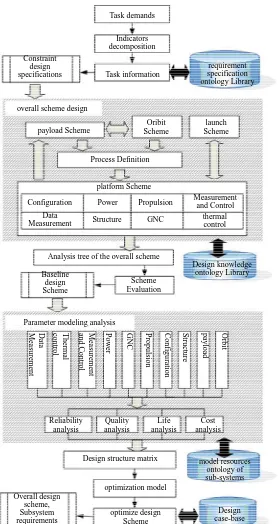
satellite design, analysis and optimization process, spe- cifically manifested in all kinds of Satellite overall pro- gram feasibility stage study by Knowledge of various ontologies [6] and the support of the innovative design in optimize the design phase. As shown in Figure 4, an ontology-driven innovation design process flow of the satellite is illuminated. By using the ontology construc- tion method of complex product mentioned above, we
Task demands
Indicators decomposition Constraint
design
specifications Task information
requirement specification ontology Library
overall scheme design
Oribit Scheme
launch Scheme payload Scheme
Process Definition
platform Scheme
Configuration Power Propulsion
GNC
Structure thermal control Measurement
and Control Data
Measurement
Analysis tree of the overall scheme
Design knowledge ontology Library Scheme
Evaluation Baseline
design Scheme
Parameter modeling analysis
Reliability analysis
Quality analysis
Cost analysis Life
analysis
Design structure matrix
optimization model
optimize design Scheme
Design case-base model resources
ontology of sub-systems
Overall design scheme, Subsystem requirements
O
rbit
p
ay
lo
ad
St
ru
ctu
re
Co
nf
ig
ur
at
io
n
Pr
o
p
ul
si
on
GN
C
Pow
e
r
Me
as
ur
em
en
t
an
d C
o
ntr
o
l
The
rm
al
co
nt
ro
l
Da
ta
Me
as
ur
em
en
[image:5.595.158.436.190.714.2]t
can separately establish satellite requirement specifica- tion ontology, design knowledge ontology, resources ontology of sub-systems complexity changing model and the corresponding ontology library. In the process, the satellite requirement specification ontology library is established to support the analysis of design task re- quirements and setting the design specifications. In addi- tion, the satellite design knowledge ontology library in the process is established to support the general design including payload, obit, platform, structure and so on. The ontology libraries established in the different stage in the innovation design process can provide the support functions of analysis, process, optimization and innova- tion.
4.2. The Examples of Knowledge Representation for Satellite Product Design Ontology
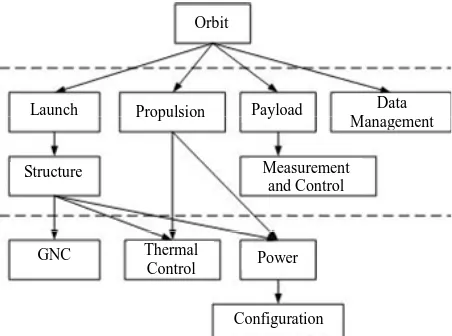
[image:6.595.60.286.547.715.2]Data flow relations among the subsystem design models decide the knowledge flow relations of the satellite de- sign process. The sequence of the relations among sub- systems design missions may be serial, parallel. The complex-coupled feedback also may exist. As shown in
Figure 5, a simple series/parallel data flow coupling
re-lations consists of satellite design disciplines module, which has two data streams at the source of thermal con- trol, power supply design. The plan reflected in the structure of subject knowledge is difficult to express if by a simple cross-classification system or thesaurus struc- ture, but can be expressed by ontology technology.
The ontology top-level categories are combined shown
in Figure 2 and Figure 5 which show the relations
among satellite subject knowledge. Selecting relations among the concept of entities, the concept of attributes and concepts in conceptual design links illustrates the satellite product knowledge ontology expression through the implication concept, attribute associated mutual con-
straints, the definition of ontology axioms and many other building ways to form a satellite product design ontology model which has clear semantic relations.
OWL which is the latest specification by the W3C as a semantic network ontology language [7] can be used to clearly express a glossary of terms, as well as the rela- tionship among these terms. The terms and their rela- tionship are referred to as ontology. OWL has more mechanism to express the semantics, which overtake XML and RDF can only express content in machine- readable documents online. Therefore, this paper uses OWL language to describe design ontology model of satellite Product. Interception of the ontology fragment is described as follows:
<owl:class rdf:ID=“satellite”> <owl:Restriction>
<owl:onProperty rdf:resource=“#type”/> <owl:cardinality>1</owl:cardinality> </owl: Restriction>
<owl:Restriction>
<owl:onProperty rdf:resource=“name”/> <owl:mincardinality>1</owl:mincardinality> </owl:Restriction>
</owl:class>
<owl:class rdf:ID=“Propulsion”>
<rdfs:subclass of rdf:resource=“#satellite”/> </owl:class>
<owl:Object Property rdf:ID=“Propulsion Types”> <rdfs:domain rdf:resource=“#Propulsion”/> <rdfs:range rdf:resource=“#Orbit Scheme”/> <owl:Object Property>
Semantic interpretation is one satellite product that only has one type, and at least has one name. Propulsion is a knowledge class of certain satellite product type in- heriting product attributes knowledge, and also has the relations attributes of Propulsion Types. At the same time, making limits to Propulsion Types, such kind of knowl- edge only belongs to Propulsion knowledge field. Its value changes depend on the choice of the track program. Orbit
Launch Propulsion Payload Data
Management
Measurement and Control Structure
GNC Thermal Power
Control
Configuration
In the above semantic description, it is applied class axioms “subclass of”, relations attribute “Object Prop- erty”, axiom attributes “domain” and “range” and many other ontology concepts. Class axioms describe the in- herit relations between two classes. The relation attribute describes a certain attribute or the relations between two types. The attribute axiom expresses the application and the values of the field basis and scope of attributes.
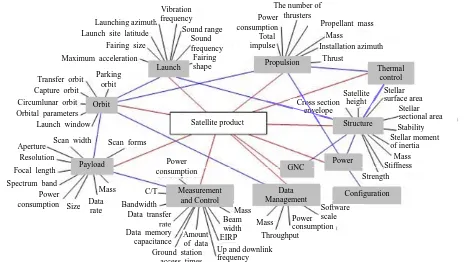
As the example process described above, it is to build the design knowledge ontology of satellite product, in- cluding the orbit, launch, propulsion, payload, data man- agement, structure, measurement and control, GNC, thermal control, power and configuration and many other subject knowledge domain ontology. Figure 6 is an ex- ample of display figure to show the related knowledge
Launch
Satellite product
Propulsion
Thermal control
Orbit
Payload
Measurement and Control
Data
Management Configuration
Structure
Power GNC
Launching azimuth Launch site latitude
Fairing size Maximum acceleration
Transfer orbit Capture orbit Circumlunar orbit Orbital parameters
Launch window
Scan width Scan forms
Aperture Resolution Focal length Spectrum band Power
consumption Size Datarate
Mass Parking
orbit
Vibration frequency
The number of thrusters
Sound range Sound frequency
Fairing shape
Power consumption Total impulse
Propellant mass Mass
Installation azimuth Thrust
Power consumption
Power consumption Bandwidth
Mass
Mass Beam width C/T
Data transfer rate Data memory
capacitance Ground station
access times
Throughput
Software scale
EIRP
Up and downlink frequency Amount
of data
Strength Stiffness
Stellar moment of inertia
Stability Stellar sectional area Stellar surface area Satellite
height Cross section
envelope
[image:7.595.73.538.84.346.2]Mass
Figure 6. Knowledge structure of satellite ontology.
which has satellite product as the key type after founding ontology. The red line represents the inheritance and ownership relations, while the blue line expresses the link between the two types of relations.
5. Conclusion
In this paper the features of knowledge-intensive com- plex products are analyzed, and a theoretical study for the realization of knowledge ontology-driven complex product is made to provide some development concepts and practical experiences. Application examples of satel- lite product show the effectiveness and interoperability of knowledge ontology evolution cycle building method and OWL-based knowledge expression method in the appli-cation of complex product flow design. This method can effectively organize and reuse the knowledge resources in the product design process, and open out the implied relations among various kinds of knowledge, help com-panies to create more competitive products based on the existing knowledge. To realize the specific software fra- mework, a further and in-depth study is still needed.
6. Acknowledgements
The authors would like to acknowledge the support of High-Tech R&D Program of China for Contemporary Integrated Manufacturing System (grant No. 2007- AA04Z134) and National Key Technology R&D Pro- gram of China (grant No. 2006BAF01A48 and 2006- BAF01A04).
REFERENCES
[1] G. Stumme, et al., “The Karlsruhe View on Ontologies,” Technical Report, University of Karlsruhe, Karlsruhe, 2003.
[2] M. Uschold and M. King, “Towards a Methodology for Building Ontologies,” Proceedings of the Workshop on Basic Ontological Issues in Knowledge Sharing, Interna- tional Joint Conference on Artificial Intelligence, Mont-real, 1995.
[3] M. Gruninger and M. S. Fox, “The Logic of Enterprise Modeling,” In: J. Brown and D. O’Sullivan, Eds., Reen-gineering the Enterprise, Chapman and Hall, London, 1995, pp. 83-98.
[4] M. Fernandez, P. A. Gomez and J. Sierra, “Building a Chemical Ontology Using METHONTOLOGY and the Ontology Design Environment,” IEEE Intelligent Systems, Vol. 14, No. 1, 1999, pp. 37-46.
doi:10.1109/5254.747904
[5] Y. Zhao, X. Liu, X. Q. Chen, et al., “The Analysis on the Multidisciplinary Design Optimization Process for Satel- lite System,” Manufacturing Information Engineering of China, Vol. 35, No. 15, 2006.
[6] Z. H. Deng, S. W. Tang, M. Zhang, et al., “An Overview of Ontology,” Peking University Transactions (Natural Science Edition), Vol. 38, No. 5, 2002, pp. 730-738. [7] D. M. Zhang, W. H. Liao, J. Hu, et al., “Design