Role and function(ing) of the new
European financial supervisory
architecture
Kreisz, Brigitta
2012
Online at
https://mpra.ub.uni-muenchen.de/40342/
Role and function(ing) of the new European financial supervisory
architecture
Brigitta Kreisz
The financial and economic crisis has created real and serious risks to the financial stability. Experience of the financial crisis has exposed important failures in financial supervision, both in particular cases and in relation to the financial system as a whole.
In accordance with the proposals presented by the report of the high level group of experts, chaired by Mr Jacques de Larosière (2009), the objective of establishing a more efficient, integrated and sustainable European system of supervision became essential.
Considering the fact, that financial integration and stability are mutually reinforcing; maintaining a stable and reliable financial system is an absolute prerequisite to preserving trust and coherence in the internal market, and hence to preserve and improve the conditions for the establishment of a fully integrated and functioning internal market in the field of financial services. Moreover, deeper and more integrated financial markets offer better opportunities for financing and risk diversification, and thus help to improve the capacity of the economies to absorb shocks.
The aim of this article is to examine the question whether the establishment of the European Financial Supervision System could address the weaknesses highlighted by the crisis and provide a system that is in line with the objective of a stable and single EU financial market for financial services – linking up national supervisors into a strong and complex Community network.
Keywords: European financial system, European financial supervisory architecture, financial stability, strong and complex Community network
Introduction
By writing this article my aim was to examine the question whether the newly constructed under the name European System of Financial Supervision (ESFS)1 since the 1st of January 2011 existing
construction could have a worthwhile significance and role in the further run of the integration process of the European Union.
Athough much of the scientific literature – including the manifestations of the different new published working documents of the European decision making2
- endeavours special importance in connection
with the future of the European Union to the established supervisory architecture – linking national
1
The ESFS shall comprise the following: the European Systemic Risk Board (ESRB), for the purposes of the tasks as specified in Regulation (EU) No 1092/2010., European Insurance and Occupational Pensions Authority established by Regulation (EU) No 1094/2010 of the European Parliament and of the Council, European Securities and Markets Authority established by Regulation (EU) No 1095/2010 of the European Parliament and of the Council, the Joint Committee of the European Supervisory Authorities, the competent or supervisory authorities in the Member States as specified in the Union acts.
2
See: Conclusions of the European Council http://www.consilium.europa.eu/uedocs/cms_data/docs/, ECB
supervisors within a strong Union network – it could be declared, that the referred opinions either fail to seize conceptual importance of the founded system or interpret it differently.
The fact that the final provisions of the Regulations3 establishing the architecture they themselves
oblige the European Commission to revise the need of an European-level organised frame of
supervisory authorities strengthens mistrusts in connection with the future importance and effectiveness of the existing architecture.
In order to answer the question whether the reformed supervisory system as a factor within the European institutional framework is able to contribute to the merit to the further development of the future of the European Union, two questions have to be clarified. First, the adjudication of whether the affect which is required by the activity of this organisational system exceeds the concrete scope of actions, which are settled in the regulations in connection with the legal status of the institutions. To put this question the other way around: Could the integrated European System of Financial Supervision be incorporated into a wider and more conceptual context. Secondly, if the integrated supervisory role would posses a conceptual importance, how could be this latter approached?
Searching for the importance of the European financial supervisory system, we are looking for the answer, whether the existence of an integrative supervisory order is able to support the realization of the tasks which are necessary to maintain and develop the economic union. As it was highlighted by the financial and economic crisis which broke out in 2008, the latter question could not remain unanswered anymore. By now, it is getting to be clear that in case of the lack of an adequte financial architecture, organised at the European level, is unconceivable in the future to the maintainance and development of an integrated European financial system.
For this reason I am going to introduce the construction and function of the ESFS in two dimensions.
In the first part of my essay I am going to present a surway about the general institutional framework of the ESFS construction, especially emphasizing those factors which are very decisive from the perspective of the European economic governance. Paying accentuated attention on making clear the relationship between the supervisory activity and the economic governance. Within this circle I am going to take stock of the characteristics of the European financial system, the scope of regulation of the European framework of economic administration. Finally I am going to highlight the interactions between the administration of the financial system and the functioning and efficiency of the economy. In the second part of my work I am goint to turn on the internal structure of the ESFS. Within this circle besides the general organisational matters I am going to try grouping the different tasks of the new European micro-prudential authorities, supplemented with the evaluation of the special powers
and the means which are in relationship with the effective execution of these tasks.
In consideration of the editing limitations, the history of the development of the model of the financial supervision architecture, the aims of the crisis and some relevant and detailed information about the reform of the regulation of international financial system would merely be tackled by this article.
3
1.
External public framework: linkage between the European financial
system and the ESFS
The fact that in a form of the ESFS integrated supervisory role has a conceptual importance regarding the functioning of the economic union assumes the acknowledgement of the truth of the presumption that the construction of the ESFS is a little system in the system of the – broadly interpreted – bigger, complex European and global financial system.
Considering the fact that this article does not intend to discuss the process of the regulation reform of the international financial system in detail, hereafter the explanation would be extended solely to the European financial system. In the interest of these it is necessary to make clear shortly the meaning of the term European financial system by highlighting the legal and institutional frame of it.
1.1.
Meaning of the term: European financial system
Outlining the European financial system it could be done in many ways and perspectives. Depending on the approache, the outlines and dimensions of the system could be also different. This article aims to interpret the European financial system within the system of financial law.
According to the above mentioned analytical point of view, the European financial system could be interpreted as the object of the European financial law. By this point it should be pointed out, that the European attribute is a very incertain category considering the fact that the degree and sort of certain parts of the financial system are different.4 Nevertheless – although in plural dimension and with
restrictions – the financial law is the most appropriate to seize the intersections of the multi-level
financial system where the necessity and significance of the integrated supervisory structure could be illustrated. It is because financial law is a sum of legal material, which is responsible for to get regulated and operated the working of financial relationships.
Considering those characteristics of the financial relationships that they are able to create multi
-dimensional and complex connections the financial law should be suitable to frame and describe the functioning of such complex systems and mark out the intersections in their regulation.
Since the transformation of the public legal order resulted that the financial relations became more complex, expanded the functions of financial law. To follow this expansion it became necessary to approach financial law in a broader - namely European – perspective. It is a very interesting question
whether financial law is able to and if so what kind of means are to be used to regulate the above mentioned expanded relationships? These questions could be raised differently.
First, could the development of (financial) law keep up with the complicated development of financial relationships? Second, is it possible at all to establish such complex public (regime) framework which is able and entitled to rule?
In order to dissolve the raised questions it is necesssary to pay attention to the dual nature of financial law especially considering within that circle the following correspondence: although financial law is more than the sum of norms of public law, without the existence of an effective public legal order those private legal relationships which are significat components of the integrated financial system are not able to fulfil their interest in a long-run and at the same time they are either not able to warrant the
balanced functioning of financial relations.
4
As it was pointed out by the crisis, it is the challenge of the future to establish those public legal structures – over the member states level - through which it is possible to operated financial
relationships effectively i.e. long-run and stable.
Since the explosion of the crisis in 2008 it became a significant point in the agenda of the European administration to strengthen the structures of European economic governance. Within this framework the institutions of the European Union are working on building out of – new and/or renewed - public
legal administrative structures and mechanisms which are vitally based on the Member States level but – considering its essence - exceed it, and in virtue of their comprehensive and coherent nature are able
to insure sustainable operation of the financial relationships.
The establishment of the ESFS was the first step of this comprehensive reform procedure which was carried out in the light of the recognition that to get operated the cross-border financial relationships
instead of coordinating them with the tools of private law special public institutional and regulative framework is needed with effective rights and mechanisms deriving from the empowerment of a special public regime.
1.2.
Division and internal intersection of the European financial system
In general the European financial system could be divided into fiscal and monetary sphere. The concept of Economic and Monetary Union (EMU) is based on this system either. It is also well known that regarding its European nature - there is an asymmetric relationship between the two pillars of that
„creation”.
Although both pillars of the construction possess essentially European character, the monetary pillar is based fundamentally on an at the European level centralised institutional and regulative structure contrarily the economic pillar which consists of a mixture of decentralised but coordinated and centralised parts.
In connection with the EMU it is necessary to emphasize that the construction and regulation of the structure of the EMU is imperfect because it is in the lack of the system of special authorities which should be able to govern that interaction which exist between the internal market of financial services and the financial system as a whole (Vörös, 2011).
Before the establishing of the integrated financial construction at the European level the financial supervisory structure was defective in the European Union because the previous system did not give enough significance in its institutional order to the divided, cross-border character of the European
financial system and to its institutionalization in accordance with its intersections.
Considering the before mentioned the characterization of the financial system could not only be done by separation of the different spheres, but in accordance with the intersections of the financial system. Intersection means at this respect those connecting spheres through which the different bigger parts of the financia system are connected.
Following this cross-sectoral interpretation, fundamental sections of the financial system are the
The financial system as a whole is working in three big circles these are the circle of public finances, undertakings and banks. With the development of the financial relationships the latter category split up to the bank, insurance and financial services sectors (Simon, 2007).
1.3.
Multi
-
dimensional character of the coordinative role of the ESF
The coordinative role of the ESFS is multi-dimensional. Within these dimensions the first and most
important is the „middle dimension” where the newly established micro-prudential European
Supervisory Athorities (ESAs) could realize a paralell supervision beside the Member Statets. Through this supervision method complex subsections of the cross-boarder and cross-sectoral banking system
could be more effectively performed according to the common-european interests.
Before the establishment of the ESFS the Lámfalussy Committees were authorised to enforce the common-european interests. Since these Committees operated within the structure of the European
Committee they did not have enough rights to intervene directly into concrete financial relationships. Due to the specialities of the institutional structure and lack of powers they did not have the rights and means either to transmit effectively information to the monetary system.
With the establishment of the ESFS new institutional structures were established in the form of mediation channels of knowledge and information which institutionalized cross-sectoral connections
of the European financial system.
By possessing relevant and systemic information later functioning stage of the ESFS would be possible to get created and operated an integrated public legal order in the field of European financial law which would be able to build on the information reached by the operation of the authorities and to rule the interests of those private legal relationships which could cause risk for the stability of the whole European system. Examining the special intersections from the perspective of the fiscal sphere it could be determined, that the supervisory order seems to be competent to mediate information about the macro-prudential operation to the sphere of public finance.
Identifying systemic risks the factors causing macroeconomic imbalaces could be strained off and prevent. In the interest of the latter institutionalized information and mediation channels are essential to create and mainatain the connections between the motery and fiscal spehere of the complex European financial system.
It is worthwhile to stress by this point that one of the elements of the sixth pack established in its regulation in connection with the prevention of macroeconomic imbalances the institution of in-depth
review which prescribes that the Commission shall take into account any warnings or recommendations from the European Systemic Risk Board.5
The second dimension which should be tackled is the institution of Joint Committee which gives institutional solution for the challenges stemming from the complexity of the financial institutions in order to avoid the problems deriving from the sectoral supervisory approach. It is clear that at this level the systemic aspect has a different meaning in comparison to the macro-prudential level
discussed before. According to this interpretation intersections should interpret as sectoral intersections.
5
Further intersections – which would be only tackled by this article - of the ESFS are the intersections
[image:7.595.125.497.125.421.2]the institutional connections among the European institutions, the intersections among the different interests, and the intersections which are in connection with the international organisations.
Figure 1: European System of Financial Supervision
Source: author’s own
2.
The internal organisation of the ESFS: reformed and institutionalized
construction
Although the ESFS is a very complex system which is organised at multi-levels in fact it consist of
bodies which operated previously – though not under the same name – in the institutional order of the EU. The predecessors of the authorities which are currently responsible for the micro-prudential
supervision (ESAs) were the Lámfalussy Committees.6 These 3L3 Commitees functioned within the
structure of the European Commission and possessed limited rights and powers. Since there was no broader organised supervisory frame around them their functioning could not be so fully valid and coordinated as the current regulation grants it for the new authorities.
While it is a novelty of the reforms that the construction of the ESFS were expanded with the function of macro-prudential supervision. Macro-prudential supervision introduced a new institutional frame as
well which created a new level within the system of the European financial supervision. Previously, similar function was fulfilled by the ESCB’s Banking Supervision Committee (ECB, 2011b).
Within the ESFS architecture the European Systemic Risk Board (ESRB) is responsible for the macro
-prudential supervision. „Given the wide scope and the sensitivity of its missions, the ESRB is not be conceived as a body with legal personality and binding powers but rather as a body drawing its
6
legitimacy from its reputation for independent judgements, high quality analysis and sharpness in its conclusions.”7
The ESRB would play an important role in the development of the European macro-prudential
perspective to address the problem of fragmented individual risk analysis at national level. It shall enhance the effectiveness of early warning mechanisms by improving the interaction between micro
-and macro-prudential analysis. It shall allow for risk assessments to be translated into action by the
relevant authorities.
Paying attention to the composition of the ESRB - beside its tasks – it could be determined that it is a
body within which the main institutions and bodies of the European Union and Member States are organisatory integrated. In the function of the ESRB take part the representatives of the European Commission, the European Central Bank, the National Banks of the Member States, the European Supervisory Athorities, the President of the Economic and Financial Committee and the delegated representatives of the national supervisory authorities.
We could draw the conclusion that the novelty of the architecture derives from its complex nature. It is a system-based supervisory structure which is integrated at different levels and different ways. The
predecessors of its institutions in the organisational structure of the EU could be found previously as well, however since the systemic functioning of these institutions were not granted they were unable to carry out the supervision of the European financial markets in organised and coordinated manner. According to my point of views institutional shortcomings of the supervisory system were repaired by the establishment of the new architecture.
The ESFS brought not only institutional changes but functional as well. To illustrate the latter it is important to stress that the reform of the system of supervision expanded the powers of the European Supervisory Authorities which strengthened the binding legal effect of their means.
It is also necessary to outline that the Authorities could exercise their power not only in the field of execution, they are entitled to supplement the European rule making as well. The reform of the comitology8 which was carried out by the Lisbon Treaty gave the permission to grant power directly
for the ESAs to draft regulatory and implementing technical standards. It should be emphasized that by now the Authorities are entitled to adopt the abovementioned standards in the form of a draft instead of recommendation which results that the Commission is to be bound in a certain amount by the professional opinions of the Authorities.
Draft technical standards should be adopted by the Authority on the basis of qualified majority of the members of the Boards of Supervisors. The Union legal order requires the Commission to subsequently endorse these draft standards in the form of regulations or decisions so as to give those direct legal effects. The Commission may decide restricted – i.e. in very exceptional cases, and only for reasons of Union interest - to endorse the standards in part, or with amendments, or not at all.
Although there is no room for this article to deal in details with the process through which the non
-legislative acts are adopted, it is worth to raise the attention for the fact that the new schemes of the
7
COM(2009) 499 final Proposal for a REGULATION OF THE EUROPEAN PARLIAMENT AND OF THE COUNCIL on Community macro prudential oversight of the financial system and establishing a European Systemic Risk Board
8
Lisbon Treaty made it possible to involve stronger professional support of the supervisory authorities into the rule-making process. That is the reason why this reform is known as Lisbonisation of the rule
-making process.9
3.
Functioning of the ESFS: powers, specific legal institutions and their
aims
The tasks of the ESAs and the related institutions and decision powers could be categorized into the following significant groups: tasks related to the cross-border institutions, tasks related to specific EU
-wide institutions, tasks related to the area of regulation, tasks related to to supervisory standards and practices, tasks related to macro-prudential issues, tasks related to area of crisis management, tasks
related to international matters.10 In connection with the first tasks we should outline a very important
supervisory power namely the exercise of the right to mediation with binding settlements, which would be an effective way to settle disagreements between national supervisory authorities.
Indirect aim of this mechanism is to ensure that relevant national supervisory authorities take due account of the interests of other Member States within colleges of supervisors. In the earlier stage of the crisis it occured in many cases that the national supervisory authorities took due account of their own interests neglecting the interests of the other member states and the interest of European Union as a whole.
Direct aim of the mechanism is to assist in reaching a common approach or settle the matter if a supervisory authority disagrees on the procedure or content of an action or inaction by another supervisory authority where the relevant legislation requires cooperation, coordination or joint decision making. The binding legal effect of the settlement of the ESA is one of the examples for stronger powers of the new Authorities. By this institution it would be possible in the future to prevent the situations when a Member State fails to perform its existing obligation by refusing cooperation or remaining solely inactive.
The central institution of this procedure is the conciliation during which the ESA tries to reach an agreement among the national supervisory authorities with the involvement of the Authority as necessary in a mediatory capacity. In case of the lack of agreement in exeptional cases, after a phase of conciliation, the ESAs may settle the matter through a decision. However, this would clearly be exceptional as in most cases the respective national authorities should be able to come to an agreement in the preceding conciliation procedure. In case of non-compliance by a supervisory authority with the
previous decision, the Authority may also decide to adopt decisions addressed to financial institutions specifying their obligations in respect of Union law which is directly applicable to financial institutions.
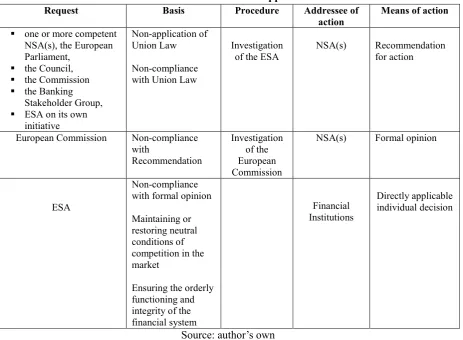
In connection with the enforcement of Union law it is necessary to discuss the systems of new mechanisms which are responsible to ensure the consistent application of European rules. Additional aim of this mechanism is to support the work of the European Commission.
9„Lisbonisation of the rulemaking process” presentation of
Jonathan Overett Somnier on 6 December 2010, Paris
10
Table 1: Settlement of disagreements between competent authorities in cross-border situations
Request Basis Procedure Competence of
the ESAs
Means
NSA
ESA (on its own
initiative)
Disagrees about the procedure or content of an action or inaction
of a competent authority of another Member State
Conciliation Mediator Agreement
ESA
NSAs are unable to reach an agreement + exceptional situation Settlement of disagreements Settlement competence Legally binding- decision
Source: author’s own
Previously in case of divergence of Union legislation the problem could be solved only through the the initiation of infringement proceedings by the Commission against Member States. As the infringement proceedings are very complicated and take a long time, this mechanism itself was not effective enough to prevent the cases when the financial institutions benefited from the advantages of the regulatory arbitrage. In many cases however the regulatory arbitrage resulted the underming of financial stability.
Table 2: Powers to ensure the consistent application of Union Law
Request Basis Procedure Addressee of
action
Means of action
one or more competent NSA(s), the European Parliament,
the Council,
the Commission
the Banking Stakeholder Group,
ESA on its own initiative
Non-application of Union Law
Non-compliance with Union Law
Investigation of the ESA
NSA(s) Recommendation
for action
European Commission Non-compliance with Recommendation Investigation of the European Commission
NSA(s) Formal opinion
ESA
Non-compliance with formal opinion
Maintaining or restoring neutral conditions of competition in the market
Ensuring the orderly functioning and integrity of the financial system
Financial Institutions
Directly applicable individual decision
Source: author’s own
[image:10.595.55.519.359.699.2]ESAs, on their own initiative or upon request from one or more national supervisors or from the Commission, would investigate these cases and, where necessary, adopt a recommendation for action addressed to the supervisory authority. In the exceptional situation that the supervisory authority does not comply with the latter, the ESAs may as a last resort adopt a decision addressed to financial institutions in respect to Union law which is directly applicable to them.
Closing words: Position in the question of effectivity
Judging the effectivity of the functioning of the ESFS it would be early to consider that the ESAs started their work a year before. However it should be emphasized by this point that only in a coherent organisational order functioning system could warrant in the future the all around (effective) supervision of the integrated European financial system.
References
1. COM(2009) 499 final Proposal for a REGULATION OF THE EUROPEAN PARLIAMENT
AND OF THE COUNCIL on Community macro prudential oversight of the financial system and establishing a European Systemic Risk Board.
2. Conclusions of the European Council http://www.consilium.europa.eu/uedocs/cms_data/docs/ 3. ECB (2011a): Financial Stability Review, European Central Bank.
http://www.ecb.int/pub/fsr/html/index.en.html
4. ECB (2011b): The European Central Bank, the Eurosystem, the European System of Central Banks. European Central Bank. http://www.ecb.int/pub/html/index.en.html
5. European Commission (2012): Comitology Register
http://ec.europa.eu/transparency/regcomitology/index.cfm?do=FAQ.FAQ&CLX=en
6. Larosière, de J. (2009): High-level Group on Financial Supervision in the EU. Report, Brussels,
pp. 52-54. http://ec.europa.eu/internal_market/finances/docs/de_larosiere_report_en.pdf
7. Regulation (EU) No1092/2010 of the European Parliament and of the Council of 24November
2010 on European Union macro-prudential oversight of the financial system and establishing a
European Systemic Risk Board,OJ L 331, 15.12.2010, pp. 1-11.
8. Regulation (EU) No 1093/2010 of the European Parliament and of the Council of 24November
2010 establishing a European Supervisory Authority (European Banking Authority), amending Decision No716/2009/EC and repealing Commission Decision 2009/78/EC,OJ L 331, 15.12.2010, pp. 12-47.
9. Regulation (EU) No1094/2010 of the European Parliament and of the Council of 24November
2010 establishing a European Supervisory Authority (European Insurance and Occupational Pensions Authority), amending Decision No716/2009/EC and repealing Commission Decision 2009/79/EC, OJ L 331, 15.12.2010, pp. 48-83.
10. Regulation (EU) No 1095/2010 of the European Parliament and of the Council of 24November
2010 establishing a European Supervisory Authority (European Securities and Markets Authority), amending Decision No 716/2009/EC and repealing Commission Decision 2009/77/EC, OJ L 331, 15.12.2010, pp. 84-119.
11. Regulation (EU) No1176/2011 of the European Parliament and of the Council of 16November
12. The General Report on the Activities of the European Union – 2008 was adopted by the European
Commission on 9 February 2009 under reference number SEC(2008) 1000 final, ISBN 978-92-79
-10137-3 http://europa.eu/generalreport/pdf/rg2008_hu.pdf
13. Simon I. (ed.) (2007): Pénzügyi jog I. (Financial law I.). Osiris Kiadó, Budapest, pp. 45-46. 14. Somnier, J. O. (2010, December 6): Lisbonisation of the rulemaking process. Presentation at
European Securities and Markets Authority, Paris.
15. Vörös I. (2011): Európai jog – magyar jog: konkurencia vagy koegzisztencia (European law