Munich Personal RePEc Archive
An end to consensus? the selective
impact of corporate law reform on
financial development
Deakin, Simon and Sarkar, Prabirjit and Singh, Ajit
Centre for Business Research, University of Cambridge
June 2011
AN END TO CONSENSUS? THE SELECTIVE IMPACT OF CORPORATE LAW REFORM ON FINANCIAL DEVELOPMENT
Centre for Business Research, University of Cambridge Working Paper No 423
by
Simon Deakin Prabirjit Sarkar
Professor of Law Visiting Fellow
Centre for Business Research Centre for Business Research
University of Cambridge University of Cambridge, and
[email protected] Professor of Economics Jadavpur University, Kolkata [email protected]
Ajit Singh
Emeritus Professor of Economics, University of Cambridge Life Fellow Queens College Cambridge
Tun Ismail Ali Chair, University of Malaya [email protected]
June 2011
Abstract
Legal origins theory suggests that law reform, strengthening shareholder and creditor rights, should enhance financial development. We use recently created datasets measuring legal change over time in a sample of 25 developing, developed and transition countries to test this claim. We find that increases in shareholder protection contribute to stock market growth in the common law world and in developing countries, but not in the civil law world. We also find evidence of reverse causation, with financial development triggering legal changes in the developing world. We consider a number of reasons for the selective impact of law reform, focusing on the endogeneity of the legal system to its economic context, and on resulting complementarities between legal and financial institutions.
JEL Codes: G33, G34, K22, O16.
Keywords: legal origins, company law, shareholder rights, creditor rights, financial development.
Acknowledgements: We are grateful to the Economic and Social Research Council (Award reference RES-156-25-0037, ‘Law, Finance and Development’) and the Isaac Newton Trust for financial support, and for comments received on an earlier draft presented at the XVI Congress of the International Economic Association in Beijing, July 2011.
1
1. Introduction
The view that a strengthening of shareholder and creditor rights is a precondition for financial development has been a mainstay of global policy initiatives and national law reform programmes since the early 1990s. Underpinning this policy has been the ‘legal origins’ hypothesis (see La Porta et al., 2008 for a recent restatement). This claims that legal institutions have a long-run impact on the pattern of economic growth. Countries whose legal systems derive from the common law are said to place a greater emphasis on freedom of contract and the protection of private property than those with civil law roots, which tend to favour an activist role for the state (Glaeser and Shleifer, 2002). The common law/civil law divide is reflected in economic outcomes. Quantitative indicators have been developed to chart the extent of cross-national variation in the content of laws governing the business enterprise and to establish correlations between legal and economic variables (Djankov et
al., 2003). These show that common law systems have a higher degree of
dispersed share ownership and more liquid and extensive capital markets (La Porta et al., 1998), together with more highly developed systems of private credit (Djankov et al., 2007a), than civil law ones. In part through the Doing
Business reports of the World Bank, these findings have come to influence
policy reform in ‘dozens of countries’ over the past decade (La Porta et al., 2008: 326). Over this period, changes to corporate and insolvency law became a core component of the Washington consensus view on the importance of legal and institutional reform in promoting economic development (Williamson, 2000).
Important and influential as it is, the legal origins literature is radically incomplete at the theoretical level. The claim that legal origin is exogenous to the long-run pattern of economic development carries with it the implication that the nature of a country’s legal infrastructure is fixed at the point when it first adopts or has imposed upon it a particular type of legal system. This is a very strong claim. An alternative hypothesis is that, over time, legal systems interact with economic and political structures at national level, and as well as influencing them, may be altered by them. National legal orders are also subject to external pressures from harmonization and regulatory competition. These aspects of the dynamics of legal change are not currently well captured by legal origins theory.
2
on the long-run relationship between legal change and economic development on the basis of cross-sectional data of this kind, although this is precisely what many papers do, including some of the most highly cited in the law and finance field (e.g. La Porta et al., 1998).
In this paper we synthesise the results of an emerging body of work, both theoretical and empirical, which provides a critique of the legal origins approach. This work draws on newly constructed longitudinal measures of cross-national legal variation which make it possible to reassess the relationship between legal and economic variables, using time-series and panel-data techniques. Section 2 below discusses legal origins theory and identifies a number of core hypotheses to emerge from that body of work and associated new-institutional analyses of legal systems. Section 3 provides an account of methodological issues arising from the coding of legal change over time and provides evidence from longitudinal datasets concerning the nature and direction of legal reforms since the mid-1990s in a range of developed, developing and transition countries. Section 4 presents econometric analysis concerning the relationship between legal reforms and economic outcomes in the area of financial development in these countries. In addition to summarising some earlier research using longitudinal datasets, we present new findings for a sample of 25 countries over the period 1995 to 2005. Section 5 concludes.
2. Legal Origins Theory: Refining the Core Hypotheses
The theoretical foundation of the interdisciplinary field of law and finance lies in new institutional economics, and specifically in the claim that the quality of legal and other institutions makes a difference to economic development and growth (North, 1990). Within this general framework, legal origins theory, which has been extremely influential among researchers and policy-makers since the mid-1990s, has generated two central hypotheses (La Porta et al., 1998, 2008). The first of these is that the content of the law affects the nature of economic growth: countries with laws that protect contract and property rights, and in particular those which seek to foster financial development through norms of shareholder and creditor protection, should experience a pattern of market-driven, financially-orientated economic growth. The second version of the claim is that countries with a common law origin (that is to say, derived ultimately from the English legal system) are more likely to have market-friendly laws in the sense just described, than those with their origins in one of the civil law families (the French, German and Nordic legal systems).
3
account, thereby reducing agency costs associated with the separation of ownership and control in listed firms, had more dispersed share ownership and a higher level of stock market capitalisation relative to GDP than countries with weaker laws. In this early work, La Porta et al. used the common law or civil law origin of national laws as an instrumental variable for the purposes of demonstrating that the direction of causation ran from the content of the law to financial outcomes, rather than vice versa. In their more recent work, La Porta
et al. (2008) have come round to the view that legal origin should be regarded
as a causal variable in its own right. They argue that because nearly all countries in the world inherited their legal systems by conquest or colonisation (the ‘parent’ systems of England, France and Germany are almost the only exceptions) prior to industrialisation in the course of the nineteenth and twentieth centuries, legal origin must operate as an exogenous influence on the economy (La Porta et al., 2008).
It should be noted that La Porta et al. (2008) do not claim that there is empirical evidence in favour of the view that legal origin, as such, is causally linked to differences in the level of economic growth across national systems. They provide evidence that legal origin is linked to the availability of external finance through capital and credit markets. Because other studies suggest that legal support for external finance promotes growth at the level of the firm (Levine, 1999), it is tempting to conclude that legal origin is also linked to overall economic growth. However, empirical studies have generally failed to find evidence of a direct link between legal origin and the rate of growth of national GDP (see La Porta et al., 2008: 301-2). This suggests that there are aspects of the relationship between the legal system and national economic performance which have yet to be unravelled.
The two versions of the legal origins hypothesis are to some degree in tension with one another. The ‘law matters’ claim implies that a particular, market-orientated configuration of legal rules can be expected to foster financial development (and possibly economic growth more generally) in more or less all countries. The second, the legal origins claim in its more specific sense, implies that the approaches of common law and civil law systems to the governance and regulation of financial markets are fundamentally distinct. If this were the case, we would not expect ‘one size to fit all’ in the case of law reform; rather, law reform should be tailored to local business and institutional conditions.
4
should expect all systems to gravitate to the basic features of that model over time, as barriers to convergence are removed as a result of the expansion of global trade and the removal of formal restrictions on cross-border capital flows (Gugler et al., 2004). This interpretation is consistent with certain policy applications of the legal origins approach, for example those of the World
Bank’s Doing Business reports (World Bank, various years), which have
actively promoted convergence of this kind. An alternative interpretation of legal origins theory, however, is that attempts to bring about convergence through law reform based on a single model of assumed best practice are misplaced, since they amount to the external imposition of a common–law model on legal and business systems unsuited to that approach.
The legal origins literature began with a striking empirical finding on the relationship between law and finance, to which a theory was later applied. The legal origins field has arguably remained somewhat under-theorised. A reassessment of the legal origins approach in terms of first principles may help clarify its central hypotheses. The comparative institutional analysis approach (Aoki, 2001, 2010) helpfully models institutions as routines, conventions and norms of varying degrees of formality, which serve to coordinate the behaviour of agents in environments characterised by uncertainty. In this approach, institutions are seen as evolved, emergent solutions to collective action problems. More formal institutions, such as those of the legal system, contain mechanisms for storing and transmitting information about solutions which have been shown to work in particular contexts (Deakin and Carvalho, 2011). Formality may enable more information to be retained in the system, but at the expense of limiting its capacity for variation. Thus legal institutions may be broadly adaptive in the sense of reflecting features of their environments, without being optimal. Complementarities across institutions will tend to lock in particular configurations of norms and practices. An implication of lock-in is that an institution’s effectiveness depends on the context in which it is placed, and on the presence of complementary mechanisms of governance. Such institutions which may not work effectively when transplanted out of context (Schmidt and Spindler, 2003).
5
[image:8.595.74.480.358.414.2]rules and principles, but also with different ‘styles of social control of economic life’; civil law ‘style’ is ‘associated with a heavier hand of government ownership and regulation than the common law’ which, by contrast, ‘is associated with lower formalism of judicial procedures and greater judicial independence than civil law’, and hence with ‘greater contract enforcement and greater security of property rights’ (La Porta et al., 2008: 286). While there may be feedback between the economic context and particular rules governing (in this context) finance and enterprise, the core legal infrastructure is, by contrast, relatively unchanging: ‘the legal system provides the fundamental tools for addressing social concerns and it is that system, with its codes, distinctive institutions, modes of thought and even ideologies, that is very slow to change’ (La Porta et al., 2008: 308). Figure 1 captures this approach.
Figure 1: Legal origin as an exogenous influence on legal rules and the economy
Source: Armour et al., 2009c.
A more thorough-going co-evolutionary approach would argue that even legal infrastructure, in the sense referred to by La Porta et al. (2008), is susceptible to influence from the economy, and cannot be regarded as an entirely exogenous force shaping economic growth. The supposed pro-market orientation of the English common law may be just as much the result of early industrialisation, which created the conditions within which influential groups lobbied for rules which were broadly protective of property rights and placed constitutional limits on the role of government, as its cause (Ahlering and Deakin, 2007). In the British case, financial development preceded the emergence of formal legal rules protecting the rights of shareholders by several decades (Cheffins, 2001).
A co-evolutionary perspective need not imply that legal rules are perfectly
matched to their environment; the evolution of the law is to a certain degree determined by the internal conceptual forms and language of legal process (Deakin and Carvalho, 2011). However, the economic and political context can be thought of as providing the environment within which certain legal rules are selected over others, and hence persist over time. The relationship between the
Legal origin Legal rules Economic
6
[image:9.595.126.449.218.390.2]legal system on the one hand and the economic and political systems on the other is one of dynamic interaction: no single system has priority, with each one exerting an indirect, environmental pressure on the evolution of the others (see Figure 2).
Figure 2. Coevolutionary model of the legal, economic and political systems
Source: Armour et al., 2009c.
In the context of law and finance, the co-evolutionary approach suggests a number of linked propositions concerning the functionality, diversity and transmissibility of legal norms. Firstly, rules of corporate law can be thought of as reflecting solutions to coordination problems which are to some degree general to market-based economic systems, in particular the principal-agent/shareholder-manager conflict which is inherent in the structure of the modern business enterprise (Kraakman et al., 2009). This view holds that as barriers to trade and capital mobility are removed and more or less all systems accept the principles of market-based economic development, the rules of company and insolvency (or corporate bankruptcy) law will converge (the
formal convergence hypothesis). In addition, the effect of this formal
convergence should be to induce common outcomes in terms of increased financial development (the functional convergence hypothesis).
Secondly, however, it could also be the case that solutions to coordination problems take different forms in particular countries, reflecting differences in the environments within which the relevant legal rules have evolved. Where
Political system Legal system
7
structures of share ownership, modes of financing and management style differ across countries, agency costs will take different forms, which we would expect the legal rules of a given system to respond to: thus ‘it may not be accidental that codetermination in the corporate governance domain and social democratic corporatism in the polity domain coevolved in Germany, while the main bank system, the lifetime employment system, and the close alliance between industrial associations and relevant administrative bureaux coevolved in Japan, both in contrast to the so-called Anglo-American model’ (Aoki, 2001: 17). This perspective gives rise to what may be called the complementarity hypothesis.
Thirdly, and relatedly, the presence of complementarities across institutions in a given national context limits the scope for the successful transplantation of particular institutions into other contexts, no matter how well they may have worked in their systems of origin (Pistor et al., 2003). We may call this the
transplant hypothesis.
These hypotheses raise issues which can only be resolved through empirical inquiry. The critical variables are those relating to the nature and pace of legal change across systems and the extent of continuing diversity in market structures and patterns of business organization. While there is abundant evidence concerning the second of these, data on the first have until recently been either unobtainable or unreliable. This brings us to the second problem with the existing legal origins literature, namely the partial nature of the available data on legal systems.
3. Leximetric Analysis: Revealing the Pattern of Legal Change
3.1 Identifying core shareholder and creditor rights
The anti-director right index (‘ADRI’) constructed by La Porta et al. (1998), in common with most of their other indices, provides a view of the state of law as it existed in the mid-1990s. Since that time, there has been considerable legal change in the area of shareholder and creditor rights. Together with colleagues at the Centre for Business Research (‘CBR’) at Cambridge, we have constructed datasets designed to capture the direction and extent of that change. These datasets, among other things, provide a measure of legal protection for shareholders and creditors in a sample of 25 countries over the period 1995 to 2005. The sample includes a range of developed, developing and transition systems.1
8
indicators that were intended to capture the extent of shareholder control over the board of directors and the management of the firm more generally. These indicators related to the following matters: how far the law required companies to allow shareholders to vote by proxy; to what extent the law prevented the blocking by the board of shareholders’ voting and related rights prior to a general meeting; whether companies were required to observe a ‘cumulative voting’ rule allowing for proportional representation of shareholders on the board; the degree to which the law provided for shareholders to have pre-emption rights in respect of new share issues, thereby preventing the dilution of stakes; and the proportion of votes required to call a shareholders’ meeting. The composition of this index has been much criticised for, among other things, an apparent ‘home-country bias’, that is, a tendency to treat US law as the norm and, as a result, to accord unduly low scores to civil law systems which employed different legal tools to reach the same end of protecting shareholder rights (see Cools, 2005; Braendle, 2006; Spamann, 2010). There are other gaps in the index; it says nothing, for example, about board composition, or about the rules governing takeover bids. These are significant omissions since the issues of board structure and takeover regulation are at the core of the international
corporate governance standards, in particular the OECD Principles of
Corporate Governance which were first issued in 1999 (see now OECD, 2004),
which have been used by many countries to benchmark their corporate laws and regulations since the mid-1990s.
The CBR’s longitudinal shareholder protection index (‘SPI’), on which we base our analysis, contains ten variables which are intended to capture a range of legal rules relating to shareholder protection in a way which avoids ‘home-country bias’ while also including the more important elements of the law reform process of the past decade or so. The ten indicators include a variable for board independence and one for the mandatory bid rule in takeover law, a mechanism designed to protect minority shareholder rights during bids. Other variables cover issues relating to the powers of the general meeting, dismissal of directors, and legal support for private enforcement of rights by shareholders against directors (see Siems et al., 2009; Siems, 2008; Armour et al., 2009b, 2009c).
9
coded here is significantly wider than that contained in La Porta et al.’s CRI. The first three indicators are concerned with rules on minimum capital, dividend distribution and directors’ duties which, in broad terms, determine the balance of power between creditors and shareholders while the company is a going concern. The next three relate to the protection of the rights of secured creditors, and cover the scope for creation of non-possessory security interests, the priority of creditor’s rights, and the extent to which the law allows secured creditors to enforce their rights without a court order. The final four indicators code the core parts of insolvency law (that is, the law of corporate as opposed to personal bankruptcy), and cover the extent of creditors’ powers to initiate insolvency proceedings, rules on the stay of secured creditors, how far the law grants creditors (as opposed to a court or the company itself) the right to close the firm down, and how far the law determines the rank order of secured creditors in the event of bankruptcy.
3.2 Methodological considerations in coding legal change over time
10
3.3. Changes in the law governing shareholder and creditor rights 1995-2005
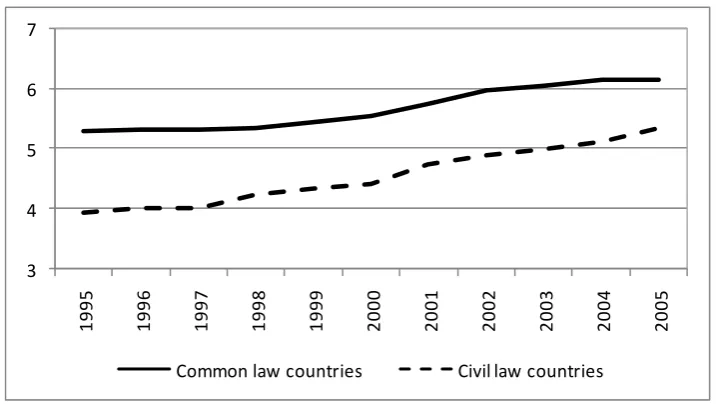
Figures 3-6 set out in graphical form the main trends in the SPI and CPI, broken down firstly by reference to countries grouped by their level of economic development and legal origin. In the case of shareholder protection, there was a steady rise in the score for all countries over the whole period. The two variables which account for most of the rise in the country scores are those relating to independent boards and the mandatory bid rule in takeover bids, both core aspects of the common law approach to corporate governance law (for further details of these changes see Armour et al., 2009c). Transition systems saw a rapid jump in protection after 1995 in developing countries there was marked increase after 2000. Developed countries continued to have a higher level of protection throughout, but the gap between them and the rest had narrowed by the end of the period (Figure 3). When the same data are analysed by reference to legal origin, a closing of the gap between common law and civil law systems can also be seen (Figure 4). Thus the picture presented in La Porta
et al. (1998), of strong protection for shareholder rights in the common law
world, while true at the start of the period under review here which is also the point in time to which their study refers, was not true at the end of it, a finding which emphasises the importance of having longitudinal data.
The charts tracking change in the CPI also show an increase in protection over time. Common law systems and developed systems again have the highest scores, but the gap between the common law and civil law has almost disappeared by the end of the period (Figures 5 and 6). Further analysis show that French origin systems (a group which includes the southern European and Latin American systems) had lower scores than both English-origin and German-origin ones, but that this family of systems also experienced some of the largest increases in protection over time. This suggests that French-origin systems were converging on the more protective approaches of the other two legal families. By type of legal rule, the most significant changes across all systems involved greater protection for the rights of secured creditors, including legal measures to facilitate out-of-court enforcement of security interests (see Armour et al., 2009c for these further details).
11
[image:14.595.75.432.182.382.2]we have to go to a further stage, that of econometric analysis aimed at identifying the nature of the relationship between legal change and economic change.
Figure 3. Shareholder protection 1995-2005: developed, developing and transition systems 2 3 4 5 6 7 1 995 1 996 1 997 1 998 1 999 2 000 2 001 2 002 2 003 2 004 2 005
Developed countries Developing countries Transition countries
Source: CBR Shareholder Protection Index, 25 countries, 1995-2005 (http://www.cbr.cam.ac.uk/research/programme2/project2-20.htm)
Figure 4. Shareholder protection 1995-2005: common law and civil law countries
3 4 5 6 7 1 995 1 996 1 997 1 998 1 999 2 000 2 001 2 002 2 003 2 004 2 005
Common law countries Civil law countries
Source: see Figure 3.
[image:14.595.73.432.490.692.2]12
Figure 5. Creditor protection 1995-2005: developed, developing and transition systems
4 5 6 7
19
9
5
19
9
6
19
9
7
19
9
8
19
9
9
20
0
0
20
0
1
20
0
2
20
0
3
20
0
4
20
0
5
Developed countries Developing countries Transition countries
Source: see Figure 3.
Figure 6. Creditor protection 1995-2005: common law and civil law countries
5 6 7
1995 1996 1997 1998 1999 2000 2001 2002 2003 2004 2005
Common law countries Civil law countries
[image:15.595.75.432.454.654.2]13
4. The Relationship between Legal Change and Financial Development: Econometric Analysis
With longitudinal data available, it becomes possible to estimate the economic impact of legal change in new ways. The critical questions are: did the increases in shareholder protection law that we have observed in the legal datasets enhance stock market development; and did stronger creditor protection induce an expansion of private credit?
One way to address this question is to carry out country by country studies of the impact of the law, using time series analyses for those cases where very long runs of data are available. We have used these techniques in earlier work, using separate indices to those described above, which cover a longer period, 1970-2005, but for a smaller range of countries. Fagernäs et al. (2008), Sarkar (2009) and Sarkar and Singh (2010) find no positive impact of increases in shareholder protection, and some negative effects, on financial development in France, Germany, India, the US and UK. Deakin et al. (2010) find a positive impact of changes in creditor protection on bank credit in India. We have also carried out, for selected countries in our sample, case-study work using documentary and interview-based materials, to complement our econometric analyses (Armour
and Lele, 2010; Buchanan and Deakin, 2008; Cankar et al., 2010). Taken
together, these individual country studies suggest that legal origin interacts with country-specific institutions in a variety of ways, but these results are hard to generalise from. A panel data analysis using a larger sample of countries may throw light on more generic properties of legal reform initiatives.
In the panel data analysis we report here for the first time, we consider two relationships: one is between the scores in the SPI and a number of measures of stock market development at national level, and the other is between the scores in the CPI and banking and credit market development, again at national level. As indicators of stock market development we employ the following four variables (used one at a time): (1) market capitalisation, or the value of listed shares to GDP (marketcap): (2) the value of total shares traded on the stock market exchange to GDP (sharestraded); (3) the turnover ratio, which is the value of total shares traded over average real market capitalization
(turnoverratio); and (4) the number of listed firms per million of population
(listed), each in natural log. As indicators of banking and credit market
14
In our causality tests, we incorporate the level of economic activity in a country, which is represented by real GDP per capita in purchasing power parity constant dollars (in natural log: gdppercap). We also include in the regression data drawn from the Rule of Law Index (rule)3 available from the WGI (Worldwide Governance Indicators) project of the World Bank. Since our period of analysis is marked by the end of the dotcom bubble, we also use a dummy variable, dot, which takes the value zero for 1995-2000, and 1 for the period, 2001-2005.
To ascertain whether the direction of causality is from shareholder or creditor protection (Z) to financial market development (X) or the opposite or both (reverse or cumulative causation), we use panel VAR (Vector-Autoregressive) Granger causality tests over the period, 1995-2005. To ascertain whether Z (shareholder or creditor protection taken one at a time) causes X (alternative finance market variables taken one at a time), the panel VAR Granger causality test suggests fitting the following regression:
p q r
(1) Xit = j Xi, t-j + k Y i, t-k + j Zi, t-l + + .ruleit + dott + it
j =1 k = 1 l=1
where Y is GDP per capita (in natural log), rule is the rule of law index, dot is a dummy for dotcom bubble which takes the value zero for 1995-2000 and 1 for the period 2001-2005, is the fixed effect common across the panels, and it is the error term varying across time and panels (for further details, see Table 1).
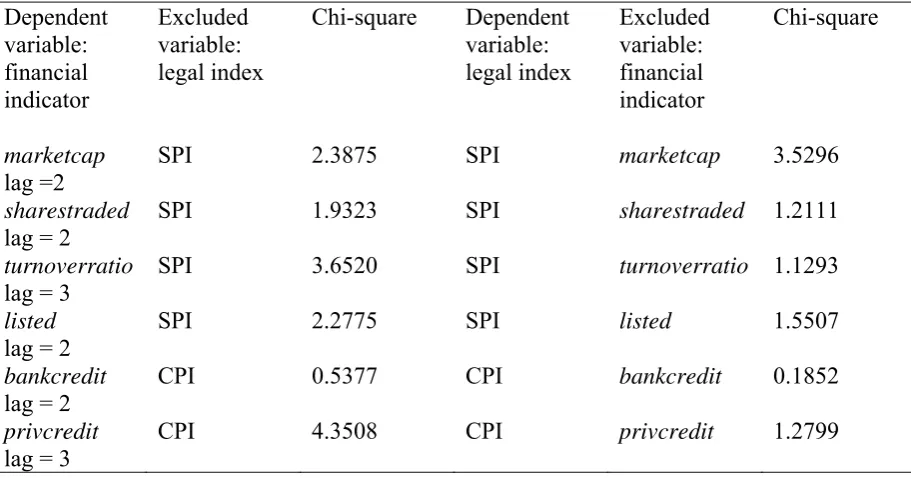
Our panel VAR causality tests first of all look at the overall sample of countries. We find no evidence of a causal relationship running from the SPI to stock market development (see Table 1a). Nor is there a causal relationship from the CPI to banking and credit market development. In short, looking at the sample of countries as a whole, legal change has not had an impact on financial development. There is also little or no evidence of reverse causation, that is to say, of changes in law caused by financial development.
15
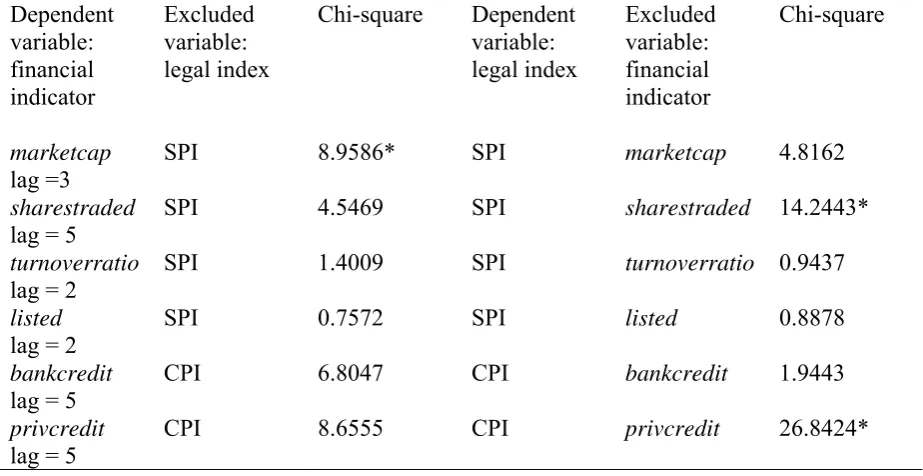
changes in the CPI linked to domestic credit provided through the banking system. With the transition systems we also see evidence of growth in stock markets feeding into changes in the law, with causation running from the stock market listing indicator to the SPI. However, there is no discernible impact of the SPI on stock market development in transition systems.
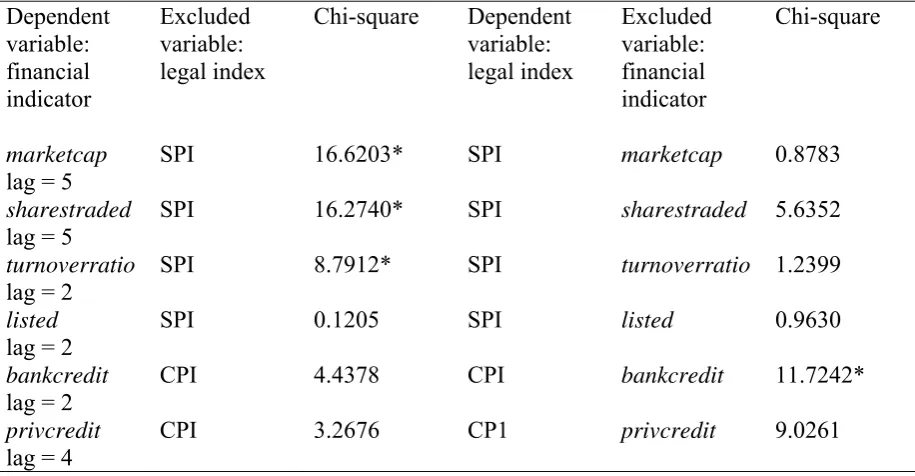
Next we examine the impact on countries by reference to their legal origin. For the common law countries in our sample, changes in the SPI are positively linked to changes in three of the stock-market development indices, namely those relating to stock market capitalisation, the value of stock trading, and stock market turnover (Table 1e). No such relationship can be found in the case of the civil law systems (Table 1f).4
[image:18.595.70.526.361.600.2]Table 1. Relationship between Shareholder and Creditor Protection and Financial Development, 1995-2005: Panel VAR Granger Causality Tests
Table 1a. All 25 countries
Dependent variable: financial indicator
Excluded variable: legal index
Chi-square Dependent variable: legal index
Excluded variable: financial indicator
Chi-square
marketcap
lag =2
SPI 2.3875 SPI marketcap 3.5296
sharestraded
lag = 2
SPI 1.9323 SPI sharestraded 1.2111
turnoverratio
lag = 3
SPI 3.6520 SPI turnoverratio 1.1293
listed
lag = 2
SPI 2.2775 SPI listed 1.5507
bankcredit
lag = 2
CPI 0.5377 CPI bankcredit 0.1852
privcredit
lag = 3
16 Table 1b. Developed countries
Dependent variable: financial indicator Excluded variable: legal index Chi-square Dependent variable: legal index Excluded variable: financial indicator Chi-square marketcap lag =4
SPI 6.6875 SPI marketcap 3.3164
sharestraded
lag = 5
SPI 5.1465 SPI sharestraded 0.8701
turnoverratio
lag = 2
SPI 4.0408 SPI turnoverratio 1.2568
listed
lag = 3
SPI 0.5766 SPI listed 4.0517
bankcredit
lag = 2
CPI 0.2445 CPI bankcredit 1.3692
privcredit
lag = 5
CPI 2.1139 CP1 privcredit 2.7815
Table 1c. Developing countries
Dependent variable: financial indicator Excluded variable: legal index Chi-square Dependent variable: legal index Excluded variable: financial indicator Chi-square marketcap lag =3
SPI 8.9586* SPI marketcap 4.8162
sharestraded
lag = 5
SPI 4.5469 SPI sharestraded 14.2443*
turnoverratio
lag = 2
SPI 1.4009 SPI turnoverratio 0.9437
listed
lag = 2
SPI 0.7572 SPI listed 0.8878
bankcredit
lag = 5
CPI 6.8047 CPI bankcredit 1.9443
privcredit
lag = 5
[image:19.595.67.529.391.629.2]17 Table 1d. Transition countries
Dependent variable: financial indicator Excluded variable: legal index Chi-square Dependent variable: legal index Excluded variable: financial indicator Chi-square marketcap
lag = 4
SPI 2.0098 SPI marketcap 6.0362
sharestraded
lag = 5
SPI 6.4195 SPI sharestraded 4.9790
turnoverratio
lag = 4
SPI 6.5939 SPI turnoverratio 7.1069
listed
lag = 5
SPI 4.1690 SPI listed 24.2963*
bankcredit
lag = 5
CPI 11.3119* CPI bankcredit 5.9692
privcredit
lag = 4
CPI 5.0256 CP1 privcredit 2.9792
Table 1e. Common law countries
Dependent variable: financial indicator Excluded variable: legal index Chi-square Dependent variable: legal index Excluded variable: financial indicator Chi-square marketcap
lag = 5
SPI 16.6203* SPI marketcap 0.8783
sharestraded
lag = 5
SPI 16.2740* SPI sharestraded 5.6352
turnoverratio
lag = 2
SPI 8.7912* SPI turnoverratio 1.2399
listed
lag = 2
SPI 0.1205 SPI listed 0.9630
bankcredit
lag = 2
CPI 4.4378 CPI bankcredit 11.7242*
privcredit
lag = 4
[image:20.595.69.527.390.628.2]18 Table 1f. Civil law countries
Dependent variable: financial indicator Excluded variable: legal index Chi-square Dependent variable: legal index Excluded variable: financial indicator Chi-square marketcap
lag = 5
SPI 8.8863 SPI marketcap 6.3117
sharestraded
lag = 5
SPI 6.9918 SPI sharestraded 6.7643
turnoverratio
lag = 5
SPI 8.2126 SPI turnoverratio 4.6309
listed
lag = 2
SPI 1.0952 SPI listed 1.4964
bankcredit
lag = 2
CPI 0.1997 CPI bankcredit 0.5737
privcredit
lag = 3
CPI 5.0221 CP1 privcredit 0.4562
Notes:
* Null hypothesis of no causality is rejected at 5 % level.
To ascertain whether Z (shareholder or creditor protection taken one at a time) causes X (alternative finance market variables taken one at a time), the panel VAR Granger causality test suggests fitting the following regression:
p q r
(1) Xit = j Xi, t-j + k Y i, t-k + j Zi, t-l + + .ruleit + dott + it
j =1 k = 1 l=1
where Y is GDP per capita (in natural log), rule is the rule of law index, dot is a dummy for
dotcom bubble which takes the value zero for 1995-2000 and 1 for the period, 2001-2005, is the fixed effect common across the panels and it is the error term varying across time and panels. To choose the lags (p, q and r in the regression model) which indicate how many past years are to be considered, a number of possible approaches are available (such as the sequential modified LR test statistic (LRM), the final prediction error approach (FPE), the Akaike information criterion (AIC), the Schwarz information criterion (SC), and the Hannan-Quinn information criterion (HQ)). Different criteria often choose different lag lengths and we have used the maximum lag length in each case. Similarly, to test whether X causes Z we interchange the position of X and Z in the above equation.
The following abbreviations are used:
SPI is aggregate shareholder protection; CPI is aggregate creditor protection;
bankcredit is domestic credit provided by the banking sector as a percentage of GDP (in natural log);
privcredit is domestic credit to private sector as percentage of GDP (in natural log);
19
sharestraded is the value of total shares traded on the stock market exchange to GDP (in natural log);
turnoverratio is the ratio of the value of total shares traded to average real market capitalization (in natural log);
listed is the number of listed firms per million of population (in natural log).
In Table 1b the eleven developed (OECD member) countries are Canada, France, Germany, Italy, Japan, the Netherlands, Spain, Sweden, Switzerland, the UK and the USA.
In Table 1c the nine developing countries are Argentina, Brazil, Chile, India, Malaysia, Mexico, Pakistan, South Africa, and Turkey.
In Table 1d the five transition countries are China, Czech Republic, Latvia, Russia, and Slovenia.
In Table 1e the seven common law origin countries are Canada, India, Malaysia, Pakistan, South Africa, UK and US.
In Table 1f the thirteen civil law countries are Argentina, Brazil, Chile, France, Germany, Italy, Japan, Mexico, the Netherlands, Spain, Sweden, Switzerland and Turkey.
Sources:
Data on shareholder and creditor protection are derived from the CBR Shareholder Protection Index (25 countries) and Creditor Protection Index (25 countries) respectively (http://www.cbr.cam.ac.uk/research/programme2/project2-20output.htm).
Financial development indicators: World Bank Financial Structure Dataset.
Rule of law: World Bank Worldwide Governance Indicators.
The Granger causality tests we have just described can help to tell us whether one variable influences another, but they do not tell us whether the impact is positive or negative. The next step is to ascertain whether the nature of the influence is favourable or unfavourable for those relationships where we observe statistically significant causal links. We do this by using the two-step GMM (generalised method of moment) technique. This involves using lags of the independent variables as instruments to tackle the problem of false correlation between the included (independent) variables and the error term which arises from the possible exclusion of time-variant factors in the regression. We use robust standard errors which are appropriate for dealing with the possibility of arbitrary heteroskedasticity and autocorrelation (using automatic band-width selection according to the Newey-West test).
20
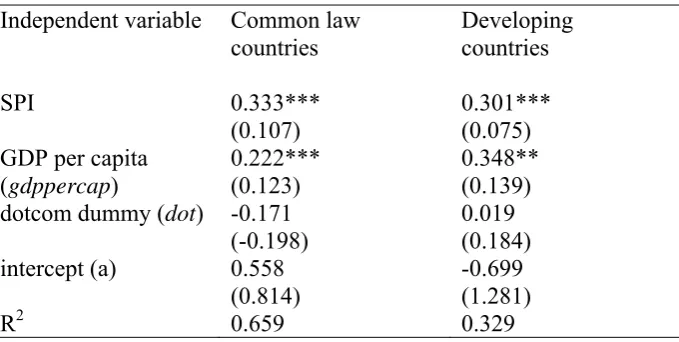
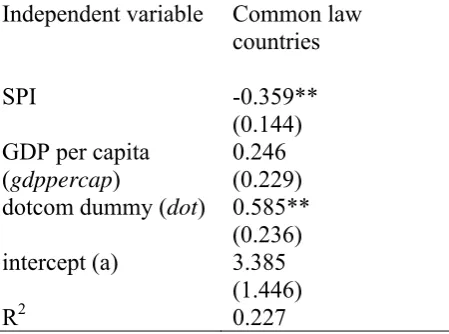
developing countries and in countries with a common law legal origin. (Table 2a) By contrast, in common law countries, the impact of shareholder protection on the turnover ratio is negative (Table 2c). For developing countries, we find a
positive impact of the value of stock market trading on shareholder protection
(Table 2f). No statistically significant relationship between creditor protection laws and either bank or private credit is indicated (Tables 2d, 2g and 2h), and the sign in the correlation between creditor protection and bank credit in transition systems is negative. This suggests that we cannot interpret our Granger causality findings as evidence for a beneficial impact of creditor rights in transition countries.
[image:23.595.72.412.342.513.2]Table 2. Relationship between Shareholder and Creditor Protection and Financial Development Indicators: Panel-data Estimation using the GMM Technique
Table 2a. Dependent variable: stock market capitalization as a proportion of GDP (marketcap)
Independent variable Common law
countries
Developing countries
SPI 0.333*** (0.107)
0.301*** (0.075) GDP per capita
(gdppercap)
0.222*** (0.123)
0.348** (0.139)
dotcom dummy (dot) -0.171
(-0.198)
0.019 (0.184)
intercept (a) 0.558
(0.814)
-0.699 (1.281)
[image:23.595.70.296.567.732.2]R2 0.659 0.329
Table 2b. Dependent variable: value of stock trading (sharestraded)
Independent variable Common law
countries
SPI 0.057 (0.108)
GDP per capita (gdppercap)
0.284* (0.123)
dotcom dummy (dot) 0.169
(0.190)
intercept (a) 1.145
(0.959)
21
Table 2c Dependent variable: turnover ratio (turnoverratio)
Independent variable Common law
countries
SPI -0.359** (0.144)
GDP per capita (gdppercap)
0.246 (0.229)
dotcom dummy (dot) 0.585**
(0.236)
intercept (a) 3.385
(1.446)
[image:24.595.66.296.363.495.2]R2 0.227
Table 2d. Dependent variable: bank credit as a proportion of GDP (bankcredit)
Independent variable Transition countries
CPI -0.178 (0.613)
GDP per capita (gdppercap)
-0.381*** (0.153)
intercept (a) 7.414***
(1.479)
R2 0.189
Table 2e. Dependent variable: shareholder protection (SPI)
Independent variable Transition countries
listed firms per million of population (list)
0.535 (0.427)
GDP per capita (gdppercap)
-2.721** (1.079)
intercept (a) 26.779*
(8.979)
[image:24.595.69.296.562.698.2]22
Table 2f. Dependent variable: shareholder protection (SPI)
Independent variable Developing countries
Value of stock trading
(sharestraded)
0.831*** (0.326)
GDP per capita (gdppercap)
-0.192 (1.079)
intercept (a) 3.083
(5.889)
R2 0.160
Table 2g. Dependent variable: creditor protection (CPI)
Independent variable Developing countries
private credit as a percentage of GDP (privcredit)
0.022 (0.031)
GDP per capita (gdppercap)
0.115 (0.031)
intercept (a) 0.349
(0.245)
[image:25.595.70.296.487.646.2]R2 0.00
Table 2h. Dependent variable: creditor protection (CPI)
Independent variable Common law
countries
Bank credit as a percentage of GDP (bankcredit)
-0.038 (0.051)
GDP per capita (gdppercap)
0.069*** (0.021)
intercept (a) 0.15
(0.089)
R2 0.603
Notes:
* significant at the 10% level
** significant at the 5% level
*** significant at the 10% level
23
Newey-West). The Hansen-J statistic supports the proposition that all the equations are exactly specified.
Sources:
See Table 1.
5. Interpretation
In interpreting these findings, we first of all consider evidence on the causal relationship between legal change and financial development. We have seen that for the sample as a whole, no clear relationship emerges. This is evidence against the hypothesis of functional convergence. There is evidence of formal
convergence of legal rules in more or less all systems, but no relationship
between these legal reforms and the expected economic outcome variables, when the whole sample is considered.
However, when we look at groups of countries by reference to state of development and legal origin, a number of relationships begin to emerge. The first such finding is that increased shareholder protection leads to stock market development in the common law but not the civil law. The formal changes recorded in the SPI essentially map the worldwide diffusion of a legal model emphasising independent boards, protection for shareholders during takeover bids, and shareholder control over key corporate decision-making processes. This model originated in the common law systems of the UK and USA and spread out from there. Thus its positive impact on the group of common law countries as a whole is evidence in favour of the complementarity hypothesis. Laws originating in the two most influential common law systems appear to have worked to have had an impact in other systems which shared similar features in terms of relatively more dispersed share ownership structures and liquid capital markets. The absence of this impact on the outcome variables in the case of the civil law world is evidence for the converse proposition, namely
the transplant hypothesis: common law institutions did not work well when
adopted in the context of the civil law world’s concentrated share ownership and relatively illiquid capital markets.
24
preferring to rely on retained earnings. In the developed country context, the stock market acts principally as a mechanism of evaluation of corporate performance, rather than as a source of finance for firms. It is in developing countries that stock markets more clearly perform the function of directly supporting the growth of firms. Our finding suggests that legal reforms can usefully support this developmental role of stock markets.
The mix of positive and negative results we derived from our GMM analysis is consistent with this analysis. For common law systems, it would appear that the increase in shareholder protection led to a growth in the value of shares in listed companies as a proportion of GDP, but not to a corresponding increase in the value of shares traded. This is why the impact of increasing shareholder rights was negative in the case of the turnover ratio, which measures the value of shares traded over average real market capitalisation. For developing countries, we see an increase in share values, but no fall in the turnover ratio. We also find that, in developing countries, an increase in the value of shares traded led to greater shareholder protection, suggesting a market-based demand for legal reform in those countries.
Thus for the common law world, the increase in shareholder rights contributed to a rise of share values which was not matched by a rise in the volume of trading. This is a hint, in our data, of the problem of ‘irrational exuberance’ in stock markets, and the resulting ‘over-valuation’ of equity (Jensen, 2005), during this period. Our results suggest that this was a phenomenon associated with stock markets in developed, common law countries. For the developing world, by contrast, we see an increase in the volume of stock market activity, as measured by the values of shares traded, triggering demand for greater shareholder rights. Shareholder protection, in turn, helped to stimulate a growth in share values without a fall in the turnover ratio, implying that the level of stock market activity was more or less keeping up. Thus in the developing world, where growth in share values which was matched by trading volumes, legal reforms were associated with financial development of a more sustainable type.
25
6. Conclusions
As a result of the above findings reported above, a clearer view is being obtained of the relationship between legal change, financial development and economic growth. Shareholder-orientated corporate laws promote stock market growth in the common law world where complementary institutions, in the form of dispersed share ownership and liquid capital markets, are present. They have a greater impact, in terms of promoting financial growth, in the developing world than in developed countries. We also find evidence of reverse causation, with stock market growth triggering demand for shareholder rights, in the developing world. Our results on creditor protection are more ambivalent: we have weak evidence of a negative causal impact of creditor rights on bank credit in transition systems.
The absence of an overall correlation between law reform and financial market development indicates that the strengthening of shareholder rights and creditor rights has not had its intended effect on countries across the board. The positive impact of increased shareholder protection in common law systems, when compared to its non-impact in the civil law world, suggests the presence of complementarities between legal and financial institutions. The evidence that shareholder protection rights have stimulated financial growth in developing countries highlights the demand for external finance supplied through equity markets in those systems.
26
Notes
1
The countries coded are: Argentina, Brazil, Canada, Chile, China, Czech Republic, France, Germany, India, Italy, Japan, Latvia, Malaysia, Mexico, the Netherlands, Pakistan, Russia, Slovenia, South Africa, Spain, Sweden, Switzerland, Turkey, UK, US. In addition to these datasets, described in the text, the CBR project has also produced longer time series, covering the period 1970-2005, for five countries: France, Germany, India, the UK and the US. All the CBR datasets referred to in this paper can be consulted and downloaded on
line. See:
http://www.cbr.cam.ac.uk/research/programme2/project2-20output.htm.
2
These are the standard measures used in analyses of stock market development and private credit at national level and are based on World Bank data. See the notes to Table 1 for further details.
3
This index is available for all the countries covered in the study for almost all the years, 1995-2005. For some years, no data are provided; in that case we used data for the following year. For example, where 1995 data are not available, we use 1996 data for both 1995 and 1996.
4
27
References
Ahlering, B. and Deakin, S. (2007) ‘Labour regulation, corporate governance and legal origin: a case of institutional complementarity?’ Law & Society
Review,41 : 865-98.
Aoki, M. (2001) Towards a Comparative Institutional Analysis (Cambridge, MA : MIT Press).
Aoki, M. (2010) Corporations in Evolving Diversity (Oxford : Oxford
University Press).
Armour, J., Deakin, S., Sarkar, P., Siems, M. and Singh, A. (2009a) ‘Shareholder protection and stock market development: an empirical test of the legal origins hypothesis’ Journal of Empirical Legal Studies, 6: 343-381.
Armour, J., Deakin, S., Lele, P. and Siems, M. (2009b) ‘How legal norms evolve: evidence from a cross-country comparison of shareholder, creditor and worker protection’ American Journal of Comparative Law, 57: 579-629.
Armour, J., Deakin, S., Mollica, V. and Siems, M. (2009c) ‘Law and financial development: what we are learning from time-series evidence’ BYU Law
Review: 1435-1500.
Armour, J., with Mollica, V., Siems, M., Lele, P., Zhou, T., Hirooka, K., Klauberg, T., Heidenhain, S., Cankar, N., Hamilton, J., and Akman, P. (2009d) CBR Extended Creditor Protection Index, Cambridge: Centre for
Business Research, available at: http://www.cbr.cam.ac.uk/research/programme2/project2-20output.htm.
Armour, J. and Lele, P. (2009) ‘Law, finance and politics: the case of India’
Law & Society Review, 43: 491-526.
Braendle, U. (2006) ‘Shareholder protection in the USA and Germany: on the
fallacy of LLSV’ German Working Papers in Law and Economics, vol.
2006, article 18. http://www.bepress.com/gwp/default/vol2006/iss1/art18.
Buchanan, J. and Deakin, S. (2008) ‘Japan’s paradoxical response to the new “global standard” in corporate governance’ Zeitschrift für Japanisches
Recht, 13(26): 59-84.
Cankar, N., Deakin, S. and Simoneti, M. (2010) ‘The reflexive properties of corporate governance codes: the reception of the “comply or explain” approach in Slovenia’ Journal of Law and Society, 37: 501-25.
28
Cools, S. (2005) ‘The real difference in corporate law between the United States and continental Europe: distribution of powers’ Delaware Journal of
Corporate Law, 30: 697-766.
Deakin, S. and Carvalho, F. (2011) ‘System and evolution in corporate governance’, in P. Zumbansen and G. P. Calliess (eds.), Law, Economics
and Evolutionary Theory (Cheltenham: Edward Elgar).
Deakin, S., Demetriades, P. and James, G. (2010) ‘Creditor rights and banking system development in India’ Economics Letters, 108: 19-21.
Djankov, S., La Porta, R., Lopes-de-Silanes, F., and Shleifer, A. (2002) ‘The regulation of entry’ Quarterly Journal of Economics, 117: 1-37.
Djankov S., Glaeser, E., La Porta R., Lopez-de-Silanes F. and Shleifer A.
(2003) ‘The new comparative economics’ Journal of Comparative
Economics, 31: 595-619.
Djankov, S., La Porta, R., Lopez de Silanes, F., Shleifer, A. (2005) ‘The law and economics of delf-dealing’ NBER Working Paper No. W11883.
Djankov, S., McLeish, C., and Shleifer, A. (2007a) ‘Private credit in 129 countries’ Journal of Financial Economics, 84: 299-329.
Djankov, S., Hart, O., McLeish, C., and Shleifer, A. (2007b) ‘Debt enforcement around the world’ ECGI Finance Working Paper No 147/2007.
Djankov, S., La Porta, R., Lopez-de-Silanes, F. and Shleifer, A. (2008) ‘The law and economics of self-dealing’ Journal of Financial Economics, 88: 430-65.
Fagernäs, S., Sarkar, P., and Singh, A. (2008) ‘Legal origin, shareholder protection and the stock market: new challenges from time series
analysis’, in B. Yurtoglu and K. Gugler (eds.), The Economics of
Corporate Governance and Mergers (Cheltenham: Edward Elgar).
Glaeser, E. and Shleifer A. (2002) ‘Legal origins’ Quarterly Journal of
Economics, 117: 1193-1229.
Glen, J. and Singh, A. (2003) ‘Capital structure, rates of return and financing corporate growth: comparing developed and emerging markets, 1994-2000’ Emerging Markets Review, 5: 161-192.
Gugler, K., Mueller, D. and Yurtoglu, B. (2004) ‘Corporate governance and globalisation’ Oxford Review of Economic Policy, 20: 129-156.
Jensen, M. (2005) ‘The agency costs of overvalued equity’ Financial
Management, 34: 5-19.
Kraakman, R., Armour, J., Davies, P., Hansmann, H., Hertig, G., Kanda, H.,
29
Comparative and Functional Approach (Oxford: Oxford University
Press, 2nd. ed.).
La Porta R., Lopez-de-Silanes, F., Shleifer, A. and Vishny, R. (1998) ‘Law and finance’, Journal of Political Economy, 106: 1113-55.
La Porta, R., Lopez-de-Silanes, F., Shleifer, A. and Vishny, R. (1999) ‘Corporate ownership around the world’ Journal of Finance, 54: 471-517.
La Porta, R., Lopez-de-Silanes, F., Pop-Eleches, C. and Shleifer, A. (2004) ‘Judicial checks and balances’ Journal of Political Economy, 112: 445-470.
La Porta R., Lopez-de-Silanes F., and Shleifer, A. (2006) ‘What works in securities laws?’ Journal of Finance, 61: 1-32.
La Porta R., Lopez-de-Silanes F., and Shleifer A. (2008) ‘The economic consequences of legal origins’ Journal of Economic Literature, 46: 285-332.
Levine, R. (1999) ‘Law, finance and growth’ Journal of Financial
Intermediation, 8: 8-35.
North, D. (1990) Institutions, Institutional Change, and Economic Performance
(Cambridge: CUP).
OECD (2004) Principles of Corporate Governance (Paris: OECD).
Pistor, K., Keinan, Y., Kleinheisterkamp, J., and West, M. (2003) ‘The evolution of corporate law: a cross-country comparison’ University of
Pennsylvania Journal of International Economic Law, 23: 791-871.
Rodrik, D. (2006) ‘Goodbye Washington consensus, hello Washington confusion?’ Journal of Economic Literature, 44: 969-983.
Sarkar, P. (2009) ‘Corporate governance, stock market development and private capital accumulation: a case study of India’, in S. Marjit (ed.), India
Macroeconomics Annual (New Delhi: Sage).
Sarkar, P. and Singh, A. (2010) ‘Law, finance and development: further analyses of longitudinal data’ Cambridge Journal of Economics, 34: 325-346.
Schmidt, R., and Spindler, G. (2002) ‘Path dependence, corporate governance and complementarity’ International Finance, 5: 311-33.
Siems, M. (2008) ‘Shareholder protection around the world: “Leximetric II”’
Delaware Journal of Corporate Law, 33: 111-37.
30
(2009) CBR Extended Shareholder Protection Index, Cambridge: Centre
for Business Research, available at: http://www.cbr.cam.ac.uk/research/programme2/project2-20output.htm.
Singh, A. (1993) ‘The stock market and economic development: should developing countries encourage stock markets?’, UNCTAD Review, 4: 1-28.
Singh, A. (1995) ‘Corporate financial patterns in industrialising economies: a comparative international study’, IFC Technical Paper No 2.
Spamann, H. (2010) ‘The “Antidirector Rights Index” revisited’, Review of
Financial Studies, 23: 467- 486.
Williamson, J. (2000) ‘What should the World Bank think about the Washington consensus?’ World Bank Research Observer, 15: 251-264.
World Bank (various years) Doing Business Report (Washington, DC:
International Bank for Reconstruction and Development).