0095-1137/07/$08.00⫹0 doi:10.1128/JCM.00675-07
Copyright © 2007, American Society for Microbiology. All Rights Reserved.
Multilocus Variable-Number Tandem-Repeat Analysis for Molecular
Typing of
Shigella sonnei
䌤
†
Shiu-Yun Liang,
1Haruo Watanabe,
2Jun Terajima,
2Chun-Chin Li,
1Jui-Cheng Liao,
1Sheng Kai Tung,
1and Chien-Shun Chiou
1,3*
Central Region Laboratory, Center of Research and Diagnostics, Centers for Disease Control, Taichung, Taiwan1;
National Institute for Infectious Diseases, Tokyo, Japan2; and Institute of Medicine,
Chung Shan Medical University, Taichung, Taiwan3
Received 27 March 2007/Returned for modification 16 May 2007/Accepted 5 September 2007
A multilocus variable-number tandem-repeat (VNTR) analysis (MLVA) method was developed and evaluated for the subtyping ofShigella sonneiisolates. A total of 26 VNTR loci were identified by exploring the repeat sequence loci in the genomic sequences ofS. sonneistrains Ss046 and 53G and by testing 536 isolates that had previously been characterized by pulsed-field gel electrophoresis (PFGE). The discrim-inatory power of MLVA (Simpson’s index of diversity [D], 0.9524; 95% confidence interval [CI], 0.9373 to 0.9564) for the 536 isolates was significantly higher than that of PFGE (D, 0.8882; CI, 0.8667 to 0.9097). MLVA typing with the four and eight most variable loci hadDvalues of 0.9468 and 0.9481, respectively, results approaching that of 26 loci. The usefulness of MLVA for outbreak investigation was evaluated using 151 isolates from 10 shigellosis outbreaks and 22 PFGE-indistinguishable isolates collected from nine epidemiologically unrelated events in five different countries. The evaluations indicated that MLVA was a powerful typing tool to distinguish isolates for outbreak investigation and that it exhibited a good discrimination of the 22 PFGE-indistinguishable isolates. Single-locus variants did occur during the outbreak; therefore,S. sonneiisolates with MLVA profiles differing at no more than a single locus should be considered part of the same outbreak. The present study suggests that MLVA has the potential to replace PFGE as a standard method of typing S. sonnei isolates for disease surveillance and outbreak investigation.
The shigellae are the causative agents of shigellosis, a com-mon diarrheal disease in developing countries. Acom-mong the four
Shigellaspecies,Shigella flexneriis the most prevalent in
devel-oping countries; in contrast,Shigella sonneiis predominant in industrialized countries (6, 10).S. sonneiinfection in industri-alized countries is often associated with food-borne transmis-sion and international travel (4, 9, 11, 20, 23).
Genetic characterization of bacterial strains with a variety of genotyping methods is frequently applied for epidemiological investigation. A number of genotyping methods have been developed forS. sonnei(3, 15, 16, 21). Among these genotyp-ing methods, pulsed-field gel electrophoresis (PFGE) has be-come the standard and has been used to build an international molecular subtyping network, PulseNet, for food-borne dis-ease surveillance (22). PFGE has been proven by PulseNet laboratories to be a powerful tool for the routine subtyping of
S. sonneiisolates for detecting clusters of infections. However,
at times, PFGE is not sufficiently discriminatory to distinguish some of the epidemiologically unrelatedS. sonneistrains, and PFGE data are not appropriate for clonal analysis ofS. sonnei
strains that have evolved over a period of years. In a previous study, we developed an inter-IS1spacer typing (IST) method
for the typing ofS. sonneiisolates (3). IST is less discriminatory than PFGE but is more useful for investigating the genetic relationships amongS. sonneistrains circulating over a longer time span and for discriminating certain strains that are indis-tinguishable by PFGE. Even though IST obtained more ge-netic information from PFGE-indistinguishable isolates, it did not discriminate all of the isolates collected from different epidemiological events (3). Therefore, an alternative method with a high discriminatory ability is needed for disease surveil-lance and outbreak investigation.
Among the next generation of subtyping methods, multilocus variable-number tandem-repeat (VNTR) analysis (MLVA) has been developed for several bacterial pathogens (12–14, 17, 19). Studies have demonstrated that MLVA has a similar discriminatory power to or higher discriminatory power than PFGE (12, 17). MLVA can be used for the routine subtyp-ing of bacterial isolates for disease surveillance and out-break investigation (8, 12, 19). The present study aims to develop an MLVA method and evaluate its usefulness in typingS. sonneiisolates for the purpose of epidemiological investigation.
MATERIALS AND METHODS
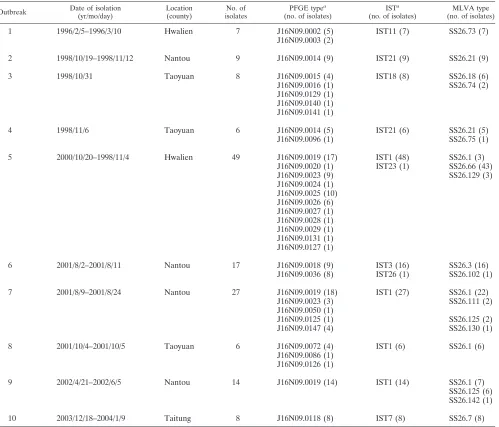
Bacterial strains.S. sonnei isolates were collected in central and eastern Taiwan between 1996 and 2005. A collection of 536 isolates was used to compare the discriminatory powers of MLVA and PFGE. Within the collection, 151 isolates derived from 10 shigellosis outbreaks were used to evaluate the relative utility of MLVA in discriminating isolates collected from the outbreaks (Table 1). Each disease outbreak was originally reported to the Taiwan Centers for Disease Control (Taiwan CDC) by local public health departments and was
* Corresponding author. Mailing address: Central Region Labora-tory, Center of Research and Diagnostics, Centers for Disease Con-trol, Taichung, Taiwan. Phone: 886-4-24750452. Fax: 886-4-24750474. E-mail: [email protected].
† Supplemental material for this article may be found at http://jcm .asm.org/.
䌤Published ahead of print on 19 September 2007.
3574
on May 16, 2020 by guest
http://jcm.asm.org/
identified by epidemiological investigation conducted by the Taiwan CDC and
local public health departments. TheShigellaisolates obtained from patients and
contact information for each outbreak were sent to laboratories of the Taiwan CDC. Outbreaks often continued over weeks or months. The isolates collected from the 10 outbreaks had previously been characterized using PFGE typing and IST methods (5). Four outbreaks, outbreaks 5, 7, 8, and 9, were caused by an IST1 clone. Another set of 22 isolates with an indistinguishable PFGE (J16N09.0015) pattern collected from nine epidemiologically unrelated events was subjected to MLVA characterization. Twenty of these isolates had been characterized previously by IST (3).
Identification of VNTR loci.The genomes ofS. sonneistrains Ss046 (GenBank accession no. CP000038) and 53G (obtained from The Wellcome Trust Sanger Institute [http://www.sanger.ac.uk {accessed 1 September 2007}]) were explored for potential VNTR loci using VNTRDB computer software developed by Chang et al. (2). The program, which incorporates the algorithm of the Tandem Repeat Sequence Finder (1), explores tandem-repeat sequence loci from one of the two genomic sequences and then locates the position and counts the number of repeat units for each of the loci in the other. The two genomic sequences are used alternately in turn as the “parent” sequence so that a locus with only one repeat unit in a genome but with two or more repeat units in the other genome
will not be missed. The computer searches identified 33 potential VNTR candi-dates, which contained various numbers of repeats in the two strains. In addition, a locus with five repeat sequence units in both genomes was included to evaluate its potential as a VNTR. In total, 34 VNTR candidates were tested on 10 genetically distinct strains. Twenty-six loci, which had various numbers of repeats in the 10 isolates tested, were considered to be VNTR loci and were chosen for
genotyping of theS. sonneiisolates.
Preparation of crude bacterial DNA.S. sonneiisolates, stored at⫺70°C, were
plated onto tryptic soy agar and incubated overnight at 37°C. A loopful (10l)
of bacterial growth was removed from the plate, suspended in 100l of
Tris-EDTA buffer (10 mM Tris-Cl, 1 mM Tris-EDTA [pH 8.0]) in an Eppendorf tube, and
boiled for 10 min. After centrifugation at 3,700⫻gfor 10 min, the supernatant
was transferred into a new tube for use.
MLVA.The primer sets for PCR amplification of the 26 VNTR loci are listed in Table S1 in the supplemental material. The primers were designed using a free program available at the Primer3 website (http://frodo.wi.mit.edu [accessed 1
September 2007]). The forward primer of each primer set was labeled at its 5⬘
end with an ABI-compatible dye, 6-carboxyfluorescein, NED, VIC, or PET, from Applied BioSystems (Foster City, CA). For multiplex PCR amplification, each
[image:2.585.46.545.80.507.2]10-l PCR mixture contained 1⫻PCR buffer, 3 mM MgCl2, 0.05 to 0.4M of
TABLE 1. Characteristics of 10 shigellosis outbreaks and genotypes of 151S. sonneiisolates from the outbreaks
Outbreak Date of isolation
(yr/mo/day)
Location (county)
No. of isolates
PFGE typea
(no. of isolates)
ISTa
(no. of isolates)
MLVA type (no. of isolates)
1 1996/2/5–1996/3/10 Hwalien 7 J16N09.0002 (5) IST11 (7) SS26.73 (7)
J16N09.0003 (2)
2 1998/10/19–1998/11/12 Nantou 9 J16N09.0014 (9) IST21 (9) SS26.21 (9)
3 1998/10/31 Taoyuan 8 J16N09.0015 (4) IST18 (8) SS26.18 (6)
J16N09.0016 (1) SS26.74 (2)
J16N09.0129 (1) J16N09.0140 (1) J16N09.0141 (1)
4 1998/11/6 Taoyuan 6 J16N09.0014 (5) IST21 (6) SS26.21 (5)
J16N09.0096 (1) SS26.75 (1)
5 2000/10/20–1998/11/4 Hwalien 49 J16N09.0019 (17) IST1 (48) SS26.1 (3)
J16N09.0020 (1) IST23 (1) SS26.66 (43)
J16N09.0023 (9) SS26.129 (3)
J16N09.0024 (1) J16N09.0025 (10) J16N09.0026 (6) J16N09.0027 (1) J16N09.0028 (1) J16N09.0029 (1) J16N09.0131 (1) J16N09.0127 (1)
6 2001/8/2–2001/8/11 Nantou 17 J16N09.0018 (9) IST3 (16) SS26.3 (16)
J16N09.0036 (8) IST26 (1) SS26.102 (1)
7 2001/8/9–2001/8/24 Nantou 27 J16N09.0019 (18) IST1 (27) SS26.1 (22)
J16N09.0023 (3) SS26.111 (2)
J16N09.0050 (1)
J16N09.0125 (1) SS26.125 (2)
J16N09.0147 (4) SS26.130 (1)
8 2001/10/4–2001/10/5 Taoyuan 6 J16N09.0072 (4) IST1 (6) SS26.1 (6)
J16N09.0086 (1) J16N09.0126 (1)
9 2002/4/21–2002/6/5 Nantou 14 J16N09.0019 (14) IST1 (14) SS26.1 (7)
SS26.125 (6) SS26.142 (1)
10 2003/12/18–2004/1/9 Taitung 8 J16N09.0118 (8) IST7 (8) SS26.7 (8)
aData from a previous study (3).
on May 16, 2020 by guest
http://jcm.asm.org/
each primer, 200M of each deoxyribonucleotide, 1.0 unit of the recombinant
SuperNewTaqDNA polymerase (Jier Sheng Company, Taipei, Taiwan), and 1
l of DNA template prepared as described above. Seven multiplex PCR
com-binations (multiplex PCR 1 [M1] to M7) were carried out for the MLVA analysis
of eachS. sonneiisolate. The combinations (and concentrations) of the primers
were as follows: for M1, SS12 (0.4M), SS14 (0.1M), SS16 (0.1M), and SS21
(0.1M); for M2, SS1 (0.05M), SS10 (0.1M), SS11 (0.1M), and SS22 (0.1
M); for M3, SS3 (0.1M), SS6 (0.2M), SS9 (0.05M), and SS23 (0.1M);
for M4, SS5 (0.1M), SS7 (0.05M), SS8 (0.05M), and SS20 (0.1M); for
M5, SS4 (0.1M), SS13 (0.05M), SS18 (0.1M), and SS25 (0.1M); for M6,
SS2 (0.1M), SS15 (0.1M), SS17 (0.1M), and SS19 (0.2M); and for M7,
SS24 (0.1M) and SS26 (0.1M). The PCR was carried out using a GeneAmp
PCR System 9600 (Applied BioSystems). M1 to M6 were performed with a denaturing step at 94°C for 5 min, followed by 30 cycles of amplification at 94°C for 45 s, 55°C for 50 s, and 72°C for 60 s. M7 was performed under the same conditions except that the annealing temperature was set at 62°C.
Prior to size analysis, the fluorescent amplicons were diluted in water in a 1:10
(M7) or 1:100 (M1 to M6) ratio, and 1l of the solution was then transferred
into 10l formamide. After denaturation by heating, amplicons were separated
by capillary electrophoresis on an ABI Prism 3130 genetic analyzer with a GeneScan 500 LIZ size standard (catalog number 4322682; Applied Biosystems). Data were collected, and the lengths of the amplicons were determined with GeneScan data analysis software, v. 3.7 (Applied Biosystems). All amplicons of different lengths from each locus were subjected to nucleotide sequence deter-mination to verify the repeat sequence and the number of repeat units in the amplicons. The primers (without the dye label) used for nucleotide sequence determination were the same as the primer sets used for PCR amplification. DNA sequencing was performed using the ABI Prism Big Dye Terminator cycle sequencing ready reaction kit and an ABI Prism 3130 genetic analyzer. The number of repeat units for the 26 VNTR loci and the calculated sizes of
ampli-cons forS. sonneistrains Ss046 and 53G (see Table S1 in the supplemental
material) were taken as the standards to infer the number of repeat units for each allele of a locus in the isolates tested.
Data analysis.The number of repeat units for each locus was saved as “char-acter type” data in BioNumerics software (version 3.5; Applied Maths, Kortrijk, Belgium) and then subjected to cluster analysis using the minimum spanning tree method. To compare the discriminatory powers of PFGE and MLVA with
various combinations of VNTR loci, Simpson’s index of diversity (D) and 95%
confidence intervals (CI) were calculated according to formulas described pre-viously by Grundmann et al. and Hunter (5, 7). The polymorphism of each locus
was represented by Nei’s diversity index, calculated as 1⫺ ⌺(allelic frequency)2.
RESULTS
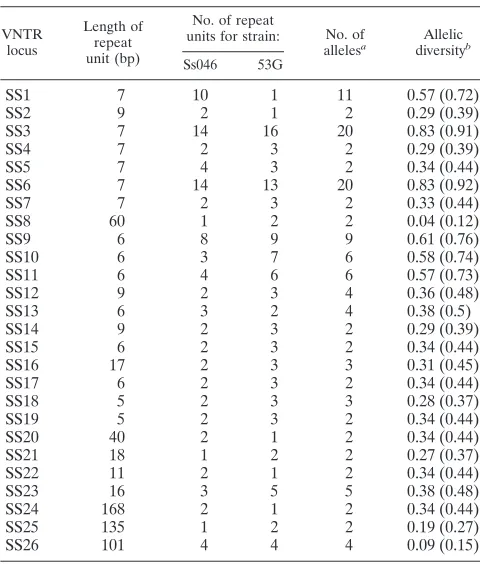
VNTR loci. In total, 26 VNTR loci were identified after testing 10 genetically distant strains. The characteristics of the 26 VNTR loci are listed in Table 2. Most of the loci had short repeat sequences, which ranged from 5 to 9 bp. Eight loci had only one repeat unit in strain Ss046 or strain 53G. Locus SS1 was unusual: it had one repeat unit in strain 53G but 10 units in strain Ss046. The calculated and observed amplicon sizes of the alleles for each locus are listed in Table S2 in the supple-mental material. The copy number of the repeat unit for each allele was confirmed by sequencing, and the nucleotide se-quences for the alleles are listed in the supplemental material. By testing 536 isolates, a range of 2 to 20 alleles was found for each of the loci (Table 2). Among the 26 loci, 6 (SS1, SS3, SS6, SS9, SS10, and SS11) were identified with six or more alleles, with a Nei’s diversity index ranging from 0.57 to 0.83 (Table 2).
Genotyping. The MLVA profiles for the 536S. sonnei iso-lates are listed in Table S3 in the supplemental material. MLVA analysis of the 536 isolates resulted in 126 MLVA types, with aDvalue of 0.9524 (CI, 0.9431 to 0.9616). Using the PFGE method, the isolates were discriminated into 98 PFGE types, with a D value of 0.8882 (CI, 0.8667 to 0.9097). The discriminatory power of MLVA was significantly higher than that of PFGE. MLVA typing with the four most variable
VNTR loci (SS3, SS6, SS9, and SS10) identified 106 types in the 536 isolates, with aDvalue of 0.9468 (CI, 0.9373 to 0.9564). MLVA typing with the eight most variable loci (SS1, SS3, SS6, SS9, SS10, SS11, SS13, and SS23) discriminated the isolates into 114 types, with aDvalue of 0.9481 (CI, 0.9387 to 0.9576). MLVA typing with another subset of eight loci (SS1, SS3, SS6, SS9, SS11, SS13, SS16, and SS23), which were variable in the 22 PFGE-indistinguishable isolates, discriminated the isolates into 109 types, with aDvalue of 0.9473 (CI, 0.9377 to 0.9569). The discriminatory powers among the four VNTR combina-tions were not different statistically.
MLVA subtyping of isolates from outbreaks.One hundred fifty-oneS. sonneiisolates collected from 10 outbreaks were analyzed. The isolates had been previously characterized using PFGE and IST (3). Of the 10 outbreaks, 6 (outbreaks 3, 4, 5, 6, 7, and 9) were identified with two or more MLVA types among the isolates collected (Table 1). Except for outbreak 9, each of the six outbreaks had a predominant MLVA type. Two main MLVA types were found in the isolates from outbreak 9; in contrast, only one PFGE type was identified in the isolates from outbreak 9 (Table 1). MLVA identified fewer types than PFGE from among the 151 isolates. In total, MLVA identified 15 types while PFGE identified 29 types in the 151 isolates.
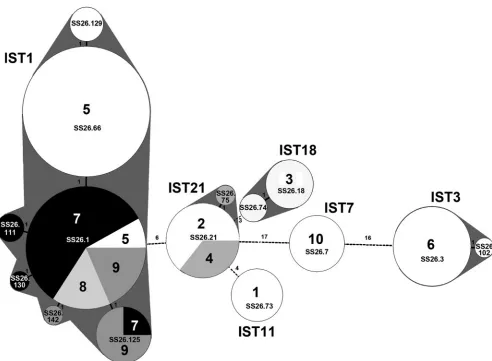
Cluster analysis of the MLVA profiles using a minimum spanning tree algorithm demonstrated the usefulness of MLVA in discriminatingS. sonneistrains collected from
dif-TABLE 2. Characteristics of 26 VNTR loci forS. sonneiidentified in this study
VNTR locus
Length of repeat unit (bp)
No. of repeat
units for strain: No. of
allelesa
Allelic
diversityb
Ss046 53G
SS1 7 10 1 11 0.57 (0.72)
SS2 9 2 1 2 0.29 (0.39)
SS3 7 14 16 20 0.83 (0.91)
SS4 7 2 3 2 0.29 (0.39)
SS5 7 4 3 2 0.34 (0.44)
SS6 7 14 13 20 0.83 (0.92)
SS7 7 2 3 2 0.33 (0.44)
SS8 60 1 2 2 0.04 (0.12)
SS9 6 8 9 9 0.61 (0.76)
SS10 6 3 7 6 0.58 (0.74)
SS11 6 4 6 6 0.57 (0.73)
SS12 9 2 3 4 0.36 (0.48)
SS13 6 3 2 4 0.38 (0.5)
SS14 9 2 3 2 0.29 (0.39)
SS15 6 2 3 2 0.34 (0.44)
SS16 17 2 3 3 0.31 (0.45)
SS17 6 2 3 2 0.34 (0.44)
SS18 5 2 3 3 0.28 (0.37)
SS19 5 2 3 2 0.34 (0.44)
SS20 40 2 1 2 0.34 (0.44)
SS21 18 1 2 2 0.27 (0.37)
SS22 11 2 1 2 0.34 (0.44)
SS23 16 3 5 5 0.38 (0.48)
SS24 168 2 1 2 0.34 (0.44)
SS25 135 1 2 2 0.19 (0.27)
SS26 101 4 4 4 0.09 (0.15)
aThe number of alleles found in the 536S. sonneiisolates tested in this study.
bThe value in parentheses was calculated from the 126S. sonneistrains with
different MLVA profiles identified in this study.
on May 16, 2020 by guest
http://jcm.asm.org/
[image:3.585.301.541.87.369.2]ferent outbreaks (Fig. 1). The analysis showed that strains with different IST genotypes were located in distinct clusters. In each of the six outbreaks identified with two or more MLVA types, the minor type(s) differed from the major type by a single locus. Outbreaks 2 and 4 shared a common MLVA type, suggesting that these two outbreaks are epidemiologically re-lated. The two outbreaks occurred in different regions (central and northern Taiwan) but in the same time period.
Four outbreaks (outbreaks 5, 7, 8, and 9) were caused by a common IST1 clone; a strain with the IST1 genotype was detected for the first time in Taiwan in 2000, and the IST1 strain then circulated and caused many outbreaks in central and eastern Taiwan in 2000 to 2003 (24). Isolates from each of the four outbreaks were identified with one to four MLVA types (Fig. 1). SS26.1 was a common MLVA type for the four outbreaks and was the major type for outbreaks 7, 8, and 9. Outbreak 5 was the first outbreak caused by an IST1 strain. SS26.66 was the predominant type for outbreak 5, which was distinguishable from outbreaks 7, 8, and 9.
MLVA of isolates with indistinguishable PFGE patterns.
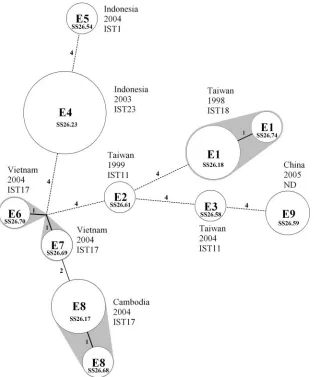
[image:4.585.47.539.64.425.2]A total of 22 S. sonnei isolates were collected from nine epidemiologically unrelated events. The infections occurred in five countries, and the isolates collected were indistin-guishable by PFGE with NotI and XbaI. In a previous study (3), 20 of the isolates from eight of the events were charac-terized and identified with five IST genotypes. The isolates from two events (event 2 [E2] and E3), which were found in Taiwan, and three (E6 to E8) events in Vietnam and Cam-bodia were not distinguished by IST. In contrast to PFGE, MLVA exhibited a high level of discriminatory power for the isolates. As shown in Fig. 2, the isolates from different events were discriminated into distinct MLVA genotypes. The genetic relationship between the MLVA types con-structed using the minimum spanning tree algorithm re-vealed that the strains from closer geographical locations shared a higher degree of genetic relatedness. For example, the strains from Vietnam and Cambodia shared a higher genetic relatedness than those from other countries. The
FIG. 1. Minimum spanning tree of the MLVA genotypes for theS. sonneistrains collected from 10 shigellosis outbreaks. The clustering was constructed by a minimum spanning tree algorithm. Arabic numerals (1 to 10) and indicate the outbreaks from which the MLVA strains were collected. The circle size is proportional to the number of isolates belonging to the indicated MLVA genotype. MLVA types differing by zero or one VNTR locus are regarded as a group and are marked with gray. Differences in loci between the two MLVA types are numbered. The IST genotypes for the outbreak strains are indicated. MLVA codes are marked in the circles.
on May 16, 2020 by guest
http://jcm.asm.org/
isolates from E1 and E8 were identified with two MLVA types differing by a single locus.
DISCUSSION
The purpose of developing a novel MLVA method is to find a replacement for PFGE as a routine typing method for dis-ease surveillance and outbreak investigation. PFGE is cur-rently the standard subtyping method for the surveillance ofS.
sonnei infections used in PulseNet laboratories (18). As the
result of testing with 536 isolates, MLVA exhibited a signifi-cantly higher discriminatory power than PFGE (D, 0.9524 ver-sus 0.8882). It has the potential to replace PFGE as the stan-dard typing method in the PulseNet disease surveillance network.
Although a total of 26 VNTR loci were identified, it is not necessary to analyze all the loci for the purposes of disease surveillance and outbreak investigation. The loci that are re-quired in a routine MLVA subtyping scheme will need to be
determined by testing more isolates collected from outbreaks in various geographical regions. In fact, the data showed that MLVA typing with the four most variable VNTR loci (SS3, SS6, SS9, and SS10), the eight most variable loci (SS1, SS3, SS6, SS9, SS10, SS11, SS13 and SS23), and the 26 loci had closely comparable discriminatory powers (Dvalues of 0.9468, 0.9481, and 0.9524, respectively). The CI values for the three VNTR combinations do not overlap, meaning that the discrim-inatory power of MLVA typing with the four and eight most variable VNTR loci is not statistically different from that per-formed with 26 VNTR loci. This study suggests that four to eight loci are sufficient for the subtyping ofS. sonneifor disease surveillance and outbreak investigation. Since a multiplex PCR can be designed for the amplification of more than four loci, MLVA typing of aS. sonneiisolate can be performed with two multiplex PCRs.
[image:5.585.138.452.68.445.2]MLVA typing of isolates from 10 outbreaks and the strains that were indistinguishable by PFGE also provided insight into
FIG. 2. Minimum spanning tree of the MLVA genotypes for 22Shigella sonneiisolates with indistinguishable PFGE patterns (J16N09.0015) collected from nine epidemiologically unrelated events (E1 to E9) in five different countries. Each event is noted with the country of infection, the year of occurrence, and the IST genotype. The circle size is proportional to the number of isolates belonging to the MLVA genotype. MLVA types differing by zero or one VNTR locus are regarded as a group and are colored gray. The differences in loci between two MLVA types are numbered. The MLVA codes are indicated in the circles.
on May 16, 2020 by guest
http://jcm.asm.org/
the choice of VNTR loci. Six of the 10 outbreaks had two or more MLVA types, and variation occurred in four loci (SS1, SS3, SS6, and SS9). For the 22 PFGE-indistinguishable iso-lates, variation was detected in eight loci (SS1, SS3, SS6, SS9, SS11, SS13, SS16, and SS23). These eight loci can differentiate the 536 isolates studied into 109 types, with aDvalue of 0.9473, the result of which approached that using 26 VNTR loci. This set of eight VNTRs and the set of the eight most variable VNTRs share seven loci but differ in the inclusion of SS10 in the former set and SS16 in the latter set.
This study showed that MLVA had good discriminatory power for distinguishing S. sonnei isolates from outbreak strains with different IST genotypes. MLVA also provided useful information for distinguishing outbreak 5 from out-breaks 7, 8, and 9. These four outout-breaks were caused by a common IST1 clone over a period of 1.5 years. The major MLVA type for outbreak 5 is distinct from the major type for outbreaks 7, 8, and 9. In contrast to PFGE, MLVA identified fewer minor types in the isolates from the 10 outbreaks. In spite of that, PFGE could distinguish only outbreak 8 from outbreaks 5, 7, and 9, which shared a common major PFGE type. It appears that neither MLVA nor PFGE can clearly discriminate the four outbreaks caused by a common IST clone. In a previous study, we showed that IST typing exhibited good discriminatory power for the PFGE-indistinguishable iso-lates, but it was still not able to discriminate all of the different events (3). In contrast to IST, MLVA can clearly discriminate all of the isolates from the different epidemiological events (Fig. 2), which took place in five countries, including Cambo-dia, China, Indonesia, Taiwan, and Vietnam, over a period of 7 years (1998 to 2005). This PFGE type might have been circulating in Asia for years. The framework of the strain genome has retained considerable stability. However, the ge-nome did vary over time. These genetic variations could not be detected by PFGE but were detectable with MLVA.
It is contradictory that PFGE is highly discriminatory forS.
sonnei but at times is not able to discriminate some of the
epidemiologically unrelated strains, for instance, the 22 PFGE-indistinguishable isolates characterized in this study. In quite a number of cases, we observed that many new PFGE strains had emerged through sustained transmission of anS. sonneistrain. However, it is quite common that a certain PFGE type will continue to be the major one over a period of years. For example, in a previous study, we conducted a PFGE analysis of
291S. sonneiisolates with the IST1 genotype. The study
iden-tified 37 PFGE types among the 291 isolates; 51% (148) of the isolates shared a common PFGE genotype (J16N09.0019) (24). When a strain with a stable PFGE genotype is widespread, PFGE will become an ineffective tool for investigation of an outbreak.
Isolates from 6 of the 10 outbreaks were identified as having more than one MLVA type. All of the minor types were single-locus variants of the major type (Fig. 1). Therefore,S. sonnei
isolates with MLVA profiles differing at no more than a single locus should be considered part of the same outbreak. Single-locus variants occurring during an outbreak are common. They have been observed in other organisms such asEscherichia coli
O157:H7 (17). In this study, we found two MLVA strains differing by a single locus in a patient from outbreak 9. The two
MLVA strains were isolated from the patient at time points separated by 6 days.
In conclusion, an MLVA method with 26 VNTR loci has been developed for typing of S. sonneiisolates. It was more discriminatory than PFGE forS. sonnei. MLVA can provide useful information for epidemiological investigation of S.
sonnei outbreaks and of PFGE-indistinguishable S. sonnei
strains; it has the potential to replace PFGE as a standard typing method for S. sonnei. However, study of a greater number of strains from a variety of geographical regions will be needed to determine which loci need to be included in a standard MLVA typing scheme for disease surveillance and outbreak investigation.
ACKNOWLEDGMENTS
This work was supported by a grant (DOH 96-DC-2025) of the Centers for Disease Control, Department of Health, Taiwan, and by a grant (H17-Shinkou-Ippan-019) of the Ministry of Health, Labor, and Welfare, Japan.
Pacific Edit reviewed the manuscript prior to submission.
REFERENCES
1.Benson, G.1999. Tandem repeats finder: a program to analyze DNA
se-quences. Nucleic Acids Res.27:573–580.
2.Chang, C. H., Y. C. Chang, A. Underwood, C. S. Chiou, and C. Y. Kao.2007. VNTRDB: a bacterial variable number tandem repeat locus database.
Nu-cleic Acids Res.35:D416–D421.
3.Chiou, C. S., H. L. Wei, Y. W. Wang, J. C. Liao, and C. C. Li.2006.
Usefulness of inter-IS1spacer polymorphisms for subtyping ofShigella
sonneiisolates. J. Clin. Microbiol.44:3928–3933.
4.Ekdahl, K., and Y. Andersson.2005. The epidemiology of travel-associated
shigellosis—regional risks, seasonality and serogroups. J. Infect.51:222–229.
5.Grundmann, H., S. Hori, and G. Tanner. 2001. Determining confidence intervals when measuring genetic diversity and the discriminatory abilities of
typing methods for microorganisms. J. Clin. Microbiol.39:4190–4192.
6.Gupta, A., C. S. Polyak, R. D. Bishop, J. Sobel, and E. D. Mintz.2004. Laboratory-confirmed shigellosis in the United States, 1989–2002:
epidemi-ologic trends and patterns. Clin. Infect. Dis.38:1372–1377.
7.Hunter, P. R.1990. Reproducibility and indices of discriminatory power of
microbial typing methods. J. Clin. Microbiol.28:1903–1905.
8.Hyytia-Trees, E., S. C. Smole, P. A. Fields, B. Swaminathan, and E. M. Ribot.2006. Second generation subtyping: a proposed PulseNet protocol for multiple-locus variable-number tandem repeat analysis of Shiga
toxin-pro-ducingEscherichia coliO157 (STEC O157). Foodborne Pathog. Dis.3:118–
131.
9.Kimura, A. C., K. Johnson, M. S. Palumbo, J. Hopkins, J. C. Boase, R. Reporter, M. Goldoft, K. R. Stefonek, J. A. Farrar, T. J. Van Gilder, and D. J. Vugia.2004. Multistate shigellosis outbreak and commercially prepared
food, United States. Emerg. Infect. Dis.10:1147–1149.
10.Kotloff, K. L., J. P. Winickoff, B. Ivanoff, J. D. Clemens, D. L. Swerdlow, P. J. Sansonetti, G. K. Adak, and M. M. Levine.1999. Global burden ofShigella
infections: implications for vaccine development and implementation of
con-trol strategies. Bull. W. H. O.77:651–666.
11.Lee, H. C., K. L. Chen, C. L. Tsai, C. H. Chen, T. N. Yeh, C. R. Yang, Y. L. Wang, H. Y. Chiu, C. L. Lee, H. P. Su, and T. H. Lin.2004. Imported
infection ofShigella sonneimolecular epidemiological investigation of cases
of the Bali tours. Epidemiol. Bull.20:23–42.
12.Liao, J. C., C. C. Li, and C. S. Chiou.2006. Use of a multilocus variable-number tandem repeat analysis method for molecular subtyping and
phylo-genetic analysis ofNeisseria meningitidisisolates. BMC Microbiol.6:44.
13.Malachowa, N., A. Sabat, M. Gniadkowski, J. Krzyszton-Russjan, J. Empel, J. Miedzobrodzki, K. Kosowska-Shick, P. C. Appelbaum, and W. Hryniewicz.
2005. Comparison of multiple-locus variable-number tandem-repeat analysis
with pulsed-field gel electrophoresis,spatyping, and multilocus sequence typing
for clonal characterization ofStaphylococcus aureusisolates. J. Clin. Microbiol.
43:3095–3100.
14.Marsh, J. W., M. M. O’Leary, K. A. Shutt, A. W. Pasculle, S. Johnson, D. N. Gerding, C. A. Muto, and L. H. Harrison.2006. Multilocus variable-number
tandem-repeat analysis for investigation ofClostridium difficiletransmission
in hospitals. J. Clin. Microbiol.44:2558–2566.
15.Mendoza, M. C., A. J. Gonzalez, F. J. Mendez, and C. Hardisson.1988.
Plasmid typing ofShigella sonneiepidemic strains and molecular relationship
of their R-plasmids. Eur. J. Epidemiol.4:158–163.
16.Mendoza, M. C., M. C. Martin, and M. A. Gonzalez-Hevia.1996. Usefulness of ribotyping in a molecular epidemiology study of shigellosis. Epidemiol.
Infect.116:127–135.
on May 16, 2020 by guest
http://jcm.asm.org/
17.Noller, A. C., M. C. McEllistrem, A. G. Pacheco, D. J. Boxrud, and L. H. Harrison.2003. Multilocus variable-number tandem repeat analysis
distin-guishes outbreak and sporadicEscherichia coliO157:H7 isolates. J. Clin.
Microbiol.41:5389–5397.
18.Ribot, E. M., M. A. Fair, R. Gautom, D. N. Cameron, S. B. Hunter, B. Swaminathan, and T. J. Barrett.2006. Standardization of pulsed-field gel
electrophoresis protocols for the subtyping of Escherichia coliO157:H7,
Salmonella, andShigellafor PulseNet. Foodborne Pathog. Dis.3:59–67. 19.Schouls, L. M., A. van der Ende, M. Damen, and I. van de Pol.2006.
Multiple-locus variable-number tandem repeat analysis ofNeisseria
menin-gitidisyields groupings similar to those obtained by multilocus sequence
typing. J. Clin. Microbiol.44:1509–1518.
20.Shiferaw, B., S. Shallow, R. Marcus, S. Segler, D. Soderlund, F. P. Hardnett, and T. Van Gilder.2004. Trends in population-based active surveillance for shigellosis and demographic variability in FoodNet sites, 1996–1999. Clin.
Infect. Dis.38(Suppl. 3):S175–S180.
21.Soldati, L., and J. C. Piffaretti.1991. Molecular typing ofShigellastrains using pulsed field gel electrophoresis and genome hybridization with
inser-tion sequences. Res. Microbiol.142:489–498.
22.Swaminathan, B., P. Gerner-Smidt, L. K. Ng, S. Lukinmaa, K. M. Kam, S. Rolando, E. P. Gutierrez, and N. Binsztein.2006. Building PulseNet Inter-national: an interconnected system of laboratory networks to facilitate timely public health recognition and response to foodborne disease outbreaks and
emerging foodborne diseases. Foodborne Pathog. Dis.3:36–50.
23.Terajima, J., N. Tosaka, K. Ueno, K. Nakashima, P. Kitsutani, M. K. Gaynor, S. Y. Park, and H. Watanabe.2006.Shigella sonneioutbreak among Japanese travelers returning from Hawaii. Jpn. J. Infect. Dis.
59:282–283.
24.Wei, H. L., Y. W. Wang, C. C. Li, S. K. Tung, and C. S. Chiou.2007. Epidemiology and evolution of genotype and antimicrobial resistance of an
importedShigella sonneiclone circulating in central Taiwan. Diagn.
Micro-biol. Infect. Dis.58:469–475.