International Journal of Emerging Technology and Advanced Engineering
Website: www.ijetae.com (ISSN 2250-2459,ISO 9001:2008 Certified Journal, Volume 5, Issue 7, July 2015)
231
Audio Steganography using Combination of LSB and Key for
Images, Audio and Text Messages
B. H. Barhate
1, Prof. Dr. R. J. Ramteke
2 1Assistant Professor & HOD, Dept. of Computer Sci., Bhusawal Arst, Sci. & P.O.Nahata Comm. College, Bhusawal, India
2Professor & HOD Dept. Of I.T, School of Computer Sciences, N.M.U., Jalgaon, Maharashtra, India
Abstract—Audio stegnography is one of the most difficult task to embed or hide message in cover. This paper the very popular algorithm LSB is used to hide message by copying LSB bits in array. To create wav file for long message is very difficult, but in this paper one solution is created for recording voice the windows recorder or conversion of big audio file in to wav file. For manipulating results of both audio or wav files PSNR and MSE quality measures are used.
Keywords— Audio Stegnography, BMP, JPG, LSB, MSE ,
PSNR, Stego,
I. INTRODUCTION
The word steganography comes from the Greek Steganos, which means covered or secret and - graphy means writing or drawing. Therefore, steganography means covered writing. Steganography is the art and science of hiding secret information in a cover file such that only sender and receiver can detect the existence of the secret information[1]
There are different names which initiates stegnography like „embedded‟,‟cover‟ and „stego‟. Many computer files such as audio files, text files, images contain few blocks of data that is either unused or not significant. Steganography takes advantage of these unused areas and hides the encrypted message.
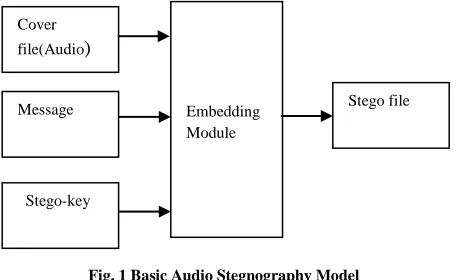
The model for steganography is shown in Fig 1. Message is the data that the sender wishes to remain it confidential. Message can be plain text, image, audio or any type of file. Password is known as a stego-key, using the stego key the receiver can extract the message from cover file if receiver knows stego key. The cover-file with the secret information is known as a stego-file.[1][2]
[image:1.612.332.561.235.375.2]Fig. 1 Basic Audio Stegnography Model
The components of steganographic system are:
Emb Message: The message to be embedded.
Cover: The data in which emb will be embedded.
Stego file: A modified version of cover that contains the
embedded message emb.
Stego-Key: Additional secret data that is needed for the
embedding and extracting processes and must be known to both, the sender and the recipient.
Steganographic algorithm: It can be characterized by a
number of defining properties. Three of them, are most important for audio steganographic algorithms, are introduced below:
Transparency: It evaluates the audible distortion due to
signal modifications like message embedding or attacking.
Capacity: The Capacity of an information hiding scheme
refers to the amount of information that a data hiding scheme can successfully embed without introducing perceptual distortion in the marked media.
Robustness: Very less problem of coloring and loss of
information.[8] Cover
file(Audio)
Message
Stego-key
Embedding Module
International Journal of Emerging Technology and Advanced Engineering
Website: www.ijetae.com (ISSN 2250-2459,ISO 9001:2008 Certified Journal, Volume 5, Issue 7, July 2015)
232 Audio Steganography is most of the important for Information Security media . Important authentication is embedded in digital sound. In Audio Steganography, the weakness of the Human Auditory System (HAS) is used to hide information in the audio. In past years , several Information hiding algorithms are proposed as well as implemented all these algorithms exploits the characteristics of human auditory system (HAS) for hiding information in transparent manner.
Audio Stegnography encoding Algorithm using key
Select any type of input as embedded message as text, audio or image
Read WAV audio file as cover and count total size
Select key by sender
Find size of message, if size of message is more than count size, then display message.
Select audio sample and first hide key and then converted code of the text in WAV file using LSB algorithm.
Repeat the above step still the whole message will be embedded in audio.
Secret Message Extracting Algorithm
Read the WAV file ie stego file covers audio after embedding.
Extract the message by reading LSB.
Select key of sender for extracting secrete message , if key matches .
Display the secret message
Fig.2 Audio stegnography
Audio stegnography is very powerful solution for information security. In this audio either .wav file is very important to hide message or even image. Due to higher storing capacity for image it needs more bit rate file is needed.
In .wav format such high bit rate files are not available therefore these files may be created by recording otherwise convert these file using . mp3.
Combination of key file and the file which we want to hide must have more capacity. In the above data hiding process there is a key file bhbkey.txt having 3 kb and the file which we want to hide bhb.txt with 4 kb.
Peak Signal-to-Noise Ratio (PSNR) :
The term peak signal-to-noise ratio (PSNR) is an expression for the ratio between the maximum possible value (power) of a signal and the power of distorting noise that affects the quality of its representation. Because many signals have a very wide dynamic range, (ratio between the largest and smallest possible values of a changeable quantity) the PSNR is usually expressed in terms of the logarithmic decibel scale.
Image enhancement or improving the visual quality of a digital image can be subjective. Saying that one method provides a better quality image could vary from person to person. For this reason, it is necessary to establish quantitative/empirical measures to compare the effects of image enhancement algorithms on image quality.
Using the same set of tests images, different image enhancement algorithms can be compared systematically to identify whether a particular algorithm produces better results. The metric under investigation is the peak-signal-to-noise ratio. If we can show that an algorithm or set of algorithms can enhance a degraded known image to more closely resemble the original, then we can more accurately conclude that it is a better algorithm.
PSNR = 10log10 [ 255 2 / MSE]
Mean Square Error (MSE) could be estimated in one of numerous approaches to quantify the contrast between values implied by an evaluation and correct quality being certified[1].
The MSE represents the cumulative squared error between the decompressed/reconstructed and the original image. MSE between two images can be computed as,
This can also be represented in a text based format as:
MSE = (1/(m*n))*sum(sum((f-g).^2)) PSNR = 20*log(max(max(f)))/((MSE)^0.5)
International Journal of Emerging Technology and Advanced Engineering
Website: www.ijetae.com (ISSN 2250-2459,ISO 9001:2008 Certified Journal, Volume 5, Issue 7, July 2015)
233 f (i,j) :image pixel value at position (i,j) in the original image
g(i,j) is the image pixel value at position (i,j) in the stego image.
Lesser the MSE, better the quality of reconstructed image.
Image Quality Metric MSE and PSNR :
The mean squared error (MSE) for our practical purposes allows us to compare the “true” pixel values of our original image to our degraded image. The MSE represents the average of the squares of the "errors" between our actual image and our noisy image. The error is the amount by which the values of the original image differ from the degraded image.
The proposal is that the higher the PSNR, the better degraded image has been reconstructed to match the original image and the better the reconstructive algorithm. This would occur because we wish to minimize the MSE between images with respect the maximum signal value of the image.[3][4]
When you try to compute the MSE between two identical images, the value will be zero and hence the PSNR will be undefined (division by zero).
MSE: 0.00 PSNR: Inf dB
Procedure for Calculating MSE and PSNR :
1. Read Cover Image from current directory. 2. Read Stego Image from current directory.
3. If Cover Image is equal to Stego Image then PSNR is 100%.
4. Find out difference between Stego Image & Stego Image.
5. Find out Mean Square Error by using above formula. 6. Find out maximum value of Pixel in Cover Image. 7. Find out Peak Signal to Noise Ratio.
[image:3.612.319.578.134.396.2]In a audio Steganography system, secret messages are embedded in digital sound. The secret message is embedded by slightly altering the binary sequence of a sound file. Existing audio Steganography software can embed messages in WAV, AU, and even MP3 sound files. Embedding secret message like images, sound text etc in to audio is critical or difficult as compare to other media.[9]
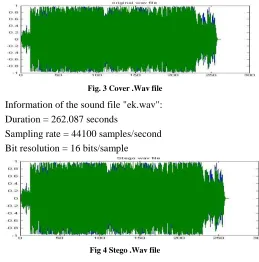
Fig. 3 Cover .Wav file
Information of the sound file "ek.wav": Duration = 262.087 seconds
Sampling rate = 44100 samples/second
Bit resolution = 16 bits/sample
Fig 4 Stego .Wav file
Information of the sound file "stek.wav":
Duration = 262.087 seconds
Sampling rate = 44100 samples/second Bit resolution = 16 bits/sample
MSE: 0.02
PSNR: 122.3672218 dB>>
Table. 1
Comparisons of Cover Audio and Secret message
Cover Secret Key MSE PSNR in DB
Audio Audio Audio (307 KB)
2.191E-08 124.7565
Image Audio 5.865E-08 122.4819 Text Audio 1.170E-07 117.4827
Audio Audio Audio (68 KB) 3.881E-08 122.2730
Image Audio 1.243E-07 117.2179
Text Audio 5.356E-07 120.8761 Audio Audio Audio (153
KB)
5.771E-08 120.5520
Image Audio 6.861E-08 119.8008
Text Audio 8.834E-08 118.7028
International Journal of Emerging Technology and Advanced Engineering
Website: www.ijetae.com (ISSN 2250-2459,ISO 9001:2008 Certified Journal, Volume 5, Issue 7, July 2015)
234
Results for Audio stegography for .PNG and JPG files
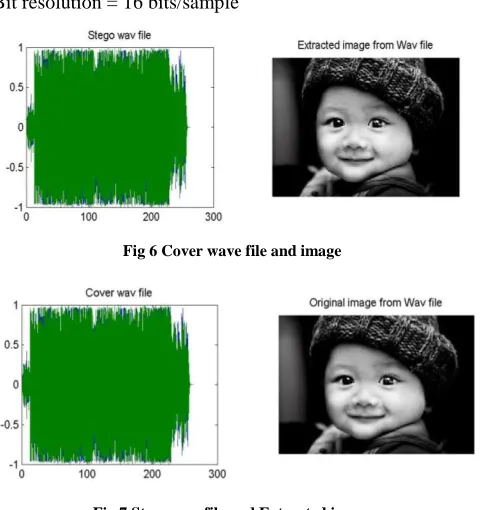
Fig.5 Stego audio file with extracted image (.png file)
Details of the stego file are
Information of the sound file "img.wav": Duration = 322.479 seconds
[image:4.612.44.569.107.606.2]Sampling rate = 11025 samples/second Bit resolution = 16 bits/sample
[image:4.612.325.562.136.242.2]Fig 6 Cover wave file and image
Fig 7 Stego wav file and Extracted image
Details for both original and stego audio are exactly same, there is no any change and loss of information.
Duration = 262.087 seconds, Sampling rate = 44100 samples/second, Bit resolution = 16 bits/sample.
[image:4.612.51.286.149.228.2]For embedding 100 characters in j1.wav audio file , following fig shows results of cover and stego audio with MSE and PSNR. It is concluded that there is no change in MSE and PSNR if we embed up to 1000 characters in .wav file.
Fig 8 Cover and Stego audio for Hiding 100 characters
MSE: 0.000000001112363337 PSNR: 137.7023326 dB>>
If we embed 3.50 KB .txt file in ab.wav file (size 30.6MB) the MSE and PSNR will be
MSE: 0.000000054563455914 PSNR: 120.7957806 dB>>
Fig. 9 Cover and Stego .wav file hiding 10 kb b/w .jpg
If we embed 10KB eye.jpg B/W image file in .WAV file MSE and PSNR will be
MSE: 0.000000149357575880 PSNR: 116.4225267 dB>>
Fig. 10 Cover and Stego .wav file hiding 10 kb color .jpg
If we embed color image in .WAV file MSE & PSNR will be MSE: 0.000000192751338826
[image:4.612.52.292.297.552.2] [image:4.612.323.571.479.613.2]International Journal of Emerging Technology and Advanced Engineering
Website: www.ijetae.com (ISSN 2250-2459,ISO 9001:2008 Certified Journal, Volume 5, Issue 7, July 2015)
235
LSB for Audio Steganography:
In Audio Steganography wav file is suitable since to maintain better quality after applying LSB coding. Every wav file classifies in two parts one is Header and second is Data. While embedding data, one can‟t deal with the header section. That is because a minimal change in the header section leads to a corrupted [10]
Steps for Data Embedding
1. Read the .wav audio file
2. Read the text file or secret message to be hidden , Convert it into a binary sequence of message bits.
3. The LSB of each sample of wav audio is replaced with the message bits.
4. The modified wav audio samples are then written to a file forming stego audio signal.
Steps for Data Extraction/ Reconstruction:
1. Read the stego wav audio file.
2. Extract the LSB of each sample of the audio file.
3. After every such 16 least significant bits are retrieved, they are converted to their decimal equivalents.
4. Finally the secret signal is reconstructed.
Design Methodology :
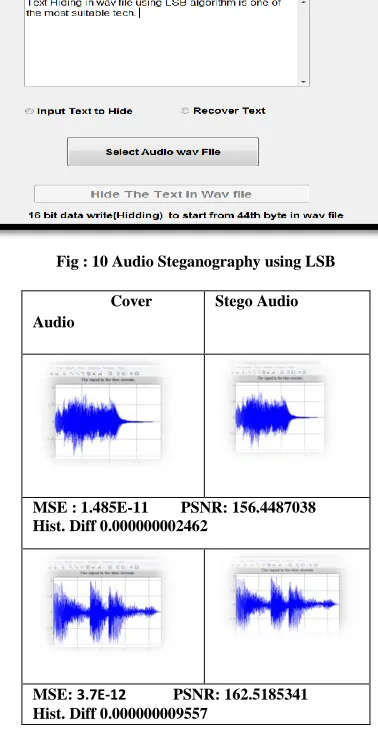
[image:5.612.346.535.170.535.2]In the above algorithm the following methodology is used. First we have to select .wav audio file as a host file. Here the paper based on LSB tech for data hiding therefore use LSB of that file should be modified without degrading the sound quality. As per the structure of .wav file have two basic parts, the header and the data. Normally header part is stored in the first 44 bytes of the file and rest of the date stored from 44 bytes in the file. . Except the first 44 bytes, the rest of the bytes of the file are all about the data Very less data stored in header section . That is because a minimal change in the header section leads to a corrupted audio file . This technique is more secured because first the secrete data is embedded into the image and that image is embedded into the audio.[11]
Fig : 10 Audio Steganography using LSB
Cover Audio
Stego Audio
MSE : 1.485E-11 PSNR: 156.4487038 Hist. Diff 0.000000002462
MSE: 3.7E-12 PSNR: 162.5185341 Hist. Diff 0.000000009557
Fig : 11 Quality measures between cover and stego audio
II. CONCLUSION
International Journal of Emerging Technology and Advanced Engineering
Website: www.ijetae.com (ISSN 2250-2459,ISO 9001:2008 Certified Journal, Volume 5, Issue 7, July 2015)
236 This proposed system will not change the size of the file even after encoding and also suitable for any type of audio file format. This method also helps to hide image as well as big messages. It has considerably low robustness against the attacks. Therefore maintain the robustness during the substitutions of bits.
REFERENCES
[1] Jayaram , Ranganatha , Anupama , “Information Hiding using audio stegnography- A Survey” The International Journal of Multimedia & Its Applications (IJMA) Vol.3, No.3, August 2011 ,Pg 86-96. [2] Burate D. J., M.R.Dixit, “Performance Improving LSB Audio
Steganography Technique”, International Journal of Advance Research in Computer Science and Management Studies, Volume 1, Issue 4, September 2013, Pg 67-75.
[3] M.Sivaram B.DurgaDevi J.Anne Steffi, “STEGANOGRAPHY OF TWO LSB BITS”, International Journal of Communications and Engineering Volume 01– No.1, Issue: 01 March2012, ,ISSN NO. 0988-0382E, pg. 82-87.
[4] Naitik P Kamdar, Dipesh G. Kamdar Dharmesh N.khandhar.,” Performance Evaluation of LSB based Steganography for optimization of PSNR and MSE”, Journal Of Information , Knowledge And Research In Electronics And Communication Engineering, Issn: 0975 – 6779| Nov 12 To Oct 13 | Volume – 02, Issue - 02 Page 505-509.
[5] Jagreeti Kaur, Baljit Singh, Ph.D, “Comparison of LSB and Predictive Coding using PSNR and MSE” International Journal of Computer Applications (0975 – 8887) Volume 98– No.7, July 2014.
[6] Gunjan Chugh, Rajkumar Yadav and Ravi Saini, “A New Image Steganographic Approach Based on Mod Factor for RGB Images”, International Journal of Signal Processing, Image Processing and Pattern Recognition Vol.7, No.3 (2014), pp.27-44,
[7] Vijaypal Dhaka* Ramesh C. Poonia Yash Veer Singh, “ A Novel Algorithm for Image Steganography Based on Effective Channel Selection Technique” , International Journal of Advanced Research in Computer Science and Software Engineering , Volume 3, Issue 8, August 2013 ISSN: 2277 128X, PAGE 428-433.
[8] Gaurav Saini, IIParulpreet Singh, “Audio Steganography by LSB Method and Enhanced Security with AES”, International Journal of Advanced Research in Computer Science & Technology (IJARCST 2014), ISSN : 2347 - 8446 (Online),ISSN : 2347 - 9817 (Print), Vol. 2, Issue 2, Ver. 2 (April - June 2014), Pg. 255-258.
[9] Laxmi Kumari, Dinesh Goyal, “ Analysis and Design of 3 LSB Techniques for Secure Audio Steganography”, International Journal of Advanced Research in Computer Engineering & Technology (IJARCET) Volume 2, Issue 8, August 2013, ISSN: 2278 – 1323,pg- 2457-2460
[10] Mrs. K.Shanthi,, Mr. K. Abhishek,, “Embedding Data in Audio and Image Processing by Steganographic Tool Techniques” , International Journal of Engineering Research & Technology (IJERT) ISSN: 2278-0181 Vol. 4 Issue 03, March-2015 , page 640-643