molecules
ISSN 1420-3049 www.mdpi.com/journal/molecules Article
Cyclization vs. Cyclization/Dimerization in o-Amidostilbene
Radical Cation Cascade Reactions: The Amide Question
Chin Hui Kee 1, Azhar Ariffin 1, Khalijah Awang 1, Ibrahim Noorbatcha 2, Koichi Takeya 3, Hiroshi Morita 4, Chuan Gee Lim 5 and Noel Francis Thomas 1,*
1 Department of Chemistry, Faculty of Science, University of Malaya, 50603 Kuala Lumpur,
Malaysia
2 Department of Biotechnology Engineering, Faculty of Engineering, International Islamic University
Malaysia, 53100 Kuala Lumpur, Malaysia
3 Department of Pharmacognosy, Tokyo University of Pharmaceutical and Life Science,
1432-1 Horinouchi, Hachioji, Tokyo 192-0392, Japan
4 Faculty of Pharmaceutical Sciences, Hoshi University, Shinagawa-ku, Tokyo 142-8501, Japan 5 Environmental and Bioprocess Technology Centre, SIRIM Berhad, 40000 Shah Alam, Malaysia
* Author to whom correspondence should be addressed; E-Mail: [email protected]; Tel.: +603-79674065; Fax: +603-79674193.
Received: 5 August 2011; in revised form: 16 August 2011/ Accepted: 17 August 2011 / Published: 25 August 2011
Abstract: The n-butyramido, isobutyramido, benzamido, and furancarboxamido functions profoundly modulate the electronics of the stilbene olefinic and NH groups and the corresponding radical cations in ways that influence the efficiency of the cyclization due presumably to conformational and stereoelectronic factors. For example, isobutyramido- stilbene undergoes FeCl3 promoted cyclization to produce only indoline, while
n-butyramidostilbene, under the same conditions, produces both indoline and bisindoline. Keywords: stilbene; indoline; bisindoline; FeCl3
1. Introduction
A large number of biologically active compounds incorporate indole and indoline moieties, particularly those that possess C-2 phenyl or heteroaryl moieties [1]. A vast array of creative approaches to the indoline ring system have been reported recently, for example the 1,6-H transfer
followed by the 5-exo-trigonal ring closure tactic that exploits o-nitrobenzaldehyde [2]; the 5-endo-trigonal ring closure of N-(o-bromophenyl)ene carbamates [3]; intramolecular carbolithiation [4]; reduction of indoles [5] and the thermal reaction of N-allylaniline and various alkoxyamines [6]. Creative bisindoline construction is also increasing in importance as recent developments clearly indicate. For example, the highly efficient successive amide transfer approach leading to C2 symmetric bisindolines [7]; diaza-Cope rearrangement resulting in C3-C3’ bisisoindolines [8] and the [CoCl(PPh3)3] mediated indolyl bromide homolyisis/dimerisation [9].
In 2004, we described the then unprecedented FeCl3-promoted acetamidostilbene radical cation 1*
cascade culminating in the indoline 3 and bisindoline 4a [10]. A subsequent X-ray analysis of the bisindoline has shown that the correct structure should be the C2 symmetric dimer 4b (Scheme 1) [11].
Four years later, we published the unexpected discovery that benzophenone (2) was capable of producing ca. a doubling of the yield of the indoline with concomittant suppression of bisindoline 4 formation (Scheme 1) [12]. The benzophenone was almost recovered always quantitatively. We proposed a Fe3+ benzophenone ketyl radical/stilbene radical cation catalytic cycle in that paper. Enhancement of indoline formation by an “internal agent” or via structural modification of the stilbene starting material was not envisaged.
Scheme 1. Oxidative coupling of 3,4-dimethoxy-acetamido stilbene (1).
An n-butyramide (in place of the acetamide in Scheme 1) would be expected, on steric grounds, to engage the C(7) benzylic cation with greater difficulty than stilbene 1. Cyclization (via FeCl3) in the
case of the isobutyramidostilbene would constitute an even greater steric impediment to indoline formation. Would the furan carboxamido and benzamido moieties undergo cyclization with comparable efficiency or are there delicate conformational factors at work here?
We reported last year full spectroscopic details of several novel stilbenes that were prepared by the Heck procedure [13]. The amido NH in stilbene 6 is more shielded than 5 (Table 1), which suggests that the amide in 6 should be somewhat more nucleophilic (under neutral or slightly acidic conditions). On the other hand, the NMR spectra also reveal that the furancarboxamido stilbene 11 and the benzamidostilbene 7 possess even more deshielded NHs compared to stilbenes 6 and 5. It could be argued, all other things being equal, that this significant withdrawal of electron density away from the amide NH could reduce the nucleophilicity of the amide group and thus adversely affect cyclization of the radical cation, in contrast to the cyclization of 5 or 6. It is significant that Crich’s heterocyclization of a non-oxidatively derived non-stilbene radical cation fails in the case of A but is successful in the case of B (see Scheme 2). The different cyclization outcomes for A and B appear to be due to the severely reduced nucleophilicity of the benzylaniline in A compared to B.
Scheme 2. Examples of Crich’s alkene radical cation cyclizations [14].
NHBn O NO2 P O PhO PhO NHBn NHBn N Bn X 50%
Bu3SnH AIBN, Benzene
NHBn O NO2 P O PhO PhO NHBn N Bn H 43%
Bu3SnH AIBN, Benzene
Example A
Example B
Another interesting observation relates to the olefinic multiplets. For the furancarboxamido stilbenes 9-12, the C(8)-H proton is more deshielded than the C(7)-H proton, the one noticeable exception being stilbene 9, where the C(7)-H is significantly more deshielded. This might mean that exposure of stilbene 9 to FeCl3 could produce a radical cation in which the positive charge was now at
Table 1. 1H-NMR [400MHz, δH (J, Hz)] of stilbenes 5-12 in CDCl3.
Entry Stilbene C(7)-H (J, Hz) C(8)-H (J, Hz) N-H (J, Hz)
1
OCH3 OCH3
N H O 7
8
5
6.85 6.95 7.56
2
6
6.90 6.97 7.31
3
7
6.93 7.04 8.03
4
8
6.91 6.97 7.21
5
N H
O 7
8 O H3CO
9
7.40 7.29 8.25
6
10
7.02 7.22 8.17
7
11
Table 1. Cont.
8
12
7.00 7.09 8.17
In order to unveil structural (electronic) and possible conformational influences on our radical cation cascade cyclization/dimerization, experiments were performed as described in the next section. We included stilbene 9 in our study to investigate the possibility of mesomeric stabilization by the ortho-methoxy substituent of the C(7) carbenium ion with the unpaired electron at C(8). Stilbene 10 was included to confirm an observation first reported in 2009 [15] where a meta-methoxy substituent directs radical cation formation in a way that is opposite to that observed with a para-methoxy substituent. We included stilbene 12 to examine the implications of having 4-methoxy substituent (rather than 3,4-dimethoxy substitution) on the formation of the radical cation.
2. Results and Discussion
2.1. FeCl3 Promoted Syntheses of Indolines
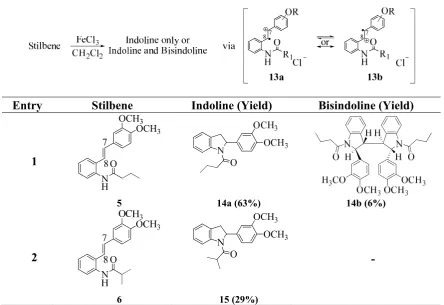
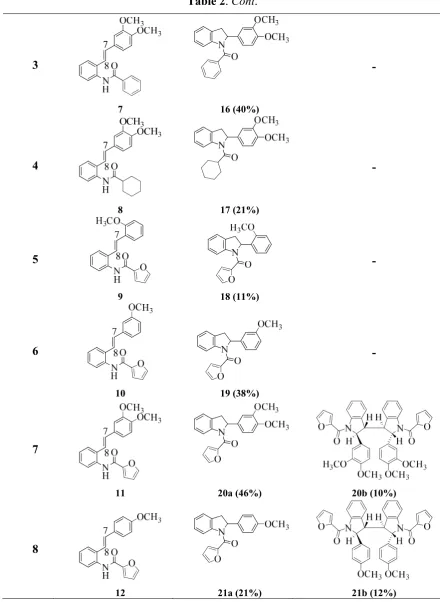
Eight carboxamidostilbenes were constructed by the Heck protocol [13]. These stilbenes were then subjected to our FeCl3 reaction conditions as shown below (Table 2). The resulting observations
demand a more complex explanation than we had anticipated based on previous experience [10]. Table 2. FeCl3 promoted syntheses of indolines and bisindolines.
Entry Stilbene Indoline (Yield) Bisindoline (Yield)
1
OCH3 OCH3
N H
O 7
8
5 14a (63%) 14b (6%)
2
6
N O
OCH3 OCH3
15 (29%)
[image:5.595.76.521.486.791.2]Table 2. Cont.
3
7 16 (40%)
-
4
8 17 (21%)
-
5
9 18 (11%)
-
6
10 19 (38%)
-
7
11 20a (46%) 20b (10%)
8
12 21a (21%) 21b (12%)
Oxidation of the stilbene 5 with FeCl3 gave rise to indoline 14a (63%) and bisindoline 14b (6%) (in
the absence of benzophenone) via radical cation 13a (in contrast to the transformation in Scheme 1) an unexpected result. We had previously reported that the 10-acetamido-4-methoxystilbene on exposure to FeCl3 produced the bisindoline in 24% yield and the indoline in 16% yield [15]. This “4-methoxy
increased. In the present study, replacement of butyramide (5) with isobutyrylamide (6) resulted in a lowering of the yield of indoline 15 to 29%. Bisindoline formation was not observed, a result that is all the more remarkable when compared to stilbene 12 (Entry 8, Table 2).
2.2. Effect of Amide Structure on the Radical Cyclization Leading to Indoline Formation
The very different behaviour of 5 and 6 on exposure to FeCl3 is readily explained by the early
transition state pictures I and II (Scheme 3) where the increase steric bulk of the isobutyrylamide renders cyclization more difficult, hence the lower yield of 15 (29%). A similar explanation would account for the low yield of indoline 17 from stilbene 8.
Scheme 3. Early transition state pictures for radical cyclization leading to indoline formation.
Section 2.3 and Scheme 10). In the case of stilbene 9, cyclization is made more difficult (and hence the significantly reduced yield) because it must proceed via radical cation 13b. It is noteworthy that the C(8) carbon of 9, in this special case, is more shielded than the C(7) (compared to the other furancarboxamidostilbenes) because of the directional nature and electron withdrawing tendency of the 2-methoxy lone electron pairs [13]. In the case of stilbene 10, radical cation 13b is again the crucial intermediate (see Ref. [10] for the similar case of 10-acetamido-3-methoxystilbene) [15]. It may be worth emphasising that the FeCl3 oxidation of stilbenes 9 and 10 proceed via a different radical cations
(analogous to 13b) whereas stilbene 12 proceeds via radical cation 13a (see Table 2). This is because stilbene 12 on oxidation produces a radical cation in which the positive charge is at C(7) as a result of mesomeric stabilization from a para-methoxy substituent. By contrast in stilbene 10 where the methoxy group is meta, the position of the positive charge changes to C(8) because of superior mesomeric stabilization which comes from the amide nitrogen lone pair in the ortho position (i.e., a C-10 amido group). In the case of stilbene 9 where mesomeric stabilization of a C(7) carbocation (in the radical cation) might have been expected, we observed a unique ortho-methoxy lone pair effect which dramatically reverses the position of radical and positive charge. The positive charge is now at C(8) rather than at C(7). This electronic factor is seen even in the NMR of the stilbenes (see Table 1). Notice that remarkably in stilbene 9 the C(7) proton is substantially more deshielded than C(8). The phenomena described above underpin the mechanistic interpretation discussed in Schemes 11 to 13. It is significant that in contrast to our first report (Scheme 1) where the bisindoline 4A was presented in the meso arrangement, in this report all bisindolines are designated as racemic. The reason for this is explained in Section 2.3.
2.3. Dimerization Pathways and PM6 Calculations for the Minor Products
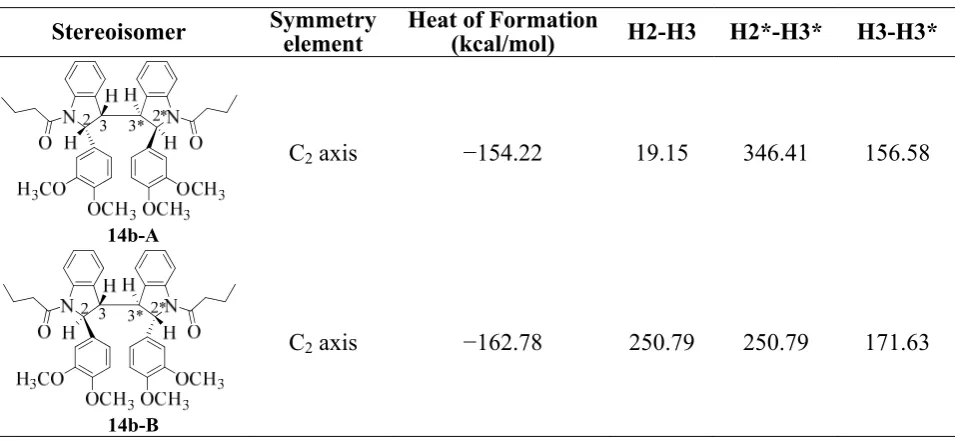
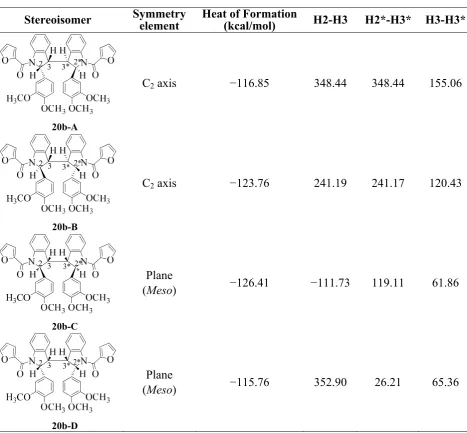
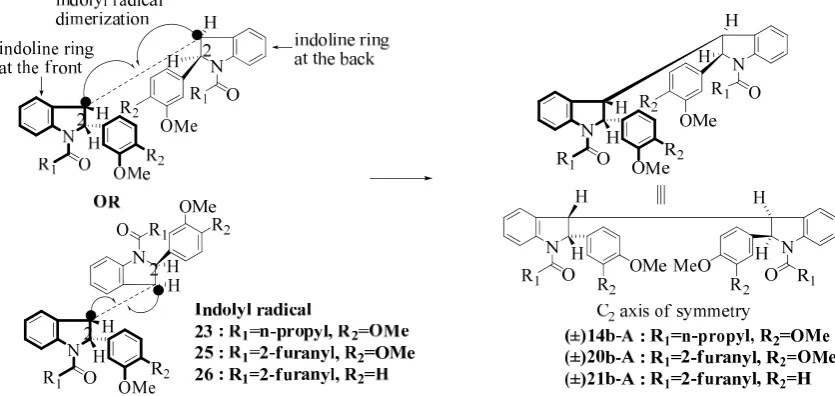
[image:8.595.62.540.557.778.2]The basis for the observed stereoselectivity for each of the bisindoline minor products (14b, 20b and 21b) is explained below. There are four diastereomeric possibilities. The PM6 calculations (MOPAC2009) are provided in Tables 3-5.
Table 3. PM6 calculation for 14b.
Stereoisomer Symmetryelement Heat of Formation(kcal/mol) H2-H3 H2*-H3* H3-H3*
14b-A
C2 axis −154.22 19.15 346.41 156.58
14b-B
Table 3. Cont.
14b-C
Plane
(Meso) −163.46 240.71 111.62 298.43
14b-D
Plane
(Meso) −133.96 310.52 324.60 24.01
Table 4. PM6 calculation for 20b.
Stereoisomer Symmetryelement Heat of Formation(kcal/mol) H2-H3 H2*-H3* H3-H3*
20b-A
C2 axis −116.85 348.44 348.44 155.06
20b-B
C2 axis −123.76 241.19 241.17 120.43
20b-C
Plane
(Meso) −126.41 −111.73 119.11 61.86
20b-D
Plane
[image:9.595.65.533.327.760.2]Table 5. PM6 calculation for 21b.
Stereoisomer Symmetry element Heat of Formation(kcal/mol) H2-H3 H2*-H3* H3-H3*
21b-A
C2 axis −48.59 340.27 340.27 115.07
21b-B
C2 axis −55.04 247.75 247.23 172.63
21b-C
Plane
(Meso) −56.28 240.70 111.61 298.43
21b-D
Plane
(Meso) −43.83 12.48 26.33 69.76
Scheme 5. Dimerization pathways leading the stereoisomers (±)14b-B, (±)20b-B and (±)21b-B.
Scheme 6. Dimerization pathways leading the stereoisomers 14b-C, 20b-C and 21b-C.
N R1
N R1 H R2 O H
R2 OMe H
O MeO
H
M eso
Symmetry plane N
R1 O
N R1 O H
H
H R2
OMe
H
OMe R2
N R1 O
N R1 O H
H
H R2
OMe
H
OMe R2 2
2
Indolyl radical
23 : R1=n-propyl, R2=OMe 25 : R1=2-furanyl, R2=OMe 26 : R1=2-furanyl, R2=H
14b-C : R1=n-propyl, R2=OMe 20b-C : R1=2-furanyl, R2=OMe 21b-C : R1=2-furanyl, R2=H
These calculations (the thermodynamic argument) lead to the same conclusions as the mechanistic analysis of dimerization pathways for the various indolyl radicals (the kinetic argument) see Scheme 4 to Scheme 7.
Scheme 8. Another perspective on dimerization pathways leading to the stereoisomer 14b-C, 20b-C and 21b-C.
The arguments that distinguish (±)14b-B and meso 14b-C (Table 3) are more finely balanced as these two diastereoisomers are closer in energy (-162.78 and -163.46 kcal/mol). This closeness is also reflected in the fact that in examining dimerization pathways for the indolyl radicals (Schemes 5 and 6), dimerization appears to be equally feasible in both cases. In comparing the early transition state pictures in Schemes 8 and 9, the approach of indolyl radicals in Scheme 9 would have the effect of keeping the “phenyl” region of the indoline rings as far apart as posible, as well as possibly minimizing interactions between the amide moieties (see Scheme 8). This would appear to lead to the conclusion that the correct stereostructures are (±)14b-B, (±)20b-B and (±)21b-B respectively (see Scheme 9 and Table 2).
Scheme 9. Another perspective on dimerization pathways leading to the stereoisomer (±)14b-B, (±)20b-B and (±)21b-B.
N R1
N R1 H R2 O
H R2
OMe H
O MeO
H
Racemic
(±)14b-B : R1=n-propyl, R2=OMe
(±)20b-B : R1=2-furanyl, R2=OMe
(±)21b-B : R1=2-furanyl, R2=H N
H H O
R1
MeO R2
N
H H O
R1
OMe R2
Indolyl radical
23 : R1=n-propyl, R2=OMe
25 : R1=2-furanyl, R2=OMe
One additional point of some importance relates to the PM6 calculations. Although (±)14b-B is slightly higher in energy, the dihedral angles in this case are consistent with the symmetrical nature of the molecule (Table 3) and is therefore to be preferred over the meso form 14b-C (Scheme 8). These arguments fully justify the exploitation of PM6 calculations for the elucidation of stereochemical problems inherent in reactions of this type.
Exactly analogous arguments can be used to justify the presentation of bisindolines 20b and 21b which carry furancarboxamide moieties, as their racemic modifications (Tables 2, 4 and 5). For 20b-A, 20b-D, 21b-A and 21b-D are readily ruled out on energetic grounds and this thermodynamic argument is again amply vindicated by the dimerization pathways for the indolyl radicals. Consideration of indolyl radical dimerization pathways and thermodynamic arguments favour formation of (±)20b-B and 20b-C (Schemes 5 and 6) and (±)21b-B and 21b-C (Schemes 5 and 6).
However careful scrutiny of the dimerization pathways as previously described (Schemes 9 and 10) inevitably leads to the conclusion that the correct stereostructures are (±)20b-B and (±)21b-B. These conclusion are supported by the X-ray data for the bisindoline depicted in Scheme 1 and confirm that the bisindoline has the structure (±)4b (and not 4a as originally reported by us).
With respect to bisindoline formation, it would seem that in the presumably early transition states involving the corresponding indolyl radicals 22 and 23 (Scheme 10), the methyl group of the isobutryl moiety in 22 is able to block dimerization so that no bisindoline is obtained. By contrast indolyl radical 23 by virtue of possessing an n-butyrylamido group has only the much smaller H in that position and dimerization is not impeded.
Scheme 11. The ortho-methoxy effect.
In the case of the 9 (Scheme 11), the attempted dimerization fails in spite of the fact that one would have expected a radical cation intermediate analogous to 13a (Table 2). The reduced nucleophilicity of this NH and the reduced electron density in the olefinic bond may well account for the low yield of the indoline 18 (Scheme 10) (see our previous discussion on NMR spectroscopic characteristics for the eight stilbenes) [13].
Scheme 12. Mechanistic interpretation I.
N O H OCH3 Cl Cl O N O H OCH3 O N 7 8 O H OCH3 O 10 N O Cl OCH3 O N O OCH3 O X No dimerization Fe2+ Fe3+ N O OCH3 O N O OCH3 O 19
FeCl3 FeCl2+1/ 2Cl2
H
It is interesting to note that in 9 the C7-H (δ 7.40) is more deshielded than the C8-H (δ 7.29) in contrast to the other furan carboxamidostilbenes 10, 11 and 12. This would have the effect of reversing the position of the radical and cation (formed after oxidation) where the removal of an electron from C8 would be preferred.
The failure of dimerization in the case of 10 is due to the formation of the radical cation analogous to 13b (Table 2) and Scheme 12. The formation of this radical cation is related to the absence of a paramethoxy group (in 10) that could stabilize a C7 cation and as a result the cation is formed preferentially at C8. Ring closure proceeds possibly via homolysis of an N-Cl bond leading to the nitrogen centred radical as shown in Scheme 12 or alternatively, via the Fe3+ azaenolate (27). Reduction of the indolyl cation (whose formation renders dimerization impossible) to the indolyl radical cation and H• uptake leads to the indoline. This pathway is shown in Scheme 13.
Scheme 13. Mechanistic interpretation II.
N 7 8 O H OCH3 FeCl3 N OCH3
O Fe3+ H
O
O 10
CH2Cl2
+H N O OCH3 H H O
Fe2+ Fe3+
N O OCH3 O 19 27 3. Experimental 3.1. General
Unless otherwise noted, materials were purchased from commercial suppliers and used without purification. THF was freshly distilled from calcium hydride. DMF was dried over 4Å molecular sieves (Sigma-Aldrich) prior to use. Column chromatography was performed using Merck silica gel (0.040–0.063 mm). For thin layer chromatography, Merck TLC aluminum sheets (silica gel 60 F254)
were used; centrifugal chromatography, Merck silica gel 60 PF254 containing gypsum were used.
Infrared spectra were recorded on a Perkin Elmer FTIR Spectrum RX-1 spectrometer at wavenumbers from 4000–400 cm−1. Nuclear magnetic resonance (NMR) spectra were obtained on a JEOL JNM-LA 400 and JEOL ECA-400 instrument. Spectra are reported in units of ppm on the scale, relative to chloroform and the coupling constants are given in Hz. Ultraviolet (UV) spectra were recorded from 190–400 nm, in methanol, on a Shimadzu UV-Visible Spectrophotometer 1650. Mass spectra were measured using an Agilent 6530 Accurate-Mass Q-TOF LC/MS system. Detailed experimental procedures for the synthesis of stilbenes 7-14 and starting materials have been reported elsewhere [13]. 3.2. General Procedure for the FeCl3 Oxidative Coupling
Stilbene (1 equiv) was dissolved in CH2Cl2 (25 mL). ‘Anhydrous’ FeCl3 (2-3 equiv) was added to
anhydrous sodium sulphate. Purification of the crude product by column chromatography afforded the desired products. Semi-empirical molecular orbital calculations were performed to optimise the geometry of the molecules using the PM6method [17] included in MOPAC2009 [18].
3.2.1. 1-(2-(3,4-Dimethoxyphenyl)indolin-1-yl)butan-1-one (14a)
Yield 0.30 g (63%); νmax/cm−1 (NaCl): 2961, 1659, 1516, 1480, 1463, 1401, 1262, 1139, 1027, 754;
λmax (MeOH)/nm: 237, 253, 281; 1H-NMR (400 MHz; CDCl3) δH 8.33 (d, J = 7.6 Hz, H-8, 1H), 7.24
(t, J = 7.8 Hz, H-7, 1H), 7.12 (d, J = 6.4 Hz, H-5, 1H), 7.03 (t, J = 7.6 Hz, H-6, 1H) , 6.76 (d, J = 8.2 Hz, H-5', 1H), 6.68 (d, J = 8.2 Hz, H-6', 1H), 6.64 (s, H-2', 1H), 5.36 (d, J = 7.3 Hz, H-2, 1H), 3.83 (s, OCH3, 3H), 3.77 (s, OCH3, 3α, 4H), 2.94 (d, J = 16.5 Hz, H-3β, 1H), 2.09-2.36 (m, H-2", CH2, 2H),
1.67 (s, H-3", CH2, 2H), 0.84 (s, H-4", CH3, 3H); 13C-NMR (100 MHz; CDCl3) δC 172.0 (C-1"),
149.5 3'), 148.5 4'), 143.5 9), 136.0 1'), 129.3 4), 127.8 7), 125.1 5), 124.0 (C-6), 117.2 (C-6'), 117.0 (C-8), 111.4 (C-5'), 108.0 (C-2'), 62.6 (C-2), 56.0 (OCH3), 55.9 (OCH3), 39.2
(CH2, C-3), 37.5 (CH2, C-2"), 18.2 (CH2, C-3"), 13.9 (CH3, C-4"); HRMS (+ESI) [M+H]+: 326.1754,
C20H24NO3 requires 326.1756.
3.2.2. 1,1'-2,2'- bis(3,4-Dimethoxyphenyl)- 3,3'- biindoline-1,1'-diyl dibutan-1-one ((±)14b)
Yield 0.06 g (6%); νmax/cm−1 (NaCl): 2961, 1666, 1516, 1462, 1398, 1255, 1140, 1027, 755 ; λmax
(MeOH)/nm: 237, 249, 281; 1H-NMR (400 MHz; CDCl3) δH 8.53 (d, J = 8.2 Hz, H-8, H-8*, 2H), 7.46
(t, J = 8.0 Hz, H-7, H-7*, 2H), 7.30 (d, J = 7.3 Hz, H-5, H-5*, 2H), 7.21 (t, J = 7.3 Hz, H-6, H-6*, 2H), 6.61 (d, J = 8.7 Hz, H-5', H-5'*, 2H), 6.21 (d, J = 7.8 Hz, H-6', H-6'*, 2H), 5.81 (s, H-2', H-2'*, 2H), 4.70 (s, H-2, H-2*, CH, 2H), 3.77 (s, 2 X OCH3, 6H), 3.61 (s, 2 X OCH3, 6H), 3.52 (s, H-3, H-3*, CH,
2H), 1.83-2.12 (m, H-2", H-2"*, CH2, 4H), 1.45-1.56 (m, H-3", H-3"*, CH2, 4H), 0.76 (t, J = 7.6 Hz,
H-4", H-4"*, CH3, 6H); 13C-NMR (100 MHz; CDCl3) δC 172.4 (C-1", C-1"*), 149.4 (C-3', C-3'*),
148.3 (C-4', C-4'*), 144.3 (C-9, C-9*), 134.7 (C-1', C-1'*), 130.0 (C-4, C-4*), 129.4 (C-7, C-7*), 125.3 (C-5, C-5*), 124.5 (C-6, C-6*), 117.7 (C-8, C-8*), 115.9 (C-6', C-6'*), 111.3 (C-5', C-5'*), 107.5 (C-2', C-2'*), 63.4 (C-2, C-2*), 56.9 (C-3, C-3*), 55.9 (2 X OCH3), 55.8 (2 X OCH3), 37.1 (CH2, C-2",
C-2"*), 17.7 (CH2, C-3", C-3"*), 13.8 (CH3, C-4", C-4"*); HRMS (+ESI) [M+H]+: 649.3276,
C40H44N2O6 requires 649.3278.
3.2.3. 1-(2-(3,4-dimethoxyphenyl)indolin-1-yl)-2-methylpropan-1-one (15)
Yield 0.13 g (29%); νmax/cm−1 (NaCl): 2964, 1653, 1516, 1479, 1263, 1138, 1026, 755; λmax
(MeOH)/nm: 210, 238, 253, 281; 1H-NMR (400 MHz; CDCl3) δH 8.36 (d, J = 5.5 Hz, H-8, 1H), 7.24
(t, J = 7.8 Hz, H-7, 1H), 7.11 (d, J = 7.3 Hz, H-5, 1H), 7.02 (t, J = 7.8 Hz, H-6, 1H) , 6.75 (d, J = 8.2 Hz, H-5', 1H), 6.68 (dd, J = 8.2 Hz, 1.8 Hz, H-6', 1H), 6.64 (s, H-2', 1H), 5.43 (d, J = 8.7 Hz, H-2, 1H), 3.82 (s, OCH3, 3H), 3.77 (s, OCH3, H-3α, 4H), 2.96 (d, J = 16.0, H-3β, 1H), 2.61 (s, H-2", 1H), 1.20
(d, J = 6.9 Hz, H-4", 3H), 0.87 (s, H-3", 1H); 13C-NMR (100 MHz; CDCl3) δC 177.0 (C-1"),
33.4 (CH, C-2"), 20.3 (CH3, C-4"), 19.1 (CH3, C-3"); HRMS (+ESI) [M+H]+: 326.1760, C20H24NO3
requires 326.1751.
3.2.4. (2-(3,4-Dimethoxyphenyl)indolin-1-yl)(phenyl)methanone (16)
Yield 0.21 g (40%); νmax/cm−1 (NaCl): 2956, 1646, 1516, 1480, 1386, 1259, 1139, 1026, 755; λmax
(MeOH)/nm: 216, 267; 1H-NMR (400 MHz; CDCl3) δH 7.38 (t, J = 6.8 Hz, H-5", 1H), 7.17-7.31 (m,
H-5, H-7, H-8, H-3", H-4", H-6", H-7", 7H), 7.06 (t, J = 7.3 Hz, H-6, 1H), 6.68 (d, J = 8.2 Hz, H-5', 1H) , 6.55 (d, J = 5.0 Hz, H-6', 1H), 6.42 (s, H-2', 1H), 5.37 (s, H-2, 1H), 3.81 (s, OCH3, 3H),
3.67-3.74 (m, OCH3, H-3α, 4H), 2.98 (dd, J = 16.2 Hz, 1.8 Hz, H-3β, 1H); 13C-NMR (100 MHz;
CDCl3) δC 169.9 (C-1"), 149.0 (C-3'), 148.3 (C-4'), 143.2 (C-9), 137.1 (C-2"), 136.2 (C-1'),
130.7 (C-4), 130.0 (C-5"), 128.3 (C-4", C-6"), 127.6 (C-7), 127.0 (C-3", C-7"), 125.3 (C-5, C-8), 124.4 (C-6), 117.5 (C-6'), 111.3 (C-5'), 108.9 (C-2'), 64.3 (C-2), 55.9 (OCH3), 55.8 (OCH3), 38.5 (C-3);
HRMS (+ESI) [M+Na]+: 382.1416, C23H21NNaO3 requires 382.1414.
3.2.5. Cyclohexyl(2-(3,4-dimethoxyphenyl)indolin-1-yl)methanone (17)
Yield 0.13 g (12%); νmax/cm−1 (NaCl): 2930, 1655, 1516, 1479, 1403, 1265, 1138, 1027, 754; λmax
(MeOH)/nm: 216, 237, 254, 282; 1H-NMR (400 MHz; CDCl3) δH 8.35 (d, J = 6.4 Hz, H-8, 1H), 7.24
(t, J = 8.1 Hz, H-7, 1H), 7.11 (d, J = 6.6 Hz, H-5, 1H), 7.03 (t, J = 7.4 Hz, H-6, 1H) , 6.76 (d, J = 8.3 Hz, H-5', 1H), 6.70 (dd, J = 8.2 Hz, 1.7 Hz, H-6', 1H), 6.65 (s, H-2', 1H), 5.42 (d, J = 7.6 Hz, H-2, 1H), 3.83 (s, OCH3, 3H), 3.77 (s, OCH3, H-3α, 4H), 2.97 (d, J = 15.8, H-3β, 1H), 2.34 (s, H-2", 1H),
1.20-1.89 (m, 5 x CH2, 10H); 13C-NMR (100 MHz; CDCl3) δC 175.9 (C-1"), 149.3 (C-3'), 148.4 (C-4'),
143.5 (C-9), 136.5 (C-1'), 129.4 (C-4), 127.7 (C-7), 124.8 (C-5), 123.7 (C-6), 117.1 (C-8, C-5'), 111.4 (C-6'), 108.0 (C-2'), 62.3 (C-2), 55.8 (2 x OCH3), 43.8 (CH, C-2"), 38.9 (CH2, C-3), 30.0, 28.7, 26.0,
25.6, 25.4 (5 x CH2); HRMS (+ESI) [M+H]+: 366.2065, C23H27NO3 requires 366.2064.
3.2.6. Furan-2-yl(2-(2-methoxyphenyl)indolin-1-yl)methanone (18)
Yield 0.07 g (11%); νmax/cm−1 (NaCl): 3007, 1634, 1479, 1397, 1243, 1025, 832, 753; λmax
(MeOH)/nm: 280, 297; 1H-NMR (400 MHz; CDCl3) δH 8.33 (s, H-8, 1H), 7.36 (d, J = 1.8 Hz, H-5",
1H), 7.28 (t, J = 7.8 Hz, H-7, 1H), 7.17 (td, J = 7.8 Hz, 1.8Hz, H-4', 1H), 7.12 (d, J = 7.3 Hz, H-5, 1H), 7.06 (td, J = 7.6 Hz, 0.9 Hz, H-6, 1H), 6.98 (dd, J = 7.6 Hz, 1.8 Hz, H-6', 1H), 6.89 (d, J = 8.2 Hz, H-3', 1H), 6.80 (d, J = 3.2 Hz, H-3", 1H), 6.75 (t, J = 7.5 Hz, H-5', 1H), 6.33 (dd, J = 3.7Hz, 1.8 Hz, H-4", 1H), 6.31 (dd, J = 9.8 Hz, 1.4 Hz, H-2, 1H), 3.92 (s, OCH3, 3H), 3.76 (dd, J = 16.2 Hz, 10.1 Hz,
H-3α, 1H), 2.90 (dd, J = 16.5 Hz, 1.4 Hz, H-3β, 1H); 13C-NMR (100 MHz; CDCl3) δC 158.2 (C-1"),
155.5 (C-2'), 147.8 (C-2"), 144.5 (C-5"), 143.7 (C-9), 131.6 (C-1'), 130.7 (C-4), 128.4 (C-4'), 127.6 (C-7), 125.2 (C-5), 125.0 (C-6'), 124.7 (C-6), 120.8 (C-5'), 118.1 (C-8), 116.5 (C-3"), 111.5 (C-4"), 110.5 (C-3'), 58.9 (C-2), 55.6 (OCH3), 38.2 (C-3); HRMS (+ESI) [M+Na]+: 342.1106, C20H17NNaO3
3.2.7. Furan-2-yl(2-(3-methoxyphenyl)indolin-1-yl)methanone (19)
Yield 0.04 g (38%); νmax/cm−1 (NaCl): 3006, 1634, 1479, 1397, 1286, 1048, 755; λmax (MeOH)/nm:
281, 296; 1H-NMR (400 MHz; CDCl3) δH 8.24 (s, H-8, 1H), 7.39 (s, H-5", 1H), 7.27 (t, J = 8.2 Hz,
H-7, 1H), 7.12-7.16 (m, H-5, H-5', 2H), 7.07 (t, J = 7.6 Hz, H-6, 1H), 6.91 (d, J = 3.7 Hz, H-3", 1H), 6.69-6.75 (m, H-2', H-4', H-6', 3H), 6.36 (dd, J = 3.4Hz, 1.8 Hz, H-4", 1H), 6.05 (dd, J = 9.6 Hz, 1.4 Hz, H-2, 1H), 3.78 (dd, J = 15.8 Hz, 9.6 Hz, H-3α, CH2, 1H), 3.69 (s,OCH3, 3H), 3.01 (d, J = 15.6 Hz,
H-3β, CH2, 1H); 13C-NMR (100 MHz; CDCl3) δC 159.9 (C-3'), 158.3 (C-1"), 148.0 (C-2"),
145.5 (C-1'), 144.3 (C-5"), 143.6 (C-9), 130.0 (C-4, C-5'), 127.8 (C-7), 125.1 (C-5), 124.8 (C-6), 117.9 (C-8), 117.3 (C-4'), 117.1 (C-3"), 112.4 (C-6'), 111.7 (C-4"), 111.0 (C-2'), 63.3 (C-2), 55.2 (OCH3),
39.3 (C-3) ; HRMS (+ESI) [M+H]+: 320.1286, C20H18NO3 requires 320.1281.
3.2.8. (2-(3,4-Dimethoxyphenyl)indolin-1-yl)(furan-2-yl)methanone (20a)
Yield 0.15 g (46%); νmax/cm−1 (NaCl): 3008, 1634, 1479, 1397, 1257, 1140, 1026, 754; λmax
(MeOH)/nm: 207, 283, 296; 1H-NMR (400 MHz; CDCl3) δH 8.21 (d, J = 5.5 Hz, H-8, 1H), 7.41 (dd,
J = 1.8 Hz, 0.92 Hz, H-5", 1H), 7.26 (t, J = 7.8 Hz, H-7, 1H), 7.16 (d, J = 7.8 Hz, H-5, 1H), 7.07 (td, J = 7.6 Hz, 0.92Hz, H-6, 1H), 6.89 (d, J = 3.6 Hz, H-3", 1H), 6.63-6.68 (m, H-2', H-5', H-6', 3H), 6.36 (dd, J = 3.4Hz, 1.4 Hz, H-4", 1H), 6.02 (dd, J = 9.6 Hz, 1.8 Hz, H-2, CH, 1H), 3.76-3.82 (m, H-3α, OCH3, 4H), 3.73 (s,OCH3, 3H), 3.01 (dd, J = 16.0 Hz, 1.84Hz, H-3β, CH2, 1H); 13C-NMR (100 MHz;
CDCl3) δC 158.5 (C-1"), 149.1 (C-3'), 148.3 (C-4'), 148.1 (C-2"), 144.1 (C-5"), 143.5 (C-9),
136.4 (C-1'), 130.1 (C-4), 127.7 (C-7), 125.1 (C-5), 124.7 (C-6), 117.7 (C-8), 117.1 (C-5'), 117.0 (C-3"), 111.7 (C-4"), 111.3 (C-6'), 108.2 (C-2'), 63.1 (C-2), 55.9 (2 x OCH3), 39.4 (C-3); HRMS
(+ESI) [M+H]+: 350.1404, C21H20NO4 requires 350.1387; [M+Na]+: 372.1215, C21H19NNaO4 requires
372.1206.
3.2.9. (2,2'- bis(3,4-Dimethoxyphenyl)-3,3'-biindoline-1,1'-diyl)-bis(furan-2-ylmethanone) ((±)20b) Yield 0.07 g (10%); νmax/cm−1 (NaCl): 2934, 1636, 1516, 1476, 1394, 1254, 1141, 1025, 754; λmax
(MeOH)/nm: 207, 283; 1H-NMR (400 MHz; CDCl3) δH 8.59 (d, J = 7.8 Hz, H-8, H-8*, 2H), 7.48 (td,
J = 7.8 Hz, 1.4 Hz, H-7, H-7*, 2H), 7.36 (d, J = 7.3 Hz, H-5, H-5*, 2H), 7.23-7.27 (m, H-6, H-6*, H-5", H-5"*, 4H), 6.67 (d, J = 3.6 Hz, H-3", H-3"*, 2H), 6.54 (d, J = 8.2 Hz, H-5', H-5'*, 2H), 6.28 (d, J = 1.8 Hz, H-6', H-6'*, 2H), 6.21 (dd, J = 3.4 Hz, 1.8 Hz, H-4", H-4"*, 2H), 5.83 (d, J = 1.8 Hz, H-2', H-2'*, 2H), 5.78 (s, H-2, H-2*, CH, 2H), 3.70 (s, 2 x OCH3, 6H), 3.60 (s, H-3, H-3*, 2H), 3.57 (s,
2 x OCH3, 6H); 13C-NMR (100 MHz; CDCl3) δC 158.4 (C-1", C-1"*), 149.1 (C-3', C-3'*), 148.1 (C-4',
C-4'*), 147.4 (C-2", C-2"*), 144.9 (C-9, C-9*), 144.6 (C-5", C-5"*), 135.6 (C-1', C-1'*), 130.8 (C-4, C-4*), 129.2 (C-7, C-7*), 125.4 (C-5, C-5*), 125.0 (C-6, C-6*), 118.2 (C-8, C-8*), 117.3 (C-3", C-3"*), 115.9 (C-6', C-6'*), 111.5 (C-4", C-4"*), 111.1 (C-5', C-5'*), 107.6 (C-2', C-2'*), 63.6 (C-2, C-2*), 57.3 (C-3, C-3*), 55.81 (2 x OCH3), 55.76 (2 x OCH3); HRMS (+ESI) [M+H]+: 697.2542,
3.2.10. Furan-2-yl(2-(4-methoxyphenyl)indolin-1-yl)methanone (21a)
Yield 0.10 g (21%); νmax/cm−1 (NaCl): 3005, 1635, 1513, 1478, 1397, 1249, 1179, 1034, 834, 755;
λmax (MeOH)/nm: 203, 226, 283, 297; 1H-NMR (400 MHz; CDCl3) δH 8.25 (d, J = 4.6 Hz, H-8, 1H),
7.40 (dd, J = 1.8 Hz, 0.92 Hz, H-5", 1H), 7.27 (t, J = 7.8 Hz, H-7, 1H), 7.16 (d, J = 7.8 Hz, H-5, 1H), 7.04-7.09 (m, H-6, H-2', H-6', 3H), 6.90 (d, J = 4.1 Hz, H-3", 1H), 6.72-6.75 (m, H-3', H-5', 2H), 6.35 (dd, J = 3.7Hz, 1.8 Hz, H-4", 1H), 6.05 (dd, J = 9.6 Hz, 1.8 Hz, H-2, CH, 1H), 3.76 (dd, J = 16.0 Hz, 10.1Hz, H-3α, CH2, 1H), 3.70 (s, OCH3, 3H), 2.98 (dd, J = 16.0 Hz, 1.4Hz, H-3β, CH2, 1H); 13C-NMR (100 MHz; CDCl
3) δC 158.8 (C-4'), 158.4 (C-1"), 148.1 (C-2"), 144.2 (C-5"), 143.6 (C-9),
136.0 (C-1'), 130.1 (C-4), 127.7 (C-7), 126.1 (C-2', C-6'), 125.1 (C-5), 124.7 (C-6), 117.8 (C-8), 117.0 (C-3"), 114.2 (C-3', C-5'), 111.7 (C-4"), 62.8 (C-2), 55.3 (OCH3), 39.4 (C-3); HRMS (+ESI) [M+H]+:
320.1294, C20H18NO3 requires 320.1281; [M+Na]+: 342.1105, C20H17NNaO3 requires 342.1101.
3.2.11. (2,2'- bis(4-methoxyphenyl)- 3,3'- biindoline-1,1'-diyl) bis(furan-2-ylmethanone) ((±)21b) Yield 0.11 g (12%); νmax/cm−1 (NaCl): 3008, 1636, 1512, 1477, 1395, 1249, 1177, 1034, 755; λmax
(MeOH)/nm: 205, 226, 284; 1H-NMR (400 MHz; CDCl3) δH 8.59 (d, J = 8.2 Hz, H-8, H-8*, 2H), 7.49
(td, J = 7.8 Hz, 1.4 Hz, H-7, H-7*, 2H), 7.31 (d, J = 6.4 Hz, H-5, H-5*, 2H), 7.24-7.27 (m, H-6, H-6*, H-5", H-5"*, 4H), 6.69 (d, J = 3.6 Hz, H-3", H-3"*, 2H), 6.55-6.60 (m, H-3', H-3'*, H-5', H-5'*, 4H), 6.44-6.47 (m, H-2', H-2'*, H-6', H-6'*, 4H), 6.20 (dd, J = 3.4 Hz, 1.8 Hz, H-4", H-4"*, 2H), 5.81 (s, H-2, H-2*, CH, 2H), 3.63 (s, 2 x OCH3, 6H), 3.55 (s, H-3, H-3*, 2H); 13C-NMR (100 MHz; CDCl3) δC
158.7 (C-4', C-4'*), 158.3 (C-1", C-1"*), 147.5 (C-2", C-2"*), 144.8 (C-9, C-9*), 144.6 (C-5", C-5"*), 135.3 (C-1', C-1'*), 130.7 (C-4, C-4*), 129.3 (C-7, C-7*), 125.6 (C-2', C-2'*, C-6', C-6'*), 125.4 (C-5, C-5*), 125.1 (C-6, C-6*), 118.1 (C-8, C-8*), 117.3 (C-3", C-3"*), 114.2 (C-3', C-3'*, C-5', C-5'*), 111.4 (C-4", C-4"*), 63.5 (C-2, C-2*), 57.2 (C-3, C-3*), 55.2 (2 x OCH3); HRMS (+ESI) [M+H]+:
637.2341, C40H33N2O6 requires 637.2333.
4. Conclusions
Although previous studies by our group have demonstrated the synthetic utility of benzophenone (an organocatalyst) as an effective additive for dramatically improving the yield of indolines (and suppressing bisindoline formation), the present study demonstrated that even in the absence of benzophenone, the amide structure can also under certain conditions discriminate between the indoline and bisindoline forms (enhancing the former and suppressing the latter). Stilbene 5 (with an n-butyramide moiety) will, on exposure to FeCl3, give the corresponding indoline 14a in 63% yield,
compared to stilbene 6 (with an isobutyramide moiety) which yields indoline 15 in 29%. Previously undiscovered steric, conformational and stereoelectronic effects have been considered in this study involving eight stilbenes.
stilbenes 11 and 12 with predictable consequences for the cyclization/dimerization. These transformations exploit FeCl3 (an environmentally friendly oxidant) as the single electron transfer
reagent [19-21]. Further developments will be reported in due course. Acknowledgments
The authors (NFT, AA, KA) thank MOSTI (eScienceFund: 14-02-03-4013) and University of Malaya (UMRG: RG023/09AFR, FRGS: FP018/2009). CHK thanks University of Malaya (Vote: P0263/2007A and PS195/2008A), Malaysia Toray Science Foundation (08/G21) and MOSTI for a NSF scholarship.
References and Notes
1. Fuwa, H.; Sasaki, M. Synthesis of 2-substituted indoles and indolines via Suzuki-Miyaura coupling/5-endo-trig cyclization strategies. J. Org. Chem. 2009, 74, 212-221.
2. Prediger, I.; Weiss, T.; Reiser, O. Facile access to 2-arylindolines and 2-arylindoles by microwave-assisted tandem radical cyclization. Synthesis 2008, 2008, 2191-2198.
3. Anas, S.; Kagan, H.B. Routes toward enantiopure 2-substituted indolines: An overview. Tetrahedron: Asymmetry 2009, 20, 2193-2199.
4. Bailey, W.F.; Luderer, M.R.; Mealy, M.J. Preparation of differentially 1,3-disubstituted indolines by intramolecular carbolithiation. Tetrahedron Lett. 2003, 44, 5303-5305.
5. Kuwano, R.; Sato, K.; Kurokawa, T.; Karube, D.; Ito, Y. Catalytic asymmetric hydrogenation of heteroaromatic compounds, indoles. J. Am. Chem. Soc. 2000, 122, 7614-7615.
6. Leroi, C.; Bertin, D.; Dufils, P.-E.; Gigmes, D.; Marque, S.; Tordo, P.; Couturier, J.-L.; Guerret, O.; Ciufolini, M.A. Alkoxyamine-mediated radical synthesis of indolinones and indolines. Org. Lett. 2003, 5, 4943-4945.
7. Muñiz, K. Advancing palladium-catalyzed C-N bond formation: Bisindoline construction from successive amide transfer to internal alkenes. J. Am. Chem. Soc. 2007, 129, 14542-14543.
8. Zhu, Q.; Huang, H.; Shi, D.; Shen, Z.; Xia, C. An efficient synthesis of chiral diamines with rigid backbones: Application in enantioselective michael addition of malonates to nitroalkenes. Org. Lett. 2009, 11, 4536-4539.
9. Movassaghi, M.; Schmidt, M.A. Concise total synthesis of (-)-calycanthine, (+)-chimonanthine, and (+)-folicanthine. Angew. Chem. Int. Ed. 2007, 46, 3725-3728.
10. Thomas, N.F.; Velu, S.S.; Weber, J.-F.F.; Lee, K.C.; Hadi, A.H.A.; Richomme, P.; Rondeau, D.; Noorbatcha, I.; Awang, K. A tandem highly stereoselective FeCl3-promoted synthesis of a
bisindoline: Synthetic utility of radical cations in heterocyclic construction. Tetrahedron 2004, 60, 11733-11742.
11. Kam, T.-S.; Low, Y.-Y. We thank Prof. Kam and Mr Low (Dept. of Chem., University of Malaya) for crystal data of the bisindoline 4b. A CIF file is included in the supplementary data submitted.
cyclization - an improved synthesis of 2-(3', 4'-dimethoxyphenyl) indoline. Heterocycles 2008, 75, 1097-1108.
13. Kee, C.H.; Ariffin, A.; Awang, K.; Takeya, K.; Morita, H.; Inayat Hussain, S.; Chan, K.M.; Wood, P.J.; Threadgill, M.D.; Lim, C.G.; et al. Challenges associated with the synthesis of unusual o-carboxamido stilbenes by the Heck protocol: Intriguing substituent effects, their toxicological and chemopreventive implications. Org. Biomol. Chem. 2010, 8, 5646-5660.
14. Crich, D.; Shirai, M.; Brebion, F.; Rumthao, S. Enantioselective alkene radical cations reactions. Tetrahedron 2006, 62, 6501-6518.
15. Ahmad, K.; Thomas, N.F.; Mukhtar, M.R.; Noorbatcha, I.; Faizal Weber, J.-F.; Nafiah, M.A.; Velu, S.S.; Takeya, K.; Morita, H.; Lim, C.-G.; et al. A FeCl3-promoted highly
atropodiastereoselective cascade reaction: Synthetic utility of radical cations in indolostilbene construction. Tetrahedron 2009, 65, 1504-1516.
16. Anslyn, E.V.; Dougherty, D.A. Modern Physical Organic Chemistry; University Science Books: Sausalito, CA, USA, 2006.
17. Stewart, J. Optimization of parameters for semiempirical methods V: Modification of NDDO approximations and application to 70 elements. J. Mol. Model. 2007, 13, 1173-1213.
18. Stewart, J. Mopac 2009; Stewart Computational Chemistry: Colorado Springs, CO, USA. http://OpenMOPAC.net
19. Bolm, C.; Legros, J.; Le Paih, J.; Zani, L. Iron-catalyzed reactions in organic synthesis. Chem. Rev. 2004, 104, 6217-6254.
20. Díaz, D.D.; Miranda, P.O.; Padrón, J.I.; Martín, V.S. Recent uses of Iron (III) chloride in organic synthesis. Curr. Org. Chem. 2006, 10, 457-476.
21. Sarhan, A.A.O.; Bolm, C. Iron (III) chloride in oxidative C-C coupling reactions. Chem. Soc. Rev. 2009, 38, 2730-2744.
![Table 1. 1H-NMR [400MHz, δH (J, Hz)] of stilbenes 5-12 in CDCl3](https://thumb-us.123doks.com/thumbv2/123dok_us/8651903.867973/4.595.85.523.94.788/table-h-nmr-mhz-dh-hz-stilbenes-cdcl.webp)