I m p r o vi n g t h e e n e r g y e ffici e n c y
fo r t h e WB S N b o t tl e n e c k z o n e
b a s e d o n r a n d o m li n e a r n e t w o r k
c o di n g
Al S h a h e e n , H a n d Tak r u ri-Riz k, H
h t t p :// dx. d oi.o r g / 1 0 . 1 0 4 9 /i e t-w s s . 2 0 1 7 . 0 0 5 6
T i t l e
I m p r o vi n g t h e e n e r g y e ffici e n cy fo r t h e WB S N b o t tl e n e c k
zo n e b a s e d o n r a n d o m li n e a r n e t w o r k c o di n g
A u t h o r s
Al S h a h e e n , H a n d Tak r u r i-Riz k, H
Typ e
Ar ticl e
U RL
T hi s v e r si o n is a v ail a bl e a t :
h t t p :// u sir. s alfo r d . a c . u k /i d/ e p ri n t/ 4 3 9 0 4 /
P u b l i s h e d D a t e
2 0 1 7
U S IR is a d i gi t al c oll e c ti o n of t h e r e s e a r c h o u t p u t of t h e U n iv e r si ty of S alfo r d .
W h e r e c o p y ri g h t p e r m i t s , f ull t e x t m a t e r i al h el d i n t h e r e p o si t o r y is m a d e
f r e ely a v ail a bl e o nli n e a n d c a n b e r e a d , d o w nl o a d e d a n d c o pi e d fo r n o
n-c o m m e r n-ci al p r iv a t e s t u d y o r r e s e a r n-c h p u r p o s e s . Pl e a s e n-c h e n-c k t h e m a n u s n-c ri p t
fo r a n y f u r t h e r c o p y ri g h t r e s t r i c ti o n s .
IET Wireless Sensor Systems
Research Article
Improving the energy efficiency for the WBSN
bottleneck zone based on random linear
network coding
ISSN 2043-6386 Received on 8th May 2017 Revised 5th September 2017 Accepted on 2nd October 2017 E-First on 30th November 2017 doi: 10.1049/iet-wss.2017.0056 www.ietdl.org
Hisham Alshaheen
1, Haifa Takruri Rizk
11Computing, Science and Engineering School, University of Salford, Manchester, UK
E-mail: [email protected]
Abstract: The reduction of energy consumption and the successful delivery of data are important for a wireless body sensor network (WBSN). Many studies have been performed to improve energy efficiency, but most of them have not focused on the biosensor nodes in the WBSN bottleneck zone. Energy consumption is a critical issue in WBSNs, as the nodes that are placed next to the sink node consume more energy. All biomedical packets are aggregated through these nodes forming a bottleneck zone. This study proposes a novel mathematical model for body area network topology to explain the deployment and connection between biosensor nodes, simple relay nodes, network coding (NC) relay nodes and the sink node. Therefore, this study is dedicated to research both the energy saving and delivery of data if there is a failure in one of the links of the transmission, which relates to the proposed random linear NC model in the WBSN. Using a novel mathematical model for the WBSN, it is apparent that energy consumption is reduced and data delivery achieved with the proposed mechanism. This study details the stages of the research work.
1 Introduction
A wireless body sensor network (WBSN) consists of several biological sensors. WBSNs are used in both medical and non-medical applications. In a non-medical application, these are designed to monitor vital signs in the human body, and WBSNs are used to show different vital signs, for instance, blood glucose level, heart rate, body temperature, body posture and blood oxygen saturation. In addition, WBSNs are used to measure electrocardiography (ECG), blood pressure, and electroencephalography. Such sensor devices fall into two types: implantable medical devices and wearable medical devices. The former are implanted inside the human body. The latter are worn or placed on the skin or very near to the patient. The biosensor nodes sense or otherwise measure the different health signs of the body; the medical data is then transmitted to the sink node. The sink node is situated on the human body or at a nearby location [1].
There is some energy wastage in the bottleneck zone by the nodes that are placed near the sink node, which consumes more energy, as they are required to forward data from nodes outside the bottleneck zone. For this reason, the proposed design of a mathematical model for the body area network (BAN) attempts to explain the deployment and connection of nodes. Furthermore, in this study, we consider a technique to reduce energy usage for the biosensor nodes in the WBSN bottleneck zone.
This study contributes a novel mathematical model design for a BAN topology which considers the connection and relationship for the biomedical sensor nodes, simple relay nodes, network coding (NC) relay nodes and the sink node. In this model, the NC technique is used in a sample of the relay nodes to create the NC relay node inside the bottleneck zone. Moreover, applying the new algorithm to the nodes in the bottleneck zone of the WBSNs will improve the energy consumption of biosensor nodes and guarantees better data delivery.
The paper is organised as follows. Section 2 reviews the related work. Section 3 presents the energy consumption model. Section 4 shows the path loss model for the body. Section 5 describes the BAN model design. Section 6 presents the proposed design for random linear NC (RLNC). Section 7 discusses the WBSN performance. Finally, conclusions are drawn in Section 8.
2 Related work
The NC concept was first introduced by Ahlswede et al. [2]. NC has become one of the popular research areas in practical networking systems. It is a technique that integrates different sets of data at relay nodes in such a way that they can be decoded at the destination. This technique can lead to the better throughput of the network [2, 3]. Based on the NC concept, instead of simply forwarding the received packets, the intermediate node will combine them and create one or several output packets [3]. NC also enhances the reliability of transmission in a wireless sensor network (WSN) by reducing the number of lost packets [4] as it has been used for various applications [5].
Many studies used NC to achieve the enhancement of energy efficiency. In [6], Platz et al. showed that deterministic NC achieves a reduction in energy usage. However, in [7], Funde et al.
proposed a mechanism to achieve the minimisation of energy usage, the improvement of the throughput and packet delivery ratio by including the duty cycle, NC, and cluster head selection. Clearly, in the multi-hop body area sensor networks, the authors proposed a distance-aware relaying energy efficient protocol to decrease the energy usage and prolong the network lifetime but the number of patients was only eight [8]. Movassaghi proposed a novel NC technique to improve energy usage in WBSNs [9]. In [10, 11], the authors demonstrate an improvement in the energy efficiency based on cooperative communication techniques for WBSNs. In addition, in [12], the authors propose the cooperative MAC protocol, which is termed cooperative physical NC for short range networks. The characteristics of physical NC is exploited in order to improve the energy with high reliability.
The DQBAN protocol utilises a novel cross-layer fuzzy logic, which is implemented in the biosensor node in order to reduce energy consumption, improve the required reliability, and produce a better quality of service in healthcare applications.
In [18], D'Andreagiovanni and Nardin proposed the mathematical optimisation model for the BAN to solve the uncertainty traffic in the BAN by using relay nodes. The previous works improved the energy efficiency in WBSNs by adding relay nodes. However, most of the previous works did not consider the NC relay nodes in the bottleneck zone. In this study, we propose a technique to minimise energy usage for biosensor nodes in the WBSN bottleneck zone. Furthermore, in the proposed technique, we use a special case of NC family, called RLNC to encode the biomedical packets to improve the energy efficiency.
3 Energy consumption model
The energy consumption for communication in the body sensor network is considered in this study, which is the transmission energy and the reception energy as [19]
Etxkbio, d = ETXelect⋅ kbio+ Eamp n ⋅ kbio⋅ dn (1)
Erxkbio = ERXelect ⋅ kbio (2)
In the former formula, the Etx represents the transmission energy,
ETXelect represents the dissipated radio energy to run the circuit for transmission, kbio represents the number of transmitted biomedical bits, Eamp represents the energy consumption of the transmitter amplifier, finally n is the path loss coefficient. The latter formula for reception energy, Erx represents the reception energy and
ERXelect represents the dissipated radio energy of a reception circuit. The total energy consumption of transmitting and receiving for the node is given as
Etxrkbio, d = Etxkbio, d + Erxkbio (3)
Nordic nRF2401 has low power consumption, it is operated in 2.4– 2.45 GHz, and commonly used WSNs [19]. Table 1 shows the values of the specific parameter for Nordic nRF2401 [16].
4 Path loss model for the body
This model is a function of the distance between the transmitting and receiving antenna [20]. It is measured by (4). There are two types of propagation models in the WBSN: the LOS and non-LOS (NLOS) propagation. The former applies to propagation along the front of the torso. It was investigated in [21], however, it did not consider the communication between the torso and back. The latter propagation is a higher path loss around the torso [22]. The semi-empirical formula is used for both models as follows:
PdB= P0,dB+ 10nlog dd0 (4)
In the above formula, P0,dB represents the path loss at a reference distance d0 and n represents the path loss exponent, it is equal to 2 in free space [14]. Table 2 shows the two different propagation models of path loss according to (4). The path loss coefficient (n) of LOS and NLOS is considered as 3.38 and 5.9, respectively [16].
5 BAN model design
A BAN model is usually represented by a directed graph G (V, A) based on graph theory [23]. There is a set of vertices V that includes one element for each wireless device (biosensor node, simple relay node, NC relay node or sink node) of the network. The A represents a number of links (arcs). However, in [18], the authors explained the relationship between biosensor nodes, relay nodes and the sink node only without NC relay nodes. With respect to the set of vertices, the set V is the union of four disjointed sets of vertices as follows: the set B of vertices refers to biosensor nodes, the set Rr of vertices refers to the deployment of relay nodes, the set Rnc of vertices refers to NC relay node, and the set S of vertices refers to sink nodes (assumption the number of sink nodes in this model is one).
V = Bb∪ Rr∪ Rnc∪ S (5)
Each node is a device situated within a range depending upon the power of the transmitting device. Each biosensor generates the data which is routed from a source node b to a destination node s (sink node) in the network is represented by the graph G (V, A). Moreover, the capacity of a relay node in a WBSN is (0 < capr≤ 250 kbps) for each relay r ∈ R. The transmission link
from the bio-medical sensor node to the sink node through a simple relay node and a network code relay node can be expressed as
A = AB→S∪ AB→Rr∪ AB→Rnc∪ ARr↔Rr∪ ARr→S∪ ARr→Rnc
∪ ARnc→S (6)
5.1 Energy consumption assumptions of the designed model
The following are the connectivity parameters for WBSN of the designed model representing the relationship between biosensor nodes, simple relay nodes, NC relay nodes and the sink node.
If the biosensor node b can establish a link with the simple relay node r, it can be expressed as
aijbr= 1 a link on arc(i, j) ∈ A0 Otherwise B→Rr (7)
Sometimes, in WBSN topology, the biosensor node is connected to more than the simple relay node. In this case aijbr= hr, where hr is
the number of relay nodes that receive the packets from biosensor
b.
If the biosensor node b can establish a link with the NC node, it is represented as
aijbnc= 1 Link on arc(i, j) ∈ A0 Otherwise B→Rnc (8)
If the biosensor node b can establish a link with the sink node, it follows as
[image:3.595.41.555.58.99.2]aijbs= 1 a link on arc(i, j) ∈ A0 otherwise B→S (9)
Table 1 Values of the specific parameter for Nordic nRF2401 [16]
Parameter nRF2401 Parameter nRF2401
ETXelec 16.7 nJ/bit Eamp(3.38) 1.97 × 10⁻⁹ J/bit
ERXelec 36.1 nJ/bit Eamp(5.9) 7.99 × 10⁻⁶ J/bit
Table 2 Path loss model: the values of parameters Parameter Value LOS [20] Value NLOS [21]
d0 10 cm 10 cm
P0,dB 35.7 dB 48.8 dB
σ 6.2 dB 5.0 dB
[image:3.595.42.288.127.192.2]If the simple relay node r can establish a link with the sink node s, it can be expressed as
eijrs= 1 link on arc(i, j) ∈ ARr→S
0 otherwise (10)
If the simple relay node r can establish a link with the NC node, it is represented as
eijrnc= 1 link on arc(i, j) ∈ A0 Otherwise Rr→Rnc (11)
If the simple relay node r can establish a link with another simple relay node l, it can be represented as
eijrl= 1 link on arc arc(i, j) ∈ A0 Otherwise Rr→Rr (12)
If the NC relay node can establish a link with the sink node s, it is expressed as
eijncs= 1 link on arc(i, j) ∈ ARnc→S
0 Otherwise (13)
There are two binary decision variables: the former relates to the data generated from the biosensor node while the latter is a decision variable of the installation of the NC technique in the simple relay node to create the NC relay node in the network [24]. Binary generated data variable is
xijbs∈ 0, 1 ∀b ∈ B, s ∈ S, i, j ∈ A, and the biosensor node
generated data transmitted to the sink node can be expressed as
xijbs= 1 link on arc i, j ∈ A0 Otherwise (14)
The binary NC relay node deployment variable
znc∈ 0, 1 ∀nc ∈ Rnc is represented as
znc= 1 if install NC in relay node0 otherwise (15)
The total transmission and reception energy for all wireless nodes in the WBSNs represent the total energy consumption. The
calculation of the total energy consumption to transmit medical data from all biosensor nodes to the relay nodes is given as
ETXbrt =
∑
b ∈ B, r ∈ R, s ∈ Skbiobsx ij bsa
ijbrETXelec+ Eampnbr Dbrnbr (16)
The simple relay nodes receive the medical data from the biosensor nodes. The total energy consumption for reception is computed by
ERXbrt =
∑
b ∈ B, r ∈ R, s ∈ Skbiobsx ij bsa
[image:4.595.43.288.69.292.2]ijbrERXelec (17)
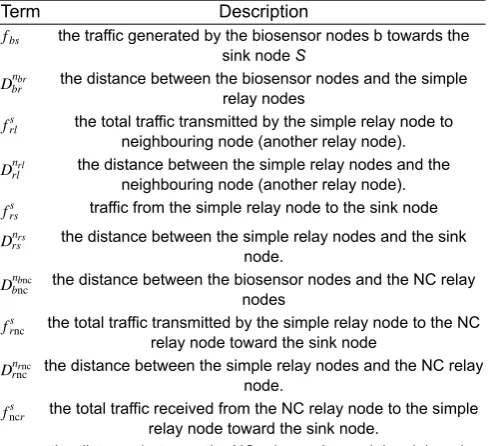
Table 3 details all terms used in this model. The simple relay nodes consume energy to forward the medical packets to another relay node l as follows:
ETXrlt =
∑
r, l ∈ R, s ∈ Sfrls E
TXelec+ Eampnrl Drlnrl+ ERXelec (18)
The total energy consumption to relay medical data from the simple relay nodes to the sink node is given as
ETXrst =
∑
r ∈ R, s ∈ Sfrss E
TXelec+ Eampnrs Drsnrs+ ERXelec (19)
5.2 Energy consumption with NC
With respect to the connection between NC relay nodes and bio-medical sensor nodes with simple relay nodes. The calculation of the total energy consumption to transmit medical data from all biosensor nodes to the NC relay nodes is given as
ETXbnct =
∑
b ∈ B, nc ∈ NC, s ∈ Skbio bsx
ijbsaijbncETXelec+ Eampnbnc Dbncnbnc(20)
The NC relay nodes receive the medical data from the biosensor nodes. The total energy consumption for reception is computed by
ERXbnct =
∑
b ∈ B, nc ∈ NC, s ∈ Skbio bsx
ij
bsaijbncERXelec
(21)
The simple relay nodes consume energy to forward the medical packets to the NC relay nodes, which can be expressed as
ETXrnct =
∑
r ∈ R, nc ∈ NC, s ∈ Sfrnc
s E
TXelec+ Eampnrnc Drncnrnc
+ ERXelec (22)
The total energy consumption to relay medical data from the NC relay nodes to the sink node is given by
ETXncst =
∑
nc ∈ NC, s ∈ Sfncss E
TXelec+ Eampnncs Dncsnncs+ ERXelec (23)
The calculation of the traffic flow in WBSNs is as follows: Let kbiobs
represent the number of transmitted biomedical bits through WBSN and received by the simple relay node, NC relay node and sink node. The total traffic generated by the biosensor node towards the sink node is given below
∑
b ∈ Bkbio bs x
ijbsaijbr ∀r, l ∈ R, s ∈ S (24)
Therefore, all traffic is destined towards the sink node S as given below
∑
b ∈ Bkbio bsx
ijbsaijbr+
∑
l ∈ R flrs− f
rls − frst = 0 ∀r ∈ R, s ∈ S (25)
where the term ∑b∈Bkbiobsxijbsaijbr represents the total generated
[image:4.595.45.287.664.755.2]traffic by the biosensor nodes towards the sink node S. The term Table 3 Explanation of all terms uses in the model for
WBSN
Term Description
fbs the traffic generated by the biosensor nodes b towards the
sink node S
Dbrnbr the distance between the biosensor nodes and the simple
relay nodes
frls the total traffic transmitted by the simple relay node to
neighbouring node (another relay node).
Drlnrl the distance between the simple relay nodes and the
neighbouring node (another relay node).
frss traffic from the simple relay node to the sink node
Drsnrs the distance between the simple relay nodes and the sink
node.
Dbncnbnc the distance between the biosensor nodes and the NC relaynodes
frncs the total traffic transmitted by the simple relay node to the NC
relay node toward the sink node
Drncnrnc the distance between the simple relay nodes and the NC relay
node.
fncrs the total traffic received from the NC relay node to the simple
relay node toward the sink node.
∑l∈Rflrs represents the total traffic received by the simple relay
node from the neighbouring nodes, ∑l∈Rfrls is the total traffic
transmitted by the simple relay node to neighbouring nodes and ∑l∈Rfrst is the transmission of traffic towards the sink node s,
those are expressed as
frls ≤
∑
b ∈ Bkbiobse
ijrl≅ flrs ∀r, l ∈ R, s ∈ S (26)
frls− flrs = 0 ∀r, l ∈ R, s ∈ S (27)
∑
b ∈ Bkbio bse
ij
rl−
∑
b ∈ Bkbio bse
ij
lr= 0 ∀r, l ∈ R, s ∈ S
(28)
∑
b ∈ B, s ∈ Skbio bsx
ijbsaijbr+
∑
l ∈ R, s ∈ Sflrs ≤ cap
r ∀rR (29)
where capr represents the capacity of the relay node in WBSN. The traffic must not exceed the capacity of the node. The total traffic transmitted towards the sink node s as shown in (30) which represents the original flow (native data) in BAN
frst ≤
∑
b ∈ Skbiobse ij rs= f
native_rss ∀r ∈ R, s ∈ S (30)
where the value
eijrs= 1 ∀r ∈ R, s ∈ S (31)
Meaning that there is a connection between the simple relay node and the sink node. The traffic is expressed as
frst = kbiobs ∀r ∈ R, s ∈ S (32)
On the other hand, the total traffic flow received in the NC nodes is transmitted from the biosensor nodes and the simple relay nodes. After that, the NC relay node encodes the received biomedical data and directly sends to the sink node S. The total traffic in the NC relay node is given as
∑
b ∈ Bkbio bsx
ij bsa
ijbncznc+
∑
l ∈ Rfrncs ∀r, ∈ R, nc ∈ NC, s ∈ S
(33)
where fncrs ≤
∑
b ∈ Bkbiobse
ijrncznc ∀r, ∈ R, nc ∈ NC, s ∈ S (34)
where the terms aijbnc, xijbs, znc and eijrnc are equal to 1, NC relay node
receives kbiobs from a bio-sensor node and receives k
biobs from a simple relay node. Where Ddata_nc represents the total traffic which is received, it can be expressed as
Gi≤
∑
b ∈ Bkbiobsfrom biosensor node +
∑
b ∈ Bkbiobsfrom relay node
(35)
To encode biomedical packets, the NC relay node is chosen as a sequence coefficient q = (q1, q2, …, qn) from Galois field (GF) (2s), this is called an encoding vector. The single output encoded
packet is calculated as the sum of products of each of the n native packets that are received at a node Gi (i = 1, 2, 3, 4, …, n) with a
random coefficient qi. The output encoded packet is described
below as
Y =
∑
i = 1 n
qiGi qi∈ GF(2s) (36)
The ingress flow to the sink node S from the NC relay node is expressed as
Dsending_from_NC= [qi+ Y] qi∈ GF 2s (37)
where Dsending_from_NC represents the traffic in the sink node which is received from the NC relay node and qi represents the random
coefficient based on GF.
Decoding in the sink node: the sink node receives data from both the simple relay node and the NC relay node, which represents the native data and encoding data, respectively. With respect to Gaussian elimination, the sink node decodes the received packets to recover the native packets [25] as follows:
Dnative_PKT=
∑
i = 1 n
qiDencoding_nc_i qi∈ GF 2s (38)
The total energy consumption in the time t (for instance the duration is [0, t]) for the network is defined as
Ewhole_networktotal = t (ETXbrt + ERXbrt + ETXrlt + ETXrst + ETXbnct
+ ERXbnct + ETXrnct + ETXncst ) (39)
6 Proposed design for RLNC
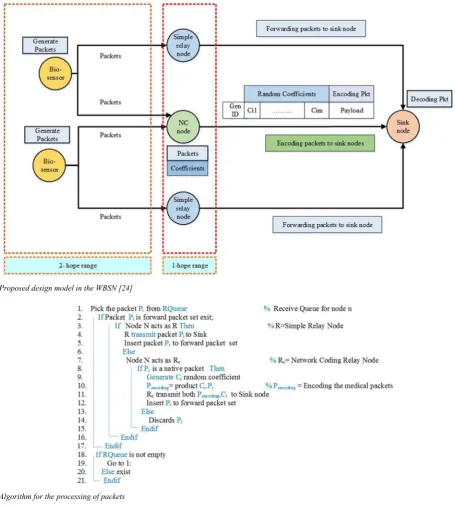
The system model is composed of the biosensor nodes, simple relay nodes, NC relay nodes and the sink node as shown in Fig. 1. The biosensor nodes set is positioned at specific points on the human body. Each biosensor generates biomedical data, which is transmitted to the sink node through the set of relay nodes and NC relay nodes in the network. These nodes represent the bridges between the biosensor nodes and the sink node, which improve energy efficiency. The set of simple relay nodes (R) transport the packets collected by the biosensor nodes to the sink node. Moreover, they forward the data aggregated from the biosensor nodes to another relay node or to the NC relay node towards the sink node. The nodes are around the sink node, and this area is called the bottleneck zone. The definition of the bottleneck zone is an area within a certain radius from the sink node, where the radius is represented by the transmission range of the sensor nodes [24].
Each biosensor node transmits duplicate biomedical packets, one to the simple relay node and the other to the NC relay node. The processing of packets at the node site (simple relay node and NC relay node) has been given in Fig. 2, showing the algorithm which implements the forwarding of the medical packets and the encoding algorithm at the simple relay node and the NC relay node, respectively. Each node in the bottleneck zone receives a queue (RQueue) into which received packets are placed, and the node checks the packet to see whether or not the packet is a native.
6.1 Algorithm for the processing of packets
As far as the algorithm for the processing of packets is concerned, as shown in Fig. 2, each node has a receive queue (RQueue), which includes biomedical packets, and the node deposits biomedical packets into the queue (RQueue). In the first section of the algorithm, if the node acts as a simple relay node, it checks the packet, which is received. If it is already forwarded toward the sink node then it should be removed from the queue and inserted into the forward packet set; otherwise, the simple relay node transmits the packet toward the sink node.
In the second section of the algorithm, as shown in Fig. 2, if the node represents the NC relay node and the biomedical packet is a native packet, the NC relay node is chosen as a sequence coefficient based on the GF (28). The NC node encodes the medical
packets by applying random coefficients to the packets. After successfully creating the encoded packets, the NC node transmits the encoded packets and coefficients to the sink node.
6.2 Algorithm for packets decoding
sink node receives the native packets from the simple relay node. Additionally, it receives the encoded packets with random coefficients from the NC relay node and performs the decoding procedure for the encoded packets. The sink node applies Gaussian elimination on the encoded packets and coefficients in order to retrieve all source packets.
7 WBSN performance
In this scenario, the WBSN topology is used as depicted in Fig. 4a
because it represents a general case. The WBSN scenario includes
[image:6.595.69.525.48.558.2]13 biosensor nodes, which are placed on the human body, for instance electroencephalogram (K sensor) and electrocardiogram (D sensor). With respect to this scenario, there are some biosensor nodes, which sense and measure vital signs of the human body such as pulse rate, temperature, motion sensor, and blood pressure. The definition of the bottleneck zone is an area within the radius (0.6 m) from the sink node, where the radius represents the transmission range of the sensor nodes. The distance between the biosensor nodes and sink node for the single-hop technique, and between biosensor nodes and closest node in the multi-hop technique is shown in Table 4. The WBSN is shown on the left-Fig. 1 Proposed design model in the WBSN [24]
Fig. 2 Algorithm for the processing of packets
hand side of Fig. 4a and the topology explains the bottleneck zone, which is shown on the right-hand side of the figure. With respect to the NC approach, there are simple relay nodes and NC relay nodes added in the bottleneck to reduce the energy consumption for the biosensor nodes as shown in Fig. 4b. The information in Table 1 for Nordic nRF2401 is used to calculate energy consumption for all approaches.
7.1 LOS and NLOS performance
In WBSNs, the energy consumption is affected by propagation path loss. The single-hop approach utilises the LOS propagation model in all transmissions and uses the path loss coefficient (n) of LOS, which equals 3.38. However, in the multi-hop approach, the NLOS value is utilised for the transmission in WBSN. In addition, the path loss coefficient (n) of NLOS is equal to 5.9. The path loss coefficient along the LOS channel is lower than along the NLOS channel, which affects the energy usage in WBSN. On the other hand, all transmissions in the relay network approach use the path loss coefficient (n) of NLOS, which is equal to 5.9, except for the nodes that are placed next to the sink node, those utilise the path
loss coefficient (n) of LOS, which equals 3.38. Similarly, in the NC approach, for instance, the biosensor nodes B and C are directly connected to the sink node, which uses the LOS. However, the biosensor nodes such as A, F, D, and H connect to the sink node through the simple relay node and the NC relay node, which uses the NLOS where the path loss coefficients of the LOS and NLOS are equal to 3.38 and 5.9, respectively. In all approaches, the energy usage for the transmit amplifier in (1) equals to 1.97 × 10⁻⁹
J/bit for n = 3.38 and 7.99 × 10⁻⁶ J/bit for n = 5.9 etc.
Each biosensor node consumes energy based on the propagation model and the distance between the sensor node and the sink node. For example, electromyogram (EMG) (node A) and the ECG (node
[image:7.595.143.453.48.443.2]D) consume more energy that sensor B as they send biomedical packets toward the sink node through a simple relay node and a NC relay node, whereas the body temperature sensor (B) is transmitted directly from the biomedical packets to the sink node.
Fig. 4 WBSN topology and explain the bottleneck zone
(a) WBSN topology with 13 biosensor nodes and explain the area of the bottleneck zone, (b) Tree topology for WBSN with simple relay nodes (R) and NC relay nodes (NC) added in the bottleneck zone
Table 4 Distance (metres) between the biosensor node and sink node for the single hop, and between the biosensor and the nearest node for the multi-hop [2]
Sensor A B C D E F G H I J K L M
[image:7.595.40.555.513.550.2]7.2 Energy consumption results
The energy consumption for the WBSN bottleneck zone is computed based on the NC approach comparing single-hop [26], multi-hop [26], and relay network approaches.
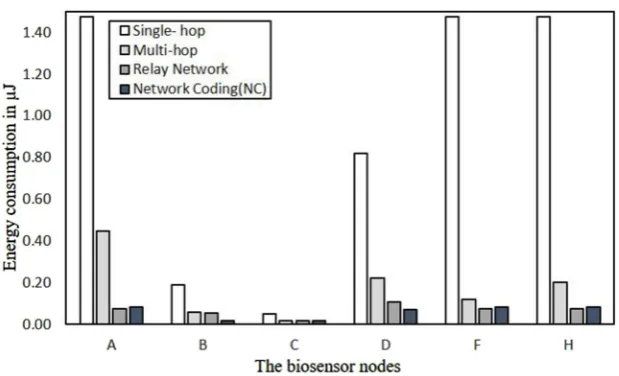
In the single-hop approach, the biosensor nodes in the bottleneck zone consume more energy based on the distance when compared with other approaches; the biosensor nodes A, F, and H
show greater energy consumption, as shown in Fig. 5. However, in the multi-hop approach, the biosensor nodes relay the packets via the intermediate node towards the sink node. The nodes A and D
have higher energy consumption in the multi-hop but the node C
has the same value of energy in most approaches because it is connected only to the sink node, as illustrated in Fig. 5.
With respect to the relay network approach, adding to the number of relay nodes, which forward the packets to the sink node improves the energy efficiency and decreases the energy usage of biosensor nodes in the bottleneck zone. Moreover, there is at least one possible relay node in LOS. The energy consumption for all biosensor nodes is lower compared with single-hop and multi-hop approaches.
In the NC approach, simple relay nodes and NC relay nodes are added to the bottleneck zone to reduce the energy consumption for the biosensor nodes in this area. It can be observed that energy usage for the nodes B and D is lower than other approaches except that the values of energy consumption for A, F and H are slightly higher than in the relay network approach because energy consumption of these nodes is calculated based on NLOS as illustrated in Fig. 5. Detailed results are shown in Table 5.
Moreover, each biosensor node sends duplicated packets, one through the simple relay node and the second through the NC relay node. In the transmission range of 0.3 cm, the NC relay node receives packets from different nodes and encoded packets are then sent to the sink node. The sink node decodes the received packets and retrieves native packets even if there is a failure in one of the transmission links.
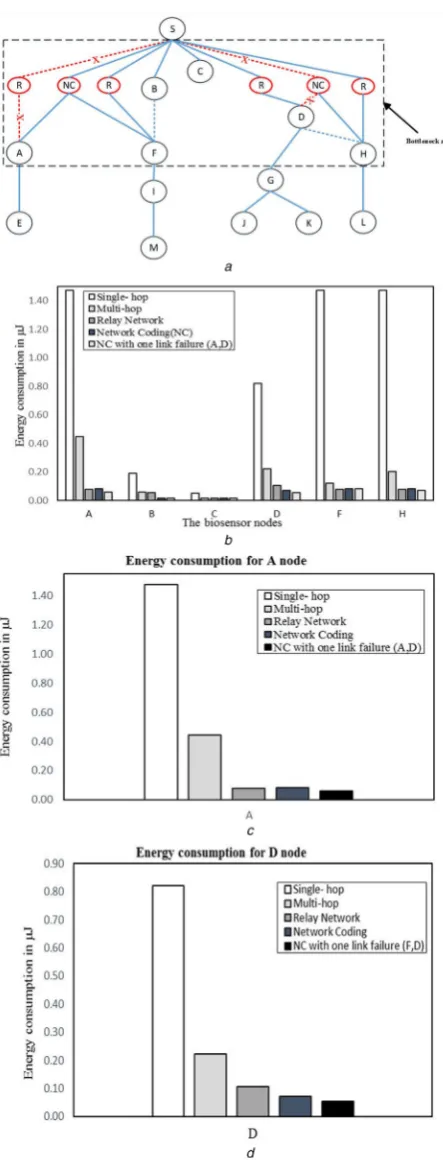
With respect to tree topology for BANs as presented in Fig. 6a
in the first case, the biosensor node A (EMG sensor) sends biomedical packets through two paths, first through the simple relay node, which forwards biomedical packets to the sink node,
and second through the NC relay node, which creates the encoded packets and then transmits them with coefficients to the sink node. If a failure occurs in one of the links (one path) through the transmission, as shown in Fig. 6a (tree topology), where the dashed red line represents the failed link for node A, successful transmission of the medical packets is achieved through an alternative link. In this case, it can be seen that the energy consumption for node A based on the NC with one link failure saves energy and achieves the delivery of data, as illustrated in Fig. 6b.
The bar chart shown in Fig. 6c compares the energy consumption for node A, calculated based on the single-hop (1.4741 µJ/bit), multi-hop (0.4451 µJ/bit), relay network (0.0761 µJ/bit), NC (0.0826 µJ/bit,) and NC with one link failure (0.0593 µJ/bit). We can see significant differences in the energy consumption value for node A in the single hop and the NC with one link failure. The energy usage for node A is higher in the single hop. Moreover, the energy consumption for node A in the relay network scheme is slightly higher than the NC with one link failure. On the other hand, the amount of energy is lower in the later scheme.
According to the bar graph shown in Fig. 6d, which compares the energy usage for node D for all approaches, the energy consumption for node D based on the single-hop, multi-hop, relay network, NC, and NC with one link failure, are equal to 0.8202, 0.2227, 0.1062, 0.0707 and 0.0534 µJ/bit, respectively, which is low in the NC with one link failure.
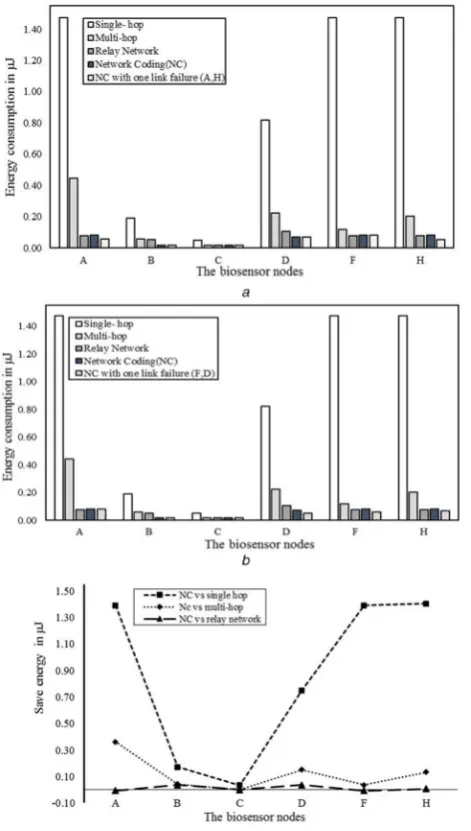
In the second case, if there is a failure of links for nodes F and
H, as shown in Fig. 7a, the energy consumption is calculated for biosensor nodes in the bottleneck zone based on the single hop, multi-hop, relay network, NC, and NC with a link failure in F and
H nodes, which are compared in Fig. 7b. The energy usage for node F is calculated depending on the single-hop, multi-hop, relay network, NC, and NC with one link failure, which is equal to 1.4741, 0.1187, 0.0761, 0.0826 and 0.0593 µJ/bit, respectively. Moreover, the energy consumption for node H based on the single-hop, multi-single-hop, relay network, NC, and NC with one link failure is equal to 1.4741, 0.2033, 0.0761, 0.0826 and 0.05281 µJ/bit, respectively. The results, in this case, show more details in Fig. 7b
[image:8.595.150.460.45.233.2]concerning the comparison of the energy usage for nodes F and H
Fig. 5 Comparison of energy consumption for biosensor nodes in the bottleneck zone based on the single-hop, multi-hop, relay network and NC
Table 5 Energy consumption for the nodes in the all approaches Node Energy usage in single-hop,
μJ/bit Energy usage in multi-hop,μJ/bit Energy usage in relay network,μJ/bit Energy usage in NC, μJ/bit
A 1.47414 0.44512 0.07610 0.08263
B 0.18933 0.05937 0.05283 0.01671
C 0.05138 0.01671 0.01671 0.07070
D 0.82028 0.22270 0.10623 0.08264
F 1.47414 0.11874 0.07610 0.08264
[image:8.595.40.553.269.364.2]in all schemes, which are shown in Figs. 7c and d, respectively. Figs. 7c and d also show that the energy consumption for nodes F
and H using NC with a link failure are lower than for other approaches.
Also, in the other cases, the comparisons of the energy consumption for biosensor nodes in the bottleneck zone are shown in Figs. 8a and b for all approaches and NC with link failure in the nodes A and H, and nodes F and D, respectively. The energy usage
for nodes A and H are equal to 0.0593 and 0.0528 µJ/bit, respectively, in NC with link failure in nodes A and H. In addition, nodes F and D energy consumption equals to 0.05939 and 0.0534 µJ/bit, respectively, based on NC with link failure in nodes F and
D.
The energy saved is calculated based on the difference between the proposed approach and other approaches, as shown in Fig. 8c. With regard to NC, the results of the total energy saved are 5.131, 0.714, and 0.052 µJ/bit for single-hop, multi-hop, and relay networks, respectively, as shown in Fig. 8c.
8 Conclusions
[image:9.595.57.279.43.624.2]In this study, we address the problem of high-energy usage of biosensor nodes caused by the bottleneck zone in WBSNs. The design of a novel mathematical model is proposed for BAN topology based on the graph theory, the connection and relationship between the biosensor nodes, simple relay nodes, NC relay nodes and the sink node are explained in this model. Our results show that the proposed RLNC model improves the energy Fig. 6 Case 1: the energy consumption for all the nodes in the bottleneck
zone with energy consumption for nodes A and D
(a) Tree topology for WBSN with a failure link for the nodes A and D, (b) Comparison of energy consumption for biosensor nodes for all approaches and NC with a failure link in A and D nodes, (c) Comparison energy consumption for node A
in all approaches, (d) Comparison energy consumption for node D in all approaches
Fig. 7 Case 2: the energy consumption for all the nodes in the bottleneck zone with energy consumption for the nodes H and F
[image:9.595.321.551.52.507.2]efficiency for biosensor nodes in the bottleneck zone and guarantees data delivery in the case of link failure. The mathematical model is therefore developed for the enhancement of wireless body networks. Moreover, energy saving for biosensor nodes in the bottleneck zone is achieved through applying the RLNC scheme.
9 References
[1] Iftikhar, M., Al Elaiwi, N., Aksoy, M.S.: ‘Performance analysis of priority queuing model for low power wireless body area networks (WBANs)’,
Procedia Comput. Sci., 2014, 34, pp. 518–525
[2] Ahlswede, R., Cai, N., Li, S.-Y.R., et al.: ‘Network information flow’, IEEE Trans. Inf. Theory, 2000, 46, (4), pp. 1204–1216
[3] Li, S.Y.R., Yeung, R.W., Cai, N.: ‘Linear network coding’, IEEE Trans. Inf. Theory, 2003, 49, (2), pp. 371–381
[4] Shahidan, A.A., Fisal, N., Ismail, N.N., et al.: ‘Data recovery in wireless sensor networks using network coding’, J. Teknol., 2015, 73, (3), pp. 69–73 [5] Magli, E., Wang, M., Frossard, P., et al.: ‘Network coding meets multimedia:
a review’, IEEE Trans. Multimed., 2013, 15, (5), pp. 1195–1212
[6] Platz, D., Woldegebreal, D.H., Karl, H.: ‘Random network coding in wireless sensor networks: energy efficiency via cross-layer approach’. 2008 IEEE 10th Int. Symp. Spread Spectrum Techniques and Applications, Italy, August 2008, pp. 654–660
[7] Funde, M.V., Gaikwad, M.A., Hinganikar, P.A.W.: ‘Review of lifetime enhancement of wireless sensor networks’, IORD J. Sci. Technol., 2015, 2, (2), pp. 35–39
[8] Tauqir, A., Javaid, N., Akram, S., et al.: ‘Distance aware relaying energy-efficient: DARE to monitor patients in multi-hop body area sensor networks’. Proc. 2013 8th Int. Conf. Broadband, Wireless Computing, Communication and Applications (BWCCA 2013), France, October 2013, pp. 206–213 [9] Movassaghi, S., Shirvanimoghaddam, M., Abolhasan, M.: ‘A cooperative
network coding approach to reliable wireless body area networks with demodulate-and-forward’. Proc. 2013 9th Int. Wireless Communications and Mobile Computing Conf. IWCMC2013, Italy, July 2013, pp. 394–399 [10] Deepak, K.S., Babu, A.V.: ‘Improving energy efficiency of incremental relay
based cooperative communications in wireless body area networks’, Int. J. Commun. Syst., 2015, 28, (1), pp. 91–111
[11] Yousaf, S., Javaid, N., Qasim, U., et al.: ‘Towards reliable and energy-efficient incremental cooperative communication for wireless body area networks’, Sensors, 2016, 16, (3), p. 284
[12] Miliotis, V, Alonso, L., Verikoukis, C.: ‘CooPNC: a cooperative multicast protocol exploiting physical layer network coding’, Ad Hoc Netw., 2014, 14, pp. 35–50
[13] Dharshini, P.M.P., Tamilarasi, M.: ‘Adaptive reliable cooperative data transmission technique for wireless body area network’. Proc. Int. Conf. Information Communication and Embedd Systems (ICICES 2014), India, February 2014, pp. 4–7
[14] Arrobo, G.E., Gitlin, R.D.: ‘Improving the reliability of wireless body area networks’. 2011 33Annu. Int. Conf. IEEE Engineering in Medicine and Biology Society, USA, 30 August–1 Septmber 2011, pp. 2192–2195 [15] Movassaghi, S., Shirvanimoghaddam, M., Abolhasan, M., et al.: ‘An energy
efficient network coding approach for wireless body area networks’. 38th Annu. IEEE Conf. Local Computing Networks, Australia, October 2013, pp. 468–475
[16] Ehyaie, A., Hashemi, M., Khadivi, P.: ‘Using relay network to increase life time in wireless body area sensor networks’. IEEE Int. Symp. on a World of Wireless, Mobile and Multimedia Networks, June 2009, pp. 1–6
[17] Begonya, O., Alonso, L., Verikoukis, C.: ‘Highly reliable energy-saving MAC for wireless body sensor networks in healthcare systems’, IEEE J. Sel. Areas Commun., 2009, 27, (4), pp. 553–565
[18] D'Andreagiovanni, F., Nardin, A.: ‘Towards the fast and robust optimal design of wireless body area networks’, Appl. Soft Comput., 2015, 37, pp. 971–982 [19] Braem, B., Latré, B., Moerman, I., et al.: ‘The need for cooperation and
relaying in short-range high path loss sensor networks’. Proc. 2007 Int. Conf. Sensor Technologies and Applications (SENSORCOMM 2007), Spain, October 2007, pp. 566–571
[20] Bangash, J.I., Khan, A.W., Abdullah, A.H.: ‘Data-centric routing for intra wireless body sensor networks’, J. Med. Syst., 2015, 39, (91), pp. 1–13 [21] Reusens, E., Joseph, W., Vermeeren, G., et al.: ‘On-body measurements and
characterization of wireless communication channel for arm and torso of human’. Proc. 4th Int. Work. Wearable Implantable Body Sensor Networks, Germany, March 2007, pp. 264–269
[22] Fort, A., Ryckaert, J., Desset, C., et al.: ‘Ultra-wideband channel model for communication around the human body’, IEEE J. Sel. Areas Commun., 2006, 24, (4), pp. 927–933
[23] Bondy, J.A., Murtty, U.S.R.: ‘Graph theory with applications’ (Macmillan Press Ltd, 1976)
[24] Alshaheen, H., Takruri Rizk, H.: ‘Improving the energy efficiency for biosensor nodes in the WBSN bottleneck zone based on a random linear network coding’. Proc. 11th Int. Symp. Medical Information and Communication Technologies, Portugal, February 2017, pp. 59–63 [25] Pfletschinger, S., Navarro, M., Ibars, C.: ‘Energy-efficient data collection in
WSN with network coding’. 2011 IEEE GLOBECOM Workshops (GC Workshops), USA, December 2011, pp. 394–398
[image:10.595.53.289.50.466.2][26] Reusens, E., Joseph, W., Latre, B., et al.: ‘Characterization of on-body communication channel and energy efficient topology design for wireless body area networks’, IEEE Trans. Inf. Technol. Biomed., 2009, 13, (6), pp. 933–945
Fig. 8 Energy consumption and saving in the bottleneck zone
![Table 1 Values of the specific parameter for Nordic nRF2401 [16]](https://thumb-us.123doks.com/thumbv2/123dok_us/8683000.875160/3.595.42.288.127.192/table-values-specific-parameter-nordic-nrf.webp)
![Table 4 Distance (metres) between the biosensor node and sink node for the single hop, and between the biosensor and thenearest node for the multi-hop [2]](https://thumb-us.123doks.com/thumbv2/123dok_us/8683000.875160/7.595.143.453.48.443/table-distance-metres-biosensor-single-biosensor-thenearest-multi.webp)