International Journal of Emerging Technology and Advanced Engineering
Website: www.ijetae.com (ISSN 2250-2459,ISO 9001:2008 Certified Journal, Volume 4, Issue 11, November 2014)
150
Disaster Alert and Notification System Via Android Mobile
Phone by Using Google Map
Amit Gosavi
1, S. S. Vishnu
21
M.Tech Scholar, 2Asst. Professor, Department of Computer Science & Engineering, Maharashtra Institute of Technology (MIT), Aurangabad, Maharashtra, India
Abstract-- Since history started human activities enforced many natural disasters. Due to continuous change in geographic position and climate, countries situated near oceans are most sensitive countries to natural disasters. The developing countries also lack effective disaster preparedness system to resist natural disasters. Disaster warnings and evacuation guidelines may save lives of many peoples. A tourist or blind people can face problem in finding safe place if any natural disaster occurs. For this reason, we have proposed a location based early disaster warning and evacuation system for both normal and blind people using Google Map. Because of the use of smart phones in developing countries increases, the system is implemented on android mobile phone. So, our system consists of a third-party server named Disaster Management Server (DMS), android device on which our application installed and user. Updates of the disaster (tsunami, cyclone or flood) are put on DMS by the local weather office. To get automatic notification of upcoming disaster device user registers on Disaster Management Server (DMS) else user can gets manual notification. The user keep in touch with DMS to get most renew data obtained by GSM. The proposed application notifies the user located in possible disaster zone with visual and audio disaster warning and evacuation guideline combine with nearest location of shelter or safe zone on the map of the application. DMS also tracked Evacuation progress and national identification of user. The experimental result proves the effectiveness of our system.
Keywords-- Natural Disaster, Google Map, Disaster Warning, Evacuation Guideline, Android.
I. INTRODUCTION
Natural Disaster is the consequence of natural hazards such as cyclone, storm, earthquake, tsunami and flood etc. This earth has already viewed the harmful, damaging mode of nature which has taken millions of lives. The 2011 Japan earthquake and tsunami, the 2010 Haiti earthquake, the 2008 cyclone Nargis, the 2004 Indian Ocean Tsunami, the 1991 Bangladesh cyclone are some recent examples of violent natural disasters[4]. Generally natural hazards end up with disasters where the affected areas are sensitive. According to the ranking report of United Nation’s International Strategy for Disaster Reduction (UNISDR) on Mortality Risk Index (MRI), countries situated near oceans are most at risk from earthquakes, floods, tropical cyclones, and landslides [6].
To save lives and properties prevention is necessary, since developing countries like Bangladesh are most natural disaster-prone countries. Sometimes people may be inattentive about the upcoming natural hazards. Absence of preparation of people causes the major damage during disaster. So, former sufficient disaster warning and effective evacuation system can save number of lives in the country prone to frequent disasters. In disaster sensitive area, tourist, new comer or blind people may face problem in finding safe shelter from their current stay position. To overcome such situation here we are proposed location disaster warning and evacuation system on mobile phone using Google Map which provides audio and visual messages. Because of the availability of map information across the world and the approach towards inexpensive
Portable GPS devices, use of Google Map is rapidly growing [8]. This open source Google Map has recently been employed in many projects like Wiki Project Libya and Wiki Project Haiti etc. In the Wiki Project Libya [10], the roads and places of interest were mapped in details. The Wiki Project Haiti facilitated the rescue work and helped in providing relief aid after the devastating earthquake at Haiti in 2010[12]. So, Google Map has achieved the popularity to use. With the increased use of smart phones the demand of location based services is also increasing day by day. This system is also an android platform based smart phone application used to deliver location based services which provides alerts to the user of upcoming disaster if user is in or near to the disaster affected area and provides nearest safe place on map of application. As it delivers both audio and text messages, it is useful for normal as well as blind peoples.
II. RELATED WORK
International Journal of Emerging Technology and Advanced Engineering
Website: www.ijetae.com (ISSN 2250-2459,ISO 9001:2008 Certified Journal, Volume 4, Issue 11, November 2014)
151
Short Message Service (SMS) is used to collect the upcoming flood warning and send back to all citizens from the server [3], [14]. But lots of SMS transfer can cause the network congestion which may lead to breaking of the voice call communication through the same network. This can make the evacuation process difficult. To avoid such, Cell Broadcasting Service is used to directly send messages to the users in a specific area with no network congestion [5]. Still it fails to help in evacuation process which provides information about safe place. GSM alarm device for early disaster warning is proposed to place it in the local police station or fire brigade station, which takes warning from weather office and make three different types of warning. Then evacuation process is controlled by the police station or fire brigade station [1]. Though it can avoid network congestion, the GSM alarm is not a faster way for evacuation process. For delivery of warnings researchers also proposed Area Mail disaster information service provided by NTT Do Como for tsunami alert and evacuation system with a view to support fishery workers [7], [9]. It is possible with area mail service to inform persons in limited area about damage due to disaster. With the help of mobile application centre monitoring authority will observe evacuation progress of the fishing boats. Though this service is a quicker and efficient one, it will not work as fast in overall population. Well developed countries like Australia and South Korea are planning to use satellite communication for disaster management when the failure of mobile network occurs [11], [14], [16]. Satellite communication services will be more fast, reliable, robust and secure but initialization and maintenance of this service maintenance are expensive and developing countries cannot afford this. Very few researchers worked to provide location based services for disaster management on mobile phones. Early works on location based services for disaster management did not distinguish normal people and blind people. So considering this, here we are presented a location based early warning and evacuation system. Thissystem estimate upcoming disasters, circulate
understandable visual and audio warnings useful to both normal and blind people, provide evacuation guidance in response to the warnings.
III. LOCATION BASED EARLY DISASTER WARNING AND EVACUATION SYSTEM
The disaster management consists of four fundamental steps such as mitigation, preparedness, response, and recovery. Out of these four steps, focus of our work is on preparedness which involved development of a system for the action plan of upcoming disasters.
For this, we present a location based early disaster preparedness system including audio and visual warning and evacuation process on the map of the system for a developing countries like Bangladesh.
A. Preliminaries
Geographically few South Asian countries are situated in between the Himalayas and the ocean, on the delta of wide rivers, means that the countries are very exposed to flooding [15]. The people lives in seaside areas have to face several storms each year and cultivable lands disappear in river due to river erosion. Such countries are most affected to the planet’s climate changes and growing number of cyclones [15]. Also, there is a greater risk of drought, as well. Few countries are also surrounded by the Bay of Bengal which is indeed north-eastern part of Indian Ocean [15] and can damage the country, particularly the sea side area. Hence, there is also the risk of Tsunami in these countries. Our disaster preparedness system protects the people from upcoming disaster. For this it uses Google Map because the development of Google Map is very rapid. It also encourages growth, development and distribution of free geospatial data and allows geospatial data for anyone to use and share [8]. Our proposed work can be implemented on android mobile phones. Android is an operating system for mobile devices such as smart phones and tablet computers developed by Open Handset Alliance led by Google. As android is more open and comprehensive than other mobile operating system, they are best- selling products worldwide. It also allows building of new applications at lower cost [2]. Result of this is more interactive for users. So, the android mobile platform has been used in our proposed disaster
preparedness system
.
B. Proposed System
International Journal of Emerging Technology and Advanced Engineering
Website: www.ijetae.com (ISSN 2250-2459,ISO 9001:2008 Certified Journal, Volume 4, Issue 11, November 2014)
152
User using our proposed system will get early upcoming disaster warnings with the help of both audio and visual message with shortest path of the safe place. The national id of the user is stored in the internal storage of the mobile phone which is sent to DMS later on. Regional evacuation control authority keeps track of the evacuation progress with the help of DMS which accelerate the evacuation process and the stored national id of the user. The steps of our proposed system are as follows:1) Register/Unregister process: The application on android device does not need be running any service to receive this lightweight message. Fig. 2 shows the
registration/ unregistration process. User using
application on android phone can register or unregister on the Disaster Management Server (DMS). After registration on this server, application receives a registration id which is stored into the (DMS) [5]. Then the device user gets updated notification about the upcoming disasters in DMS regardless of whether the application is running on android mobile phone or not. This helps the people who are unaware about the upcoming disasters. User can also unregister from Disaster Management Server (DMS) by which assigned registration id for the user is deleted from DMS.
2) Communication with Disaster Management Server (DMS):Our application gets the current position through
GSM from the user mobile phone and application
communicates with DMS to send the latitude and longitude of user’s current position. On the other hand, for registered user, when DMS needs to push a message to our android application, it requests to broadcast the message via an HTTP POST. Afterwards, our android application fetches the data from DMS. And for unregistered user, our application receives the message when he wishes to from DMS. Fig. 3 illustrates the communication with Disaster Management Server (DMS).
3) Probable Disaster Affected Area Determination:
The DMS server finds the user in probable disaster affected areas. If user’s current location is in these areas, then first server returns the feedback message to the device and then to the application. This is also shown in Fig. 3.
4) Dissemination of Disaster Warning and Evacuation Guideline: When the application finds its user in a
disasterzone, it will give him a notification along with an
International Journal of Emerging Technology and Advanced Engineering
Website: www.ijetae.com (ISSN 2250-2459,ISO 9001:2008 Certified Journal, Volume 4, Issue 11, November 2014)
153
Subsequently, the user of our application gets early disaster warning message both in visual and audio message on map of the application. Google Map renders its map for our application showing the two different places with different icon over the map. The TTF (Text-to-Speech) engine provides the audio direction to the user as evacuation guideline. In Fig. 4, it presents the utilizing tools of the application to disseminate warning message and evacuation guideline.5) Tracking Evacuation Progress: If system recognizes the user is in any disaster zone, the application starts another service to track the user so that the authority can rescue him from probable affected area. For this, the user is identified with stored national id in the application. The application uses GSM to detect the phone’s current position and sends this data to the DMS for tracking the evacuation progress. When user comes to the safe area then application removes the tracking process. Fig. 5 shows the tracking evacuation progress
process of our system.
This Disaster Management System application uses Dijkstra’s algorithm to rescue user from probable disaster area and provides route of nearest shelter to user [13].
Finding nearest path using Google Map-
Network of road represented as: Weighed directed graph G= (V, E)
Starting point s
Destination t
Length le = length of edge e
s belongs to V
Shortest path problem: Finding of nearest path from s to t [13].
Cost of path= Sum of edge cost in path.
Following fig shows weighted directed graph with nearest distance and minimum cost from source to destination.
Minimum cost path from s to t: s-2-3-5-t = 9+23+2+16 = 48
S = Set of nodes for which shortest path from s is known
Un= Set of unprocessed nodes.
Above fig shows explored nodes by highlighted portion for which shortest path from s is known and unexplored nodes [13].
S= {s, 2, 3, 4, 5, 6, 7}
Un= {t}
Dijkstra’s Algorithm
Maintain set of explored (visited) nodes S for
which we have determined shortest path distance d (u) from s to u.
Initially, set of nodes contain source itself, then
one by one we select vertices from V\S to add in S.
International Journal of Emerging Technology and Advanced Engineering
Website: www.ijetae.com (ISSN 2250-2459,ISO 9001:2008 Certified Journal, Volume 4, Issue 11, November 2014)
154
Then we repeatedly choose unexplored
(unvisited) node to add in S which minimizes ( ) = min d(u) + le
e = (u, v): u S
Where,
le= shortest path to some u in explored part,
followed by single edge (u, v).
After computation of minimum distance we add
V to set of explored nodes S and
Set d (v) = (v).
Dijkstra’s algorithm: Proof of correctness
Invariant: For each node u S, d (u) is the length of
shortest s-u path.
Proof: (by induction on |S|)
Base case: |S| = 1 is trivial.
Inductive hypothesis: Assume true for |S| = k 1.
Let v be next node added to S, and let u-v be the
chosen edge.
The shortest s-u path plus (u, v) is an s-v path of
length (v).
Consider any s-v path P. We'll see that it's no
shorter than (v).
Let x-y be the first edge in P that leaves S, and
let P' be the sub path to x.
P is already too long as soon as it leaves S.
IV.SYSTEM IMPLEMENTATION
We have developed an android-based mobile application that provides early disaster warning and evacuation progress of the upcoming disaster by using Google Map, Disaster Management Server (DMS) as a third-party server. This application will run on mobile phones supported by 2.3.3 and upgraded versions. The mobile phone must have GSM supported Location Identification Facility. Our application finds the user location through network provider of mobile operator. Our application has two major parts:
(1) Early Disaster Warning (2) Tracking Evacuee User.
A. Early Disaster Warning:
The application provides early disaster warning in two ways:
1). Automatic Warning Notification: By using toggle button which is on application’s homepage, we can starts or stop a service. When user starts the service, the application sends a registration request to the server and fetches a registration ID which is sent to the Disaster Management Server (DMS). It provides immediate notification to the application if any change in the server. In such case the application automatically starts a broadcast service which communicates with server for current position of user to check if user is in probable disaster affected area or not. If application can determine user location as exposed area to disaster then application notify user risk message.
When user stops the service, the application the application unregisters from the server and then application does not get any notification from server even though there is update in DMS database.
2). Manual Warning Notification: The application also has a reload button which connects application with the DMS and checks the current user area from the perspective of upcoming disaster.
B. Tracking Evacuee User:
The service checks that if the user currently is in any probable disaster affected area, starts another service. If user changes his location then this service sends the location of user to DMS. DMS stores the data in tracking of users. Our application has a button labelled as Show Message on Map. When user press the button it shows Google Map which identifies user’s current position and displaying shortest path to nearest shelter area. The menu has two options, one is for text message and the other is to provide the audio direction to go to nearest safe place.
International Journal of Emerging Technology and Advanced Engineering
Website: www.ijetae.com (ISSN 2250-2459,ISO 9001:2008 Certified Journal, Volume 4, Issue 11, November 2014)
[image:6.595.49.281.130.367.2]155
Fig: 6 Tracking users and available rescue team information
C. Android Mobile Application
Fig 7(a) and 7(b) shows the screens of Disaster Management Applications hone screen. This application is based on android operating system.
Fig: 7(a) Disaster Management System application screen
Fig: 7(b) Disaster Management System application screen
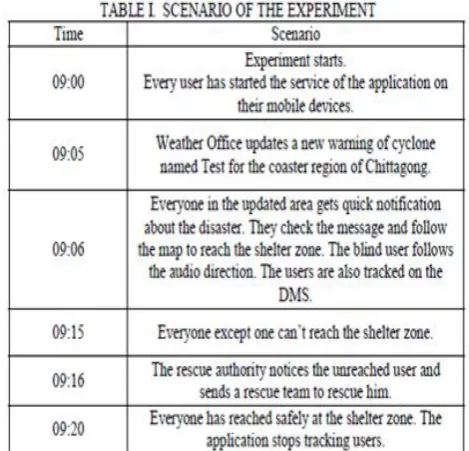
V. EXPERIMENTAL RESULT
[image:6.595.330.521.133.425.2] [image:6.595.79.249.439.735.2] [image:6.595.314.549.540.765.2]International Journal of Emerging Technology and Advanced Engineering
Website: www.ijetae.com (ISSN 2250-2459,ISO 9001:2008 Certified Journal, Volume 4, Issue 11, November 2014)
156
VI.CONCLUSIONOur proposed system is an android mobile phone application consisting of Google Map, Disaster Management Server (DMS) as third party server. If the user of application is in probable disaster affected area then user will get visual and audio disaster warning and evacuation help on the map of the application. This system helps out to both normal and blind people to reach to the nearest safe place prior to disaster. Our application also facilitates the work of authority to track evacuation progress constantly so that user can take immediate steps if needed to reach to safe place. Lack of details on Google Map of developing countries is the main challenge of our work. The more volunteers working on Google Map can make map of the countries rich. In such case, our application will perform better in developing countries. We have future plan to implement an application for rescue and relief operation with better server side application to totally automate the system of detecting disaster prone area.
REFERENCES
[1] Jayasinghe, Gamini, Fahmy, Farazy, Gajaweera, Nuwan, and Dias, Dileeka, “A GSM Alarm Device for Disaster Early Warning,”, pp. 383- 387, May 2007. [1st IEEE international Conference on Industrial and Information Systems]
[2] Android
[http://en.wikipedia.org/wiki/Android_(operating_system)] [3] Marius Cioca, Lucian-Ionel Cioca, and Sabin-Corneliu Buraga,
“SMS Disaster Alert System Programming”, pp. 260-264, Feb. 2008. [Second IEE International Conference on Digital Ecosystems and Technologies]
[4] List of natural disasters by death toll [http://en.wikipedia.org/wiki/List_of_natural_disasters_by_death_ toll].
[5] Tobias Schernerand Lothar Fritsch, “Notifying Civilians in Time Disaster Warning Systems Based on a Multilaterally Secure, Economic, and Mobile Infrastructure”. [11th Americas Conference on Information Systems, Omaha, NE, USA, Aug. 2005].
[6] United Nations International Strategy for Disaster Reduction Secretariats (UNISDR), Mortality Risk Index, 15 June 2009.
[7] Hidenori Torii, Jun Sawamoto, Norihisa Segawa, Eiji Sugino, and Yukinori Nomura, “Tsunami Early Alert and Evacuation Support System for Fishery Workers by Mobile Phones,” pp. 704-709, Apr. 2010. [24th International Conference on Advanced Information Networking and Applications Workshops].
[8] OpenStreetMap in Wikipedia [http://wiki.openstreetmap.org/wiki/OpenStreetMap].
[9] Yasuaki Teshirogi, Jun Sawamoto, Norihisha Segawa, and Eiji Sugino, “A Proposal of Tsunami Warning System Using Area Mail Disaster Information Service on Mobile Phones,” pp. 890-895, May 2009. [International Conference on Advanced Information Networking and Application Workshops]
[10] Project Libya
[http://wiki.openstreetmap.org/wiki/WikiProject_Libya] [11] Dugkeun Park, “One of the Now casting Applications: Early
Warning Systems for Natural Disasters in Korea,” Oct. 2006.
[12] Project Haiti
[http://wiki.openstreetmap.org/wiki/WikiProject_Haiti]
[13] Dijkstra’s algorithm [http:// http://courses.cs.washington.edu/courses/cse190x/09sp/slides/shor test-paths-alg.pdf]
[14] D. H. Jeong, “National Disaster Warning System in Korea,” Sep. 2009.
[15] Sufian Latif, K.M. Rakibul Islam, Md. Monjurul Islam Khan, and Syed Istiaque Ahmed, “OpenStreetMap for the Disaster Management in Bangladesh,” pp. 429-433, Sept. 2011. [IEEE Conference on Open Systems]
[16] Anas Aloudat and Katina Michael, “Toward the Regulation of Ubiquitous Mobile Government: A Case Study on Location-Based Emergency Service in Australia,” Journal of Electronic Commerce Research, Vol. 11, Issue 1, Article 3, pp. 31-74, Jan. 2011.
BIOGRAPHY
Amit Gosavi is born at SolapuDt, Maharashtra on 29-02-1992, received
Diploma Degree in Information