#uksnow: webscience weather watch
Kreps, DGP and Fletcher, G
Title
#uksnow: webscience weather watch
Authors
Kreps, DGP and Fletcher, G
Type
Conference or Workshop Item
URL
This version is available at: http://usir.salford.ac.uk/16962/
Published Date
2010
USIR is a digital collection of the research output of the University of Salford. Where copyright
permits, full text material held in the repository is made freely available online and can be read,
downloaded and copied for noncommercial private study or research purposes. Please check the
manuscript for any further copyright restrictions.
#uksnow: webscience weather watch
Abstract. This paper utilises the theoretical perspective of Orlikowski's materiality to examine and interpret the #uksnow Mashup - a real-time map of the UK showing where it was snowing, and where the snow was heaviest ± based on the premise that enough users of Twitter would be sufficiently distributed across the country to accurately report snowfall. We identify the key technological and social phenomena that intersected in 2009 to provide the environment in which this web-based application was constructed. As an API driven Mashup that relies upon user-generated data, #uksnow problematises the relationships that are conventionally crafted between the user and the data they manipulate. We argue that #uksnow is an exemplar of a new paradigm in software development that is driven by web-based services shaped by APIs, with a relatively short lifespan, and versionless or 'permanent beta'. Equally significant is the way in which the #uksnow Mashup amplifies and visualises social knowledge and experience ± without which no 'system' would exist. The authors conclude, with others, that a new web science is needed to theorise and understand this phenomenon.
Keywords: Web2.0, Twitter, social perspectives, Internet usage
1 Introduction
Internet usage in the mid-late noughties (2005-09) was characterised by a particular constellation of phenomena that is hallmarked in the #uksnow event of late 2008. This event comprised, in brief, the use of the Twitter microblogging service by a large number of individuals to post a rating of the quantity of snowfall at a particular location. This data was displayed on a map of the UK, which showed in real-time where it was snowing, and how heavily. There were two primary technical capabilities that contributed to the shaping of this event: the widespread adoption of Application Programming Interfaces (API) based development, and of the mobile internet (Sawyer et al 2003;; Henning 2009;; Wareham 2009;;). These technical developments however were part of a complex social phenomenon (Wareham 2009:139) that included the creative use of multiple APIs that enabled construction of WKH µSODWIRUP¶ ZHE 7VDL :HLVV DQG ZLWK WKH VSHFLILF VRFLR-cultural circumstances of a massified blogosphere (and micro-blogosphere) (Song et al 2007;; Silva et al 2009;; Shamma et al 2009;; Adams et al 2009;;). This, coupled with celebrity and disaster orientated media (Katz & Liebes 2007;; Babcock & Whitehouse 2005), WKH DGRSWLRQ RI µRSHQ¶ WKLQNLQJ &KHVEURXJK YDQ GHr Meer 2007), and specific shifts in mainstream UK public funding priorities (Atkinson 1997:409), all coalesced as #uksnow.
2 The #uksnow event
The #uksnow event was exemplary of these elements of contemporary internet phenomena that spans a combined range social and technical circumstances. Creative thinking by a leading figure in the blogosphere enabled utilisation of the potentials of new technologies and their application to an immediate and visible problem. The solution he offered involved clever and rapid application development using web- based APIs and the creation of a Mashup application that could deliver visual information using freely available online tools. Pivotal to the rapid implementation of the application was its use of crowd-sourced data. The result was a real-time map of the UK showing where it was snowing, and where the snow was heaviest ± based on the premise that enough users of Twitter would be sufficiently distributed across the country to accurately report snowfall.
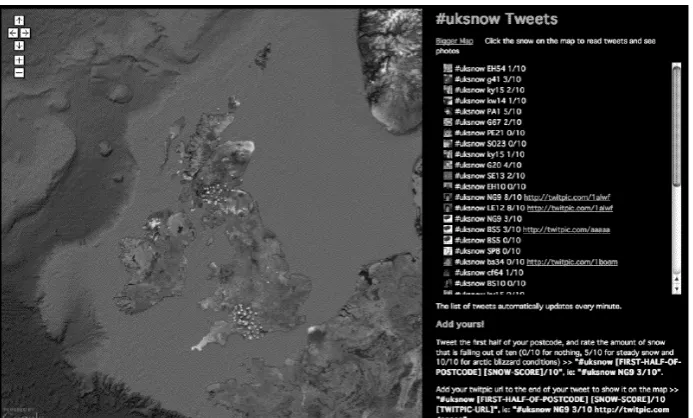
Opinion leader Paul Clarke (Clarke 2009), musing one wintry morning on his blog, envisioned what could happen with crowd-sourced data as snow began to fall in the UK. A few hours later, keen coder and opinion watcher Ben Marsh (Marsh 2009) had created the code needed for a Twitter-GoogleMaps mashup and #uksnow was available to the blogoshere. Following the instructions on Ben Marsh's website, thousands of people using the micro-blogging site, Twitter, tweeted two very simple pieces of information: the first three or four digits of the UK postcode of their current location and a rough gauge of the heaviness of the snow in their location as a mark out of five. People provided this information, (often while standing outside to accurately gauge the snow, and using their mobile internet device to provide the UHTXLUHG WZHHW WR WKH XNVQRZ µKDVKWDJ¶ RQ 7ZLWWHU DQG WKH UHVXOWLQJ VWUHDP IURP the remote gathering of this hashtag provided the data to create a real-time snow-map of the UK at http://www.benmarsh.co.uk/snow/.
By the end of the first day Microsoft had created ± albeit briefly ± a clone (see http://twitpic.com/1boki for a screengrab of what had been posted at http://estc.msn.com/br/intl/twitter/uk/snow.html. Ben Marsh uploaded the image of this clone helpfully annotated with the LQWHUQHWFOLFKp³)$,/´7KHDSSOLFDWLRQOLYHG on for several more days, as the snowfall continued, but it was in the first 36 hours that the application gained a critical mass of tweets and user acceptance. The Baseball World Series was taking place simultaneously in the United States, but was briefly eclipsed in terms of Twitter traffic volume by the number of people tweeting about (and to) #uksnow.
Figure 1 Screengrab of #uksnow at Ben Marsh's website 4-2-09
3 A Socio-Technical Mashup
The technical and social developments that come together to form the #uksnow event deserve attention, prior to our discussion of their impact on social shaping theories.
3.1 Technical Capabilities
systems. As a free service, hundreds of Application Programming Interfaces (APIs) became available for general use by web developers (Kirkpatrick 2008).
3.2 Open thinking
It is important to emphasise that offering an API for third party developers to utilize a service requires a particular corporate mindset that understands how intellectual prop- erty rights can be maintained in a framework of open information and sharing. The adoption of this mindset is arguably at the core of the global success of Google, and difficulties with adoption and incorporation of this mindset is behind the correspond- ing decline of Microsoft, whose significance as a guiding organisation for the use and adoption of new digital technologies continues to fall (Chesbrough 2006). As Ches- brough (2006) points out open innovation should not be conflated with the Open Source movement. Although they share many characteristics, the former is very much focused on sustainable business models in a way that the latter is not. Open innovation is a new corporate mindset that looks outside the traditional opacity of FRUSRUDWHZDOOVDVVXPLQJWKDW³XVHIXONQRZOHGJHLVZLGHO\GLVWULEXWHGDQGWKDWHYHQ the most capable R&D organizations must identify, connect to, and leverage external knowOHGJHVRXUFHVDVDFRUHSURFHVVLQ LQQRYDWLRQ´&KHVEURXJK7KLVDV van der Meer points out with regard to the Dutch experience (2007), is no mean feat, DQGIRUPDQ\³RSHQLnnovation practLFH«LVODJJLQJEHKLQGLWVSURPLVHV´YDQGHU Meer 2007:192). However, for the likes of technology giants such as Google, Yahoo and others it has proven a crucial strategy for corporate advancement, albeit that Google in particular seems gradually to be morphing into the kind of company Micro- soft became (http://www.guardian.co.uk/technology/2010/feb/14/google-gmail-buzz- john-naughton)
3.3 Platform Web
3.4 Mobile Internet
Parallel with these developments, access to the internet on mobile devices significantly increased in popularity through the late noughties (Nutley 2006). This popularity has been publicly led largely by the advent of the iPhone (Marsden 2007), but quickly bolstered by the appearance of a range of different mobile internet GHYLFHV ZKLFK OLNH $SSOH¶V RZQ HQWU\ LQWR WKLV PDUNHW DOPRVW FRLQFLGHQWDOO\ included the ability to make phone-calls. It is indeed arguable that the phenomenon of micro-blogging, and rising levels of mobile internet access, are very closely interlinked (Milstein et el 2008), and that the success of Twitter, with its arbitrary 140 character limit, rests on the success of the Short Messaging Service (SMS) which originally surprised everyone in the mobile phone industry with its unexpected and unintended mainstream popularity (Wareham 2009:140). The popularizing of the PRELOHLQWHUQHWVKDSHGLWDVDQ³DOZD\VRQ´Pultimedia communication platform that was simultaneously ubiquitous and a manifestly disruptive social technology. The mobile internet provided the mechanism to directly engage with large organizations in situ and to express immediate critique (Liu et al 2005). The mobile internet also presented the potential for a genuinely participatory social media enabling immediate vocal, textual and visual reporting (e.g. qik.com) without the overlay of editorial or corporate agendas or the sensationalism inherent in most mainstream journalism (Langer 1998:1).
3.5 Socio-cultural circumstances
The significance of blogging as a cultural activity has been well recognized (Youngs 2009). By the advent of the #uksnow event there was already a well established blogosphere which ± perhaps necessarily ± had settled into a pattern in which certain bloggers were continuously watched, commented upon and linked to by a much wider range of blogs including those with a commercial or media orientation as well as more individual efforts. These bloggers (and their blogs) had, in effect, become leaders of the blogosphere (Song et al 2007). Their appearance at the top of rankings in blog-watch websites such as Technorati1 also reinforced and ensured a continued
place within this role. The authority brought by this ascription of leadership can often produce unexpected and contrary points of view from that of mainstream media. The new phenomenon of micro-blogging, led by Twitter, adds an additional layer to the blogosphere, and a new class of authoritative and leading twitterers identified through Twithority2, whose tweets are followed by tens and even hundreds of thousands. The
expanded blogosphere now produces vast quantities of written and visual material that is made denser by constant recycling through retweeting and reposting. The identification and ascription of authority becomes a necessary process to filter and manage the quantity of lower quality information that fills the blogoshere.
The proliferation of low quality information delivered online by semi-anonymous individuals has also influenced the perspective and focus of mainstream broadcast media reporting. The increasing competition of the blogosphere as a reporting and
news medium and more generally from the web itself has produced a celebrity and disaster orientated mainstream media that permeates all of its formats including the nightly news bulletins. This approach continues the trajectory of sensationalism that began prior to the popularization of the internet but has become accentuated with the increasing authority of celebrities within the blogsphere and equally by offering increasing transparency onto their activities. Similarly, the need to compete with the vast bulk of materials within the blogosphere has necessitated focus on the most dramatic events (to divert attention from the mundane of the blogosphere) and to constitute these events as disastrous and life(style) threatening. The most recent #uksnow event ± in January 2010 - has seen the focus of the media shift rapidly through the spectrum of numerous deaths from falls, failing infrastructure and workplace chaos onto confusion over national student examination arrangements and remote communities being further isolated.
Shifts in mainstream UK politics also contributed to the way in which the #uksnow event was received and interpreted publically. The influence of celebrity orientated media has forced political leaders of major parties to be judged on criteria of personality and charisma (Spinrad 1991). This has increasingly driven political attention upwards towards the reporting of national level politics and at the same time fragmented local government representation with an increasing number of councilors representing small and single interest parties or choosing to stand as independents. In the UK, government privatization agendas have meant that the provision of salt is undertaken by a commercial organization that sells this product to the Highways Agency - the body with overall responsibility for road safety - and local councils for subsequent spreading onto roads and footpaths. Salt is therefore a budget line for these public bodies and one that can be given more or less priority based on political priorities. Relatively mild winters in the UK over the last decade coupled with the diverse set of interests that now frame local council decision-making with a vested interest towards re-election has seen this service provision become a lower priority. However, as AtNLQVRQREVHUYHV:LQWHUPDLQWHQDQFHLV³Whe service where the travelling public show the least tolerance and perhaps the only service that can achieve star media rating by mid-PRUQLQJ´ 7KH LPSDFW RI WKH XNVQRZ HYHQW ZDV consequently doubled as adverse weather conditions combined with a low level of civil preparedness to maintain infrastructural services ± which became the most noticeable and widespread effect of the event. The situation further combined with PDLQVWUHDPPHGLD¶VSURFOLvity for reporting disaster.
4 Analysis and Discussion
particular interest in this respect, and specifically in understanding the phenomenon of #uksnow, especially her conceSWXDO WRRO RI WKH µVFDIIROG¶ %H\RQG WKH GLFKRWRPLHV EHWZHHQ µWHFKQR-FHQWULF¶ DQG µKXPDQ-FHQWUHG¶ DSSURDFKHV WR XQGHUVWDQGLQJ technology, whereby either techQRORJ\³OHYHUDJHVKXPDQDFWLRQ´RU³µYDQLVKHV¶IURP view in the preoccupation with the soFLDO´06:461), Orlikowski proposes a third approach, citing Latour (1992;; 2004), and Law (1992) among others as having provided a theoretical framework that eschews this binarism. This alternative approach outlines a socio-materiality capable of encompassing both perspectives, and thereby not overlooking or devaluing the essential contributory elements of either. This socio-material approach characterizes knowing as emergent, i.e. continually unfolding;; embodied, i.e. experiential, tacit;; embedGHGLH³JURXQGHG in the situated VRFLRKLVWRULFFRQWH[WVRIRXUOLYHVDQGZRUN´DQGVLJQLIicantly, material (Orlikowski 2006:460).
To this background Orlikowski brings the concept of the scaffold, outlining a number of characteristics of scaffolding which she then applies to two vignettes, or short case studies, of technologies in organizational settings. For the purposes of this paper we concentrate on just three of these characteristics: that scaffolds are temporary: typically existing for the duration of a project;; flexible³FRQVWUXFWHGLQVLWXDGDSWHG WRILWWKHSDUWLFXODUORFDOFRQGLWLRQV´DQGemergent³HUHFWHGRYHUWLPHFKDQJLQJLQ form and function, as needed to continue supporting the changing scale and scope of WKHHOHPHQWVEHLQJEXLOWRYHUWLPH´2UOLNRwski 2006:461-2).
2UOLNRZVNL¶V DSSURDFK IRFXVHV RQ ZKDW VKH WHUPV WKH ³VFDIIROGLQJ RI NQRZOHGJHDELOLW\´ 7KLV FKDUDFWHUL]HV NQRZLQJ DV EHLQJ VFDIIROGHG ³FXOWXUDOO\ HJ WKURXJK FRGHV ODQJXDJH QRUPV DQG PDWHULDOO\ HJ WKURXJK physical objects, bioORJLFDOVWUXFWXUHVVSDWLDOFRQWH[WVDQGWHFKQRORJLFDODUWLIDFWV´ (Orlikowski 2006:462) with special emphasis upon the last. .
potential of microblogging. #uksnow is temporary ± a quick script that presents itself in response to snow, and is simply forgotten and discarded once it has melted. It also represents a supremely flexible array of potential implementations for both the technologies involved and the cultural obsessions they directly cater to.
In taking up the theoretical lens of materiality offered by Orlikowski, however, we also suggest, along with other more philosophical work embracing the lessons of post-structuralism for Information Systems research (Kreps 2010), that the advent of the social web in many ways extends and problematises the distinction of the artefact from peoSOH¶VXVDJHXNVQRZUHFRQILUPV6FRODL¶VREVHUYDWLRQWKDW³PRYLQJ away from a network perspective to a performative view in order to grapple with the LVVXH RI PDWHULDOLW\ PD\ EH XQQHFHVVDU\´+RZHYHU RXU UHDVRQV GLffer from that of Scolai (2008) in that the distinction of artefact from people has not only become indefinite but has moved towards an intimate merger of the human and machine in a manner described by Virilio (1997) and Deleuze and Guattari (1987). This merger or µPaFKLQLFSK\OXP¶'HOHX]HDQG*XDWWDULDOVRUHIOHFWVWKHF\ERUJGHVFULEHGE\ Haraway (1991) as the human directly provides the data based upon their own subjective assessment of snowfall levels and without this real time stream of data #uksnow cannot exist.
The information technology of the #uksnow mashup thus becomes merely an appen- dage for amplifying each element of human communication (masquerading as data) WKDWLVUHFHLYHG³7KHFUX[RIHPERGLPHQWUHODWLRQVLVWKDWZHH[WHQGSHUFHSWLRQDQG WKHVSDWLDOLW\RIRXUERGLHVE\PHDQVRILQIRUPDWLRQV\VWHPV´6FRODL2WKHU systems delivered by mobile devices similarly adopt this blending of human and ma- chine in a way that makes distinction difficult and problematic. Examples include location-based applications such as the Grindr and Layar applications offered for iPhones as well as FourSquare and Gowalla. ScoODLDGYRFDWHVWKDW³DGRSWLQJD more flexible approach to symmetry and intentionality is a practical route to develop- LQJPDWHULDOLW\´
5. Conclusions
The #uksnow Mashup offers insight into a specific paradigm of software development practices that eschews many of the formal software engineering principles found in computer science. The Mashup relies on the free and ready availability of APIs that enable rapid linking of data sources with acceptable contemporary user interfaces. While Ben Marsh, the creator of the #uksnow Mashup, has now updated the website and registered the twitmap.com domain, the original mashup was the result of rapid development that was never meant to represent the first version in an iterative development process. This shifting paradigm also emphasises the way in which software has increasingly become an engaged social process that requires mass- participation with the resultant visual representation being an amplification of human activity and knowledge.
The theoretical lens of Orlikowski, and the importance of materiality more broadly, are confirmed in the discussion of #uksnow as it reveals the complex interplay and mutually dependent references that combined to form the #uksnow Mashup. The inferences to be gained from the multiple technological and social threads whose FRPSOH[LQWHUWZLQLQJUHVXOWLQWKHXNVQRZHYHQWVXJJHVWQRWRQO\WKDW2UOLNRZVNL¶V socio-materiality is a better approach than either a techno-centric or human-centred bias, but suggest further, with Scolai and others, that this socio-materiality, from a poststructuralist perspective, incorporates constitutive interrelationships between cul- tural and artefactual realities making the question of materiality versus sociality fur- ther complex. This intimate merger of human and machine, RUµPDFKLQLFSK\OXP¶ we conclude, is perhaps most poetically evidenced in the core ephemerality of the entire event.
Finally, then, with Nigel Shadbolt and Tim Berners-Lee (2008) we conclude that in the space between technical, social, and philosophical appraisal and critique of such events as #uksnow, a new web science is being ± and needs to be - carved out, but one that is beyond both techno-centricity and human-centricity, and prepared to explore the existential and epistemological implications of such human-machine mergers, the better to understand, theorise, respond to, and create such socio-technical mashups.
References
1. Adams, B., Phung, D., Venkatesh. S.: Social reader: Following social networks in the wilds of the blogosphere. In: 1st ACM SIGMM International Workshop on Social Media, :60¶ &R-Located with the 2009 ACM International Conference on Multimedia, 00¶S-80 (2009)
3. Babcock, W., Whitehouse, V.: Celebrity as a Postmodern Phenomenon, Ethical Crisis for Democracy, and Media Nightmare Journal of Mass Media Ethics. 20(2) 176-191 (2005)
4. Bakker, J-L. McGoogan, J., Opdyke, W., Panken, P.: Rapid Development and Delivery of Converged Servces Using APIs. Bell Labs Technical Journal 5(3) 12-29 (2000)
5. Benslimane, D., Dustdar, S., Sheth, A.: Services Mashups: The New Generation of Web Applications. Internet Computing, IEEE 12(5) 13-15 (2008)
6. Chesbrough, H.: Open Innovation: A New Paradigm for Understanding Industrial Innovation. In: Chesbrough, H., Vanhaverbeke, W., West, J. (eds.) Open Innovation: Researching a New Paradigm Oxford University Press, Oxford (2006)
7. Clarke, P.: A flurry of #uksnow. Honestly Real. The blog of Paul Clarke. http://honestlyreal.wordpress.com/2009/02/01/a-flurry-of-uksnow/ (2009)
8. Crawford, K.: Following you: disciplines of listening in social media. Continuum 23(4) 525 -535 (2009)
9. de Souza, C., Redmiles, D., Cheng, L., Millen, D., Patterson, J.: Sometimes you need to see through the walls. In Proceedings of the 2004 ACM conference on Computer supported cooperative work. 63-71 (2004)
10. Deleuze, G., Guattari, F.: A thousand plateaus : capitalism and schizophrenia. Minneapolis, University of Minnesota Press (1987).
11. Fletcher, G.: Cargo Cults in Java. Paper presented to The Eighth Java and the Internet
Computing Curriculum Conference (JICC8).
http://www.ics.heacademy.ac.uk/events/presentations/408_fletcher.pdf (2004)
12. Halpin, H., Thompson, H.S.: Social Meaning on the Web: From Wittgenstein to Search Engines. IEEE Intelligent Systems 24(6) 27-31 (2009)
13. Haraway, D.: Simians, Cyborgs and Women. Free Association Books. (1991) 14. Henning, M.: API Design Matters Communications of the ACM 52(5) 46-56 (2009) 15. Howe, J.: The Rise of Crowdsourcing. Wired 14(6) (2006)
16. Huberman, B., Romero, D., Wu, F.: Crowdsourcing, attention and productivity. Journal of Information Science 35(6) p758-765 (2009)
17. Jansen, B., Zhang, M., Sobel, K., Chowdury, A.: Twitter power: Tweets as electronic word of mouth Journal of the American Society for Information Science and Technology 60(11) 2169-2188 (2009)
18. Katz, E., Liebes, T.: No More Peace!: How disaster, terror and war have upstaged media events. International Journal of Communication 1 157-166 (2007)
19. Kirkpatrick, M.: So You're Launching a Platform: After Ubiquitous APIs - What's the Next Frontier? ReadWriteWeb. www.readwriteweb.com/archives/after_apis.php 23rd Apr (2008)
20. Kreps, D.: My Social Networking Profile: Copy, Resemblance or Simulacrum. A Poststructuralist Interpretation of Global Information Systems. European Journal of Information Systems 19(1)
21. Kulathuramaiyer, N.: Mashups: Emerging Application Developmnent Paradigm for a Digital Journal. Journal of Universal Computer Science 13(4) 531-542 (2007)
22. Langer, J.: Tabloid television: popular journalism and the 'other' news. Routledge (1998)
23. Latour, B.: Where are the missing masses? Sociology of a few mundane artefacts. In: Bijker, W., Law, J. (eds.) Shaping Technology, Building Society: Studies in Sociotechnical Change. pp 225±258, MIT Press, Cambridge, MA. (1992)
24. Latour, B.: Nonhumans. In: Harrison, S., Pile, S., Thrift, N. (eds.) Patterned Ground: Entanglements of Nature and Culture. pp 224±227, London: Reaktion Books. (2004) 25. Law, J.: Notes on the theory of the actor-network: ordering, strategy, and
heterogeneity. Systems Practice 5(4), 379±393. (1992)
27. Liu, B., Hu,M., Cheng, J.: Opinion Observer: analyzing and comparing opinions on the Web. Proceedings of the 14th international conference on World Wide Web. Chiba, Japan, 342-351 (2005)
28. Marsden, G,: What is the mobile internet? Interactions 14(6) 24-25 (2007) 29. Marsh, B.: The blog of Ben Marsh http://www.benmarsh.co.uk/ (2009)
30. Milstein, S., Chowdhury, A., Hochmuth, G., Lorica, B., Magoulas, R.: Twitter and the micro-messaging revolution: Communication, connections and immediacy ± 140
FKDUDFWHUVDWDWLPH6HEDVWRSRO&$2¶5HLOO\0HGLD
31. Nutley, M.: Users will dictate the development of mobile content New Media Age 09.02.06 16 (2006)
32. Orlikowski, W.: Material knowing: the scaffolding of human knowledgeability. European Journal of Information Systems 15, 460±466 (2006)
33. Passant, A., Samwald, M., Breslin, J.G., Decker, S.: Federating Distributed Social Data to Build an Interlinked Online Information Society. IEEE Intelligent Systems 24(6) 44-48 (2009)
34. Reckwitz, A.: The status of the 'material' in theories of culture. From 'social structure' to 'artefacts'. Journal for the Theory of Social Behaviour, 32(2), 195- 217. (2002)
35. Sawyer, S., Allen, J., Lee, H.: Broadband and mobile opportunities: a socio-technical perspective Journal of Information Technology 18 121-136 (2003)
36. Scolai, P.: Materialising Materiality. In: Proceedings of the 29th International Conference on Information Systems (ICIS), Paris. (2008)
37. Shadbolt, N,. Berners-Lee, T.: Web Science Emerges. Scientific American. October 2008, 32-37.
38. Shamma, D., Kennedy, L., Churchill, E.: Tweet the debates: Understanding community annotation of uncollected sources. In: 1st ACM SIGMM International :RUNVKRS RQ 6RFLDO 0HGLD :60¶ &R-Located with the 2009 ACM International &RQIHUHQFHRQ0XOWLPHGLD00¶SS-10 (2009)
39. Silva, L., Lakshmi, G., Mousavidin, E.: Exploring the dynamics of blog communities: the case of MetaFilter Information Systems Journal 19(1) 55-81 (2009)
40. Song, X., Chi, Y., Hino, K., Tseng, B.: Identifying Opinion Leaders in the %ORJRVSKHUH,Q&,.0¶3URFHHGLQJVRIWKHWK$&0FRQIHUHQFHRQLQIRUPDWLRQDQG knowledge management pp971-974 (2007)
41. Spinrad, W.: Charisma: A blighted concept and an alternative formula. Political Science Quarterley 106(2) 295-308
42. Tsai, C., Lee, C., Tang, S.: The web 2.0 movement: Mashups driven and web services. WSEAS Transactions on Computers 8(8) 1235-1244 (2009)
43. Van der Meer, H.: Open Innovation ± The Dutch Treat: Challenges in Thinking in Business Models. Creativity and Innovation Management 16(2) 192-202 (2007)
44. Virilio, P.: Pure War. Semiotexte, NY. (1997)
45. Wareham, J., Busquets, X., Austin, R.: Creative, convergent, and social: Prospects for mobile computing. Journal of Information Technology 24 139-143 (2009)
46. Weiss, M., Gangadharan, G.: Modeling the mashup ecosystem: Structure and growth. R and D Management 40(1) 40-49 (2010)
47. Youngs, G.: Blogging and globalization: the blurring of the public/private spheres. In: Aslib Proceedings: New Information Perspectives 61(2) 127-138 (2009)
48. Zang, N., Rosson, M., Nasser, V.: Mashups: who? what? why? In: Conference on +XPDQ)DFWRUVLQ&RPSXWLQJ6\VWHPV&+,¶SS-3176 (2008)