Complexity & fractality in simple optical
systems
Mcdonald, GS, Christian, JM, Heyes, AS, Millington, NGI, Walsh, TM and Huang,
JG
Title
Complexity & fractality in simple optical systems
Authors
Mcdonald, GS, Christian, JM, Heyes, AS, Millington, NGI, Walsh, TM
and Huang, JG
Type
Conference or Workshop Item
URL
This version is available at: http://usir.salford.ac.uk/18246/
Published Date
2011
USIR is a digital collection of the research output of the University of Salford. Where copyright
permits, full text material held in the repository is made freely available online and can be read,
downloaded and copied for noncommercial private study or research purposes. Please check the
manuscript for any further copyright restrictions.
COMPLEXITY&FRACTALITY IN SIMPLE OPTICAL SYSTEMS
G. S. McDonald†, J. M. Christian†,∗, A. S. Heyes†, N. G. I. Millington†, T. M. Walsh†, J. G. Huang‡
†Materials&Physics Research Centre, University of Salford, Greater Manchester, M5 4WT, UK ‡School of Engineering and Mathematical Sciences, City University London, London EC1V 0HB, UK
∗Email: [email protected]
Abstract
Complexity draws on commonality of universal phe-nomena and brings together research in fields that are tra-ditionally quite disparate. A key thematic in the study of complex systems is pattern emergence. Spatial pattern formation can often be categorized as either: simple (pos-sessing a single dominant scale); or fractal (pos(pos-sessing proportional levels of detail across many scales).
Here, we present an overview of our research on the fractal-generating properties of two distinct wave con-texts: fractal eigenmodes of linear systems with inherent magnification; and spontaneous spatial fractals in non-linear systems. Our latest research focuses on: polygo-nal (“kaleidoscope”) linear laser cavities; and nonlinear cavity and bulk media optical systems. Results for lin-ear systems include the first systematic study of fully-2D transverse eigenmodes that possess significant levels of fractality. New system geometries and media types are considered for nonlinear fractal generation. We conclude with proposal and exploration of some potential applica-tions of fractal waves.
Spatial fractals in linear optical systems
Unstable cavity lasers
Cavities that are geometrically unstable exhibit a broad range of phenomena that have captivated researchers for the past forty years. In particular, the intrinsic tendency of such simple systems to generate complex multi-scale light patterns continues to attract wide and sustained in-terest. Within earlier collaborations [1,2], we discov-ered that the linear eigenmodes of one-dimensional (1D) and two-dimensional (2D) unstable resonators are frac-tals. Fractality was initially explained on the basis of ge-ometrical optics and a careful reinterpretation of what the cavity eigenvalue problem represents physically. It was later shown that the origin of self-reproducing mode pro-files is much more subtle, lying in the interplay between round-trip magnification and periodic aperturing (diffrac-tion at the edge of the feedback mirror) [3].
Kaleidoscope lasers are an intuitive generalization of classic unstable resonators to fully-2D transverse geome-tries, where the defining aperture has the shape of a
reg-ular polygon [3]. The non-orthogonal edges of this ele-ment have a profound impact on the structure of the cavity eigenmodes, which exhibit a striking level of complex-ity and beauty. Most obviously, N-sided regular-polygon boundary conditions impose N-fold rotational symmetry on the intensity pattern. Transverse aperture symmetry also has a strong influence on the excess noise properties of the cavity [4].
Virtual source theory
Here, we present the first detailed analysis of kaleido-scope lasers through accommodation of arbitrary equiva-lent Fresnel numberNeq (which quantifies the cavity
as-pect ratio) and round-trip magnification M. All previous analyses have been restricted to regimes where either:
Neq = O(1) (when conventional ABCD paraxial
ma-trix modelling, in combination with Fast Fourier Trans-forms, FFT, can be deployed [5]); or Neq ≫ O(1) (in
which case asymptotic approximations may be used [6]). Our approach is based on a fully-2D generalization of Southwell’s Virtual Source method [7], and exploits ex-act (Fresnel) mathematical descriptions of the constituent edge-wave patterns [8].
One key advantage of our technique is that a single cal-culation allows one to access entire families of modes (i.e. lowest-loss and all higher-order modes); another is that any particular mode may be computed to any desired ac-curacy. We also quantify the convergence properties of kaleidoscope laser modes (eigenvalue spectra and mode patterns themselves) in the limit thatN → ∞, where the feedback mirror becomes circular.
Virtual source theory unfolds an unstable cavity into an equivalent sequence of NS = log(250Neq)/log(M) virtual apertures. Any eigenmode can then be con-structed from a weighted superposition of the edge-waves diffracted by each aperture, plus a plane-wave compo-nent. In scaled units, the mode patternV(X) is given by
V(X)∝ ENS+1(XC)
αNS(α−1) + NS X
m=1
α−mEm(X), (1)
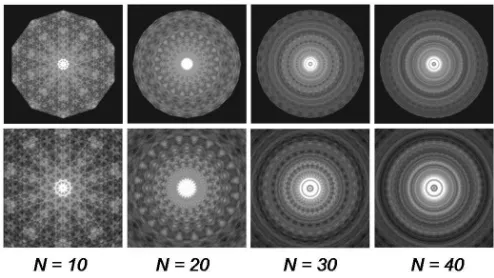
Figure 1: Computations of the lowest-loss modes of kaleidoscope lasers for a range of feedback-mirror
symmetries with cavity parametersNeq = 30and M = 1.5. The lower row of panes shows a magnification
of the central region of the corresponding pattern.
mirror, and Em(X) is the composite edge-wave pattern arising from themth virtual aperture [8]. The weighting factor αplays the role of the mode eigenvalue; it is ob-tained by finding the roots of an associated polynomial equation. Our virtual source modelling also allows one to calculate a small portion of any particular eigenmode, in contrast to FFT-based approached (see Figure 1).
The circular limit
WhenN → ∞, the feedback mirror becomes circular and the cavity essentially has only a single transverse di-mension. This limit has been investigated by Berry under the assumptionNeq ≫O(1), and only for the lowest-loss
mode [9]. For cavities with arbitrary Neq and M, this
type of fully-2D convergence phenomenon does not lend itself to asymptotic analysis; indeed, it can only be truly addressed via numerical computation. We will present, what is to the best of our knowledge, the first in-depth treatment of the circular limit of families of kaleidoscope laser modes (see Figure 2). It was found that this is a far more subtle problem than might first be imagined.
Spatial fractals in nonlinear optical systems
Universal route to spontaneous fractality
Turing instability is the susceptibility of a uniform state (one that is homogeneous in space and stationary in time) to become spontaneously patterned [10,11]. Nonlinear-ity couples the various components of a system in feed-back loops that may be either very simple or enormously complicated. When sufficiently stressed, winner takes all dynamics can drive the emergence of universal large-amplitude patterns that are essentially determined by the
Figure 2: Computations showing the transition of the lowest-loss mode pattern for a kaleidoscope laser with
Neq = 30andM = 1.5. For these parameters, a
reasonable degree of convergence to circular symmetry does not begin until one reaches regimes around
N = 40.
details of the dominant feedback loop. Such patterns can be characterized as simple if they are associated with a single dominant length scale that corresponds to a single minimum in the Turing instability threshold curve.
Investigations of spontaneous pattern formation tend to concentrate on regimes close to the instability minimum. However, a wide range of wave-based reaction-diffusion systems exhibit a hierarchy of comparable local Turing minima. By operating far above the first threshold, one can excite further unstable spatial frequencies. One can then, in principle, enter a profoundly new regime of pat-tern formation where intrinsic nonlinear dynamics (har-monic generation, four-wave mixing, etc.) tend to create new spatial length scales. We proposed that this multi-Turing mode hierarchy could be a signature for a system’s innate capacity to develop spontaneous spatial fractals, i.e., patterns with proportional levels of detail recurring across decades of scale [12].
Complexity in a simple optical ring cavity
Over the last two decades, spontaneous spatial pattern formation has blossomed into a huge field of research in nonlinear photonics. However, the majority of theoretical investigations have been rooted in the mean field approxi-mation [13], where light propagation effects are averaged out and the spatiotemporal complexity is consequently re-duced. Such models tend to possess, at most, only a single Turing minimum and hence are unlikely to predict multi-scale spatial structures.
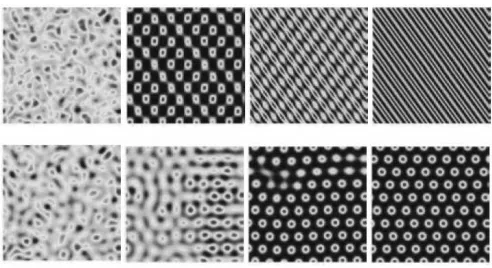
[image:3.595.40.289.100.243.2] [image:3.595.318.565.101.240.2]clas-Figure 3: Spontaneous self-reorganization of a uniform stationary state perturbed with a small level of noise. The simple universal patterns that result here are; stripes
in the purely-dispersive cavity (top row); and, hexagons in the purely-absorptive cavity (bottom row).
sic 2-level saturable absorber system is modelled in the thin-slice regime (where the medium has near-negligible thickness). The scalar electric fieldEand population in-versionware then governed by
∂E ∂z =
α0 2
Ew
1 +i∆, (2a)
T1
∂w ∂t −l
2
D∇
2
⊥w+ (1 +w) =−
T1T2
1 + ∆2|E| 2
w. (2b)
Here, (t, z) are time and the longitudinal coordinate (along the cavity axis), respectively, and∇2
⊥is the
trans-verse Laplacian. The relaxation times for wand the po-larization areT1andT2 ≪T1, respectively, andlDis the diffusion length of medium excitation. Optical absorp-tion is set by α0, while the pump detuning parameter ∆
determines the level of dispersion [the system is purely absorptive when∆ = 0, and purely dispersive (Kerr-like) when |∆| ≫ O(1)]. Periodic pumping and losses at the outcoupling mirror are implemented in Fourier space via a conventional ring-cavity boundary condition. A spatial filter is also introduced into the free-space path to allow control of pattern formation.
Simple and fractal patterns
Linear stability analysis has uncovered multi-Turing threshold minima that are precisely those proposed as necessary for spontaneous fractal generation [12]. We begin by demonstrating simple pattern formation through numerical computations.
A small level of background noise is added to a stationary-homogeneous solution of model (2), and the spatial filter is set so that only those spectral components within the first instability band may propagate freely
Figure 4: Transition from simple (single-scale) patterns to scale-dependent fractal (multi-scale) patterns in
purely-dispersive (top row) and purely-absorptive (bottom row) cavities. The transformation begins once
the spatial filter is removed.
around the cavity (waves outside this band are attenu-ated). When the intensity of the stationary state exceeds threshold, spontaneous self-organization (the feedback between diffraction, diffusion, and nonlinearity) drives the system toward a simple static pattern (see Figure 3).
Once the new stationary state is established, we re-move the spatial filter and allow all spectral components to propagate freely. One finds that the simple patterns evolve into scale-dependent fractals (see Figure 4) whose characteristics depend upon system parameters (e.g., dif-fusion length, pump intensity, and mirror reflectivity).
New contexts and applications
[image:4.595.41.287.100.234.2] [image:4.595.319.566.100.231.2]optical wavelength-scale spatial structure.
Both linear and nonlinear fractal generators hold enor-mous potential for inspiring novel laser designs and a wide range of applications (e.g., more efficient probing, scanning and ablation experiments). Moreover, the huge spatial bandwidths associated with fractal sources may have potential exploitation within distinct novel informa-tion contexts. The generic characters of fractal linear eigenmodes and multi-Turing instabilities in wave sys-tems may even lead to analogous applications in non-optical systems. We conclude with a brief account of prospective new application technologies.
References
[1] G.P. Karman and J.P. Woerdman, “Fractal structure of eigenmodes of unstable-cavity lasers,” Opt. Lett., vol. 23, pp. 1909-1911, 1998.
[2] G.P. Karman, G.S. McDonald, G.H.C. New, and J. P. Woerdman, “Fractal modes in unstable resonators,” Nature, vol. 402, pp. 138, 1999.
[3] G.H.C. New, M.A. Yates, G.S. McDonald, and J.P. Woerdman, “Diffractive origin of fractal resonator modes,” Opt. Commun., vol. 193, pp. 261-266, 2001.
[4] G.P. Karman, G.S. McDonald, J.P. Woerdman, and G.H.C. New, “Excess noise dependence on intracav-ity aperture shape,” Appl. Opt., vol. 38, pp. 6874-6878, 1999.
[5] G.S. McDonald, G.P. Karman, G.H.C. New, and J.P. Woerdman, “Kaleidoscope laser,” J. Opt. Soc. Am B, vol. 17, pp. 524-529, 2000.
[6] M. Berry, C. Storm, and W. van Saarloos, “Theory of unstable laser modes: edge waves and fractality,” Opt. Commun., vol. 197, pp. 393-402, 2001.
[7] W.H. Southwell, “Virtual-source theory of unstable resonator modes,” Opt. Lett., vol. 6, pp. 487-489, 1981.
[8] J.G. Huang, J.M. Christian, and G.S. McDonald, “Fresnel diffraction and fractal patterns from polyg-onal apertures,” J. Opt. Soc. Am. A, vol. 23, pp. 2768-2774, 2006.
[9] M. Berry, “Fractal modes of unstable lasers with polygonal and circular mirrors,” Opt. Commun., vol. 200, pp. 321-330, 2001.
[10] A.M. Turing, “The chemical basis of morphogene-sis,” Proc. Roy. Soc. Lond., vol. 237, pp. 5-72, 1952.
[11] M.C. Cross and P.C. Hohenberg, “Pattern formation outside of equilibrium,” Rev. Mod. Phys., vol. 65, pp. 851-1112, 1993.
[12] J.G. Huang and G.S. McDonald, “Spontaneous op-tical fractal pattern formation,” Phys. Rev. Lett., vol. 94, art. no. 174101, 2005.
[13] L.A. Lugiato and R. Lefever, “Spatial dissipative structures in passive optical systems,” Phys. Rev. Lett., vol. 58, pp. 2209-2211, 1987.
[14] A.S. Patrascu, C. Nath, M. Le Berre, E. Ressayre, and A. Tallet, “Multi-conical instability in the pas-sive ring cavity: linear analysis,” Opt. Commun., vol. 91, pp. 433-443, 1992.
[15] W.J. Firth and C. Par´e, “Transverse modulational in-stabilities for counterpropagating beams in Kerr me-dia,” Opt. Lett., vol. 13, pp. 1096-1098, 1988.
[16] W.J. Firth, A. Fitzgerald, and C. Par´e, “Transverse instabilities due to counterpropagation in Kerr me-dia,” J. Opt. Soc. Am. B, vol. 7, pp. 1087-1097, 1990.
[17] M. Lax, W.H. Louisell, and W.B. McKnight, “From Maxwell to paraxial wave optics,” Phys. Rev. A, vol. 11, pp. 1365-1370, 1975.
[18] S. Chi and Q. Guo, “Vector theory of self-focusing of an optical beam in Kerr media,” Opt. Lett., vol. 20, 1598-1600, 1995.