International Journal of Emerging Technology and Advanced Engineering
Website: www.ijetae.com (ISSN 2250-2459, ISO 9001:2008 Certified Journal, Volume 7, Issue 1, January 2017)
20
Subcarrier Performance Optimization using Adaptive
Relaying Protocol
M. G. Aswini
1, M. Ashokkumar
21
PG Scholar, 2Assistant Professor, Dept. of ECE Adhiyamaan college of Engineering, Hosur
Abstract—Cooperative communication has recently been
considered as a key technology for modern wireless standards and next generation wireless networks to improve the quality-of-service (QoS) and extend transmission coverage in a cost-effective manner. For designing the efficient OFDM-based relay communication systems, there are various relaying schemes are used. Distributed coding schemes employ two major relaying protocols, decode and forward (DF) and amplify and forward (AF). They suffer from a disadvantage of either noise amplification or error propagation. An adaptive relaying protocol (ARP) for general relay networks is proposed here. For the proposed approach, all relays are included into one of two relaying schemes, referred to as a DF relay and an AF relay. All relays, which decode correctly, are included in the DF relaying scheme, and other relays, which could not decode correctly, are included in the AF relay scheme. Performance improvement analysis of the proposed scheme is carried out, and compared with other relaying protocols. Simulation result demonstrates the proposed method to give better performance when compared with the conventional techniques in terms of SNR and BER.
Keywords—Adaptive Relaying Protocol, Amplify and
Forward (AF) and Decode and Forward (DF)
I. INTRODUCTION
In wireless relay networks (WRNs) signals are transmitted from one terminal to another through a number of relays. The main advantage of doing so is a reduced signal transmit power. As multiple users come into play, efficient management of relay resources becomes a critical issue for improving the system performance. In [1], the authors developed power allocation schemes for AF multi-user system using different objectives such as maximizing the minimum rate, maximizing the sum rate, and minimizing the total power consumption with a constrained minimum transmission rate. In [2], the authors studied relay assignment and power allocation for AF relay system to maximize the sum-rate of all users subject to individual and total power constraints.
Resource allocation in OFDMA systems is a complex problem, especially in the uplink communication due to the following reasons: the discrete nature of the subchannel assignment, the heterogeneity of the users’ subchannel conditions, and individual resource constraints.
Compared to conventional OFDMA transmission, relay-aided (cooperative) OFDMA transmission raises more complicated resource allocation problems as it introduces extra tasks. Such tasks are: deciding the transmission mode of each subcarrier, and determining the assisting relays and power assignment for each subcarrier at the source and relay nodes under individual and total power constraints [16]-[19]. Orthogonal frequency division multiple access (OFDMA) allows multiple users to transmit simultaneously on different subcarriers during the same symbol period.
Subcarrier allocation in OFDMA systems was investigated in many works to achieve different objective criteria [13]-[15]. In [13], the objective is to minimize the total transmit power under minimum rate constraint. In [14], the objective is to maximize the weighted sum rate subject to individual power constraint. Maximizing the overall system rate subject to individual power constraint while considering proportional fairness based on Nash bargaining is considered in [15]. In [5], authors analysed the performance of adaptive relaying protocol with various number of relays. Few distributed coding schemes have been proposed to explore the cooperative spatial diversity and cooperative coding gains in WRNs. Most of the existing distributed coding schemes [3]-[12] are based on the Amplify and Forward (AF) and decode and forward (DF) relaying protocols, suffering from a disadvantage of either noise amplification or error propagation.
International Journal of Emerging Technology and Advanced Engineering
Website: www.ijetae.com (ISSN 2250-2459, ISO 9001:2008 Certified Journal, Volume 7, Issue 1, January 2017)
21
Resource allocation for OFDMA with cooperative communication was investigated in many works such as [24]-[26]. In [20], the authors proposed a heuristic algorithm for downlink multi-hop OFDMA systems.An adaptive relaying protocol (ARP) is proposed here, which takes advantages of both DF and AF protocols and minimize their disadvantages. For the proposed scheme, all relays are included into one of two relay schemes, which we called a DF relay scheme, and an AF relay scheme. All relays, which can correctly decode the signals transmitted from the source, are included in the DF relay scheme and the rest of relays, which fail to make a correct decoding, are included in the AF relay scheme. All the relays in the AF relay scheme amplify the received signals from the source and forward it to the destination, while the relays in the DF relay scheme decode the received signals, re-encode and forward them to the destination. Another important feature is that the processing at relays and destination for the ARP scheme in a practical application is that the relay can automatically adapt to the channel quality by simply switching between the AF and the DF without any need for the channel state information (CSI) to be fed back from the destination to the relays or the source. The processing at the destination for the ARP is the same as for the AF and DF.
All signals received at the destination, forwarded from the relays in both the AF and DF schemes are combined together into one signal. The performance of the proposed ARP is analyzed and compared with other relaying protocols. It is shown that the proposed ARP scheme considerably outperforms the AF scheme and circumvents the error propagation due to the imperfect decoding at relays in a DF protocol, thus considerably outperforming both the AF and the DF protocols. This performance gain grows as the number of relays increases and it approaches the perfect DF at the high signal to noise ratios (SNR). The above analytical results are also validated by simulation results.
Rest of the paper is structured as follows. Section II describes the system model. Section III describes different relaying protocols. The Performance analysis is presented in Section IV. Numerical results are presented and discussed in Section V. Section VI concludes this paper.
II. SYSTEM MODEL
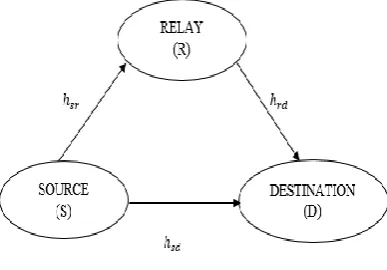
Fig. 1 gives a block diagram of a 2-hop relay system consisting of one source, relay and one destination with a direct link from the source to the destination. We assume that the source and relays transmit data through orthogonal channels. In the separate time slots, the source and relays transmits the information to the destination. The source first broadcasts the information to both the destination and relays.
The received signals at the relay i and destination, at time k, denoted by and respectively, can
be expressed as
√ (1)
√ (2) where s(k) is the symbol transmitted at time k,
( ) , are the received signal
power at the relay i and destination, respectively, is the source transmit power, and are the channel gains
between the source and relay i and that between the source and destination, respectively. Also and
are the fading coefficients between the source and the relay i and between the source and destination, respectively [5]. In this paper, we consider the fading coefficients are constant within one frame and change independently from one frame to another. Furthermore, and are zero mean
complex Gaussian random variables with power spectral density of /2 per dimension. The relays then process the received signals and send them to the destination [5]. Let represent the signal transmitted from the
relay i at time k. It satisfies the following transmit power constraint,
( | | ) (3)
where is the transmitted power limit at the relay i.
The corresponding received signal at the destination at time k, denoted by , can be written as
(4)
where is the channel gain between the relay i and
destination, is the fading coefficient between the
[image:2.595.333.527.594.729.2]relay i and destination and is a destination noise with power spectral density of N0/2 per dimension.
International Journal of Emerging Technology and Advanced Engineering
Website: www.ijetae.com (ISSN 2250-2459, ISO 9001:2008 Certified Journal, Volume 7, Issue 1, January 2017)
22
III. ADAPTIVE RELAYING PROTOCOL (ARP)
In this section, we propose an adaptive relaying protocol for OFDM system. Before describing the proposed relaying protocol, we first define an AF and DF relaying schemes.
A.AF Relaying Scheme
An AF relaying scheme, denoted by , consists of
all the relays, which could not decode correctly [5]. Upon receiving signals from the source, each relay in the AF relay scheme will simply amplify the received signals from the source. Let represent the signal transmitted from the relay i at time k, then it can be expressed as
(5)
where is an amplification factor such that
satisfies the power constraint in (3) and it can be
calculated as
√
| | (6)
By substituting (5) and (1) into (4), the received signal at the destination, transmitted from relay i become
(√ ) (7)
B.DF Relaying Scheme
The DF relaying scheme, denoted by , consists of
all the relays, which can make an error-free decoding [5]. Since all the relays in the DF relay scheme can decode correctly, each relay in the DF relay scheme can accordingly recover the binary information stream is then encoded and modulated into S. The relay i in the DF relay scheme will then forward the modulated symbols S with power to the destination,
√ (8)
The received signals at the destination, transmitted from the relay i in the DF relay scheme, become
√ (9)
C.Adaptive Relaying Protocol
For the proposed adaptive relaying protocol (ARP), in each transmission, based on whether relays can make correct decoding or not, each relay is included into one of two schemes, an AF relay scheme and a DF relay scheme. All the relays in the AF relay scheme amplify the received signals from the source and forward it to the destination, while all the relays in the DF relay scheme will decode the received signals, re-encode and forward them to the destination.
All signals received at the destination, forwarded from the source, the AF and DF schemes, are combined as follows,
∑
∑ (10)
The optimal values of and are given by
√
√
√
( | | ) (11)
By substituting (11) into (10), the destination SNR after combination, denoted by , can be approximated
as
(12)
where | | ∑ (13) ∑ | | (14)
where is
called the Harmonic Mean of variables
IV. PERFORMANCE ANALYSIS
In this section, we analyze the performance of the ARP and compare with other relaying protocols. For simplicity of calculation, we assume that and
for all i=1,….n.
Let and represent the instantaneous received
SNR of the combined signals in the AF and DF relay schemes.
| | ∑ (15) ∑ | | (16)
Due to the uniform distribution of relays and assumption of for all i=1….n. the average
PEP at high SNR, denoted by , can be calculated as
∑ ( ) *∏ ( | )∏ ( ( | )) (√ )+ (17)
At high SNR,
(
International Journal of Emerging Technology and Advanced Engineering
Website: www.ijetae.com (ISSN 2250-2459, ISO 9001:2008 Certified Journal, Volume 7, Issue 1, January 2017)
23
(19)
Eq. (18) can be expressed as,
( )
= (20) where (
) (21)
represents the performance loss of the ARP compared to the DF. Let be the average upper bound on the bit error rate (BER) for the ARP. At high SNR, it can be approximated as
∑ ∑
( ) |
(22)
where ( ) is the number of words with Hamming weight j and | is the probability that an input word with Hamming weight j produces a code word with Hamming weight d.
Similarly analysis, the average PEP of the AF of incorrectly decoding to a code word with weight d, denoted by , can be similarly calculated as
(√
) (
)
Compared to , the average PEP of the ARP in Eq. (18) can also be expressed as
(23)
where (
) (24) represents the performance gain of the ARP over the AF.
V. SIMULATION RESULTS AND DISCUSSION
In this section, we provide simulation results comparisons for various relaying schemes. Here, we assume that and for all i=1,….n, and and are the same. As discussed in [5], the DF
[image:4.595.314.545.105.282.2]relay protocol requires the relays to fully decode the source information and this limits the performance of DF to that of direct transmission between the source and relays, so it does not offer a diversity gain.
Fig 2.BER vs SNR performance of different relaying protocols
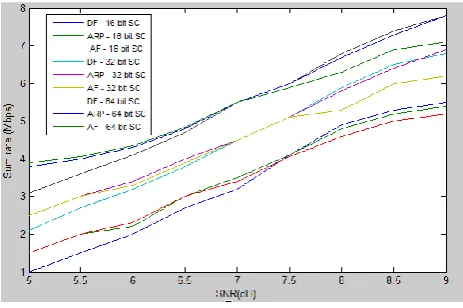
The other relaying protocols, including the AF, ARP, can all achieve a full diversity order for large SNR referring to Section IV. Fig. 2 compare the performance of the AF, the ARP and the DF for different SNR Values. It can be noted that the ARP significantly outperforms the AF in all SNR regions, and perform very close to the perfect DF as increases. This conclusion is consistent
with the analysis in Section IV. The above results can be explained from the analytical results in Section IV. It can be noted from Eq. (24) that is a decreasing function of , therefore, as either or n increases,
is exponentially decreasing, and the ARP can
achieve considerable performance gain compared to the AF.
For low , values, the channel from the source to the
relays are very noisy and probabilities of decoding errors at each relay are very high, so most of relays cannot correctly decode the received signals. In this case, as the number of relays is small, most of relays are included in the AF relay scheme at a very high chance and the DF relay scheme only occasionally includes few relays. For low values, the relays in the DF relay scheme can
considerably improve the overall channel quality. Fig 3 compares the SNR performance of three relaying protocols at different subcarrier such as 16, 32 and 64 bits.
[image:4.595.315.547.604.758.2]International Journal of Emerging Technology and Advanced Engineering
Website: www.ijetae.com (ISSN 2250-2459, ISO 9001:2008 Certified Journal, Volume 7, Issue 1, January 2017)
24
The above simulation results confirm that the ARP can provide a significant coding gain in all SNR regions and perform very closely to the perfect DF as , increases.VI. CONCLUSION
Analytical and theoretical results shows that the proposed adaptive protocol can achieve significant power saving or coverage extension compared to the direct transmission. To conclude, the proposed scheme can provide a significant SNR gain compared to the AF relay schemes and DF relay schemes. This can also evade the error propagation due to imperfect decoding at relay, which usually occurs in a DF relay protocol, and approach the perfect DF relay scheme at a high SNR region.
REFERENCES
[1] K. T. Phan, T. Le-Ngoc, S. A. Vorobyov, and C. Tellambura, “Power allocation in wireless multi-user relay networks,” IEEE Trans. Wireless Commun., vol. 8, no. 5, pp. 2535–2545, May 2009.
[2] G. Zheng, Y. Zhang, C. Ji, and K.-K. Wong, “Optimizing relay selection and power allocation for orthogonal multiuser downlink systems,” in Proc. International Conference on Wireless Communications Signal Processing, WCSP, Nanjing, China, Nov. 2009, pp. 1–5.
[3] M. O. Hasna and M. S. Alouini, ”Harmonic mean and end-to-end performance of transmission systems with relays,” IEEE Trans. Commun., vol. 52, Jan. 2004, pp.130 - 135.
[4] J. N. Laneman, D. N. C. Tse and G. W. Wornell, ”Cooperative diversity in wireless networks: Efficient protocols and outage behavior,” IEEE Trans. Inform. Theory, vol. 50, no. 12, Dec. 2004,pp. 3062-2080.
[5] Yonghui Li and Branka Vcetic “ On the performance of a simple adaptive relaying protocol for wireless relay networks,” Vehicular Technology Conference,May 2008,pp-2400-2405
[6] G. Kramer, M. Gastpar, and P. Gupta, ”Cooperative strategies and capacity theorems for relay networks,” IEEE Trans. Info. Theory, vol. 51, no. 9, pp. 3037-3063, Sept. 2005.
[7] E. Malkamaki and H. Leib, ”Evaluating the performance of convolutional codes over block fading channels,” IEEE Trans Inform Theory, vol. 45, no. 5, July 1999, pp. 1643-1646. [8] Y. Li, B. Vucetic, T. F. Wong and M. Dohler, ”Distributed turbo
coding with soft information relaying on multi-hop relaying networks,” IEEE J. Select. Area Commun., vol. 24, Nov. 2006, pp. 2040-2050.
[9] P. A. Anghel, and M. Kaveh, ”On the performance of distributed spacetime coding systems with one and two non-regenerative relays” IEEE Trans Wireless Commun., vol. 5, no. 3, March 2006, pp. 682 - 692.
[10] M. Janani, A. Hedayat, T. E. Hunter, A. Nosratinia, ”Coded cooperation in wireless communications: space-time transmission and iterative decoding,” IEEE Trans. Signal Processing, vol. 52, Feb. 2004, pp.362 371
[11] S. Yiu, R. Schober, and L. Lampe, ”Distributed space-time block coding,” IEEE Trans Commun., vol. 54, no. 7, July 2006, pp. 1195 - 1206.
[12] J. N. Laneman and G. W. Wornell, ”Energy-efficient antenna sharing and relaying for wireless networks,” in Proc. IEEE WCNC, 2000, pp. 7-12.
[13] C. Y. Wong, R. S. Cheng, K. B. Lataief, and R. D. Murch, “Multiuser OFDM with adaptive subcarrier, bit, and power allocation,” IEEE J. Sel. Areas Commun., vol. 17, no. 10, pp. 1747–1758, Oct. 1999.
[14] W. Yu and J. M. Cioffi, “FDMA capacity of Gaussian multipleaccess channels with ISI,” IEEE Trans. Commun., vol. 50, no. 1, pp. 102–111, Jan. 2002.
[15] Z. Han, Z. Ji, and K. J. R. Liu, “Fair multiuser channel allocation for OFDMA networks using Nash bargaining solutions and coalitions,” IEEE Trans. Commun., vol. 53, no. 8, pp. 1366–1376, Aug. 2005.
[16] T. Wang, “Resource allocation in OFDMbased wireless communication systems,” Ph.D. Thesis, Universit Catholique de Louvain (UCL), Louvain-la-Neuve, Belgium, Feb. 2012. [17] W. Dang, M. Tao, H. Mu, and J. Huang, “Subcarrier-pair based
resource allocation for cooperative multi-relay OFDM systems,” IEEE Trans. Wireless Commun., vol. 9, no. 5, pp. 1640–1649, May 2010.
[18] O. Duval, Z. Hasan, E. Hossain, F. Gagnon, and V. Bhargava, “Subcarrier selection and power allocation for amplifyand-forward relaying over OFDM links,” IEEE Trans. Wireless Commun., vol. 9, no. 4, pp. 1293–1297, Apr. 2010.
[19] J. Huang, V. Subramanian, R. Agrawal, and R. Berry, “Joint scheduling and resource allocation in uplink OFDM systems for broadband wireless access networks,” IEEE J. Sel. Areas Commun., vol. 27, no. 2, pp. 226–234, 2009.
[20] W. Yu and R. Lui, “Dual methods for nonconvex spectrum optimization of multicarrier systems,” IEEE Trans. Commun., vol. 54, no. 7, pp. 1310–1322, 2006.
[21] J. Huang, V. Subramanian, R. Agrawal, and R. Berry, “Downlink scheduling and resource allocation for OFDM systems,” IEEE Trans. Wireless Commun., vol. 8, no. 1, pp. 288–296, 2009. [22] I. Wong and B. Evans, “Optimal downlink OFDMA resource
allocation with linear complexity to maximize ergodic rates,” IEEE Trans. Wireless Commun., vol. 7, no. 3, pp. 962–971, Mar. 2008.
[23] D. Zhang, Y. Wang, and J. Lu, “Resource allocation in OFDMA based cooperative relay networks,” in Proc. IEEE GLOBECOM Workshops, New Orleans, Louisiana, Dec. 2008, pp. 1–5. [24] C. Bae and D.-H. Cho, “Fairness-aware adaptive resource
allocation scheme in multihop OFDMA systems,” IEEE Commun. Lett., vol. 11, no. 2, pp. 134–136, 2007.
[25] G. Sidhu, F. Gao, and A. Nallanathan, “A joint resource allocation scheme for multi-relay aided uplink multi-user OFDMA system,” in Proc. International Conference on Wireless Communications and Signal Processing, WCSP, Suzhou, China, 2010, pp. 1–6. [26] Y. Liu and W. Chen, “Adaptive resource allocation for improved
DF aided downlink multi-user OFDM systems,” IEEE Commun. Lett., no. 99, pp. 1–4, 2012.
[27] Hanan Al-Tous, Imad Barhumi, “Resource allocation for Multiple-Sources Single-Relay Cooperative communication OFDMA Systems” IEEE Trans. Mobile Computing, vol.15, No.4, April. 2016
[28] S. Boyd and L. Vandenberghe, “Localization and cutting-plane methods,” Stanford Engineering, Notes for EE392o, 2003. [29] M. Dohler and Y. Li, Cooperative Communications: Hardware,
Channel & PHY. Wiley & Sons, Feb. 2010.
International Journal of Emerging Technology and Advanced Engineering
Website: www.ijetae.com (ISSN 2250-2459, ISO 9001:2008 Certified Journal, Volume 7, Issue 1, January 2017)
25
[31] Y. Shen, G. Feng, B. Yang, and X. Guan, “Fair resource allocation and admission control in wireless multiuser amplify-and-forward relay networks,” IEEE Trans. Veh. Technol., vol. 61, no. 3, pp. 1383– 1397, Mar. 2012.