Biomanufacturing Technologies for
Engineering Biology
August 2016
Released for Public Review and Comment: March 2016
Initial Draft: December 2015
Report Number: MF-RR-2016-0101
MForesight: Alliance for Manufacturing Foresight serves as the voice of the national advanced manufacturing community, providing government and industry with information and analysis about emerging technologies, workforce training, and opportunities for public-private partnerships that strengthen U.S. competitiveness.
MForesight is funded by the National Science Foundation (NSF) and National Institute for Standards and Technology (NIST).
This material is based upon work supported by the National Science Foundation under Grant No. 1552534. Any opinions, findings, and conclusions or recommendations expressed in this material are those of MForesight and do not necessarily reflect the
i
T
ABLE OFC
ONTENTSTABLE OF CONTENTS ... I LIST OF TABLES ... II TABLE OF FIGURES ... II
EXECUTIVE SUMMARY ... 1
SUMMARY OF KEY OBSERVATIONS ... 2
INTRODUCTION ... 4
BACKGROUND ON ENGINEERING BIOLOGY ... 4
ABOUT THIS REPORT ... 6
IDENTIFYING TRANSLATIONAL TECHNOLOGIES ... 8
SELECTION OF EMERGING TECHNOLOGIES ... 9
REFINING THE EMERGING TECHNOLOGY LIST ... 10
SELECTED TRANSLATIONAL TECHNOLOGY & ENABLING TOOLS ... 11
KEY TRANSLATIONAL PLATFORM TECHNOLOGY ... 11
ENABLING TOOLS FOR HOST CELL DEVELOPMENT ... 14
OTHER OPPORTUNITIES ... 17
SCALED-UP, COST-EFFECTIVE PROTEIN OR RNA PRODUCTION FOR AGRICULTURAL -SPECIFIC DIAGNOSTICS ... 17
PROTEIN &DNA SCREENING KITS OF TRANSGENICS WITH NON-UNIQUE DNA SIGNATURES FOR QC,REGULATORY COMPLIANCE &BIOSAFETY CONCERNS ... 18
SCALING OUT TECHNOLOGIES:MINIATURIZED FERMENTERS AND CELL-FREE SYNTHESIS .. 18
BROADER CHALLENGES AND THE ROLE OF THE FEDERAL GOVERNMENT ... 19
DE-RISKING &TECHNOLOGY DEVELOPMENT ... 19
REGULATORY REFORM ... 21
PRIVATE INVESTMENT ... 24
BARRIERS WITH TECHNOLOGY TRANSFER &INTELLECTUAL PROPERTY ... 24
WORKFORCE DEVELOPMENT ... 26
PARTNERSHIP MODELS ... 27
ii
U.S.COMPARATIVE ADVANTAGES/DISADVANTAGES ... 28
UNIQUE U.S.ADVANTAGES TO LEVERAGE ... 29
SUMMARY ... 29
APPENDIX 1: PANEL EXPERTS ... 31
APPENDIX 2: INITIAL PROJECT GUIDANCE & RESOURCES ... 35
L
IST OFT
ABLES Table 1: Emerging Platform Technologies and Expert Poll Results ... 9T
ABLE OFF
IGURES Figure 1: MForesight Process ... 8Figure 2: A Range of Candidate Translational Technologies were reduced to a Key Platform Technology and Enabling Tools ... 10
1
E
XECUTIVES
UMMARYEngineering Biology seeks to apply engineering principles to design, modify, and produce customized biological components and systems. The recent advent of tools such as the CRISPR/Cas9 system for gene editing and gene regulation has sharply accelerated development in this exciting field. However, several challenges need to be addressed in order to transition laboratory-scale results to commercial-scale solutions. This report identifies emerging platform technologies that, if matured, will accelerate the growth in the rapidly changing field of Engineering Biology. The conclusions in the report are intended to guide stakeholders from government, industry and academia as they seek to further develop innovations in this field.
In order to gain the most up-to-date perspective on emerging technologies in Engineering Biology, MForesight convened panel of industry-based subject matter experts. The panel evaluated a range of pre-competitive, emerging platform technologies and assigned a development priority to one technology and several enabling development tools based on several specific selection criteria:
• The platform technologies must be cross-cutting, with broad applications across the engineering biology industry.
• The maturity of the technologies must be suitable for both private industry and government to consider investing in further development.
• The new technologies should increase the likelihood that the technology will give the U.S. a first-mover advantage in the marketplace.
The technologies that clearly met the selection criteria include:
• The key platform technology—Standardized Verified and Tractable Host Cells or Strains for Biomanufacturing—will provide industries with host cells and strains that are amenable to engineering for scale-up or scale-out. The standardized and verified nature of these hosts will streamline regulatory processes and significantly de-risk aspects of the biomanufacturing process.
• Several enabling tools are needed to fully realize the potential offered by the development of tractable host cells or strains. These tools will also enable more rapid Design-Build-Test-Learn (DBTL) cycles, which is critical for the development of new host cells or strains. These tools include:
(i) High Throughput Omics;
2
S
UMMARY OFK
EYO
BSERVATIONSo Pre-competitive and core technology development should be kept as open as possible in order to sustain the network effect gained from using standard biological platforms, data systems, and testing/manufacturing standards.
o Intellectual property (IP) generated through publicly-funded development should be made widely available.
o The high cost of clinical trials is pushing investors away from smaller markets. Additional cost is incurred when substantial human data is required prior to investment in definitive clinical trials.
o The burden of bridging the gap from animal models to exploratory human studies can be de-risked via transitional funding from government sources.
o Standards and reference materials lag behind the rapid pace of change within this industry. Regulatory agency personnel should be embedded with technology creators during the development process in order to collaboratively establish effective and appropriate regulations.
o Many university technology transfer offices underestimate the complexities of maturing a technology into a market-ready state and personnel may overvalue early-stage discoveries. To arrive at more accurate valuations, universities could seek a better understanding of the true cost of scaling and process development.
o Modeling for predictive scaling is needed to inform organism design and is a critical aspect of de-risking technologies for industrial adoption.
o Biosafety/bioterrorism concerns are driving calls for increased oversight of such tools or even equipment.1 Collaboration between government agencies and industry-experts will result in technically sound solutions that can be effectively implemented.
o Science-based advocacy is needed to address public concerns regarding genetically modified organisms (GMOs).2
o Significant on-the-job training for new biotech employees is often needed to help them master the core concepts of biomanufacturing. To better prepare students for
1 An additional challenge in biosafety/bioterrorism is the fundamental question of how to clearly and
unambiguously define a taxonomic name (e.g. pathogen X or toxin Y) for insertion into legislation. With few exceptions, current regulations do not enumerate genes or gene sequences in spite of the fact that all of modern biology deals with specific sequence descriptions based on A, T, C, G. This has resulted in a fundamental gap in converting well-defined sequences of concern into regulatory lists.
2 Genetically Modified Organisms (GMOs) are living organisms that have had their intrinsic genetic
3
jobs requiring high-levels of technical knowledge, universities should consider creating new undergraduate and master’s degree programs specifically targeted towards biomanufacturing.
o Practical, hands-on training at the internship and apprenticeship level will fill an important gap in the current workforce.
o The U.S. does not have a roadmap or national strategy in the area of Engineering Biology to help identify sectors for investment. (The Engineering Biology community in the UK is well-organized and has strong support from the government).3
3 Research Councils UK. A Synthetic Biology Roadmap for the UK. July 2012.
4
I
NTRODUCTIONFor centuries, humans have been altering the genetic material of living organisms through selective breeding. Yet, today, these old practices are taking on fundamentally new meaning and consequence. Scientists are creating new DNA sequences from scratch in order to produce materials with potential to solve practical problems in diverse fields from medical treatment to energy production. By applying engineering principles to design, modify, and produce customized biological components and systems, the field of Engineering Biology is rapidly changing how biological systems can be used. The potential benefits of Engineering Biology — from low-emissions biofuels to new cancer-fighting medical technologies — are enormous. But so are the potential pitfalls.
Venturing into a field with extraordinary tools and unprecedented implications — altering the building blocks of life itself — requires skillful measures to identify and address potential unintended consequences. Governing the growth of Engineering Biology means not only maximizing efforts to enable discovery and invention to create jobs and meet crucial human needs; it also means thinking in interdisciplinary ways about unforeseen implications for health, safety, the environment, and the economy in the long-range future.
With the rise of Engineering Biology, U.S. firms are finding that they must invest strategically in new technology if they wish to assume the “first-mover advantage” and bring meaningful innovations from the laboratory to the marketplace. Identifying and prioritizing emerging technologies increasingly depends on a strong collaboration between those firms, U.S. universities and federal agencies.
B
ACKGROUND ONE
NGINEERINGB
IOLOGYThe current state-of-the-art in Engineering Biology can be best described as artisanal, where each company follows their own pathway in the classic Design-Build-Test-Learn (DBTL) development cycle to design and scale-up new products. Given the high inherent cost of biotechnology development (the cost for a new bioproduct can be in the hundreds of millions of dollars4), the aggregated cost of duplicated effort across companies in the industry is substantial. The high development cost also represents a substantial barrier-to-entry that precludes many entrepreneurs and investors from starting Engineering Biology-based companies, which dampens further growth in this nascent bioeconomy.
4 The development cost for semi-synthetic artemisinin (an antimalarial drug) is estimated by UC Berkeley
5
This environment is ideal for a public-private partnership (PPP) on platform development of key pre-competitive technologies. 5 A PPP can benefit from
standardized software, standardized processes, and can also accelerate development by sharing information on successes/failures with other members of the partnership. Biotechnology platform technologies in the pre-competitive space can provide a leveraging mechanism so that all companies can benefit from pooled resources.
By moving past basic laboratory research into the translational research area, Engineering Biology innovations can be matured toward their use in commercial settings. An important step is to develop translational tools and technology to automate and scale-up the processing of synthesized DNA. In addition, a new generation of workers will require training in the critical skills needed to operate bio-factories safely and cost-effectively. Rapid, cost-effective DNA synthesis will ultimately be able to develop transgenic or synthetic chromosomes for use in areas as diverse as agriculture, health care, and natural products.
Recent reports from the National Academies of Sciences,6 OSTP Bioeconomy Blueprint,7 World Technology Evaluation Center (WTEC),8 Department of Energy,9 and the Wilson Center10 have broadly addressed various challenges and opportunities in
Engineering Biology. This report is a concise evaluation of translational technology opportunities that can accelerate the growth and vitality of the Engineering Biology community.
5 The emphasis on “pre-competitive” is critical; individual companies are keenly focused on keeping their
competitive advantage for their later-stage technology.
6 National Research Council. Industrialization of Biology: A Roadmap to Accelerate the Advanced
Manufacturing of Chemicals. Washington, DC: The National Academies Press, 2015.
doi:10.17226/19001.
7 Office of Science and Technology Policy. National Bioeconomy Blueprint. April 2012.
https://www.whitehouse.gov/sites/default/files/microsites/ostp/national_bioeconomy_blueprint_april_2012. pdf
8 WTEC. Global Assessment of Biological Engineering & Manufacturing. World Technology Evaluation
Center. July 2015. http://www.wtec.org/bem/docs/BEM-FinalReport-Web.pdf
9 U.S. Department of Energy. Synthetic Biology: Report to Congress. July 2013.
http://www.synberc.org/sites/default/files/DOE%20Synthetic%20Biology%20Report%20to%20Congress_ Fnl.pdf
10 Drinkwater, K., Kuiken, T., Lightfoot, S., McNamara, J., & Oye, K. Creating a Research Agenda for the
Ecological Implications of Synthetic Biology. Synthetic Biology Project, Wilson Center, and Massachusetts
Institute of Technology, May 2014.
6
A
BOUTT
HISR
EPORTThe goal of this report is to identify translational platform technologies in Engineering Biology with cross-cutting appeal and the potential for co-investment by the private sector.
Subject matter experts in Engineering Biology were asked to identify and prioritize emerging platform technologies, and to also address industry challenges related to intellectual property, technology transfer, regulation, and other topics. By recruiting the Panel Experts primarily from commercial companies, the perspective of industrial stakeholders in the field was captured. However, selected academics were included to offer a balanced range of views and opinions on key platform technologies that may be at an earlier stage of development. This report relies heavily on the inputs of Panel Experts in order to arrive at the recommendations. For more information about the Panel Experts, please see Appendix 1.
This report is designed to be a short-duration assessment of technology opportunities and challenges germane to advanced manufacturing R&D, with a specific focus on translational R&D. Technologies are evaluated using a variety of criteria, including:
• The potential for private sector co-investment,
• Cross-cutting appeal/impact to industry, and
• The likelihood that the technology (if matured) will give the U.S. a first-mover advantage in the marketplace.
This report identifies four key translational and enabling technologies that are critical in the Design-Build-Test-Learn (DBTL) development cycle in Engineering Biology. These tools are likely to address some of the most significant barriers in the biomanufacturing industry. The key technologies identified here represent only a subset of possible solutions in the very broad and very dynamic field of Engineering Biology. A deeper dive into this topic could yield a more comprehensive set of solutions.
The findings in this report were echoed in an Agile Biomanufacturing workshop sponsored by Department of Energy (DOE).11 This DOE workshop asked industrial stakeholders to identify and prioritize a common set of pre-competitive biomanufacturing tools that could be developed by a government-sponsored consortia. The ultimate goal is to develop shared development tools to speed the scale up/out process, thereby accelerating the bioeconomy in the process. The workshop confirmed that the
11 The initial Agile Biomanufacturing Industry Listening Day was held on March 15, 2016, sponsored by
7
development of standardized and tractable host organisms remains an elusive but potentially beneficial solution for the industry. The DOE workshop elaborated on the concept of host strains by emphasizing a focus on the development of “beachhead molecules” where defined “beachhead pathways” can be used to guide developers to specific molecules of interest in a particular host.
Beyond the technology challenges, this report found that several other non-technical barriers exist that will continue to hamper the biomanufacturing industry if not addressed. The issue of regulatory barriers and the need for reform was repeatedly raised by the Panel Experts and this was also reiterated by other recent reports.12,13 This report includes suggestions on how to address regulatory barriers, as well as other efforts and roles that the Federal Government can adopt to further the bioeconomy including co-investment in various technological, regulatory, and public education initiatives. Some of these areas overlap with those discussed in the 2012 report on the National Bioeconomy Blueprint.14
Another element that differentiates this report from the other recent Synthetic/Engineering Biology reports is the inclusion of intellectual property (IP) and workforce development issues faced by the bioeconomy. Additionally, this report includes a section on international benchmarking, which identifies targets of opportunity that the U.S. can seek to to leverage.
12 Carter, S. R., Rodemeyer, M., Garfinkel, M. S., Friedman, R. M. Synthetic Biology and the U.S.
Biotechnology Regulatory System: Challenges and Options. J. Craig Venter Institute. May 2014.
http://www.jcvi.org/cms/fileadmin/site/research/projects/synthetic-biology-and-the-us-regulatory-system/full-report.pdf
13 Bergeson, L. L., Campbell, L. M., et al. The DNA of the U.S. Regulatory System: Are We Getting It
Right for Synthetic Biology? The Wilson Center: Synthetic Biology Project. October 2015.
https://www.wilsoncenter.org/sites/default/files/synbio_reg_report_final.pdf
14 Office of Science and Technology Policy. National Bioeconomy Blueprint. April 2012.
8
I
DENTIFYINGT
RANSLATIONALT
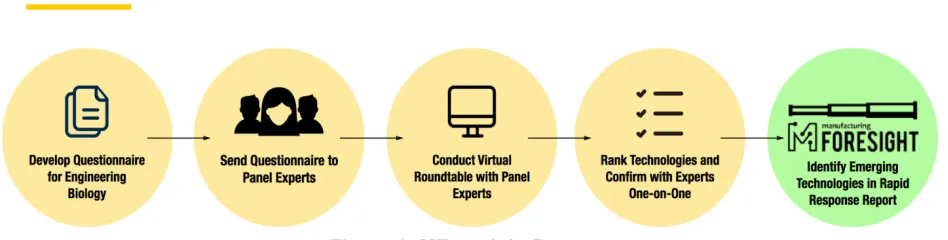
ECHNOLOGIESUnder an accelerated timeline of two months, the process illustrated by Figure 1 was used to identify the emerging technologies discussed in this report.
1) A questionnaire was developed that covered a range of topics related to technical maturity, scale-up/scale-out of emerging platform technologies, private sector investment, regulations, technology transfer, workforce development, and international benchmarking.
2) Based on recent academic, industry and government reports, a panel of national thought leaders in the field of Engineering Biology was assembled.
3) The Panel Experts supplied detailed answers to the questionnaire to determine the emerging platform technologies that could meet the following criteria:
o Cross-Cutting Appeal: The first criterion is to select those platform technologies in Engineering Biology that will be applied most broadly to the industry and also to the consumer. Cross-cutting appeal leads to a larger market potential, thereby generating a future economic benefit that warrants government investment.
o Co-Investment Potential: The second criterion is whether private industry would be likely to co-invest with the Federal Government in the identified emerging platform technologies. The desire is to find platform technologies that are highly desirable, but not sufficiently mature to warrant purely private investment.
The barriers facing these technologies were discussed, including (but not limited to) IP, technology transfer, regulations, and irregular funding patterns. Questions about economic impact, job growth, and the likelihood of the U.S. gaining a first-mover advantage were also discussed.
[image:14.612.73.547.168.288.2]4) Data on early-stage technologies were refined and ranked according to the cross-cutting and co-investment criteria above. Virtual roundtables were conducted to
9
understand the tradeoffs between different emerging technologies and to ultimately select those technologies that best meet the criteria above.
5) Additional one-on-one phone interviews with Panel Experts were conducted to clarify some of the points raised at the roundtable and to seek more holistic responses on specific topics.
S
ELECTION OFE
MERGINGT
ECHNOLOGIESThe questionnaire asked the following:
Please identify the promising platform technologies (both in manufacturing and in therapeutics) in your field that you feel will have the maximum impact in health outcomes and economic growth over the next 5-10 years.
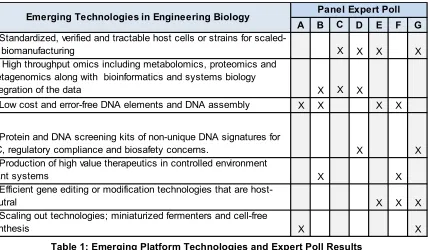
Table 1 provides a listing of seven emerging platform technologies identified in response to the question.
These seven technologies represent a cross-section of topics in Engineering Biology with the greatest potential for improved health outcomes and economic growth. Each technology was then evaluated using the criteria of cross-cutting appeal and co-investment potential. The degree to which a given technology would give the U.S. a first-mover advantage was also considered.
A B C D E F G 1. Standardized, verified and tractable host cells or strains for
scaled-up biomanufacturing X X X X
2. High throughput omics including metabolomics, proteomics and metagenomics along with bioinformatics and systems biology
integration of the data X X X
3. Low cost and error-free DNA elements and DNA assembly X X X X
4. Protein and DNA screening kits of non-unique DNA signatures for
QC, regulatory compliance and biosafety concerns. X X
5. Production of high value therapeutics in controlled environment
plant systems X X
6. Efficient gene editing or modification technologies that are
host-neutral X X X
7. Scaling out technologies; miniaturized fermenters and cell-free
synthesis X X
[image:15.612.97.527.329.579.2]Emerging Technologies in Engineering Biology Panel Expert Poll
10
R
EFINING THEE
MERGINGT
ECHNOLOGYL
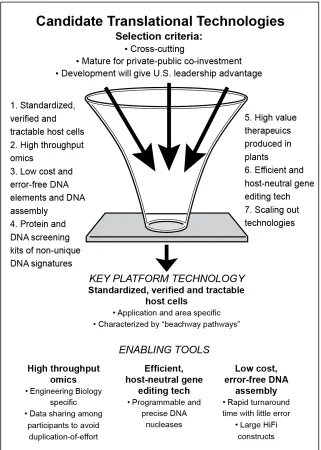
IST [image:16.612.146.467.149.599.2]Using the results from the Expert poll, the seven candidate technologies were reduced to one key platform technology and three enabling tools.
11
S
ELECTEDT
RANSLATIONALT
ECHNOLOGY&
E
NABLINGT
OOLSThe results include one key translational technology and three enabling tools (see Figure 3).
Figure 3: Translational Technologies That Can Be Applied Broadly Across the Engineering Biology Industry
K
EYT
RANSLATIONALP
LATFORMT
ECHNOLOGYStandardized, Verified and Tractable Host Cells or Strains for Scaled-Up
Biomanufacturing
The issue of tractable host cells or strains was consistently supported. Currently, the development of new host cells and strains (hosts) is a slow and expensive process, so companies typically use existing, well characterized host cells or strains based on
Escherichia coli (bacteria), Saccharomyces cerevisiae (yeast), and Chinese hamster ovary (CHO) cells (mammalian). Some of these host cells or strains are not well characterized. While it is expedient to use existing hosts, the scale-up process can yield unintended results.
[image:17.612.96.520.155.361.2]12
to have highly tractable hosts and robust measurement tools that quickly achieve the pathway modifications, leading to faster and more predictable outcomes.
These issues can be addressed by developing an improved understanding of some of the more poorly characterized existing hosts or the development of new hosts. The recommended number of new hosts needed is not excessive; perhaps in the range of five or six. Hosts based on Pichia pastoris, Bacillus subtilis, Streptomyces are examples of hosts used in industry. Markets and reference hosts for Chinese hamster ovary (CHO) cells are another possibility.
CHO cells actually refer to a very diverse set of cells that originated from a single CHO cell from the 1950s. One important feature of CHO cells is the ability to rapidly adapt to various environments and applications. This feature has led to the widespread use of CHO cells for manufacturing therapeutic proteins. However, the ability to rapidly evolve is believed to be a result of genomic instability. As a result, the CHO cells used by one company are very different from the CHO cells used by any other company, and are different than the CHO cells used in academic research. Each collection of these cells will have different performance characteristics, media and growth requirements, and productivity.15 Moreover, even within a
single company, CHO cells evolve over time resulting in "cell line instability" which creates a challenge: once a
platform process is established, the cells may behave unexpectedly for no obvious
15 A recent publication sequenced the genome of the CHO K1 cell (the most basic, standardized CHO
cell). The team sequenced the cells from the ATCC collection (the 'standard reference collection in America') as well as ECACC (the European equivalent). The study identified hundreds of thousands of single nucleotide variants between what should have been identical genome sequences.
Lewis N. E., Liu X., Li Y., et al. Genomic landscapes of Chinese hamster ovary cell lines as revealed by
the Cricetulus griseus draft genome. Nat Biotechnol. 2013 Aug: 31(8):759-65. doi: 10.1038/nbt.2624.
http://www.ncbi.nlm.nih.gov/pubmed/23873082
DIFFERING PERSPECTIVES
Based on the evidence that many companies prefer to work with hosts that they understand well to explore exotic pathways, there were some reservations about the value of developing new ‘exotic’ host strains. This is contrary to the suggestion that a single, fully synthetic host be supported, even though a minimal set of metabolic pathways might result in tractability and predictable modification of the host.
13
reason. There is a need for the development of reference cells, reference cell culture media, reference proteins, and other related materials to streamline and accelerate production of therapeutic proteins, facilitate regulatory approval, and broaden the impact of research on CHO cells.
Another approach, in addition to the development of standardized hosts, is to focus on developing standardized pathways to generate defined enzymes called “beachhead molecules.”16 Hosts might then be characterized by a tiered specification sheet that not
only classifies hosts for certain culture conditions, but also for the production of certain beachhead molecules. Companies can then utilize these hosts and their defined “beachhead pathways” to further develop molecules of interest. The advantage with beachhead molecules is that the industry can readily retain intellectual property to any commercially viable molecule they develop, but the pathway to that molecule need not be fully developed from scratch.
Managing the Host Strain
One potential avenue for development is to create a PPP to develop new tractable hosts, with the characterized hosts made available in a national repository (potentially located at one of the national laboratories). This model would manage access to verified, standardized hosts in a controlled way. In addition, U.S. companies could focus on the hardening and commercialization of a new product rather than redundantly developing suitable host strains.
A further advantage of the national repository model is the ability for regulatory agencies to be included from the start of host organism development. The resulting host organisms would be an entry point solution that is pre-vetted from a regulatory standpoint,17 which in turn would lower barriers for small and mid-sized companies to
enter the market. This represents a democratization of the technology by creating new opportunities for innovation in all levels and segments of the bio-industry.
The concept of managing host strains at the national laboratories was discussed with industrial stakeholders at the Agile Biomanufacturing workshop in March of 2015. The DOE already has substantial facilities based on their work to develop advanced
16 This approach is advocated by Lawrence Berkeley Labs.
17 An example of a successful pre-approval process can be found in the EPA MCAN § 725.420, where
recipient microorganisms are listed that are eligible for the tiered exemption from review. The following recipient microorganisms are listed in MCAN § 725.420 as eligible for exemption under this subpart: (a) Acetobacter aceti. (b) Aspergillus niger, (c) Aspergillus oryzae. (d) Bacillus licheniformis. (e) Bacillus subtilis. (f) Clostridium acetobutylicum. (g) Escherichia coli K-12. (h) Penicillium roqueforti. (i)
Saccharomyces cerevisiae. (j) Saccharomyces uvarum.
14
biofuels, renewable chemicals, and bioproducts. This invested capital can be further leveraged to manage any host strain developed, but mechanisms are still needed to resolve the challenges of intellectual property and cost.
E
NABLINGT
OOLS FORH
OSTC
ELLD
EVELOPMENTThe following enabling tools are used by developers seeking to create new host cells or strains.
High Throughput Omics Including Metabolomics, Proteomics and Metagenomics
Along With Bioinformatics and Systems Biology Integration of the Data
Current State: The tools and technologies currently used in determining pathway function and cellular physiology in Engineering Biology were co-opted from the omics field of the life sciences. However, the needs and challenges in the Design-Build-Test-Learn loop of Engineering Biology necessitate the development of new tools and technologies for this space. These Engineering Biology specific omics tools would be used in the development and optimization of organisms for scale-up manufacturing. Concomitantly, the development of bioinformatics tools is also needed to effectively analyze the data acquired with the new
omics tools.18
Value Propositions & Impact: In both the design and verification stage of developing hosts, the Engineering Biology-specific omics developed will be relied upon to create and standardize these hosts. Without the development of these high throughput tools, the ability to fully characterize and screen hosts would be hampered, and would likely delay the development of hosts or efforts to standardize hosts.
The combined Engineering Biology-specific omics and bioinformatics tools and techniques would accelerate natural product discovery from metagenomes for small molecule therapeutics. This discovery paradigm can expand and
18 An example: Smanski, M. J., Bhatia, S., et al. Functional optimization of gene clusters by combinatorial
design and assembly. Nature Biotechnology. 2014 Nov.: 32, 1241-1249. doi: 10.1038/nbt.3063
DIFFERING PERSPECTIVES
Several Panel Experts felt that although sufficient omics tools were already on the market, the advantage of public-private partnerships would be the creation of open omics tools and ever-growing databases. These tools would be readily accessible by the public without IP barriers.
15
accelerate efforts that have otherwise become inefficient. This is especially important in the context of anti-infective therapeutics.
In the Agile Biomanufacturing workshop, data sharing to avoid duplicating efforts was a key theme. Specifically, the advantages/disadvantages of a “push-pull” bioinformatics system were discussed. In the optimal system, a “push” system triggers a notification to an interested party when a certain enzyme had been developed. This is in contrast to a “pull” system where a given developer seeks to independently elucidate a pathway or develop a certain enzyme for their product. A push-based bioinformatics system would tie in well with the concept of developing beachhead molecules (open source intermediates) that companies can use to develop their own IP. Such a system can also incorporate Life Cycle Analysis and Technoeconomic Analysis to notify interested parties when favorable conditions have arisen.
Value Proposition and Impact: Metagenomics would support the genomic analysis of large scale environmental samples to discover novel natural products, molecules, or enzymes for therapeutic and biotech applications. Additional development of bioinformatics will lead to the ability to process large amounts of sample data, ultimately probing the structure of mixed microbial communities. These technologies would have applicability in other relevant areas.
Low Cost and Error-Free DNA Elements and DNA Assembly
Current State: Oligonucleotide synthesis is the underlying method used in building complex DNA elements. Presently, oligonucleotide synthesis is still based on a 30 year- old phosphoramidite-based synthesis technique, and is a limiting factor in the progression of genetic engineering. The current price of DNA constructs is in the range of 10 to 30 or more cents per base, depending on quality, length, complexity, and yield. Interestingly, the industrial stakeholders in the Agile Biomanufacturing workshop had the opinion that the cost of DNA synthesis is not the limiting factor in their Build process. Instead, the industrial stakeholders desired rapid synthesis of gene constructs (in the range of 20 – 30kb) in weeks instead of months. That said, some industrial stakeholders believe that federal funding for the development of new (faster and cheaper) ways of DNA synthesis would lead to industry-wide benefits.
16
Additional reductions in cost would enable high throughput design and testing of novel organisms and genetic pathways. As a result, designers would see improved scale-up, improved hosts, and improved pathways. Lowering cost barriers would impact all sectors of Engineering Biology including metagenomics and host cell development.19
Further development in DNA elements would also addresses a major limitation in oligonucleotide synthesis, which is the accumulation of errors in the sequences of long DNA elements. These errors arise during the oligonucleotide synthesis or during the assembly of these oligonucleotides into longer DNA elements. Elimination of these errors while keeping the costs down for these DNA elements would transform all areas of Engineering Biology. The expansion of the types of sequences which can be synthesized is also a needed area for development. For example, existing technologies are limited to a narrow nucleotide composition range which is limiting when using gram-positive host organisms. Development of improved high-GC synthesis, homopolymer runs, and transcriptional control elements (which often contain secondary structure) will be another key area of research that is needed to fully realize DNA synthesis impact and application.
Desired Result: Ideally, additional development will result in low cost (below one-cent a base pair), high fidelity DNA constructs of lengths up to 50 kB.20
19 An example: Zhou, H., Vonk, B., Roubos, J. A., Bovenberg, R. A. L., & Voigt, C. A. Algorithmic
co-optimization of genetic constructs and growth conditions: application to 6-ACA, a potential nylon-6 precursor. Nucleic Acids Research. 2015 Dec: 43(21): 10560-10570. doi: 10.1093/nar/gkv1071
20 The outcome technology might be oligos but the actual customer most likely will want to see double
stranded DNA because it is a significant extra set of steps to assemble 20 kB from oligos. DIFFERING PERSPECTIVES
17
Efficient, Host Neutral Gene Editing Techniques
Current State: Gene editing techniques allow the knock-in or knock-out of genes or genetic elements in an organism. The need exists for the ability to multiplex with the use of different guide sequences as most disease states are multi-factorial from a genetic standpoint.
Value Proposition and Impact: In the development of host cells or strains, site-specific insertion, mutation, and deletion of genes is likely necessary, and new gene editing techniques would enable these tasks to be done efficiently and with low error rates. With the development of precise and efficient gene editing tools, the design cycles and timelines for host development will be significantly reduced.
Gene editing has the potential to play a significant impact in the healthcare sector through human gene therapy. Treatment of genetic diseases might be accomplished through inactivating genes, repairing mutations, or introducing other genes. Gene editing is also influencing the biomanufacturing industry by enabling the genetic modification of host strains to produce novel metabolites through exotic pathways. The approaches to gene editing have primarily involved nucleases to cleave the genome at specific sites. These nucleases include zinc-finger nucleases (ZFNs), transcription activator-like effector nucleases (TALENs) and CRISPR/Cas9. Newer CRISPR-based or RNA-guided nucleases, such as Cpf1, will make gene editing more efficient.
O
THERO
PPORTUNITIESThe remaining technologies in Table 1 did not fully meet the cross-cutting/co-investment criteria. For completeness, a brief description is provided for the remaining emerging technologies along with comments on each.
S
CALED-
UP,
C
OST-E
FFECTIVEP
ROTEIN ORRNA
P
RODUCTION FORA
GRICULTURAL-S
PECIFICD
IAGNOSTICS18
or they simply cannot do it. Development of agricultural focused technologies to scale up the production of these analytes in a reliable and cost-effective manner would accelerate the regulatory process and the eventual commercialization of the product.
Comment: This technology was likely not selected due to the narrow impact.
P
ROTEIN&
DNA
S
CREENINGK
ITS OFT
RANSGENICS WITHN
ON-U
NIQUEDNA
S
IGNATURES FORQC,
R
EGULATORYC
OMPLIANCE&
B
IOSAFETYC
ONCERNSThis platform technology addresses anticipated, future concerns in the agricultural industry, particularly in the management of compliance and quality control (QC) of transgenic plants. Screening kits to detect the protein and DNA of inserted genes are required to ensure import or export compliance of transgenic plants, and to prevent unregistered transgenic plants from being distributed (thus ensuring international competitiveness). Existing screening kits have been developed to utilize the unique DNA signatures that arise from random insertions of genes into the plant which determines lot specificity of the transgenic plant (in the parlance, the regulated event). Advances in gene editing technologies allowing the insertion of transgenes into a genome at specific locations with repeatability will theoretically remove this advantage of random insertions that serve to determine lot event specificity with the diagnostics. Thus, novel methods for screening protein and DNA of transgenes developed using these new gene editing tools are needed to address QC, regulatory lifespans, and biosafety concerns.
Comment: The limited applicability of this technology to other sectors of Engineering Biology did not elicit a large number of votes.
S
CALINGO
UTT
ECHNOLOGIES:
M
INIATURIZEDF
ERMENTERS ANDC
ELL-F
REES
YNTHESISThe traditional production of therapeutics using bacterial or mammalian cells will reach the limits of their production capacity in the near future. Transgenic plants have been developed as an alternative to address this limitation in therapeutic production and the lower cost of production and expansion with transgenic plants may provide this technology with a cost advantage over traditional production systems. However, transgenic plants need to be cultivated in controlled environments and this requirement can potentially increase the cost of production. Pharmaceuticals produced in plants range from antibodies to vaccines. Some plant-made pharmaceuticals are in clinical trials and many more are in other stages of development. For instance, a patient with Ebola was treated in part by a protein therapeutic produced in a plant.21
21 PBS NewsHour. How to grow an Ebola vaccine with a tobacco plant. 2015.
19
Comment: The issue of scaling up miniaturized fermenters was discussed at length during the virtual roundtable and also with a one-on-one phone call with a Panel Expert. This is an example of the so-called common correlation problem, where assays on microtiter plates do not accurately scale to commodity-scale 200 liter fermenters. This is a substantial barrier and many companies are individually seeking to address the problem by investigating fundamental parameters such as temperature maintenance or oxygen transfer rates. If this barrier were to be removed, the pace of technology scale-out would be increased and more products could move towards commercial viability.
B
ROADERC
HALLENGES AND THER
OLE OF THEF
EDERALG
OVERNMENTCertain factors have contributed to market failures among Engineering Biology ventures. Primary barriers for investment include technical risk, an uncertain regulatory climate, and undefined market opportunities that limit private investment.
D
E-R
ISKING&
T
ECHNOLOGYD
EVELOPMENTGovernment co-investment is seen as necessary to de-risk any nascent platform technology. A number of examples show how government co-investment can result in a successful product, e.g. the development of the anti-malarial drug Artemisinin by UC Berkeley and its commercialization by Amyris and Sanofi.22
Platform technologies can be significantly de-risked if all the stakeholders are involved in their development through a consortium-like arrangement. This is the approach advocated by the Department of Energy, where federal labs will leverage existing resources to develop pre-competitive tools for industry.
There is a need to keep the pre-competitive and core technology development as open as possible. Open collaboration is based on the use of standard biological platforms, data systems, and testing/manufacturing standards. Openness allows the powerful development of such standards, and populates the academic and industrial environments with enough common technology to accelerate research.
A key advantage of the open consortia model is that it hedges against a narrow or specialized agenda for the foundational platforms, instead yielding technologies that are beyond company-specific inventions. Potential consortia models that could be replicated include the NSF-funded Synberc (Synthetic Biology Research Center),23 and the
22 Sanders, R. Launch of antimalarial drug a triumph for UC Berkeley, synthetic biology. 2013.
http://news.berkeley.edu/2013/04/11/launch-of-antimalarial-drug-a-triumph-for-uc-berkeley-synthetic-biology/
20
on EBRC (Engineering Biology Research Consortium),24 now under development. It was noted that Synberc has been effective in bringing together academics and industry folks in partnerships where industry can—for relatively low cost—observe and co-design longer-term investment or high-risk science and technology. Industry and academia appreciate opportunities for close collaboration in such co-development, which ultimately accelerates the development and implementation of related intellectual property.
While government co-investment can, in general, de-risk technology development, current aspects of the regulatory environment can make commercialization and end-user acceptance difficult. Government should also understand how to de-risk technology commercialization, especially given the anti-GMO sentiment in the public today. Science-based advocacy is the best approach to inform the public.
On the topic of therapeutics for humans, there is difficulty with conducting risk assessment owing to several unknowns, such as the jump from animal models to humans, thereby lessening the predictive value of early-stage data. Also, the FDA and insurance payers have continually shifting requirements, and the technological progress of competitors is hard to predict. Furthermore, the huge cost of clinical trials and the need for substantial human data prior to investment in definitive clinical trials has caused investors to shy away from smaller markets. This has put a burden on the government to bridge the gap between animal models and exploratory human studies. One Panel Expert stated: “This has also created interest in developing flexible research platforms for exploratory clinical research to better understand the biology as it pertains to the heterogeneous human population, and to help define the most simple and reliable system that can be manufactured at a price-point for sustainable commercial dissemination, given insurance reimbursement. This research platform is notably more complex than what the final product will be and is therefore much more costly and less scalable, but it has become a critical necessity to obtain human data to better define the eventual medical device product.”
Other potential public and private funding model examples include the NIH SPARC Program ($248M pending available funding),25 the NIH BRAIN Initiative (projected $4.5 billion through 2025),26 the DARPA ElectRx, SUBNETS, and RAM Programs27 ($78.9M,
24http://www.synberc.org/ebrc
25Bioelectronics SPARC at NIH. Nature Biotechnology, 32: 855. 2014. doi:10.1038/nbt0914-855b
26 National Institutes of Health. NIH embraces bold, 12-year scientific vision for BRAIN Initiative. 2014 Jun. 5. https://www.nih.gov/news-events/news-releases/nih-embraces-bold-12-year-scientific-vision-brain-initiative
27 DARPA. DARPA and the BRAIN Initiative.
21
$70M, and $40M respectively, pending available funding), and the GlaxoSmithKline Bioelectronic Medicines efforts (over $50M).28 The European Union has recently
announced a similar effort to the NIH SPARC Program in scope and scale (FET Proactive, Topic: Intra- and inter-cell bio-technologies).29 Although each of these funding efforts differs in terms of a) focus on underlying biology, b) therapeutic indications considered, c) stage of development of projects solicited, and d) fundamental tolerance for risk, these programs are designed to push the boundaries of what is currently known about current Engineering Biology technology. Taxpayer investment is justified by the unique promise of Engineering Biology therapies (as shown in clinical results) and the previously mentioned regulatory drivers that require government support due to unknowns in the business case. As the technology matures, venture capital and industry investment in translational technologies becomes more viable.
A major risk for Engineering Biology is the high degree of complexity for scaling-up and process development. This complexity is often overlooked in the development of new biological processes, especially those developed at universities. To fully manage development risk, developers need a good understanding how an organism will behave in production conditions, what separations are needed, and what fouling agents or contaminants can be carried through the process. That risk can be effectively mitigated by applying predictive scaling techniques and also by using downstream processing conditions to inform organism design. These are critical aspects of de-risking technologies for industrial adoption.
R
EGULATORYR
EFORMThe optimum regulatory approach is to implement a science-based framework that anticipates the rapid pace of technological development. This approach would be highly beneficial to the industry as a whole, enabling the U.S. to be more competitive internationally. Admittedly, regulatory challenges stem in part from the rapid pace of change in the Engineering Biology industry. 30 Currently, the FDA categorizes products by the primary mode of action (21CFR3.2(k)) which is either chemical (CBER/CDER) or physical (CDRH). The Office of Combination Products (OCP) spans and bridges centers within the FDA, coordinating the review of any combination products that consist of two
28 GSK. Bioelectronics R&D. http://www.gsk.com/en-gb/partnerships/bioelectronics-research-network/ 29 European Commission. FET Proactive. https://ec.europa.eu/programmes/horizon2020/en/h2020-section/fet-proactive
30 Bergeson, L. L., Campbell, L. M., et al. The DNA of the U.S. Regulatory System: Are We Getting It
Right for Synthetic Biology? The Wilson Center: Synthetic Biology Project. October 2015.
22
or more regulated components (biological products and a device).31 As an example, a biological product packaged with a delivery device would fall under this definition.32
Recent public outreach meetings in 2015/2016 coordinated by the Office of Science and Technology Policy (OSTP) have occurred in order to review progress made on efforts to modernize the regulatory system for biotechnology products.33 This positive action is part of an overall effort to modernize the regulatory system for biotechnology products, and seeks to clearly identify roles and responsibilities of the EPA, FDA, and USDA regarding biotechnology products.
The following suggestions are offered to increase the speed and predictability of regulatory processes:
• Embed (more) technology experts in regulatory agencies to enhance and accelerate guidance.
The FDA has become much more proactive in recent years by creating a partnership in innovation. The result has been beneficial for the industry and continued efforts are strongly encouraged. Additional resources could be routed to regulatory agencies in order to hire the additional expertise needed to evaluate next-generation technologies in this rapidly growing and fast-moving field.
Early stakeholder engagement was also identified as a critical component for improved regulations. For example, a regulatory (inter)agency consultation process could be established that provides incentives for engagement early in the development of the intended product. Leveraging the Pre-Submission Program may be one avenue for companies, academics, and others with 510(k)s34 or appropriate performance testing to obtain FDA feedback prior to the
submission of the marketing application. Regulatory bodies may consider including subject matter experts in these Submission meetings. A Pre-Submission (Pre-Sub) is appropriate when FDA’s feedback on specific questions is necessary to guide product development and/or application preparation. The
31http://www.fda.gov/CombinationProducts/default.htm
32http://www.fda.gov/CombinationProducts/AboutCombinationProducts/ucm101496.htm
33 Several public meeting have been held to receive public comment regarding the memorandum
“Modernizing the Regulatory System for Biotechnology Products,” issued by the Executive Office of the President (EOP) in July 2015. These meetings were organized by OSTP (contact Robbie Barbero, Ph.D.). Documents regarding this outreach can be downloaded under “Coordinated Framework for the Regulation of Biotechnology and Developing a Long-Term Strategy for the Regulation of the Products of Biotechnology.” https://www.regulations.gov/#!docketDetail;D=FDA-2015-N-3403
23
FDA has streamlined the process by creating guidance documents to help an inventor or innovator submit a formal written request to the FDA for feedback.35
The FDA has been proactive and open to innovators asking for either a formal written response, a meeting, or a teleconference to address concerns, questions, etc. The FDA recommends that innovators engage with The Center for Biologics Evaluation and Research (CBER), and may consider a similar policy requesting a Pre-Submission no less than 90 days prior to the submission of the pre-market application. Through the Pre-Submission Program, innovators may interact directly with the appropriate review branch.36 There is no user fee associated with the Pre-Submission Program, which helps encourage early engagement from startups and early stage innovators.
• Increase coordination between multiple agencies to encourage new efficiencies.
In cases where multiple agencies are required to assess the technology (such as genetically modified crops for food), the lead agency (acting as point of contact) needs to be identified promptly, with supporting agency roles clarified. For maximum efficiency, reviews should run in parallel (rather than serially) to provide guidance.
• Establish a science-based biosafety regulatory policy.
A strategic plan for new biotechnologies is strongly recommended, based on independent (non-industry specific) research objectives. External third party entities (such as university or government institutions) are best suited to develop this plan and validate the safety and efficacy of a proven technology. A regulatory process developed through the collaborative efforts of federal agencies and academics will likely yield a more objective, evidence-based method for evaluating products and future innovations.
Currently, receiving approval for modified micro-organisms is highly heterogeneous and for some applications it can take as long as the development of the original organism. By adopting the recommendations above, approval times may be reduced.
35 “Requests for Feedback on Medical Device Submissions: The Pre-Submission Program and Meetings
with Food and Drug Administration Staff”
http://www.fda.gov/downloads/MedicalDevices/DeviceRegulationandGuidance/GuidanceDocuments/UC M311176.pdf
36http://www.fda.gov/AboutFDA/CentersOffices/OfficeofMedicalProductsandTobacco/CDRH/CDRHOffices
24
P
RIVATEI
NVESTMENTInvestors typically seek opportunities where a sector is continually growing and the technology has potential to have applicability across multiple sectors. Typical investment metrics include a desire to see at least a 20% price reduction compared to an existing product and at least a 5x to 10x improvement in performance to an existing product. Because of the long time frame for Engineering Biology technology to result in new therapies (and therefore realize economic value), the industry model includes some level of government investment to offset the long horizon.
Some private investment in Engineering Biology has taken place in areas like early tools, and collaborative investment by public/private entities has taken place in newer platform technology startups. If regulatory agencies were to be involved early in the drug approval process, the private sector would be more likely to participate. Closer collaboration with regulators would keep the companies focused on their core activities, which increases the appeal to private investors.
There is also a lack of standards and reference materials, as well as flexible and clear regulations. Clear regulations would result in well-defined platform technologies that have a “regulatory advantage.” These technologies may, in turn, end up as industry standards and references due to their clearly defined use profiles, rather than their quality.
B
ARRIERS WITHT
ECHNOLOGYT
RANSFER&
I
NTELLECTUALP
ROPERTYThere are a number of barriers in transferring technology from academia to the marketplace.
• Many academic institutions’ technology transfer offices do not understand the complexities of maturing a technology into a market-ready state, causing an overvaluation of early-stage discoveries. The academic community is typically unfamiliar with the level of non-clinical testing and manufacturing that is necessary to transition a product from proof-of-concept in the lab to exploratory clinical research. Bringing a product to market is a multi-step process involving regulatory compliance, marketing strategies, and (ultimately) operation within the Good Manufacturing Practices (GMP) regime. Technology transfer offices need additional seasoned staff and experience to correctly account for these development factors.
25
problem.37 Some options such as Small Business Technology Transfer (STTR) exist to continue development work, but the relative funding level for this program is much smaller than the Small Business Innovation Research (SBIR) program (which, admittedly, requires the creation of a startup company).
• Experts also described the tension between the goals of academics and technology transfer personnel. Academics typically work in a collaborative commons-style fashion where ideas are freely shared and advances are built on the results from multiple colleagues. Conversely, staff at the technology transfer offices sometimes seek to constrain access to technology via IP claims, which allows a university to earn revenue via well-defined licensing agreements. This issue is compounded when a consortium, such as Synberc, fuses the work of multiple investigators and multiple universities. In this case, any industry person interested in acquiring a license may be challenged to even find the right person and/or institution to discuss the technology and negotiate the terms for using a technology.
• Technology development could be accelerated through collaboration with academic institutions and national laboratories. However, accessing academic or national laboratories expertise and conducting benchtop, pre-clinical, or clinical testing is often out of reach; time- and budget-constrained innovators and startups often cannot afford to pay the direct and indirect costs associated with external validation testing.
Government can play a key role in accelerating technology development by: 1) Making government funding available to help innovators and startups access academic and national laboratories resources such as clinical faculty expertise and laboratory equipment/testing services, and 2) Allowing funds to cover a larger fraction of indirect costs so that startups and innovators may apply funding directly to necessary technology validation.
• A current concern is that a “patent-centric” approach to IP for Engineering Biology may be ill-suited to the needs of synthetic biology and synthetic biology companies.38 The concept of an “open source DNA” is a very powerful antidote to the current restrictive licenses, especially for translational platform technologies. Current open source models from software are already being modified to fit
37 Ford, J. C. Federal Government’s Role in Tech Transfer Innovation. 2014 Nov. 4.
http://www.nist.gov/director/upload/ford_Lab-to-Market_NIST.pdf
38 Holman, C. M. Developments in Synthetic Biology are Altering the IP Imperatives of Biotechnology
26
biotechnology.39 Government can play an important role by bringing resources to a public-private partnership with industry and advocacy groups to clarify potential open models suitable for biotechnology.
• Engineering Biology advances and developments can be hindered by negative publicity and resistance from consumer groups. For example, the public has shown “strong resistance” to genetically-manipulated salmon from the company AquaBounty (who produce a salmon which can grow to market size in half the time).40 A number of companies have had to deal with negative press and complaints from advocacy groups against genomic-based products for consumer use.41,42 This has been identified as a serious barrier that must be addressed. There is potential to curtail and shift public opinion with the creation of science-based advocacy and consumer education initiatives.
W
ORKFORCED
EVELOPMENTNew graduates entering the Engineering Biology field are not always well matched to the current job requirements. This is due to a variety of reasons:
a) Academic faculty typically do not have expertise in commercialization, and instead focus on teaching the technical fundamentals of engineering to students. As a result, new employees at biotechnology firms can require significant time (up to 2 years) to gain an understanding of core concepts such as Design Controls and Quality Systems, Good Laboratory Practices (GLP), and Good Manufacturing Practices (GMP) for regulatory approval.
b) Biotechnology companies are having difficulty creating clear distinctions between a career as a technologist and a career as a scientist. Entry-level positions for a technologist usually require a bachelor’s degree, but the skills at this level often include the use of complex instrumentation, computational/analytic tasks, and experience with software programming and instrumentation complexity. The difficulty and diversity of tasks exceeds the “technician” designation.
c) Additional training to master the tasks in (b) can be found in graduate programs, but the reality is that funding for graduate students in the field of biotechnology has not
39 BiOS, http://www.bios.net/; BioBricks Foundation, http://biobricks.org/
40 Zhou, J. Despite Consumer Resistance, FDA Approves Salmon as First GMO Animal Fit for Food
Supply. Epoch Times. 2015 Nov 23.
http://www.theepochtimes.com/n3/1903295-salmon-approved-by-fda-as-first-gmo-animal-fit-for-food-supply/
41 Strom, S. Companies Quietly Apply Biofuel Tools to Household Products. The New York Times. 2014
May 30. http://www.nytimes.com/2014/05/31/business/biofuel-tools-applied-to-household-soaps.html 42 Colwell, K. Non-GMO Project says no to synthetic biology. 2015 Jun. 15. Friends of the Earth.
27
been adequate. As a result, graduate students are being trained in related areas (e.g. stem cell biology) that do not align well with current industry needs.
Opportunities for improvement in workforce training include:
• An expansion of certificate programs in high schools that result in entry level employees qualified to work in an Engineering Biology or molecular biology laboratory.
• An expansion of programs like the Cold Spring Harbor Synthetic Biology summer course43 would be invaluable.
• Better alignment of federal investment in research fellowships to the basic technology needs of the current industry.
• Academic faculty integrating more industry development process concepts (GLP, GMP, etc.) into the engineering curriculum. Ideally, professors would have experience working in industry or they could bring in experts with regulatory and commercialization experience to supplement instruction.
• Internships that expose students to industry-grade tooling.
P
ARTNERSHIPM
ODELSThese are opportunities for strategic partnerships:
• Engineering Biology firms can partner with specialized engineering firms who are devoted to the “last mile” of development needed to commercialize a product. This mimics the model used by hardware engineering firms to complete the commercialization process, and is a straightforward, simple partnership.
• Multiple academic institutions can partner to support research centers such as Synberc, which build the foundational tools and technologies for Engineering Biology. Synberc also provides a training ground for young researchers and engages with policymakers to advance the field of Engineering Biology. Research centers should encourage regulators to actively participate by previewing new technologies and working with industry to define appropriate application of those technologies.
• Academic institutions can encourage collaboration between academic researchers and entrepreneurs by supporting startup accelerators. Many of these startups are funded by SBIR/STTR. Federal support of such accelerators would enhance collaboration.
28
• A formal pre-competitive consortium based on the NNMI model44 is another possible partnership. Academic institutions and industry could collaborate using the NNMI manufacturing research infrastructure to solve pre-competitive predictable scaling and process development challenges. Advances in these two areas would be transformative. The challenge is to identify companies with similar motivations and appropriate resources to apply to the NNMI model.
• The proposed biomanufacturing consortium centered in the DOE’s national labs is yet another potential model. This approach has the advantage in that it brings substantial capital and the expertise of DOE national lab personnel who have diverse, project-based experience in feedstocks and bioproducts. But this approach is also challenged by industry’s perception (whether true or not) that working with the national labs may require longer timelines and higher fees.
I
NTERNATIONALB
ENCHMARKINGU.S.
C
OMPARATIVEA
DVANTAGES/D
ISADVANTAGESThe U.S. currently has the advantage of inheriting the scientific expertise from the biological/biotech revolution and by having funding mechanisms (SBIR/STTR) to support the commercialization of research in this area. In addition, U.S.-based venture capitalists are quite active in Engineering Biology and are tolerant to the inherent risks in this industry. They are also willing to invest substantially more money into commercializing a technology as compared to their counterparts in Europe.
It was noted that the U.S. does not have a roadmap or national strategy in the area of Engineering Biology to help identify sectors for investment. A more comprehensive roadmap, similar to that drawn up by the Engineering Biology community in the UK, would spur the growth of the bioeconomy.45 The National Academies of Sciences (NAS),46 OSTP Bioeconomy Blueprint,47 the Department of Energy,48 and the Wilson
44 The National Network for Manufacturing Innovation. https://www.manufacturing.gov/nnmi/
45 Research Councils UK. A Synthetic Biology Roadmap for the UK. July 2012. http://www.rcuk.ac.uk/publications/reports/syntheticbiologyroadmap/
46Industrialization of Biology: A Roadmap to Accelerate the Advanced Manufacturing of Chemicals.
National Research Council. 2015. http://www.nap.edu/catalog/19001/industrialization-of-biology-a-roadmap-to-accelerate-the-advanced-manufacturing
47 Office of Science and Technology Policy. National Bioeconomy Blueprint. April 2012.
https://www.whitehouse.gov/sites/default/files/microsites/ostp/national_bioeconomy_blueprint_april_2012. pdf
48 U.S. Department of Energy. Synthetic Biology: Report to Congress. July 2013.
29
Center49—among others—have addressed various challenges and opportunities, with the NAS focusing on a r