2018 International Conference on Information, Electronic and Communication Engineering (IECE 2018) ISBN: 978-1-60595-585-8
Absorbing Performance of the Nearly PML with the CFS Factor
Kun-lai LI
1and Jian-xiong LI
1,2,*1
School of Electronics and Information Engineering, Tianjin Polytechnic University, Tianjin 300387, China
2
Tianjin Key Laboratory of Optoelectronic Detection Technology and Systems, Tianjin 300387, China
*Corresponding author
Keywords: Finite-difference time-domain, Nearly perfectly matched layer (NPML), Complex frequency-shifted (CFS) factor.
Abstract. The nearly perfectly matched layer (NPML) with the complex frequency-shifted (CFS) factor, named here as the CFS-NPML, is proposed to truncate the finite-difference time-domain (FDTD) grids. To estimate the absorbing performance of the proposed CFS-NPML, we simulate the radiation of a dipole antenna in three-dimensional (3-D) free space. The simulation results demonstrate that the CFS-NPML significantly enhance the absorbing performance compared with the original NPML.
Introduction
The finite-difference time-domain (FDTD) method has gained widespread applications in electromagnetics [1]. To model electromagnetic wave propagation in unbounded space, the perfectly matched layer (PML) absorbing boundary condition is usually used [2]. Among several PML implementations, the stretched coordinate PML (SC-PML) can be the most simply implemented in corners and edges of the PML regions [3]. To make the implementation of the SC-PML more efficient, the nearly PML (NPML) was presented in [4]. However, the original SC-PML and NPML cannot effectively attenuate low frequency and evanescent waves and reduce late-time reflections. To solve such problems, the complex frequency-shifted PML (CFS-PML) was introduced in [5]. The CFS-PML is carried out by using CFS factor and simply shifting the frequency-dependent pole off the real axis and into the negative-imaginary half of the complex plane.
In this paper, we propose the NPML with the CFS factor. The proposed implementation is referred to here as the CFS-NPML. To evaluate the absorbing performance of the CFS-NPML, the radiation of a dipole antenna in three-dimensional (3-D) free space is simulated. The results show the CFS-NPML hold better absorbing performance than the original NPML in both time and frequency domain.
Formulation
For simplicity without losing generality, we assume that the NPML is used to truncate the 3-D isotropic, lossless and nondispersive media. As an example, the frequency-domain modified Maxwell’s equation in the x-direction to calculate electric field in the NPML regions [4] can be written as
0
y z
x
y z
H H
j E
y S z S
, (1)
where S ( x y z, , ) is the complex stretched coordinate variable. For the original NPML[4],S is
0 1 S j
. (2)
With the CFS factor in this paper, S is rewritten as
0 S j
, (3)
where and are assumed to be positive real and is real and 1 . After simple
manipulations, we rewrite (3) as
b j S a j
, (4)
where a 0 and b a ( 0).
By introducing auxiliary variables as follows:
1
y z
zy z y y zy y zy y z z
y y y
a j
H
H H b H j H a H j H
S b j
, (5)
1
y z
yz y z z yz z yz z y y
z z z
H a j
H H b H j H a H j H
S b j
, (6)
(1) can be written as
0 zy yz x H H j E y z
. (7)
Applying the relationship j t to (7), (5) and (6), we have
0
zy yz
x H H
E
t y z
, (8)
zy z
y y y zy y z
H H
b H a H
t t
, (9)
yz y
z z z yz z y
H H
b H a H
t t
. (10)
1 1 1 1 1 1 1 1
1/2 1/2 1/2
1 2
2 2 2 2 2 2 2 2
1 1/2 1 1
3 2 2 2
( , , ) ( ) ( , , ) ( ) ( , , )
( ) ( , , )
n n n
yz z yz z y
n
z y
H i j k u k H i j k u k H i j k
u k H i j k
(13)
where t is the time step, (x y z, , )is space step,
1 2 2 tb u tb
, 2 2
(2 y)
ta u tb
, and 3 2
(2 y)
ta u tb .
Similar formulations can be obtained for other field components including Ey, Ez, Hx, Hy and
z
H . Obviously, the CFS-NPML implementation above is completely independent of the material properties of the FDTD computational domain and can be applied to truncate arbitrary media, such as lossy, dispersive, anisotropic, inhomogeneous or nonlinear media without any modification.
Numerical Study
To validate the proposed CFS-NPML, we conduct the FDTD simulation of a simple dipole antenna with its axis oriented in the z-direction [6]. The computational domain is 40 40 41 -cell, space steps are x y z 10 mmand the time step is Δ =19.226 pst . Two metal arms of the dipole antenna are equal 15 cells long and they are split by a one-cell gap (20, 20, 20.5), which is the center of the computational domain. A differentiated Gaussian pulse source with the bandwidth of 2GHz is excited in the gap. The FDTD computational domain is truncated by 8-cell-think PML. In the PML, and are scaled using an m-order polynomial scaling and is a constant. To obtain the
lowest reflection, the CFS-NPML chooses _max 5, 0.04, m3 , _ max _opt, and the original NPML does m3 , _ max 0.8_opt , where _opt is given as
_opt (m 1) / (150 )
. An observation point (1, 1, 20.5) that is in the edge of the computational domain is chosen.
Firstly, the absorbing performance of the PML is evaluated by the relative reflection error in the time domain defined as
dB 10
( ) ( ) ( ) 20 log
max{ ( )}
T R
z z
R z
E t E t R t
E t
, (14)
Figure 1. Relative reflection errors of the CFS-NPML and the original NPML in the time domain.
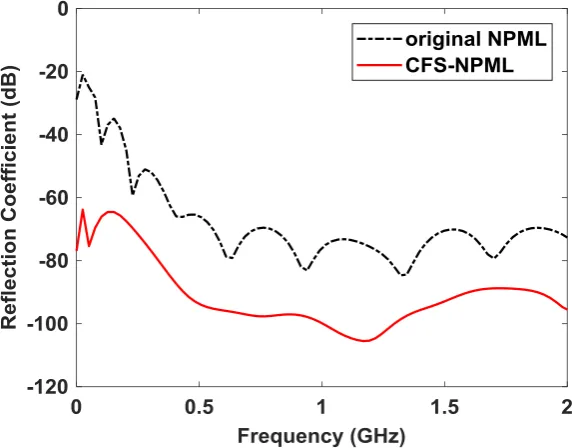
Secondly, we estimate the absorbing performance of the PML by the reflection coefficient in the frequency domain, which is defined as
dB 10
{ ( ) ( )} ( ) 20 log
{ ( )}
T R
z z
R z
FT E t E t R f
FT E t
. (15)
[image:4.595.142.430.475.699.2]computational domain so that the CFS-NPML can truncate arbitrary media without any modification. The results in the numerical test show that the CFS-NPML is more efficient than the original NPML in the absorption of low frequency and evanescent waves and in the reduction of late-time reflections.
Acknowledgement
This research was financially supported by National Natural Science Foundation of China (Grant No. 51877151, 61372011) and Program for Innovative Research Team in University of Tianjin (Grant No. TD13-5040).
References
[1] A. Taflove, S.C. Hagness, Computational Electrodynamics: The Finite-Difference Time-Domain Method, third ed., Artech House, Boston, MA, USA, 2005.
[2] J.P. Berenger, A perfectly matched layer for the absorption of electromagnetic waves, J. Comput. Phys. 114 (1994) 185-200.
[3] W.C. Chew, W.H. Weedon, A 3D perfectly matched medium from modified Maxwell’s equations with stretched coordinates, Microw. Opt. Technol. Lett. 7 (1994) 599-604.
[4] S. A. Cummer, A simple nearly perfectly matched layer for general electromagnetic media, IEEE Microw. Wireless Compon. Lett. 13 (2003) 128-130.
[5] M. Kuzuoglu, R. Mittra, Frequency dependence of the constitutive parameters of causal perfectly matched anisotropic absorbers, IEEE Microw. Guided Wave Lett. 6 (2002) 447-449.