2018 3rd International Conference on Computational Modeling, Simulation and Applied Mathematics (CMSAM 2018) ISBN: 978-1-60595-035-8
Energy Saving Transformation Technology of Green Data Center
Based on Hardware and Software Joint Control
Chun-guang ZHANG
1, Jin-duo ZHAO
1, Ying LI,
2Yun LI
1and Chun-ji HU
11Beijing Guo Dian Tong Network Technology Co., Ltd., Beijing, 100070, China
2State Grid Hubei Information & Telecommunication Company Jingzhou Power Supply Company, Jing Zhou, 434000, China
Keywords: Software and hardware joint control, Green data center, Energy saving transformation, PUE, Data center load.
Abstract. The green data center is based on the infrastructure of traditional data centers and modular data centers. By the way of the optimization of energy efficiency such as IT systems, heating, lighting, and electrical, obtained the maximizes energy efficiency and minimizes environmental impact, by the way of the optimization of energy efficiency such as IT systems, heating, lighting, and electrical. Through the green data center energy-saving transformation technology and based on software and hardware joint control, the data center can meet the characteristics of virtualization, high utilization, green energy, and intelligent security. The use of advanced, targeted energy-saving technologies for traditional data centers for data center software and hardware joint control can effectively reduce data center PUE to meet modern green data center standards.
Introduction
With the in-depth application of information technology in various companies, the company’s business development and daily business activities have become more and more dependent on IT, and the requirements for the security, high-efficiency, energy-saving and stable operation of the company’s information system have become higher and higher. IT management has been it has become the lifeline for companies and companies to maintain their operations and development. In the past, those traditional localized, coarse, and fragmented IT management models have failed to meet the company’s actual needs for security, stability, efficiency, green, and production. This requires IT management to be global, intelligent, and energy-efficient. Refined, streamlined, paradigm shifts to meet business needs and achieve high-quality, high-level IT management models. In recent years, data centers in the world and in China have been booming. The annual power consumption of data centers has exceeded 1.5% of the electricity consumption of the entire society. In most of these data centers, the PUE is generally greater than 2.2, and the international advanced level is widespread. Maintaining around 1.6 or even lower, there is still a big gap compared with the international advanced level. It can be seen that the space for energy-saving transformation is very large. At the same time, data centers will continue to generate large amounts of greenhouse gas emissions, consume large amounts of water resources, and data center equipment will cause greater pollution to the environment after being scrapped. This also gives the natural environment and resources A great challenge has come. With the continuous promotion of technologies such as mobile Internet, Internet of Things, artificial intelligence, cloud computing, and big data over the past few years, China’s data center industry has witnessed rapid development. There are a variety of data center types in China, and the number is increasing. The structure was gradually optimized and the ecosystem was gradually established.
after adopting energy-saving technologies after being put into operation is about 1.5, which can significantly reduce the energy consumption index of the data center. According to relevant statistics, as of the end of December 2017, the total number of green modular data centers that have landed in China has reached about 4,100 sets, with more than 1.2 million servers built, which is almost twice the growth rate from 2016; the market is expected to reach 2018. The total scale will reach 5,200 sets, and the scale of server construction will exceed 1.7 million units.
In order to further promote the sustainable and healthy development of China's data center industry, in January 2013, the Ministry of Industry and Information Technology, together with the National Development and Reform Commission, the National Energy Administration, and other relevant departments, issued the “Guiding Opinions on the Distribution of Data Center Construction”. Proposed the layout orientation, basic principles and safeguard measures that the data center construction should comply with. In February 2013, the Ministry of Industry and Information Technology issued the “Guiding Opinions on Further Strengthening the Energy Conservation and Emission Reduction of the Communication Industry” and proposed the relevant energy saving of the data center. Environmental requirements. At the same time, relevant standards of the Green Data Center have been successively approved and promulgated, and third-party non-governmental organizations have also initiated data center green grading assessments. In order to strengthen the construction of green data centers, we have formulated the “National Green Data Center Pilot Work Program”, which aims to focus on key areas, sub-fields, and steps to improve the energy conservation and environmental protection level of the data center. Since 2013, the Chinese government has issued "Guidelines on the layout of data center construction" and "National Green Data Center Pilot Work Program", etc., which will guide the development of data center industries in the direction of green and energy conservation.
Based on the green energy-saving technological transformation project of a traditional data center in Hubei of the State Grid Corporation of China, this paper analyzes the status quo of the data center and formulates feasible energy-saving technological transformation plans based on hardware and software joint control, making the PUE of this data center the original 2.76 dropped to 1.8. The effect of this technique is very significant, and it has universal promotion. This article will elaborate on the status quo background, technical solutions, results, etc. of the transformation based on this project, which has a good guiding significance for this kind of traditional engine room.
Background Investigation of Energy Saving Reform
State Grid Corporation of China, a data center in Hubei Province (hereinafter referred to as the data center), was established in 2011. The total area of the engine room is 200 square meters, which is divided into three production areas. It is equipped with 40 cabinets and the total number of equipment is 152. The entire equipment room adopts a three-phase and two-way power supply mode, uses precise air conditioning and refrigeration, and adopts ordinary lighting methods. This data center is a full-fledged traditional data center. Before the energy-saving transformation, it will fully analyze the status quo of the data center in all aspects, so as to formulate targeted feasible reform programs through energy-saving technologies.
Infrastructure
are 6 columns of lighting in the information room, 3 columns on the left and right sides, and 4 columns in each. In addition, the power distribution room has 1 lamp, 2 hallways, and 28 storage rooms. The firefighting facilities of the main room are mainly hexafluoropropane gas fire extinguishing devices. A total of 10 launch devices are deployed: 8 in the engine room and 2 in the power room. In addition, four sets of heptafluoropropane fire extinguishers were installed in the four corners of the machine room, and 12 smoke detectors and 3 temperature detectors were installed on the ceiling of the host room; 2 smoke detectors and 1 temperature detector were installed on the ceiling of the UPS room; Walkway to install a smoke detector.
Surveillance System
The power environment monitoring system adopted by the data center can realize on-site real-time monitoring and unified management of power (power supply and distribution, UPS systems), environment (air conditioning, temperature and humidity), and access control security (but not fire) on the engine room site. The monitoring system adopts the B/S architecture. The management personnel can conveniently monitor the information on the site of the information room through the intranet host. The room is equipped with two PTZ cameras and two fixed cameras. The UPS room is equipped with a PTZ camera. When the alarm threshold is reached, an SMS message is sent to the information operation and maintenance personnel's mobile phone. The infrared alarm is used to monitor the access to and from the computer room. The access control system is a fingerprint lock device for the engine room door. The data center room uses HostMon to monitor all the switches and servers in a certain area.
Analysis of Current Situation of Energy Saving Reform
Infrastructure
The computer room adopts a three-phase, two-way power supply mode and two UPSs are configured to operate in parallel. For the concept of energy saving in modern green data centers, more and more high-frequency UPS, modular UPS or high-voltage DC power supply technologies are used. For the data center reconstruction, if you use the 1 way power supply + 1 way uninterruptible power supply with two direct power supply methods, you will further meet the requirements of green energy conservation. For the computer room cooling, the existing computer room still uses the constant frequency electric compressor cooling method, which greatly reduces the use of energy. If more energy-efficient inverter air conditioners are used, not only the energy consumption of the equipment room will be greatly reduced, but also the temperature of the equipment room will be more stable and the local hot spots will be further eliminated.
Surveillance System
Through the background research of the data center, it can be seen that the monitoring of power distribution does not involve air conditioning, lighting, power distribution, PDU, and column heads. There is no corresponding detection and collection for leaks and gases. In addition, many management and control functions such as energy efficiency, operation and maintenance, capacity, and assets are also not available in the monitoring system. The information in all aspects of the equipment room still relies on the traditional way of manual inspection records, which brings many problems to the unified management, operation, maintenance, and operation of the equipment room. Whether from the overall control of the data center or the management of each key facility in the data center, there are different degrees of potential security risks and risks.
Energy Saving Technical Solutions
DCIM System
acquires the monitoring data of each subsystem in real time. Through the monitoring, data processing, analysis, and logical judgment of each subsystem, the above-mentioned each Centralized view of the subsystems, centralized monitoring, centralized alarms, centralized data analysis, and unified operation and maintenance management. Through the transformation of the data center system, the DCIM system can be separately monitored and managed from multiple dimensions such as infrastructure, operation and maintenance, assets, and capacity, and the interconnection of multiple subsystems and infrastructures can effectively control energy
[image:4.595.64.531.194.383.2]consumption and significantly reduce the PUE.
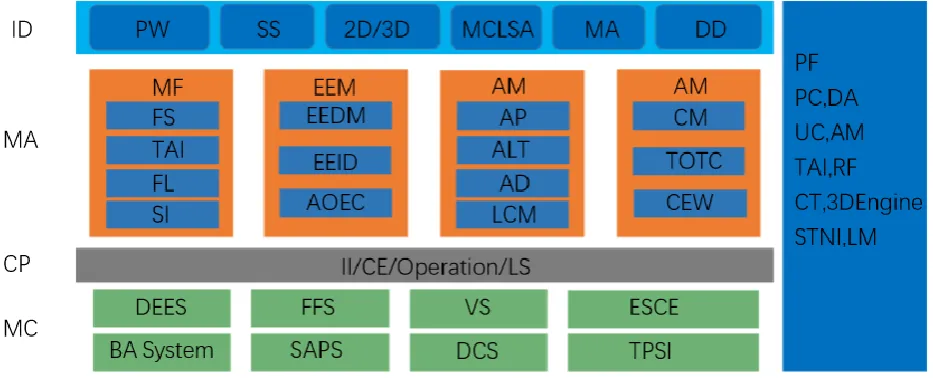
Figure 1. The soft infrastructure architecture of the integrated infrastructure management platform.
As shown in Figure 1, the energy-saving technology transformation for the data center is based on the design of the DCIM system in the operation and maintenance management system. It fully considers the requirements of the data center operation and maintenance plan and provides the above-mentioned overall system function planning architecture. To avoid the waste of data center investment due to system architecture design issues in the later stage. At the same time, the overall system software has the capability of online upgrade online expansion. The system upgrade can be upgraded locally or remotely. It is easy to operate and has backward compatibility in different periods. The top-level architecture design of the infrastructure monitoring and management system fully meets the subsequent capacity expansion and compatibility requirements for this energy-saving technology transformation.
Energy-Saving Control Cabinet
Figure 2. The principle of adjustable cooling technology.
Scroll compressors are two-function equation type lines with moving and fixed scrolls meshing with each other. In the process of suction, compression, and exhaust, the stationary plate is fixed on the frame, the moving plate is driven by the eccentric shaft and is controlled by the anti-rotation mechanism, and the circle rotates around the circle center of the stationary plate. The gaseous refrigerant is sucked into the outer periphery of the stationary disc through the gas filter. As the eccentric shaft rotates, the gaseous refrigerant is gradually compressed in several monthly compression chambers formed by the dynamic and stationary disc phasing, and then the axial hole of the center part of the stationary disc is continuous. Discharge, complete the entire suction, compression and exhaust process, the gaseous refrigerant from low temperature and low pressure
gas into high pressure and high temperature gas, sent to the condenser for heat exchange.
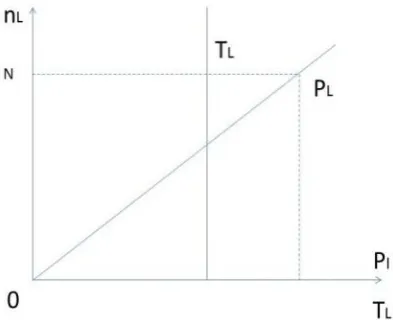
Figure 3. Torque load characteristics.
The DCIM system regulates the speed of the compressor through the energy-saving control cabinet according to the real-time demand of the cooling capacity. The compressor can be similar to a constant torque load. Its characteristics are shown in Figure 3. Its power is proportional to the speed. When the speed of the compressor is reduced, the power is proportionally reduced. For an air-conditioning refrigeration system, reducing the compressor speed will reduce the mass flow of the refrigerant, and the heat transfer efficiency will be improved at the same time, thus improving the cooling efficiency of the air conditioner. In other words, by reducing the speed of the compressor, the same cooling output can be achieved with less power, and the energy saving principle of the energy-saving control cabinet is based on this.
After the completion of the energy-saving transformation, the dominant changes mainly include the following two aspects:
[image:5.595.193.390.411.572.2]caused frequent air conditioner compressor shutdowns; Causes a greater energy waste; after the transformation, the compressor's starting mode becomes a soft start, allowing the compressor to start smoothly according to the set time and let it run at the set frequency. It not only effectively reduces the number of compressor shutdown starts, but also enables the compressor energy consumption to be effectively controlled, which improves the use efficiency of the air conditioner and reduces the operating power consumption.
Figure 4. Renovation of the cooling and start-stop cooling of the pre-air conditioning with electric power P; continuous cooling after P-transformation.
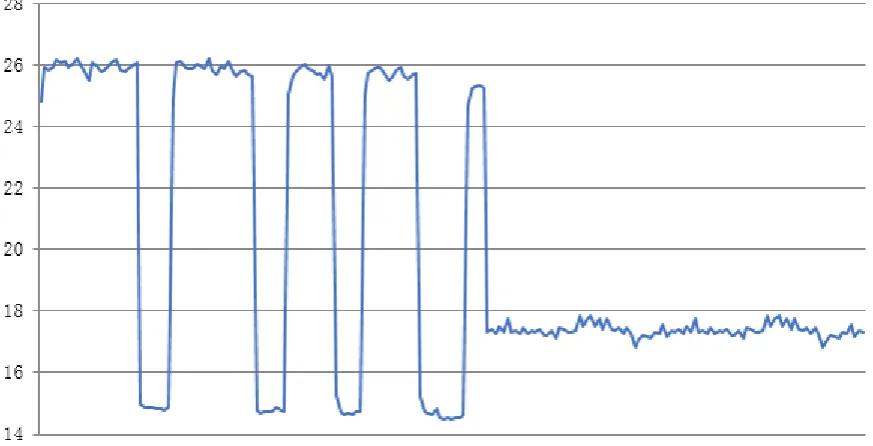
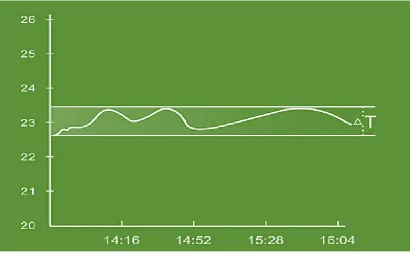
(2) The temperature of the equipment room is more stable, because the precision air conditioning cooling capacity is greater than the IT load of the equipment room, and the air conditioning will achieve the cold and heat balance by stopping the compressor, which will inevitably lead to the temperature fluctuation of the equipment room, which is normally ±2°C of the set point; After the transformation, the cooling capacity is automatically adjusted according to the actual heat load, and the room temperature is more stable with a fluctuation range of ±0.5°C.
Figure 5. Supply air temperature ΔT before transformation = ± 2°C; ΔT transformation after = ± 0.5°C.
EC Fan Retrofit
Four precision air conditioners were deployed in the data center room, and AC fans were used for the fans. The energy-saving technological transformation needs to replace the above-mentioned four sets of precision air-conditioning indoor unit fans with more advanced and more efficient direct-attached EC retro-inclined centrifugal fans. This kind of fan has the characteristics of high efficiency, stable operation, large air volume, large pressure head, etc. It is the most advanced fan for precision air conditioning.
Figure 6. EC fan schematic.
As shown in Figure 6, through the transformation of the EC fan, the efficiency of the air-conditioning fan can be improved, the energy consumption of the fan can be reduced, and energy saving of about 30% can be achieved. After the transformation, the air supply mode of the primary air-conditioning unit will not be changed. The EC fan is safe and stable in operation, which can avoid failures caused by the failure of transmission components such as belts and pulleys, reduce the failure rate, and reduce the maintenance workload.
Outdoor Machine Water Spray Energy-saving Reform
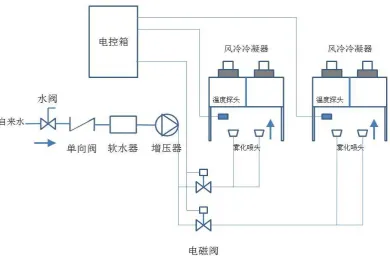
Figure 7. Schematic diagram of soft water spray auxiliary cooling device.
Energy-saving Transformation Implementation Results
Software System
For system-level energy-saving technological transformation, through DCIM infrastructure management and control technology, BPM (Business Process Management) is used to explore the internal data flow and event flow of management technology; then each type of data is analyzed on a type-by-type basis, and the correlation between data is used, and CMDB is used at the same time. Technology, improving the storage and configuration of the entire data stream; then analyzing the processing flow between events through BPM, exploring the mutual influence between multiple events, comparing the internal operation and maintenance team structure of the Group, and creating an adjustable process processing engine. Configure the required process processing functions and tools for the various stages of the event life cycle to complete the full-chain intelligent management and control of cloud data centers. From "people" and "system" as the main body to "system", "Process is the main body".
The following functions can be achieved through intelligent control of the DCIM system:
(1) Integrate the integrated monitoring and control system of the engine room to help the data center managers understand the current operating status of the equipment room in real time, and provide multiple analysis models based on complex event analysis (CEP) to identify meaningful events based on the operation trend of the equipment room. Traceability analysis. Based on historical data, the data analysis module discovers potential problems and analyzes development trends through various analysis algorithms so as to provide early warning, warning, and management decision information. The control strategy provides algorithm support for various automatic control and optimization control, and executes control algorithms to achieve system AI, automation, and intelligence.
assets related to the computer room (inventory assets, on-shelf assets, office assets, etc.) Life cycle management, that is, IT equipment from the purchase, to the shelves, maintenance, warehousing, out of storage, off the shelf, move out of the system are recorded, managed, and provide a comprehensive asset management services for the operation and maintenance personnel to assist the data center Managers accurately understand the matching of assets and capacity, increase resource utilization, reduce operating costs, and provide a basis for future data center planning.
(3) Providing real-time calculation of calculation formulas through a numerical calculation module, including calculation of various virtual measurement points (such as real-time calculation of data center PUE, energy consumption, average temperature, flow ranking, average flow, etc.), and provide all service modules The required data. The system uses graphical tools that allow users to create their own calculation formulas by dragging and dropping various calculation primitives (add, subtract, multiply, divide, etc.), and to use and expand the formulas built into the formula library (such as PUE, CLF, WUE, redundancy, etc.). Comprehensively grasp the state of energy consumption, reasonably allocate energy, establish energy use early warning mechanisms, and continuously optimize energy efficiency through measurement, statistics, analysis, and improvement management techniques. In addition, various energy efficiency information is provided to facilitate the operation and maintenance personnel to take effective measures for energy conservation of the data center according to various data information, thereby effectively reducing energy efficiency indicators such as PUE.
(4) Expand the video, access control management system, operation and maintenance management functions, and 3D visualization functions according to actual needs, and provide a basic platform for the later extension of data center functions.
Hardware Transformation
[image:10.595.108.487.473.675.2]After installing energy-saving control cabinets on the precision air conditioners of existing data center equipment rooms, the original fixed-frequency electric compressor air conditioners were converted into inverter-type compressor air conditioners. As shown in Figure 8, the purpose of reducing energy consumption and PUE is achieved by controlling the down-conversion of the air conditioner.
Figure 8. Schematic diagram of air conditioner operating power.
original ±3.0°C to ±0.5°C. Through the installation of energy-saving control cabinets, according to the measurement display, the value of the PUE of the transformed data center can be reduced by 0.36, which greatly reduces the energy consumption value of the PUE.
Figure 9. Supply air temperature range after energy saving.
Another transformation of the data center is to convert the original AC fan in the data center to an EC fan. The EC fan can greatly improve the efficiency of the motor by 20%-30% from its structural configuration. The modified EC fan will not change the air supply mode of the original air-conditioning unit. The operation safety and stability of the EC fan are also kept at a very high level, and failure accidents caused by the failure of transmission components such as belts and pulleys can be avoided, the failure rate of the equipment is greatly reduced, and the maintenance workload is reduced. After replacing the EC fan, the data center can reduce PUE by approximately
0.1. Finally, through the transformation of outdoor wind condenser water spray cooling
energy-saving technology, so that the original long-term work in high-condensation working conditions of the pressure of the precision air-conditioning refrigeration system, because of its high compressor power consumption, energy consumption. After the atomized water vapor is directly sprayed on the inlet of the condenser fin through the spray nozzle, vaporization and heat absorption of the water vapor can be achieved, the inlet temperature of the condenser is greatly reduced, and the heat exchange efficiency of the condenser is improved, and then Reduces the power consumption of the compressor. The water spray device reduces the inlet air temperature of the outdoor unit, thereby greatly increasing the heat exchange efficiency of the outdoor unit and achieving the effect of energy saving reform. Moreover, the water spray device will not have any negative impact on the power supply and distribution of the equipment room, nor will it affect the normal business production of the equipment room. Through outdoor wind coagulation condenser water spray cooling energy-saving reform, according to the measurement statistics can make the data center PUE reduced by about 0.1.
Outlook and Summary
Humanity has entered the information age, and information and communication technology (ICT) is undergoing a leap forward. This development trend has prompted network service providers to constantly update and upgrade their equipment to meet greater information exchange rates and capacities. This makes the size of the data center more and more like a snowball, and the energy consumption problems that this brings are becoming more and more prominent. The issue of energy consumption has gradually become an extremely critical factor that hinders the development of the Internet [3].
For the green and energy-saving data center, in recent years, it has always been a hot spot for people at home and in the world. In the data center, virtualization has become an important tool for system integration, management, and green energy conservation [4]. Energy conservation technologies such as modularization, new power supply, and new HVAC are always being researched and used for new data centers. For many old and traditional data centers, in order to adapt to the advanced concept of green energy conservation, energy-saving technological transformation for traditional data centers has gradually attracted everyone's attention. The energy-saving technological transformation based on hardware and software joint control has good guidance for a class of traditional data centers that cater to green energy conservation. Most of the traditional data centers in companies can also be based on this energy-saving transformation. Formulate energy saving technology solutions that meet their own characteristics.
For this time, the energy-saving technological transformation of the green data center based on hardware and software joint control is merely combined with the characteristics of the data center itself that was transformed, adopting energy-saving technology solutions that have both feasibility and availability, and taking into account the existing data center. Various limitations. With limited means, the traditional data center room is reduced to the requirements of the green data center room. Because of the limited capabilities of the project team members, there may be deficiencies in the technical plan. Expert readers are also requested to criticize and advise and understand.
Acknowledgments
This research was financially supported by Science and Technology Project of the State Grid Corporation of China (SGGSXT00YJJS1600102) and the State Grid Information & Telecommunication Group Co. Ltd. (SGITG0000KXJS2016040).
References
[1] Fang Xin, Research on Information Maintenance System Based on ITIL [J]. Electronic Technology and Software Engineering, 2015, 4:263.
[2] Li Ke, Integrated Operation and Maintenance under Data Concentration [J]. China Financial Computer, 2015, 2: 69-73.
[3] Gupta M, Singh S, Greening of the internet [C]. Proceedings of the 2003 conference on Applications, technologies, architectures, and protocols for computer communications, ACM, 2003: 19-26.