2018 International Conference on Computer, Communications and Mechatronics Engineering (CCME 2018) ISBN: 978-1-60595-611-4
Study on the Effect of Catalyst PC-41 on the Foaming of
Recycled Polyurethane
Xiao-hua GU
1, Hong-xiang LUO
1,*, Chun-shi WEI
2and Shi-wei LV
11
College of Materials Science and Engineering, Qiqihar University, Qiqihar, China
2
Qiqihar Institute of Engineering, Qiqihar, China
*Corresponding author
Keywords: Polyurethane rigid foam, Trimerization catalyst, Degradation.
Abstract. The waste polyurethane was degraded by diethylene glycol (DEG) and ethanolamine (ETA) to obtain the oligomer polyol. It was used to prepare the regenerated polyurethane rigid foam by a "one-step method".In this study, the effects of 1,3,5-Tris[3-(dimethylamino)propyl] hexahydro-1,3, 5-triazine(PC-41), a kind of trimerization catalyst, on foaming process of waste polyurethane were studied, and the rigid polyurethane foam was prepared by "one-step" foaming method. According to analyzing the effects of PC-41 on foaming time, apparent density, cellular structure and compressive property of the foamed plastics, the results showed that when the addition of PC-41 is 0.5%, the properties of the products were relatively the best, and the environment-friendly polyurethane foam materials with high performance could be prepared.
Introduction
Polyurethane materials are developing rapidly in China, increasing at a rate of 20% to 30% every
year[1,2]. The current annual output has reached more than 20 million tons, and its waste is difficult to
handle, insoluble and infusible[3], which brings a lot of problems to enterprises. At present, Environment-friendly materials and clean energy are the development direction of the emerging materials industry in the future[4]. Hence, the recycling of waste polyurethane products must be carried out.
There are two main reactions in the synthesis of polyurethane foam[5,6]. One is gel reaction, and another is outgassing reaction. Only when the balance between gel reaction and deflation reaction is achieved, the polyurethane foam with good property and well-distributed pore can be obtained.
If the gel reaction speed is so fast that the bubble has not yet grown, the system has been solidified[7]; if the gas production speed is so fast that the polymer is not enough strength to wrap the gas, the gas will quickly escape[8], resulting in collapsing in the foam formation. The catalyst can not only improve the reaction rate, but also achieve the balance between the gel reaction and the outgassing reaction result from changing addition of catalysts. In the synthesis of polyurethane foam, the catalysts of different types have different effects on the foaming performance, especially on the reuse of the degradable materials. In this study, the high-efficiency trimerization catalyst can accelerate the trimerization of isocyanate and shorten the time of foaming.
Materials and Methods
Materials
Waste Polyurethane Rigid Foam; Diethylene Glycol(DEG), Analytical Reagent(AR),Tianjin Kaitong Chemical Reagent Co. Ltd.; Ethanolamine(ETA), Analytical Reagent (AR),Tianjin Chemical Reagent No.1; PC-41, Chemical Pure(CP),Shanghai Demand Chemical Co. Ltd.; Polyether (4110),Chemical Pure(CP), Langfang Quanzheng Chemical Co. Ltd.; polyaryl polymethylene isocyanate(PAPI),Analytical Reagent(AR), Wanhua Chemical Group Co.Ltd..
Instruments and Equipment
Reaction kettle, 5L, Zhengzhou Shangyu Glass Instrument Co., Ltd.; thermostat electric heating set, DRT-TW, Shanghai Baishen Instrument Equipment Co., Ltd.; cantilever type constant speed electric mixer, GZ type, Dongguan Jinpeng Testing Equipment Co., Ltd.; Fourier transform infrared spectrometer, FTS-135, American BJO-RAD Co., Ltd.; rotary viscometer, NDJ-5S, Wuxi Xigong Tools and Measuring Co., Ltd.; universal testing machine, WSM-20KN,Changchun Intelligent Instrument Equipment Co., Ltd..
Testing and Characterization
Fourier transform infrared spectra of samples in KBr pellets were obtained by a spectrometer. The FT-IR spectra were acquired in the wave number range of 400-4000 cm-1.
According to GB/T 6343-1986, the apparent density of the sample was tested after prepared 72 h ago. The results were averaged from five data.
The foam sample was cut into thin slices, and then the microstructure of the foam was observed by a polarizing microscope. The clear and uniform pore structure would be recorded.
According to GB/T 8813-2008, the sample was cut into a cube of 50 mm × 50 mm × 50 mm, and the compression strength test is performed on a universal testing machine.
Experimental Method
The waste polyurethane rigid foam was cleaned ,dried and pulverized, and then it was degraded by diethylene glycol (DEG) and ethanolamine (ETA) at 160℃ for 5h.The obtained degradation product was subjected to treat to obtain a recovered oligomer polyol, which is used to prepare the recycled polyurethane rigid foam by a one-step method. In order to study the effect of PC-41 on the foaming, different amounts of the trimerization catalyst was added.
Results and Discussion
Infrared Spectrum of Products in PC-41 System
Figure 1. Infrared spectrum curve of products in PC-41 system.
It can be seen from the curve c in the fig.1 that the a and b curves are the infrared spectrum of polyether polyols in the reaction. In curve c,O-H vibration absorption peak at 3300 cm-1,and there is a strong absorption peak near 2240cm-1, which is attributed to the C≡N stretching vibration on the PAPI. The stretching vibration peak of the substituted benzene ring at 1522cm-1 is the structural characteristic absorption peak belonging to PAPI. In curve d, the absorption peak representing C≡N is generally disappeared, and the characteristic absorption peak of the O-H of the polyether polyol is also totally weakened, indicating that the O-H in the degradation system reacts with the C≡N in the PAPI system. Therefore, it can be seen that all the polyether polyol and PAPI monomers in the PC-41 system successfully are reacted, indicating that PC-41 has high catalytic activity to promote the polymerization carry out entirely,generating the recycled polyurethane foam with PC-41.
Effect on Foaming Time
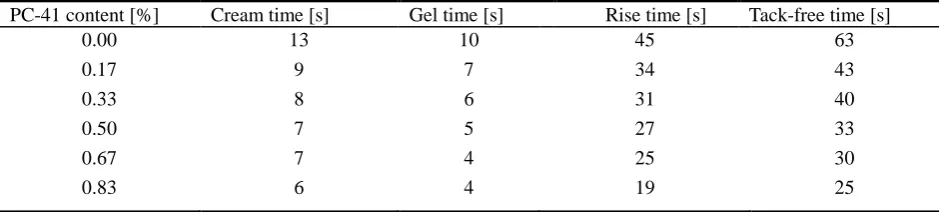
The foaming time mainly includes cream time, gel time, rise time and tack-free time. The results of the foaming time are shown in Table1.
Table 1. Foaming time of foam with different PC-41 content.
PC-41 content [%] Cream time [s] Gel time [s] Rise time [s] Tack-free time [s]
0.00 13 10 45 63
0.17 9 7 34 43
0.33 8 6 31 40
0.50 7 5 27 33
0.67 0.83
7 6
4 4
25 19
30 25
From Table1, we can see that the more PC-41 contented, the less the foaming time is. PC-41 is a kind of trimerization catalyst that can accelerate the trimerization rate of isocyanate and shorten the foaming time.
Effect on Compressive Strength of Foam
[image:3.595.63.534.510.616.2]Figure 2. Effect of PC-41 with Different Contents on Compressive Strength of Products.
As can be seen from Fig.2, with the increasing of PC-41 content, the compressive strength of the products gradually improve. However, when the content of PC-41 exceed 0.5%, the compressive strength begins to decrease. According to the data shown in the figure, when the content of PC-41 is 0.5%, the compressive strength of product is 0.243MPa.
Effect on Apparent Density of Foam
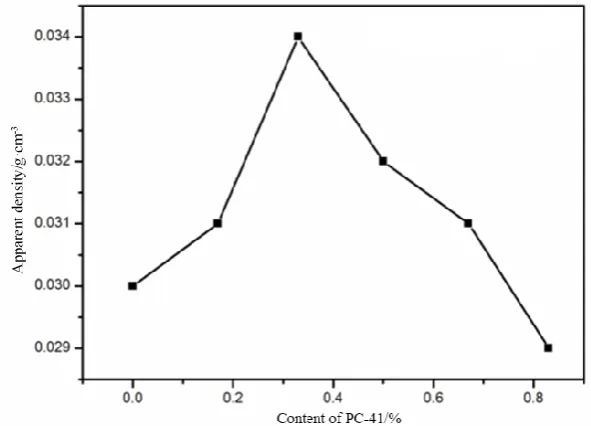
The apparent densities of products with different PC-41 contents is shown in Fig.3. We can see that in a range of the PC-41 content, the apparent density of the foam show an increasing trend. However, when the content of PC-41 exceed 0.33%, the apparent density begins to decrease. When the content of PC-41 is 0.5%, the density of the foam is 0.032g·cm-3.
Figure 3. Density of foam with different PC-41 content.
Effect on Pore Structure of Foam
[image:4.595.149.445.469.682.2][image:5.595.85.516.70.221.2]
(a) Pore structure of foam without PC-41 (× 20) (b) Pore structure of foam with 0.5% PC-41 (× 20)
Figure 4. POM of polyurethane foam of different type.
It can be seen from Fig.4(a), the cell of the foam without PC-41 is smaller. But the one with 0.5% PC-41 has a large cell structure, which is a hexagon. The skeleton is thick and the crosslinked structure is good, indicating that compressive performance of the foam with 0.5% PC-41 is improved. Moreover, we can see that the closed cells are good and the pore film is relatively smooth.
Conclusion
In this work, the foaming of polyether polyol obtained by degrading waste polyurethane was studied by using the trimerization catalyst PC-41. The effects of PC-41 on foaming time, apparent density, compressive property and pore structure of the polyurethane foam were studied to explore its changing regularity and find the optimal foaming formula. The trimerization catalyst PC-41 has great catalysis for the trimerization of isocyanate to form polyisocyanurate. When the content of PC-41 is 0.5%, the compressive strength of the obtained product is 0.243 MPa, which is the best and the apparent density is 0.032 g·cm-3. Therefore, in this study, the recycled polyurethane rigid foam with good performance successfully prepared using the high-efficiency catalyst PC-41.This study is important for theoretical guiding significance and practical reference value for resuse of waste polyurethane.
Acknowledgements
This research was financially supported by Heilongjiang Provincial Department of Education Project (135109214) and Qiqihar Science and Technology Bureau Project (GYGG-201504).
References
[1] Sun Jianhua, Recycling of waste foam polyurethane foam, Chemical Industry Management. 08(2016) 224.
[2] Zhu Gaofeng, Ge Mingqiao, Yu Tianshi. Preparation and characterization of rigid polyurethane foams, New Chemical Materials. 45, 09(2017)207-208.
[3] Ana M. Borreguero, Juan F. Rodríguez, José L. Valverde, Ton Peijs and Manuel Carmona, Characterization of rigid polyurethane foams containing microencapsulted phase change materials: Microcapsules type effect, Journal of Applied Polymer Science.128, 1, (2012)582-590.
[4] Allan Manalo, Structural behaviour of a prefabricated composite wall system made from rigid polyurethane foam and Magnesium Oxide board, Construction and Building Materials.41, (2013)642.
[6] Liping Gao, Guangyao Zheng, Yonghong Zhou, Lihong Hu, Guodong Feng. Improved mechanical property, thermal performance, flame retardancy and fire behavior of lignin-based rigid polyurethane foam nanocomposite, Therm Anal Calorim.13, 120, (2015) 1311–1325.
[7] J.E. Campbell, F. Forte, G.D,Hibbard and H.E. Naguib, Periodic Cellular Metal/Polyurethane Foam Hybrid Materials, Journal of Composite Materials.43, 3, (2009) 207.