R E S E A R C H
Open Access
Positive eigenvector of nonlinear
eigenvalue problem with a singular
M
-matrix
and Newton-SOR iterative solution
Cheng-yi Zhang
*, Yao-yan Song and Shuanghua Luo
*Correspondence:
School of Science, Xi’an Polytechnic University, Xi’an, Shaanxi 710048, China
Abstract
Some sufficient conditions are proposed in this paper such that the nonlinear eigenvalue problem with an irreducible singularM-matrix has a unique positive eigenvector. Under these conditions, the Newton-SOR iterative method is proposed for numerically solving such a positive eigenvector and some convergence results on this iterative method are established for the nonlinear eigenvalue problems with an irreducible singularM-matrix, a nonsingularM-matrix, and a generalM-matrix, respectively. Finally, a numerical example is given to illustrate that the Newton-SOR iterative method is superior to the Newton iterative method.
MSC: 15A06; 15A15; 15A48
Keywords: singularM-matrix; nonlinear eigenvalue problem; positive eigenvector; Newton-SOR iterative solution; convergence
1 Introduction
In research of physics, Bose-Einstein condensation of atoms near absolute zero tempera-ture is modeled by a nonlinear Gross-Pitaevskii equation, see [, ],i.e.,
–u+V(x,y,z)u+ku=λu, ()
lim
|(x,y,z)|→∞u= ,
∞
–∞
∞
–∞
∞
–∞u(x,y,z)
dx dy dz= , ()
whereV is a potential function. The discretization of this equation usually leads to the following nonlinear eigenvalue problem:
Ax+F(x) =λx, ()
whereA∈Rn×nis an irreducibleM-matrix, the functionF(x) is diagonal, that is,
F(x) =
⎡ ⎢ ⎢ ⎢ ⎢ ⎣
f(x)
f(x)
.. . fn(xn)
⎤ ⎥ ⎥ ⎥ ⎥ ⎦,
with the conditions thatxi> andfi(xi) > fori= , , . . . ,n.
In [–], some scholars studied the conditions that the nonlinear eigenvalue problem () with an irreducible nonsingularM-matrix has a unique positive eigenvector, applied the Newton iterative method to solve numerically this problem, and established some sig-nificant theoretical and numerical results. It is shown in [–] that the main contributions were made to the nonlinear eigenvalue problem as follows: (i) any number greater than the smallest positive eigenvalue of the nonsingularM-matrix is an eigenvalue of the nonlin-ear eigenvalue problems; (ii) the corresponding positive eigenvector is unique, and (iii) the Newton iterative method is convergent for numerically solving the positive eigenvector.
However, not all nonlinear eigenvalue problems from the discretization of various Gross-Pitaevskii equations have a nonsingularM-matrix. Maybe some nonlinear eigen-value problems have a singularM-matrix or aZ-matrix. In this paper, we will mainly study the theory and solution of positive eigenvector of nonlinear eigenvalue problem with a singularM-matrix. Some sufficient conditions will be proposed such that the nonlinear eigenvalue problem with an irreducible singularM-matrix has a unique positive eigen-vector. Meanwhile, the Newton-SOR iterative method will be proposed under these con-ditions for numerically solving such a positive eigenvector, and some convergence results on this iterative method will be established for the nonlinear eigenvalue problems with an irreducible singularM-matrix, a nonsingularM-matrix, and a generalM-matrix, respec-tively.
The paper is organized as follows. Some notations and preliminary results as regards M-matrices are given in Section . The existence and uniqueness of a positive eigenvec-tor are studied in Section for the nonlinear eigenvalue problem () with an irreducible singularM-matrix. The Newton-SOR iterative method is proposed in Section for nu-merically solving such a positive eigenvector and some convergence results on this iter-ative method are established for the nonlinear eigenvalue problems with an irreducible singularM-matrix, a nonsingularM-matrix and a generalM-matrix, respectively. In Sec-tion , a numerical example is given to demonstrate the effectiveness of the Newton-SOR iterative method. Conclusions are given in Section .
2 Preliminaries
The following lemmas for theM-matrix are useful and can be found in the literature, see [, , –], we present them here to make the paper self-contained.
Definition A matrixA= (aij)∈Rn×nis callednonnegativeifaij≥ for alli,j∈ n=
{, , . . . ,n}.
We writeA≥ ifAis nonnegative. LetA≥ andB≥, we writeA≥BifA–B≥.
Definition A matrixA= (aij)∈Rn×nis called aZ-matrixifaij≤ for alli=j.
We will useZnto denote the set of alln×n Z-matrices.
Mn,M•n, andM
n will be used to denote the set of alln×n M-matrices, the set of all n×nnonsingularM-matrices, and the set of alln×nsingularM-matrices, respectively. It is easy to see that
Mn=Mn•∪Mn and M•n∩Mn=∅. ()
Lemma (see []) If A∈Mn,then A+D∈M•nfor each positive diagonal matrix D. Lemma (see []) If A= (aij)∈M•n,and B= (bij)∈Znsatisfies aij≤bij,i,j= , . . . ,n,then B∈M•n,and hence,B–≤A–andμA≤μB,whereμAandμBare the smallest eigenvalues of A and B,respectively.In addition, if A is irreducible and A=B,then B–<A–and μA<μB.
Lemma (see []) Let A∈M•nandμbe the smallest positive eigenvalue of A.Then,for anyν≤μ,A–νI∈Mn.
Lemma (see []) Let S:Rn→Rnbe defined and continuous on an interval[y,z]and let
(i) y<S(y) <z; (ii) y<S(z) <z;
(iii) y≤x<x≤zimpliesy<S(x) <S(x) <z.
Then
(a) the fixed point iterationx(k)=S(x(k–))withx()=yis monotone increasing and
converges:x(k)→x∗,S(x∗) =x∗,y<x∗<z;
(b) the fixed point iterationx(k)=S(x(k–))withx()=zis monotone decreasing and
converges:x(k)→x∗,S(x∗) =x∗,y<x∗<z; (c) ifxis a fixed point ofSin[y,z]thenx∗≤x≤x∗;
(d) Shas a unique fixed point in[y,z]if and only ifx∗=x∗.
Definition (see []) A splittingA=M–NofA∈Rn×nis called a regular splitting of the matrixAifMis nonsingular withM–≥ andN≥.
Lemma (see []) If A=M–N is a regular splitting of the matrix A∈Rn×nwith A–≥,
then
ρ M–N= ρ(A
–N)
+ρ(A–N)< .
Thus,the matrix M–N is convergent,and the iterative method of Mxm+=Nxm+k,m≥ converges for any initial vector x.
3 Existence and uniqueness of positive eigenvector
In this section, we study the existence and uniqueness of positive eigenvector of nonlinear eigenvalue problem () with an irreducible singularM-matrix.
Theorem Let A∈M
Proof In (), we letF(x) =D(x)x, where
D(x)=
⎡ ⎢ ⎢ ⎢ ⎢ ⎢ ⎣
f(x)
x · · ·
f(x)
x . ..
.. . ..
. . .. . .. · · · f(xn)
xn
⎤ ⎥ ⎥ ⎥ ⎥ ⎥ ⎦
()
is a positive diagonal matrix forxi> ,fi(xi) > ,i= , . . . ,n. We reformulate () equivalently as follows:
A+D(x)–λIx= . ()
Sinceλ≤ andD(x)is a positive diagonal matrix, it follows from Lemma thatA+D(x)–
λI is an irreducible nonsingularM-matrix. Consequently, () has a zero solution. Thus, equation () has no positive solution forλ≤.
In what follows we study the solution of () whenλ> .
Theorem Let A∈M
nbe irreducible.Ifλ> ,and fi(·) : (,∞)→(,∞)is a Cfunction satisfying the conditions:
lim t→
fi(t)
t = , tlim→∞ fi(t)
t =∞ ()
for i= , . . . ,n,then the nonlinear eigenvalue problem has a positive solution.In addition, if
fi(t) >fi(t)
t , i= , . . . ,n ()
for any t> ,then the positive solution is unique.
Proof SinceAis an irreducible singularM-matrix,μ= is the smallest eigenvalue ofA and there exists a positive vectorp= (p,p, . . . ,pn)Tsuch thatAp= . According to (), takeβsmall enough such thatλ(βpi) >fi(βpi),i= , . . . ,n, and takeβ>βlarge enough
so thatλ(βpi)≤fi(βpi),i= , . . . ,n. This is possible in view of () if and only ifλ∈(,∞). Take a positive numbercsuch that
c>max
≤i≤n
sup
βpi≤t≤βpi
fi(t)–λ, ()
and let
S(x) = (cI+A)–·(c+λ)x–F(x).
To prove existence we show thatS(x) satisfies conditions of Lemma withy=βpand
z=βp. For condition (i) of Lemma , since
S(y) = (cI+A)–·(c+λ)(βp) –F(βp)
in combination with (), we can fully show that
(cI+A)–·c(βp)≤(cI+A)–·
(c+λ)(βp) –F(βp)
≤(cI+A)–·c(βp). ()
Since (cI+A)–·c> , () is equivalent to
βp< (cI+A)–·
(c+λ)(βp) –F(βp)
<βp.
This follows immediately from the choices ofβandβ. The conditions (ii) and (iii) can
be verified in a similar way using the condition in () onc.
Now letx∗andx∗are two fixed points ofS, and <x∗≤x∗. That means
x∗= (cI+A)–·(c+λ)x∗–F x∗, x∗= (cI+A)–·(c+λ)x∗–F(x∗),
or equivalently that
Ax∗+F x∗=λx∗, ()
Ax∗+F(x∗) =λx∗. ()
Let us show that in this casex∗=x∗. Pre-multiplying () and () byxT∗ andx∗T, respec-tively, and subtracting we get
xT∗F x∗=x∗TF(x∗),
or equivalently
n
i=
fi x∗i
x∗i–fi(x∗i)x∗i
= n
i=
x∗ix∗i
fi(x∗i) x∗i –
fi(x∗i) x∗i
= . ()
Sincefi(t) satisfies the condition (),
fi(t) t
=tf
i(t) –fi(t) t >
for anyi= , , . . . ,n. Thus, the functionfi(tt)is monotone increasing, and consequently, for anyi= , , . . . ,n,
fi(s) s <
fi(t)
t , <s<t.
Since all terms in () are nonnegative, the sum is zero if and only if
x∗=x∗.
Remark It is easy to see that the function F(x) = (f(t),f(t), . . . ,fn(t))T in the
Gross-Pitaevskii equation withfi(t) =t fori= , , . . . ,nsatisfies all conditions of Theorem .
Thus, this equation has a positive solution.
4 Newton-SOR iteration of positive eigenvector
The Newton iterative method was applied by Choi, Koltracht, and McKenna in [] to solve numerically the nonlinear eigenvalue problem () with Stiltjes matrices. Later, Choiet al. in [, ] and Liet al.in [, ] used this iterative method to compute this problem with nonsingularM-matrices, and they established some significant theoretical and numerical results. But each step in the Newton iterative method solves one linear system
R xkx=R xkxk–Rxk, k= , , . . . , ()
whereR(xk) =A+F(xk) –λIis nonsingular. IfAis singular or ill-conditioned, the Newton iterative method can perform very bad. Thus, it is necessary to improve this method.
On the other hand, many iterative methods are proposed for linear systems; see [– ]. Among these methods, SOR iterative method is a more effective one. In the following the Newton iterative method will be improved to propose a new iterative method -the Newton-SOR iterative method. Next, -the SOR iterative method will be introduced to construct the new iterative method.
For the linear equations
Ax=b, ()
letA=D–L–U, whereD=diag(a,a,, . . . ,ann), andLandUare, respectively, strictly
lower triangular and strictly upper triangular. We may then write the SOR iteration in the form
xk+= (D–ωL)–( –ω)D+ωUxk+ω(D–ωL)–b, k= , , . . . . ()
The quantityωis called therelaxation factor, and ≤ω≤. Clearly, () reduces to the Gauss-Seidel iteration whenω= . For the equation
R(x) =Ax+F(x) –λx,
[R(x)]–exists ifA,F(x), andλsatisfy the conditions of Theorem , and the fixed point
function of the Newton iteration scheme has the following form:
x=x–R(x)–R(x). ()
From ()
R(x)x=R(x)x–R(x), ()
where
can be decomposed as
R(x) = D+D(x)–λI–L–U,
where
D(x)=
⎡ ⎢ ⎢ ⎢ ⎢ ⎢ ⎣
f(x) · · ·
f(x) . .. ...
..
. . .. . .. · · · fn(xn)
⎤ ⎥ ⎥ ⎥ ⎥ ⎥ ⎦
.
LetDx=D+D(x)–λI. Then
R(x) =Dx–L–U,
whereDx,L, andUare diagonal, strictly lower triangular, and strictly upper triangular matrices, respectively. It follows from the SOR iteration scheme () and the fixed point function () of the Newton iteration scheme that the fixed point function of the Newton-SOR iteration scheme is as follows:
x= (Dx–ωL)–( –ω)Dx+ωU+ω(Dx–ωL)–R(x)x–R(x). ()
Assume thatxkhas been determined. Then the Newton-SOR iteration scheme is given by
xk+= (Dxk–ωL)–
( –ω)Dxk+ωU
xk
+ω(Dxk–ωL)–
R xkxk–R xk, k= , , . . . . ()
It follows from Theorem . in [] that the SOR iterative method converges to the unique solution of () for any choice of the initial guessx()if and only ifρ(H
ω) < , whereHωis
the SOR iterative matrix.
In the remainder of this section, the convergence result of the Newton-SOR iterative method will be established for the nonlinear eigenvalue problem ().
Theorem If A,λ,and F(x) = [f(x),f(x), . . . ,fn(xn)]Tin()satisfy all conditions of
The-orem,thenρ(Hk
ω) < ,where Hωk= (Dxk–ωL)–[( –ω)Dxk +ωU]is the Newton-SOR
it-erative matrix,i.e.,the sequence{xk}generated by the Newton-SOR iterative scheme() converges to the unique solution of()for any choice of the initial guess x().
Proof We only proveρ(Hk
ω) < . According to the Newton-SOR iterative matrix
Hωk= (Dxk–ωL)–
( –ω)Dxk+ωU
,
letMk=Dxk–ωLandNk= ( –ω)Dxk+ωU. ThenHωk=M–k Nkand
Mk–Nk= (Dxk–ωL) –
( –ω)Dxk+ωU
=ω A+D(xk)–λI
=ωR xk. ()
It follows from Lemma thatA+D(x)is an irreducible nonsingularM-matrix, whereD(x) is defined in (). From (),D(x)>D(x), thenA+D(x)>A+D(x). Lemma shows the smallest eigenvalue ofA+D(x)is larger thanA+D(x). The Perron-Frobenius theorem (see Theo-rem . in []) indicates that the positive solution of () exists ifλis the smallest eigen-value ofA+D(x). Lemma shows thatA+D(x)–λIis an irreducible nonsingularM-matrix. So
R xk=A+D(xk)–λI
is an irreducible nonsingularM-matrix, the same forωR(xk). It is easy to see thatD xk–ωL
is an irreducible nonsingularM-matrix, then (Dxk–ωL)–≥. It follows that ( –ω)Dxk+ ωU≥,
ωR xk=Mk–Nk
is a regular splitting of the matrix ωR(xk). It follows from Lemma that ρ(M–
k Nk) =
ρ(Hk
ω) < ,i.e., the sequence{xk}generated by the Newton-SOR iterative scheme ()
con-verges to the unique solution of () for any choice of the initial guessx(). This completes
the proof.
Theorem Let A∈M•n.Ifλand F(x) = [f(x),f(x), . . . ,fn(xn)]T in() satisfy all con-ditions of Theorem ,thenρ(Hωk) < ,where Hωk= (Dxk –ωL)–[( –ω)Dxk+ωU]is the
Newton-SOR iterative matrix,i.e.,the sequence{xk}generated by the Newton-SOR itera-tive scheme()converges to the unique solution of()for any choice of the initial guess x().
Proof Similar to the proof of Theorem , the conclusion of this theorem is obtained im-mediately from Lemma , Lemma , Lemma , and Lemma .
Theorem Let A∈Mn.Ifλand F(x) = [f(x),f(x), . . . ,fn(xn)]T in()satisfy all
condi-tions of Theorem,thenρ(Hk
ω) < ,where Hωk= (Dxk–ωL)–[(–ω)Dxk+ωU]is the
Newton-SOR iterative matrix,i.e.,the sequence{xk}generated by the Newton-SOR iterative scheme ()converges to the unique solution of()for any choice of the initial guess x().
Proof According to (), the conclusion of this theorem is obtained immediately from
The-orem and TheThe-orem .
5 Numerical experiment
Now, we verify the convergence of Newton-SOR iterative solution by a numerically exam-ple. We start with the one-dimensional prototype of the Gross-Pitaevskii equation,
–x(t) +ν(t)x(t) +kx(t) =λx(t), –∞<t<∞, x(±∞) = ,
∞
–∞
Table 1 Iteration number, CPU time, and values ofe(1k)ande(2k)for different values ofω
ω 0.25 1 1.5 2.1 2.45
CPU time 2.5498 0.4931 0.2930 0.1685 0.4252
Iter. 664 137 76 50 103
e(1k) 7.7452×10⁻¹² 3.1752×10⁻¹¹ 4.9257×10⁻¹¹ 1.5896×10⁻¹⁰ 2.5597×10⁻¹⁰
e(2k) 9.9186×10⁻⁷ 8.7991×10⁻⁷ 8.1715×10⁻⁷ 7.6891×10⁻⁷ 8.8627×10⁻⁷
Table 2 Iteration number, CPU time, and values ofe(1k)ande(2k)of the Newton method
Iter. CPU time e(k)1 e(k)2
93 4.5745 4.0768×10⁻¹¹ 8.9977×10⁻⁷
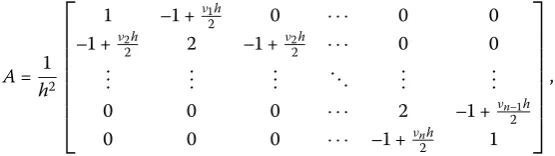
whereν(t) =t. The finite difference method is applied to this equation, which leads to the
matrix of the form
A= h
⎡ ⎢ ⎢ ⎢ ⎢ ⎢ ⎢ ⎢ ⎣
– +νh
· · ·
– +νh
– +
νh
· · ·
..
. ... ... . .. ... ... · · · – +νn–h
· · · – +νnh
⎤ ⎥ ⎥ ⎥ ⎥ ⎥ ⎥ ⎥ ⎦
,
whereνiare the values ofν(t) at the mesh points,his the discretization step-size. When his small enough,Ais a singularM-matrix.
For simplicity, we truncate ton the interval [–., .]. Letn= ,h=n+, andti= +ih,i= , . . . ,n+ . We chose the parameter valuesk= ,λ= ,α= . We begin the iteration with x()=αp, wherepis a positive eigenvector ofA. Let e(k)
=x k–xk–
xk
and
e(k)=Axk+F(xk) –λxk
. The iteration stops whene(k)+e (k)
<ε,ε= –. We adopt the
Newton-SOR iterative method and the Newton iterative method to compute the equation above on a PC computer by Matlab .. The results on performing a numerical experiment are given in Tables and .
The CPU time, iteration number, and values ofe(k)ande(k)of the Newton-SOR method for different values ofωand the Newton method are given in Table and Table , respec-tively. This experiment shows that the Newton-SOR method has the shortest CPU time, the least iterations, and the minimal error whenω= .. By comparing Table and Ta-ble , we find that Newton-SOR has a much shorter CPU time, much less iterations, and much smaller error than Newton iterative method does. It is clearly illustrated that the Newton-SOR iterative method is superior to the Newton iterative method.
6 Conclusions
[image:9.595.136.414.292.370.2]numeri-cal example to illustrate that the Newton-SOR iterative method is superior to the Newton iterative method.
Competing interests
The authors declare that they have no competing interests.
Authors’ contributions
All authors contributed equally to this work. All authors read and approved the final manuscript.
Acknowledgements
The work was supported by the National Natural Science Foundations of China (11601409, 11201362, and 11271297), the Natural Science Foundations of Shaanxi Province of China (2016JM1009) and the Science Foundation of the Education Department of Shaanxi Province of China (14JK1305).
Received: 27 April 2016 Accepted: 7 September 2016
References
1. Parkins, AS, Walls, DF: The physics of trapped dilute-gas Bose-Einstein condensates. Phys. Rep.303(1), 1-80 (1998) 2. Chang, SM, Lin, CS, Lin, TC, Lin, WW: Segregated nodal domains of two-dimensional multispecies Bose-Einstein
condensates. Phys. D, Nonlinear Phenom.196(3), 341-361 (2004)
3. Choi, YS, Koltracht, I, McKenna, PJ: A generalization of the Perron-Frobenius theorem for non-linear perturbations of Stiltjes matrices. Contemp. Math.281, 325-330 (2001)
4. Choi, YS, Koltracht, I, McKenna, PJ, Savytska, N: Global monotone convergence of Newton iteration for a nonlinear eigen-problem. Linear Algebra Appl.357(1), 217-228 (2002)
5. Choi, YS, Koltracht, I, McKenna, PJ: On eigen-structure of a nonlinear map inRn. Linear Algebra Appl.399, 141-155 (2005)
6. Li, YT, Wu, S, Liu, D: Positive eigenvector of nonlinear perturbations of nonsymmetricM-matrix and Newton iterative solution. Appl. Math. Comput.200(1), 308-320 (2008)
7. Li, YT: A generalization of the Perron-Frobenius theorem for nonlinear perturbations ofM-matrix. In: Proceedings of the 14th Conference of the International Linear Algebra Society, July, pp. 159-162. World Academic Union, Edgbaston (2007)
8. Berman, A, Plemmons, RJ: Nonnegative Matrices in the Mathematical Sciences. Academic Press, New York (1979) 9. Ortega, JM, Rheinboldt, WC: Iterative Solution of Nonlinear Equations in Several Variables. Academic Press, New York
(1970)
10. Varga, RS: Matrix Iterative Analysis, 2nd edn. Springer, Berlin (2000)
11. Mathews, JH, Fink, KD: Numerical Methods Using MATLAB, 4th edn. Publishing House of Electronics Industry, Beijing (2002)
12. He, JH: A coupling method of a homotopy technique and a perturbation technique for non-linear problems. Int. J. Non-Linear Mech.35(1), 37-43 (2000)