Journal of Management 1998, Vol. 24, No. 2, 201-233
Examining the Market Orientation-
Performance Relationship:
A Context-Specific Study
K a m a l e s h K u m a r
The University of Michigan-Dearborn Ram Subramanian Grand Valley State University
Charles Yauger Arkansas State University
This study developed a comprehensive measure of market orienta- tion and examined the market orientation-performance relationship in the health care industry. A survey of 159 hospitals yielded a strong posi- tive relationship between market orientation and various measures of organizational performance. Additionally, the study found that market turbulence, competitive hostility, and supplier power moderated the market orientation-performance relationship.
Duncan (1972) defined the environment as consisting of all the relevant physical and social factors outside the boundary of an organization that act as inputs to the organizational decision making process. While initial research (e.g., Tung, 1979) treated the environment as a single monolithic entity, recent studies (e.g., Daft, Sormunen, & Parks, 1988) have stressed the importance of different sectors of the environment, each of which may have a distinct influence on the organization. Recently, researchers (Kohli & Jaworski, 1990; Narver & Slater, 1990) have operationalized market orientation as a proxy for an organization's response to the specific part of the environment that deals with customers and competitors. Empirical evidence suggests that the activities involved in becoming market oriented provide a unifying focus for efforts and projects of individuals within the organization, thereby leading to superior performance (Greenley,
1995a, 1995b; Jaworski & Kohli, 1993; Slater & Narver, 1994; Ruekert, 1992). There are, however, two important unresolved issues in the existing research on market orientation. First, although Narver and Slater's (1990) investigation
Direct all correspondence to: Kamalesh Kumar, Associate Professor of Management, School of Management 4901 Evergreen, The University of Michigan-Dearborn, Dearborn, MI 48128; Fax: (313) 593-5636, e-maih <[email protected]>.
Copyright © 1998 by JAI Press Inc. 0149-2063
202 KAMALESH KUMAR, RAM SUBRAMANIAN, AND CHARLES YAUGER
about the nature of market orientation and its association with performance was a major contribution, their effort to construct a valid and reliable measure of market orientation was only partly successful. Narver and Slater had conceptualized market orientation as a one dimension construct and operationalized it as the sum total of an organization's emphasis on three behavioral components and two deci- sion criteria---customer orientation, competitor orientation, interfunctional coor- dination, long-range focus and profit emphasis. However, in the course of the validation of a five-component market orientation scale, they found that two of the subscales--long-term focus and profit emphasis---did not meet scale reliabil- ity criteria, and therefore, had to proceed with the validation of a three component scale. It was noted (Narver & Slater, 1990, p. 24) that the possible reason for this could be that the items in the two subscales were "insufficient and inappropriate." As such, they could not draw conclusions about the empirical relationship of the two decision criteria with market orientation. However, none of the studies that have followed (Greenley, 1995a, 1995b; Ruekert, 1992; Slater & Narver, 1994) has addressed this concern.
The second issue relates to the equivocality of empirical support for the market orientation-performance relationship. Greenley's (1995a) study that followed the initial work of Narver and Slater (1990) and Kohli and Jaworski (1990) did not find evidence strong enough to support an unequivocal relationship between market orientation and performance. In addition, there are irreconcilable differences in the findings of studies that have examined competitive environment as a moderator of market orientation-performance relationship. Thus, while Day and Wensley (1988) and Kohli and Jaworski (1990) predicted that the relationship between market orientation and performance will be moderated by the competi- tive environment, Slater and Narver (1994) found only limited support for the proposition, while Jaworski and Kohli (1993) found no support at all.
Objectives of the Study
This study had two specific objectives, each designed to contribute to the emerging body of empirical literature on the market orientation and organizational performance relationship. The first objective was to develop a robust and compre- hensive measure of market orientation (especially as it applies to the health care industry). In addition, the relationship of long-term focus and profit orientation components with the three component model of market orientation advanced by Narver and Slater (1990) was also examined. The second objective of the study was to examine the market orientation-performance relationship in a context specific setting of the health care industry, thus controlling for industry effects (Dess, Ireland, & Hitt, 1990), an aspect ignored in prior studies. The study also sought to identify control variables and moderator variables that are unique to the hospital industry, and could affect the market orientation-performance relation- ship. Also, for assessing organizational performance, in addition to the measures of performance used in previous studies, performance criteria specific to the health care industry were examined.
MARKET ORIENTATION-PERFORMANCE RELATIONSHIP 203
The choice of the health care industry as a setting for this research was considered particularly appropriate for three important reasons. First, it has been noted that the health care industry accounts for over 12% of our national GNP and, thus, warrants serious attention from management scholars (Blair and Boal, 1991). Second, in recent years, the health care industry has gone through what many observers feel are "quantum changes" (FoUler, 1987, p. 367), and these changes have resulted in a shift from,"...health care as a social good to health care as an economic good, from a production orientation to a marketing orientation..." (Shortell, Morrison, & Robbins, 1985, p. 219). These changes have also affected industry profitability. Vogel, Langland-Orban, and Gapenski (1993) report that while the average operating profit margin for hospitals was around 2% in 1984, it declined to -0.2% in 1990. A 1990 survey by Deloitte and Touche reported that 43% of 1,765 responding hospital executives believed that their hospitals could fail within five years (Cleverley and Harvey, 1992). Given this industry environ- ment, one would expect to see varying degrees of market oriented behaviors among different hospitals, providing the right research setting for examining the market orientation-performance relationship. Finally, as strategic planning is becoming more common in the health care industry (Subramanian, Kumar, & Yauger, 1993), the applicability of findings generated in general management contexts to the health care industry has come under close scrutiny. A number of researchers (e.g., Fottler, 1987; Luke, Begun, & Pointer, 1989; Blair & Boal, 1991) have questioned the external validity of generic management findings to the health care sector on the basis of such factors as the difficulty of defining and measuring output and the complexity of the political, legal, and financial environ- ments confronting these organizations (for a full review, see Blair and Boal, 1991).
By examining the market orientation-performance relationship in a "context- specific" setting using a large number of hospitals as the sample, the present study would not only extend the generalizability of findings generated in "context-free" (Blair & Boal, 1991) situations, but also provide evidence for the applicability of an important strategic management and marketing concept to the field of health care management. The importance of market orientation to business performance has been underscored in the strategic management and marketing literatures for long; ascertaining its applicability to health care organizations should provide important pointers to health care professionals as they try to make their organiza- tions more effective and efficient.
The Market Orientation Literature and Hypotheses Development
The Market Orientation Construct
A market oriented organization considers itself an "open system," in that it emphasizes interaction with the environment as essential for its functioning (Scott, 1992). This is in contrast to an organization that is oriented to internally driven optimization and, thus, seeks to defend itself against the environment/ More specifically, market orientation involves generation and dissemination of market intelligence that is composed of information about the external environ-
204 KAMALESH KUMAR, RAM SUBRAMANIAN, AND CHARLES YAUGER
ment confronting an organization, sharing of this information among all functions in an organization and rapid managerial action in response to this information. An organization, that is market oriented also possesses a strong long-term orientation to ensure that preferences of current and potential customers are identified, as also the ability of current and potential competitors to satisfy these preferences. Finally, a market oriented organization also exhibits a determined orientation toward profitability to ensure that the resources necessary to support the informa- tion collection, dissemination, and organizational response activities are available (Kohli & Jaworski, 1990; Narver & Slater, 1990).
The use of intelligence--gathering and acting on it--is the key to market orientation. To be market oriented, an organization has to communicate, dissemi- nate, and oftentimes "sell" market intelligence to relevant departments and indi- viduals in the organization. The market oriented organization also has to respond to or act on the market intelligence gathered and disseminated. An organization's degree of market orientation, therefore, would depend on the extent to which it successfully gathers information about competitors and customers, disseminates this information to relevant organizational units, and responds and acts on the information gathered and disseminated. Market orientation is more than a bound- ary-spanning activity. Boundary-spanning theory suggests that certain individuals in organizations acquire information from external sources and subsequently disseminate this information to others in the organization, thus playing a "gate- keeper's" role (Culnan, 1983). Market orientation, on the other hand, goes beyond the information collection and dissemination activities of boundary-spanners to include acting on the information to provide value for the customer and, thus, obtain a sustainable competitive advantage.
Conceptualized this way, market orientation can be viewed as a continuous, rather than a dichotomous, either-or construct. In other words, organizations may differ in their degree of market orientation depending on their extent of orientation toward different dimensions (activities associated with) of market orientation. Because of the close conceptual linkage among the different dimensions of market orientation, both Narver and Slater (1990) and Kohli and Jaworski (1990) treated market orientation as a single construct composed of different dimensions. These dimensions consist of sets of coherent organizational activities that are different, yet synergistically dependent on each other. Narver and Slater make this point well, "...for a business to maximize its long-run profit, it must continuously create superior value for its target customers. To create continuous superior value for customers, a business must be customer oriented, competition oriented, and inter- functionally coordinated" (p. 22-23). Given the fact that an organization's degree of market orientation is the synergistic outcome of a number of activities conducted in unison, with each contributing separately and in combination with others, to the creation of superior value for customers, it appears best to theorize about market orientation as a single construct, rather than theorize about each of its dimensions. It is the collective nature of different activities involved in becom- ing market oriented that contributes to the creation of superior customer value and, hence, to a sustainable competitive advantage. Examined individually, these activities are likely to be of far less significance. One could even argue that exam-
MARKET ORIENTATION-PERFORMANCE RELATIONSHIP 205
ining market orientation in terms of distinct dimensions would shift attention to such individual activities that may have little independent relevance for creating superior value for customers, and hence could lead to misguided efforts and resources. As a complex construct, market orientation represents a holistic config- uration of multiple unidimensional constructs (Doty & Glick, 1994); therefore, conceptualizing it as a singular construct, and examining its attributes together, would be both theoretically justified and empirically desirable. Nonetheless, the current study did not automatically take the singularity assumption of market orientation as a given. Rather, it first sought to statistically test this assertion before proceeding with the analyses.
Research suggests that market orientation is a means of obtaining a sustain- able competitive advantage (Jaworski & Kohli, 1993; Slater & Narver, 1994; Greenley, 1995a, 1995b). This is achieved through the creation of superior customer value. A firm with high degree of market orientation, thus, continuously examines alternative sources of sustainable competitive advantage to determine how it can be most effective in creating superior value for its present and future target customers. Strategic management literature has clearly established that organizations obtain sustainable competitive advantage if they create sustainable superior value for their customers (Aaker, 1989). For example, Hitt, Ireland, and Hoskisson (1995) contend that a firm has a sustainable competitive advantage when it "implements a value-creating strategy that current and potential competi- tors are not simultaneously implementing and when other companies are unable to duplicate the benefits of its strategy" (p. 5). According to Deshpande and Webster (1989), the desire to create superior value for customers, and thus obtain a sustain- able competitive advantage, forces a firm to create and maintain a culture that will produce the necessary behaviors in its employees.
A more explicit link between customer value and sustainable competitive advantage is posited in the marketing literature (e.g., Forbin & Mehta, 1981; Zeithaml, 1988). Since a seller, any seller, has myriad alternative opportunities for creating buyer value through increasing a buyer's benefits and/or decreasing a buyer's total acquisition and use costs, a business has to create and maintain the culture that will produce the necessary behaviors to create superior value for customers. The activities associated with becoming market oriented require behaviors necessary for the creation of superior value for buyers and, thus, contin- uous superior performance for the business.
Operationalization of the Market Orientation: Literature Review
Based on an extensive review of the literature on sustainable competitive advantage (e.g., Porter, 1980; 1985) and strategic marketing (Kotler, 1984; Levitt, 1960), Narver and Slater (1990) concluded that market orientation consists of three behavioral components--customer orientation, competitor orientation, and interfunctional coordination--and two decision criteria--long-term focus and profit emphasis. They conceptualized an organization's degree of market orienta- tion as the sum total of its emphasis on these five components. Elaborating on the components of market orientation, Narver and Slater noted that customer orienta- tion and competitor orientation include all the activities involved in acquiring
206 KAMALESH KUMAR, RAM SUBRAMANIAN, AND CHARLES YAUGER
information about the buyers and competitors in the target market and disseminat- ing it throughout the business(es). Interfunctional coordination is based on the customer and competitor information, and comprises the business's coordinated efforts, typically involving more than the marketing department to create superior value for the buyers. The organization also needs to prevent its competitors from overcoming the buyer value superiority it has created; hence a long-range invest- ment perspective is implied in market orientation. Finally, profitability ensures resources necessary to pursue a market orientation. For non-profit organizations, an analogous objective would be survival and growth.
Using both a literature review as well as field interviews of 62 managers in four U.S. cities, Kohli and Jaworski (1990) operationalized the market orientation construct as consisting of three basic components: intelligence generation, intelli- gence dissemination, and responsiveness. Intelligence generation extends beyond collecting information about customer needs and preferences to include informa- tion about the entire task environment confronting an organization. While Narver and Slater (1990) defined the market orientation construct by explicitly including two stakeholder groups---customers and competitors--in a firm's environment, Kohli and Jaworski (1990) include just the customer element of a firm's environ- ment in their version of the market orientation construct. However, in their opera- tionalization of the market orientation construct, monitoring customers is a broad- based activity that includes "monitoring... competition that influence the needs and preferences of customers" (1990, p. 4). According to Ruekert (1992), "the difference between these two approaches to defining the construct rests more on emphasis than on substantive differences " (p. 229).
Market Orientation and Performance
A number of studies using samples of U.S. companies (Narver, & Slater, 1990; Kohli, & Jaworski, 1990; Ruekert, 1992) found unequivocal support for a positive relationship between market orientation and performance. Performance measures used in these studies ranged from hard measures such as market share, return on equity, and return on assets to soft measures including organizational commitment and esprit de corps. However, a non-U.S, study (Greenley, 1995a) did not find evidence strong enough to unequivocally support the market orienta- tion-performance relationship. The Greenley (1995a) study found market orienta- tion to be a predictor of performance only under certain environmental conditions (tested through the presence of environmental moderator effects).
Although results of the non-U.S, study do introduce the element of equivo- cality, in the absence of any conclusive evidence, it appears reasonable to extend the positive relationship between market orientation and performance established in the general industry context to the hospital sample. The rationale for this comes from the link between market orientation and sustainable competitive advantage. As suggested by Narver and Slater (1990), a market oriented firm recognizes that there are numerous ways by which additional benefits can be created for the buyer of the firm's products (or services), as well as different ways by which the buyer's acquisition costs can be reduced. A market oriented firm, thus, continuously examines these alternate sources of sustainable competitive advantage and adopts
MARKET ORIENTATION-PERFORMANCE RELATIONSHIP 207
the most suitable one. This quest for and ultimate fulfillment of customer needs translates into superior performance by the market oriented f'Lrm.
Performance Measures
Earlier studies have primarily examined three performance criteria, return on asset (ROA)/return on investment (ROI), new product success, and sales growth when examining the market orientation-performance relationship. The use of accounting-based performance measures have been criticized in the literature (e.g., Montgomery & Wilson, 1986). The use of ROA/ROI and sales growth is, however, justified on the ground that they measure important aspects of perfor- mance. ROA/ROI is the earnings stream that is at the disposal of the finn as a percentage of assets (or equity) employed to earn the return. Sales growth is a measure of the firm's size and its ability to support increases in operating and other expenditures. In the specific context of market orientation, the success of new products/services indicates how well the organization has combined the information collection and dissemination activities to provide an organizational response in the form of new products that customers want and that competitors cannot offer at all, or offer only at a higher cost/benefit ratio. Based on the adapta- tion of these performance criteria to correspond to the health care industry context, it is predicted that:
H l a : Market orientation will be positively associated with return on assets.
H l b : Market orientation will be positively associated with growth in revenue.
H i e : Market orientation will be positively associated with success of new services~facilities.
Although the three measures of performance noted in the hypotheses above may be adequate to test the market orientation-performance relationship in the general industry context, this may not be so in the specific context of the health care industry. Two reasons account for this. One is that players in the health care industry come from both for-profit and not-for-profit orientations, thereby limit- ing the use of profitability measures to compare performance. The second reason is that there is a compelling need for health care managers to focus on both effi- ciency and effectiveness in order to satisfy the demands of the myriad stakehold- ers (Fottler, 1987). Efficiency is important since "competition for patients has been intensifying, and much of the future health care business will be determined through competitive bidding" (Fottler, 1987, p. 373). Effectiveness is important to elicit and retain economic and political support for the organization from external and internal stakeholders (Fottler & Lanning, 1986).
To test the market orientation-performance relationship among hospitals in a comprehensive and industry-relevant way, this study employed two additional performance criteria. First, a hospital's ability to control operational expenditures
208 KAMALESH KUMAR, RAM SUBRAMANIAN, AND CHARLES YAUGER
was used as the surrogate measure of efficiency. A market oriented hospital is expected to use its market information to achieve operating efficiency because it is likely that such a firm understands that value can be created for buyers not only by additional benefits to them but also by reducing their acquisition and use costs. Internal efficiency is, thus, the springboard to reducing the cost of the service to buyers. Second, ability to retain patients, which is a function o f clinical quality, patient satisfaction, and employee attitudes and behavior, was used as the other performance criteria. As noted earlier, effectiveness in this category is critical because continued economic and political support for a hospital considerably depends upon the hospital's success in satisfactorily meeting the expectations of stakeholders on these measures (Fottler, 1987). A market oriented hospital by virtue of knowing what patients want and preparing the organization to act on patients' needs is expected to be highly effective on this performance measure. It is, therefore, further hypothesized that:
H i d : Market orientation will be positively associated with success in controlling operational expenses.
H i e : Market orientation will be positively associated with success in retaining patients.
Controlling for Other Influences on Performance
The strategic management literature has identified a number of situational variables that affect an organization's performance (Aaker, 1988; Bain, 1959; Day, 1984). These variables must be controlled for in analyzing the effect of market orientation on organizational performance. Based on a review of the health care strategy literature (e.g., Fottler, 1987; Topping & Hernandez, 1991; Blair & Boal, 1991; Zallocco & Joseph, 1991), four control variables specific to the health care industry were identified. These were: hospital size, profit orientation, loca- tion, and age. It is argued that each one of these variables can influence a hospi- tal's performance, and, therefore, needs to be controlled for in examining the effect of market orientation on hospital performance.
Prior research indicates that larger organizations have better technological, human, and financial resources to pursue market oriented strategies (Liu, 1995). In addition, the size of a hospital may help it to obtain economies of scale in vari- ous activities, thereby positively affecting its performance (Scherer, 1980). In terms of profit orientation, hospitals were classified as either for-profit or not-for- profit. Profit orientation was controlled for since it affects the ability of the hospi- tal to obtain resources (Fottler, Blair, Whitehead, Laus, & Savage, 1989) and, hence, could be critical in determining the extent to which it can pursue market orientation. For example, while for-profit hospitals can obtain capital from the public, not-for-profit hospitals have a more constrained set of sources of capital. Also, as Autry and Thomas (1986) note, "investment monies for non-profit hospi- tals in some areas are shrinking in this time of governmental retrenchment and budget cutting" (p. 10). In addition, management constraints vary greatly between for-profit and not-for-profit hospitals (Fottler, 1987). The location of a hospital
MARKET ORIENTATION-PERFORMANCE RELATIONSHIP 209
may have an impact on the nature of the competitive environment being faced by different hospitals. Competitive rivalry may be more intense in large urban loca- tions, which may adversely affect the performance of hospitals in these areas. On the other hand, hospitals in small rural areas may have little or no competition, which in turn could contribute to the superior performance by these hospitals. The last control variable was the age of the hospital. The health care strategy literature (e.g., Topping & Hernandez, 1991) identifies age as a factor that influences the type of strategy pursued by the organization. Since the degree of market orienta- tion reflects the strategic orientation of an organization (Narver & Slater, 1990), it was deemed necessary to control for the age of hospitals in examining the market orientation-performance relationship.
Moderators of Market Orientation-Performance Relationship
The strategic management literature has long espoused support for the exter- nal environment playing a moderator role in the organization-performance rela- tionship (e.g., Snow & Hrebiniak, 1980; Hambrick, 1983). Prior studies on the market orientation-performance relationship have identified a number of variables that are likely to moderate this relationship (Day & Wensley, 1988; Kohli & Jaworski, 1990; Slater & Narver, 1994). These variables include: market growth, buyer power, competitor concentration, competitor hostility, market turbulence, technological turbulence, and supplier power. Market growth refers to the demand for an industry's products or services; buyer power is the ability of powerful buyers to exert pressure on sellers or force sellers to provide higher quality goods or services; concentration refers to the number of competitors; competitor hostil- ity deals with the breadth and aggressiveness of competitive actions; market turbulence relates to the number of customers and the stability of their prefer- ences; technological turbulence refers to the change in the way the transformation process takes place in the industry; and supplier power is the degree to which a supplier can negotiate higher prices, or a higher value from its buyer.
The current study identified competitive hostility, market turbulence, and supplier power as moderators of the market orientation-performance relationship in the health care industry. Some variables (e.g., technological turbulence) were omitted, not because they were unimportant, but because they were not relevant to a single industry study. Other variables were considered less appropriate for use in the present study because of the nature of the industry. For example, the matura- tion of the hospital because of market saturation and slower growth (Zallocco & Joseph, 1991) reduces the importance of market growth as a moderating variable, while the easing of entry barriers have made this a fragmented industry (Autry & Thomas, 1986), thereby downplaying the importance of competitor concentration. On the other hand, the variables that were included in this study form a parsimoni- ous group that moderates the market orientation-performance relationship in the specific context of the health care environment. Industry-specific rationale for including these variables, and their hypothesized effect on the market orientation- performance relationship are discussed below.
Competitive forces play a critical role in strategy formulation in health care organizations. The orientation of competition determines goal selection (Kralewski,
210 KAMALESH KUMAR, RAM SUBRAMANIAN, AND CHARLES YAUGER
Gifford, & Porter, 1988). Also, as the competitive intensity increases, hospitals are forced to initiate adaptive responses (Carter, 1"990), otherwise it may lead to the fail- ure of the hospital (Amould & DeBroek, 1986). As the environment of an organi- zation moves from a "placid, cloistered state...to a more competitive, turbulent state" (Autry & Thomas, 1986, p. 7), there may be a more compelling necessity to keep better track of what competitors are doing. Acquiring superior information about the competition may provide managers with information that other organiza- tions miss, thereby giving the organization an information advantage (Dutton & Freedman, 1984). Thus, in a hostile competitive environment, a market oriented organization has the infrastructure to monitor competitors' moves and countermoves and quickly act in response to such moves. In a more benign environment, on the other hand, there may not be a great necessity for such a posture because of the dearth of competitor actions. Therefore, it is hypothesized that:
H2: The greater the competitive hostility, the greater the positive impact of market orientation on performance.
Market turbulence in the context of the health care industry relates to changes in the number and preferences of the buyers of health care services (government, employers, and third-party payers). In recent years, hospitals have witnessed numerous changes in this respect, such as encouragement of competi- tion by the Federal government, increased cost consciousness of buyers, and a prospective pricing system for Medicare reimbursements, all of which have added to the turbulence of the health care market (Fottler, 1987, p. 367). Recent studies have also noted that market turbulence is a key driver of hospital strategy forma- tion (e.g., Conrad,'Mick, Madden, & Hoare, 1988), as hospitals have tried to become more effective and efficient. It is, therefore, hypothesized that:
H3: The greater the market turbulence, the greater the positive impact of market orientation on performance.
Suppliers to the hospital industry, which include physicians, nurses, and other service providers, in addition to suppliers of capital equipments and consumable goods, form a powerful stakeholder group affecting hospital perfor- mance (Autry & Thomas, 1986). Physicians pose a credible threat of forward inte- gration and the "turbulent nature of the industry...increases the potential for new alignments between physicians and hospitals" (Autry & Thomas, 1986, p. 10). Notwithstanding the shifting balance of power from physicians to managers, physicians, through their clinical decision making, may account for more than 70% of the organization's activities and costs (Shortell, Morrison, & Robbins, 1985). Thus, the impact of market orientation may be limited by the possibility that a hospital may not be able to act on customer information because of the powerfulness of the supplier group. Therefore:
H4: The lesser the supplier power, the greater the positive impact of market orientation on performance.
MARKET ORIENTATION-PERFORMANCE RELATIONSHIP 211
Method
Sample
The sample for this study was randomly drawn from the American Hospital
Association Guide to the Health Care Field which provides a sampling frame of all U.S. hospitals. A pre-notification letter was first mailed to chief administrators of 600 hospitals informing them of the study being conducted and its importance to academicians and health care professionals. Two weeks later, a questionnaire titled "Business Practices Survey," together with a personal letter, was mailed to the same 600 chief administrators. In the letter, respondents were told that the aim of the survey was to investigate current business practices, and the importance of certain performance criteria among hospitals. Respondents were assured of anonymity. A total response of 171 (28.5%) was obtained, yielding a usable response of 159 fully completed questionnaires.
The profile of the sample organizations shows a reasonable spread of hospi- tals based on profit orientation, size, location, and age. Thirty-four percent of the hospitals that responded were non-profit organizations, 66% were for-profit. In terms of location, 35% of the hospitals were located in towns of less than 100,000 people, 28% in towns of over 100,000 people, 21% in the suburb of a large city, and 16% in large cities. More than half (55%) of the hospitals that responded were over 25 years old, 31% were between 11 and 24 years old, and 14% were less than 11 years old. Finally, 37% of the hospitals were small independent hospitals, 15% were mid-sized independent hospitals, 9% were large independent hospitals, and 39% were part of a larger system of hospitals.
In the absence of secondary data, with which the sample for this study could be compared to ensure its representativeness, sample bias was assessed using the time-trend extrapolation test (Armstrong & Overton, 1977). The assumption nndedying this test is that non-respondents are more like late respondents than early respondents. No differences were apparent between these two groups (early respondents and later respondents) in terms of size (F = .15, p > .70), location (F = 1.79, p > .18), age (F = 3.62, p > .06), and profit orientation (F = .03, p > .87).
Developing a Comprehensive Measure of Market Orientation
The contents of the revised market orientation scale included the same five components identified by Narver and Slater (1990). However, the process of refinement and revalidation for the health care industry required modifications in the wording of the scale items developed by Narver and Slater (1990). Also, the component of profit orientation was expanded to include survival and growth. This was deemed necessary because a significant number of hospitals are non- profit organizations. For non-profit organization,s survival and growth are analo- gous to profitability in for-profit organizations (Kottler & Andreasen, 1987). In effect, the profitability dimension for non-profit organizations includes efforts to have sufficient revenues to cover long-run expenses and to be able to grow over the long-run. New items that were added to the scale reflect such objectives as
212 KAMALESH KUMAR, RAM SUBRAMANIAN, AND CHARLES YAUGER
earning revenues sufficient to cover long-range expenses and timely payback of new services/facility. New items were also included in the scale designed to measure long-term focus. These items related to the objectives of satisfying key constituents, overcoming deficiencies in services, and discovering new values for patients.
The revised scale had a total of 25 items, 5 each for interdepartmental coordi- nation, long-term focus, and survival and growth/profit emphasis, 6 items for customer orientation, and 4 items for competitor orientation. Respondents were asked to respond on a 7-point Likert-type scale where 1 indicated that their orga- nization did not engage in the practice described by the item at all, and 7 indicated that their organization engaged in the practice to a great extent.
Validity of Market Orientation Scale
The validity of an instrument refers to the effectiveness with which the instrument measures what it was designed to measure. There are three general approaches to validity: content validity, construct validity (convergent and discriminant validities), and concurrent validity (Kidder & Jude, 1986).
Content validity. Content validity assesses whether the substance of the items included in the instrument tap the construct that is being measured. It also indicates whether the scale items are representative of the content area. Most of the items (16 out of 25) included in the revised scale were those validated by Narver and Slater (1990). However, wordings of the items were modified to make them oriented toward the health care industry. The new items included in the long-term focus and survival and growth/profitability emphasis were derived directly from the literature on sustainable competitive advantage (e.g., Porter, 1980; Kotler, 1984) and strategic management of health care organizations (e.g., Blair & Boal, 1991; Fouler, 1987). Although content validity was not a major concern, it still remained an issue. To establish this aspect of validity, the measure was submitted to a panel consisting of two academicians with active research interest in the fields of strategic management and health care, and an academician who had worked as a health care professional for a number of years. Panel members were asked to comment on the clarity of the items and their relevance and appropriateness to the health care industry. Based on their comments, changes were made in the wordings of some items.
Construct validity. For determining the construct validity, the market orientation scale was tested for both convergent and discriminant validity (Cron- bach & Meehl, 1955). If the pattern of correlations among variables confirms to what is theoretically predicted, evidence of construct validity is present (Ghiselli, Campbell, & Zedeck, 1981; p. 281).
Evidence of convergent validity of the market orientation scale was examined through factor analysis and simple correlations among the five components of the scale. Although Narver and Slater (1990) hypothesized market orientation as a one- dimension construct since its five components are conceptually closely related, they could not provide conclusive evidence in this regard. As such, the revised and expanded 25 item market orientation scale was first subjected to factor analysis.
MARKET ORIENTATION-PERFORMANCE RELATIONSHIP 213
Since the general nature of the factors was already outlined, a confirmatory factor analysis was performed. The procedure employed was maximum likelihood, which is noted as the most common of the confirmatory factor analytic procedures (Joreskog, 1971). Both orthogonal and oblique rotations were performed and solu- tions were compared to identify the simpler structure (Carroll, 1953). Results of factor analyses indicated that differences in rotation techniques had little bearing on the results of the analysis. The factor analysis procedure using maximum likelihood and oblique rotation provided a five-factor solution which explained 70.5% of the variance. The eigenvalues associated with each of the five factors was greater than 1.00. The value of Bartlett' s test for sphericity was 2,853.73 (significance .000). The Kaiser-Meyer-Olkin measure of sampling adequacy was .90, which is very high (Kaiser, 1974). Results of factor analysis are reported in Table 1. The five-factor solution found in this study is different from the results reported by Narver and Slater (1990). In their exploratory factor analysis, Narver and Slater (1990) had found a one factor solution explaining 44.8% of the variance. It is, however, impor- tant to note that even in this study the first factor had a very high eigenvalue (10.51) and explained 42.2% of the variance.
Since the five factors identified through factor analysis consist of activities that have been theorized to be synergistically dependent and linked to the common construct of market orientation, one would expect them to be correlated with each other and with the overall construct of market orientation (sum of five components). Results reported in Table 2 show that the correlations among the five components of market orientation ranged from .42 to .67, and all correlations were significant at p < .01. Each of the factors was also highly correlated (.74 and above) with the overall measure of market orientation. The pattern of correlations among the five component conforms to what was theoretically predicted, thus providing evidence of convergent validity.
To test if the singularity assumption about market orientation was valid, separate regressions were run with the five dimensions of market orientation iden- tified through factor analysis as independent variables and different performance measures as dependent variables. The five dimensions exhibited a substantially similar pattern of effects, in that standardized beta coefficients of the five dimen- sions of market orientation were significant for different performance measures. Also, each dimension of market orientation contributed independently (m_ easured by r 2) to different performance measures only to a modest degree (r e ranged between .02 and. 10). However, when taken togethe, their contribution to various performance measures was substantial (r 2 ranged between .14 and .28). These results, together with the conceptual justifications provided by previous research- ers (Narver & Slater, 1990, Kohli & Jaworski, 1990, Greenley, 1995a), provide support for the assertion that market orientation should best be considered as a single influence.
Discriminant validity refers to the fact that theoretically non-relevant and dissimilar constructs should not be associated with scores on the instnunent. The strategy used for discriminant validation of the revised market orientation scale was identical to the one followed by Narver and Slater (1990). Discriminant validity was established by comparing the correlation between interfunctional
214 KAMALESH KUMAR, RAM SUBRAMANIAN, A N D CHARLES YAUGER
t ' q
E
. . ~ . : : : : ~ ~. . . ~ 2
: ~ : : ~ : ~ -. . . - ~
,-, ~>
O
~ ~- . ~
•
~ ' N
~
" ~
JOURNAL OF MANAGEMENT, VOL. 24, NO. 2, 1998
0
to
- ~ ~ ' ~ 0 "I0 ~.
~ ~ ~ 0
0 0 0 ~ ,
i
~ . ~ . ~ ~ . -
o., o., [,,-, [.,.,
0J " O ¢"
~ . ~ ~ ' " ~
o ~ R
- ~ ~ ~
~ ~ ~ . - ,-,
M A R K E T O R I E N T A T I O N - P E R F O R M A N C E R E L A T I O N S H I P 2 1 5
~ o ~ . . .
. 1
e.,
~_~ _~~
r~
~ - ~
~ ' ~
~-.~, :~ ~ ~,
o
o 0~ r~ ;~ ¢-, • ~ 0.)
~..~
~
~ . - ~ o ~
~
~.! ~ .~.
~ ~ ~~ = ~ ~. ~ .-~
216 KAMALESH KUMAR, RAM SUBRAMANIAN, AND CHARLES YAUGER
° ~
t 9
¢ ) r-4
t'x]
-Z
.rt.
• " ° " I"
~ v'~ " ~ r ~ ~ ~ ~ ~ ~ ~
• . . . . . . . . i •
~.. ~. ~. ~. ~. ~. ~. ~. ~. .
~'~ ~.~ tt~ ~ r"- ¢xl ~ - t ~ ~ ~ -~. .
I v
~ 2
MARKET ORIENTATION-PERFORMANCE RELATIONSHIP 217
coordination and human resource policy scale (Hitt & Ireland, 1986), and inter- functional coordination and other components of the market orientation scale. Both interfunctional coordination and human resource policy are related to management policy. To affirm that all the subscales of market orientation were measuring market orientation instead of some general construct describing good management policy, the correlation between human resource policy and inter- functional coordination was predicted to be substantially less than the correla- tions between interfunctional coordination and other subscales of market orientation. Results presented in Table 2 show that interfunctional coordination was more strongly correlated with the other four components of market orienta- tion than it was with human resource policy. Results of t-tests conducted to test for significant differences between dependent correlation coefficients (Cohen & Cohen, 1975) show that these correlations are different at the .05 level, thus providing support for discriminant validity of the five-component market orienta- tion construct.
Concurrent validity.
The touchstone of concurrent validity is that bothpredictor and criterion variables are measured at the same time (Ghiselli, Camp- bell, & Zedeck, 1981, p. 272). Accordingly, while reporting on their extent of market orientation, hospitals were also asked about the extent to which they were pursuing the differentiation-based and low-cost based competitive strategies. It was hypothesized that since the primary focus of both market orientation and differentiation strategy was external, the two should correlate more strongly than the correlation between market orientation and low-cost strategy, which is prima- rily concerned with creation of internal efficiencies (For detailed discussion see Narver and Slater, 1990). It can be seen from the results presented in Table 2 that the correlation between market orientation and differentiation strategy was .56, while the correlation between low-cost strategy and market orientation was only .43. The difference between these two correlations was significant at the .05 level (Cohen & Cohen, 1975).
Reliability Analysis
The reliability values (coefficient alphas and item-total correlations) of the five subscales are presented in Table 3. Reliability for each of the five scales far exceeded the recommended .7 threshold (Nunnally, 1978, p. 345). The item-total correlation for the items in each of the five subscales ranged between .56 and .85, with the majority of correlations being .70 and above. In addition, the split-half alphas (calculated by dividing the items in the scale into two halves) for the five subscales (see Table 3) were also quite high (range .78-.90). The Cronbach alpha for the 25 items pooled into a single aggregate measure was .94. The item-total correlation for the twenty-five items ranged between .56 and .85, with each one of the items holding up well in a single integrated scale. This evidence of reliability clearly indicates that the items included in the scales that measure the five compo- nents of market orientation are all related to a common construct, i.e., the degree of market orientation.
218 KAMALESH KUMAR, RAM SUBRAMANIAN, AND CHARLES YAUGER
m
[..,
o o r'~
. r . - : o ~
t'q o ~
eD
S~
•~ ' ~
~ ~ •
• ~ . ~
JOURNAL OF MANAGEMENT, VOL. 24, NO. 2, 1998
O
• ¢,,,,;'
e',, e", ~)
M A R K E T O R I E N T A T I O N - P E R F O R M A N C E RELATIONSHIP 219
O
".,~ - - ~ t..,
. ~
~
- ~ ~ ~
. ~ e-, ¢" O
E ..,.9, ~..,.9, ,~ ~ o c
~-~
~ -
~-~.~ ~
~
. - ~ ~ . 7 ~ ~ . ~ ~~.,_., ~ ~ t~
220 KAMALESH KUMAR, RAM SUBRAMANIAN, AND CHARLES YAUGER
Measures Used in the Study
CompetitiVe Environment
Information on three aspects of the competitive environment was obtained. These were competitor hostility, market turbulence, and supplier power. The measures used in this study were the modified version of the scales constructed and validated by Miles and Snow (1978). Respondents were asked to rate the characteristics or behaviors of various sectors on the degree of their predictability, where 1 -- highly predictable and 7 = highly unpredictable. Market turbulence was measured through an organization' s relationship with three sectors of the external environment--competitors, customers, and government and regulatory agencies. A total of 12 items was used to measure market turbulence. The coefficient alpha for the 12 items was .90. Competitive hostility and supplier power were each measured by a four-item scale. The coefficient alphas for these scales were .89 and .79, respectively. These reliability coefficients compare favorably with the reliability coefficients reported by previous researchers who used other measures of these constructs (Slater & Narver, 1994; Jaworski & Kohli, 1993). The means, standard deviations, and intercorrelations of the three measures of the competitive environment are presented in Table 2.
Business Performance
As stated earlier, the performance criteria used in this study included the performance measures used in previous studies (but modified to suit the health care environment)--growth in revenue, return on capital, and success of new services/facilities--and two other performance criteria, success in retaining patients and success in controlling expenses. The last two performance criteria have been noted to be especially critical for the long-term survival, growth, and profitability of health care organizations (Autry & Thomas, 1986; Fottler, 1987). The unit of analysis in the current study was the individual hospital. To ensure consistency, data on both market orientation and performance were collected for the individual hospital in the sample. The business performance of the sample group was measured using a subjective approach. This approach consisted of asking respondents for their assessment of their organization's performance on various measures (Covin, Prescott, & Slevin, 1990; Golden, 1992; Greenley, 1995a; 1995b; Slater & Narver, 1994). In contrast, an objective approach to measuring business performance uses absolute values of performance measures (Chakravarthy, 1986; Cronin & Page, 1988). Previous studies that have used both the subjective approach and objective measures have found a strong correlation between the two approaches (Pearce, Robins, & Robinson, 1987; Robinson & Pearce, 1988; Venkatraman & Ramanujam, 1986). Dess and Robinson (1984) concluded that it is appropriate to use subjective measures where objective measures were inappropriate or unavailable.
For this study, a subjective rather than an objective approach was used for several reasons. First, many of the organizations in the sample were not-for-profit organizations and, thus, lacked the conventional performance measures used by for-profit organizations (Subramaninan, Kumar, & Yauger, 1994). Second, abso-
MARKET ORIENTATION-PERFORMANCE RELATIONSHIP 221
lute scores on financial performance criteria are known to be affected by industry- related factors (Miller & Toulouse, 1986). As such, financial performance measures obtained from health care organizations would have made it misleading to compare the results of this study with other studies, all of which have been conducted with samples from manufacturing industries or mixed samples of manufacturing and service industries. Finally, a number of organizations included in the study were small organizations. Such organizations are noted to be reluctant to provide hard financial data (Fioritto & LaForge, 1986; Covin, Prescott, & Slevin, 1990).
Business performance was measured using a modified version of an instru- ment developed by Gupta and Govindrajan (1984). The respondents were first asked to indicate on a 7-point Likert-type scale, where 1 = of little importance and 7 = of extreme importance, the importance their organization attaches to various performance criteria. The respondents were then asked to indicate on a second 7- point Likert-type scale, where 1 = highly dissatisfied and 7 = highly satisfied, the extent to which their organization was currently satisfied with their performance on each of the same performance criteria. For each performance measure, a weighted average was computed by multiplying the "satisfaction" score with the "importance" score.
Results
Tests f o r M a i n Effects on P e r f o r m a n c e ( H l a through H i e )
The potential effects of market orientation on performance of hospitals (hypotheses la through le) were investigated with multiple regression analyses. Five equations were built and tested by estimating the following regression equations:
Y1 = b | X l + b2X2 + .... + b8X8 + el Y2 = b l X l + b2X2 + .... + b8X8 + ex Y3 = b l X ! + b2X2 + .... + b8X8 + e3 Y4 = b l X l + b2X2 + .... + b8X8 + e4 115 = b l X l + b2X2 + .... + b8X8 + e5
where Y1 through II5 are the five performance measures denoting growth in reve- nue, return on capital, success of new services, success in retaining patients, and success in controlling expenses, respectively, and X 1 corresponds to market orien- tation, X 2 through X 5 correspond to the four control variables--relative size, profit orientation, location, and age--and, X 6 through X 8 correspond to the three moder- ator variables, competitive hostility, supplier's power, and market turbulence.
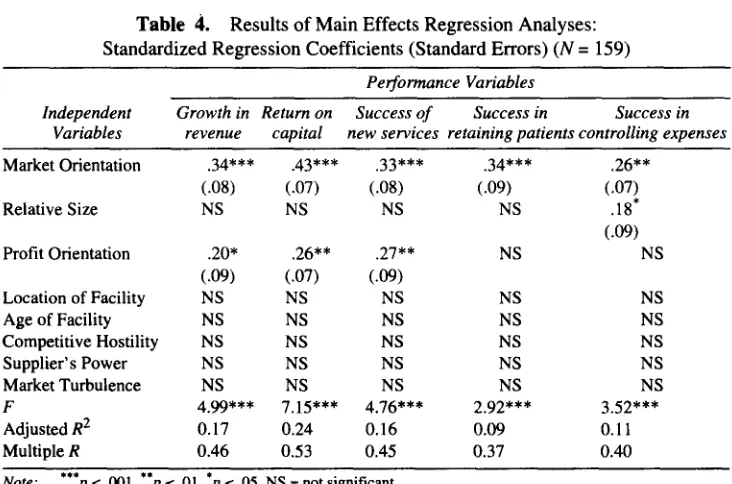
Table 4 contains the results of the tests for the main effects of market orienta- tion and the control variables on five performance measures. Market orientation is the only predictor variable that is significant for all five dependent variablesm growth in revenue (b --- .34, p < .001), ROC (b = .43, p < .001), success of new
222 KAMALESH KUMAR, RAM SUBRAMANIAN, AND CHARLES YAUGER
services (b --- .33, p < .001), success in retaining patients (b = .34, p < .001), and success in controlling expenses (b --- .26, p < .01). Of the four control variables, profit orientation is a significant predictor of growth in revenue (b = .20, p < .05), return on capital (b --- .26, p < .01), and success of new services (b = .27, p < .01), while size is a predictor of success in controlling expenses (b = . 18, p < .05). Age of the hospital and its location do not affect the performance in terms of any of the five criteria. None of the variables---competitive hostility, supplier power, and market turbulence--that was predicted to have a moderating effect on the market orientation-performance relationship was by itself a significant predictor of performance.
Tests f o r Moderator Effects on the Market Orientation-Performance Relationship (t12, It3, and It4)
The influence of competitive environment (competitive hostility, market turbulence, and supplier power) on the relationship between market orientation and performance was tested using moderated multiple regression analysis (MMR) (Arnold, 1982; Sharma, Durand, & Gur-Arie, 1981). The procedure requires the introduction of a multiplicative interaction term into the regression equation. Accordingly, three multiplicative interaction terms were created by multiplying the values of market orientation by the values of hypothesized environmental moderators. A total of fifteen equations were built and tested by estimating the following regression equation:
Y = b o + b l X 1 + b2X 2 + b3X1X 2 + e
Table 4. Results of Main Effects Regression Analyses: Standardized Regression Coefficients (Standard Errors) (N = 159)
Performance Variables
Independent Growth in Return on Success of Success in Success in
Variables revenue capital new services retaining patients controlling expenses
Market Orientation .34*** .43*** .33*** .34*** .26**
(.08) (.07) (.08) (.09) (.07)
NS NS NS NS .18'
(.09)
NS NS
Relative Size
Profit Orientation .20* .26** .27** (.09) (,07) (.09)
Location of Facility NS NS NS NS NS
Age of Facility NS NS NS NS NS
Competitive Hostility NS NS NS NS NS
Supplier' s Power NS NS NS NS NS
Market Turbulence NS NS NS NS NS
F 4.99*** 7.15"** 4.76*** 2.92*** 3.52*** Adjusted R 2 0.17 0.24 0.16 0.09 0.11 Multiple R 0.46 0.53 0.45 0.37 0.40
Note: ***p < .001, p <. 01, p < .05, NS ~= not significant.
[image:22.447.40.406.382.624.2]MARKET ORIENTATION-PERFORMANCE RELATIONSHIP 223
where Y is the performance m e a s u r e , X 1 is market orientation, X 2 is a moderator variable, and X1X 2 is the multiplicative interaction term (the cross product of the independent and moderator variable). Performance measures were simultaneously regressed on market orientation, the environmental dimension, and the interaction term. While the control variables (age, size, profit orientation, and location) were included in the main effect model because of their recognized effect on perfor- mance, they were not included in the moderated model because they were not hypothesized to moderate the strength of the market orientation-performance rela- tionship. If the multiplicative interaction term is statistically significant, a moder- ator effect is present. If the coefficients of both the multiplicative interaction term and the moderator variable are significant, the moderator is a quasi moderator. However, if the coefficient of the multiplicative interaction term was significant and the coefficient of the moderator variable effect was not significant, the moder- ator is a pure moderator. A pure moderator effect implies that the moderator vari- able (competitive environment) modifies the relationship (i.e., the regression coefficient) between the predictor variable (market orientation) and criterion vari- able (performance).
Since the regression equation used in M M R includes both the individual predictor and the cross-product term, multicollinearity is a concern (Dunlap & Kemery, 1987). Two steps were taken to address this concern. First, standardized scores (Z scores) of the predictor variables were used to minimize the potential effect of multicollinearity (MendenhaU, 1986). Next, the Variance Inflation Factor (VIF) was calculated for each of the three variables in each of the equations. The tolerance for each of the variables was high (.7 or above) and the VIF was low (around 1.00).
Results of the moderated multiple regression analyses are given in Table 5. These results show the influence of three aspects of competitive environment-- competitive hostility, market turbulence, and supplier p o w e r - - o n the relationship between market orientation and growth in revenue, return on capital, success of new services, success in retaining patients, and success in controlling expenses.
Competitive hostility (It2). The results (Table 5) show that competitive hostility moderates the relationship between market orientation and return on capital (b =. 16, p < .05), success of new services (b = .22, p < .01), and success in controlling expenses (b = .26, p < .01). However, it has no impact on the market orientation and growth in revenue and success in retaining patients relationships. The positive signs for the interaction term indicates that competitive hostility has a positive moderating effect on the market orientation-performance relationship.
Market turbulence (H3). Results presented in Table 5 show that market turbulence moderates the relationship between market orientation and four of the five performance measures, namely, return on capital (b = .21, p < .01), success of new services (b =. 18, p < .05), success in retaining patients (b = .21, p < .01), and success in controlling expenses (b = .25, p < .01). It does not, however, moderate the relationship between market orientation and growth in revenue. The standard- ized beta coefficients for the interaction terms are positive, indicating that the market orientation-performance relationship is stronger in the presence of market turbulence.
224 KAMALESH KUMAR, RAM SUBRAMANIAN, AND CHARLES YAUGER
° ~
~Z
o ~
. o . o ~ ~
-It- "~¢'~ ~ o " ~ 1 ~ -,x-
~. ~ ~. I
• ~
~ " ~ ~ ~
~ ~ ~ I ' ~
~ ~ ~
~ _
• ~
~ ~ ~ 1 ° . ~
t',,i -- ~ I I
.~ ~ ~
~ ~ ~
~ ~
~"
~3"~ ~
~=
- ~ , ~ ~.~ 2 = - e ~ < ~ : ~ ~ < ~ _ = ~ <
V
V
V
MARKET ORIENTATION-PERFORMANCE RELATIONSHIP 225
Supplier's power (H4).
Results presented in Table 5 also show thatsupplier's power has a moderating effect on market orientation and three perfor- mance measures: return on capital (b = -.18, p < .05), success of new services (b = -.16, p < .05), and success in controlling expenses (b = -.20, p < .01). The beta coefficient signs are negative, indicating that the market orientation-perfor- mance relationship is strengthened when the supplier power is less.
Discussion and Limitations
The discussions in this section focus on the substantive interpretation of results and their implications for strategic management of health care organiza- tions. The first section of the discussion relates to the revised and expanded market orientation scale. The relevance and relationship of the two additional components of market orientation long-term focus and survival and growth/ profit emphasis--with the three component model of market orientation advanced by Narver and Slater (1990) are examined, and implications of these two compo- nents for hospitals discussed. Next, results of the test of hypotheses to examine the market orientation-performance relationship are discussed and interpreted. Finally, discussion and interpretations relevant to the moderator effects on the market orientation-performance relationship are presented.
Relevance of Long-term Focus and Growth~Profit Emphasis
Components of market orientation.
The revised and expanded marketorientation scale provides a reliable and valid measure of all the five components of market orientation. The inclusion of the long-term focus and survival and profit/growth emphasis components in the scale allows market orientation to be measured as it was originally conceptualized by Narver and Slater (1990). As regards the empirical relationship of these two components, both were strongly and positively correlated (.84 and .80, p < .001) with market orientation. These two constructs were also positively and significantly correlated (correlations between .52 and .67) with other components of market orientation. It has been stressed that a long-range perspective is an integral part of market orientation (Anderson, 1982). The strong, positive relationship noted between long-term focus and market orientation provides support for this assertion. As regards the survival and profit/growth component, it was suggested (Narver & Slater, 1990) that it is an objective very closely related to market orientation. The strong and high correlation (r = .80, p < .001) between this component and market orientation provides support for this relationship.
The question that remains is, what do these relationships mean for a hospital that is trying to become market oriented? A market oriented hospital's long-term focus would revolve around creating new value to patients. As a part of this long- term focus, it would seek to develop competencies of relevance that the market rewards (Liedtka, 1992). In contrast to this proactive approach (characteristic of hospitals with high market orientation) to obtaining a sustainable competitive advantage, a defensive approach (characteristic of hospitals with low market orientation) could be to match the services provided by rival hospitals. Thus,
226 KAMALESH KUMAR, RAM SUBRAMANIAN, AND CHARLES YAUGER
hospitals with low market orientation would lack long-term focus and largely attempt to cover gaps in the services offered relative to competitors.
As for the survival and growth/profit emphasis, hospitals high on this dimen- sion would be likely to do a better job in stakeholder management. Hospitals have a "more complex and far-reaching set of responsibilities than traditional busi- nesses." (Liedtka, 1992, p. 21), and their stakeholders "exert influence on issues ranging from hospital governance to financial reimbursement to patient services." (Fottler, Blair, Whitehead, Laus, & Savage, 1989, p. 526). Hospitals with high market orientation would be able to set and pursue the growth and profit objective in a more firm and focused manner, thereby doing a better job in stakeholder management.
Tests for Market Orientation-Performance Hypotheses (Hla through Hle )
Two sets of variables were included in the first five hypotheses
(Ilia
throughHle)
that tested the market orientation-performance relationship. First, there werethree variables related to the competitive environment. These variables were predicted to moderate the market orientation-performance relationship, and their moderating effect is discussed later in this section. In the main-effect analyses, none of these three variables was found to be a predictor of performance by itself. Next, there were four control variables that were included in the regression models because of their recognized influence on organizational performance. Results, however, did not support the inclusion of age and location as control vari- ables, since neither of these variables were predictors of performance.
Although one can not account with certainty for these results, there are some plausible explanations. It is possible that the experience curve phenomenon that often accounts for differences in the performance of organizations of different ages (Porter, 1980) may not be important given the technological environment of hospitals. Alternatively, age-based differences in the strategic orientation of orga- nizations (Liu, 1995) may not be so pronounced in hospitals, given the rather uniform nature of services offered. The absence of any difference on this account between old and new hospitals may be contributing to the lack of performance differences. As for location, it did not have any significant impact on hospital performance, either. A possible explanation may lie in the fact that while location may affect the extent of rivalry being faced by a hospital, the nature of the service being purchased by the patients (often life-saving) may encourage them to seek the best (Fottler, 1987), thus nullifying the effect of location on the extent of competitive rivalry and, hence, on performance.
Size and profit orientation were both predictors of hospital performance. Size implies benefits from economies of scale that could result from volume purchases and the ability to spread fixed costs over a larger volume. Consequently, when performance was measured in terms of the hospital's ability to control operating expenses, size was a significant predictor of performance. This finding is consis- tent with results reported by both Slater and Narver (1994) and Greenley (1995a), both of whom have found size to be an important predictor of performance. Profit orientation predicted performance on three measttres--growth in revenue, return on capital, and success of new services. While the health care strategy literature