2018 International Conference on Computational, Modeling, Simulation and Mathematical Statistics (CMSMS 2018) ISBN: 978-1-60595-562-9
An Improved Algorithm of Binary Balanced Tree with
Super Large-scale Data Set
Zhong-ming YANG
1,*, Ya-ping CHANG
1and Ya-ru YANG
21College of Computer Engineering Technical Guangdong Polytechnic of Science and Technology, Zhuhai, Guangdong, P.R. China 519090
2Zhuhai Vocational School of Polytechnics, Zhuhai, Guangdong, P.R. China 519090 *Corresponding author
Keywords: Balanced binary tree, Large scale data, Size balanced tree, Multi-line merging sort.
Abstract. Realization of quick search still relies on ordered data in the application scenarios of large-scale data search and analysis. This paper analyses an improved algorithm of realizing super large-scale balanced tree efficiently in the concurrent environment. Size Balanced Tree, which is hard to build a balanced tree in the processing of mass data, can group the mass data and then combined groups into a SBT by multi path conflation algorithm. Experiment shows compared with other binary sorting trees(AVL, Treap, random BST), there is no detailed leap variation in time along with the increasing knots. This algorithm has a low time complexity and high running efficiency. It can be applied in the application scenarios of operating quick ordered search of super large-scale data in the artificial intelligence field.
Introduction
Balanced binary tree, an optimized form of binary search tree, is to utilize the optimized strategy of reducing average path length and average search time to avoid over-deformed tree structure. Quick searching still relies on ordered data in the application scenarios of large-scale of data search and analysis, thus how to realize super large-scale balanced tree efficiently in concurrence environment seems very important. [1]
Paper [2] presents a unified framework of realization of balanced binary tree. Sleator [3] presents a quite classic sorting algorithm and Splay tree namely self-adjusting balanced tree, whose algorithm has a complexity rate of O(logn). Lai[4] present a self-adjusting heuristic upper and lower bound method to maintain the binary sorting tree and operate on the tree with pointer constant. Paper[5] presents multi Splay tree and make optimization of operation complexity.
In the aspect of Large Scale Data, Paper[6] presents a conflation algorithm by utilizing parallel processor, whose algorithm can make the ordered data distribution completely balanced and achieve a higher loading balance, extensibility and distribution stability. Paper[7] presents an odd bitonic sequence algorithm which is improved after adding CCI operation. The improved algorithm can make correct sorting of random odd bitonic sequence without adding the storage space and keeping calculation complexity level grade unchanged. The method in Paper[8] is to use hardware parallel processing sorting algorithm. The algorithm in Paper[9] can make the ordered data distribution completely balanced and achieves a higher loading balance, extensibility and distribution stability.
Thoughts of Size Balanced Tree
Size Balanced Tree
Size Balanced Tree (SBT), suggested by Chen Qifeng, is the improvement of BST method. In this method, the tree balance is kept during the sorting procedure of binary sorting tree to make the time cost always be O(NlogN). So the important thought of this algorithm is to maintain binary sorting tree as balanced tree.
First of all, so as to define SBT, the concept of tree size is used here. The tree size refers to the number of total knots in tree i. Assumed the root knot of the tree as T, and the size of tree is marked as s[T]. Right sub-tree of one knot t in Tree T is marked as right[t] and left sub-tree is marked as left[t]. And each knot t of SBT will meet two natures as below.
Nature a: s[right[t]] ≥ s[left[left[t]]],and s[right[t]] ≥ s[right[left[t]]] Nature b: s[left[t]] ≥ s[right[right[t]]],and s[left[t]] ≥ s[left[right[t]]]
s[L] ≥ s[C] and s[L] ≥ s[D], here T, L and R are knots and A, B,C and D are sub-tree.
When inserting or deleting the knots, SBT tree will not meet nature a and nature b. The rotary operation of tree refers to the adjustment operation of sub-tree in binary tree. And each time’s rotation will not affect the result of in order traversals of binary tree. Tree rotation includes left rotation and right rotation and these two rotation will be in mirror image and be reversal operation.
When using rotation to maintain the nature of SBT tree, the tee will be restored by the maintain operation, that is to recalculate the tree size. Assumed that function maintain(T) is used to restore SBT root on T. Precondition for calling maintain(T) is sub-tree of T belongs to SBT.
The Details of the BST
Here are 4 situations need to be discussed. Since nature a and nature b is symmetric, only two situations of nature a will be discussed here.
Situation 1: if s[Left[Left[T]]>s[Right[T]],then s[A] > s[R], (1) right rotate T, namely rotate_right(T), (2)restore size of T, namely maintain(T), (3)restore size of L, namely maintain(L).
Situation 2: if s[right[left[t]]>s[right[t]], then s[B] > s[R], (1) left rotate L sub-tree (2) right rotate T (3) restore size of L (4) restore size of T, (5) restore size of B.
Main operation of SBT are as below. insert(T,k); insert k into tree T; delete(T,k); insert k into tree T;
find(T,k); seek k in tree T, return to k knot if k is found, otherwise return to NULL; maintain(T,flag); restore size of T, flag is judging mark of situation 1 and situation 2; right_rotate(T); right rotate tree T;
left_rotate(); left rotate tree T;
As SBT is balanced, the tree height is logN. Searching should be done before inserting and deleting operation. Time complexity of search operation is O(logN) and time complexity of SBT sorting is O(NlogN).
Improvement of SBT
If mass knots data is need to be processed, then it is hard to build a SBT by using SBT. So the mass data can be grouped firstly, then combined the groups into a SBT by mufti path conflation algorithm. Assumed the number of knots is N, number of groups M is (we take the upper bound of root N), the number of knots of each group is n=N/M, the conflation algorithm of two SBT is as below.
Assumed two SBT respectively as T1 and T 2. Key(T) is the key code value of knot T, depth(k,T) is the depth value of key code k in tree T. Multi-Line Merging Sort algorithm of M groups is as the code.
we take the upper bound of root N), the number of knots of each group is n=N/M, the conflation algorithm of two SBT is as below.
Assumed two SBT respectively as T1 and T 2. Key(T) is the key code value of knot T, depth(k,T) is the depth value of key code k in tree T. Multi-Line Merging Sort algorithm of M groups is as below.
numbers and data size inserting the tree is random. Analogously, measure SBT to be insert and be inserted by depth of tree. So the search complexity of conflation algorithm with N data and M group is O(logN/M)=O(logN-logM) and sorting complexity is O(N/MlogN/M)=O(N/M(logN-logM), whose complexity is obviously lower than O(NlogN).
Algorithm Experiment
Definition of Data Type of Algorithm
Realization of SBT is firstly using template type in SBT and then it can be easily applied in different types of data and realize SBT tree by chain table.
while( M > 1) {
// number of Multi-Line Merging Sort
for( i = 1 – M/2) { // group number of two paths
conflation If ( s[T1] > s[T2] ) // the knot number of T1 is larger
than T2
Merge(T1, T2); // insert T2 into T1
Else if ( s[T1] < s[T2]) // knot number of T2 is larger than
T1
Merge(T2, T1); // insert T1 into T2
Else if( all( depth( key(T1),T2)) > all(depth(
key(T1),T2)))
//total depth of key code of T1 is larger than T1
Merge(T1, T2); // insert T2 into T1
Else
Merge(T1, T2); // insert T2 into T1 Merge(T2, T1); // insert T1 into T2
M = upper(M/2); // update M as upper bound
of M/2 }
Algorithm of inserting T2 into T1 Merge(T1, T2):
for( each node n in T1) If (not find(T2, key(n)))
//n isn’t in T2
Data knots are ordered by key code K key. The data installed with E type can be used to define knots data randomly in corresponding to knots in SBT.
Members of the newly added data of this type should be the number of sub-knots size 1, namely size of sub-tree, involved in this knot.
Operation Definition of Algorithm
In operation of comparison key code, we use comparison type to realize integer type’s key code and comparison type.
The definition of template type of SBT tree is as below. Root knot and head knot of tree, pointer of end knot and core mender function of SBT is as follows. Right rotation, left rotation and maintain operation.
The rest member function of this template type is the main operation of SBT including inserting, deleting and searching which will cause imbalance of tree. So we need to judge if it could meet the conditions of SBT. Otherwise, main operation will be called to maintain conditions of SBT.
Experimental Data Set-up
When verifying the algorithm, we generate 10 thousand to 100 thousand knots data which will be storage in the file of sbt_file.txt in data sub-catalog by process. Special attention paid to be that the type of key word and knot size should be long type in case of transboundary mistake due to huge number of knots. In addition, we haven’t considered the situation of same key code, thus this algorithm doesn’t consider the stability issue.
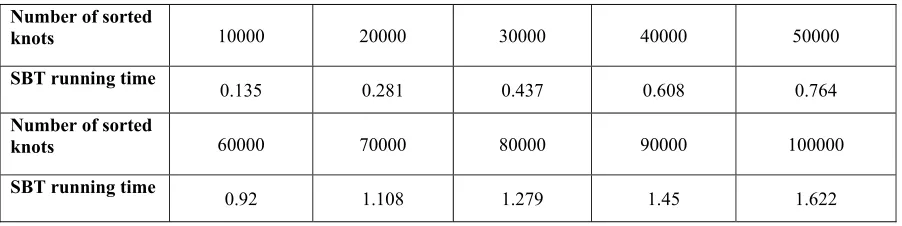
[image:4.612.82.533.408.521.2]The experimental environment is the personnel computer with double core 2.60GHz and 4GM internal storage, which operate 10 thousand to 100 thousand knots inserting (sorting) on SBT tree. The average running time is as below. It shows no leap variation of time along with the increasing of knots. The improved SBT tree is showed as Table 1.
Table 1. Average time test for knots inserting.
Number of sorted
knots 10000 20000 30000 40000 50000
SBT running time
0.135 0.281 0.437 0.608 0.764
Number of sorted
knots 60000 70000 80000 90000 100000
SBT running time
0.92 1.108 1.279 1.45 1.622
Experimental Result Analysis
SBT Experimental Result
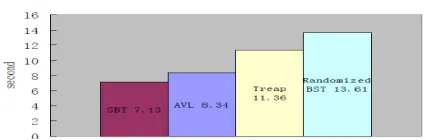
Figure 1. Comparison between SBT and other binary sorting trees.
Two million ordered value knots and two million random value knots are operated. Table 2 presents a comparison of tree’s depth, height and rotation times between SBT algorithm and other algorithms.
Table 2. Experimental result of inserting two million knots data.
Inserting two million ordered value knots
Type SBT AVL Treap Random
BST Splay
average depth
18.9514 18.9514 25.6528 26.2860 999999.5
height 20 20 51 53 1999999
rotation
times 1999979 1999979 1999985 1999991 0
Inserting two million random value knots average
depth 19.2415 19.3285 26.5062 25.5303 37.1953
height 24 24 50 53 78
rotation
times 1568017 1395900 3993887 3997477 25151532
SBT Experiment Analysis
Seen from Figure 1, compared with other binary sorting trees(AVL, Treap and random BST), SBT achieves the minimum time complexity and the best running efficiency. SBT will juggle if occurring imbalance before each operation, so the tree will always be in optimal state. The maintenance of algorithm is to make comparison of knots size, with low cost of storage and high efficiency.
Seen from Table 2, random value sorting is faster than ordered value sorting for random value will be more likely to produce balanced binary tree and the cost of maintenance will decrease. The tree depth of ordered value sorting tree is lower than that of random value sorting tree for the maintenance operation in algorithm will make tree more balanced and tree height will be lower.
Conclusions
This paper presents SBT Multi-Line Merging Sort algorithm based on the improved SBT sorting algorithm. N knots are grouped into M groups and it offers Multi-Line Merging Sort algorithm of SBT tree and description of two SBT conflation algorithm. This algorithm has time complexity of O(N/M(logN-logM)) in the operation of sorting and kinds of operations like inserting, deleting and searching and it is especially applied in the sorting handling of large-scale mass data and shows a good experimental result.
Acknowledgment
References
[1]Shavit N. Data structures in the multicore age [J].Communications of the ACM,201,54(3): 76-84.
[2]Guibas, L.J. and Sedgewick, R. A Dichromatic Framework for Balanced Trees, Proceedings of the Nineteenth Annual IEEE Symposium on Foundations of Computer Science, 1978, 8-21.
[3]Sleator, D.D. and Tarjan, R.E. Self-adjusting Binary Search Trees, JACM, 1985, 32, 652-686. [4]Lai, T.W. and Wood, D. Adaptive Heuristics for Binary Search Trees and Constant Linkage Cost. SIAM Journal on Computing 1998, 27: 6, 1564-1591.
[5]Wang, C.C., Derryberry, J. and Sleator, D.D. O(log log n)-Competitive Dynamic Binary Search Trees. Proceedings of the Seventeenth Annual ACM-SIAM Symposium on Discrete Algorithms (SODA) 2006, January 22-26.
[6]Wang Wenyi, Qiou Yong. A New Algorithm for Parallel Mergesorting [J]. Computer Engineering and Applications. 2005, 41(5): 71-72.
[7]Zhang Jian-ping, Du Xue-dong. Parallel Sorting Algorithm of Odd Sequence [J]. Computer Engineering, 2007, 33(15): 96-97.
[8]Shi Y., Zhang L., Liu P. THSORT: A single-processor parallel sorting algorithm [J]. Journal of Software, 2003, 14(2): 159-165.