the
gender
variant
jacket
D Wang Zhao
2
BLUE //
“I want you t
o think about blue.
Yes, perhaps the M
aggie Nelson kind o f blue,
But I want
you to think o
f blue.
I want you t
o think about
the blue your fingers turn
when you’v
e been gripping your
fist so tight
When you dig
your nails int
o skin,
Breaking skin, because the thought
of confronting ano
ther professor
at the
Stamps School o
f Art and D
esign, when the
y blatantly misgender you—
Again—
is excruciating.
Because I kno
w as well as the ne
xt person that
deception IS surviv
al, and if I hav e
to perform f
emininity as best
I can, by skipping int
o women’s restr
oom because
there is no
t gender-inclusiv
e restroom av
ailable, so be it .
My gender
-fluidity makes me question my
affinity for blue, mak
es me wonder if I
travel through spaces mor
e masc or more
femme because it
makes me saf er, or
because I think I’
m safer,
or if I think that
I will be ok
ay if I walk int
o the women’
s restroom in loose jeans and
a button do wn—
or if I walk int
o the women’
s restroom in these little blue Calvin K
lein jeans and this
tight little black halt
er top--
but yet, the blue r
emains underneath me. ”
Excerpt from “Blue”
, a poem b
y D Wang Zhao, F
3
“I want you to think about blue.
Yes, perhaps the M
aggie Nelson kind o f blue,
But I want
you to think o
f blue.
I want you t
o think about
the blue your fingers turn
when you’v
e been gripping your
fist so tight
When you dig
your nails int
o skin,
Breaking skin, because the thought
of confronting ano
ther professor
at the
Stamps School o
f Art and D
esign, when the
y blatantly misgender you—
Again—
is excruciating.
Because I kno
w as well as the ne
xt person that
deception IS surviv
al, and if I hav e
to perform f
emininity as best
I can, by skipping int
o women’s restr
oom because
there is no
t gender-inclusiv
e restroom av
ailable, so be it .
My gender
-fluidity makes me question my
affinity for blue, mak
es me wonder if I
travel through spaces mor
e masc or more
femme because it
makes me saf er, or
because I think I’
m safer,
or if I think that
I will be ok
ay if I walk int
o the women’
s restroom in loose jeans and
a button do wn—
or if I walk int
o the women’
s restroom in these little blue Calvin K
lein jeans and this
tight little black halt
er top--
but yet, the blue r
emains underneath me. ”
Excerpt from “Blue”
, a poem b
y D Wang Zhao, F
ebruary 8th, 2018
INTRODUCTION //
To begin, I want to root this thesis work (both the physical exhibition and this paper) in intention-ality, compassion, and redefining.
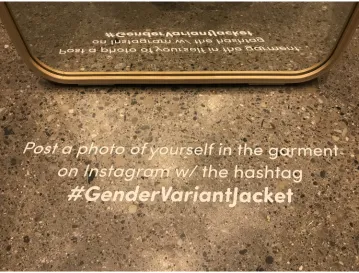
I begin with an excerpt from my poem to ground my thesis in personal experience and to pick up the threads of blue and emotionality that line this work. My project, The Gender Variant Jacket, is a tunable garment for gender variant folx (including but not limited to transgender, agender, gender non-binary, gender-nonconforming, and genderfluid identities) that will allow them to adjust presentation based on how they style the jacket. My exhibition design for the show will be styled like a fashion showroom, where people will be free to try on the garments and style themselves in front of two free-standing mirrors. I invite people to engage with the garment further, through vinyl text placed on the ground and mirror. The text asks people to post a pho-to of themselves in the jacket on instagram and use the hashtag #GenderVariantJacket. I have also created The Gender Variant Jacket Application, a Google Form that allows people to apply for a garment of their own. The application asks the participant about their own style, the gaps in their current closet, and how they think this garment will help them better express their own gender presentation. Beginning in the spring, I will be producing more copies of the garments to then send out to selected applicants.
My goals are the following:
1. Develop my own pattern-making techniques that allow silhouettes to change shape on the wearer
2. Design an exhibition/fashion showroom space that is deliberately gender variant-affirming 3. Allow gender variant people to feel witnessed in their struggle to find inclusive garments
Clothing is a politicized object, space, concept. It can reveal class status, race, ethnicity, ability, sexuality, as well as gender. Thus, as a transgender and gender non-binary person myself, I am too aware of the stakes in a project that seeks to INTENTIONALLY create clothes for gender vari-ant people.
When I think about getting dressed in the morning, I need to think about the spaces I will move through. Will I be going to class? Will I be in public, walking down the street? What classes will I be taking, and how likely are said classes to be affirming and validating towards a gender non-binary person like me?
But in a larger scope, I want my project to give other gender variant people the opportunity to wear a garment that centers their perspectives and considerations throughout the entire design process. Granted, I understand that my own aesthetic in dressing more androgynous influences this project in a way that might not work for all gender variant people, but I hope that The Gen-der Variant Jacket is a starting point for me to explore how I can create genGen-der variant-affirming clothes.
While my focus is on the sartorial aspects of gender presentation, one can think of the fash-ion industry as a DSM.1 The Diagnostic and Statistical Manual of Mental Disorders (DSM) is a
4
“handbook used by health care professionals in the United States and much of the world as the authoritative guide to the diagnosis of mental disorders”2. Similarly to the DSM, the fashion
in-dustry has been the authority in understanding the criteria for what is “good”, “bad”, or “accept-able”. It perpetuates these through various agents such as fashion brands and fashion media, all the while branding itself as a space for “progressive” expressions of aesthetics. As a consumer, I have taken note of the troubling ways various brands have tokenized gender variant identities in order to sell clothing. Within the past few years, fast fashion giants like Zara3 and H&M4 have
released “unisex” clothing lines to much fanfare. However, when a “gender-fluid”5 clothing line is
revealed to consist of mostly baggy shirts and pants, there is little intentionality.
And, as local, state, and federal legal protections for gender-variant and transgender folx are being placed in jeopardy, I want to present more possibilities for what gender variant-affirming fashion might look like. My garment will be one way for folx to feel comfortable in the clothing they have and to give them the tool to change their presentation more flexibly.
2 “DSM–5: Frequently Asked Questions,” DSM-5 FAQ, accessed April 20, 2018, https://www.psychiatry.org/psy-chiatrists/practice/dsm/feedback-and-questions/frequently-asked-questions.
3 Linda Sharkey, “Zara Joins the Gender Fluid Movement with New Unisex Clothing Line,” The Independent, March 7, 2016, https://www.independent.co.uk/life-style/fashion/news/zara-gender-fluid-agender-unisex-fash-ion-transgender-ruby-rose-a6917496.html.
4 Ana Colon, “H&M’s New Denim Line Is Entirely Unisex,” Refinery29, March 23, 2017, https://www.refinery29. com/2017/03/145866/hm-new-unisex-collection-spring-2017?bucketed=true&bucketing_referrer=https://www. google.com/#slide-21.
5
DEFINITIONS//
Before understanding my thoughts and methodologies around my work, it is important to make note of the basic presumptions that are made about identities-- and how these gross miscal-culations can cause violence. But, it is important to understand that many of these terms have their basis in Western-centric notions of self and embodiment and thus, the following definitions cannot be used for every gender-nonconforming person.
Firstly, here are some basic definitions:
Gender Variant - “an umbrella term used in a manner similar to how the word transgender is
often intended (i.e., to denote people who defy societal gender norms in some way)... [also used] ... in an attempt to be inclusive of gender-diverse people who were rejecting the label “trans-gender” for various political or aesthetic reasons....”6
Trans (transgender) - “An umbrella term for people whose gender identity and/or expression is
different from cultural expectations based on the sex they were assigned at birth. Being trans-gender does not imply any specific sexual orientation. Therefore, transtrans-gender people may iden-tify as straight, gay, lesbian, bisexual, etc.”7
Agender - “An umbrella term encompassing many different genders of people who commonly
do not have a gender and/or have a gender that they describe as neutral. Many agender peo-ple are trans. As a new and quickly-evolving term, it is best you ask how someone defines agen-der for themselves.”8
Gender non-conforming - “A broad term referring to people who do not behave in a way that
conforms to the traditional expectations of their gender, or whose gender expression does not fit neatly into a category.”9
Gender non-binary -
“Preferred umbrella term for all genders other than female/male or woman/man, used as an adjective (e.g. Jesse is a nonbinary person). Not all nonbinary people identify as trans and not all trans people identify as nonbinary. Sometimes (and increasingly), nonbinary can be used to
5 “Julia Serano’s Trans, Gender, Sexuality, & Activism Glossary,” Julia Serano - Writer, Performer, Speaker, Ac-tivist, accessed April 18, 2018,
http://www.juliaserano.com/terminology.html#G.
6 “Glossary of Terms,” Human Rights Campaign, accessed April 10, 2018, https://www.hrc.org/resources/glos-sary-of-terms.
7 “LGBTQ+ Definitions,” Trans Student Educational Resources, accessed April 10, 2018, http://www.transstudent. org/definitions.
6
describe the aesthetic/presentation/expression of a cisgender or transgender person.”10
Gender fluid - “According to the Oxford English Dictionary, a person who does not identify with
a single fixed gender; of or relating to a person having or expressing a fluid or unfixed gender identity”11
Genderqueer - “Genderqueer people typically reject notions of static categories of gender and
embrace a fluidity of gender identity and often, though not always, sexual orientation. People who identify as “genderqueer” may see themselves as being both male and female, neither male nor female or as falling completely outside these categories.”12
Folx - “a derivative of “folks”, folx is a term used to “indicate [queer/trans]/gender-diverse community and to denote a politicized identity”13 This term is additionally used as a way to be
explicit in the visibility of trans and queer identity.
Gender dysphoria - “Anxiety and/or discomfort regarding one’s sex assigned at birth.”14
Passing/blending/assimilating - Being perceived by others as a particular identity/gender or
cisgender regardless how the individual in question identifies, e.g. passing as straight, passing as a cis woman, passing as a youth. This term has become controversial as “passing” can imply that one is not genuinely what they are passing as.15
Cis(gender) - Adjective that means “identifies as their sex assigned at birth” derived from the Latin word meaning “on the same side.” A cisgender/cis person is not transgender.
“Cisgender” does not indicate biology, gender expression, or sexuality/sexual orientation. In discussions regarding trans issues, one would differentiate between women who are trans and women who aren’t by saying trans women and cis women. Cis is not a “fake” word and is not a slur. Note that cisgender does not have an “ed” at the end.16
9 “LGBTQ+ Definitions.”
11 “Glossary of Terms.
12 “Glossary of Terms.
13 "Why Do You Use the Term "folx"? I'm Curious About..,” T-FFED: Trans Folx Fighting Eating Disorders, July 05, 2014, http://trans-folx-fighting-eds.tumblr.com/post/90860544471/why-do-you-use-the-term-folx-im-curious-about.
14 “LGBTQ+ Definitions.”
15 “LGBTQ+ Definitions.”
7
I am not simply seeking to create non-normative aesthetics, but also to redefine sartorial prac-tices and question what normative embodiment and presentation is.
In “Mutilating Gender”, Dean Spade uses Michel Foucault to discuss the methods in which med-ical institutions exert their power over transgender folx with controlling access to “body-mod-ifying procedures,” and how the normalization of genders and gender presentation is an in-sidious process. Spade states that through the “creation of the subject position ‘transsexual’ by the medical establishment”, it constricts access to these body modifying procedures, and also encourages “norm-abiding gendered subjects”.17 Within fashion, these gendered subjects can be
understood through the visual differences in menswear and womenswear. In explaining why the pathologization of transsexualism is problematic, Spade says, “containing gender distress within ‘transsexualism’ functions to naturalize and make ‘healthy’ dichotomized, birth-assigned gender performance” and further, that the assumption is that “it is ‘in the minds of the ill’ that gender problems exist, not in the construction of what is ‘healthy’”.18
The Gender Variant Jacket was not created to “alleviate symptoms” of gender variant embod-iment, but to critique the validity of normative presentation. In the centering of gender variant perspectives, I reject the construction of the subject position “gender variant” as an other, be-cause my own understanding of identity has always included my community. And thus my proj-ect asks how an reframing of fashion can be both affirming to gender variant identities, without pandering to the dichotomy of “the normative cisgender” and “non-normative gender variant”.
In Susan Stryker’s “My Words to Victor Frankenstein above the Village of Chamounix: Performing Transgender Rage,” she reframes Mary Shelley’s Frankenstein as a representation of “the critical encounter between a radicalized transgender subjectivity” and the “normativizing intent of med-ical science”.19 Stryker begins by explaining her own transsexual body as one that is “torn apart
and sewn together again in a shape other than that in which it was born” but that because of this, has faced deep “exclusion from human community… [which, like the monster] fuels a deep and abiding rage”.20 Yet she claims monstrosity as her own, reconceptualizing the rage
transgen-der people feel as a “basis for self-affirmation, intellectual inquiry, moral agency, and political action”.21
Stryker explores monstrosity both in terms of physical embodiment and language.
As she reclaims “monster”, she also re-appropriates the criteria for which that term is used,
17 Dean Spade, ‘‘Mutilating Gender,’’ in The Transgender Studies Reader, ed. Susan Stryker and Stephen Whittle, (New York: Routledge, 2006), 316.
18 Spade, “Mutilating Gender,” 319.
19 Susan Stryker, ‘‘My Words to Victor Frankenstein above the Village of Chamounix: Performing Transgender Rage,’’ in The Transgender Studies Reader, ed. Susan Stryker and Stephen Whittle, (New York: Routledge, 2006), 244.
20 Stryker, “My Words to Victor Frankenstein,” 245.
8
calling upon her non-normative self and experience. Stryker’s “transgender rage”22 resonates
with me and my work, as I have struggled with completing my work while experiencing varying degrees of discrimination. Throughout this year, my work has not only included the intellectual and physical requirements of research and garment construction, but also emotional labor. I felt “transgender rage” when i had to repeatedly correct my colleagues and thesis advisors when they misgendered me, or navigate gendered restrooms on campus or, find a lack in gender variant faculty at Stamps. But if Stryker’s writing proves anything, it is that personal experience within the context of a lifetime of discrimination can be the foundation for radical work. For The Gender Variant Jacket, I have used my own commitment to the gender variant community as fuel for “self-affirmation, intellectual inquiry, moral agency, and political action” 23
22 Stryker, “My Words to Victor Frankenstein,” 247.
9
DESIGNERS WITH NONCONFORMING AESTHETICS//
In the Introduction, English looks to how the work of these given designers have pushed the fash-ion industry to “re-think old ideas and to re-configure old forms”,24 even going as far to note the
particular aesthetics they have given visibility to. Most particularly, by adjusting the silhouette of womenswear and menswear to be much looser and comfortable, and to use unhemmed edges, tears, and rips as an essential aesthetic. These Japanese designers further explore “conceptual aesthetics”,25 considering not only the clothes themselves, but of the conceptual theories behind
their own work. Issey Miyake in particular, considered the demographic of the models as well as the fashion exhibition settings to be just as important to the collection as the garments were. Miyake’s 1995 Collection included “six models aged between sixty-two and ninety-two”26 and
later, set the precedent for using galleries and art museums as exhibition venues. Similarly, my garments will be sensitive about silhouettes, and about how silhouettes can be used when folx want to present themselves. By its very nature as a garment, The Gender Variant Jacket is con-nected to a history of gendered dressing, but also subverts conventions similar to the Japanese designers English writes on. English points out Miyake’s intentional praxis, where fashion must be contextualized through careful selection of models and exhibition design. The fashion industry has a history of tokenizing in its use of gender variant identities and presentations (see footnotes 2-4), but like Miyake, my thesis work’s focus will not only be on The Gender Variant Jacket itself, but also the casting of models and the final exhibition design, one where trans, agender, gen-der-nonconforming, and gender non-binary folx will feel affirmed and validated.
Operating outside of the traditional fashion-retail institutions, JUMPSUIT is a project The Rational Dress Society, “an ungendered, multi-use monogarment for everyday wear”.27 It is available “in
two forms: as a pre-made garment for purchase, and as an open-source pattern, available to download free of charge. The Rational Dress Society has developed a comprehensive new sizing system that can accommodate up to 248 different body types using gender-neutral terminolo-gy”.28 JUMPSUIT’s expansive sizing chart disrupts typical womenswear and menswear
conven-tions by creating sizing categories with unique names like “jasper”, “echo”, or “amphibian”. They plan to democratize their jumpsuit pattern by putting the pattern files online.29 They also plan to
democratize their jumpsuit pattern by putting the pattern files online. JUMPSUIT is a test-case for how fashion can be designed and marketed through social practice. I was interested in the idea of one ready-to-wear garment that would be designed for utility and use. I had thought of the potential impact JUMPSUIT would have on the fashion industry-- and how could their business
24 Bonnie English, Japanese Fashion Designers: The Work and Influence of Issey Miyake, Yohji Yamamoto and Rei Kawakubo (London: Berg, 2011), 1-8, http://dx.doi.org.proxy.lib.umich.edu/10.2752/9781472572417/English0002.
25 English, Japanese Fashion, 1-8.
26 English, Japanese Fashion, 1-8.
27 “About,” JUMPSUIT, accessed March 2, 2018, https://www.jumpsu.it/about-2/.
28 "About."
10
model affect the possibility for other fashion brands? Their very extensive sizing chart also fasci-nated me-- with 248 different sizes, JUMPSUIT can potentially redefine the standardized sizing conventions. But despite The Rational Dress Society’s potentially reactionary politics (see: their “Make American Rational Again” project),30 seeing JUMPSUIT in operation gives me hope for the
work that I could be making post-graduation.
I began my process by conducting interviews with six other gender variant people. The majority of them identified as Asian or Asian-American. While all were in their 20’s, they varied in gen-der identity and presentation. Most of them were interviewed via Skype or phone call, while two people were interviewed in-person.
Some dressed more femme or masc, or would oscillate amongst and between presentations. At times, some interviewees talked about their acute awareness of their presentation, especially in regards to spaces that made them feel safe vs. unsafe. Some shared their styling tips for hid-ing and/or emphasizhid-ing different parts of their body. Overall, it was clear that through all my interviews that they had many thoughts on clothing and style. I began to wonder how I could construct a single garment that could both conceal and emphasize the body. What form could it possibly take?
In the beginning of my making process, I was constantly ordering fabric samples as I had lit-tle idea of what I wanted my garments to be made out of. Quickly, I was gravitating towards reflective fabrics and camouflage. After attempting to create my own camouflage patterns, I quickly moved on from that concept as my “trans camo” elicited connotations of “deception” and stealth” in relation to gender variance. Problematic implications that was devoid of the empow-ering, gender variant-affirming work I wanted to do. But, thinking more about the utility of print-ed fabric, I turnprint-ed to security envelope patterns. Usually found inside of envelopes, they are in-tended to protect the sensitive content inside, by rendering the information illegible when viewed from the outside. I was interested in the “security” aspect, that something on the inside needed protection. But I realized a final pattern would have required much more time to fully develop, so I moved onto top-stitching. I found inspiration from Issey Miyake’s Homme Plisse SS18 Mens-wear, where narrow rows of parallel top-stitching made up the fabrics.
With the help of my thesis advisors and some colleagues, I constructed a “presentation chart”. Split into quadrants, the chart mapped out the different visual presentations I wanted my
gar-30 “Make America Rational Again,” JUMPSUIT, accessed March 1, 2018, https://www.jumpsu.it/mara/.
11
ment to have. On the x-axis was femme/masc, and on the y-axis was hidden/exposed. **Femme and masc are referring to the gender presentations based in sartorial conventions of wom-enswear and mwom-enswear, not gender identity** This chart then allowed me to focus on what the tunable aspects of my garment would include-- adjustable sleeves, necklines, and waist.
From here, I assembled my rough prototypes using polyester batting and muslin fabric that had been top-stitched.
The days prior to Spring Break was my “point of no return”. I needed to make critical decisions on the final fabrics to order. (In fact, I ordered all my materials right as my flight to China was boarding.) I chose three fabrics; a denim, a reflective fabric, and a black knit.
The first fabric I chose was my “Ralph Lauren Splotchy Indigo Crisp Cotton Denim”.31 Denim
has a larger social history, but for the purposes of this project I will be focusing on its gendered connotations. Denim is a fabric that is genderful-- one that has been used to connote a variety of gender presentations, all through the femme and masc spectrum. It is a woven twill weave, traditionally constructed with 100% cotton yarn. As a result, the material is sturdy and can be used for workwear.32 When selecting my denim, I chose the “Splotchy Indigo Crisp Cotton” for its
high quality as a designer fabric as well as the color. The unique “splotchy” texture of the denim differentiated my garments from other denim clothes.
For both practical (see: reflective material is safer for crossing streets at night) as well as aes-thetic reasons, the second fabric I chose was the “Alexander Wang Silver and Black Ribbed Novelty Double Knit”.33 In contrast to my denim material, the “Alexander Wang… Double Knit” was
eye-catching and almost futuristic-- making for a more visually exciting counterpart. This mate-rial felt closer to a neoprene matemate-rial. It was thicker than the denim but was squishy-- a charac-teristic I wanted as this fabric would make up the interior lining of The Gender Variant Jacket.
31 "Ralph Lauren Splotchy Indigo Crisp Cotton Denim," Mood Fabrics, accessed April 15, 2018, https://www. moodfabrics.com/ralph-lauren-splotchy-indigo-crisp-cotton-denim-308704.
32 “Denim Fabrics,” Textile School, last modified March 18, 2018, https://www.textileschool.com/298/den-im-fabrics/.
12
The third and final fabric selected was the “Black Cotton Rib Knit”.34 It would be sandwiched
be-tween the Ralph Lauren and Alexander Wang fabrics as the batting, but also be a neutral, inter-mediary fabric. A simple fabric that would not enhance the intentionality and particulars with the two aforementioned materials.
After my top-stitching tests as inspired by Issey Miyake’s Homme Plisse SS18 Menswear, I real-ized I wanted to construct a more advanced pattern. My original plan was to exactly mimic the pattern on Miyake’s garments, but I realized stitching parallel lines ¼” apart would prove to be incredibly time-consuming. Instead, I opted for a pattern that would be easier to top-stitch and would solidly attach the fabrics together to create one material. While on spring break in China, a coat I saw inspired the “diamond-X” pattern that would later be used to make up The Gender Variant Jacket. As it was constructed, this particular pattern reminds me of quilted armor pad-ding, a material something that is highly reinforced with layers of fabric sandwiched between each other. Although the “diamond-X” pattern still required measuring and chalking onto the fabric, it became a repetitive process that I enjoyed. The Gender Variant Jacket became a man-ifestation of my love and labor made visible-- that all aspects of the garment were assembled with purpose and intention.
Unfortunately, I felt I could only rely on Annica Cuppetelli (Lecturer I) throughout the production process. And emotionally, I was exhausted at having to both advocate for the stakes in my work, as well as my own gender variant identity. My patience has been worn thin as I continue to be misgendered by my thesis advisors (and sometimes colleagues), despite verbally corrections and emailing them. With such an example of disregard for my safety, I felt unable to wholly trust the opinions of my advisors which affected my ability to do work. Moreover, neither of my advisors nor the MDes student assisting our section had a background in fashion design, so I was left try-ing to make sense of my work with Cuppetelli.
I see the irony in working on my VERY gender variant-affirming work, while my advisors continue to use the incorrect pronouns for me-- all the while, also feeling they were not always prepared to help me in garment construction.
34 "Black Cotton Rib Knit,” Mood Fabrics, accessed April 15, 2018, https://www.moodfabrics.com/black-cotton-rib-knit-316149.
13
THE PHOTOSHOOT AND MODELS//
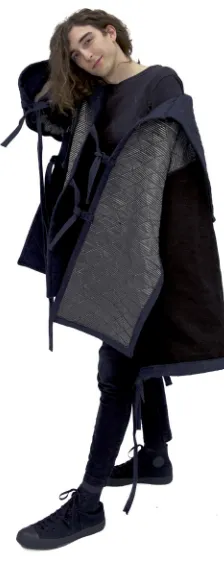
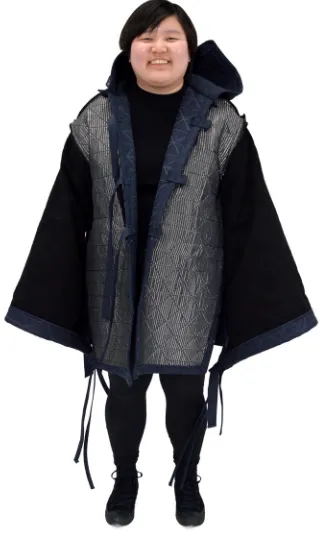
[image:13.612.301.413.385.677.2]The casting of models is similarly a politicized subject-- often I have seen clothing that is sup-posedly for gender nonconforming people with models who are not openly gender variant themselves. I was able to ask a few of my other transgender and gender nonconforming friends to be my models. As a group, they vary in gender presentation, age, class, and race. The pho-toshoot itself was incredibly fun. I did not need to spend energy trying to get to know my mod-els-- they were my friends to begin with and we celebrated ourselves in front of a backdrop. The garment being fully reversible, I wanted to present the varying styling options for the jacket-- but acknowledging that presentation is not always prescriptive. The Gender Variant Jacket adjusted presentation based on who was wearing it, regardless of how I styled the garment on their bod-ies. I had two versions of the jacket. The first jacket I had made was slightly larger and heavier. The second was designed to be slightly smaller, better created for shorter and/or smaller bodies. Carta and Phil (Fig. 1, 2) are wearing the larger version while Youna and Phy (Fig. 3, 4) are wear-ing the smaller version.
Figure 1
[image:13.612.58.181.397.659.2]14
Figure 3 [image:14.612.53.180.137.400.2]15
EXHIBITION DESIGN//
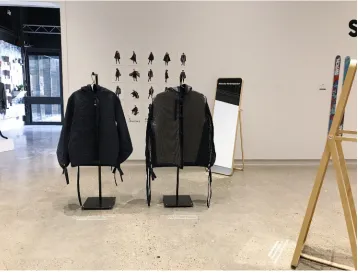
In the creation of my exhibition design, I aimed to create a minimal, fashion showroom space. My goals for the exhibition were the following:
1) Arrange the garments that would invite people to try on the clothes.
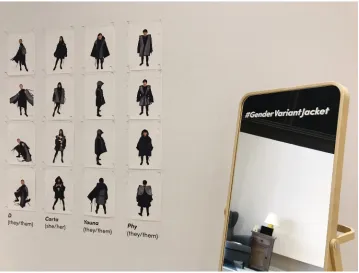
[image:15.612.48.406.128.401.2]2) Engage with participants more than the literal exhibition opening-- see: application and hashtags
Figure 5
16
Figure 6Photo display of models in a 4x5 grid with the names and pronouns of the models underneath each column.
Figure 7
[image:16.612.47.406.429.702.2]17
Figure 818
My future: unsure, deeply uneasy. I think about wanting to create garments, and the transforma-tion something as drab as a bolt of cloth can make when it is put onto a person and a body who loves what they’re wearing. The residual euphoria one might experience by witnessing a body rejoice in a garment you made.
What I have learned as a designer: That nobody knows you as well as you do. I didn’t need to go through a fashion program to make clothing. I didn’t need a fashion mentor to make clothing. All I had was a few people I could ask questions and tips on-- a healthy amount of grant money, and the faith that I could achieve what I wanted. Especially as I have found myself not want-ing feedback from my thesis advisors (trywant-ing to get guidance from them as they are blatantly misgendering is me is akin to hurtling myself onto some craggly rocks below a cliff-- when all I wanted to see was the sea beyond the rocks). Does that makes sense? In these last two weeks, I have made dramatic advances in my garment, pushing myself to make my own critical de-sign decisions-- this or this? “This reflective Alexander Wang Rib Knit or the Black Rib Knit?” “The Ralph Lauren denim as the bias tape, or…?” This amount of time that proved to myself, that I could complete my work in the way that I wanted it to be completed.
Forget my mistrust of my thesis advisors and their advice-- I learned to take my own advice. When I have felt most overwhelmed and pained, I reminded myself that although my work is me, I am not my work. And that above all, my well-being (physical, emotional, mental) needs to be just as cared-for in these last few weeks as my work will be. To risk my own well-being for my work would be to disrespect my work as well-- because the creator is the source for the concept.
Uneasiness is natural. Uneasiness is necessary. Uneasiness is okay. I am okay.
19
Colon, Ana. "H&M's New Denim Line Is Entirely Unisex." Refinery29, March 23, 2017. https://www.refinery29. com/2017/03/145866/hm-new-unisex-collection-spring-2017?bucketed=true&bucketing_referrer=https:// www.google.com/#slide-21.English, Bonnie. Japanese Fashion Designers: The Work and Influence of Issey Miyake, Yohji Yamamoto and Rei Kawakubo. London: Berg, 2011. http://dx.doi.org.proxy.lib.umich.edu/10.2752/9781472572417/En-glish0002.
Human Rights Campaign. “Glossary of Terms.” Accessed April 10, 2018. https://www.hrc.org/resources/glossary-of-terms.
JUMPSUIT. “About.” Accessed March 2, 2018. https://www.jumpsu.it/about-2/.
JUMPSUIT. “Finding Your Jumpsuit.” Accessed March 2, 2018, https://www.jumpsu.it/find-your-jumpsuit/.
Knoepp, Lilly. "These Brands Are Proving Gender-Fluid Is The Future Of Fashion." Forbes, March 27, 2017. https://www.forbes.com/sites/lillyknoepp/2017/03/22/these-brands-are-proving-gender-fluid-is-the-fu-ture-of-fashion/.
Serano, Julia - Writer, Performer, Speaker, Activist. "Julia Serano's Trans, Gender, Sexuality, & Activism Glossary." Accessed April 18, 2018.
http://www.juliaserano.com/terminology.html#G.
Sharkey, Linda. "Zara Joins the Gender Fluid Movement with New Unisex Clothing Line." The Independent, March 07, 2016. https://www.independent.co.uk/life-style/fashion/news/zara-gender-fluid-agender-uni-sex-fashion-transgender-ruby-rose-a6917496.html.
Spade, Dean, ‘‘Mutilating Gender,’’ in The Transgender Studies Reader, ed. Susan Stryker and Stephen Whittle, (New York: Routledge, 2006), 315-32
Stryker, Susan, ‘‘My Words to Victor Frankenstein above the Village of Chamounix:
Performing Transgender Rage,’’ in The Transgender Studies Reader, ed. Susan Stryker and Stephen Whittle, (New York: Routledge, 2006), 244–56
T-FFED: Trans Folx Fighting Eating Disorders, "Why Do You Use the Term "folx"? I'm Curious About...” July 05, 2014.http://trans-folx-fighting-eds.tumblr.com/post/90860544471/why-do-you-use-the-term-folx-im-curious-about.
Textile School. “Denim Fabrics.” Last modified March 18, 2018. https://www.textileschool.com/298/denim-fabrics/.
Trans Student Educational Resources. “LGBTQ+ Definitions.” Accessed April 10, 2018. http://www.transstudent.org/definitions